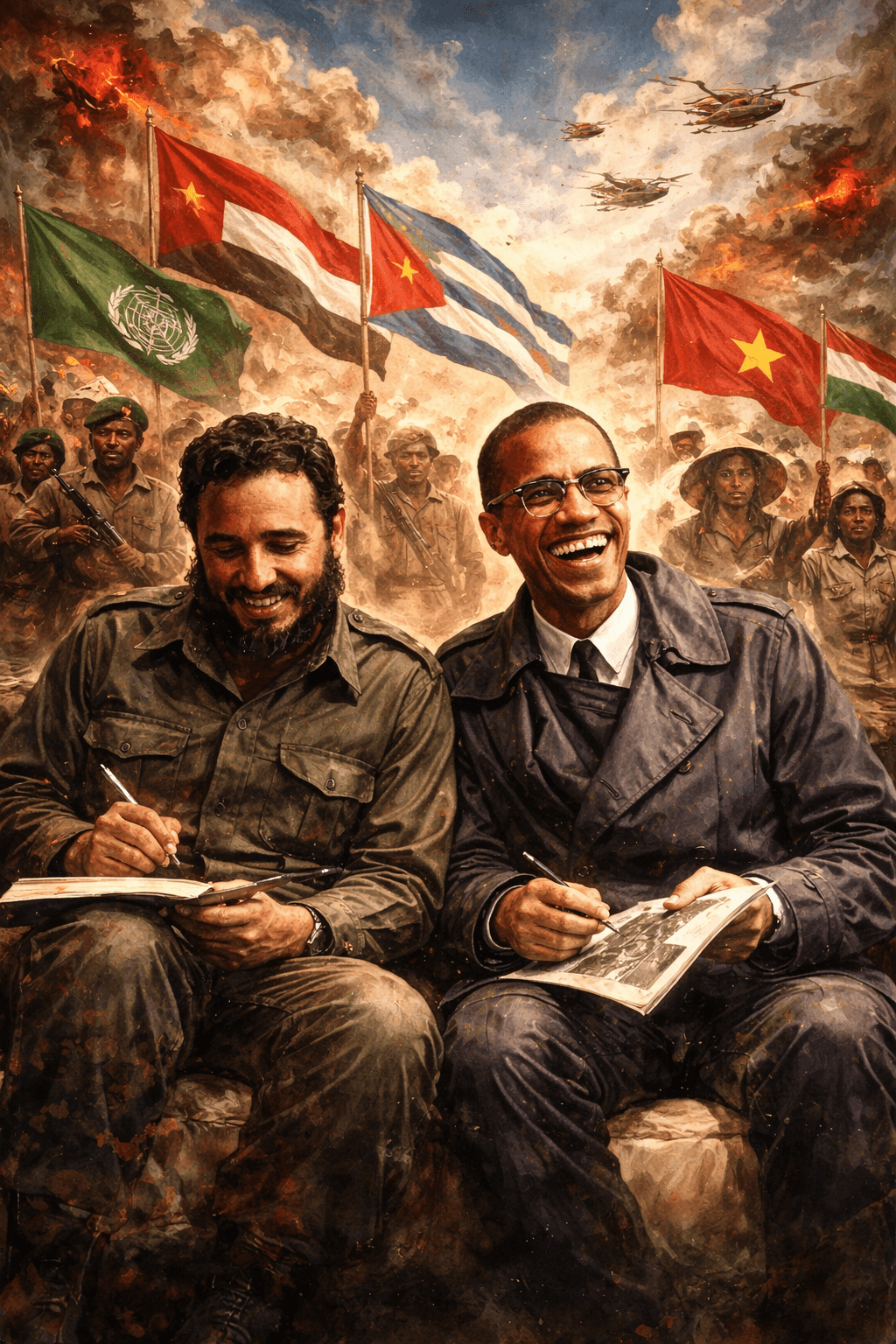
From colonial violence in the American Midwest to the global battlefields of Africa and Asia, Malcolm’s life traces the sharpening of Black consciousness under empire. His final years mark not moderation but expansion — from religious nationalism to human rights insurgency and anti-imperialist alignment. This essay follows the dialectical arc of his transformation and the revolutionary legacy it ignited.
By: Prince Kapone | Weaponized Information | Black History Matters Series | February 12, 2026
A Life That Refused Containment
Malcolm X has been flattened into too many safe shapes. He is marketed as a fiery orator, reduced to a handful of sharp quotes, or embalmed as a martyr whose anger can be admired so long as it is not understood. But Malcolm’s life was not a slogan. It was movement. It was evolution under pressure. To study him seriously is to trace how a Black man formed inside American racial capitalism sharpened his political line as the contradictions around him intensified. His thought did not descend from the clouds. It was forged in confrontation.
This essay does not freeze Malcolm at any single moment — not as the street hustler, not as the disciplined Nation of Islam minister, not even as the international figure traveling across Africa and the Middle East. Instead, it follows the arc of transformation. Malcolm’s trajectory — from colonial subject to religious nationalist to revolutionary internationalist — reveals how Black political consciousness developed in the mid-twentieth century United States. Each phase of his life corresponded to a widening analysis. Each break was forced by material conditions.
Too often, commentators describe Malcolm’s final years as a “moderation,” as though exposure to the wider world softened him. This is a misreading convenient to liberal memory. What occurred after 1963 was not retreat but expansion. Malcolm moved from a framework centered primarily on racial theology to one rooted in geopolitics, anti-imperialism, and the language of human rights. He began situating the Black struggle inside the global architecture of colonialism and Cold War power. If anything, he became more dangerous — not less.
The core claim of this study is simple: Malcolm’s evolution demonstrates that revolutionary theory emerges from lived confrontation with empire. He did not begin as an internationalist. He became one. He did not start with systemic critique of capitalism. He moved toward it as experience and study sharpened his understanding. The United States of the 1950s and 1960s — a nation preaching democracy abroad while policing Black life at home — produced in Malcolm a thinker unwilling to accept rhetorical reform in place of structural change.
His final two years are especially decisive. In that short span, Malcolm broke organizationally with the Nation of Islam, traveled extensively across Africa and the Middle East, established the Organization of Afro-American Unity, developed a human rights strategy aimed at indicting the United States before the world, engaged with militant Black youth formations, and articulated a Third Worldist anti-imperialist orientation that would directly prefigure the revolutionary Black movements of the late 1960s. The Malcolm who died in 1965 was not static. He was in motion.
To understand Malcolm, then, is to understand transformation. It is to see how historical forces — domestic racial control, global decolonization, Cold War polarization, youth radicalization — pressed against an evolving political mind. The life and the line cannot be separated. The biography is the theory in formation. And what that formation reveals is this: revolutionary consciousness is not born in abstraction. It is forged in struggle, clarified by contradiction, and widened by contact with the world.
Malcolm X refused containment — ideological, organizational, and national. That refusal is precisely why he remains dangerous.
Colonial Violence as Childhood
Malcolm’s political evolution did not begin in a mosque or a prison library. It began in a burning house. Born Malcolm Little in 1925 in Omaha, Nebraska, he entered a family already marked by struggle. His father, Earl Little, was a Garveyite organizer preaching Black self-determination in the Midwest. That alone placed the household in the crosshairs of white supremacist terror. The Ku Klux Klan and affiliated groups harassed the family repeatedly. Their home was set ablaze. The message was clear: Black independence would be met with fire.
When Earl Little was found dead under suspicious circumstances — officially ruled an accident, widely understood in the community as racial murder — the state did not protect the family. Insurance companies refused full payment. Welfare authorities intervened. Malcolm’s mother, Louise Little, was pushed into economic desperation and later institutionalized. The children were dispersed into foster homes. What is often narrated as personal tragedy was, in material terms, the functioning of colonial order. A Black nationalist household was dismantled through terror, economic strangulation, and bureaucratic authority.
Before Malcolm ever articulated the language of self-defense, he had witnessed the limits of American protection. Before he read about colonialism in Africa, he experienced its domestic form in Michigan and Nebraska. The state appeared not as a neutral arbiter but as an instrument of white social stability. Social workers, courts, police, and welfare agencies did not arrive as guardians of justice; they arrived as managers of Black dispossession.
Even in school, discipline came wrapped in ideology. When a teacher praised Malcolm as intelligent but a counselor advised him that becoming a lawyer was “no realistic goal for a Negro,” the lesson was not merely about career aspiration. It was a rehearsal in containment. Talent was acknowledged, but ambition was circumscribed. In miniature, this was the logic of racial capitalism: Black capacity was acceptable so long as it remained within approved limits.
These early experiences were not abstract injuries. They formed a consciousness of vulnerability and mistrust toward white institutions. Malcolm did not need theoretical treatises to understand that Black life existed under conditional citizenship. The destruction of his family, the forced removal of children, the quiet erasure of his father’s political commitment — all of this functioned as a lived education in power. The United States presented itself as democratic; Malcolm’s childhood revealed a different structure.
It is important not to romanticize this phase as preordained radicalism. Malcolm did not emerge from childhood with a finished ideology. He emerged with scars and questions. But those questions were rooted in material experience. When later he would describe Black Americans as victims of internal colonialism, he was not inventing metaphor. He was naming a structure he had already encountered.
The colonial order did not simply marginalize Malcolm. It shaped him. And in shaping him, it prepared the ground for rebellion.
Prison as Political Rebirth
If Malcolm’s childhood exposed him to the violence of the colonial order, prison forced him to confront its structure. Arrested in 1946 and sentenced to nearly a decade behind bars, Malcolm entered the penitentiary as a hustler shaped by survival, anger, and improvisation. He left in 1952 as something else entirely: disciplined, self-educated, and politically oriented. The state had confined his body, but in doing so it inadvertently created the conditions for intellectual transformation.
Prison was not benevolent. It was a warehouse of discarded Black labor. But within its walls Malcolm encountered books, and through books he encountered history. He read voraciously — philosophy, religion, world history, political theory — copying entire dictionaries to rebuild his literacy. This was not self-improvement in the liberal sense. It was reconstruction of consciousness. The hustler who had navigated Boston and Harlem through instinct began to systematize his understanding of race, power, and civilization.
It was here that he encountered the teachings of the Nation of Islam. The NOI did not offer a conventional class analysis, nor did it speak in the language of Marx. It offered something different: moral inversion. It named white supremacy as devilish, rejected integrationist pleading, and insisted on Black dignity and self-determination. For a man who had watched white institutions dismantle his family, this was not abstract theology. It was psychological decolonization.
The Nation provided structure. It demanded discipline, sobriety, study, and organizational loyalty. For Malcolm, whose earlier life had been defined by instability, this discipline was transformative. He abandoned self-destructive habits and adopted a new name — first Malcolm X — symbolically rejecting the slave surname “Little.” The X signified the unknown African name stolen through slavery. In that gesture, identity became political.
Yet even here we must be precise. The Nation of Islam’s framework was nationalist and theological, not historical materialist. It critiqued white civilization as morally corrupt but did not fully theorize capitalism as a global system. It called for separation, not systemic overthrow. Still, it gave Malcolm a platform and a method. He learned how to speak with cadence and force, how to build institutions, how to transform rage into disciplined rhetoric.
Prison thus functioned as a crucible. The state sought to neutralize him; instead it incubated him. Repression produced reflection. Confinement produced clarity. The hustler became a minister. The street survivor became an organizer. And beneath the religious nationalism that would define his next decade, the deeper impulse was already forming: the refusal to accept the legitimacy of the social order that had caged him.
Malcolm did not leave prison with a finished revolutionary theory. He left with tools — intellectual, moral, and organizational. Those tools would sharpen under pressure. And the pressure was coming.
Nationalism Against the American Dream
When Malcolm emerged from prison in 1952, he stepped into a nation congratulating itself on postwar prosperity while maintaining a rigid racial caste system. Suburbs expanded, factories hummed, and politicians spoke of freedom — yet Black communities remained segregated, policed, and economically contained. Into this contradiction walked Malcolm X, now a minister of the Nation of Islam, armed with discipline, memory, and an uncompromising tongue.
Throughout the 1950s and early 1960s, Malcolm became the Nation’s most visible and electrifying spokesperson. He built temples, recruited members, debated clergy, and dominated television panels. His message cut cleanly against the grain of liberal optimism. America, he argued, was not a flawed democracy in need of reform; it was a white supremacist power structured on violence. Integration was not salvation but absorption into a hostile order. Nonviolence, preached to the oppressed but not to the oppressor, was political theater.
His critique exposed the moral asymmetry of American liberalism. While civil rights leaders pleaded for inclusion, Malcolm demanded dignity on Black terms. He insisted that self-defense was not extremism but common sense. If the state would not protect Black life, Black people had the right to protect themselves. This position did more than inflame white conservatives; it unsettled liberal allies who preferred disciplined protest over militant assertion.
Yet this period must be understood dialectically. The Nation of Islam gave Malcolm institutional power and a mass base, but it also imposed ideological limits. Its theology framed white oppression in civilizational terms rather than economic ones. It rejected electoral politics and direct protest but did not articulate a coherent program for dismantling capitalism. The hierarchy centered ultimate authority in Elijah Muhammad, constraining independent political maneuver.
As Malcolm’s prominence grew, so did his exposure to global currents. He observed African decolonization movements, read about revolutions abroad, and encountered activists who framed oppression in geopolitical rather than purely racial terms. The more he spoke publicly, the more he recognized that American racism was not an isolated pathology but a pillar of imperial power. That realization began to strain against the Nation’s narrower theological framing.
By the early 1960s, Malcolm had become larger than the organization that shaped him. He debated civil rights leaders, criticized U.S. foreign policy, and increasingly connected domestic repression to global domination. The contradiction sharpened: a disciplined nationalist minister inside an organization wary of political expansion. Tension was inevitable.
The Nation years were not a detour. They were preparation. They forged Malcolm’s rhetorical force and mass appeal while revealing the limits of religious nationalism as a complete political theory. In confronting liberal integrationism head-on, Malcolm laid the groundwork for a more expansive turn. The American Dream had met its fiercest critic. Soon, the critique would widen beyond race alone to system itself.
Rupture, Pilgrimage, and the Widening of the Struggle
The break did not begin in Mecca. It began in contradiction. By 1963, Malcolm’s political vision was stretching beyond the doctrinal boundaries of the Nation of Islam. He was speaking not only about white devils and moral decay, but about colonial wars, African independence, and the hypocrisy of American democracy on the world stage. When he remarked, after the assassination of John F. Kennedy, that the “chickens [were] coming home to roost,” the leadership suspended him. The comment was a pretext. The real issue was expansion. Malcolm’s analysis was outgrowing its container.
In early 1964, he formally severed ties. What followed has too often been mischaracterized as moderation. In truth, it was transformation under pressure of reality. The pilgrimage to Mecca — the Hajj — shattered certain racial absolutisms he had inherited. He encountered Muslims of many colors, witnessed forms of solidarity that did not map neatly onto American binaries, and returned with a broader vocabulary. But this was not a retreat from militancy. It was a shift from theological race critique to political internationalism.
After Mecca, Malcolm traveled through Egypt, Ghana, Nigeria, Algeria, and other newly independent African states. He met heads of state, revolutionaries, diplomats, and students. He studied the Algerian war against French colonialism. He listened to debates about nonalignment, socialism, and the future of the Third World. The center of gravity moved. The Black struggle in the United States was no longer a minority civil rights issue. It was a colonial question inside an imperial core.
In speech after speech, he reframed the terrain. The problem was not simply segregation in Birmingham. It was the global system that linked Mississippi to the Congo, Harlem to Hanoi. He began to speak of human rights rather than civil rights. Civil rights, he argued, kept the struggle within the jurisdiction of the same government committing the abuses. Human rights internationalized the question. It moved the courtroom from Washington to the United Nations.
This was strategic escalation. By situating Black Americans within the broader anti-colonial majority of Asia and Africa, Malcolm altered the political calculus. The United States could ignore domestic petitions. It could not easily dismiss charges before the world. He recognized that Cold War geopolitics created openings. If Washington claimed to defend freedom abroad, its racial order at home became diplomatic liability.
The widening was theoretical as well as strategic. Malcolm’s language began to shift from condemning “the white man” as an individual moral category to critiquing “the system” as an organized structure of exploitation. He did not abandon the realities of racial violence. He contextualized them within power. Racism was not merely hatred; it was governance. It was labor control, territorial containment, ideological discipline.
The rupture with the Nation, therefore, marks the beginning of Malcolm’s most dynamic phase. Freed from organizational constraints, he began synthesizing Black nationalism with anti-imperialist analysis. The pilgrimage did not tame him. It armed him with a broader map. And once the map expanded, there was no return to narrower terrain.
Militant Youth, Revolutionary Networks, and the Question of Armed Struggle
If the pilgrimage widened Malcolm’s horizon, his return to Harlem radicalized the ground beneath his feet. By 1964, a layer of young Black militants had already concluded that liberal integrationism was bankrupt. They were studying Fanon, Mao, and the Cuban Revolution. They were watching Algeria defeat France. They were asking not whether self-defense was justified, but how struggle should be organized. Malcolm did not create this generation — but he became its most coherent voice.
The Revolutionary Action Movement (RAM), led by Max Stanford (later Muhammad Ahmad), emerged as one of the clearest expressions of this new current. Influenced by anti-colonial guerrilla warfare and Third World Marxism, RAM framed Black Americans as an oppressed nation inside the United States and advocated revolutionary transformation rather than reform. Its cadres studied Malcolm’s speeches intensely, not as scripture, but as strategic orientation. They saw in his post-Nation evolution a bridge between nationalist consciousness and global insurgency.
Malcolm, for his part, increasingly engaged militant youth beyond the confines of religious nationalism. In Harlem, Detroit, and at forums like the Militant Labor Forum, his tone sharpened. Self-defense was no longer rhetorical defiance; it was contextualized within the logic of anti-colonial struggle. When Africans took up arms against European rule, it was called liberation. When Black Americans spoke of defending their communities, it was labeled extremism. Malcolm exposed the double standard with surgical clarity.
His travels reinforced this shift. In meetings with revolutionaries and newly independent African leaders, he encountered movements that did not beg for inclusion but demanded sovereignty. Guerrilla struggle was not chaos; it was political method under conditions where legal avenues were foreclosed. Malcolm did not romanticize violence, but he refused to condemn it when it arose from colonial domination. The colonized, he insisted, had the right to defend themselves “by any means necessary.”
What distinguished this phase was synthesis. Malcolm was moving beyond the moral framing of racial injustice toward structural analysis of power. Armed self-defense was not an expression of anger; it was a recognition of how states maintain order. Police violence in Harlem was not aberration; it was domestic occupation. Internationally, the same pattern operated through military bases, proxy wars, and economic coercion. Empire abroad and repression at home were mirror images.
The state understood this convergence. A Malcolm who condemned white hypocrisy was disruptive. A Malcolm who connected Harlem to Havana and Algiers was dangerous. The more he spoke with militant youth, the more his politics crystallized into something that transcended organizational labels. He did not found RAM. He did not formalize a guerrilla apparatus. But he legitimized the intellectual terrain upon which revolutionary Black nationalism would stand.
By 1965, Malcolm had become a node in a widening network of anti-imperialist thought and insurgent aspiration. The bridge was forming — between domestic revolt and global liberation, between nationalist pride and systemic critique. Bridges, however, are intolerable to empires. They make crossings possible.
From Domestic Protest to International Indictment
If Malcolm’s engagements with militant youth and revolutionary formations clarified the legitimacy of resistance, the founding of the Organization of Afro-American Unity clarified the terrain on which that resistance would be waged. This was not about repeating the language of self-defense. It was about reclassifying the struggle itself. Malcolm began to argue that the fundamental mistake of the civil rights framework was jurisdictional. As long as Black people framed their demands as civil rights, they remained under the authority of the very government accused of violating them.
Civil rights confined the struggle to the domestic courts of empire. Human rights ruptured that confinement. By redefining Black oppression as a human rights violation, Malcolm sought to move the question beyond the Constitution and into the arena of international law and global diplomacy. This was not rhetorical flourish. It was structural repositioning. He understood that the United States, in the midst of Cold War competition, depended heavily on its image among newly independent African and Asian nations. International exposure could produce pressures that domestic protest alone could not.
The OAAU was therefore conceived less as a protest vehicle and more as a political instrument. Its program emphasized political education, community self-organization, and diplomatic outreach. Malcolm envisioned delegations traveling to African capitals, building alliances with anti-colonial governments, and presenting evidence of racial repression before the United Nations. In effect, he was attempting to convert Black America’s condition into a question of colonial governance inside the imperial core.
This move deepened his analysis. The problem was no longer framed primarily as interpersonal racism or moral failure; it was framed as a structural contradiction between empire and a colonized population. By shifting the struggle from civil inclusion to international accountability, Malcolm implied that the United States functioned domestically in ways analogous to European colonial regimes abroad. That comparison alone destabilized the mythology of American exceptionalism.
Importantly, this strategy did not replace militancy; it complemented it. Malcolm was developing a multi-layered approach: grassroots political consolidation at home, ideological clarity about systemic power, and diplomatic maneuvering abroad. He was situating Black liberation within the broader realignment of the postwar world, where Africa, Asia, and Latin America were asserting sovereignty against Western domination. In that context, Black Americans were not an isolated minority but part of a global majority confronting imperial hierarchy.
The significance of this turn cannot be overstated. By attempting to internationalize the Black question, Malcolm was preparing to force the United States to answer not just to its own citizens, but to the world. That transformation marked a new stage in his political development — one in which the struggle for Black liberation became inseparable from the global crisis of empire itself.
The System Named: Third Worldism and the Architecture of Empire
Once Malcolm repositioned the struggle onto the terrain of international law and anti-colonial diplomacy, his analysis sharpened with unmistakable clarity. The language of “the white man” began to give way to the language of systems. He was no longer primarily indicting individual bigots or even cultural racism. He was mapping an architecture — an imperial order sustained by military force, economic extraction, ideological management, and domestic racial containment.
In his final year, Malcolm spoke increasingly of Vietnam as a colonial war, of Africa as a geopolitical battlefield between competing powers, and of the United States as an empire projecting violence abroad while policing dissent at home. This was not a rhetorical escalation; it was analytical maturation. He recognized that Black oppression in the United States could not be understood outside the global circulation of capital and power. The ghetto and the battlefield were linked.
His travels across Africa and the Middle East did not moderate him; they radicalized him. Meeting leaders of newly independent states, observing the aftershocks of colonial rule, and witnessing the fragility of postcolonial sovereignty deepened his conviction that racism functioned as a tool of geopolitical management. The “color line” was not simply a domestic social boundary. It was a global dividing line organizing labor, resources, and political authority.
Malcolm began identifying liberalism itself as a stabilizing force within this structure. He distinguished between open reaction and liberal paternalism, arguing that the latter often neutralized rebellion more effectively than the former. The white liberal, in his analysis, did not dismantle empire; he humanized it. That insight marked a decisive break from reformist expectations. The issue was not better management of the existing order. It was the order itself.
His critique also edged toward political economy. He spoke of exploitation, of wealth accumulation built on colonial domination, and of the alignment between corporate power and state violence. While he did not yet articulate a fully developed historical materialism, the trajectory was unmistakable. The problem was systemic. Racism was not the disease; it was a mechanism within a larger structure of capitalist imperial control.
This was Malcolm at his most intellectually dangerous. He had moved beyond moral denunciation, beyond nationalist theology, and beyond narrow domestic protest. He was situating Black liberation within the global crisis of empire. In doing so, he offered a framework that would nourish the Black Power movement, revolutionary nationalism, and the internationalist currents that followed. The evolution was incomplete — cut short by assassination — but the direction was clear. The target was no longer simply racial hierarchy. It was the architecture of imperial power itself.
Bridges Must Be Burned: Assassination and Counterinsurgency
By early 1965, Malcolm had become something more dangerous than a charismatic nationalist. He was becoming a bridge. A bridge between Harlem and Accra. Between mosque and movement. Between street-level rage and geopolitical analysis. And history teaches us a simple lesson: empires do not tolerate bridges that connect domestic unrest to global insurgency.
February 21, 1965 was not an isolated eruption of internal rivalry. It unfolded inside a climate thick with surveillance, infiltration, and escalating state anxiety about Black militancy. Federal intelligence agencies had already intensified monitoring of Black nationalist formations. Informants circulated. Tensions were amplified. Divisions hardened. The architecture that would soon be formalized under expanded counterintelligence programs was already taking shape.
Malcolm’s political trajectory made him uniquely threatening. He was no longer confined to the Nation of Islam’s religious hierarchy. He was organizing independently. He was engaging revolutionary youth. He was speaking to international audiences about colonialism, capitalism, and human rights. He was attempting to reframe the Black struggle as an international question — one that could not be managed through local concessions.
The timing matters. Urban unrest was intensifying across the United States. Anti-colonial wars were escalating globally. Youth radicalization was accelerating. Malcolm’s evolving analysis provided ideological coherence to these currents. He linked domestic repression to global empire. He linked self-defense to anti-colonial warfare. He linked Black liberation to the majority world.
Counterinsurgency does not only eliminate individuals; it disrupts political synthesis. It prevents convergences. Malcolm’s assassination removed a figure capable of consolidating disparate radical energies into a more unified internationalist framework. In that sense, his death functioned as strategic containment. The state had learned from Reconstruction, from Garveyism, from earlier waves of Black rebellion: when a movement begins to align internal dissent with global opposition, it must be fractured.
Yet assassination does not erase trajectory. It freezes a moment. Malcolm died in motion — not retreating, not moderating, but expanding. His elimination did not extinguish the ideological shift he had initiated. It exposed it. The very act of violence underscored the depth of the threat he represented. And in doing so, it confirmed the argument he had been making: that liberation struggles confronting empire are never simply local disputes. They are battlegrounds in a global system.
After the Gunshots: The Revolution That Walked Forward
Malcolm did not live to see Watts burn. He did not live to see the cry of “Black Power” reverberate through Mississippi. He did not live to see young Black militants study guerrilla warfare manuals, read Fanon in tenements, or patrol their communities with law books and rifles. But the political line that made those developments possible was already forming in his final speeches. His last two years were not a coda; they were a transmission.
Revolutionary Action Movement cadres studied him closely. The Black Panther Party absorbed his insistence on armed self-defense and international solidarity. The League of Revolutionary Black Workers operationalized his recognition that labor and race were fused inside industrial capitalism. The Republic of New Afrika carried forward his framing of Black people as an oppressed nation inside the United States. Across these formations, one sees not imitation but continuation — an expansion of the terrain Malcolm had opened.
What did he leave behind that proved so combustible? First, psychological decolonization. Malcolm stripped away the moral dependency on white approval. He taught that dignity is not negotiated. Second, legitimacy of armed self-defense — not as spectacle, but as political principle in a system built on violence. Third, international orientation. He relocated the struggle from a domestic petition to a global alignment. Fourth, the human rights strategy — a juridical offensive that treated Black Americans not as a minority seeking reform but as a colonized people seeking redress.
Most importantly, Malcolm’s final evolution modeled something even deeper: political development under pressure. He did not stagnate in theology. He did not calcify in rhetoric. He studied, traveled, listened, recalibrated. He moved from moral denunciation to systemic critique. From naming the white man to naming the system. From isolation to international alliance. That movement itself became a blueprint.
The wave of 1966–1975 — urban rebellions, armed patrols, factory insurgencies, international solidarity campaigns — did not emerge from nowhere. It emerged from a generation that heard Malcolm widen the frame. He made it intellectually legitimate to understand Black struggle as anti-imperialist struggle. Once that door was opened, it could not be easily shut.
Empire understood the danger. That is why his memory was softened, domesticated, turned into a poster instead of a process. But Malcolm’s real legacy is not an image frozen in 1963. It is a political trajectory that insists consciousness must sharpen as contradictions sharpen. The revolutionary afterlife of Malcolm X lies not in nostalgia, but in unfinished motion.
The Revolutionary in Motion: What Malcolm Still Teaches
Malcolm’s life does not offer the comfort of a completed doctrine. It offers something more useful: a method forged in the furnace. He teaches that revolutionary consciousness is not a moral posture you adopt, but a line you develop under pressure — under surveillance, under disappointment, under the hard schooling of contradiction. That is why the state could not “debate” Malcolm. It had to contain him, fracture his base, and finally remove him. A moving target is harder to neutralize than a fixed one.
The arc matters because it clarifies the stakes. Malcolm begins as a child of domestic counterinsurgency — Garveyism hunted, a family broken, a future narrowed by the casual authority of white institutions. He becomes a disciplined nationalist through the brutal pedagogy of prison, then a mass organizer whose oratory punctures liberal mythology. But the decisive turn is late: he steps beyond the boundaries of any single organization, beyond the nation-state frame, beyond the comforting fiction that the problem is merely “prejudice.” He finds the system — and once you find the system, you start asking different questions: who profits, who governs, who is armed, who is silenced, and who is connected across borders.
That is the higher synthesis: Malcolm’s final years were not a change of tone but a change of terrain. He began to treat Black struggle as a node in a world struggle against colonial capitalism — a struggle with diplomatic fronts, ideological fronts, and, when forced, military fronts. He did not reach a fully articulated historical materialism in the language of Marxist textbooks, but he was moving toward the material relations with unmistakable clarity: empire is structure, not accident; racism is governance, not misunderstanding; and freedom is not granted by the oppressor’s conscience but won through organized power.
For us, the lesson is not to worship Malcolm. It is to refuse containment the way he refused it — to refuse the sentimental version of history where martyrs replace movements, where quotes replace strategy, where the white liberal imagination sets the boundaries of what is “reasonable.” Malcolm’s danger was never simply that he spoke harshly. His danger was that he evolved publicly, dialectically, and without asking permission — and that evolution illuminated pathways for others to organize beyond the narrow lanes of civil rights management.
So the conclusion is not an epitaph. It is a directive. If Malcolm’s life proves anything, it is that the oppressor will try to freeze you at the safest stage of your development — the stage where you are legible, containable, and useful to their narrative. The task of revolutionaries is to keep moving: to widen the frame, deepen the analysis, sharpen the line, and build institutions that can outlive any single leader. Malcolm was assassinated in the middle of transformation. His legacy is that transformation must continue — on a higher basis, with greater organization, and with the international horizon he fought to open.
 Weaponized Information
Leave a comment