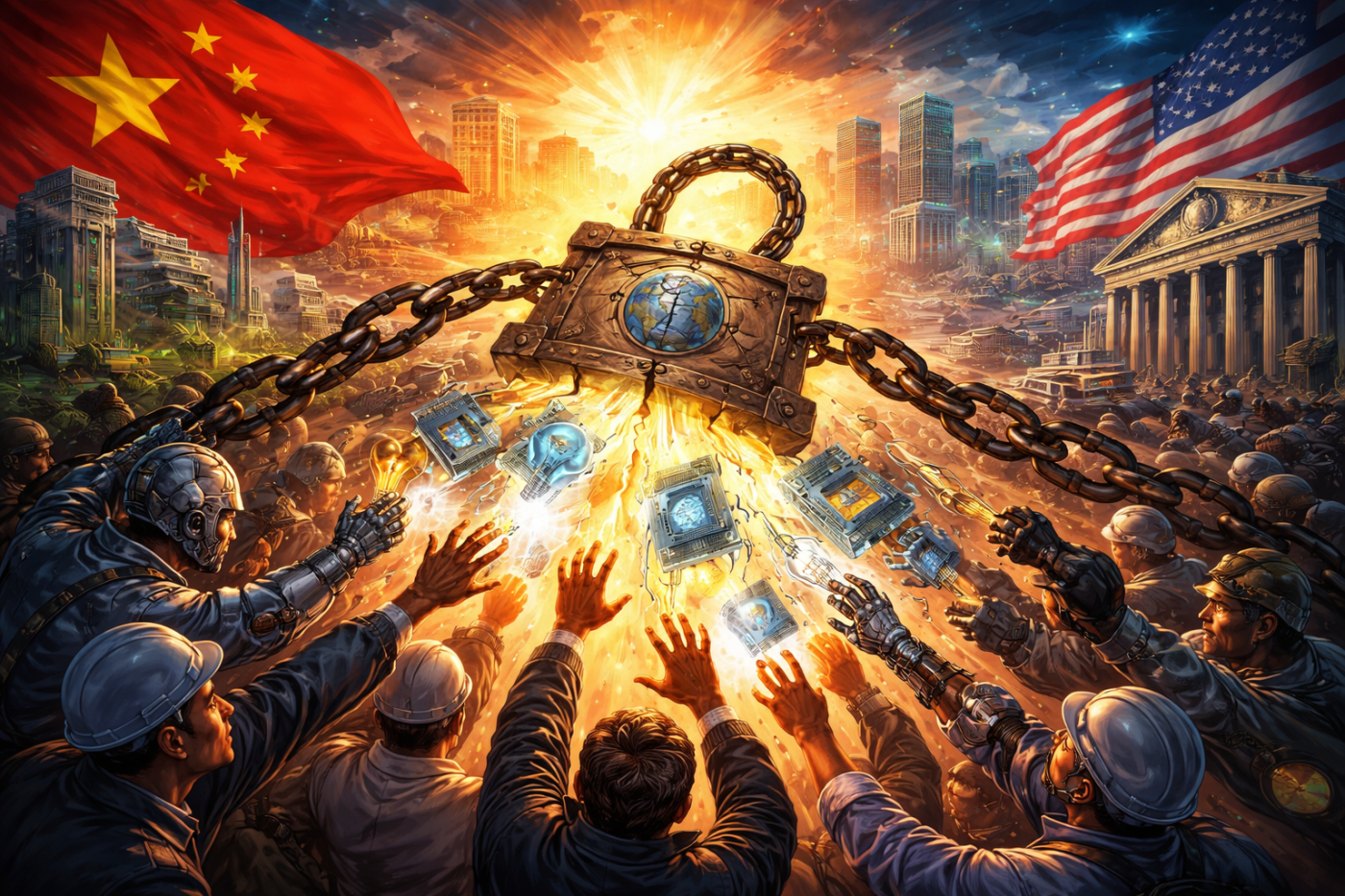
What begins as a story about counterfeit toys reveals a deeper moral architecture designed to police who is allowed to innovate and who must remain a follower. A closer look at the empirical record exposes intellectual property not as a neutral legal system, but as a historically weaponized regime built to preserve hierarchy once monopoly is threatened. As Chinese innovation breaks through inherited limits, courts and lawsuits replace factories and productivity as the primary terrain of struggle. The enclosure of knowledge now confronts the global working class and the colonized world with a choice between submission to monopoly or organized resistance in defense of shared human development.
By Prince Kapone | Weaponized Information | February 9, 2026
From Plush Toys to Moral Parables
The article under excavation, “China once stole foreign ideas. Now it wants to protect its own”, published by The Economist on February 9, 2026, presents itself as a straightforward piece of business reporting on the rise of intellectual-property litigation in China. It opens with a vignette about counterfeit plush toys flooding Beijing markets and closes with Chinese firms suing foreign competitors abroad, suggesting a world turned upside down. On the surface, it is a story about courts, patents, trademarks, and global commerce. But like much of what passes for neutral economic journalism, its deeper work is not to inform, but to narrate—to arrange facts into a moral sequence that reassures Western readers that history still moves according to familiar hierarchies.
The article’s architecture is doing most of the ideological labor. It begins not with semiconductors, infrastructure, or industrial systems, but with toys—small, whimsical, unserious objects. Counterfeiting is introduced not as a structural feature of capitalist production but as a kind of cultural infestation, populated by creatures with silly names. This framing matters. By miniaturizing the problem at the outset, the text invites the reader to view what follows not as a struggle over productive power, but as a story about disorder, imitation, and excess. China appears first not as an economy, but as a marketplace gone a little feral.
From there, the narrative advances along a carefully drawn moral timeline. There is a past in which China “stole” ideas, a present in which it is belatedly learning to respect intellectual property, and a future in which its newfound litigiousness threatens to spill over borders. The language does not argue this progression explicitly; it assumes it. Western norms of ownership and originality sit quietly in the background as the unspoken standard, while China is cast as the latecomer, awkwardly adjusting to rules it once ignored. Development is thus rendered not as a contested historical process, but as a kind of ethical maturation, with China perpetually a step behind.
Word choice reinforces this moral staging. Technologies are “nabbed,” ideas are “pilfered,” imitation “floods” markets. These are not neutral verbs. They belong to the vocabulary of crime reporting, not political economy. When Chinese courts are described as inundated with cases, the image is one of overload and dysfunction rather than transformation. Volume itself becomes suspicious. The reader is encouraged to see scale as pathology, not as a sign of intensified social activity. The possibility that a rapidly changing economy might generate legal friction as a byproduct of growth is never seriously entertained.
Voice and authority in the piece follow a similarly narrow channel. The people allowed to interpret events are lawyers, corporate representatives, and compliance specialists. They speak fluently about delays, enforcement gaps, and foreign exposure. Absent entirely are the workers who produce the goods, the engineers who design them, or the public institutions that shape industrial direction. China, as a collective social actor, is reduced to enforcement raids and courtroom statistics. Creativity, labor, and learning remain offstage. What we encounter instead is a legal abstraction—China as a problem to be managed.
The tone subtly shifts when the story crosses borders. Domestic counterfeiting is treated as nuisance and chaos; Chinese lawsuits abroad are framed as escalation. When Western companies are affected, the narrative tightens, the stakes rise, and the issue becomes properly “global.” What is presented as symmetry—Chinese firms now suing foreign rivals—never quite feels equal in the telling. The implication lingers that when China asserts its claims internationally, it is overreaching, testing limits, disturbing a balance that once felt natural.
The article closes without resolution, offering instead a sense of inevitability. More lawsuits are coming. More clashes lie ahead. The reader is left with anticipation rather than explanation, anxiety rather than understanding. Structural causes are left unnamed, while conflict itself is naturalized as the regrettable consequence of China’s rise. In this way, the piece does what such journalism is designed to do: it converts a historical transformation into a morality play, and prepares its audience not to ask why the system is straining, but to brace for the turbulence caused by those who have entered it too fully.
Intellectual Property on a Shifting Battlefield
Stripped of its narrative framing, the article’s central empirical claim is straightforward: China’s courts now process an immense volume of intellectual-property disputes each year. According to official judicial reporting, Chinese courts received and concluded more than half a million IP cases in 2024, a scale unmatched by any other national jurisdiction. Public briefings from China’s State Council Information Office further confirm that over 540,000 IP cases were concluded nationwide in a single year. These figures establish China not as an outlier, but as the world’s most active venue for IP adjudication by raw volume.
This caseload is not accidental. China has constructed a specialized judicial architecture to manage it, including dedicated IP courts and a national-level appellate body. The China National Intellectual Property Administration documents the operation of the Supreme People’s Court Intellectual Property Tribunal, which centralizes appeals in technically complex patent and technology cases. Whatever one thinks of the outcomes of these cases, the institutional fact is clear: China has invested heavily in formalizing IP adjudication as a core function of its legal system.
The article also notes that Chinese firms increasingly pursue IP claims outside China. This is empirically verifiable. In Southeast Asia, Luckin Coffee successfully enforced its trademark against imitators in Thailand, a ruling confirmed in reporting on the Thai Intellectual Property and International Trade Court decision. In North America, Chinese renewable-energy firms have moved aggressively into patent litigation. Canadian Solar publicly acknowledged that it was sued by Trina Solar over alleged patent infringement, a dispute detailed in the company’s own investor disclosure and expanded upon in industry reporting that describes the case as a multi-jurisdictional conflict involving U.S. patents.
Chinese firms are not only plaintiffs abroad; they are also frequent defendants. Analyses of U.S. court data show a sustained rise in patent, trademark, and trade-secret litigation involving Chinese companies in American jurisdictions. A comprehensive review of these trends, drawing on annual investigations by the China Intellectual Property Society, documents the expanding footprint of Chinese firms in U.S. IP litigation across multiple sectors. Similar disputes have emerged in Canada, particularly in energy and technology markets integrated with U.S. supply chains.
Counterfeiting, which the article links to excess industrial capacity, is also a measurable phenomenon at the global level. Joint studies by the OECD and EUIPO estimate that counterfeit and pirated goods accounted for approximately $467 billion in global trade in 2021. These same studies identify China as a major provenance economy in customs seizure data, a finding detailed in the OECD–EUIPO report Mapping Global Trade in Fakes. What these datasets do not do is establish a simple causal chain between overcapacity and counterfeiting; they document scale and geography, not motive.
What the article does not acknowledge is that strict intellectual-property regimes are historically associated with already dominant industrial powers. Britain and the United States did not develop under the conditions they now demand of others. Economic historians have shown that early industrializers relied heavily on imitation, diffusion, and weak enforcement, tightening IP rules only after securing technological leadership. This pattern is summarized in development research demonstrating that strong IP protection typically follows, rather than precedes, industrial dominance. Britain itself attempted to block knowledge diffusion by criminalizing the export of machinery and the emigration of skilled workers, a policy history documented in standard accounts of the Industrial Revolution.
Western states were not merely permissive during their ascent; they actively appropriated foreign knowledge. The United States built its early textile industry by reproducing British techniques, a process described in historical reconstructions of industrial espionage in the cotton sector. European powers also extracted Chinese technical knowledge under colonial conditions. British efforts to transplant Chinese tea cultivation relied on the systematic transfer of botanical and production knowledge, a history detailed in accounts of the nineteenth-century tea trade. Knowledge flowed westward long before it flowed east.
At the international level, today’s IP regime is anchored in the WTO’s Agreement on Trade-Related Aspects of Intellectual Property Rights. WTO documentation makes clear that TRIPS established uniform minimum standards for IP enforcement across vastly unequal economies. Research by the South Centre shows how these standards have constrained technology transfer and access to medicines in the Global South, despite formal flexibilities, a dynamic examined in detail in analyses of TRIPS and public health.
Against this backdrop, China’s own innovation output has expanded rapidly. Data from the World Intellectual Property Organization show that China became the first country to receive over one million patent applications in a single year in 2015 and has remained the world’s leading patent office by filings since then, a milestone documented in WIPO’s global patent indicators. More recent UN-linked reporting indicates that Chinese entities now lead in patenting activity in emerging fields such as generative artificial intelligence, according to a Reuters summary of UN data.
China’s earlier opening to foreign capital was not unconditional. For decades, access to the Chinese market was structured around joint ventures, local production, and negotiated technology sharing. Detailed policy analysis shows that foreign automakers were required to form joint ventures and share production knowledge, a framework described in studies of China’s joint-venture system and confirmed in U.S. Congressional Research Service reporting on market access conditions. Many of these requirements were relaxed only after domestic industrial capacity had been firmly established.
Taken together, these facts situate the present surge in IP litigation within a broader historical transition. Patent filings, frontier-sector innovation, and cross-border lawsuits all point to a redistribution of technological capacity in a world no longer organized around a single center. Since the global financial crisis, legal disputes over intellectual property have intensified in sectors where new competitors threaten established monopolies, a pattern visible in proliferating solar and technology patent conflicts reported by Reuters’ coverage of renewable-energy litigation.
What appears in isolation as congestion or conflict thus corresponds to a deeper shift: China’s movement from export assembly toward full-stack industrial systems encompassing design, tooling, production, and innovation. IP enforcement has expanded alongside this transformation, as domestic firms accumulate knowledge worth defending. Whether this maturation will be interpreted as convergence, confrontation, or something else entirely is a political question. The empirical record alone establishes that the struggle over intellectual property has become a central arena in a rapidly changing global technological order.
When Knowledge Escapes the Monopoly
Read against the factual record already established, the story of China “learning” to protect intellectual property collapses into something far more revealing. What is at stake is not a moral awakening or a belated embrace of universal rules, but a struggle over who gets to control knowledge at a moment when the old monopolies are breaking. Intellectual property surges to the foreground of global politics precisely when productive advantage can no longer be taken for granted. Law steps in where dominance once stood.
For much of modern history, innovation did not rely on rigid exclusion. The industrial powers that now sermonize about patents and trademarks advanced through imitation, diffusion, and state shelter. Protection hardened only after supremacy was secured, once rivals threatened to do what the pioneers themselves had already done. What presents itself today as timeless legal principle is, in fact, a historically timed enclosure. Intellectual property becomes most sacred when it is most fragile.
This helps explain why legal conflict explodes at the precise point when Chinese firms begin producing, designing, and innovating at scale. The dramatic rise in litigation is not evidence of disorder; it is evidence of collision. Where Chinese industry once assembled components designed elsewhere, there was little to fight over. Where it now generates its own technical knowledge, the terrain shifts. Lawsuits proliferate because something of value is finally on the table.
From the standpoint of Western capital, this transformation appears as transgression. Not because rules are being broken, but because hierarchy is being disturbed. The outrage that accompanies Chinese enforcement is tightly correlated with the erosion of monopoly, not with any newfound concern for ethics. When dominance is secure, enforcement is flexible. When it slips, enforcement becomes dogma.
International IP law, globalized through trade agreements, supplies the infrastructure for this defense. Uniform standards applied across radically unequal economies do not level the playing field; they freeze it. They reward those who arrived first and penalize those who arrive later. In this sense, intellectual property functions less as a reward for creativity than as a gatekeeping mechanism, disciplining development paths that fall outside imperial control.
China’s own turn toward stricter enforcement must be understood within this pressure field. As domestically produced knowledge accumulates, it becomes a strategic asset worth defending. Enforcement here is not an imitation of Western norms but a response to vulnerability. In a world where legal systems are already weaponized against latecomers, failing to defend indigenous innovation would amount to unilateral disarmament.
This defensive posture carries contradictions. China is not a classless society, and the benefits of enforcement do not flow evenly. Firms defend patents; workers defend livelihoods; the state defends development capacity. These interests overlap but do not coincide. Yet to collapse China’s actions into simple capitalist mimicry is to miss the larger structure: a post-revolutionary state navigating capitalist mechanisms under sustained external pressure.
Seen from the perspective of the global working class and peasantry, the stakes extend well beyond any single country. Intellectual property determines whether knowledge circulates or is hoarded, whether technologies spread or stall, whether development is shared or strangled. When law substitutes for production as the primary means of maintaining advantage, inequality hardens into doctrine.
The current wave of litigation thus reads less like a series of isolated disputes than like a proxy war for the future of production itself. Courts become battlegrounds because factories alone no longer decide outcomes. The question being fought over is simple but immense: who gets to use what humanity already knows?
Reframed this way, the article’s anxiety about conflict points to a deeper truth it cannot name. The system is straining not because China has failed to internalize its rules, but because those rules were designed for a world that is passing. As knowledge escapes the monopoly, law rushes in to capture it. Whether that capture succeeds will shape the next phase of global struggle.
Organizing Where the Law Tries to Cage Knowledge
If intellectual property has become a frontline in the struggle over who controls knowledge, then the response cannot remain confined to courtrooms and policy memos. The contradictions exposed here already animate real movements, real campaigns, and real acts of resistance. Around the world, working people, scientists, farmers, engineers, and organizers are contesting the enclosure of knowledge not as an abstract legal issue, but as a material condition shaping life, labor, and survival.
In the Global South, this struggle is most visible where intellectual property collides directly with human need. Public-health movements fighting for access to medicines have long challenged patent monopolies that restrict production and inflate prices. Organizations and coalitions pressing for the use of TRIPS flexibilities, compulsory licensing, and public manufacturing are not theorizing IP; they are dismantling its lethal consequences in practice. Their work demonstrates that knowledge can be defended collectively, outside the logic of private exclusion.
Among industrial workers and technical labor, especially in sectors like renewable energy, electronics, and manufacturing, the fight over IP increasingly overlaps with the fight over jobs, skills, and sovereignty. When production is blocked or throttled by legal choke points, workers experience it as layoffs, outsourcing, and stalled development. Trade unions and shop-floor organizations confronting plant closures and supply-chain disruptions are already grappling with the reality that legal monopolies can be as destructive as factory shutdowns. Linking labor struggles to the political economy of intellectual property turns isolated workplace battles into systemic resistance.
In the Global North, especially within socialist and anti-imperialist currents, the task is to refuse alignment with monopoly rents disguised as national interest. Campaigns challenging pharmaceutical profiteering, opposing technology export controls, and resisting sanctions regimes are already pushing against the same architecture that weaponizes IP. These efforts expose how “innovation protection” functions domestically as austerity and internationally as blockade. Solidarity here means breaking with the reflex to defend corporate advantage simply because it carries a national flag.
Knowledge workers themselves occupy a decisive position. Scientists, engineers, and researchers increasingly recognize that enclosure limits their own capacity to collaborate and build. Open-source movements in software, hardware, and scientific research demonstrate that collective production can outpace proprietary models when freed from artificial scarcity. These practices do not reject innovation; they reclaim it as a social process rather than a private asset.
For revolutionary and multipolar forces, the immediate task is connection rather than invention. The movements already exist: public-health coalitions, labor organizations, open-knowledge networks, anti-sanctions campaigns, and development sovereignty initiatives. What remains fragmented must be woven together. Intellectual property should be named explicitly as a shared constraint across these struggles, a common mechanism through which power enforces dependency.
Concretely, this means building political education that demystifies IP law, supporting campaigns that challenge monopoly enforcement, and strengthening international links between movements confronting enclosure in different forms. It means defending states and communities that assert control over knowledge against external coercion, without romanticism and without surrendering class critique. Above all, it means insisting that what humanity learns together should not be locked away from humanity itself.
The enclosure of knowledge is neither natural nor permanent. It is enforced because it can be enforced, and it will persist only so long as it remains uncontested. As production becomes multipolar and innovation spreads beyond old centers, the choice sharpens. Either law will succeed in recapturing what has escaped, or organized struggle will pry it open further. The terrain is already active. The task now is to enter it deliberately, collectively, and with clear eyes.
 Weaponized Information
Leave a comment