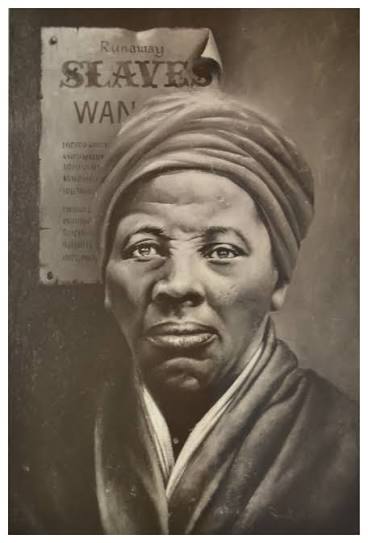
Harriet Tubman did not merely flee bondage; she attacked the economic foundations of slavery by organizing collective escape, disrupting the immobilization of Black labor, and later striking directly at Confederate infrastructure in war. Emerging from a regime that depended on the total control of Black women’s bodies, she transformed from exploited worker into disciplined strategist, proving that freedom is constructed through organization, intelligence, and force rather than granted by moral appeal. Her life exposes slavery as racial capitalism in motion and reveals how empire survives by sanitizing those who once threatened its stability. To remember Tubman truthfully is to recover escape as class struggle and insurgency as a material weapon against domination.
Prince Kapone | Weaponized Information | Black History Matters Series | February 7, 2026
They Call Her a Hero; History Knows She Was a Threat
Harriet Tubman has been polished into legend. They place her on posters, in children’s books, in speeches about courage. She is presented as brave, kind, determined — a woman with a lantern guiding trembling souls to freedom. It is a pleasant story. It is also incomplete. Empires have a habit of domesticating the people who once terrified them. They prefer their revolutionaries softened into symbols, their insurgents reduced to inspirational quotes. But history, if we are honest with it, does not remember Harriet Tubman as a gentle icon. It remembers her as a material danger to the slave system.
Tubman did not merely “seek freedom.” She disrupted property relations. She withdrew labor from one of the most profitable economic systems in the modern world. Slavery in the United States was not a regional quirk or a moral misunderstanding; it was a labor regime embedded in global capitalism. Cotton grown by enslaved hands fueled textile mills in Britain and New England. Banks, insurers, and merchants depended upon the bodies chained in the fields. The plantation was not simply a site of cruelty — it was a factory guarded by whips and patrols. When Tubman organized escape, she was not only defying masters; she was attacking an economic order.
The mythology tells us she was fearless. The record tells us she was disciplined. She studied routes. She built networks. She coordinated timing. She carried a firearm not as ornament but as insurance — against slave catchers, against betrayal, against hesitation that could doom an entire group. This was not spontaneity. It was operational clarity. She understood what many in her era did not yet dare to articulate openly: that freedom is not granted by moral appeal but seized through organized withdrawal from exploitation.
We must also be clear about what she represented as a Black woman in that moment. The slave system depended not only on forced field labor but on the reproductive labor of Black women — the bearing and raising of future property, the maintenance of households under coercion, the management of survival within terror. Tubman’s rebellion was therefore double-edged. She rejected not only racial domination but the gendered discipline that sought to confine Black women to silent endurance. She transformed from what the system defined as property into what it feared most: a mobile insurgent capable of destabilizing its labor force.
They call her a hero because the word is safe. It implies admiration without obligation. But Harriet Tubman was a strategist operating inside the belly of an empire. She exposed the fragility of a system that relied on captivity by demonstrating that collective escape could unravel its foundations. Her life forces a sharper question than the one we are usually asked in school. Not “Was she brave?” — that is obvious. The real question is this: what does it mean when the oppressed organize themselves into a force capable of disrupting the economic engine of their oppression?
This essay does not approach Tubman as folklore. It approaches her as a revolutionary actor navigating the political economy of slavery. Her story is not sentimental. It is structural. It is about labor, land, surveillance, war, and strategy. It is about a Black woman who turned the mechanisms of empire against themselves. And if history is a battlefield — as it has always been — then remembering Harriet Tubman truthfully is an act of alignment. Not with myth. But with insurgency.
Slavery Was a Labor System, Not a Moral Accident
To understand Harriet Tubman, we must first strip slavery of the sentimental haze that often surrounds it. Slavery was not simply prejudice hardened into cruelty. It was an economic machine. By the early nineteenth century, the United States had become a global supplier of cotton, and cotton had become the lifeblood of industrial capitalism. The wealth of ports, banks, railroads, and textile mills was tethered to the forced labor of enslaved Africans in the South. The plantation was not a backward relic; it was a disciplined labor camp integrated into world markets. Violence was not incidental to this system — it was its management strategy.
Enslaved people were legally defined as property, but economically they functioned as labor power. Their bodies were collateral. Their children were future capital. Every sunrise signaled another extraction of value under threat of punishment. Work was supervised by overseers, enforced by patrols, and reinforced by a legal structure that criminalized movement and literacy. In such a regime, escape was not simply a personal act of desperation. It was a direct interruption of production. Every person who fled represented stolen capital, disrupted schedules, and heightened surveillance costs for slaveholders. Resistance struck at the heart of profitability.
Black women occupied a particularly brutal intersection within this structure. They labored in fields, bore children who were automatically enslaved, and endured sexual violence that blurred the line between exploitation and terror. The system depended on their productivity in both the fields and the quarters. Reproductive labor ensured the growth of the enslaved population; field labor ensured immediate output. Tubman’s existence within this regime meant that her rebellion challenged multiple layers of control at once. When she rejected bondage, she rejected not only forced work but the entire reproductive logic of racial capitalism.
The ideology of the period insisted that enslaved people were passive, dependent, incapable of self-direction. This fiction justified both the whip and the ledger. Yet the constant need for patrols, branding, and punishment told a different story. Systems built on coercion are haunted by the possibility of withdrawal. The plantation functioned because enslaved laborers were held in place. The moment they moved — strategically, collectively — the system trembled. It is within this material reality that Tubman’s actions must be situated. She did not resist an abstract evil. She resisted a labor order designed to extract value from her body and those of her community.
When we reduce slavery to moral failure, we obscure its structural foundations. When we understand it as a political economy, Tubman’s significance sharpens. She emerged from within one of the most tightly controlled labor systems in modern history and learned its rhythms, routes, and vulnerabilities. The knowledge required to survive under slavery became the knowledge required to subvert it. Her later operations would rely not on romantic courage alone, but on intimate familiarity with how the system worked — and therefore where it could be broken.
Slavery was enforced by law, normalized by culture, and protected by state power. But it remained dependent on the compliance of those it oppressed. Tubman’s life begins in this contradiction. She was born into a regime that treated her as property, yet that regime required her labor to function. The tension between control and dependence created space for insurgency. Her rebellion would grow from that tension, transforming personal survival into organized disruption.
From Property to Maroon Strategist: The Decision That Changed the Equation
Harriet Tubman was born Araminta Ross around 1822 on Maryland’s Eastern Shore, inside a slave society that understood geography as a weapon. Fields, forests, rivers, and roads were mapped not for leisure but for control. Movement was monitored. Passes were required. Patrols roamed at night. The plantation was an open-air prison designed to make escape appear impossible and obedience appear inevitable. From childhood, Tubman labored in this environment — hired out, beaten, forced into tasks far beyond her years. She learned quickly that survival required attention: who watched, who slept, who drank, who talked too much.
One incident would mark her body permanently and sharpen her political clarity. As a young woman, she was struck in the head by a heavy object thrown by an overseer attempting to stop another enslaved person from fleeing. The blow fractured her skull and left her with lifelong seizures and intense headaches. In the twisted arithmetic of slavery, punishment meant to enforce discipline instead forged resolve. The system sought to break resistance; it created a strategist who understood that violence was not exceptional but foundational. The injury did not produce submission. It deepened her understanding of what she was up against.
By the late 1840s, the conditions around her tightened. Family members were sold. Rumors of further sales circulated. Sale meant permanent rupture — the severing of kinship networks that had already been strained to breaking. In 1849, Tubman made the decision that transformed her from laboring property into a self-liberated insurgent. She fled north. This act is often narrated as an individual escape, but its meaning was larger. She withdrew her labor from a system that depended upon it. She refused to allow her body to be counted in another season’s yield. In doing so, she punctured the illusion that the enslaved were fixed assets.
Her escape required calculation. She moved at night, followed waterways, relied on informal Black networks and sympathetic contacts. The journey was long and dangerous. Capture meant whipping, sale, or death. Yet once she reached relative safety in the North, she did not settle into anonymity. The transition from enslaved worker to free laborer could have ended her story. Instead, it became the beginning of her insurgency. Freedom, for Tubman, was not a private possession; it was a collective condition yet to be realized.
The transformation here is critical. Many enslaved people fled; fewer returned. Tubman returned repeatedly, not from recklessness but from disciplined commitment. She understood something fundamental about power: as long as the slave system retained its labor force, it retained its strength. Each person liberated weakened it. Each successful journey exposed its vulnerabilities. Her escape in 1849 was not the end of her struggle. It was the moment she crossed from the category of exploited worker into that of maroon strategist — one who would navigate the terrain of empire not as prey, but as a planner of collective flight.
The system labeled those who fled as thieves of their own bodies. Tubman embraced that accusation in practice. If the enslaved were considered property, then escape was the repossession of stolen humanity. Her decision altered the equation of slavery in miniature: what had been counted as stable capital became mobile, unpredictable, and organized. In this sense, her personal liberation was already political. It revealed that the machinery of control depended on containment — and that containment could be broken.
The Underground Railroad as Organized Withdrawal from Slave Capital
The Underground Railroad has been softened into folklore — a loose chain of lanterns, quilts, and whispered kindness. But beneath the romance was structure. Beneath the legend was coordination. What existed across the North and border states was not spontaneous charity but a counter-economy operating inside a hostile nation. Free Black communities, dockworkers, church networks, mariners, and select abolitionists formed corridors of movement that transferred human beings out of the slave market and into relative safety. This was not simply aid; it was the deliberate relocation of labor power away from plantation capitalism.
Tubman entered this network not as a passive guide but as an organizer. After securing her own freedom, she returned to Maryland repeatedly, sometimes traveling hundreds of miles, sometimes guiding small groups, sometimes larger ones. Each mission required reconnaissance. Who had been sold? Who could move quietly? Which patrol routes had shifted? Which captains could be trusted? She learned to read landscapes the way others read ledgers. She moved through swamps, woods, river crossings, and farm roads with a map held in memory rather than paper. This was operational discipline born from years of enforced attention under slavery.
Armed self-defense was not theatrical bravado; it was necessity. Tubman carried a revolver. It was a tool against slave catchers, but also against panic. Retreat was not an option once a group began moving. One frightened voice could doom many. The decision to enforce forward motion was not cruelty; it was collective survival. The Underground Railroad was not a symbolic protest. It was a war of attrition fought in small increments. Each successful journey deprived slaveholders of capital, embarrassed local authorities, and forced increased expenditure on patrols and enforcement.
We must be precise about what this meant economically. Enslaved people were appraised, insured, and mortgaged. Their projected labor output was calculated into credit systems. When Tubman guided people northward, she was disrupting more than a household. She was altering balance sheets. Slaveholders complained not only about “runaways” but about financial losses. Notices in newspapers framed escape as theft because, within the logic of racial capitalism, that is what it was: the theft of capital in motion. Tubman understood instinctively that collective flight weakened the system materially, not just morally.
The Underground Railroad therefore functioned as a shadow infrastructure within the empire — one that reallocated bodies from coerced labor to precarious freedom. It required trust, secrecy, and layered communication. Tubman excelled because she combined patience with decisiveness. She did not improvise recklessly; she prepared meticulously. Her reputation among the enslaved grew not because of myth but because of results. People reached safety. Families reunited. The slave system’s aura of inevitability cracked with each disappearance.
In this phase of her life, Tubman demonstrates something that socialist analysis often emphasizes but rarely illustrates so vividly: systems of exploitation depend on the immobilization of labor. Once labor begins to move collectively outside its assigned position, control falters. The Underground Railroad was not a humanitarian detour. It was an organized withdrawal from the plantation economy. Tubman was not merely a conductor; she was a strategist in a long campaign to destabilize a regime built on captivity.
From Underground Operative to War Strategist: Striking the Infrastructure of Slavery
When the Civil War erupted, the contradiction that Tubman had long exploited in secret burst into open conflict. What had been a shadow war over labor now became a military confrontation over the future of the slave economy. Tubman did not retreat into symbolic support roles. She entered the war as an intelligence operative. Working with Union forces in South Carolina, she served as a scout, nurse, and, more significantly, a gatherer of information. Enslaved people, dockworkers, and field hands trusted her in ways they did not trust uniformed officers. Through these relationships, she helped map Confederate supply routes, troop movements, and vulnerabilities along the coastal waterways.
Intelligence is often invisible in official histories, but it is decisive in war. Tubman understood terrain not as scenery but as strategy. Rivers were arteries of commerce. Bridges and rice plantations were nodes in a system that fed Confederate forces. If the Underground Railroad had disrupted labor quietly, war offered the opportunity to strike at its infrastructure openly. Tubman’s work moved from extraction of labor power to the destruction of the logistical framework that sustained slavery’s war machine.
The most striking example of this transition came in June 1863 during the Combahee River Raid. Working alongside Union Colonel James Montgomery, Tubman played a central role in planning and guiding the expedition. Gunboats moved upriver, avoiding torpedoes (then called “mines”) that Confederate forces had planted in the water. As plantations were reached, enslaved people were signaled to flee. The operation resulted in the liberation of more than seven hundred people and the destruction of rice mills and supply depots vital to the Confederate economy. Tubman became the first woman in U.S. history to lead an armed military expedition.
This raid was not symbolic. It struck directly at production. Rice plantations were not simply farms; they were engines of export and revenue. By guiding Union forces through the river system and coordinating with enslaved communities, Tubman helped convert a liberation operation into an economic blow. The Confederacy lost labor, infrastructure, and supplies in a single sweep. The act demonstrated what she had long practiced on a smaller scale: that enslaved people, once organized and mobilized, could shift from being exploited laborers to active participants in dismantling the regime that bound them.
Tubman’s military role unsettles comfortable narratives. She was not merely a compassionate rescuer tending to wounds at the margins of battle. She was a participant in strategic warfare aimed at weakening slave capitalism. The Combahee River Raid exposed a fundamental truth: the enslaved were not waiting passively for emancipation to be declared. They were ready to move, to fight, to sabotage. Tubman’s leadership channeled that readiness into coordinated action. The line between escape and revolution blurred.
In this phase of her life, Tubman reveals another layer of her significance. She did not only withdraw labor from slavery; she helped destroy its war capacity. The Underground Railroad had undermined the system from within. The Combahee Raid attacked it from without. Together, these actions show continuity rather than rupture. The same strategic mind that mapped forests and backroads now mapped rivers and supply lines. Freedom was not abstract. It was secured through intelligence, discipline, and the calculated use of force against the economic foundations of oppression.
Black Women Were Never Passive: Tubman and the Discipline of Insurgency
Harriet Tubman unsettles more than slaveholder mythology; she unsettles modern mythologies as well. Too often, Black women in history are cast either as silent sufferers or as moral symbols of endurance. Tubman refuses both roles. She was not a passive victim rescued by events, nor was she merely a figure of spiritual resilience. She was disciplined, strategic, and at times uncompromising. She made decisions under conditions of extreme risk and held others accountable within those decisions. That is not saintliness. That is leadership under insurgent conditions.
The slave system depended heavily on controlling Black women’s bodies — not only as laborers in fields and households, but as reproducers of future labor. The plantation’s logic required their compliance in both visible and intimate forms. Tubman’s rebellion therefore carried specific weight. By fleeing, she disrupted the expectation that Black women would remain anchored within reproductive and domestic containment. By returning armed and organized, she shattered the idea that women were to be shielded from militancy. She embodied a contradiction the system could not reconcile: a Black woman who refused both economic exploitation and gendered confinement.
Her leadership also complicates narrow understandings of rebellion. Insurgency is often imagined as chaotic, emotional, and spontaneous. Tubman demonstrated the opposite. She operated with secrecy, timing, and discipline. She evaluated who could move, who might falter, and what risks were acceptable. Her insistence on forward motion during escape missions was not cruelty but recognition that hesitation could collapse the entire effort. Collective liberation required firmness. She did not romanticize fear; she managed it.
Tubman’s life exposes another distortion common in liberal retellings: the separation of gender struggle from class struggle. For enslaved Black women, these were inseparable. To resist forced labor was to resist both racial and gender domination. To organize escape was to reorganize social relations beyond the plantation’s reach. Tubman did not articulate this in academic language, but her actions embodied it. She demonstrated that the struggle against economic exploitation necessarily destabilized the structures that confined Black women to prescribed roles.
In this sense, Tubman stands within a long tradition of Black women whose political clarity was forged in survival. From market women funding resistance to women leading maroon communities in the Caribbean, insurgent discipline has often been gendered female in practice, even when history has preferred to spotlight men. Tubman did not seek permission to lead. She assumed responsibility because conditions demanded it. Her authority emerged from results, not from recognition by dominant institutions.
To restore Tubman to her full stature requires us to abandon sentimental frameworks. She was not a symbol of abstract courage; she was a strategist who integrated labor refusal, intelligence work, and armed coordination into a coherent practice of resistance. In doing so, she redefined what Black womanhood could mean inside a system designed to deny Black women autonomy altogether. Her insurgency was not incidental to her gender; it was sharpened by it.
How the Empire Domesticates Its Enemies: Turning Insurgents into Icons
Once a revolutionary becomes safe, the system places them on a pedestal. Harriet Tubman now appears in classrooms, commemorations, postage stamps, and proposals for currency redesign. The transformation is subtle but decisive. The woman who carried a pistol and dismantled slave infrastructure becomes the grandmotherly guide with a lantern. The strategist who coordinated armed raids becomes a symbol of compassion. The empire has learned that it is easier to preserve a figure’s name than to preserve their politics.
Sanitization is not accidental. Tubman’s actual life presents uncomfortable lessons. She organized collective withdrawal from exploitative labor. She participated in military operations against the Confederacy. She did not ask permission from established authorities before acting. These realities challenge the myth that progress comes primarily from moral persuasion within existing institutions. If Tubman is remembered accurately, she suggests that systems of domination can be disrupted from below through disciplined, organized action. That message is far less convenient than a story about personal bravery detached from structure.
The reduction of Tubman into a symbol also isolates her from the collective forces that sustained her work. The Underground Railroad was not the effort of one extraordinary individual acting in isolation. It relied on networks of free Black communities, sailors, church members, and fugitives who themselves became guides. The Combahee River Raid depended on the readiness of enslaved people to move when signaled. When we convert Tubman into a lone hero, we obscure the mass dimension of struggle and reinforce the idea that history advances through rare individuals rather than organized communities.
There is a pattern here. Figures who once unsettled the foundations of racial capitalism are recast as national treasures. Their sharp edges are filed down. Their critique of property relations disappears. Their militancy is reframed as humanitarian service. By placing Tubman safely within a patriotic narrative, the nation suggests that its past conflicts are resolved and its contradictions healed. The reality is more complex. The structures she fought — economic extraction, racial hierarchy, gendered exploitation — did not vanish with emancipation. They transformed.
To remember Tubman truthfully, we must resist this domestication. Honoring her does not mean rehearsing praise; it means restoring context. She was feared in her own time precisely because she was effective. Slaveholders placed bounties on her head. Newspapers denounced “runaways” as threats to order. The system recognized her as an enemy of its stability. If she is no longer treated as dangerous, it is not because her actions were mild, but because memory has been managed.
The task of a serious Black history project is therefore not commemoration alone, but clarification. Harriet Tubman was not absorbed into the nation because she fit its ideals; she was absorbed because her insurgency has been reframed to fit a narrative of gradual moral progress. Recovering her as strategist, organizer, and participant in armed struggle reopens the historical tension. It reminds us that the United States was shaped not only by founding documents, but by those who refused to remain property within its borders.
What Harriet Tubman Teaches Revolutionaries Inside the Empire
Harriet Tubman’s life is not a relic for museum cases. It is a strategic lesson written in motion. She operated inside the most powerful slave society of her time and demonstrated that even deeply entrenched systems depend on compliance, containment, and predictable labor. When those conditions are disrupted in an organized way, the structure begins to wobble. For revolutionaries living inside empire — whether from colonized nations within it or from the colonizer nation itself — this is not inspiration. It is instruction.
For those emerging from the colonized strata of the empire, Tubman clarifies something fundamental: freedom does not begin with symbolic recognition but with organized withdrawal from exploitation. She did not ask the plantation for inclusion. She built networks that made departure possible. She did not rely on spontaneous outrage. She relied on preparation, secrecy, and discipline. Collective movement — not isolated rebellion — made escape sustainable. The lesson is plain. When labor, bodies, and knowledge are organized, even a fortified system can be punctured.
For those in the colonizer nation who claim allegiance to socialism, Tubman poses a harder question. Slavery enriched the entire political economy of the United States, not only the plantations. Northern merchants, financiers, and industrialists were bound to the profits of forced labor. To oppose slavery in practice required material disruption, not sentimental discomfort. Tubman did not merely disapprove of the system; she attacked its logistical foundations. Solidarity inside empire cannot remain rhetorical. It demands a break with the structures that provide comfort at the expense of the oppressed.
It is here that John Brown enters the picture—not as a romantic martyr, but as a defector from settler power who understood what Tubman already practiced. Brown did not imagine slavery could be voted away or morally persuaded into disappearance. He believed it required organized, armed rupture. Tubman worked with him, assisted in recruitment, and was aware of the Harpers Ferry plan. Brown called her “General” not out of sentiment but out of recognition. He understood that she possessed operational knowledge of insurgency that few white abolitionists had. Their alliance matters because it clarifies something often blurred in modern discourse: solidarity inside the colonizer nation is meaningful only when it crosses from sympathy into material confrontation. Brown risked property, reputation, and life itself in direct conflict with the slave system. Tubman had already done so. Their convergence represented a rare historical moment when segments of the colonizer population aligned themselves not with reform, but with insurrection. For those today who speak of socialism while remaining tethered to imperial comfort, this history poses a hard question. Are you willing to defect from the structures that secure your relative stability? Or will your opposition remain rhetorical while the machinery of exploitation turns uninterrupted?
Tubman also teaches that underground infrastructure precedes open confrontation. Before the Combahee River Raid, there were years of quiet organizing. Before mass liberation, there were small groups moving at night. Intelligence networks, safe houses, disciplined communication — these were not afterthoughts but prerequisites. Revolutionary romanticism often skips this stage, leaping directly to spectacle. Tubman’s practice reminds us that durable struggle is constructed patiently, beneath the surface, long before it becomes visible.
Another lesson lies in her integration of roles. She did not confine herself to one domain — escape organizer, scout, military guide, community caretaker. She moved fluidly because the struggle required it. Socialist revolutionaries inside the empire cannot afford compartmentalization that weakens capacity. Organization, defense, education, logistics — these functions must align. Tubman embodied that synthesis not in theory but in action.
Finally, her life reveals that discipline is not authoritarian rigidity but collective responsibility. She insisted that those she guided move forward together. Retreat endangered all. In this sense, her leadership was rooted in mutual survival. Systems of domination rely on fragmentation, hesitation, and fear. Tubman countered them with cohesion, clarity, and courage grounded in preparation. For revolutionaries today, the lesson is neither to imitate nineteenth-century tactics nor to romanticize danger. It is to recognize that liberation requires structure equal to the system it confronts.
Harriet Tubman operated inside the empire and struck at its core. She reminds us that even within powerful states, insurgent capacity can be built when organization meets material clarity. The question her life leaves us with is not whether she was heroic. It is whether we understand the depth of what she actually did — and what that demands of those who claim to struggle for systemic transformation.
Escape Was Never an Exit — It Was Class Struggle in Motion
Harriet Tubman’s life closes no circle of sentimental redemption. It opens a permanent question. What happens when those defined as labor units refuse to remain in place? Slavery treated human beings as fixed capital, counted and collateralized. Tubman converted that fixed capital into movement. She exposed the truth that systems of domination are strongest when labor is immobilized and weakest when it organizes its own departure. Her escape was not retreat. It was rupture.
The arc of her life — from enslaved worker to maroon strategist to military operative — reveals continuity rather than transformation. At every stage, she confronted the same structure: a regime that extracted value through coercion. Her tactics evolved with circumstance, but the target remained constant. The plantation, the patrol, the supply line, the river — these were nodes in a network of exploitation. Tubman did not challenge them with rhetoric. She challenged them with coordination.
After the war, like many who had fought and sacrificed, she did not receive the full recognition or compensation owed to her. The empire is reluctant to reward those who undermine its foundations. Yet even in relative obscurity, her example persisted. Not as myth, but as method. She demonstrated that oppressed people can become strategists, that discipline can coexist with compassion, and that withdrawal from exploitation can destabilize even entrenched power.
If we understand her correctly, Tubman does not stand alone as a heroic exception. She stands as evidence of collective capacity. The enslaved who moved with her, the communities who sheltered her, the soldiers who followed her guidance on the Combahee — these were participants in a broader struggle over the future of labor and land in the United States. Reconstruction would later show how fragile such openings could be. Counterrevolution would attempt to restore hierarchy in new forms. But the fact remains: within the belly of a slave empire, organized resistance altered history.
To conclude with Tubman is not to conclude with nostalgia. It is to confront the structural insight her life offers. Freedom is not a proclamation delivered from above. It is constructed through networks, defended through discipline, and sustained through collective will. Escape, when organized, is not disappearance. It is class struggle in motion. And in that motion, Harriet Tubman carved a path that continues to challenge any system built on the immobilization of human beings.
 Weaponized Information
Leave a comment