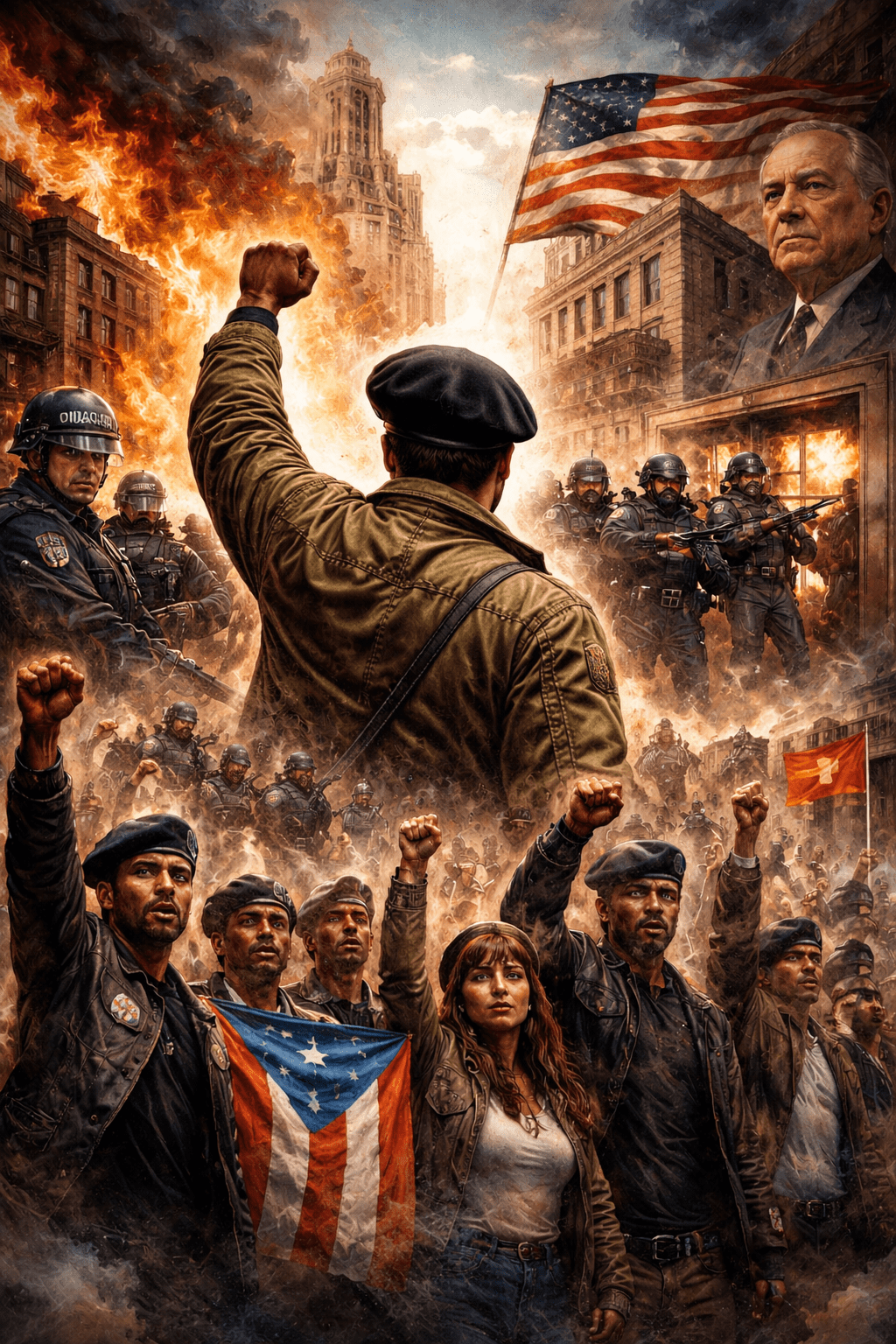
Chicago is shown here not as a northern refuge of progress, but as what it actually was and remains: an internal colony where segregation, poverty, and police occupation shaped Fred Hampton into a revolutionary Marxist with no illusions about the system he was up against. From those conditions came a politics willing to go where liberals never would—into the streets, into the lumpen, into the lives of those written off as disposable—and to build unity precisely where the system survived by keeping people divided. Out of that work emerged the original Rainbow Coalition, not as a celebration of diversity or a plea for inclusion, but as a hard, anti-capitalist, anti-imperialist, anti-police alliance inside the empire itself. And when that solidarity began to look like real power rather than symbolic protest, the state answered in the only way it knows how, turning assassination into an instrument of counterrevolution.
By: Prince Kapone | Weaponized Information
Black History Matters Series | February 6, 2026
Why They Had to Kill Fred Hampton
Fred Hampton is remembered in the United States, when he is remembered at all, as a charismatic young leader who preached unity and paid for it with his life. This version is incomplete by design. It strips his politics of their content and his assassination of its meaning. The purpose of this essay is not to mourn Fred Hampton, nor to place him gently on a shelf of tragic heroes, but to clarify why the state identified him as a threat that had to be eliminated. Hampton was not killed because he spoke eloquently or dreamed of peace. He was killed because he organized power.
In the years since his assassination, Hampton has been steadily de-radicalized. His Marxism is softened into vague calls for fairness. His anti-imperialism is reduced to moral outrage. His revolutionary understanding of the United States as a settler-colonial, capitalist system is replaced with the comforting fiction that he simply wanted America to live up to its ideals. Most grotesquely, the Rainbow Coalition he helped build is retroactively portrayed as an early form of multicultural harmony politics—a benign coalition of identities seeking inclusion rather than a militant alliance confronting the state itself.
This distortion is not accidental. It performs the same political function today that bullets and informants performed in 1969. It neutralizes Hampton by misrepresenting him. Fred Hampton did not believe the system could be reformed into justice. He understood capitalism, racism, and imperialism as a single structure of domination, enforced through police violence at home and military violence abroad. He did not seek representation within that structure; he sought its overthrow. That clarity, paired with his extraordinary capacity to organize across the most oppressed layers of society, made him uniquely dangerous.
Hampton represented a convergence the U.S. state could not tolerate: revolutionary Marxism rooted in Black anti-colonial politics, disciplined mass organizing, and principled alliances with lumpen and working-class formations the system relied on keeping divided and criminalized. His work among street organizations, his rejection of liberal respectability, and his insistence on unity against capitalism and police occupation pointed toward something rare in U.S. history—a real internal threat to settler-capitalist rule, emerging from below.
The question, then, is not whether Fred Hampton was too radical, too militant, or too confrontational. The question is why the state concluded that allowing him to live posed a greater danger than assassinating him in his sleep. To answer that, we must situate Hampton in the material conditions that produced him, trace his political development without dilution, and examine the alliances he forged with the clarity they deserve. Only then does his murder appear not as tragedy, but as counterrevolution.
Chicago as Internal Colony: The Conditions That Produced Hampton
Fred Hampton did not emerge from abstraction or ideology alone. He was formed in a city that functioned as a textbook case of internal colonialism inside the imperial core. Born in 1948 and raised in the Chicago metropolitan area, Hampton came of age in a northern city often mythologized as progressive, but structured in practice by segregation, dispossession, and racialized state violence. Chicago was not an exception to Southern apartheid; it was its modernized extension, redesigned for an industrial and post-industrial economy.
By the time Hampton was a teenager, Chicago’s Black population had been herded into overcrowded neighborhoods through redlining, restrictive covenants, and predatory real estate practices. These communities supplied labor when factories were expanding and were abandoned when deindustrialization set in. Jobs disappeared, schools deteriorated, housing decayed, and unemployment soared. What replaced employment was not opportunity but policing. The state did not withdraw from Black neighborhoods; it changed its function. Social investment gave way to surveillance and force.
In this environment, the police did not operate as neutral enforcers of law. They functioned as an occupying force. Routine harassment, arbitrary stops, raids, and brutality were not responses to crime so much as mechanisms of control. For young Black people, encounters with police were among the most consistent interactions with the state. This reality shaped political consciousness far more powerfully than speeches about democracy. Hampton learned early that the promises of citizenship rang hollow when one’s community was treated as hostile territory.
These conditions were not accidental outcomes of neglect; they were structural necessities of racial capitalism. Chicago’s segregation ensured cheap labor, protected white property values, and maintained political order through spatial containment. When unrest emerged, it was framed as criminal pathology rather than political response. This framing justified repression while obscuring the material causes of anger. Hampton did not need theory to grasp this contradiction. He lived it. His politics grew out of daily confrontation with a system that claimed equality while practicing domination.
Understanding Chicago as an internal colony clarifies why Hampton’s later politics took the shape they did. He did not begin from a belief in gradual reform because his environment offered no evidence that reform reached those at the bottom. He did not view police violence as deviation because it was routine. And he did not imagine unity as a moral appeal because power, as he experienced it, was organized against his community. The city that produced Hampton was a training ground in realism. It taught him that liberation would not come from persuasion alone, but from organized struggle against a system designed to contain him from birth.
From Reformism to Revolution: Hampton’s Break with Liberal Politics
Fred Hampton’s political life did not begin in rejection of reform. Like many young Black organizers of his generation, he first entered politics through channels that promised change without rupture. As a leader in the NAACP Youth Council, Hampton demonstrated extraordinary discipline, clarity, and organizing talent. He built chapters, recruited youth, and led campaigns that exposed segregation and discrimination. Even at this early stage, what set him apart was not rhetoric but capacity. He understood organization as a science—something to be built patiently, methodically, and with mass participation.
Yet Hampton’s experience inside liberal civil rights structures quickly revealed their limits. The contradiction was unavoidable. While campaigns won symbolic victories, the material conditions of Black life in Chicago remained unchanged. Police violence continued. Jobs did not return. Housing stayed segregated. The gap between political language and lived reality widened. Hampton began to recognize that reformism functioned less as a pathway to liberation than as a mechanism for managing dissent. It offered participation without power and recognition without transformation.
This realization pushed Hampton toward a deeper analysis of the system he was confronting. He did not abandon civil rights politics out of impatience or romantic militancy, but because he concluded—correctly—that capitalism, racism, and imperialism operated as a unified structure. Studying Marxism and revolutionary theory gave him the language to articulate what his experience had already taught him: that exploitation was not the result of bad policy alone, but the foundation of the system itself. From this perspective, racism was not a moral flaw that could be legislated away, but a tool used to stabilize class rule and settler domination.
Hampton’s turn toward revolutionary socialism marked a decisive break. He no longer sought inclusion within American democracy, because he no longer accepted its legitimacy as a neutral framework. He identified the United States as a settler-capitalist society that relied on internal colonies, external imperialism, and organized violence to sustain itself. This analysis placed him squarely outside the boundaries of acceptable dissent. It also clarified his strategic horizon. Liberation would not come through appeals to conscience or incremental reform, but through the organized power of the oppressed.
This shift was not abstract or academic. It reoriented Hampton’s entire approach to organizing. Leadership was no longer about representation; it was about building capacity. Politics was no longer about negotiating access; it was about constructing an alternative power base rooted in the most exploited layers of society. By the time Hampton joined the Black Panther Party, he had already outgrown liberalism. What the Panthers provided was not his radicalism, but the organizational vehicle capable of matching his analysis to practice. In this transition—from NAACP reformer to revolutionary Marxist—we see the making of a leader the state would soon identify as intolerable.
Organizing the Lumpen: Why Hampton Went Where Liberals Would Not
Fred Hampton’s most misunderstood and most dangerous contribution to revolutionary politics was his deliberate turn toward organizing those layers of society that liberalism had written off entirely. In Chicago, this meant the lumpenproletariat—street organizations, gangs, and young people surviving at the sharpest edge of segregation, unemployment, and police occupation. Where reformers saw pathology and chaos, Hampton saw social formations produced by material conditions. He understood that these organizations did not emerge from moral failure, but from a society that had withdrawn every legitimate avenue for survival and dignity.
Under conditions of internal colonialism, the lumpen is not an accidental byproduct; it is a structural outcome. Segregation concentrated poverty, deindustrialization destroyed employment, and the state replaced social provision with repression. Street organizations arose to meet needs the system refused to address—protection, identity, income, and belonging. Hampton rejected the liberal impulse to condemn or distance revolutionary politics from these formations. He recognized instead that any movement claiming to represent the oppressed while abandoning the most dispossessed was already defeated.
Hampton approached these organizations as political forces in formation. He met with their leadership, spoke to them without fear or moralism, and treated them as capable of discipline and transformation. His work included negotiating peace truces between rival gangs, reducing internecine violence that only benefited the police and the state. This was not pacifism. It was strategy. By redirecting energy away from self-destruction and toward collective struggle, Hampton exposed the deeper enemy responsible for the conditions they all faced.
Political education was central to this process. Hampton did not ask street organizations to dissolve themselves into respectability. He asked them to understand their position in a broader system of exploitation. Through study, discussion, and joint action, territorial formations were reframed as community-rooted political forces. What had been criminalized as deviance was revealed as potential resistance awaiting direction. This was revolutionary praxis grounded in realism, not romanticism.
This strategy terrified the state because it worked. Hampton was doing what the system relied on being impossible: stabilizing unity among those it governed through fragmentation and fear. NGOs, liberal politicians, and the professional-managerial class could never lead such a process because they depended on distance from the lumpen for their legitimacy. Hampton depended on no such approval. He understood that revolution would not be led by grant-funded organizations or media-friendly spokespeople, but by those whose lives made the system’s violence unmistakable. In organizing the lumpen, Hampton moved the struggle from protest toward power—and crossed a line the state could not allow to remain uncrossed.
The Original Rainbow Coalition: What It Was and What It Was Not
The Rainbow Coalition forged by Fred Hampton was not an exercise in symbolism, tolerance, or electoral arithmetic. It was a material alliance formed under pressure, rooted in shared conditions of exploitation and repression, and aimed squarely at the structures that produced those conditions. Hampton brought together the Illinois Black Panther Party, the Young Lords, and the Young Patriots Organization not because their identities complemented one another, but because their communities were being crushed by the same political economy—capitalist extraction enforced by police power.
Each formation entered the Coalition from a distinct historical position. The Panthers organized within the Black internal colony, confronting hyper-policing, unemployment, and housing apartheid. The Young Lords emerged from Puerto Rican national liberation politics, shaped by colonial domination on the island and racialized displacement in northern cities. The Young Patriots organized poor white Appalachian migrants who had been pushed north into deindustrialized neighborhoods and treated as disposable labor. Hampton did not flatten these differences. He insisted that unity had to be built on honesty about them.
What bound these organizations together was not a belief in American democracy, but a shared antagonism toward the institutions that governed their lives: landlords, bosses, police departments, and the state apparatus that protected property while criminalizing poverty. The Coalition’s program was explicitly anti-capitalist, anti-imperialist, and anti-police violence. It rejected liberal patriotism and the myth that inclusion within existing institutions would deliver liberation. The aim was not representation in a rigged system, but coordinated struggle against it.
This is precisely why later narratives attempt to recode the Rainbow Coalition as an early form of multiculturalism. That retelling drains the alliance of its political content and makes it safe for consumption. Hampton’s Coalition did not ask oppressed groups to celebrate diversity while competing for crumbs. It demanded that they recognize a common enemy and organize accordingly. Unity was not premised on sameness or moral appeal; it was forged through shared material struggle and disciplined coordination.
In this sense, the Rainbow Coalition represented an anti-colonial alliance inside the empire. It confronted the settler-capitalist order by linking struggles that the state worked tirelessly to keep separate. Its power lay not in optics, but in its capacity to stabilize solidarity across racial and national lines without denying the colonial contradiction at the heart of the United States. That capacity—to translate difference into collective power—was what made the Coalition intolerable to the state and indispensable to any serious revolutionary project.
COINTELPRO and the War on Revolutionary Solidarity
The response of the U.S. state to Fred Hampton was neither spontaneous nor improvised. It followed a well-established doctrine of counterinsurgency designed to neutralize revolutionary movements before they could consolidate power. By the late 1960s, the FBI’s COINTELPRO program had already identified the Black Panther Party as a primary internal enemy. What made Hampton especially dangerous was not simply his rhetoric or charisma, but his success in solving one of the state’s most carefully maintained problems: how to keep the oppressed divided.
COINTELPRO’s strategy was explicit. Its internal documents made clear that the goal was to prevent the rise of a unifying Black leader capable of mobilizing the masses. Hampton fit that description precisely. He combined political clarity with organizational discipline and had begun to knit together alliances across Black, Puerto Rican, and poor white communities, while also stabilizing relationships with lumpen formations the state depended on portraying as irredeemable criminals. This convergence threatened to transform fragmented resistance into durable solidarity.
The FBI moved quickly to sabotage these developments. Informants were embedded within the Panthers, most notoriously William O’Neal, who provided detailed intelligence on Hampton’s movements, routines, and political plans. Psychological warfare accompanied infiltration. Forged letters and planted rumors were used to inflame tensions between allied organizations, particularly between Panthers and street groups, in an effort to reignite violence that Hampton had worked to suppress. The aim was not simply to gather information, but to destabilize trust and fracture unity from within.
These efforts reveal the state’s own assessment of the threat. COINTELPRO did not focus its energy on symbolic protest or isolated militancy. It targeted organizers who demonstrated the ability to align theory with mass practice. Hampton’s alliances showed that revolutionary unity across racial and national lines was not only possible, but already emerging. For the state, this was intolerable. A coalition capable of coordinating resistance, defending communities, and articulating a coherent anti-capitalist politics represented a level of internal challenge that could not be managed through surveillance alone.
COINTELPRO was therefore not merely a campaign against individuals, but a war on solidarity itself. Its objective was to preserve fragmentation as a condition of governance. By disrupting Hampton’s work, the state sought to reassert its preferred terrain of politics: isolated grievances, competing identities, and controlled opposition. The intensity of the campaign against him underscores a central truth of revolutionary struggle in the United States: when unity begins to take material form, repression escalates. Hampton’s fate was being sealed not because he spoke radical words, but because he was building structures that could endure.
Assassination as Counterrevolutionary Practice
In the early hours of December 4, 1969, the U.S. state made its position unmistakably clear. Fred Hampton was not killed in a chaotic encounter or an unfortunate mistake. He was executed in a coordinated operation involving the FBI and the Chicago Police Department, carried out with military precision. Hampton was drugged, asleep, and defenseless when police stormed his apartment, firing nearly one hundred rounds. By the end of the raid, Hampton and Mark Clark were dead. This was not policing. It was counterrevolution.
The details matter because the political meaning is embedded in them. Hampton was not arrested. He was not given the opportunity to surrender. He was not treated as a citizen with rights. He was treated as an enemy combatant whose continued existence posed an unacceptable risk. The state did not act in panic; it acted with planning, intelligence, and intent. The informant network, the floor plans, the timing, and the aftermath all point to the same conclusion: Hampton was targeted because his leadership had crossed from potential into reality.
Assassination has a specific function in counterrevolutionary strategy. It is not simply about removing an individual, but about breaking the momentum of organization. Hampton had begun to solve problems the state depends on remaining unresolved: unity across oppressed groups, discipline among the most criminalized populations, and a clear articulation of capitalism and imperialism as the enemy. His leadership threatened to stabilize alliances that could not be easily dismantled once consolidated. Killing him was meant to decapitate that process before it matured further.
The immediate response of authorities revealed their confidence in impunity. Police described the raid as a “shootout,” despite overwhelming evidence that nearly all gunfire came from law enforcement. The media largely reproduced this narrative, and legal accountability was delayed and diluted. This pattern was not incidental. It reinforced a broader lesson: when the state kills revolutionaries, it relies on its control over institutions, courts, and media to sanitize the act after the fact. Violence is followed by narrative management.
Hampton’s assassination marks a critical moment in U.S. political history. It demonstrated that when revolutionary organizing begins to align theory, mass base, and disciplined unity, the state abandons any pretense of neutrality. The killing of Hampton was not an aberration, but a signal—a warning to anyone who believed that radical politics could advance beyond protest without triggering lethal repression. In this sense, his death stands as a grim confirmation of his own analysis: that the state responds to organized power not with dialogue, but with force.
Liberal Memory and the Continuation of COINTELPRO by Other Means
The assassination of Fred Hampton did not end the state’s campaign against him. It merely shifted terrain. When bullets could no longer silence him, narrative would. In the decades since his death, Hampton has been steadily recoded into something safer: a gifted speaker, a bridge-builder, a symbol of unity without antagonism. This process is not accidental nostalgia; it is political work. It performs the same function as COINTELPRO once did—neutralization—only now through culture, education, and memory rather than raids and informants.
What is consistently erased in these liberal retellings is Hampton’s Marxism and his clarity about empire. He is remembered as a man who brought people together, but not as a revolutionary who named capitalism, imperialism, and settler colonialism as the enemy. The Rainbow Coalition is celebrated as diversity before its time, while its anti-capitalist program, its rejection of liberal patriotism, and its confrontation with police power are quietly omitted. Unity is praised; purpose is removed. The result is a Hampton who can be admired without being followed.
This sanitization mirrors the logic of counterinsurgency. COINTELPRO sought to fracture movements by isolating leaders from their base and from one another. Liberal memory achieves a similar effect by isolating Hampton’s image from his politics. By presenting him as a moral figure rather than a strategic organizer, the state and its allied institutions ensure that his example does not threaten existing arrangements. People are encouraged to quote him, not to organize as he did.
The distortion is especially pronounced in discussions of the Rainbow Coalition. Stripped of its anti-imperialist content, it becomes a template for coalition politics without struggle—a vision of cooperation that asks nothing of power and demands no rupture with the system. This inversion serves contemporary governance well. It allows institutions to celebrate Hampton while pursuing the very policies—police expansion, economic dispossession, imperial war—that he spent his life opposing.
To understand this process as a continuation of COINTELPRO is not rhetorical excess. It recognizes that repression evolves. When movements are too dangerous to tolerate, they are destroyed. When their memory becomes unavoidable, it is managed. The lesson of Hampton’s afterlife is clear: revolutionary figures are either buried or embalmed. The task of those who claim to honor him is to refuse both—to insist on a memory that retains its edge, its clarity, and its capacity to organize against the structures he identified as illegitimate.
What Fred Hampton Still Demands
Fred Hampton does not belong to the past. He belongs to an unresolved struggle that continues to shape the present. The clarity of his politics and the severity of the state’s response to him leave behind demands that cannot be satisfied by remembrance alone. Hampton’s life insists on a reckoning with how revolutionary unity is built, who it must include, and what it must be willing to confront. His example makes clear that solidarity is not an aesthetic choice or a moral posture, but a strategic necessity forged in shared struggle against a common enemy.
One of Hampton’s most enduring lessons is that unity must be rooted in material conditions, not symbolic inclusion. The alliances he built were not based on polite dialogue or abstract tolerance, but on the lived realities of exploitation, police violence, and dispossession. He demonstrated that lumpen and working-class formations, when organized and politicized, are not liabilities but essential forces under colonial conditions. Movements that abandon these layers in favor of respectability or institutional access repeat the mistakes Hampton worked tirelessly to overcome.
Hampton also leaves a clear warning about the nature of the state. The same system that claims to safeguard democracy will resort to assassination when its foundations are threatened. This is not a failure of oversight or a temporary excess; it is a structural response to organized power. Understanding this reality does not mean retreating into despair. It means organizing with seriousness, discipline, and an awareness of the risks involved. Hampton’s life reminds us that repression escalates when movements begin to solve the problem of unity.
Finally, Hampton demands honesty. To honor him is not to soften his politics or translate his legacy into language acceptable to power. It is to engage the same questions he confronted without compromise: how to dismantle capitalism, how to oppose imperialism, how to confront settler colonialism, and how to build revolutionary solidarity among those the system works hardest to divide. His assassination was meant to halt that project. Its failure lies in the fact that the project remains necessary.
Fred Hampton’s life and death leave us with a responsibility rather than a monument. The task is not to repeat his words, but to reproduce his clarity; not to mimic his style, but to extend his strategy. He showed that revolutionary politics in the United States must be rooted in the most oppressed, disciplined in organization, and uncompromising in its analysis of power. What he still demands is simple and unforgiving: organize or be organized against.
 Weaponized Information
Leave a comment