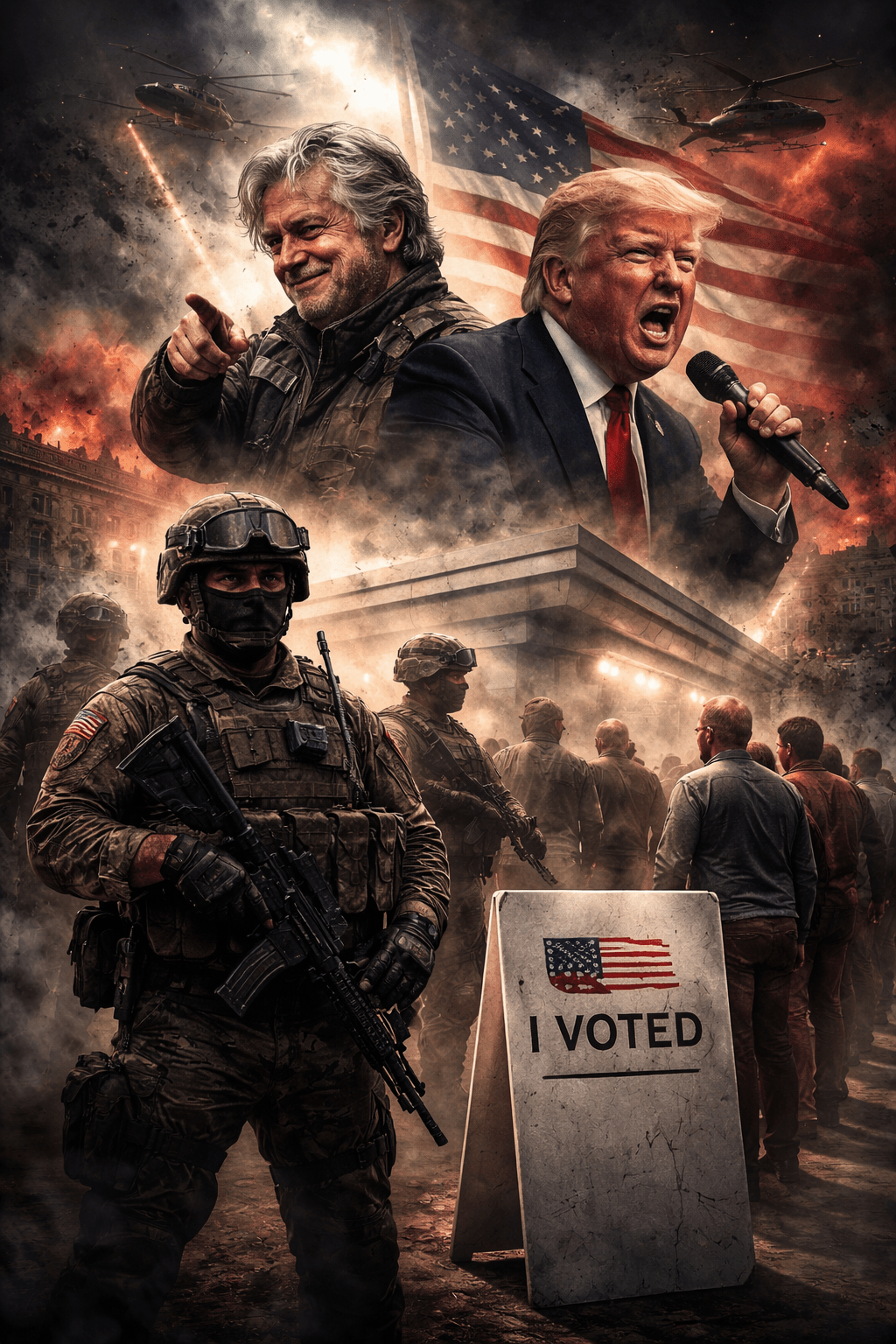
A media spectacle reframes intimidation as mere rhetoric. Administrative power is already reorganizing elections from above. Imperial crisis turns participation into a security problem. Political space is defended only through organization from below.
By: Prince Kapone | Weaponized Information | February 6, 2026
How the Press Turns a Threat Into “Just Talk”
The article under excavation, Jacob Wendler’s “Steve Bannon calls for Trump to deploy ICE and military troops to polling sites”, reports on a series of public statements in which Steve Bannon endorses Donald Trump’s call to “nationalize” U.S. elections and urges the deployment of federal enforcement forces — first Immigration and Customs Enforcement, then the U.S. military — at polling locations. The piece situates these remarks within the immediate political reaction they provoked, noting Democratic outrage, Republican hesitation, and legal prohibitions that would ostensibly block such actions. Framed as a news account of provocative rhetoric meeting institutional resistance, the article presents the episode as a clash between inflammatory speech and the stabilizing constraints of constitutional order.
The story’s first trick is to shrink the problem into a personality. Bannon is introduced as a “firebrand,” a “commentator,” a podcast voice — a loud man at a lectern, a familiar villain with a familiar grin. This casting matters. If the threat is presented as one man’s frenzy, then the deeper question — what kind of political order makes such talk thinkable, useful, repeatable — can be postponed. The narrative becomes a weather report about a stormy character rather than an assessment of a shifting climate. You can disagree with Bannon, mock him, and move on. That’s the containment.
From there, the article constructs a second, even more important divide: the separation of rhetoric from reality. Nearly every move is phrased as an utterance — “said,” “called for,” “floated,” “threatened,” “reiterated.” The world is rendered as quotation marks. This grammatical choice is not neutral. It subtly trains the reader to treat the content as performative agitation rather than as a message addressed to institutions, agencies, and disciplined followers. The story doesn’t have to deny danger; it only has to keep danger suspended in the air, like smoke that never becomes fire.
Then comes the soothing chorus: the law. The piece foregrounds prohibitions and constitutional structure as if they were physical barriers, not political terrain. It repeats that something is “prohibited,” that the Constitution grants states jurisdiction, that deploying troops at elections is barred — all true within the text’s own frame, and yet deployed here as reassurance. The effect is a kind of legal lullaby. If a thing is illegal, the reader is encouraged to assume it is therefore unlikely. The article’s tone implies that illegality itself is the endpoint of analysis, rather than the beginning of the question: what happens when powerful actors speak past the law, not because they misunderstand it, but because they are testing what can be normalized in public?
Another device follows neatly: stability by elite reaction. We are given condemnations from Democrats and reluctance from Republican leadership, offered as proof that the system still functions. The narrative arc is almost therapeutic: provocation, outrage, institutional shrug, return to order. Even the inclusion of internal voices downplaying the prospect works like a sedative — a promise that responsible adults are in the room. The reader is pushed toward spectator politics, watching elites argue over the edges of the permissible, rather than toward the recognition that intimidation is not an opinion, but a practice with a target.
Most revealing is how the story narrows what an election is. In this telling, elections are a technical procedure administered by states, monitored by laws, and debated by leaders. The people appear mainly as abstractions — “voters,” “noncitizens,” “Democrats,” “Republicans” — not as communities with histories, vulnerabilities, and memories of being “managed” at the point of contact with authority. The article does not need to say “intimidation works” for intimidation to work; it only needs to describe intimidation in a voice that treats it as a controversy among officials. That is the quiet craft of normalization: to present coercive imagination as a talking-point skirmish.
The end result is a piece that looks like a warning while functioning like a pressure release valve. It tells you something unsettling has been said, then escorts you back to the familiar rooms of legal commentary and elite reaction. The reader is left with the sense that the danger is real but distant — a possible future problem, not a present political signal. And that is precisely the political utility of this genre: it converts a program of intimidation into a headline-sized drama, while keeping the deeper question offstage — not whether the talk is outrageous, but why it is being said now, with such confidence, and to whom it is really addressed.
When “Election Integrity” Becomes an Administrative Weapon
Stripped of its narrative cushioning, the episode reported by Politico sits on top of a dense and already-moving field of concrete actions. What appears in the article as an eruption of dangerous rhetoric is, in fact, surrounded by ongoing legal, administrative, and organizational maneuvers that point in the same direction. The call to “nationalize voting,” the suggestion of ICE at polling sites, and the invocation of military force do not arrive in a vacuum; they arrive amid a systematic effort to pull election administration upward into the federal executive and to redefine participation itself as a matter of enforcement.
At the most visible level, the Trump administration has moved aggressively through the courts. The Department of Justice has filed lawsuits against 23 states, demanding access to statewide voter registration rolls and related election records that states have historically controlled. These suits are not symbolic. They seek names, birth dates, residential addresses, driver’s license numbers, and partial Social Security numbers, framed by the Justice Department as necessary for “election integrity” and “accurate voter rolls”, but carrying obvious implications for privacy invasion and downstream use in enforcement and investigative pipelines. The article mentions this litigation in passing, but never treats it as part of a strategy; it is presented instead as another dispute in the long-running procedural quarrel between states and Washington.
Alongside litigation, executive action has been used to test administrative workarounds. Trump’s election-related executive orders have attempted to impose citizenship verification requirements by routing them through federal agencies rather than state legislatures. Federal courts have blocked key provisions, but the pattern matters more than the outcome. These efforts reveal a governing approach that treats elections not as a settled constitutional domain, but as a system that can be reshaped incrementally through bureaucratic pressure, agency rulemaking, and selective enforcement. The law is encountered not as a boundary, but as a surface to be pushed against repeatedly.
Congress, too, is part of this terrain. Legislative proposals such as the SAVE Act formalize the same logic in statutory form: voting rights are redefined around documentary proof, citizenship is transformed into a gatekeeping mechanism, and administrative burden becomes a filter. Whether or not such bills pass in their current form, they establish a policy vocabulary that links participation to compliance and treats exclusion as a neutral byproduct of “standards.” The article’s focus on Bannon’s speech leaves this quieter, more durable infrastructure in the background.
Beyond formal government, a parallel legal and ideological apparatus has been at work. Organizations aligned with Trump-world, such as America First Legal, have pursued rulemaking petitions before the Election Assistance Commission, seeking to impose proof-of-citizenship requirements on the federal voter registration form itself. This is not cable-news theatrics; it is an attempt to nationalize exclusion through administrative process. The campaign has generated hundreds of thousands of public comments and sustained pressure on a little-known federal body whose decisions can quietly reshape access nationwide.
All of this unfolds under the shadow of a coherent programmatic vision articulated elsewhere. The policy blueprint known as Project 2025, produced by the Heritage Foundation and allied networks, outlines a reorientation of the Department of Justice toward aggressive “election crime” prosecution and expanded federal enforcement authority. In that document, voter fraud is treated not as a marginal concern, but as a central justification for restructuring enforcement priorities. When read alongside DOJ lawsuits, executive orders, and EAC petitions, the document functions less as speculation than as a guidebook.
The ideological layer is no less important. Figures from the tech–finance elite orbiting Trump have openly questioned the compatibility of mass democracy with what they define as freedom. This is explicit in Peter Thiel’s own writing. This hostility to popular participation is not rhetorical excess; it aligns neatly with a governance model that prefers data-driven administration, verification regimes, and managerial control over unpredictable collective decision-making. When election administration is reframed as a problem of compliance and security, this worldview finds practical expression.
Even the White House’s own messaging reinforces the pattern. When asked about deploying ICE at polling sites, officials have responded with carefully calibrated ambiguity: no formal plans, but no categorical rejection. This posture keeps intimidation in a state of suspended possibility, a dynamic political communication research describes as strategic ambiguity. It signals to supporters that enforcement is thinkable, to opponents that resistance may be costly, and to the broader public that the boundaries of the permissible are shifting—precisely the kind of chilling effect election researchers and monitors have long warned can follow from the threat or presence of law enforcement at or near polling places. The article reports this ambiguity without naming its function.
Taken together, these facts collapse the comforting distinction between “talk” and “action.” Litigation, executive maneuvering, legislation, rulemaking, policy blueprints, and elite ideology all point toward the same conclusion: what is being proposed rhetorically has already been prepared administratively. The danger, then, is not that the law might suddenly be broken, but that it is being patiently reorganized so that exclusion and intimidation can be presented, when the moment arrives, as ordinary governance.
Empire Governs Best When Consent Wears Thin
Once the scaffolding of facts is in place, the meaning of the moment sharpens. What appears, on the surface, as a controversy over election administration is better understood as a symptom of a deeper political condition: a governing order that no longer trusts consent to reproduce itself. The push to centralize elections, to surround participation with verification, enforcement, and the implied presence of force, is not a deviation from democratic practice so much as a reversion to older habits of rule that emerge when legitimacy frays.
Historically, elections have never been neutral rituals. They have always been calibrated instruments, expanded when participation stabilized the system and narrowed when it threatened to disrupt it. When large sections of the population become unpredictable — economically insecure, politically alienated, or increasingly skeptical of elite authority — ruling institutions respond by tightening the channels through which power is formally expressed. The language changes, but the impulse is consistent: control the conditions of participation, and you control the outcome without having to abolish the form.
What distinguishes the present phase is the method. Instead of dramatic suspensions of law, the contemporary approach works through administration. Lawsuits compel data. Executive orders probe jurisdictional seams. Rulemaking petitions target obscure commissions. Legislative proposals normalize documentation hurdles. Each step appears modest in isolation, even technical. Together, they assemble a machinery capable of sorting populations with remarkable efficiency. Voting becomes less a collective act of decision and more a compliance process — one that can be slowed, challenged, or denied without ever announcing an emergency.
This shift coincides with a broader transformation in how power understands itself. The governing imagination no longer treats popular participation as the source of stability, but as a variable to be managed. In this framework, uncertainty is the enemy. Data promises predictability; verification promises order; enforcement promises discipline. The more governance is mediated through information systems and legal processes, the easier it becomes to justify exclusion as mere error correction rather than as political choice. What disappears is the idea that mass participation has intrinsic value.
From an imperial vantage point, this turn inward is unsurprising. As global dominance weakens and the old assurances of prosperity erode, the center begins to resemble the periphery it once managed from afar. Techniques long used against colonized populations — documentation regimes, surveillance, selective enforcement, and the quiet threat of force — migrate homeward. Elections remain, but they are hollowed of their promise, transformed into checkpoints rather than forums. The rhetoric of democracy persists even as its substance is rationed.
The class content of this transformation is unmistakable. Elite sectors whose wealth and power depend on insulation from popular pressure increasingly view mass democracy as an obstacle rather than a foundation. Their preference is not chaos, but control — governance by procedure, data, and managed consent. In this vision, political participation is acceptable only insofar as it is predictable and containable. Anything else is framed as risk, disorder, or fraud. The language is sanitized; the effect is exclusionary.
For the global working class and the peasantry, this pattern is familiar. Across the world, elections have often been preserved in form while being stripped of their capacity to challenge entrenched power. What makes the present moment notable is not the existence of such practices, but their consolidation within the imperial core itself. The methods once justified as necessary for governing “unstable” societies are now redeployed against domestic populations deemed unreliable. The circle closes.
Seen from this angle, the calls for ICE or troops at polling sites are less important than what makes them intelligible. They signal a governing order preparing for politics without trust. The real story is not about whether such deployments occur tomorrow, but about the kind of future being assembled: one in which participation is conditional, dissent is administratively inconvenient, and democracy survives primarily as a vocabulary. The task of analysis is to name this trajectory clearly, before it is fully normalized as common sense.
Defending Political Space When Power Turns Inward
If the analysis so far has done its job, then the question that follows is not whether existing institutions will restrain themselves, but how people organize when those institutions begin to treat participation as a problem to be managed. The tightening of elections through law, data, and enforcement is not aimed at abstract principles; it is aimed at concrete communities whose political presence has become inconvenient. Any meaningful response must therefore begin from the ground up, rooted in those already confronting the edge of this consolidation.
Across the United States, migrant justice organizations have long understood elections as one front in a wider system of policing and exclusion. Groups fighting deportation raids, surveillance, and document-based harassment recognize immediately what it means when ICE is even rhetorically associated with polling places. Their experience is not theoretical. It is lived knowledge of how “verification” functions in practice: as fear, withdrawal, and silence. Linking electoral defense to migrant defense is not an act of charity; it is a recognition of shared terrain.
Grassroots election protection efforts, often dismissed as auxiliary or nonpartisan, already contain the seeds of a different approach. When rooted in neighborhoods rather than party headquarters, these efforts become more than monitors of procedure. They become collective assertions that public space belongs to the people who live in it, not to roaming enforcement agencies or distant administrators. Strengthening these formations means treating them as sites of political education and solidarity, not just technical safeguards.
Labor and community organizations, especially those already resisting workplace surveillance, algorithmic management, and bureaucratic discipline, have a clear stake in this struggle. The same logic that reduces workers to data points reduces voters to entries in a database. Connecting electoral repression to everyday experiences of managerial control allows people to see the pattern not as an isolated crisis, but as part of a broader restructuring of power. Democracy erodes not only at the ballot box, but wherever collective voice is replaced by compliance metrics.
Internationally, movements in the Global South have long confronted elections conducted under the shadow of coercion, documentation regimes, and foreign-backed “integrity” campaigns. Their lessons are neither cynical nor dismissive. They show how people defend political space even when formal democracy is constrained — through popular organization, parallel institutions, and sustained pressure outside official channels. Building solidarity with these movements is not symbolic. It is an exchange of hard-earned knowledge about how power behaves when it fears the many.
The task, then, is not to romanticize elections nor to abandon them. It is to refuse the narrowing of politics to a managed procedure. That means defending polling places as public space, exposing administrative intimidation wherever it appears, and insisting that participation is a collective right rather than a privilege to be earned through paperwork and compliance. It also means recognizing that electoral struggle cannot be separated from struggles against policing, deportation, and surveillance; they are expressions of the same governing impulse.
The consolidation now underway thrives on fragmentation — voters here, migrants there, workers somewhere else, each addressed as a separate “issue.” The counter-move is alignment. When people recognize that the defense of political space is inseparable from the defense of social life itself, the logic of intimidation begins to falter. The goal is not merely to protect a vote in November, but to expand the terrain on which collective power can be exercised. In that expansion lies the possibility of a politics that does not depend on permission from above.
 Weaponized Information
Leave a comment