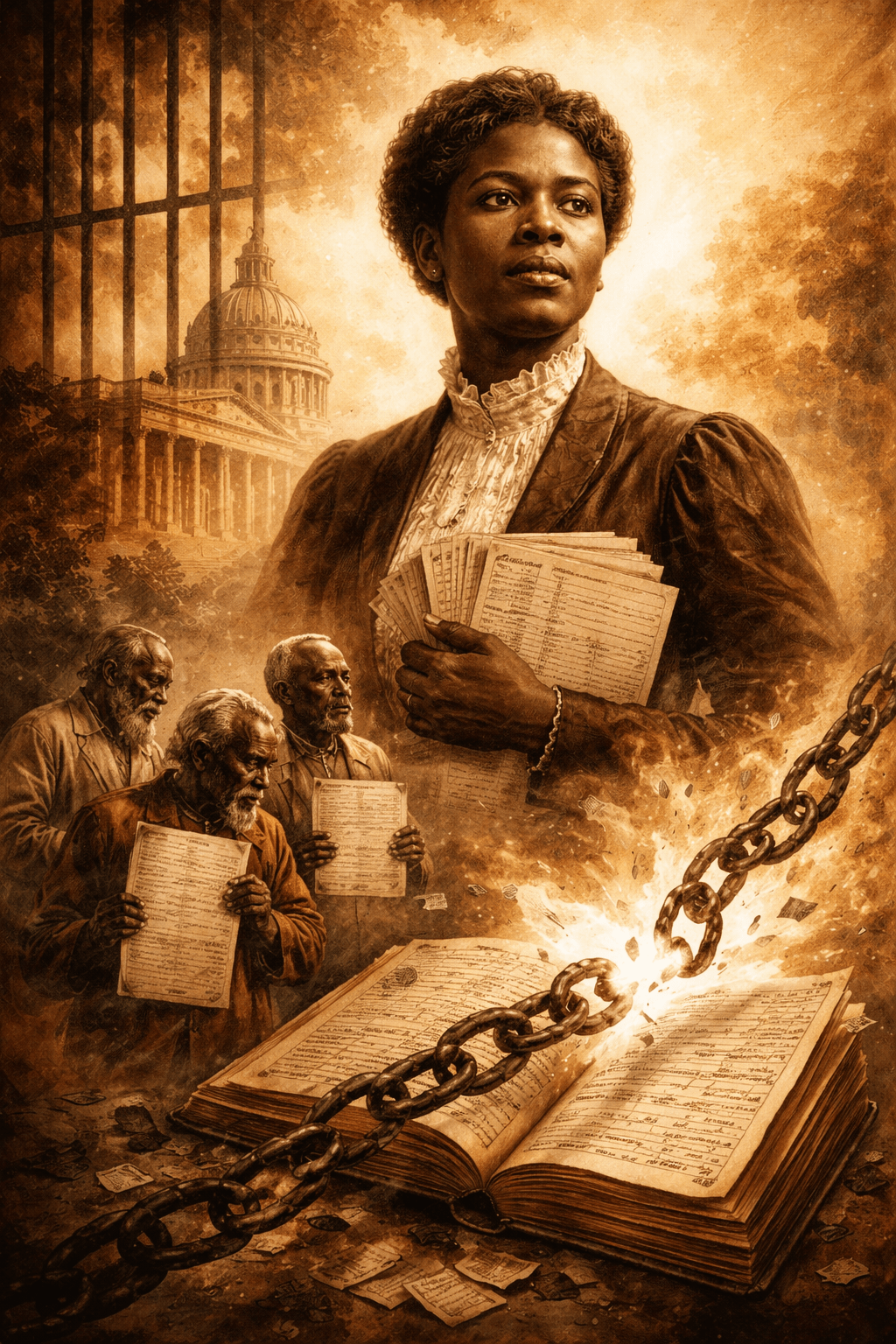
A formerly enslaved woman who helped turn memory of bondage into a national economic claim. Her movement proved reparations was a working-class demand for stolen labor, not a plea for charity. The federal government criminalized her because compensation threatened the racial economic order. Her legacy links Black liberation to the broader struggle over wealth, power, and justice.
Prince Kapone | Weaponized Information | Black History Matters Series | February 3, 2026
Reparations Was Never a Whisper: Callie House and the Debt the Empire Refused to Pay
The United States likes to treat reparations as a modern controversy—something invented by academics, politicians, or social media. That story is convenient, because it hides a more dangerous truth: the demand for reparations rose from the very ground of emancipation, raised not by elites but by the people who had been worked, whipped, bought, sold, and then “freed” with empty hands. Long before today’s commissions and debates, formerly enslaved Black people organized themselves into a mass movement to demand what was owed. And at the center of that movement stood Callie House—a working-class Black woman born into slavery who helped build one of the largest grassroots political organizations of ex-slaves in U.S. history.
To remember House properly, we have to stop treating her like a curiosity and start recognizing her as a political threat—because that is how the state treated her. She was not asking for sympathy. She was not making a moral appeal to the “better angels” of the American ruling class. She was organizing a claim. A debt. A bill. Reparations, in House’s hands, was not charity. It was class justice: compensation for stolen labor, and the economic basis for real freedom. That is why her movement matters. It exposes the lie at the heart of U.S. liberal mythology—that emancipation was the end of the story. For the freedpeople, emancipation was the beginning of a new struggle: how to live when the plantation had been renamed but the economy still demanded Black poverty as the price of white wealth.
Callie House helped found the National Ex-Slave Mutual Relief, Bounty and Pension Association in the late 1890s, a national organization that rallied ex-slaves behind a program of federal pensions and reparative compensation. Through dues, petitions, and an organizing network that stretched across states, the association turned elderly freedpeople—many of them impoverished, many of them ignored by the nation that had profited from their lives—into a coordinated political constituency. This was not symbolic politics. This was mass organization built from the bottom. The very fact that the movement relied heavily on mail networks and petitions is itself telling: the people who were denied property, denied protection, denied schools, denied safety, still found a way to assemble themselves into a national force.
And here is the core contradiction that makes House so important for Weaponized Information: the United States could build railroads, fund banks, subsidize industry, and finance war—yet it treated compensation for centuries of unpaid Black labor as unthinkable. Not because the money did not exist, but because paying the debt would admit the crime. And admitting the crime would open the door to something the ruling class fears more than protest: redistribution, political leverage, and Black self-determination anchored in material power. House understood what every serious revolutionary eventually learns: freedom without an economic base is a word used to decorate dependency.
This essay is not a sentimental tribute. It is a historical-materialist study of a suppressed mass movement and the woman who helped lead it. The thesis is straightforward: Callie House proved that reparations was a mass demand rooted in the lived experience of the freedpeople, and the federal government criminalized her because a successful reparations movement would have threatened the entire post-slavery racial economy—an economy rebuilt to keep Black labor cheap, Black communities dependent, and the wealth of slavery safely converted into “legitimate” American capital. The story of House is therefore not only Black history. It is a lesson about how the state responds when the oppressed organize to collect what they are owed.
Freedom Without Land, Wages, or Protection Is Just a Change of Management
When slavery formally ended in 1865, the United States congratulated itself on a moral victory. Chains were removed, auctions ended, and the language of liberty filled the air. But history is not written in proclamations; it is written in property relations. Four million formerly enslaved people stepped into “freedom” with no land, no compensation for lifetimes of stolen labor, and no protection from the very class that had just lost its legal ownership over them. The plantation system did not disappear—it rebranded. The whip was replaced with contracts, the auction block with debt, and the slave patrol with the sheriff.
Sharecropping and tenant farming spread across the South as the dominant labor systems of the postwar era. On paper, these arrangements looked like partnership. In practice, they functioned as a trap. Black families worked land they did not own, bought supplies on credit at inflated prices, and settled accounts with landlords who controlled the books. Year after year, debts rolled forward, ensuring that “free labor” remained tied to the soil in conditions eerily similar to bondage. Convict leasing added another layer, criminalizing Black life through vagrancy laws and then selling prisoners’ labor to private industry. The state that had once enforced slavery now enforced its afterlife.
Politically, Reconstruction briefly opened space for Black participation, but that window closed violently. White supremacist terror campaigns, lynching, voter suppression, and federal retreat ensured that Black political power would be strangled before it could consolidate. By the late nineteenth century, Jim Crow segregation was law, and the promise of citizenship had been hollowed out. Black communities were expected to survive economically in systems designed to exploit them, while being excluded from the levers of policy that shaped those systems. The message was clear: you are free to work, free to struggle, free to starve—but not free to control the conditions of your existence.
It was in this world that the demand for reparations took shape. Formerly enslaved people did not need a philosopher to tell them something was wrong with the equation. They had labored for generations without wages, built wealth they would never see, and then been released into poverty while their former masters kept the land, the tools, and the profits. Reparations, in this context, was not an abstract theory. It was a logical demand rooted in lived arithmetic: if wealth had been created through stolen labor, then justice required repayment. Without that repayment, “freedom” meant competing at the bottom of an economy built on your own dispossession.
This is the terrain that produced Callie House’s movement. Reparations was not a luxury idea dreamed up in comfortable rooms. It was a survival strategy born from the recognition that legal emancipation had left the economic structure of racial domination largely intact. The freedpeople understood a truth that polite society preferred to ignore: without land, without capital, and without compensation, Black freedom would remain conditional and fragile. Callie House would take that understanding and help turn it into organized political demand—one that named the debt directly and refused to let history’s balance sheet be buried.
From Enslaved Girl to Political Organizer: When Survival Turned into Strategy
Callie House did not enter politics through lecture halls or party meetings. She entered through life itself—through the memory of bondage and the hard arithmetic of post-emancipation survival. Born into slavery in Tennessee in the early 1860s, she grew up in a world where Black labor created wealth that others claimed, and where Black suffering was treated as the natural order of things. Emancipation changed her legal status, but it did not change the economic structure that shaped her life. Like millions of freedpeople, she moved through a landscape where freedom existed on paper while poverty, exclusion, and racial violence governed daily reality.
What is remarkable is not that House endured these conditions. It is that she refused to treat them as inevitable. In the decades after the Civil War, Black communities built mutual aid networks, churches, fraternal organizations, and informal support systems to compensate for a hostile state. These were not simply charitable institutions; they were schools of political thought. They taught that survival depended on collective action, and that collective action required organization. House emerged from this environment of grassroots self-help, where the line between caring for one’s neighbor and challenging the social order was thin.
As a working-class Black woman in the post-Reconstruction South, House stood at the intersection of race, class, and gender exploitation. Domestic labor, agricultural work, and low-wage service positions offered little security and even less respect. Yet these positions also placed women like House in the heart of community life. They saw who was struggling, who was hungry, who was aging without support after a lifetime of forced labor. Political awareness grew not from theory alone, but from watching elders who had survived slavery sink into poverty while the nation that had used their bodies spoke of progress.
House’s political development reflects a broader historical pattern: formerly enslaved Black women were not just participants in freedom struggles, but architects of them. They carried the memory of enslavement in their own lives and families, and they understood that freedom without material security was a fragile promise. House did not need to be told that something was owed. She had lived the evidence. When she stepped into organizing, she did so not as an abstract reformer but as someone who recognized that justice required structure—dues, meetings, petitions, and coordinated action across communities.
This is what makes Callie House a figure of such political importance. She represents the moment when lived experience hardened into strategy. The suffering of slavery and the betrayal of Reconstruction did not produce resignation; in her case, they produced organization. She helped transform private memory into public demand, and individual grievance into collective claim. From that transformation would emerge one of the earliest mass movements for reparations in U.S. history—a movement built not by elites, but by those who had survived the very system they now sought to hold accountable.
From Emancipation to Compensation: Making Freedom Material
The demand Callie House helped organize was radical not because it was emotional, but because it was precise. Formerly enslaved people were not simply asking for recognition of suffering. They were making a claim grounded in labor, law, and political economy. Enslaved Africans and their descendants had produced enormous wealth for the United States through generations of uncompensated labor. Cotton, tobacco, rice, sugar, and other commodities grown by enslaved workers fueled national and international markets. The profits enriched plantation owners, merchants, insurers, banks, and the federal government itself through taxes and tariffs. Emancipation ended legal slavery, but it did not address the transfer of wealth that slavery had made possible.
House’s movement argued that emancipation without compensation left freedpeople in a condition of formal liberty but material dispossession. Unlike formerly enslaved people, slaveholders had often received compensation when slavery was abolished in other parts of the world. In the United States, the enslaved received nothing: no land, no pensions, no wages owed for decades of forced labor. House and her comrades reframed this absence as a legal and economic contradiction. If labor creates value, and if that labor was stolen, then a debt exists. The demand for pensions and reparations was therefore not charity; it was a claim for unpaid wages accumulated over lifetimes of forced work.
The pension model the movement proposed reflected this logic. Rather than vague promises of uplift, they advocated direct financial payments to formerly enslaved people, structured as government pensions. The federal government, which had enforced slavery through law and benefited from the economy it sustained, was identified as the debtor. House’s organization even identified potential funding sources, including taxes on industries and individuals whose fortunes had been built on slavery. This was a program rooted in redistribution, not moral persuasion alone. It treated slavery as an economic crime with calculable consequences.
This argument also had a constitutional dimension. The federal government had once recognized property claims of slaveholders; it had upheld contracts, protected slave patrols, and enforced fugitive slave laws. House’s movement turned that logic back on the state. If the law had once defended ownership of human beings, then justice demanded that the same system acknowledge the harm done to those who had been treated as property. The legal system could not simply wash its hands after emancipation. It had been an active participant in the system that generated the debt.
By grounding their demand in labor value, legal responsibility, and state obligation, House and her comrades moved the struggle beyond moral appeal into the terrain of political economy. They exposed a foundational contradiction: a nation that claimed to stand for freedom had built its wealth through forced labor and then refused to compensate those who had produced it. Reparations, in this framework, was not an act of generosity but an act of accounting. It was an attempt to settle an unpaid balance sheet that emancipation had left open.
This clarity is precisely why the movement became threatening. A moral complaint can be acknowledged and ignored. A financial claim implies redistribution. House’s organizing forced the country to confront not just the memory of slavery, but the material inheritance of it. By tying freedom to economic repair, she and her comrades transformed emancipation from a symbolic event into an unfinished economic question—one that remains unresolved to this day.
If the Debt Were Paid, the System Would Have to Admit the Theft
The demand led by Callie House was treated as radical not because it was illogical, but because it was too logical. If formerly enslaved people were owed compensation for generations of stolen labor, then the wealth of the United States had to be reexamined from the ground up. Plantations, banks, railroads, insurance firms, and industrial fortunes had all grown fat on the unpaid work of Black bodies. Reparations would not have been a side payment at the edge of the system. It would have been an audit of the system itself.
House and her comrades understood something the ruling class desperately wanted to keep buried: emancipation had transferred the legal status of Black people without transferring the wealth they had created. Land remained in the hands of former enslavers. Capital accumulated through slavery was laundered into respectable enterprise. The nation moved forward proclaiming freedom while carrying forward the profits of bondage. A successful reparations movement would have cracked that illusion. It would have forced the United States to acknowledge that its prosperity was not merely the result of hard work and innovation, but of organized theft sanctified by law.
Economically, the implications were explosive. Compensation on a meaningful scale would have provided Black communities with resources for land ownership, business development, education, and independent institutions. In other words, it would have created a material base for self-determination. That shift would have weakened the racial labor hierarchy that kept Black workers cheap and politically vulnerable. A population with economic leverage negotiates differently than a population forced to accept whatever terms are offered. Reparations threatened to move Black people from permanent dependency toward collective power.
Politically, payment would have meant recognition. The state would have had to admit that slavery was not a regrettable episode but a foundational crime with ongoing consequences. Such an admission would have strengthened other claims for justice, from voting rights to labor protections to land redistribution. It would have established a precedent that historical exploitation creates present obligations. For a ruling class invested in portraying inequality as natural or accidental, that precedent was intolerable.
This is why Callie House’s movement could not be safely ignored. It did not ask for inclusion into an unjust order; it demanded a restructuring of the economic relationship between Black people and the state. It named a debt and organized thousands around collecting it. In doing so, it revealed that reparations was not a sentimental appeal but a structural threat. Paying the debt would have meant admitting the theft, and admitting the theft would have shaken the moral and material foundations of American capitalism.
Criminalizing a Claim: How the State Turned Reparations into a “Crime”
When a movement becomes too clear, the state stops pretending not to see it. The growth of Callie House’s organization drew the attention of federal authorities who understood exactly what was at stake. Hundreds of thousands of formerly enslaved people were being organized around a financial claim against the U.S. government. That was not merely activism—it was a political force with economic implications. Rather than confront the demand openly, the government chose a familiar method: redefine the movement as criminal.
The primary weapon used against House and the association was the federal mail system. Because the organization relied on letters, pamphlets, dues collection, and petitions sent through the post, authorities targeted it through mail fraud charges. Officials claimed that House and her colleagues were misleading members by suggesting pensions were imminent or guaranteed. But the deeper issue was not miscommunication. It was mobilization. The mail network had allowed poor, elderly Black people across vast distances to function as a coordinated constituency. That infrastructure had to be disrupted.
House was eventually arrested, prosecuted, and imprisoned on mail fraud charges in the early twentieth century. The legal case presented her as a schemer preying on the hopes of the vulnerable. In reality, the state was suppressing one of the first mass Black movements demanding material repair from the federal government. The punishment served two purposes: it dismantled the organization’s operational center and sent a warning to others who might try to organize similar claims. The message was unmistakable—economic demands by the formerly enslaved would be treated as threats to national order.
This pattern would repeat throughout the twentieth century. When Black movements built independent economic or political structures, the state responded with surveillance, prosecution, infiltration, and legal harassment. What happened to Callie House stands as an early example of that counterinsurgency logic. The government did not fear fraud in the abstract; fraud was common in the corporate and political worlds it protected. What it feared was a mass of Black working people organized around a demand that exposed the unpaid bill at the heart of the nation’s wealth.
House’s imprisonment did not erase the truth she had helped make visible. It confirmed it. The state’s response revealed that reparations was not a symbolic issue but a structural one. If the demand had been harmless, it would have been ignored. Instead, it was criminalized. In that repression lies one of the clearest proofs of the movement’s significance: Callie House and her comrades had moved from memory to organized claim, and the system answered them not with debate, but with a prison sentence.
From Stolen Labor to Class Struggle: Why Callie House Belongs to the Whole Radical Tradition
Callie House’s struggle did not end with her imprisonment; it flowed into the broader current of the Black Liberation Movement. Her central insight—that freedom without material repair is a trap—would reappear whenever Black people confronted the limits of legal equality. From early twentieth-century self-help movements to mid-century civil rights campaigns and later Black Power demands for community control and economic justice, the same contradiction kept surfacing: political rights without an economic base leave oppression structurally intact. House had already named that problem decades earlier. She insisted that emancipation created a debt, and that without payment, Black life would remain tethered to poverty inside a system enriched by its past exploitation.
Reparations, in this sense, is not a narrow racial claim detached from class politics. It is a working-class demand rooted in the theft of labor. Enslaved Africans were workers whose wages were stolen in full. Their unpaid labor formed a massive transfer of value into the hands of slaveholders, financiers, and the emerging industrial economy. When their descendants demanded pensions and compensation, they were demanding the return of value extracted through forced labor—no different in principle from workers demanding unpaid wages, stolen benefits, or compensation for dangerous conditions. The scale is larger, the history longer, but the logic is the same: those who produced the wealth are owed its return.
This is why House’s legacy matters beyond Black political history. She stands at the intersection of anti-racist struggle and class struggle, showing that racial oppression in the United States has always had an economic engine. The racial order was not simply a matter of prejudice; it was a labor regime designed to secure cheap, controllable workers and protect accumulated wealth. By organizing ex-slaves around reparations, House exposed that engine. She revealed that what appeared as “race problems” were, at their core, questions about who controls labor, land, and capital.
For the radical left as a whole, House offers a crucial lesson: class struggle that ignores the specific history of racialized labor theft in the United States is incomplete. The Black working class did not enter capitalism as free sellers of labor power; it was dragged in chains, then released into systems built to keep it at the bottom. Reparations is therefore not a distraction from class politics—it is a demand that clarifies how class exploitation has been structured through race. House’s movement reminds the left that confronting capitalism in the United States requires confronting the unpaid bill of slavery and segregation as part of the broader fight over wealth and power.
In this way, Callie House belongs not only to Black history but to the shared inheritance of radical movements. She organized workers who had been denied wages altogether. She linked memory of oppression to material demand. And she showed that when the oppressed move from grievance to organized economic claim, the state responds as if facing rebellion. Her legacy challenges today’s movements to see reparations not as symbolic redress, but as part of a larger struggle to reclaim stolen labor, redistribute power, and build a society where freedom is backed by material security.
What Callie House Teaches Movements About Power, Memory, and Organization
Callie House’s life offers more than inspiration; it offers instruction. The first lesson is about memory as a political tool. The formerly enslaved did not forget what had been done to them, and House refused to let the nation forget either. She understood that history is not neutral background—it is a ledger. When movements name the past as a source of present injustice, they challenge the moral foundation of the existing order. House’s insistence on reparations turned memory into a material claim, showing that historical truth can become a demand for redistribution rather than a story filed away in textbooks.
A second lesson concerns organization from below. House did not begin with wealthy patrons or institutional backing. She began with people who had almost nothing—elderly ex-slaves struggling to survive in a hostile economy. Through dues, meetings, correspondence, and persistent outreach, she helped build a national structure that allowed the most marginalized to act collectively. This reminds movements today that power does not only grow from resources; it grows from coordination, political clarity, and shared purpose. Even those denied wealth can build institutions capable of confronting it.
The third lesson is about the nature of repression. House’s prosecution demonstrates that when the oppressed organize around concrete economic demands, the state often responds not with negotiation but with criminalization. Legal language becomes a cover for political suppression. Recognizing this pattern is crucial for contemporary movements. It underscores the need for resilience, legal awareness, and strategies that anticipate pushback. House’s experience shows that repression is not evidence of failure; it is often proof that a movement has struck at something real.
There is also a lesson about strategy. House tied a moral argument to a specific, measurable demand—pensions and compensation. She did not rely on symbolic recognition alone. This combination of ethical clarity and material focus gave her movement weight. Modern struggles can draw from this by pairing broad visions of justice with concrete programs that address housing, wages, land, healthcare, and debt. Structural problems require structural remedies, and House’s example shows how to link principle with program.
Finally, House teaches continuity. Her movement was suppressed, but the demand she articulated never disappeared. It resurfaced in later generations because the underlying injustice remained. Movements today are part of that same historical arc. Understanding figures like House allows activists to see themselves not as isolated actors but as participants in a long struggle against economic dispossession. That sense of continuity can strengthen resolve, sharpen analysis, and remind us that today’s fights are chapters in a much older story about labor, wealth, and the right to live with dignity.
The Woman Who Tried to Collect the Debt and the Nation That Tried to Forget
Callie House did not live to see reparations paid. She did not see a federal check arrive in the hands of those who had survived slavery, nor did she watch the United States openly admit that its wealth had been built on stolen Black labor. What she did leave behind was something the state could not fully erase: a political truth that refuses to die. Emancipation without repair was not justice—it was a restructuring of exploitation. By organizing ex-slaves around compensation, House exposed the unfinished business of freedom and made clear that the so-called end of slavery had left a balance sheet unsettled.
The government tried to bury her movement under legal charges and prison walls, and history books largely cooperated by sidelining her name. But the demand she helped raise survived suppression. It resurfaced whenever Black communities confronted the gap between formal rights and material reality. It resurfaced in movements for land, for fair wages, for housing, for pensions, for debt relief, and for reparations itself. Each time the question is asked—who owes what, and to whom?—Callie House stands quietly in the background, reminding us that this conversation began not in think tanks, but among the formerly enslaved themselves.
Her life forces a reckoning with how the United States narrates its past. The national story celebrates freedom while ignoring the economic structures that made Black freedom fragile. House’s organizing challenged that narrative at its root. She treated history as a material inheritance, not a moral parable. If wealth had been accumulated through stolen labor, then justice required redistribution. That argument remains dangerous because it cuts through the myths that protect inequality. It says plainly that the past is not past—it lives on in the distribution of land, capital, and opportunity.
Remembering Callie House is therefore not an act of sentimentality. It is an act of alignment. It places us on the side of those who tried to turn survival into organization and memory into claim. It reminds us that the fight for reparations is as old as emancipation itself, born from the lived experience of those who knew exactly what had been taken from them. The state tried to silence her voice, but it could not silence the demand. That demand still stands, waiting not for sympathy, but for payment.
The Woman Who Tried to Collect the Debt and the Nation That Tried to Forget
Callie House did not live to see reparations paid. She did not see a federal check arrive in the hands of those who had survived slavery, nor did she watch the United States openly admit that its wealth had been built on stolen Black labor. What she did leave behind was something the state could not fully erase: a political truth that refuses to die. Emancipation without repair was not justice—it was a restructuring of exploitation. By organizing ex-slaves around compensation, House exposed the unfinished business of freedom and made clear that the so-called end of slavery had left a balance sheet unsettled.
The government tried to bury her movement under legal charges and prison walls, and history books largely cooperated by sidelining her name. But the demand she helped raise survived suppression. It resurfaced whenever Black communities confronted the gap between formal rights and material reality. It resurfaced in movements for land, for fair wages, for housing, for pensions, for debt relief, and for reparations itself. Each time the question is asked—who owes what, and to whom?—Callie House stands quietly in the background, reminding us that this conversation began not in think tanks, but among the formerly enslaved themselves.
Her life forces a reckoning with how the United States narrates its past. The national story celebrates freedom while ignoring the economic structures that made Black freedom fragile. House’s organizing challenged that narrative at its root. She treated history as a material inheritance, not a moral parable. If wealth had been accumulated through stolen labor, then justice required redistribution. That argument remains dangerous because it cuts through the myths that protect inequality. It says plainly that the past is not past—it lives on in the distribution of land, capital, and opportunity.
Remembering Callie House is therefore not an act of sentimentality. It is an act of alignment. It places us on the side of those who tried to turn survival into organization and memory into claim. It reminds us that the fight for reparations is as old as emancipation itself, born from the lived experience of those who knew exactly what had been taken from them. The state tried to silence her voice, but it could not silence the demand. That demand still stands, waiting not for sympathy, but for payment.
 Weaponized Information
Leave a comment