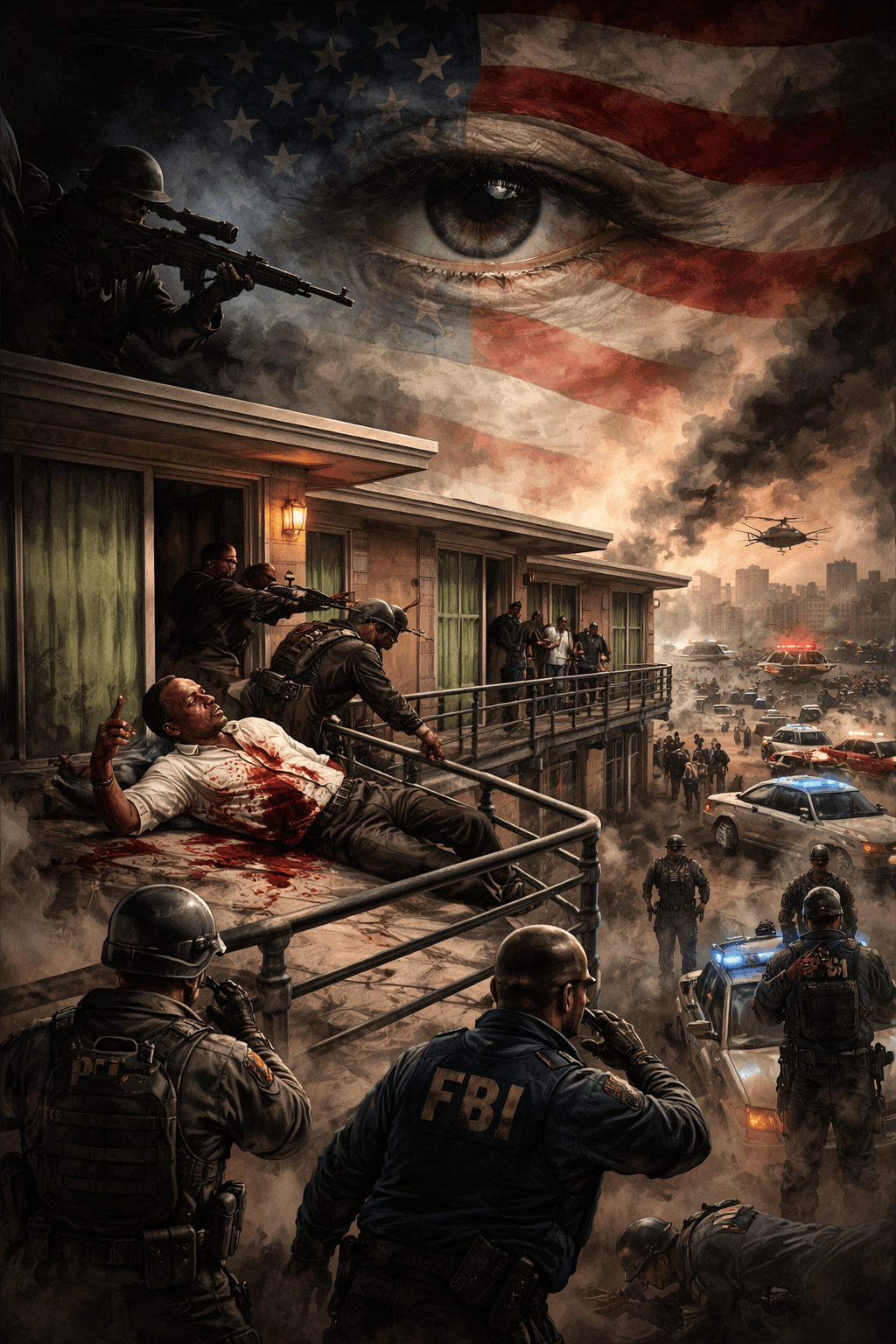
William F. Pepper’s An Act of State dismantles the myth of a tragic killing and exposes the assassination of Martin Luther King Jr. as a deliberate act of governance—carried out to halt a revolutionary convergence of anti-imperialism, class struggle, and mass organization inside the United States. This MLK Day intervention refuses memorialization and restores King as a political threat the empire chose to eliminate.
By Prince Kapone | Weaponized Information | Weaponized Intellects Book Review
January 20, 2026 — MLK Day
Empire Had a Motive
Martin Luther King Jr. was not killed because he dreamed too boldly. He was killed because he organized too effectively. William Pepper’s An Act of State forces us to abandon the sentimental mythology that has embalmed King into a harmless national icon. What emerges instead is a revolutionary figure who crossed a line the U.S. empire does not forgive: he moved from moral appeal to material confrontation.
By 1967, King was no longer simply a civil rights leader challenging segregation in the South. He had become a systemic threat. He publicly denounced the Vietnam War as a criminal enterprise. He named the United States as the greatest purveyor of violence in the world. He linked racism, militarism, and capitalism as a single structure of domination. And most dangerously of all, he began organizing the poor—Black, white, and brown—into a national movement aimed at economic disruption.
Pepper makes this point unmistakably clear: King’s assassination cannot be understood apart from the Poor People’s Campaign. This was not protest politics. It was an organized challenge to state legitimacy. Mass encampments in Washington. Coordinated civil disobedience. A direct confrontation with federal power over housing, employment, and war spending. King was preparing to bring the dispossessed into the capital of empire itself. That is when the question of “neutralization” entered the equation.
The liberal story insists that King was universally beloved by the time of his death. Pepper demolishes that lie. King’s approval ratings had collapsed. The press turned hostile. Political elites denounced him as reckless and dangerous. The FBI had already declared him the most dangerous Black man in America. Surveillance was total. Harassment was constant. Threats were routine. This was not the atmosphere surrounding a protected national hero. It was the atmosphere surrounding a marked enemy.
Pepper’s central intervention is to reframe the assassination not as a crime of hate, but as a political act carried out in defense of state power. King’s opposition to the war threatened imperial legitimacy. His economic program threatened capitalist stability. His capacity to mobilize threatened social order. Taken together, these made him intolerable. The issue was not extremism. It was effectiveness.
This is why the question of motive matters. The lone-gunman narrative exists to erase it. If the killing is random, the system is innocent. If it is personal, the structure survives. Pepper refuses that erasure. He insists on motive because motive reveals power. And the motive here was simple: King had become a revolutionary force capable of uniting class struggle with anti-imperialist politics inside the United States.
The U.S. state has a long history of assassinating such figures—abroad and at home. From Lumumba to Allende, from Fred Hampton to Malcolm X, the pattern is consistent. When reform becomes rupture, when dissent becomes organization, when leadership becomes mobilization, the response escalates. Pepper places King squarely inside this tradition of state violence. Not as an exception, but as a domestic application of imperial policy.
This is the starting point the official histories refuse to accept. King was not drifting toward irrelevance in 1968. He was converging on power. And empire does not wait for its enemies to succeed. It moves first.
King Was Already a Target
Martin Luther King Jr. did not become a target because of Memphis. Memphis was simply where the operation concluded. William Pepper makes clear that by the late 1960s, King had already been classified as an enemy of the state. This designation did not require secrecy. It was expressed openly through surveillance, harassment, and psychological warfare carried out by the FBI under J. Edgar Hoover, with the knowledge and consent of the highest levels of government.
The FBI did not monitor King to protect him. It monitored him to neutralize him. COINTELPRO treated King not as a citizen exercising dissent, but as a subversive force whose influence had to be broken. His phones were tapped. His hotel rooms were bugged. His movements were tracked in real time. Informants were embedded in his inner circle. This was not passive intelligence gathering. It was a sustained campaign to map, pressure, and ultimately remove a political threat.
Pepper emphasizes that King’s turn against the Vietnam War triggered a decisive escalation. Once King publicly aligned the Black freedom struggle with anti-imperialist resistance abroad, he crossed from domestic reformer into international liability. The war could not tolerate a figure of King’s stature exposing its criminal character from within the United States itself. At that point, containment gave way to hostility.
Hoover’s FBI attempted first to destroy King’s credibility. The infamous blackmail letter urging him to commit suicide was not an aberration—it was policy. The goal was not moral exposure but political elimination. When humiliation failed, isolation followed. Allies were pressured. Donors withdrew. Media narratives shifted. King was framed as divisive, irresponsible, and dangerous. This was counterinsurgency, not law enforcement.
What Pepper forces us to confront is the continuity between surveillance and assassination. Intelligence agencies do not abandon targets they have already identified as existential threats. They escalate. By the time King arrived in Memphis, the state knew where he would be, who he would be with, and how he would be protected—or not protected. Surveillance does not end at observation. It prepares the ground for action.
The lone-gunman myth depends on the fiction that the state was unaware. Pepper dismantles that fiction completely. King was one of the most closely watched individuals in the country. His presence in Memphis was no surprise. His lodging was known. His schedule was predictable. The idea that his assassination occurred outside the awareness of the security apparatus is not naïve—it is ideological cover.
Once this reality is accepted, the frame shifts. The question is no longer how a single man could pull off the killing. The question becomes why a man under total surveillance was left exposed. That question does not point toward incompetence. It points toward intention.
Pepper’s work demands that we see surveillance as the first stage of political murder. King was not killed suddenly. He was selected, tracked, pressured, isolated, and prepared for removal. Memphis was not the beginning. It was the end of a process already in motion.
The Patsy Was Built in Advance
Political assassinations do not end with the killing. They end with the containment of meaning. William Pepper’s most devastating contribution is not simply proving that James Earl Ray did not kill Martin Luther King Jr., but demonstrating that Ray’s role was constructed long before the shot was fired. Ray was not a spontaneous suspect. He was a prepared solution.
Ray was a career drifter, a petty criminal, a man without ideology, discipline, or organizational capacity. He had no history of racial violence, no demonstrated animus toward King, and no skills that would explain the precision attributed to him. Pepper shows that Ray was manipulated, guided, and positioned through a network of handlers who fed him money, instructions, and a sense of purpose he never independently possessed.
This is how modern states manufacture lone assassins. You do not recruit professionals. You select marginal men—unstable, disposable, and deniable. You steer them through intermediaries. You provide just enough resources to move them into place. And when the operation concludes, you let the weight of the state collapse onto them, sealing the narrative before questions can form.
Pepper meticulously dismantles the official claim that Ray acted alone. Ray’s movements across multiple countries required funding he did not have. His acquisition of weapons and transportation involved contacts he could not explain. His presence near Memphis coincided with other known intelligence assets in the area. These facts were not disputed—they were ignored. Courts do not reject evidence accidentally. They do so to preserve outcomes.
The confession that sealed Ray’s fate was extracted under coercion and immediately recanted. That detail alone should have collapsed the case. Instead, it was treated as final. No trial. No adversarial testing of evidence. No examination of alternative suspects. Speed mattered because delay risks exposure. The faster the story hardens, the harder it is to break.
Pepper also exposes the deliberate suppression of witnesses whose testimony contradicted the lone-gunman narrative. Multiple individuals reported gunfire from locations inconsistent with Ray’s alleged position. Others placed different shooters in the vicinity. Physical evidence failed to match the state’s account. None of this mattered. The narrative had already been selected.
The purpose of the patsy is not just to absorb blame. It is to collapse complexity into simplicity. One man. One rifle. One motive. Racism. End of story. This framing absolves institutions, dissolves conspiracy into pathology, and turns political murder into personal tragedy. Pepper’s work shows that this is not a flaw in the justice system—it is its function.
Once Ray was installed as the culprit, the case was effectively closed—not legally, but ideologically. Every subsequent question could be dismissed as obsession or paranoia. Every challenge could be framed as disrespect to King’s legacy. The lie protected itself by moralizing doubt.
Pepper refuses that closure. He shows that Ray’s role only makes sense when understood as part of a larger operation involving intelligence agencies, local assets, and political authority. Ray did not kill King. He was used to end the story.
Memphis Was Prepared
The assassination of Martin Luther King Jr. did not occur in an uncontrolled environment. William Pepper demonstrates that Memphis functioned as a managed space, shaped in advance to enable the killing while shielding those responsible. This was not a matter of a single shooter finding an opportunity. It was the creation of opportunity itself.
In the days leading up to King’s arrival, standard security arrangements were altered without credible explanation. Black police officers who had previously been assigned to King were reassigned. Tactical units were withdrawn. Normal patrol patterns were disrupted. The state did not fail to secure King’s surroundings. It actively changed them.
Pepper places particular emphasis on the decision to move King to a different room at the Lorraine Motel. The room he was assigned placed him in full public view, exposed on an open balcony, visible from multiple angles. This change was not incidental. It transformed a private space into a kill zone.
At the same time, police presence in the immediate area was conspicuously reduced. Officers normally stationed nearby were reassigned. Surveillance remained, but protection vanished. This distinction matters. Observation without intervention is not negligence—it is positioning.
The geography of the area surrounding the Lorraine Motel further undermines the official story. Pepper documents multiple locations from which shots could have been fired, several of which were inconsistent with the state’s claim about James Earl Ray’s position. These locations were accessible, unguarded, and known. The environment allowed for deniability.
Witnesses reported activity in areas that were later sealed off or ignored by investigators. Some heard shots from directions the official narrative could not accommodate. Others saw individuals moving in coordinated ways before and after the shooting. None of this was pursued. The investigation did not fail to collect evidence. It selected which evidence could exist.
What Pepper makes unavoidable is that space itself was used as a weapon. You do not need to issue orders when you can shape conditions. You do not need to fire a weapon when you can ensure that someone else will. Memphis functioned as a permissive environment, engineered to allow violence while preserving institutional distance.
This is how state assassinations differ from crimes. Crimes are chaotic. This was ordered. Every element—visibility, timing, security withdrawal, narrative readiness—aligned. When King stepped onto the balcony, he did so in a space already structured for his removal.
The question, then, is not whether the state could have prevented the assassination. Pepper shows it could have done so effortlessly. The question is why it did not. And once that question is asked honestly, the answer becomes inescapable.
The Cover-Up Began Immediately
The assassination of Martin Luther King Jr. did not end with the gunshot. It entered its second phase: containment. William Pepper shows that from the first moments after King fell, the machinery of the state shifted into damage control. Evidence was not carefully preserved. It was rapidly shaped. The goal was not truth. It was closure.
Crime scenes were contaminated almost instantly. Areas that should have been sealed were opened. Witnesses were moved along. Physical evidence that contradicted the official story was ignored or mishandled. Pepper documents how basic investigative protocols were violated in ways that consistently favored a single conclusion. This was not incompetence. It was direction.
The rifle attributed to James Earl Ray was conveniently discovered, yet its forensic connection to the killing was never conclusively established. Ballistics evidence failed to match the certainty claimed by authorities. Instead of prompting deeper inquiry, these inconsistencies were buried under repetition. The story did not become true because it was proven. It became true because it was declared.
Witness testimony that conflicted with the lone-gunman narrative was sidelined. People who placed shots from different locations were dismissed. Those who observed suspicious movements were deemed unreliable. Pepper makes clear that this was not the natural winnowing of weak evidence—it was the systematic exclusion of facts that threatened the official account.
Media coordination played a decisive role. Within hours, James Earl Ray’s name circulated nationally. Before any trial, before any cross-examination, before any forensic clarity, the public was given a culprit. This is how narrative power operates. Speed replaces scrutiny. Repetition replaces proof.
Courts then performed their assigned function. By denying Ray a full trial and accepting a coerced guilty plea, the judicial system foreclosed the possibility of exposure. No adversarial process meant no discovery. No discovery meant no institutional risk. Pepper emphasizes that justice was not denied accidentally—it was preempted.
This phase of the operation reveals the true nature of the American legal system in moments of political crisis. It does not seek truth when truth threatens power. It seeks resolution. It seeks stability. It seeks to move history forward without allowing the past to be interrogated.
The assassination was transformed from a political act into a criminal anomaly. The state absolved itself not by disproving involvement, but by closing every avenue that could have established it. The cover-up did not require secrecy. It relied on procedure.
Pepper’s work exposes this mechanism with precision. The murder of King was not hidden behind silence. It was buried beneath process—police procedure, court procedure, media procedure. The lie survived because it was institutionalized.
At this point, the question of who pulled the trigger becomes secondary. What matters is who controlled the aftermath. And the answer, again, points upward.
The Courts Enforced Silence
If the assassination of Martin Luther King Jr. was the act, and the cover-up its immediate continuation, then the courts were the mechanism that made the lie permanent. William Pepper shows that the American judicial system did not fail to deliver justice—it delivered exactly what the state required: finality without truth.
James Earl Ray was denied what even the most basic conception of justice demands: a full public trial. By accepting a coerced guilty plea, the courts shut down discovery, blocked cross-examination, and ensured that no institutional actors would be placed under oath. This was not procedural efficiency. It was preemptive damage control.
When Ray later recanted and demanded a trial, the courts responded with hostility. Appeals were dismissed on technical grounds. New evidence was excluded not because it lacked credibility, but because it threatened closure. Pepper documents how judges repeatedly ruled that truth itself was irrelevant once the system had decided to move on.
Witnesses who contradicted the official narrative were never allowed to testify in meaningful proceedings. Ballistics inconsistencies were deemed immaterial. Evidence pointing to additional shooters or intelligence involvement was labeled speculative and ignored. The courts treated institutional stability as a higher priority than factual resolution.
Pepper’s legal battles reveal a chilling reality: the judiciary operates as a political institution when power is at stake. It does not ask whether the state acted criminally. It asks whether revisiting the question would destabilize authority. In King’s case, the answer was always the same. Do not reopen. Do not examine. Do not disturb the narrative.
The most revealing moment came decades later, when a civil jury—outside the criminal justice apparatus—heard the evidence Pepper had spent years assembling. In 1999, the jury concluded that King had been killed as the result of a conspiracy involving governmental agencies. This verdict did not provoke reflection. It provoked silence.
The media dismissed the trial. Officials ignored it. Courts treated it as an inconvenience rather than a revelation. The truth had emerged in the only venue not structurally aligned with state power—and the system responded by pretending it had not happened.
This is the function of courts in moments like these. They are not neutral arbiters. They are filters. They determine which truths are admissible and which must be excluded to preserve legitimacy. Pepper’s work demonstrates that the legal system did not merely fail King. It completed the assassination by ensuring that accountability would never follow.
By the time the courts finished their work, the lie had hardened into history. Not because it was proven, but because it was protected. The judiciary did not uncover the truth. It buried it with legal finality.
Why King Still Had to Die
Martin Luther King Jr. did not have to be silenced because he was radical in theory. He had to be silenced because he was radical in practice. William Pepper’s work leaves no room for the liberal fantasy that King was drifting toward irrelevance by 1968. The opposite is true. King was converging on power.
By the final year of his life, King had fused three lines of struggle the U.S. state could not allow to merge inside its borders: mass Black insurgency, anti-imperialist opposition to U.S. war, and an explicitly class-based challenge to capitalism. This was no longer a civil rights movement seeking inclusion. It was a revolutionary project threatening legitimacy itself.
The Poor People’s Campaign was the breaking point. King was organizing the dispossessed across racial lines into a sustained campaign of economic disruption aimed directly at the federal government. Encampments in Washington. Shutdowns. Noncompliance. A confrontation not with Southern segregationists, but with the imperial state at its core. This was not symbolic protest. It was strategic pressure.
Pepper makes clear that King’s opposition to the Vietnam War intensified this threat exponentially. King was not merely criticizing policy; he was exposing empire. He named the United States as a system built on violence abroad and deprivation at home. He connected bombs in Southeast Asia to poverty in American cities. That linkage could not be allowed to organize.
This is why timing matters. King was killed not at the height of his popularity, but at the moment his politics crystallized into something operational. The state did not act out of panic. It acted out of calculation. Waiting carried risk. Allowing King to complete the Poor People’s Campaign carried greater risk. Neutralization was the safer option.
Pepper’s central contribution is forcing us to see the assassination not as a response to hate, but as a preemptive act of governance. King was not removed because he inspired moral discomfort. He was removed because he was capable of mobilizing mass resistance against imperial power inside the United States itself.
In this sense, King’s assassination belongs to the same political lineage as Lumumba, Allende, and Sankara. Different contexts. Same logic. When leadership threatens to unify the exploited against empire, the response escalates. Reform is tolerated. Organization is not.
How Liberal Memory Neutralizes Revolutionary Threat
The assassination of Martin Luther King Jr. required a second operation to succeed: the transformation of his memory. William Pepper’s work collides directly with the official mythology that followed King’s death, revealing it as an extension of the same political project that eliminated him.
King was recast almost immediately into a harmless moral figure—an apostle of harmony detached from struggle, conflict, and power. His critique of capitalism disappeared. His condemnation of U.S. militarism vanished. His strategy of mass disruption was erased. What remained was a dream without demands.
This was not historical drift. It was political neutralization. By turning King into a symbol of individual tolerance rather than collective struggle, liberal memory severed his ideas from their revolutionary content. King became safe to quote precisely because he was no longer dangerous to follow.
Pepper exposes the obscene contradiction at the center of this process. The same institutions that surveilled King, harassed him, and ultimately facilitated his removal now present themselves as his moral heirs. This is not reconciliation. It is appropriation.
Liberal memory functions as counterinsurgency. It converts revolutionary leaders into national property, strips their politics of antagonism, and redeploys them as tools of social discipline. King is invoked to condemn unrest, shame resistance, and delegitimize struggle—often against the very forces he was organizing to confront.
The result is a ritualized King, endlessly celebrated and endlessly misunderstood. A King who opposed “violence” but never named structural violence. A King who preached unity but never named class struggle. A King who marched but never disrupted. This King exists to pacify, not to liberate.
Pepper’s work refuses this erasure. By grounding King’s assassination in his revolutionary trajectory, Pepper restores the political meaning liberal memory is designed to destroy. King was not betrayed by misunderstanding. He was neutralized by design.
MLK Day Under Empire: What Honoring King Would Actually Require
MLK Day does not commemorate Martin Luther King Jr. as he lived or as he died. It commemorates a version of King made compatible with empire. William Pepper’s An Act of State destroys that compatibility.
If King was assassinated because he threatened imperial legitimacy, then honoring him cannot mean speeches, murals, or corporate service days. It must mean confrontation. It must mean opposition to war, capitalism, and racialized poverty as interconnected systems. Anything less is tribute to the lie that justified his removal.
Pepper forces a simple but devastating conclusion: the United States did not lose control when King was killed. It exercised control. And the survival of the official narrative depends on forgetting why.
To honor King honestly would require rejecting the mythology that sanitizes him. It would require recognizing him as a revolutionary organizer whose trajectory led inevitably into conflict with the state. It would require acknowledging that his assassination was not a tragic accident, but an act of political violence carried out in defense of power.
MLK Day under empire functions as closure. Pepper reopens the case—not just legally, but politically. He reminds us that King’s struggle was unfinished, not because it failed, but because it was interrupted.
The question, then, is not what King would think of us. The question is whether we are willing to think as King did when it mattered most—when moral appeal gave way to material struggle, when reform gave way to confrontation, and when the cost of telling the truth became fatal.
Remembering King is easy. Continuing his trajectory is not. And that difference explains both his assassination and the way he is remembered.
 Weaponized Information
Leave a comment