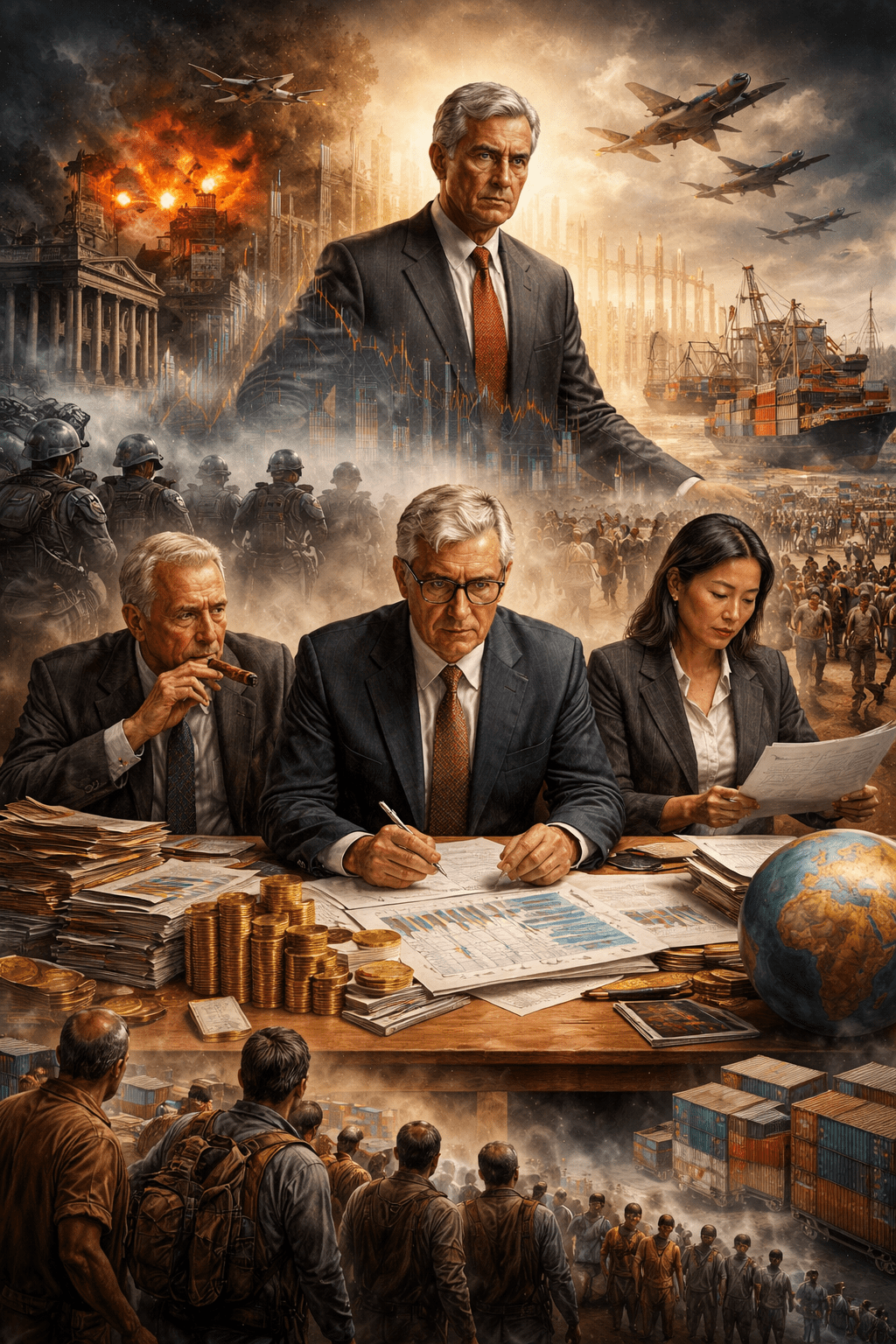
Experts speak so capital can rule without consent. Facts reveal an imperial system under strain, not a neutral economy at risk. Monetary discipline, tariffs, and militarization form a single strategy of control. The task before the people is organization, not faith in forecasters.
How the Economy Is Ventriloquized Through Experts
The article titled “Experts predict what lies ahead for the global economy in 2026” is not really about prediction. It is about authority. It stages a familiar ritual in modern capitalism: the summoning of experts to speak on behalf of the economy, as if the economy were a shy god that only whispers to economists and never to the people who actually produce its wealth. Forty-eight economists are assembled like a jury, not to judge power, but to reassure it.
The piece opens by narrowing the reader’s sense of danger with remarkable efficiency. The world, we are told, will trudge along with “steady if unspectacular growth,” but there is a new anxiety in the air. Not hunger. Not debt. Not the slow grinding violence of austerity or deportation. The danger, we are warned, is that the world’s most important financial institution might become too political. In one move, the terrain of concern is lifted away from daily life and relocated to the rarefied air of central banking.
This is how the story teaches us what matters. The economy is not presented as a set of social relationships, but as a machine overseen by technicians. The real threat is not what happens to workers, migrants, or indebted households, but what happens to “confidence.” The article quietly trains the reader to see the world through the eyes of markets, not people. Stability is defined not by whether lives are livable, but by whether investors remain calm.
Authority in the text is constructed through counting rather than reasoning. We are told what “two thirds” think, what “nearly 80 per cent” expect, what “three quarters” assume. Numbers are substituted for arguments. Percentages replace politics. The effect is subtle but powerful: disagreement becomes a matter of calibration among professionals, not a clash of interests. The economy appears as something to be managed by specialists, not struggled over by classes.
When tension enters the story, it is personalized. The problem is narrated through familiar characters—presidents, chairmen, nominees. Power appears as temperament and appointment, not as structure. Political pressure is cast as interference, while technocratic insulation is treated as virtue. In this way, the system’s contradictions are reduced to a question of who sits in which chair, rather than what the chairs are designed to do.
The choice of voices reinforces this narrowing of vision. Central bankers speak. Asset managers speak. Bank economists speak. Professional strategists speak. These are introduced as “leading” figures, their authority assumed rather than examined. Meanwhile, the vast majority of humanity appears only as scenery. Workers exist as a “labour market.” Migrants appear as a “drag.” Communities are flattened into “conditions.” The people who carry the costs of policy never get a sentence of their own.
The emotional tone of the article is not alarmist; it is managerial. The language is cool, measured, and anxious in the way a boardroom grows anxious—not when people suffer, but when spreadsheets wobble. The fear that animates the text is not social breakdown but market reaction: sell-offs, tighter conditions, jittery investors. The reader is gently coached to feel concern on behalf of capital, as if that were the natural point of identification.
Geography, too, is arranged according to power. The United States sits at the center of the narrative, its policies radiating outward like weather systems. Other regions enter as satellites: Britain as a fiscal headache, Germany as a spending experiment, China as a growth puzzle. The rest of the world is just that—the rest. “Global” here does not mean universal. It means whatever is touched by Atlantic decision-making.
Time is treated in the same way. History is compressed into a calendar of elite events: the next meeting, the next decision, the next appointment. Long struggles vanish. Structural processes dissolve into short-term outlooks. The economy becomes a sequence of announcements rather than a battlefield shaped by generations of exploitation and resistance.
Most effective of all is what the article presents as obvious and therefore beyond question. “Independence” is assumed to be neutral. “Confidence” is treated as a common good. “Growth” is offered as a universal blessing, without ever asking who grows and who is crushed beneath it. These assumptions do not need to be defended because the reader is expected to have already absorbed them, like a catechism learned long ago.
What we are left with is a carefully managed worldview. Institutions replace people. Markets replace society. Experts replace democracy. The article does not shout. It does not threaten. It simply explains the world from above and asks the reader to accept that this is where serious thinking happens. It is not a report from the shop floor or the street. It is a memo from management, calmly circulated, reminding us who is allowed to speak for the economy—and who is not.
What the Forecast Measures — and What It Refuses to Name
The Times article gives us a tidy, expert-managed picture of 2026: “steady if unspectacular” global growth, the United States outperforming Europe, and a new anxiety centered on the independence of the Federal Reserve. But the moment we treat this as more than a dinner-party briefing for investors—once we ask what material forces actually shape the world economy—the article’s thinness becomes obvious. It reports certain surface movements while withholding the deeper terrain: how credit, tariffs, fiscal rules, and trade imbalances function as instruments of power in a world system that is no longer smoothly governed by a single imperial center.
Start with the article’s headline concern: Federal Reserve “independence.” It notes that Jerome Powell’s term as chair ends in May and that President Trump is expected to name a successor, setting up a potential confrontation between the White House and the central bank. These institutional details are real: Powell’s chair term does end in May 2026, and he can remain a governor beyond that date, which changes the political mechanics of any attempted takeover. Reuters has likewise described 2026 as a moment of heightened institutional tension precisely because the chair transition becomes the lever through which a president can try to reshape policy direction and norms of independence. What the Times does not provide is the historical record that the Fed’s “independence” is not independence from politics in general; it is independence from popular pressure, while remaining structurally intertwined with the banking system and the state’s need to manage capitalism’s contradictions—a point made plainly even in mainstream institutional discussions of what independence actually means in practice.
The article then moves to tariffs and treats them mainly as a drag that might restrain growth while remaining politically durable. But the omitted facts here matter. The scale of the tariff regime is not rhetorical—it is measurable. The Budget Lab at Yale estimated that consumers faced an overall average effective tariff rate around 18% in October 2025, described as the highest since 1934. Reuters has separately reported research indicating the average import tariff rose to roughly 17% in 2025, the highest since the mid-1930s. Whatever one thinks about tariffs politically, the point is that the article presents them as a policy atmosphere while largely avoiding what their magnitude implies: a structural shift in the rules of world trade, with consequences that extend far beyond the price of imports.
Here is another omission that reshapes everything: the relationship between tariffs and the labor market. The Times notes deportations could “hurt the labour market” and that tariffs remain high, but it does not grapple with how these policy streams interact materially. Reuters, summarizing San Francisco Fed research, notes that large historical tariff increases have been associated with higher unemployment and lower inflation—a pattern the researchers connect to uncertainty and contractionary effects. Whether the pattern holds perfectly in every moment is less important than the suppressed implication: policy can cool inflation by cooling people’s livelihoods. That is not an unfortunate side effect. It is how capitalist stabilization often works.
On China, the article acknowledges export strength and notes debate about whether official growth targets will be met. But it does not give the reader the scale of China’s export dominance in the period it is describing. Multiple outlets reported that China’s trade surplus pushed past the $1 trillion mark in 2025, with Al Jazeera citing customs data showing the goods surplus in the first eleven months of 2025 was up 21.7% year-on-year and driven heavily by high-tech goods. The Guardian likewise framed China’s record surplus as both a strength and a vulnerability, precisely because it reflects deep reliance on external markets. If the Times wants to talk about “hackles” in the US and Europe, it should show the numbers that explain the political temperature.
On Germany, the Times highlights fiscal stimulus after the removal or reform of the “debt brake,” implying a simple growth boost for the eurozone. But the underlying policy shift is not merely Keynesian plumbing. Bruegel notes that Germany approved a historic constitutional amendment in March 2025, including a carve-out where defence spending above 1% of GDP would be treated differently under the fiscal rule. The European Commission’s own summary describes a new infrastructure fund worth EUR 500 billion created outside the debt brake framework. In other words, the fiscal opening is fused to strategic industrial and defence priorities. The Times speaks of “spending taps,” but it does not name what the taps are being turned toward.
Once you place these pieces side by side—Fed leadership tensions, an effective tariff regime at levels not seen since the 1930s, tariff effects entangled with labor market outcomes, China’s trillion-dollar-plus trade surplus, and Germany’s fiscal shift tethered to defence carve-outs—the article’s “global outlook” reads less like neutral forecasting and more like a carefully limited briefing that avoids the system’s actual fault lines. Those fault lines are not simply “uncertainty.” They are contradictions rooted in a shifting world order: the tightening grip of finance over trade and development, the leverage of interest rates over entire national budgets, and the vulnerability of the Global South to swings in liquidity and risk appetite.
That last point is not an abstraction; it is documented. Tricontinental, summarizing UNCTAD’s findings, notes that around 90% of world trade depends on trade finance and that changes in interest rates, liquidity, and investor sentiment can shape trade volumes as much as changes in real output. In plain language: when the financial heart of the system tightens, entire regions feel it in their ability to import medicine, export crops, service debt, and fund development. The Times can talk about “the world’s most important financial institution,” but it avoids saying what that importance means for those who live outside the imperial core.
So the factual baseline is this: the article is not wrong to treat 2026 as a year shaped by central bank decisions, tariffs, and strategic fiscal shifts. It is wrong in what it excludes. It presents these forces as technical variables inside an expert conversation, rather than as instruments through which power is exercised across borders and classes. That omission is not a small editorial choice. It is the ideological foundation on which the next reframing will be built.
What the Forecast Cannot Say: Imperial Power in an Age of Fracture
Once the facts and omissions are placed side by side, the problem with the Times forecast becomes clear. What is presented as a technical discussion about interest rates, tariffs, and growth targets is in fact a political narrative designed to manage perception during a period of imperial strain. The article speaks the language of neutrality, but the world it describes is already structured by power—by who controls credit, who sets trade rules, and who absorbs the shocks when the system tightens. The “risk” identified by the experts is not instability for the masses. It is instability for the managers of empire.
Take the obsession with central bank independence. In the article, this is framed as a universal good, a kind of economic hygiene necessary for global stability. But historically, central banking has never been independent of class power. It has been a mechanism through which capitalist states coordinate accumulation, discipline labor, and protect financial interests during moments of crisis. What changes in 2026 is not that politics enters monetary policy, but that conflicts within the ruling bloc are becoming harder to contain behind technocratic language. When presidents, markets, and central bankers clash in public, it signals not the corruption of a neutral institution, but the stress of a system that can no longer smoothly reconcile competing imperatives.
The same is true of tariffs. The article treats them as an unfortunate but manageable drag on growth, a distortion that might soften with negotiation or legal challenge. In reality, tariffs at levels not seen since the interwar period mark a structural shift in how the imperial core manages competition and decline. They are instruments for reshaping supply chains, disciplining rival states, and reorganizing labor markets at home. When paired with deportations and labor market tightening, tariffs become part of a broader strategy: protecting profits by constraining workers, narrowing options, and forcing adjustment downward. This is not incoherence. It is class policy.
China’s position in the forecast further exposes the ideological limits of the expert frame. Its export strength is acknowledged, but treated as a puzzle or a provocation—something that raises “hackles” in Washington and Brussels. What disappears is the historical context of containment, sanctions, and technological restriction that has pushed China to deepen export reliance even as domestic demand lags. From the standpoint of the imperial core, China’s trade surplus appears as excess. From the standpoint of a country navigating hostile external conditions, it appears as adaptation. The article’s framing quietly aligns the reader with the former view, without ever naming it as such.
Europe’s fiscal turn, especially in Germany, is handled with similar sleight of hand. Increased spending is framed as a welcome stimulus that might lift a sluggish eurozone. Yet the underlying direction of that spending—toward defense, strategic industry, and bloc consolidation—is largely left unspoken. What is emerging is not a revival of social Europe, but a recalibration of the European project around militarization and competition in a more openly confrontational world order. The forecast speaks of growth, but the growth it anticipates is inseparable from preparations for conflict and tighter alignment within the Atlantic system.
Across these cases, the same pattern repeats. Economic tools are discussed as if they were neutral levers, while their role in maintaining imperial hierarchies is obscured. Interest rates shape who can borrow and who must default. Trade rules determine which countries industrialize and which remain suppliers of cheap inputs. Fiscal rules decide whether social needs or military priorities come first. The article’s expert consensus normalizes these outcomes by refusing to name them as political choices embedded in a global system of inequality.
From the standpoint of the global working class and peasantry, this “steady if unspectacular” outlook looks very different. For workers in the imperial core, stability often means wages lagging behind prices, housing becoming unreachable, and labor being disciplined in the name of fighting inflation. For workers and farmers in the Global South, it means vulnerability to swings in liquidity, debt servicing costs that rise overnight, and trade conditions shaped elsewhere. The forecast speaks of growth averages, but averages conceal whose lives are being squeezed to keep the numbers respectable.
What the article ultimately reveals—despite itself—is a system trying to manage decline without relinquishing control. The anxiety around institutions like the Federal Reserve reflects fear that the old mechanisms of coordination are weakening. Tariffs, fiscal carve-outs, and export redirection are attempts to patch over deeper fractures. None of these resolve the underlying contradiction: a world economy organized around profit and hierarchy cannot deliver stability without coercion, exclusion, and sacrifice imposed on the many for the benefit of the few.
Read this way, the forecast is not a window into the future but a snapshot of imperial recalibration in motion. It tells us how elites hope to manage the coming period—through tighter control of money, selective openness in trade, and strategic spending aligned with power. What it cannot admit is that these strategies sharpen the very tensions they aim to contain. For those on the receiving end of these policies, the task is not to hope the managers get it right, but to recognize the structure at work and prepare to confront it.
From Forecast to Frontline: Organizing Where the Cracks Are Already Open
Once the fog of expert forecasting is cleared, the task before us is no longer interpretive but practical. The contradictions exposed by the article are not theoretical abstractions waiting for academic debate; they are already being lived, resisted, and contested by millions of people. Interest rates discipline workers. Tariffs and sanctions restructure livelihoods across borders. Fiscal rules decide whether communities get hospitals or missiles. These pressures are not arriving in 2026—they are already here. The question is not whether people will respond, but how consciously and collectively that response will take shape.
Across the imperial core, working people are already organizing against the cost-of-living crisis that monetary tightening has helped produce. Trade unions, tenant associations, and debtors’ movements are contesting a system in which inflation is fought by suppressing wages rather than restraining profits. These struggles—whether over housing, healthcare, transport, or pay—are not separate from central bank policy, even when they are framed that way. They are responses to it. Political education that links everyday hardship to the architecture of money and credit is therefore not an add-on to organizing; it is one of its central tasks.
Migrant justice movements occupy another critical front. Deportations are treated in the forecast as a technical labor-market variable, but on the ground they are experienced as family separation, fear, and hyper-exploitation. Organizations defending undocumented workers, asylum seekers, and refugees are already confronting the reality that border enforcement and labor discipline operate together. Connecting these struggles to broader fights over wages, working conditions, and social rights is essential if the working class is not to be divided along lines imposed from above.
In the Global South, resistance takes different but interconnected forms. Campaigns against debt, austerity, and extractive trade relations are challenging the financial mechanisms that allow crises in the core to be exported outward. Farmers’ movements, industrial unions, and popular organizations are demanding food sovereignty, industrial policy, and control over resources. These are not local grievances; they are direct confrontations with the same global system whose smooth functioning the experts seek to preserve. Solidarity here cannot be symbolic. It must mean opposing sanctions, supporting debt cancellation, and defending the right of nations to chart their own development paths.
Europe’s turn toward militarized spending has already sparked opposition from anti-war coalitions, climate justice movements, and social organizations that recognize what is being sacrificed to fund rearmament. These movements are fighting not only budgets, but priorities—challenging the idea that security comes from weapons rather than from social provision, cooperation, and ecological repair. Their struggles intersect with those of workers facing cuts and precarity, even when governments try to separate the issues.
At the international level, the emergence of alternative trade, finance, and development arrangements outside the traditional Atlantic system points to another terrain of struggle. These efforts are uneven, contradictory, and far from complete, but they reflect a widespread refusal to accept permanent subordination to a system that disciplines through debt and volatility. Defending and expanding these spaces—while pushing them in genuinely popular and democratic directions—is part of building a world beyond imperial management.
For revolutionary and socialist forces in the Global North, the task is to break with the habit of defending institutions simply because they are old or familiar. The central banks, fiscal rules, and trade regimes now presented as fragile guardians of stability have long been instruments of inequality. Organizing must aim not at restoring their authority, but at contesting it—through mass struggle, internationalism, and the rebuilding of working-class power across borders.
The forecast asks us to trust the experts to steer the ship through rough waters. Our answer must be different. The future will not be secured by better forecasts, cleaner spreadsheets, or more insulated institutions. It will be secured by organized people refusing to carry the costs of a system in crisis. The cracks are already open. The movements already exist. What remains is to connect them, deepen them, and move from resistance to transformation.
 Weaponized Information
Leave a comment