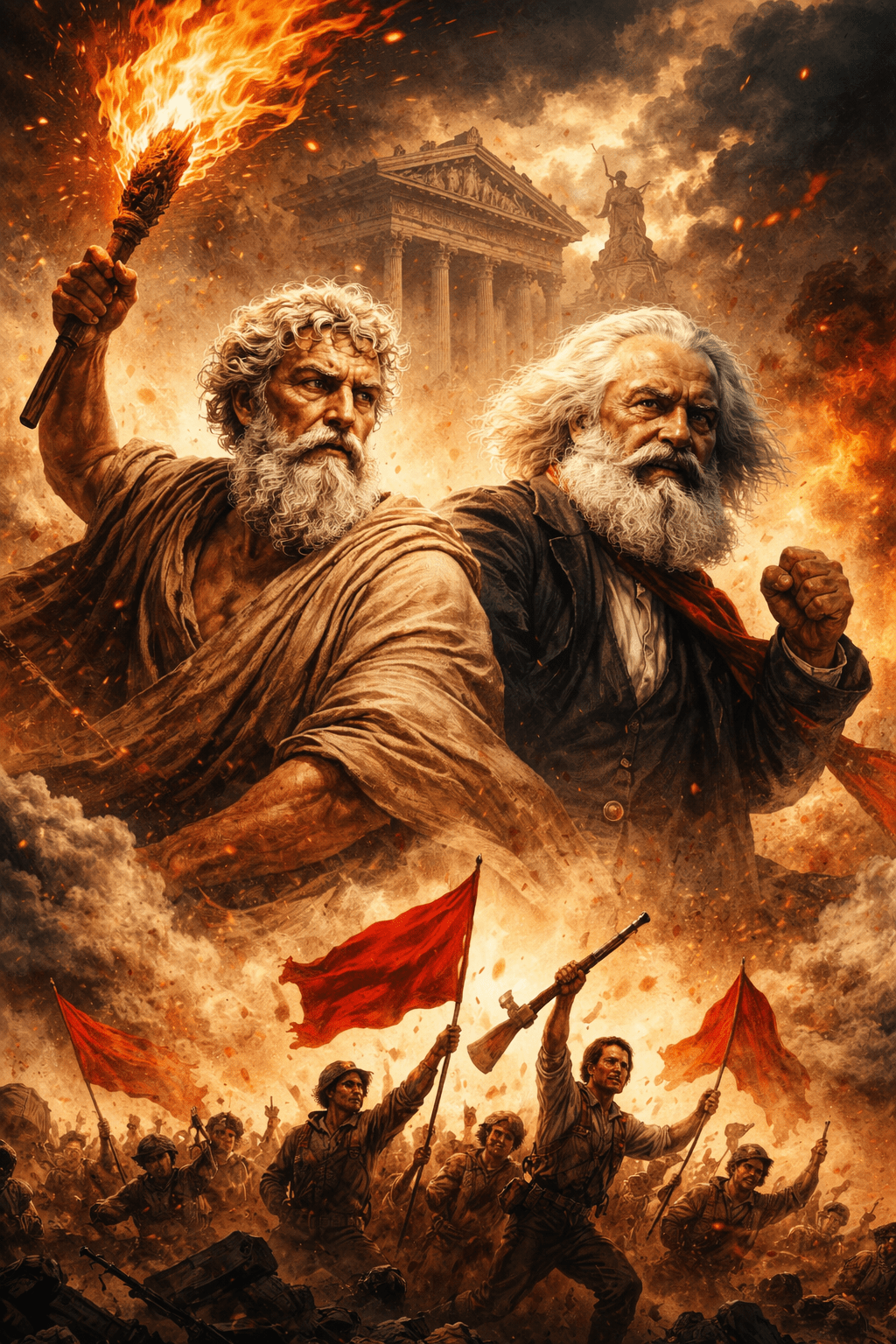
By Prince Kapone | Weaponized Information — Weaponized Intellects Book Review |
Breaking the Spell of Fate
John Bellamy Foster opens Breaking the Bonds of Fate with a refusal that is at once philosophical and political: the refusal to accept that human history, human suffering, or human defeat are governed by immutable laws. The phrase that gives the book its title—“breaking the bonds of fate”—is not rhetorical flourish. It names an ancient and ongoing ideological battle, one in which ruling classes repeatedly dress their power in the costume of necessity, while materialists insist that what is presented as destiny is in fact the product of historically specific social relations. Foster’s wager is simple and dangerous: that Marxism, properly understood, belongs to a much older insurgent lineage that has always fought against fatalism, fear, and the naturalization of domination.
The book announces itself immediately as something other than a work of political economy or environmental commentary. Its target is deeper. Foster returns to a question that haunted him after completing Marx’s Ecology: where did Marx’s extraordinary resistance to determinism come from? Neither classical economics nor nineteenth-century science can fully explain why Marx rejected inevitability so relentlessly. The answer, Foster argues, lies not in Capital’s footnotes but in Marx’s philosophical foundations—above all, his encounter with Epicurus. What Western Marxism long dismissed as a youthful detour turns out to be a decisive breakthrough. Epicurus was not Marx’s warm-up act. He was the point at which materialism learned how to say no to fate.
Foster insists that Epicurus and Marx must be treated as thinkers of equal seriousness in relation to their own epochs. Epicurus confronted a world in which the Greek polis had collapsed, empire had consolidated, and ordinary people were told—by priests, rulers, and philosophers alike—that their suffering was written into the order of the cosmos. Marx confronted a capitalist Europe that spoke a different language but delivered the same verdict: poverty, exploitation, and crisis were governed by iron laws. In both cases, materialism emerged not as an academic posture but as a weapon against fear. To deny fate was to deny the moral authority of those who ruled in its name.
From the start, Foster clarifies that this is a book about freedom without illusions. Epicurus does not abolish necessity; Marx does not promise history on autopilot. What both thinkers insist on is something more threatening to power: that necessity is not the same as destiny, that contingency exists, and that within material constraints there remains a realm of human action that is “up to us.” This is not liberal voluntarism, nor is it the empty optimism of collapse-management culture. It is a sober materialism that recognizes limits without sanctifying them, and conditions without surrendering to them.
In recovering this Epicurean-Marxist lineage, Foster is quietly intervening in contemporary Marxism itself. Against economism, against mechanical readings of history, and against the paralyzing politics of “objective conditions,” he reasserts a materialism rooted in emergence, agency, and struggle. History, in this telling, has no guarantees. There is no divine plan, no natural arc bending automatically toward justice, no algorithm of progress humming beneath the surface. There is only the open terrain of struggle, shaped by inherited conditions but never sealed shut by them.
The Preface of this book therefore does more than introduce a philosophical argument. It reopens a door that capitalism, empire, and their intellectual servants have spent centuries trying to nail shut. To say that fate can be broken is to say that domination depends on belief as much as force, and that once fear is stripped of its metaphysical costume, it loses much of its power. In an age saturated with managed despair and expert pessimism, Foster’s return to Epicurus is not antiquarian curiosity. It is a reminder that materialism, when it is true to itself, has always been an enemy of surrender.
Materialism in an Age of Imperial Defeat
Foster begins his first substantive movement by refusing to treat Epicurus as a floating abstraction or a philosopher of private tranquility. He insists, instead, on situating Epicurus firmly in the wreckage of Hellenistic Athens, in a historical moment defined by imperial conquest, political dispossession, and the collapse of collective civic life. This is not background scenery. It is the material soil from which Epicurean philosophy grows. After Alexander’s conquests, the democratic polis was hollowed out, real political participation narrowed, and ordinary people were increasingly told that the forces shaping their lives lay beyond human control. Fate became fashionable precisely when power became unreachable.
In this context, religion and superstition did not merely flourish; they functioned. Fear of the gods, fear of death, fear of cosmic punishment all served to discipline populations stripped of political agency. Foster is clear that Epicurus’s great provocation was not simply atheism, but the systematic dismantling of fear as a social weapon. To deny divine providence was to deny the moral legitimacy of rulers who governed in its shadow. Epicurus’s materialism was therefore not an ivory-tower exercise but a direct challenge to the ideological architecture of empire.
The Garden, Epicurus’s philosophical community, is treated by Foster not as a retreat from the world but as a modest, defensive form of praxis under imperial conditions. It rejected wealth, status, and power not out of moral purity, but because these had become mechanisms of domination and anxiety. Instead, Epicurean life was organized around sufficiency, friendship, reciprocity, and the deliberate reduction of fear. Happiness, in this setting, was not accumulation but liberation from false necessity. Foster is careful not to romanticize this. Epicurus did not offer revolution in the modern sense. What he offered was survival with dignity in a world structured to deny it.
Crucially, Foster emphasizes that Epicureanism was not a philosophy for elites alone. Its appeal spread widely among plebeian strata throughout the Hellenistic and Roman worlds precisely because it spoke to people whose lives were defined by insecurity and powerlessness. Epicurus promised something radically subversive: that happiness did not belong exclusively to the rich or the powerful, and that fear itself had material causes that could be understood and dismantled. Knowledge of nature became a means of social self-defense.
What emerges from this interrogation is a portrait of Epicurus as a thinker of imperial crisis. His philosophy does not deny necessity, but it refuses to confuse necessity with destiny. It insists that even in conditions of defeat, something remains within human reach: the capacity to act, to choose, to live without bowing to fear. Foster’s historical reconstruction matters because it prepares the reader for what follows. Epicurus is not introduced as a museum piece, but as a materialist forged in conditions that echo our own—conditions in which empire proclaims inevitability and philosophy is tasked either with justifying surrender or teaching people how not to kneel.
Atoms, Freedom, and the Refusal of Necessity
Having grounded Epicurus in the wreckage of Hellenistic imperial life, Foster turns to the hard philosophical labor that made Epicureanism dangerous in the first place. This chapter does not offer a casual tour of ancient atomism. It reconstructs Epicurus’s materialist system as a unified assault on fate, teleology, and the idea that human beings are nothing more than passive effects of external causes. At its core is a simple but explosive claim: the world is made of matter and void, and nothing—no god, no purpose, no cosmic plan—stands above or outside that material reality to dictate human destiny.
Foster is careful to show that Epicurus inherits atomism from Democritus only in order to break it open. Democritean atomism, for all its brilliance, collapses into a rigid determinism in which every motion follows with iron necessity from prior causes. Epicurus refuses this closure. His introduction of the swerve, the clinamen, is not a mystical escape hatch or a childish appeal to randomness. It is a minimal but decisive negation of absolute necessity. Atoms can deviate, at no fixed place or time, and this slight indeterminacy prevents the universe from becoming a sealed machine. Without it, Epicurus insists, freedom would be logically impossible.
Foster insists that the real stakes of the swerve are ethical and political, not merely physical. The denial of absolute determinism is what makes responsibility meaningful. If everything were governed by fate, praise and blame would be nonsense, and power could absolve itself of every crime. Epicurus’s target is fatalism itself, the doctrine that turns domination into destiny. By introducing contingency into nature, he creates the philosophical space in which human action can matter without invoking gods or miracles.
The chapter reaches its theoretical center in Foster’s sustained engagement with Book 25 of On Nature, a text long buried and only partially recovered through papyrological discoveries. Here Epicurus moves beyond physics to a materialist account of human development. Human beings, he argues, begin with an “original constitution,” but over time they develop character, judgment, and volition. New mental powers emerge through lived experience. Foster highlights Epicurus’s striking phrase—the “preconception of our responsibility”—as the material recognition that our actions are, in important ways, up to us. This is not metaphysical free will, but embodied agency rooted in development and interaction.
Against reductionist readings, Foster places Epicurus firmly in an emergentist tradition. Mind arises from matter, but it cannot be reduced to atomic motion alone. New levels of organization possess new causal powers. This is why Epicurus can say, without contradiction, that the world contains necessity, chance, and freedom simultaneously. Some things are necessary, some contingent, and some break the bonds of fate. Foster’s intervention here is precise: Epicurus rejects both mystical voluntarism and mechanical determinism. What remains is a materialism capable of accounting for novelty, choice, and responsibility.
Only after establishing this ontological foundation does Epicurus’s ethics come into view. Freedom from fear—of gods, of death, of punishment—is not an abstract ideal but the practical consequence of understanding nature correctly. From this flows an ethic of sufficiency rather than accumulation, of calm rather than conquest, of friendship rather than domination. Foster underscores that Epicurus explicitly rejected the endless pursuit of wealth and power, recognizing them as engines of anxiety rather than happiness. Ethics, here, is not moral preaching but the lived expression of a materialist worldview that has stripped fate of its authority.
By the end of the chapter, Foster has done something quietly devastating to modern fatalism. He has shown that a fully materialist philosophy can acknowledge limits without sanctifying them, and can recognize causality without erasing agency. Time itself, Epicurus insists, is the “accident of accidents,” a field of contingency rather than a conveyor belt of necessity. History, understood in this way, cannot be prewritten. The door now stands open for Marx to walk through—not as a break with Epicurus, but as the thinker who relocates this hard-won freedom from individual ethics to collective historical struggle.
Prometheus Without Illusions
When Foster turns to Marx, he does so with a polemical calm that masks the depth of the intervention. This chapter refuses the standard story that treats Marx’s doctoral dissertation on Epicurus as a youthful curiosity to be politely set aside once “real” Marxism begins. Foster insists, instead, that Marx’s encounter with Epicurus marks the moment when materialism learns how to think freedom without falling back into theology or idealism. What is at stake here is nothing less than the philosophical ground of historical agency.
Marx’s dissertation, Foster shows, is not an exercise in scholastic comparison but a decisive choice. Marx sides with Epicurus against Democritus precisely because Democritus’s atomism collapses into mechanical necessity. Epicurus, by contrast, introduces self-determination into nature itself. Marx reads the Epicurean swerve not as randomness but as a symbolic and philosophical assertion of autonomy. Nature is no longer a closed chain of causes marching toward predetermined ends. It is a field in which novelty, contradiction, and action are possible. Marx’s materialism is already anti-fatalist at its root.
Foster dwells on Marx’s use of Prometheus to clarify what kind of freedom is at issue. This is not the Prometheus of bourgeois mythology, conquering nature through domination and endless production. It is Prometheus the rebel, the figure who defies divine authority and exposes the gods as usurpers of human power. In Marx’s reading, Epicurus becomes Promethean precisely because he strips the gods of their terror and returns agency to human beings. The enemy here is not nature, but the ideological structures that turn nature into fate.
The chapter then traces how Marx transforms Epicurus rather than repeating him. Epicurus locates freedom primarily in individual ethical practice, in the capacity to live without fear under conditions of domination. Marx takes this hard-won philosophical freedom and relocates it into history. Agency becomes collective. Freedom becomes praxis. The struggle is no longer only against superstition and fear, but against social relations that reproduce domination materially. In this move, Marx does not abandon Epicurus’s anti-determinism; he radicalizes it.
Foster is careful to show that this continuity does not disappear as Marx matures. Across Marx’s later work, the rejection of teleology, the hostility to inevitability, and the insistence on sensuous human activity persist. Humans make their own history, Marx famously writes, but not under conditions of their own choosing. This formulation is not a concession to determinism but a precise statement of materialist freedom: conditions constrain action, but they do not script outcomes. History remains open because struggle remains real.
By re-centering Epicurus in Marx’s intellectual formation, Foster quietly dismantles those traditions of Marxism that have treated socialism as destiny rather than task. The Marx that emerges from this chapter is not a prophet of historical laws but a theorist of responsibility. Freedom is not guaranteed. Emancipation is not automatic. What exists instead is a material world shaped by contradiction, contingency, and human action. Prometheus returns here without illusions, carrying neither divine fire nor historical guarantees, only the stubborn insistence that fate is not a sufficient explanation for suffering.
Against the Politics of Inevitability
The final movement of Breaking the Bonds of Fate widens the lens without dissolving the argument. Foster does not offer a ceremonial conclusion or a moral exhortation. Instead, he returns to Marxism itself and asks a question that cuts uncomfortably close to the present: what becomes of historical materialism once it is stripped of inevitability? The answer he develops is unsparing. Any Marxism that treats socialism as destiny, rather than as a struggle whose outcome is undecided, has already surrendered its Epicurean inheritance.
Foster situates Epicureanism not as a doctrine frozen in antiquity, but as a recurring materialist stance that reappears whenever societies confront domination justified as necessity. Its defining feature is not atomism alone, but the refusal to naturalize suffering. Marxism, he argues, inherits this refusal and generalizes it historically. Where Epicurus confronted divine fate, Marxism confronts economic and social necessity, exposing both as historically produced and therefore historically vulnerable.
Central to this argument is Foster’s insistence on what he calls a complete materialism. Marxism, properly understood, is not simply an economic theory or a predictive science. It is ontological, epistemological, and practical at once. It affirms that reality is material, that knowledge arises from sensuous and social practice, and that human beings are active agents capable of transforming the conditions they inherit. This unity, Foster argues, is already present in Epicurus and is carried forward—expanded, deepened, and politicized—by Marx.
Foster returns again to emergence, now firmly within the terrain of history. Social formations arise, stabilize, and collapse. New powers appear; others disintegrate. There is no guarantee that progress will prevail over regression. Capitalism may generate the conditions for its own negation, but it also generates barbarism, ecological devastation, and new forms of domination. By introducing the concept of disemergence, Foster explicitly rejects any linear or teleological reading of Marxism. History has no built-in direction. It has struggle.
Freedom, in this framework, is neither voluntarist fantasy nor abstract moral ideal. It is the capacity to act consciously within necessity, to understand conditions well enough to change them. This formulation echoes both Epicurus’s insistence that some things are “up to us” and Marx’s insistence that humans make history under inherited constraints. Foster is explicit that freedom is collective before it is individual, practical before it is philosophical, and inseparable from organized struggle.
Without naming names, the chapter quietly takes aim at deterministic Marxism, economism, and those traditions that have treated historical outcomes as guaranteed by structural laws. Such views, Foster argues, do not strengthen materialism; they hollow it out. They replace responsibility with prophecy and struggle with patience. In doing so, they reproduce the very fatalism that Epicurus and Marx set out to destroy.
The book closes where it began: with the claim that fate is an ideological construction, not a scientific truth. To break its bonds is not to deny material limits, but to refuse their sanctification. Epicurean-Marxist materialism offers no promises and no timelines. What it offers instead is something far more dangerous to systems of domination: the insistence that history remains open, that outcomes depend on struggle, and that surrender is never a material necessity. In an age that markets despair as realism, this is not a comforting conclusion. It is a call to responsibility.
Refusing Surrender in an Age of Managed Despair
Read as a whole, Breaking the Bonds of Fate is less a work of philosophical recovery than a disciplined act of political clarification. Foster is not asking the reader to admire Epicurus or to rehabilitate an obscure corner of Marx’s early writings. He is asking something more uncomfortable: whether Marxism still understands itself as a theory of struggle, or whether it has quietly made peace with inevitability. The book’s wager is that fatalism—whether dressed up as economics, ecology, or historical law—remains one of the ruling class’s most effective ideological weapons.
By reconstructing the Epicurean lineage within Marxism, Foster dismantles the habit of treating domination as destiny. He shows, patiently and without theatrical polemic, that materialism does not require surrender to necessity, and that acknowledging limits is not the same as sanctifying them. Epicurus mattered because he taught people how to live without fear under empire. Marx mattered because he taught people how to fight without illusions under capitalism. Foster’s intervention is to remind us that these were never separate tasks.
At the same time, the book’s strengths also mark its limits. Foster remains largely on the terrain of philosophy, even when the implications point outward toward imperial power, state violence, and the global management of despair. The bonds of fate today are not only metaphysical or ideological; they are enforced materially through borders, prisons, debt regimes, counterinsurgency, and the permanent threat of deprivation. The task of breaking them cannot stop at philosophical clarification, however necessary that clarification may be.
This is precisely where Breaking the Bonds of Fate becomes useful as a weapon rather than an artifact. It strips determinism of its intellectual legitimacy and returns responsibility to human hands. It reminds us that history has no guarantees, but also no excuses. In an era when collapse is marketed as common sense and resignation passes for maturity, Foster’s Epicurean-Marxist materialism refuses the comfort of inevitability. What remains is not hope as sentiment, but struggle as necessity—chosen, not ordained.
This review therefore establishes the book’s core achievement: it reopens the philosophical ground on which revolutionary politics stands or falls. Fate, once exposed as an ideological fiction, loses its grip. What replaces it is harder and more demanding—agency without alibis, materialism without prophecy, and a history that remains open because it has not yet been surrendered.
 Weaponized Information
Leave a comment