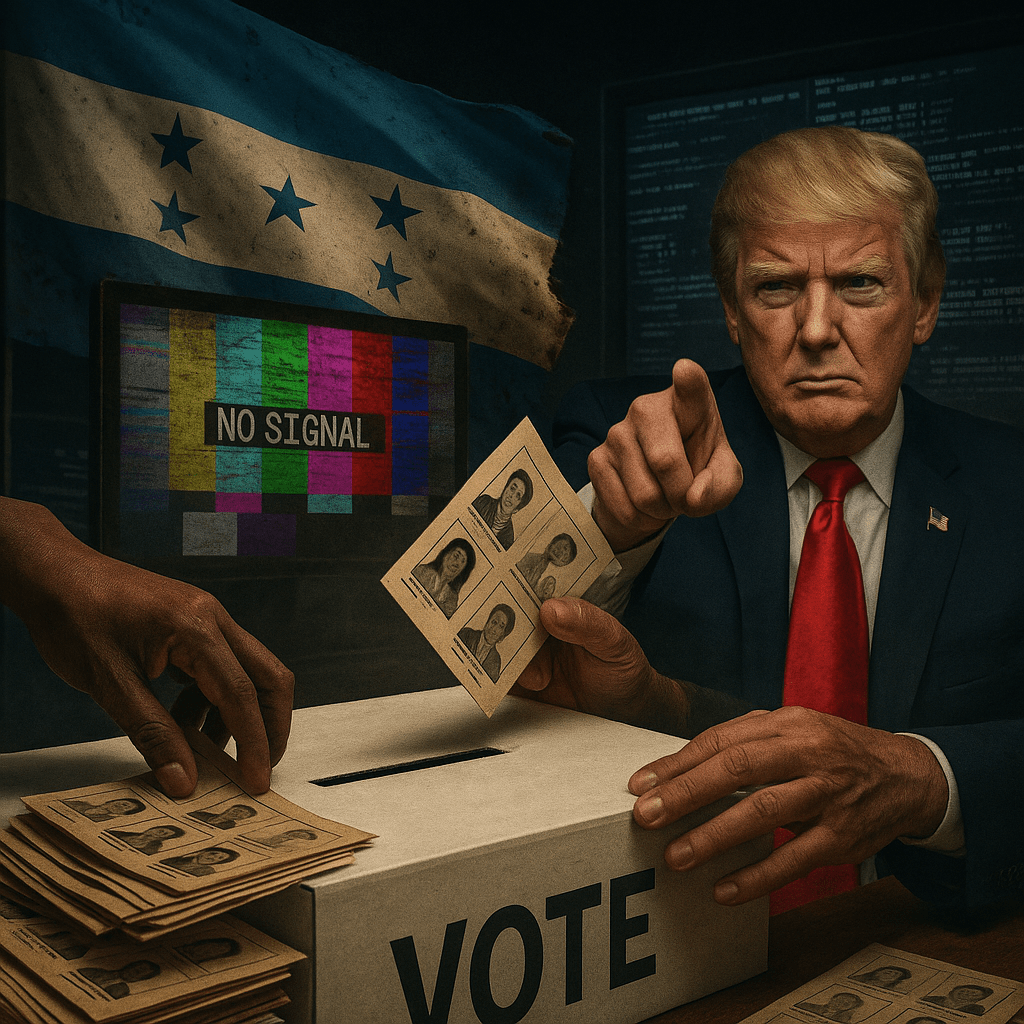
A close reading of The Guardian’s coverage reveals how liberal reporting turns a live electoral coup into a polite dispute. The fuller record shows a collapsing vote-counting system, withheld tally sheets, biometric inconsistencies, and open foreign pressure. These dynamics expose a deeper pattern in which imperial power and neocolonial compradors shape electoral outcomes across the region. Honduran movements—and their allies everywhere—now face the task of defending popular sovereignty against a democracy engineered from above.
By Prince Kapone | Weaponized Information | December 10, 2025
How The Guardian Turns a Live Coup Into a Polite Disagreement
The Guardian wants you to believe it is just calmly reporting the news from Honduras. No sides, no stakes, just a responsible liberal paper doing its duty. But if you read this piece on the so-called “electoral coup” with your class antenna switched on, you can feel the machinery at work. The words are arranged so that empire looks like a concerned observer, the Honduran oligarchy looks like a normal political force, and the people resisting all this get filed under “claims” and “allegations” that may or may not be true.
The article opens with President Xiomara Castro’s warning of an “electoral coup” and “interference from the president of the United States.” That sounds serious, like the kind of thing that should set off alarms. But before the reader can sit with that reality, the text starts quietly sanding it down. Castro’s position is immediately wrapped in quotation marks and legalistic language. She “alleges”; she “says”; she will “denounce” things. Her words are treated as a kind of loud background noise — dramatic, emotional, and in need of verification.
Notice what happens next. The article quickly pivots to the scoreboard: with “99.4% of tally sheets counted,” we are told, Nasry Asfura has 40.52% of the vote, and Salvador Nasralla 39.48%, a gap of 42,000 votes. The frame shifts from the president warning of a coup to a neat little statistical horse race between “two rightwing candidates.” The numbers are presented cleanly, almost soothingly, without telling you anything about how those numbers were produced, what broke down in the system, or who controls the machinery counting the votes. When the process itself is under question, the Guardian quietly doubles down on the numbers.
Trump’s role is introduced in the same calm tone, as if this is all very normal. We are told that Asfura “received open backing from Trump,” that the U.S. would support the next government only if he won. On the eve of the vote, Trump pardons Juan Orlando Hernández, the man once accused of building a “cocaine superhighway” to the United States. This is presented like the weather report: no outrage, no analysis, just “this happened.” The choice of language is surgical. Trump’s moves are not called blackmail, threats, or imperial interference. They sit in the paragraph like neutral events. It is Castro, not Trump, who is placed in the dock and made to prove her case.
The structure of the article keeps repeating the same move. Castro is quoted as saying that the election has been marked by “threats, coercion, manipulation of the TREP and the adulteration of the popular will,” and the Guardian immediately adds that she “presented no evidence.” That little phrase does a lot of work. It tells the Northern reader: “you don’t have to take this too seriously.” It suggests that the president of the country, dealing with a live crisis, is just throwing accusations around. There is no parallel sentence after Trump’s threats, no line that says: “Trump presented no justification for conditioning U.S. support on the victory of his preferred candidate.” The evidentiary burden is one-sided.
Even the way the candidates are described helps to domesticate the story. Asfura is introduced as a “construction magnate and former mayor,” a man with a profession and a respectable past. Nasralla is the runner-up, “claiming a monumental fraud” and demanding a recount. Moncada is simply “in third place,” with 19.29%, a number dangling there to give the impression that her camp is marginal and her complaints are more about frustration than substance. What’s missing is any sense of who these people represent socially, who backs them, whose interests line up behind each name. The Honduran ruling class is allowed to look like a set of individual personalities; the organized people are reduced to vote totals and angry quotes.
Pay attention to how the election authority is framed. The president of the electoral council, Ana Paola Hall, gets a chance to speak in a calm, reassuring tone: “I cannot tamper with the results, neither to help nor to harm anyone – and you know something, even if I could, I still wouldn’t.” It is a line designed for export — the dignified official defending the institution against the passions swirling around it. The Guardian prints it without question, as if solemnly nodding along. No mention of who built these institutions, who funds them, or how often they have served the same elite. Her declaration is treated as self-validating: the referee says she is neutral, and that is that.
The treatment of the “inconsistencies” in 14.5% of tally sheets is another quiet trick. The article acknowledges that thousands of votes are under review, but the language stays vague and bloodless. We are told that these tally sheets “showed ‘inconsistencies’ and must be reviewed,” and that there is time until 30 December to announce the result. The scale of that number — nearly one in seven tally sheets — is never unpacked. The reader is not asked to consider what it means for a narrow lead when such a large chunk of the vote is sitting in a gray zone. The problem is bureaucratized: not a potential theft of popular sovereignty, just paperwork that needs to be sorted.
Through all of this, the real power imbalance is flattened into a polite argument. On one side, a sitting president and a left candidate warning of an electoral coup and foreign interference. On the other, a U.S. president openly backing a preferred right-wing candidate, threatening consequences for voters, and releasing a convicted narco-politician tied to that same candidate. And yet the article packages it as a set of competing “claims” and “allegations,” as if everyone in the story were just another politician trying to spin the narrative. The empire becomes just one more voice in the room. Honduras is not presented as a country under pressure, but as a house with noisy family drama.
This is how liberal propaganda works in the imperial core. It does not scream; it tidies. It takes a living struggle and folds it into the narrow columns of “he said, she said.” It puts quotation marks around the word “coup” and leaves “U.S. support” floating there as if it were natural, inevitable, and harmless. It tells you exactly how many votes each candidate has, and almost nothing about what is being done to those votes, or by whom. It lets the powerful act without adjectives and forces the oppressed to speak in the conditional tense. Before we even get to the deeper history, the regional pattern, or the technical guts of this election, we can already see the outline of the operation: turn a live intervention into a respectable disagreement, and hope the reader never asks who is writing the script.
What the Record Actually Shows: Reconstructing the Facts Behind the Crisis
If Part I stripped The Guardian’s story down to its narrative scaffolding, then Part II lays out what the record actually shows—what was said, what happened, what was measured, and what the major outlets quietly left on the cutting-room floor. This is the part the working class of Honduras, and the rest of us looking on, deserve to see without filters: a clear, factual baseline reconstructed from The Guardian itself and from the independent reporting that fills the gaps the article refused to touch.
Start with what the Guardian did tell us. Honduras held its presidential election on 30 November 2025, and more than a week later the country still has no confirmed president. The official count stalled, lurched forward, and stalled again, as the electoral council’s website went dark through outages and unexplained maintenance breaks. In the preliminary tally, with 99.4% of sheets counted, two right-wing candidates—Nasry Asfura and Salvador Nasralla—hover a hair apart, separated by roughly 42,000 votes. The candidate backed by the sitting president, Rixi Moncada, trails in third. Trump openly endorsed Asfura, warned that U.S. support depended on his victory, and on the eve of the vote pardoned former president Juan Orlando Hernández, who had been serving a 45-year sentence in the United States for drug trafficking. President Xiomara Castro accused Trump of interference, coercion, and manipulation; The Guardian dutifully added that she “presented no evidence.” Nasralla cried fraud. The head of the electoral council insisted she could not tamper with the vote “even if I could.” The council says roughly 14.5% of tally sheets show inconsistencies and must be reviewed before the 30 December deadline.
But those are only the fragments that survived Western editorial triage. The broader record, spread across the work of Honduran, Latin American, and international outlets, paints a picture that is fuller, stranger, and far more alarming than the Guardian’s narrow portrait of a domestic quarrel.
For one, the electronic results system—the TREP—didn’t simply run slowly; it crashed, froze, and lost transparency repeatedly, with the CNE’s public-facing website going dark for long intervals. International wires and regional press confirm that updates stopped entirely at several critical moments, sometimes with only about 88% of sheets processed. The Organization of American States, usually a master of diplomatic understatement, publicly pressed the Honduran authorities to restore publication and produce a traceable, verifiable count. Even before election day, the TREP vendor—a private Colombian company contracted to run the system—faced serious connectivity and transmission failures during national simulations. And new information emerging this week shows the system suffered a serious security breach, involving unauthorized access, altered source code, and a results transmission platform that even the CNE’s own technicians could no longer vouch for.
The problem wasn’t just delays. It was what those delays concealed. According to data presented by electoral magistrate Marlon Ochoa, over 16,600 tally sheets—representing roughly two million votes—were retained by the TREP rather than processed normally. Of the 15,297 presidential-level tally sheets he reviewed, 13,246—86.6 percent—contained inconsistencies between biometric identity records and what appeared in the TREP. Taken together, those anomalies represent almost one million votes whose identity markers did not match the records they were attached to. These claims didn’t come from rumor or social-media agitation; they were presented in official press conferences and documented by multiple regional outlets that published the underlying figures.
Publication of results stalled precisely at the point where these inconsistencies mattered most. Long periods — sometimes more than 18 hours — passed with no updates. The CNE ultimately shifted to a manual scrutiny process, placing the roughly 14–15% of “inconsistent” tally sheets into special review, a move technically permitted but applied here at a scale that signals a structural breakdown rather than a routine procedural step. Today, that manual review of the inconsistent tally sheets is the only pathway left to determine an outcome that the electronic system failed to deliver.
Meanwhile, Honduras’s governing party, LIBRE, didn’t just cast doubt on the numbers—they filed a formal request to annul the presidential election and hold a new one nationwide. Several outlets, including Reuters, UPI, and Anadolu Agency have confirmed that the nullity petition is already in the hands of electoral authorities. LIBRE has also begun mobilizing its base to defend the integrity of the vote. Their internal parallel count, based on physical tally sheets, reportedly shows Salvador Nasralla—not Asfura—leading nationally. This directly contradicts the CNE’s preliminary count yet appears nowhere in The Guardian’s coverage.
Beyond technical failures, multiple audio recordings released by Honduran Attorney General Johel Zelaya point to a coordinated effort by senior figures of the opposition National Party, a member of the National Electoral Council (CNE), and elements of the armed forces to shape the outcome of the vote. According to a statement from the Progressive International Observatory, the recordings describe plans to infiltrate electoral observers, strike illicit deals with companies contracted for electoral logistics, and pressure international actors – including the U.S. embassy – not to recognize the result if Rixi Moncada won. In one of the audios, CNE councilor Cossette López allegedly states that “what matters is that they announce that Salvador Nasralla is winning, not Rixi Moncada,” suggesting a plan to project a premature and misleading result through the preliminary transmission system. A detailed investigation by Orinoco Tribune adds that the new leaks confirm a broader political-business structure previously flagged in 26 earlier recordings under investigation, and identifies National Party congressional leader Tomás Zambrano discussing with a telecommunications technician how to disrupt or delay the transmission of election results by weakening internet signals or simulating weather-related outages. Orinoco Tribune reports that the authenticity of the recordings has been confirmed by an international forensic review.
And all of this unfolds against a backdrop the article barely hints at: Hernández’s release from U.S. custody, the Attorney General’s immediate order to execute an international arrest warrant, and the fact that Hernández’s location remains unknown. His sudden reappearance in Honduras’s political ecosystem coincides with an election in which his allies stand to regain power.
There is also the structural setting that gets lost when reporting focuses only on daily statements and campaign drama. Honduras carries more than a decade of contested elections behind it, from the 2009 coup that broke constitutional order to the irregularities documented in subsequent electoral cycles. The country’s security apparatus is deeply entangled with U.S. regional operations. Its electoral infrastructure is partially privatized and dependent on a contracted Colombian firm to run core transmission systems, with pre-existing technical vulnerabilities openly exposed during national simulations before the vote. And the adoption of AI-driven result-processing systems introduced failure points that existing safeguards were not able to secure, as later documented by an international incident report on unauthorized manipulation of the transmission platform.
Taken together, these facts produce contradictions that the Guardian’s coverage avoids naming. The article treats the crisis as little more than competing allegations, even as independent reporting documents systemic breakdowns. It applies an evidentiary burden to Castro that it does not apply to Trump. It mentions the 14.5% inconsistent tally sheets without acknowledging that these sheets are the ones decisive for determining the winner. It omits the nullity petition, the internal parallel count, the reports of TREP breaches, and the extended periods during which the public was left without updated results. By presenting the crisis as purely domestic dysfunction, it erases the emerging evidence of international coordination and technical compromise inside the vote-counting system itself.
This is the factual terrain on which any honest analysis must stand: a documented collapse of electoral infrastructure, a pile of unresolved inconsistencies, a contested preliminary lead, a government seeking annulment, and a foreign power applying pressure at the most sensitive moment. Before we can interpret these events, we must first acknowledge them plainly—because the people of Honduras already live with their consequences.
What the Guardian Cannot Say: Seeing the Crisis With the Eyes of the People
If you put all the fragments on the table – the crashes, the “inconsistencies,” the leaked audios, the foreign threats, the missing narco-president – you don’t get a picture of a clumsy, unlucky election. You get a managed process. The Guardian gives you one slice of that story, told from the balcony of the people who need Honduras to remain predictable. What we’re doing here is walking down to street level, picking up every loose fact, and putting them back together from the standpoint of those who actually have to live with the outcome.
Start with the most basic thing: Hondurans voted, and the system choked. The electronic results platform failed in exactly the way you’d design it to fail if your goal was to create confusion at the decisive moment. The site goes dark, the updates stop, the count freezes with a tight right–right race on the screen and the bulk of “inconsistent” tally sheets still in limbo. Almost a million biometric records don’t line up with the votes they’re attached to. Instead of a clean, transparent count, you get a twilight zone: a preliminary lead for the Trump-backed candidate, a huge reservoir of contested votes, and a public asked to “wait patiently” while the same institutions that oversaw the breakdown promise to sort it out.
Now lay next to that the oligarchs’ own words. Weeks before the vote, top figures from the National Party, a CNE councilor, and military actors are caught on tape discussing how to tilt the field. They talk about infiltrating observers, pressuring logistics companies, bending international opinion, and projecting a premature narrative that “Salvador Nasralla is winning, not Rixi Moncada.” Another conversation explores how to slow or block transmissions – flick the lights on and off in the counting room by playing with the internet. At the time, these audios are treated in the North as a curious scandal. After election day, they read like a project plan.
Because what happens next follows the script. The TREP does exactly what they were talking about: it becomes a projector, not a mirror. It stalls, distorts, withholds. It delivers an image of Honduras where the left candidate is pushed into a distant third, two right-wing figures dominate the frame, and the fight is narrowed to which version of the old order will sit in the presidential chair. One of those right-wing figures, Nasralla, ends up shouting fraud himself – but from the point of view of empire that’s just a complication, not a problem. The important thing is that the real threat – a government aligned with popular movements, willing to push against U.S. dictates – is safely off the board.
Over all of this hovers Washington. Trump doesn’t hide his hand; he waves it in people’s faces. He says outright that U.S. support depends on Asfura’s victory. He threatens consequences if Moncada wins in a country where remittances and aid are lifelines. He pardons Juan Orlando Hernández – the man convicted of running the state like a narcotics franchise – right on the eve of the vote, sending a clear message to the old power networks that the doors of impunity are open again. The multilateral chorus plays its usual role: praise the peaceful election day, frown at the delays, call for “stability” and “respect for institutions,” and never ask who those institutions actually serve.
Then there’s the technical machinery, treated by liberal media as a neutral backdrop, like the weather. In reality, it’s the new face of the same old control. A privatized transmission system, contracted out to a foreign firm, fails its simulations and is deployed anyway. An AI-driven results engine, sitting in a black box that voters can’t see into, is later revealed to have been accessed and modified without authorization. The very pipeline that turns physical votes into numerical projections is in the hands of actors no one elected, answerable to contracts and power relationships, not to the barrios lining up at the polls. This isn’t just “digital modernization.” It’s the wiring of the electoral process into a network where capital, consultants, and foreign states all have more grip than the people who actually vote.
When you line up the social forces, the picture gets even clearer. Asfura is not just a man with a hardhat and a résumé; he sits at the junction of construction capital, the old National Party machine, and the narco-state that flourished under Hernández. Nasralla channels another layer of discontent within that same class order – a different faction of the same crowded table. Moncada, whatever her limits, is the candidate tied most directly to the recent break with that order: modest redistributive programs, attempts to recover some state control, gestures toward regional integration beyond Washington. In that context, it makes perfect sense that every camp is now shouting “fraud,” yet only one man’s provisional lead is treated as the natural baseline. The managed democracy has room for quarrels inside the bloc; it has no patience for a project that might change who sits at the table.
That is the real story this election is telling, if we listen to it from below. A ruling class that lost full control in 2021 is testing a new method to get it back: not an open military coup this time, but an electoral coup conducted through digital chokepoints, institutional paralysis, and foreign leverage. A narco-oligarchic network is probing how far it can go under the cover of “technical issues.” An imperial power is once again treating Honduran sovereignty as collateral in its own strategic game. And a people who have buried comrades in past uprisings are refusing to accept that a screen glitch and a press release can overrule their votes.
Seen from the barrios, the villages, the roadblocks, this is not a story about a fragile democracy that needs patience. It is a story about a popular will that keeps trying to break through, and a system that keeps finding new ways to smother it. The Guardian’s article gives you the surface: the quotes, the numbers, the official statements. Reassembling all the evidence, we see something else: a managed election whose outcome is being engineered from above, and a country that is once again being told to accept theft as “stability.” The people of Honduras are answering that message in the only language the powerful truly understand – organization, refusal, and the insistence that their future cannot be decided in someone else’s boardroom or war room.
From Crisis to Struggle: Building the Front That Can Defend the Popular Will
Once we recognize that the Honduran election is not simply malfunctioning but being managed, the question shifts from “What happened?” to “What must be done?” If the crisis has revealed anything, it is that the defense of democracy in Honduras will not come from the institutions now presiding over its erosion. It will come from the forces already mobilizing in response: the party bases demanding accountability at local counting centers, the social movements documenting irregularities in real time, the Indigenous and campesino organizations invoking their long history of resistance, and the labor unions warning that political manipulation always precedes social austerity. These are not abstract actors. They are living fronts of struggle, each positioned at a vital line of defense against the consolidation of a manipulated outcome.
Around the country, ordinary Hondurans are gathering outside departmental electoral offices, not in the spirit of partisanship but with a simple demand: count every vote transparently. They know the signs of an engineered result. They remember the 2017 election, when irregularities emerged in the dead of night and the authorities declared continuity for an increasingly authoritarian project. They remember the 2009 coup, when the people were told their sovereignty was suspended for their own good. The memory of these betrayals forms the political soil in which today’s mobilizations are rooted. The protests, vigils, and marches unfolding across the country are not spontaneous reactions; they are the accumulated knowledge of a working class and peasantry who have learned to recognize when the future is being stolen.
Regionally, too, we see movements that offer lessons for the present moment. Bolivia’s grassroots organizations, which returned their stolen democracy through disciplined mobilization; Brazil’s Black and Indigenous movements, which resisted judicial and digital warfare; Chile’s student and workers’ coalitions, which confronted the legacy of Pinochet’s constitution. In each case, people understood that an electoral attack is never just about ballots—it is about the larger project of reorganizing society to serve elite and foreign interests. The Honduran struggle is part of this same continental front, and its victory or defeat will reverberate far beyond its borders.
For those of us in the Global North, solidarity must begin by refusing the narratives being fed to us. We cannot outsource our understanding of Honduras to institutions that describe managed democracy as a technical glitch and imperial pressure as neutral “concern.” That means supporting and amplifying the reporting coming from Honduran journalists, community radio stations, and independent observers. It means pushing back against the silence or complicity of our own political parties and media outlets. It means treating Trump’s threats and the manipulation of remittance-dependent families as the political coercion they are—not as eccentric foreign policy gestures.
Practical solidarity also includes strengthening the platforms that Honduran social movements rely on: raising funds for legal teams working to preserve evidence of irregularities; supporting organizations that provide material assistance to communities mobilizing to defend the vote; amplifying the voices of Indigenous, Afro-descendant, feminist, and campesino groups that historically bear the brunt of political repression. These are not symbolic actions—they are interventions that sustain the capacity of a people to resist when the machinery of the state is turned against them.
Finally, the struggle requires political education. The Honduran crisis must be understood not as an isolated episode but as a window into the broader system that binds the hemisphere. Every manufactured electoral breakdown, every judicial maneuver, every external threat is part of a pattern: prevent the emergence of governments that challenge extraction, resist neoliberal orthodoxy, or seek alliances beyond Washington. By naming this pattern, we help equip workers and students in the Global North to recognize similar tactics at home—where their own rights are being eroded under the guise of democratic procedure.
The Honduran people are not asking the world to save them. They are asking us to stand in truth with them as they defend their sovereignty against forces that have undermined it for generations. What happens next—whether the election is annulled, whether the streets force transparency, whether the oligarchy tightens its grip—will depend on the strength of these popular movements and the solidarity they can count on. This moment is not merely a hinge in Honduran politics but a test for all of us: whether we will continue to accept democracy as a spectacle managed from above, or join the movements fighting to reclaim it as the practice of a people determined to choose their own destiny.
 Weaponized Information
Leave a comment