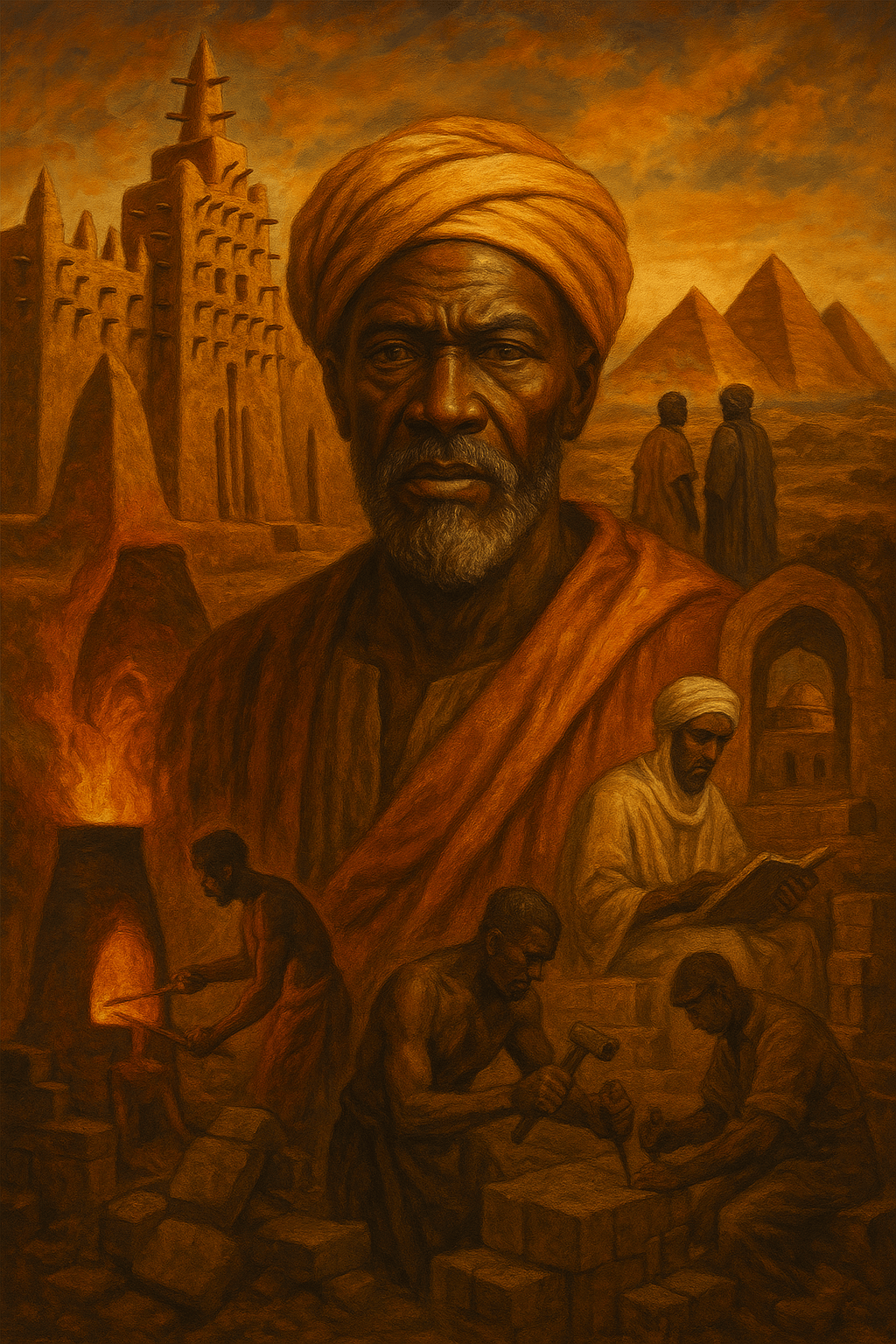
Cheikh Anta Diop’s Precolonial Black Africa shows—through hard historical evidence—that Africa followed its own material pathway to complex civilization, disproving Europe as the universal model and exposing Western Marxism’s blind spots. For today’s revolutionaries, Diop arms us with the historical clarity needed to dismantle colonial ideology and rebuild a truly internationalist, anti-imperialist science of liberation.
By Prince Kapone | Weaponized Information | November 29, 2025
When “Inferior Castes” Refuse to Rise: Caste, Abundance, and the African Difference
Cheikh Anta Diop opens Precolonial Black Africa with what looks, at first glance, like a narrow sociological question: how did the caste system work in Black Africa? But what he is really doing is setting a charge under the entire Eurocentric story of “universal” social development. If you listen closely, you can hear him saying to Europe and to Western Marxism both: your experience is not the template for humanity, and your categories do not capture our reality.
Diop starts from the ground up, from lived relations, not from abstract schemas. He takes Senegal as a concrete example and lays out a social order divided into gor (freemen) and djam (slaves). Within the freemen, there are the gér – nobles and farmers – and the ñéño, the hereditary artisans: blacksmiths, goldsmiths, shoemakers, griots. Already this is a different universe than feudal Europe. Agriculture is not “low” work; it is a sacred activity. The artisans, the so-called “lower” caste, are not despised drudges squeezed dry by lords. They are bearers of specialized skill, wealth, and social dignity.
And here Diop delivers his first hammer blow against the European norm. In this African caste system, the “superior” caste cannot openly exploit the “inferior” without disgrace. A noble who hoards and squeezes is seen as shameful. He is obliged to give to those beneath him if they ask, even if he is not particularly wealthy himself. The artisan, in turn, keeps the fruits of their own labor and adds to it what the noble must hand down to maintain honor. In other words, the manual worker’s material condition is improved by the relationship, not stripped bare by it. The very people who, in European history, became the social base for revolution – the artisans and urban poor – are here stabilized, even satisfied.
Diop pushes the point further: in this kind of system, if a revolution came, it would most likely come from above, not from below. The artisans, cushioned and respected, defend the monarchical regime or nostalgically mourn its loss. The slaves of the father’s household and the poor peasants – the bâ-dolo, literally “those without power” – have reasons to rebel, but lack the organizational space, the concentration, and the allies that made bourgeois revolutions possible in Europe. The peasant majority feeds the nation, but out of caste pride they will not “lower themselves” to ally with slaves. What you get, Diop suggests, are palace coups and uprisings against bad princes, not systemic overturning of the social order.
This is where your typical Western Marxist starts to get dizzy. The whole theoretical habit, drilled in European universities, is to map everything onto the familiar story: feudal landlords, rising bourgeoisie, dispossessed peasantry, the city plebs, the heroic working class waiting in the wings. Diop is saying: that script does not apply here. The dynamic elements – the people whose discontent “should” be explosive – are often satisfied or structurally tied into the regime. The contradictions are real, but they are not the same contradictions that shaped Paris or London.
Why is that? Diop refuses the lazy answer: that “Africans were stagnant” or “pre-political.” Instead he points to the material base. The caste system arises out of an advanced political regime, not a primitive one. It grows out of division of labor inside large, centralized monarchies like Ghana and Mali, with dense urban centers, extensive trade networks, and long periods of material abundance. Land is not hoarded and fenced by lords; it is sacred, entrusted to the community and to the spirit of the earth. The king can own people, tax production, direct war and trade – but he does not walk around feeling like a feudal landlord with the soil itself in his pocket. That single material fact – that land is not a commodity in the same way – deforms the entire European analogy.
In this context, hereditary trades and castes function less like chains on the productive forces and more like a stabilizing grid. A craft is passed down as a kind of sacred trust with the ancestors and the spirits who first taught the art to humanity. You don’t just “switch careers” because the market says so; you belong to a line of work the way you belong to a lineage. That can absolutely become a brake on change. But it also means that African societies are held together by a thick web of obligation and mutual recognition, not just naked economic compulsion. When material life is relatively abundant and long stretches of prosperity are normal, as Diop insists they were, the ruling regime is underwritten not by terror alone but by habits of reciprocity.
For revolutionaries reading this today, especially those formed in the Euro-American Left, Diop’s argument is a necessary slap in the face. He is not romanticizing African monarchies; he is dissecting them. But he is also forcing us to see that Africa’s “stability” and “lack of revolutions” were not signs of backwardness. They were the political expression of a different material trajectory, one in which abundance, sacred land tenure, and a caste system built around protection and reciprocity produced a relatively stable equilibrium. Europe’s path – scarcity, land hunger, feudal expropriation, and endless peasant wars – is not the universal yardstick. It is one provincial experience, elevated into dogma by an imperial academy.
Part I of this book, then, is not a detour. It is Diop’s way of clearing the ground. Before we can compare Europe and Africa, before we can talk about “modes of production” and “stages of history,” we have to break the mental habit of treating Europe as the measure of all things. The African caste system is his first weapon: a concrete demonstration that a society can be complex, stratified, and highly organized without reproducing European feudalism, and that the revolutionary subject in Africa cannot simply be copied from the European script. For Weaponized Information, this is where we begin: with a refusal to let the colonial experience of Europe define the possibilities of the human future.
Where Scarcity Turns Men Into Wolves: Europe’s Ancient City and the Birth of Class War
If the opening chapter of Diop’s work forces us to unlearn the European script, the second chapter demands something even harder: to recognize Europe as an exception to human development, not its model. Diop takes us into the streets of ancient Athens and Rome, and he doesn’t bother with the romantic postcards—the marble columns, the heroic philosophers, the myth of democracy. He shows us the real foundation beneath it all: a world formed under the whip of scarcity, competition, and chronic insecurity. In Europe, the city is not a monument to human progress—it is a battleground carved out between the hungry and the powerful.
Diop lays out the class structure of the ancient city with a surgeon’s clarity. At the top: the Eupatridae, the “well-born,” whose very name drips with the smug entitlement of a ruling caste. Below them, the plebs, squeezed by debt, stripped of land, shuttling between slavery and near-slavery depending on the season. Below even them, the slaves—war captives and debtors, the living instruments of the masters’ political and economic ambitions. And unlike Africa, where artisans were respected specialists and peasants were sacred feeders of the nation, Europe’s working masses were disposable material. To be poor in Athens was to be one bad harvest away from bondage.
What follows logically from these conditions is what Diop calls the “aristocratic revolution”—that is, the internal warfare within the ruling class, as nobles fought each other for spoils extracted from the labor of a volatile urban poor. Abundance in Africa had stabilized its caste system; scarcity in Europe destabilized everything. The city became a pressure cooker. Reforms came not from consensus or constitutional negotiation but from fear—fear of revolt from below, fear of rival noble factions, fear of the perpetual instability that hunger produces. This is why the European political imagination, even in its celebrated “democratic” moments, is saturated with suspicion: every citizen might become an enemy when the granaries run low.
This is where Diop’s anti-Eurocentric method shines. He does not deny the accomplishments of ancient Greece and Rome—he simply refuses to detach them from the material origins that produced them. The Western academy talks endlessly about “individualism,” as if the European individual burst from the womb declaring his rights. Diop shows that this individualism was the psychological scar tissue of a society forged in conflict. The Greek citizen learns to prize “autonomy” because he lives in a world where the community is too weak, too fractured, too precarious to protect him. The Roman citizen clings to legal status because the alternative is slavery.
In Africa, Diop reminds us, the vitalist concept of community—of life as a shared force—made individualism unnecessary. The village and the clan were durable; land was inalienable; kinship was binding; wealth circulated downward as much as upward. In Europe, by contrast, the city became a battlefield of atomized men, fighting for position because the social fabric could not hold them. Out of that fracturing came the philosophical tradition that Europe boasts about today: the obsession with the individual, the idea of the autonomous subject, the moral universe centered on the self. These are not universal truths—they are ideological adaptations to material scarcity.
Diop’s analysis also undercuts one of the great myths of Western Marxism: that Europe’s class structure represents a universal evolutionary stage that all societies must pass through. But the ancient European class system was the product of specific material forces—low agricultural productivity, fragile soil, dependence on slave labor, and demographic pressures that repeatedly tipped the society into crisis. There is nothing universal about it. It is provincial, particular, and peculiar.
Marxists formed in the European tradition often assume that the proletariat, the bourgeoisie, the peasantry, and the nobility are timeless categories—the inevitable cast of characters in every human drama. Diop teaches us otherwise. The “plebeian” of Rome is not the “bâ-dolo” of Senegal; the Athenian slave is not the African djam. The relations of production that drive European social conflict do not map neatly onto African soil. Africa’s stability was not stagnation—it was a response to different ecological conditions and different economic structures. Europe’s instability was not dynamism—it was the predictable outcome of a region chronically at war with its own geography.
Diop ends this section with a devastating insight: Europe’s political evolution—its revolutions, its republicanism, its philosophical ferment—was driven not by superior rationality, but by the violent contradictions of a society built on scarcity and social fragmentation. Africa, abundant and stable, did not produce the same forms because it did not need to. This is not cultural relativism—it is historical materialism stripped of Eurocentric delusion.
For us at Weaponized Information, this chapter is not just a comparative exercise. It is a political intervention. Diop forces the revolutionary movement to reject the false universalism of Western Marxism and to recognize that revolutionary strategy must grow from the soil beneath our feet—not from abstractions imported from Athens or Paris. To understand Africa, we must first understand that Europe’s path is the exception, not the rule. To build a new world, we must stop mistaking Europe’s nightmares for humanity’s destiny.
The Middle Ages Were No “Stage of Development”: Europe’s Feudal Crisis and the Poverty That Built a World-System
By the time Diop turns to the formation of the modern European states, he is done entertaining the fairy tales. He strips feudal Europe of its medieval romance and reveals it for what it was: a continent staggering through a thousand-year bottleneck of scarcity, war, disease, and class violence—conditions that Europe later exported as “universal history.” If the ancient city was Europe’s first crucible of conflict, the Middle Ages were its long hangover, a period defined not by chivalric nobility but by chronic instability and what Diop calls the “stagnation” of its political and technical life.
In Western textbooks, feudalism appears as an elegant schematic: lords, vassals, serfs, land tenure, and the slow march toward centralized states. But Diop reminds us that feudalism developed because Europe was locked into a miserable agricultural regime. The land was poor, divided, and fought over. Soil exhaustion was constant. Harvest failures arrived like clockwork. Population pressure overwhelmed resources. Under these conditions, the landowning aristocracy tightened its grip not because of some divine right but because controlling land meant controlling the margin between life and starvation.
Here Diop draws another decisive contrast with Africa. In West Africa the land is sacred, held in trust by the earth-priest and the community. Ownership is spiritual stewardship, not commodity title. You cannot accumulate land the way European barons did, because land does not “belong” to a lord—it belongs to the people and the earth itself. This single material difference is enough to derail the entire idea that feudalism is a universal stage in human development. Feudalism only emerges where land can be hoarded and humans reduced to bound labor attached to that hoarded soil. Africa’s land tenure system, rooted in abundance and sacred reciprocity, made feudalism materially impossible.
And so Europe, locked in scarcity, followed a path shaped by necessity. Diop explains how the European Middle Ages were characterized by a violent decentralization: fragmented lordships, endless petty wars, and a Church that functioned not as a spiritual refuge but as the ideological police of a collapsing order. Theology was the feudal superstructure: a metaphysical cover for a society incapable of meeting the basic needs of its population. Where African social organization privileged coexistence and constitutional balance, Europe produced a rigid, punitive hierarchy masked as divine harmony.
This is the part Western Marxists like to rush through—the part where their linear narrative of history starts to wobble. In their script, feudalism is the necessary chrysalis out of which capitalism emerges. The bourgeoisie overthrows the nobles, industry replaces land, science replaces superstition, and Europe surges ahead. But Diop reminds us that this trajectory is not the upward march of progress—it is a desperate improvisation by a continent trapped in a structural crisis. Europe did not “develop” through feudalism; it crawled out of feudalism by looting the rest of the world.
In fact, the modern European state—the centralized monarchies of France, England, and others—could only form once external plunder became available. The Crusades, the Reconquista, the Atlantic slave trade, and the colonization of the Americas were not accidents added on later. They were the solution to Europe’s internal collapse. As Diop shows, European society lacked the internal material base to sustain state-building. Expansion, enslavement, and extraction became the lifeline that allowed feudal monarchies to consolidate into “modern” nation-states. Without Africa’s gold, America’s silver, Caribbean sugar, and Indigenous genocide, Europe would have remained a cluster of hungry, warring baronies.
Diop’s point cuts deeper than most conventional anti-colonial critiques. He is not just saying Europe stole wealth—which it certainly did. He is saying Europe’s entire social evolution, the thing Western Marxism treats as a “stage,” was a local pathology built on scarcity. When Europe finally stabilizes, it is not because feudalism “naturally evolved” into capitalism. It is because Europe forcibly plugged itself into the abundance of Africa, Asia, and the Americas. Europe’s development is a global crime scene, not an internal triumph of rationality.
The ideological consequence of this, as Diop notes, is the intellectual Middle Ages—the long night where philosophy, science, and inquiry are policed by the Church. This era produces not enlightenment but mental enclosure. Europe emerges from this cage only when it can siphon wealth from the outside world. The Renaissance, often celebrated as Europe’s rediscovery of reason, is in reality Europe’s rediscovery of African and Arab knowledge, financed by colonial extraction.
For Weaponized Information, this section is a key pivot. Diop is exposing a double lie: the myth that Europe’s trajectory is universal, and the myth that Africa “lacked” the dynamism Europe displayed. Europe’s dynamism was not internal—it was parasitic. Africa’s stability was not stagnation—it was sustainability. The European Middle Ages are not a stage on the ladder of humanity but a cautionary tale about what scarcity does to a society. The sooner we stop treating Europe’s crisis-ridden path as the mirror in which all humanity must see itself, the sooner we can begin to imagine futures rooted in abundance rather than perpetual war.
Constitutions Without Feudalism: How African States Engineered Stability, Power, and Collective Life
By the time Diop arrives at the political organization of precolonial Africa, the contrast with Europe is so sharp it could cut glass. Europe clawed its way through feudal misery, centralizing power only after centuries of famine, plagues, peasant wars, and aristocratic bloodletting. Africa, on the other hand, built monarchies, constitutions, and administrative systems without ever passing through feudal fragmentation. Diop is reminding us—sometimes gently, sometimes with a machete—that Africa did not wait for Europe to teach it governance. African political systems were sophisticated because they had to be: they managed abundance, not scarcity.
Diop takes us into the political blueprints of places like Cayor, Ghana, Mali, Songhai, the Mossi states, and the Lebou “republic” of Cap-Vert. What emerges is a picture totally alien to European political evolution—not because Africa was “primitive,” but because its material conditions made certain political forms unnecessary and others inevitable. In Africa, the king was powerful, yes, but never absolute. His authority was checked by councils of nobles, artisans, elders, slaves in some cases—even the very castes that Europe would have excluded from politics entirely. Power was not centralized in the hands of landowning warlords, because private landownership had no foothold in a society where the earth was sacred and communally held.
Take Cayor, for example: the king (the damel) ruled, but he ruled in the presence of a constitutional cabinet representing every part of society. Even the commander of the slaves—the djarâf Bunt Keur—was a political heavyweight whose defection could topple the state. This is not feudal hierarchy; this is power shared across caste lines in a way that ensured every group had a stake in the survival of the polity. Diop’s point is unmistakable: African monarchies were not autocracies floating above the people. They were balanced regimes built on broad participation and binding social ethics.
Or consider matrilineal succession in Ghana and Mali. Europeans have spent centuries pretending lineage-based transfers of power are “irrational.” Diop demonstrates that these systems were actually brilliant safeguards against dynastic chaos. In a patrilineal regime, every ambitious son becomes a potential usurper; in a matrilineal regime, succession is predictable, and the king’s own children cannot throw the kingdom into civil war. The Africans solved in one stroke a problem that plagued Europe for a thousand years. While European courts drowned in conspiracies, regicides, and contested claims, African states secured continuity without bloodshed by simply rooting power in the maternal line.
Songhai adds another layer: the careful integration of Islamic scholarship with African political rationality. The king of Songhai was not a caliph; he was a ruler in a constitutional African monarchy that adapted Islam to local traditions without surrendering sovereignty. The state’s judicial, administrative, and religious structures were intertwined but never conflated. Europe, by contrast, fused church and state in a suffocating chokehold until the Enlightenment pried them apart with force.
Diop also highlights the Lebou “republic,” an African polity with elected officials, checks on executive power, communal land structures, and local autonomy. Here again, he is forcing us to confront something Europe cannot explain: that republican forms existed in Africa long before Europeans invented parliaments or constitutional monarchies. The Lebou case is not an outlier—it is a reminder that African societies experimented with representative governance on their own terms, rooted in their own material logic.
What makes all of this possible, Diop insists, is the African relationship to land. In Europe, private land ownership is the foundation of both feudalism and the emerging bourgeois order. In Africa, the land belongs to no individual—not even to the king. The earth is sacred, alive, a collective trust. You cannot carve it into fiefs or sell it to the highest bidder. This is why African states never developed European-style aristocracies. Without landlords, you cannot build a feudal order. Without feudalism, you cannot import Europe’s class antagonisms. Without those antagonisms, you do not need revolutions to stabilize power—you need constitutions.
Diop’s analysis is devastating to both colonial historians and Western Marxists. Colonial historians claimed Africa had no political life; Western Marxists claimed African states must be read through European categories: aristocracy, serfdom, despotism, primitive accumulation. Diop says: no. Africa’s political systems were what they were because Africa’s material foundations were different. African states did not fail to become Europe—they consciously chose forms that stabilized society, distributed obligations, limited exploitation, and tied rulers to collective norms.
For Weaponized Information, this chapter is a strategic resource. It exposes the lie that Africa’s political history is a prelude to colonialism. It shows that Africa had working constitutional orders, administrative sophistication, and rational governance long before Europe unified itself. And it challenges the U.S.-centric left, which still thinks history moves through one narrow tunnel dug in the soil of medieval Europe. Diop’s Africa tells us otherwise: there are many ways to build a state, and not one of them requires Europe’s blueprint.
Empires Without Chains: Ghana, Mali, Songhai and the African Science of Power
When Diop turns to the great African empires, the tone shifts again. The earlier chapters dismantled the lazy Eurocentric myths; here he builds. He shows us states so vast, so organized, so materially rich that Europe—still crawling out of its feudal mud—could only gape in astonishment. Ghana, Mali, Songhai: these were not tribal kingdoms drifting in a prehistorical haze. They were continental powers, centralized monarchies, administrative machines, and economic giants whose political sophistication and territorial reach rivaled the major empires of the Old World.
In the European imagination, an “empire” is inseparable from conquest, serfdom, and hereditary aristocracies. But in Africa, empire formation follows a different physics entirely. As noted, Diop shows that African empires are built not on private ownership of land but on control of people, office, and trade routes. Wealth flows through taxation, gold extraction, tribute, and commercial regulation—not from squeezing peasants tied to a plot of soil. This changes everything. Without a landed aristocracy, you have stability rather than feudal fragmentation. Without feudal fragmentation, you have political unity rather than endless civil war. Without endless civil war, you have administrative coherence rather than famine and collapse.
Ghana proves the point. The Arab chroniclers who witnessed it in the 10th century were stunned: a dual-capital city, split across the Niger, housing merchants, artisans, royal courts, and foreign residents. Its kings commanded gold mines, cavalry divisions, tributary states, and a multiethnic administrative apparatus. Ghana’s strength lay in its ability to maintain order across vast distances—and to integrate diverse peoples without hereditary land lords draining them. Where European kings could barely control the next valley over, Ghana managed trans-Saharan commerce and international diplomacy.
Mali elevated this to another level. Under the mansas—especially Mansa Musa—the empire became a global economic node. The state managed gold, copper, salt, agricultural production, taxation, and long-distance trading caravans with a precision that made it one of the wealthiest political entities on earth. Their administrative structure included governors, tax collectors, judges, royal messengers, military captains, and scribes fluent in Arabic and local languages. Mali’s strength was not simply its gold—it was the way the empire organized labor, tribute, and trade without coercive feudal landlords choking the countryside.
Songhai, the giant of the trio, perfected the architecture of power. Its government was divided into ministries: finance, agriculture, justice, foreign affairs, military command. Each region had a governor; each governor had auditors; each auditor had inspectors. The cavalry and infantry were professionally organized. The state managed river fleets, fortifications, supply chains, granaries, local courts, and commercial tariffs. Songhai had a working bureaucracy at a time when European monarchies were still struggling to standardize weights and measures.
And yet—in the African mode—power never slipped fully into despotism. The king was bound by councils, rituals, obligations, and sanctions. He had to feed the people, protect the castes, respect the sacred land, and maintain the moral order. African political power was conditional. The king who violated those conditions could be deposed—not by chaotic rebellion, but through institutional mechanisms that predated colonial constitutionalism by centuries.
Diop’s analysis of the military is another blow to Western fantasies of African “tribal warfare.” These empires had cavalry trained in coordinated maneuvers, infantry divisions drilled in formation, specialized flanking units, and logistical systems to support long campaigns. Songhai even deployed river flotillas—something Europe could not do on its own rivers with comparable coordination until much later. African armies were not mobs; they were professional forces tied into state institutions.
The judicial systems were equally rigorous. Local courts settled disputes, royal courts heard appeals, and the king’s justice was neither arbitrary nor mystical. Law in these empires was not theocracy—it was social ethics codified in custom and enforced through rational procedures.
What emerges from all this is devastating to the mythology of Western Marxism and colonial scholarship. Europe’s “rational bureaucracy”? Africa had it. Europe’s “state centralization”? Africa had it. Europe’s “military organization”? Africa had it. Europe’s “administrative unity”? Africa had it long before Europe. But Africa had all of this without the brutal infrastructure of serfdom and feudal extraction that defined medieval Europe. African empires were not perfect—they had contradictions, exploitation, slavery, internal rivalries—but their social foundations were fundamentally different.
For us, this chapter provides the ammunition needed to finally bury the colonial claim that Africa had no states, no governance, no rational political order before Europe arrived. Europe did not “introduce” the state to Africa. It dismantled African states to build an imperial order. Diop is clear: Africa’s empires fell not because they were weak or primitive, but because the Moroccan invasion, the Atlantic slave trade, and European gunpowder capitalism shattered the equilibrium these societies had built over centuries.
In short: Africa had states. Africa had empires. Africa had administration. Africa had political theory. And it had all of it without Europe’s feudal nightmare. If Europe claims a monopoly on political rationality, Diop’s fifth chapter is the quiet, measured, scholarly reply: absolutely not.
Economies of Abundance: African Wealth, African Labor, and the Material Basis Europe Refused to See
Up to this point, Diop has dismantled Eurocentric mythology piece by piece—caste, political structure, state formation, imperial organization. But it is in his treatment of Africa’s economic foundations that he detonates the deepest colonial lie: the myth of African poverty. Europe has spent five centuries selling this fiction because its entire imperial project depended on it. If Africa was poor, then Europe could pretend it “brought development.” If Africa was wealthy, then colonialism becomes what it truly was—armed robbery on a planetary scale. Diop’s sixth chapter clarifies the historical record: Africa was not poor. Africa was wealthy, organized, productive, and economically rational long before Europe emerged from its agrarian crisis.
Diop begins with barter—not as relic or rumor, but as a structured system of exchange linking villages, regions, and empires. Barter in Africa was not primitive; it was efficient. When money was unnecessary, Africans did not fetishize it. When money was useful, Africans produced it. Forms of currency—gold dust, cowries, copper rods, cloth—circulated widely. Market specialization emerged naturally: women dominated local markets; guild-based castes managed metals, textiles, and luxury goods; long-distance traders moved salt, kola, gold, and horses across thousands of miles. This was not random commerce. This was a continental economy.
Diop emphasizes something Western scholarship carefully avoids: African wealth was grounded in abundance. Unlike medieval Europe—ravaged by soil exhaustion, famines, and land scarcity—Africa had fertile agricultural zones capable of supporting dense populations without overexploitation. Millet, sorghum, rice, yams, palm oil, and cotton sustained regions with stability that Europe envied. These high yields produced surpluses, and those surpluses fed cities, courts, caravans, and armies. In Europe, scarcity drove social violence; in Africa, abundance generated equilibrium.
This does not mean African economies were static. Diop shows how African rulers extracted taxes, customs duties, and tribute—not through feudal coercion, but through administrative systems embedded in social reciprocity. Wealth flowed up to the state, and wealth flowed down to the people. Royal treasuries managed gold production; nobles redistributed land use; artisans produced goods in hereditary but respected trades; slaves contributed labor without being the foundation of the entire economy. In Europe, serfs fed the ruling class. In Africa, farmers—mostly free—fed the nation.
The difference is historical and material, not civilizational. Europe’s ruling class lived off the coercive extraction of peasant labor. Africa’s ruling class lived off trade, taxation, and political obligation. Europe needed serfdom; Africa did not. Europe’s landlord class emerged because land was scarce; Africa’s absence of serfdom emerged because land was abundant and sacred. Western Marxists often insist that societies must pass through a stage of feudal exploitation to produce class antagonisms that lead to revolution. Diop calls this out gently but firmly: that model applies to Europe, not Africa.
He goes further. Africa had its own version of “primitive accumulation,” but it looked nothing like Europe’s enclosure of peasant land. Africa’s accumulation was based on concentration of labor, not expropriation of land. Slaves in Africa did not operate as a class of agricultural serfs tied to the soil. They were war captives, domestic workers, cavalry infantry, court officials, caravan guards, artisans-in-training, and productive laborers integrated into households and lineages. Their condition was oppressive—but it was not the engine of a feudal mode of production. This distinction matters. It destroys the Euro-Marxist claim that all societies must reproduce the European pattern of class formation.
Diop even addresses what colonial scholars called “retribalization”—the movement of uprooted workers into new lineages or castes. Instead of seeing this as “backward,” he interprets it as a social technology: a way African societies metabolized social disruption and maintained cohesion. A European economy would have collapsed under similar strains. Africa absorbed them. This is why African societies appear so politically stable for long stretches: they had economic mechanisms to reincorporate the displaced, the defeated, and even the enslaved.
The comparison Diop draws between African and European socio-economic structures is perhaps the most explosive weapon in his arsenal. Europe had feudal chaos; Africa had decentralized but coordinated systems of production. Europe had fragile grain monocultures; Africa had diversified agriculture. Europe had private land and serfdom; Africa had communal tenure and free cultivators. Europe built capitalism on colonial plunder; Africa practiced sustainable self-sufficient production until that plunder arrived with gunpowder and steel.
For Weaponized Information, this chapter is not just historical scholarship—it is ammunition against the ideological architecture of empire. The myth of African poverty is the myth that justified five centuries of conquest, enslavement, and extraction. Diop refuses that lie. He shows that Africa was wealthy and rational, and that Europe, faced with its own poverty, turned to Africa as its lifeline. The gold of Wangara, the salt of Taghaza, the horses of the Sahel, the rice of the Niger Delta, the cotton of the Savannah—these were the pillars of an African world-system interrupted by Europe’s entry.
Ultimately, Diop’s message is both scholarly and revolutionary: Africa was not Europe’s past. Africa was not waiting for Europe to “develop” it. Africa had its own economic logic, its own laws of motion, and its own material trajectory. Europe’s rise required Africa’s destruction; Europe’s wealth required Africa’s dispossession. And Europe’s lies required Africa’s erasure. This chapter restores what was stolen—not just resources, but memory.
When God Arrived Peacefully: Islam, Ideology, and the African Art of Absorbing the Universal Without Losing the Particular
By the time Diop turns to ideology—specifically Islam in Black Africa—he has already shown us a continent with its own political logic, its own economic rationality, its own constitutional traditions. Now he reveals something else entirely: Africa’s astonishing ability to absorb, transform, and re-articulate foreign ideas without surrendering sovereignty or cultural coherence. While Europe fused religion and state into an instrument of domination, Africa handled Islam like everything else it encountered: through negotiation, translation, and creative adaptation.
Diop insists on a point that colonial historians could never admit: Islam entered large parts of Africa not by the sword but through peaceful penetration. It spread through merchants, scholars, mystics, and migrants who, rather than fighting the existing order, integrated themselves into it. African rulers did not adopt Islam to replace their political systems—they integrated Islam into political systems that already worked. This is key. Islam did not civilize Africa. Africa Africanized Islam.
This process relied heavily on the role of autochthonous chiefs—those who anchored the spiritual life of the community long before any outside religion arrived. These chiefs were not displaced; they became mediators. They allowed Islam to enter without displacing African cosmologies. The result was not a rupture but a synthesis. The ancestors remained powerful. The earth remained sacred. The moral order remained African even when the vocabulary shifted to Arabic. This contrast with Europe could not be sharper: while the Church demanded obedience and uniformity, African societies adopted Islam through pluralism and reciprocity.
Diop explains the metaphysical reasons for Islam’s success in Africa with a clarity that Western Marxists rarely offer when analyzing ideology. Islam offered a universalism that harmonized with African understandings of community, justice, and ethical conduct. Unlike Christianity in medieval Europe—linked tightly to feudal domination—Islam arrived in Africa without a political imperative to conquer or centralize. It spoke a language of unity and social ethics that African societies could integrate into their existing frameworks. This is why Islam in Africa did not produce the same theocratic hierarchies that Europe experienced. It reinforced African values rather than overriding them.
Another crucial point: Islam in Africa became a mystical underpinning of nationalism. This is one of Diop’s most incisive insights. The Islamic brotherhoods—Qadiri, Tijani, Mouride—did not simply spread a religion; they built networks of literacy, scholarship, trade, social solidarity, and political consciousness that later became vehicles for anti-colonial resistance. Long before modern nationalism arrived, Islam had helped forge large-scale identities that crossed clan, caste, and regional boundaries. Colonialism tried to suppress these networks precisely because they strengthened African unity.
Diop also exposes a less romantic dynamic: the tendency toward “Sherifism,” the claim by certain lineages to descent from the Prophet in order to accrue political legitimacy. This is where Islam became entangled with status and hierarchy, not as an African invention but as an imported prestige structure. Yet even here, Diop shows how Africa contained the contradiction. Sherifism never replaced African legitimacy systems; it existed alongside them, constrained by indigenous norms that refused to surrender political authority entirely to foreign bloodlines. Where Europe succumbed to holy dynasties and clerical absolutism, Africa absorbed the concept without letting it dominate.
The deeper point—one Diop makes with remarkable subtlety—is that African social structures had enough internal coherence to incorporate a world religion without being reorganized by it. The political order did not collapse; the caste system did not dissolve; the royal succession patterns did not change; the land tenure system did not become feudal. Islam influenced the ideological superstructure but could not rewire the base because the African base was stable, abundant, and communally rooted.
This is a direct attack on the Eurocentric caricature of Africa as a formless, malleable continent shaped entirely by outsiders—Arabs, Europeans, Christians, Muslims. Diop demonstrates the opposite: Africa was the active force, and Islam was the element being shaped. The ideological direction flowed not from Mecca to Timbuktu, but from Timbuktu outward—through the universities, brotherhoods, marabouts, scribal schools, and scholarly networks that African societies built.
From a Weaponized Information standpoint, this chapter is critical. It exposes the lie that African cultures were overwhelmed by outside influences because they were weak. In reality, African societies were strong—strong enough to adopt, repurpose, and weaponize global ideas in ways that strengthened African sovereignty. Islam in Africa is not a story of subjugation. It is a story of synthesis, resilience, and intellectual autonomy. For us, this chapter becomes proof that African ideology—like African politics and African economics—cannot be understood through European frameworks. Africa was never a passive recipient of history. It was, and remains, a producer of universal forms.
The Universities of the Sudan: How Africa Schooled the World Before Europe Learned to Read
When Diop moves to the intellectual level of precolonial Africa, he does something colonial scholarship still cannot forgive: he shows that Africa had universities—real universities—centuries before Europe rebuilt its own intellectual life from the ashes of feudal ignorance. And he does not romanticize them; he describes them with the precision of a historian who understands both their rigor and their political context. This is the chapter where the Eurocentric myth of the “dark continent” dies its most humiliating death.
Diop begins with Timbuktu—not as a poetic symbol, not as a tourist cliché, but as a functioning intellectual metropolis. The Sankoré University complex had colleges of law, theology, astronomy, mathematics, grammar, medicine, history, and philosophy. Each discipline had its masters, its apprentices, its peer review. Students passed through graded stages of instruction; they studied texts, commentaries, and commentaries on commentaries. They wrote, recited, debated, annotated. Their diplomas—yes, diplomas—were earned through public examinations, not through noble birth or clerical patronage. Sankoré was not a shrine to memorization. It was a school of interpretation, analysis, and intellectual struggle.
And these were not isolated institutions. Timbuktu, Jenne, Gao, Walata, Kano, Katsina, Agadez, Zaria—major centers of scholarship connected by trans-Saharan routes that carried books as eagerly as they carried gold. Manuscripts circulated in caravan loads. Libraries accumulated over centuries. Scholars corresponded across thousands of miles. What Europe later called the “Renaissance” was, in part, the recovery of African and Arab knowledge it had lost during its own Middle Ages. Meanwhile, African universities never stopped teaching.
Diop pays close attention to the teaching method. Instruction was dialogical, rigorous, and structured. Students memorized foundational texts but were required to understand them, critique them, and master the layers of interpretation. A student who could only recite but not explain was considered uneducated. Africa understood something Europe took centuries to rediscover: a university is not a cathedral of dogma, but a workshop of reason. And unlike Europe—where education was tightly controlled by the Church—African education was both sacred and secular. It trained judges, scribes, diplomats, physicians, mathematicians, astronomers, clerics, bureaucrats. It fed the state, the economy, and the intellectual life of society.
Diop also emphasizes the role of the sherif—as teachers whose prestige came not only from lineage but from intellectual mastery. They were not feudal lords of knowledge; they were custodians of a scholarly tradition that linked Africa to the broader Muslim world. Yet, as in everything else, Africa did not surrender its mind to outsiders. Islamic scholarship in the Sudan was inflected by African concerns, African metaphysics, African political needs. The African university synthesised, but never submitted.
And then comes Diop’s historical warning: the Moroccan invasion. In 1591, armed with arquebuses supplied by Europe, Morocco shattered Songhai’s intellectual centers, sacked universities, deported scholars, and destroyed libraries whose manuscripts remain lost to this day. It was not “tribal warfare” that disrupted African scholarship. It was gunpowder capitalism, entering Africa through the back door of the Mediterranean. The intellectual eclipse that followed was not natural decline—it was imperial sabotage.
For Weaponized Information, this chapter is a lesson in historical counterinsurgency. Europe’s colonial narrative needed Africa to be backward; thus, Africa’s intellectual achievements had to be erased, minimized, or stolen. Timbuktu’s 700-year scholarly tradition had to be rewritten as myth. African mathematicians, astronomers, physicians, and jurists had to vanish from the world’s memory so Europe could claim a monopoly on “reason” and “science.” Diop restores them to the record—and in so doing, restores Africa to itself.
But the deeper political point is this: African intellectual development was not derivative. It was endogenous, cumulative, and rational. It did not arise in response to European pressure; it preceded European literacy. It did not imitate European universities; it evolved parallel to them. This means the global hierarchy of knowledge—the one that structures academia today—is a colonial fiction. Africa was a producer of knowledge long before Europe recognized itself as literate. If the modern world took Africa seriously as a philosophical and scientific tradition, the entire architecture of Western supremacy would collapse overnight.
Diop issues a quiet but profound challenge: the struggle for African liberation must include the struggle to reclaim African epistemology. Without intellectual sovereignty, political sovereignty is incomplete. This chapter, then, is not simply a history of African universities—it is a manifesto for restoring the African mind to its rightful place in the world.
Steel, Stone, and the Science of Survival: Africa’s Technical Genius Before Colonial Disruption
In this chapter, Diop turns to the technical level of precolonial Africa—the field where colonial propaganda has always lied the loudest. The myth of African “technical backwardness” was the ideological oxygen of the slave trade, the justification for conquest, the alibi for underdevelopment. But Diop approaches the question not with defensiveness, but with evidence. With archaeology. With metallurgy. With architecture. With medicine. With the material record that colonialism tried desperately to bury beneath missionary reports and museum glass cases.
He begins in the Nile Valley, where the architecture of the Kushite and Nilotic regions demonstrates engineering precision that Europeans could not match until the modern period. Multi-story stone buildings, royal complexes, reservoirs, dams, fortified towns, and astronomical alignments—this was the architectural grammar of states that had mastered both geometry and the logistics of large-scale construction. These were not derivative offshoots of Egypt; they were part of a continuous African architectural tradition that Europe did not even understand, let alone replicate, during the Middle Ages.
From the Nile, Diop moves to Zimbabwe. The Great Zimbabwe complex—often attributed by racist Europeans to everyone except Africans—stands as one of the clearest examples of indigenous engineering genius. Dry-stone masonry on a monumental scale. Tens of thousands of tons of granite fitted without mortar. Ornamental chevron and herringbone patterns that require mathematical planning, not superstition. Defensive walls, enclosures, towers, and urban planning that reflected centuries of refinement. This is stone architecture at its highest form, built by African hands, African minds, African tools.
Then there is the architecture of the Western Sudan—the mud architecture of Djenné, Timbuktu, Gao, and the Niger Bend. These are not crude constructions; they are thermally efficient, aesthetically coherent, and mechanically robust. They adapt to climate, regulate temperature, and maximize airflow long before Europeans understood tropical architecture. Diop forces us to confront a simple truth: African societies mastered their environments. They did not impose an impossible architectural form onto a hostile climate; they created building sciences that were ecological long before the term existed.
But it is metallurgy that delivers the most devastating blow to Eurocentric arrogance. African ironworking is among the earliest in the world—and among the most advanced. Smelting furnaces in the Great Lakes Region reached temperatures higher than Roman furnaces. The Nok, the Mande, the Dogon, the Mossi, and other groups developed metallurgical knowledge so refined that blacksmiths became not just artisans but spiritual specialists, guardians of an esoteric science. They made tools, weapons, agricultural implements, currency forms, musical instruments, and ceremonial objects. Their techniques did not mimic Asia or Europe; they evolved independently. This means Africa was not “late” to iron. It was a pioneer.
Diop brings the same clarity to glassmaking. Yes, glassmaking—another field colonial historians pretended did not exist in Black Africa. But archaeological evidence shows beadmaking, glass production, and recycling in centers of trade along the Niger and in East Africa. These were not curiosities. They were industries linked to commerce and aesthetic traditions, supported by the technical knowledge necessary for controlled heating, cooling, coloring, and molding.
In medicine, Diop emphasizes hygienic practices, surgical procedures, herbal pharmacology, and public health systems that predate European medicine by centuries. African midwives preserved obstetric knowledge that colonial “scientific” medicine only rediscovered in the 19th century. African surgeons performed trepanation not as ritual, but with measurable rates of recovery—while medieval Europe treated skull fractures with prayer and superstition. African medical practitioners understood infection, sanitation, and botanical remedies. Their knowledge was empirical, cumulative, and transmitted through lineages of healers who were, in every meaningful sense, scientists.
Agriculture, too, shows unmistakable signs of scientific mastery. Africans domesticated crops, invented terracing systems, irrigated floodplains, identified soil types, and created seed varieties adapted to microclimates. They developed fishing technologies, textile looms, hunting strategies, tanning techniques, pottery forms, and carpentry systems that were imitated across the continent. Their nautical experience—from Lake Chad to the Indian Ocean—produced canoes, seagoing dhows, and river fleets suited for commerce, warfare, and exploration.
The cumulative picture is overwhelming: precolonial Africa was technically innovative, environmentally adaptive, materially productive, and scientifically rational. It did not lack technology; it lacked the ideological interest in producing machines of mass destruction and industrial enslavement. Europe industrialized slaughter. Africa industrialized survival. Europe turned science into empire. Africa turned science into life.
And this is where Diop delivers the political lesson. Africa’s technical achievements were not accidents; they were the outcome of stable societies grounded in abundance and communal obligation. European technology exploded only when scarcity, competition, and war forced innovation through violence. Africa’s technology grew through gradual refinement, not through genocidal necessity. One path produced cathedrals and cannons; the other produced cities and bread.
From the perspective of Weaponized Information, this chapter is a counteroffensive against the core lie of white supremacy: that Europe advanced because it was rational, and Africa stayed “behind” because it was irrational. Diop proves the opposite. African technological rationality was real, expansive, and deeply integrated into the fabric of society. Europe’s technological leap required first the destruction of Africa, then the theft of its people, its knowledge systems, its minerals, and its labor.
To restore the truth about Africa’s technical history is not nostalgia—it is revolutionary necessity. A people cannot fight for liberation if they have been taught for centuries that their ancestors built nothing, invented nothing, understood nothing. Diop gives Africa the tools to reclaim its scientific heritage. And he gives the world a warning: the narrative of African “backwardness” is not a scholarly error. It is the ideological engine of empire.
Migrations, Movements, and the Making of Peoples: An Africa in Motion, Not a “Tribal Museum”
In his final chapter, Diop turns to a subject that colonial anthropology weaponized more ruthlessly than almost any other: the idea that Africa was a continent of “tribes,” static and timeless, frozen in some prehistoric tableau while the rest of the world marched forward. Diop shatters this lie with one of the simplest tools in the historian’s arsenal: movement. Africa, he shows, is a continent defined not by stagnation, but by mobility. Migrations, ecological shifts, political realignments, economic expansions, dynastic dispersions—these forces shaped African peoples long before Europe learned to write its own name.
Diop begins with the Bantu migrations—one of the largest demographic movements in human history. This was not a “wandering” of primitive herders; it was a coordinated expansion driven by agricultural innovation, ironworking, and ecological adaptation. Bantu-speaking peoples spread across Central, Eastern, and Southern Africa, establishing new forms of agriculture, metallurgy, social organization, and political authority wherever they settled. This was nation-building on a continental scale. While Europe squabbled in feudal fragments, Africa was knitting together vast cultural-linguistic zones unified by shared technologies and economic systems.
But Diop does not stop at the Bantus. He examines the movement of Nilotic peoples, pastoralists whose migrations shaped the political geography of the Upper Nile. He traces the diffusion of Mande peoples across West Africa, bringing with them trade networks, dynastic traditions, and artistic lineages that contributed to the rise of Ghana, Mali, and Songhai. He discusses the spread of Sudanic groups whose agricultural innovations remade the savannah. He surveys the Arab-Berber flows into North Africa and the Sahel, noting how these interactions created hybrid commercial and intellectual zones rather than ethnic chaos.
Movement, for Diop, is not a sign of disorder; it is the expression of Africa’s material dynamism. Societies expanded when land was abundant. They migrated when climate patterns shifted. They absorbed others when political systems stabilized. They reorganized themselves when new techniques or crops spread. There is no monolithic African identity because Africa was not a monolithic world. It was a living, breathing, evolving system shaped by the same laws of motion that Marx identified in Europe—except Africa’s trajectory was grounded in abundance, not scarcity. This is why African identities are fluid: clan becomes lineage, lineage becomes people, people becomes nation.
Diop’s analysis also dismantles the racist trope that Africa’s diversity is a sign of primitivity. In Europe, diversity produced endless war because scarcity forced groups into desperate conflict. In Africa, diversity coexisted with political integration because material conditions did not produce the same existential pressures. Ethnic multiplicity was not a weakness—it was the soil of creativity. African societies could absorb foreigners, captives, migrants, and traders into their social systems because their institutions were flexible enough to expand without breaking.
This flexibility explains why African empires—Ghana, Mali, Songhai, Kanem-Bornu, Kongo, Zimbabwe, Benin—were multiethnic and multilingual without being “empires of conquest” in the European sense. Their unity came from shared economic interests, reciprocal obligations, spiritual frameworks, and political charters—not forced assimilation through terror. People joined because it benefited them materially. When conditions changed, alignments shifted. This is not fragmentation; this is adaptive sovereignty.
Diop ends with an argument that strikes a fatal blow to Western Marxism’s linear staging of history. Africa’s migrations did not follow Europe’s script of “tribes → feudalism → nation-state.” They followed Africa’s own material logic: movement → synthesis → stabilization → expansion → cultural elaboration. African societies were dynamic long before colonial disruption. They formed nations, dissolved them, reformed them, reinvented themselves. This means Europe’s claim that African political life began with colonial borders is not just false—it is ideological cover for the violence of colonization.
For Weaponized Information, this chapter is more than historical synthesis; it is a call to reconstruct African identity on a materialist foundation. Africa is not a continent defined by tribalism. It is a continent defined by motion, innovation, and the constant re-forging of social bonds. Colonial borders did not create African nations—they interrupted them. Postcolonial nationalism is not an artificial construct—it is the latest expression of Africa’s long history of political adaptation.
Diop’s final point is profoundly revolutionary: Africa has never been static. Its people have always moved, struggled, integrated, reorganized, and rebuilt. Colonialism froze Africa in place by force, declared that freeze “tradition,” and then blamed Africans for the paralysis Europe imposed. To reclaim the future, Africa must reclaim its past as a continent of motion. Liberation will not come from imitating Europe or from preserving colonial categories. It will come from recovering Africa’s own historic pattern: dynamic, adaptive, collective, and rooted in the material conditions that shaped the continent long before Europe appeared on the scene.
Europe Was Never the Measure: Diop, Historical Materialism, and the Defeat of Eurocentric Marxism
By the time we reach the end of Precolonial Black Africa, one truth stands above all others: Europe was never the yardstick of humanity. Its trajectory—scarcity, feudal violence, religious absolutism, capitalist plunder—is not a universal model. It is a provincial experience, inflated into a false universal through conquest, propaganda, and the silence imposed on the colonized. Diop gives us the tools to tear that false universalism down to the studs. And once that scaffolding collapses, a different world-historical picture emerges—one in which Africa is not Europe’s shadow, but one of the principal authors of human civilization.
Every chapter we have walked through—caste, city, feudalism, monarchy, empire, economics, ideology, science, education, migration—reveals the same underlying law: social forms arise from material conditions. And Africa’s material conditions were not Europe’s. Africa had fertile soils, abundant food systems, communal land tenure, stable lineages, and regional ecologies that favored continuity over fragmentation. Europe had poor soils, climatic volatility, demographic pressure, and chronic scarcity. Africa built stability; Europe built conflict. Africa built continuity; Europe built rupture. Africa built complex constitutional orders; Europe struggled through centuries of feudal war before it could even imagine a centralized state.
Diop restores to Africa what colonialism tried to destroy: agency, rationality, and historicity. Africa was not passive. It was not waiting for Arabs, Christians, or Europeans to “awaken” it. It organized itself according to its own laws of motion. It developed monarchy without despotism, urbanization without slave-based industry, trade networks without capitalist accumulation, universities without clerical tyranny, and technological mastery without industrialized slaughter. Africa refutes the entire European argument that human progress requires misery, scarcity, exploitation, and bloodshed.
And here is the blow to Western Marxism: Marxism’s European base is not the universal ground of history. The European sequence—slave society → feudalism → capitalism—is not a world pattern; it is a local one. Africa did not pass through feudalism because its material conditions did not produce feudal relations. Africa did not develop capitalist contradictions because its systems of communal land tenure and abundance-oriented production prevented the emergence of a landowning class. If Marxism is to remain a living science, not a Eurocentric dogma, it must adapt to Africa—not force Africa into Europe’s historical straightjacket.
Diop is not arguing for cultural relativism or nationalist exceptionalism. He is arguing for historical materialism against the European distortion that masqueraded as scientific universalism. He shows that social forms are born from the soil, from ecology, from demography, from labor processes—not from racial hierarchies or European inevitability. This is a Marxism freed from its imperial birthmarks, rooted in the struggles and creative capacities of the Global South.
For Weaponized Information, this book is not simply a historical study—it is a strategic weapon. Diop exposes the intellectual fraud at the heart of the colonial project: the lie that Africa had no history, no science, no political life, no economy worthy of the name. He shows how European capitalism required Africa’s destruction, how European ideology required Africa’s dehumanization, and how contemporary Western thought still depends on African erasure to sustain its own sense of superiority. To reclaim Africa’s history is to disrupt the ideological foundations of empire itself.
And finally, Diop gives the revolutionary movement something priceless: confidence. Not the shallow confidence of nationalism, but the deeper confidence of historical belonging. A people who know their past cannot be psychologically conquered. A continent that knows it produced civilizations, empires, sciences, ideologies, and technical systems without Europe cannot be made to kneel before Europe ever again. The struggle for African liberation—whether on the continent or in the diaspora—draws strength from this memory. It is not nostalgia. It is fuel.
In the final accounting, Diop restores Africa to world history, not as an appendix but as a foundation. He rewrites the ledger of civilization, replacing the lies of the imperial academy with the truth of Africa’s own creation. And he does what every revolutionary intellectual must do: he arms his people with history so they can make a new one. If Europe was never the measure, Africa was never the deficit. And if colonialism tried to freeze Africa in time, Diop breaks that freeze and returns the continent to motion—dynamic, rational, inventive, and unstoppable.
 Weaponized Information
Leave a comment