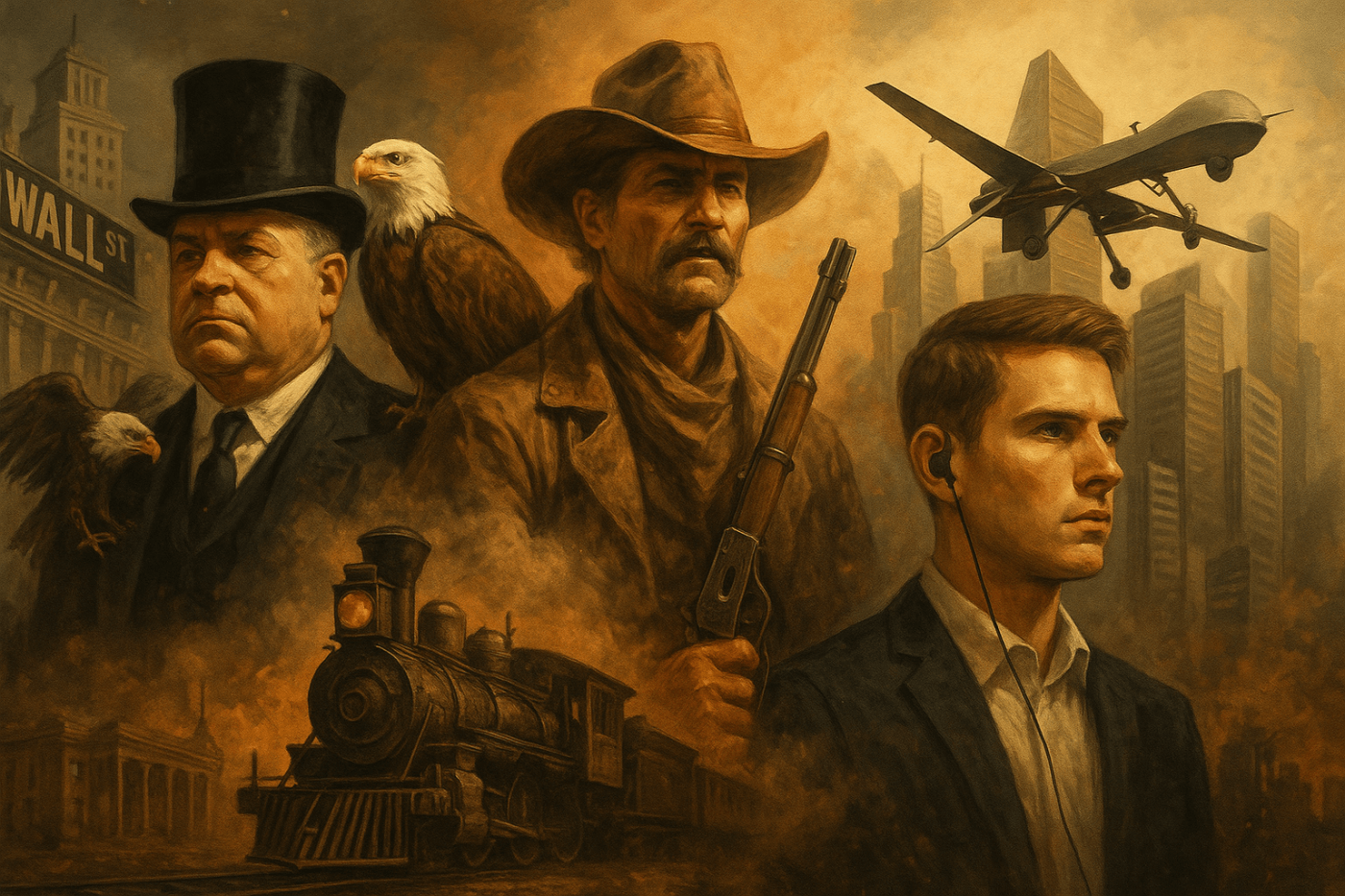
A Weaponized Intellects Book Review of The Yankee and Cowboy War — tracing how the white ruling class evolved from Atlanticist patricians and frontier militarists into the modern Cowboy–Yankee–Digerati triumvirate that governs the U.S. empire today.
By Prince Kapone | Weaponized Information | December 2025
Clandestine America and the Skeleton of White Power
Carl Oglesby opens The Yankee and Cowboy War with a simple but dangerous claim: Dallas and Watergate are not unfortunate accidents in an otherwise healthy democracy; they are “concrete links in a chain” of coup and countercoup, eruptions of an “invisible government” that has learned to live above the law and beyond any moral rule. The book is written in the 1970s, before the internet, before Silicon Valley takes command, before “national security” becomes a planetary operating system. But from the very first pages, you can already see the skeleton of what we, at Weaponized Information, call technofascism taking shape beneath the skin of U.S. liberal democracy — not as a new evolutionary stage of capitalism, but as a crisis-born mode of rule through which monopoly-finance capital tries to discipline an empire in decline.
Oglesby’s core insight is disarmingly straightforward: behind the public theater of elections, hearings, and patriotic speeches, there exists a clandestine American state, a ruling-class cockpit where rival factions of the white bourgeoisie fight over how to manage empire, how to divide the spoils, and how to discipline the people. Dallas – the assassination of John F. Kennedy – and Watergate – the takedown of Richard Nixon – are not moral failures of the Constitution. They are moments when this hidden power structure breaks the surface, when one faction of white power disciplines another with bullets, break-ins, and blackmail. What he does not fully grasp — but what becomes clear through our lens — is that these clandestine structures are not autonomous puppeteers. They are instruments of monopoly capital, improvised and deployed when the ordinary mechanisms of governance can no longer keep the system intact.
This is the first thing that makes Oglesby useful for us today. He refuses the fairy tale that “America lost its way” in the sixties and seventies. There is no fall from grace here, because grace was never on the menu. Instead, he shows a struggle inside the white ruling class itself: on one side, the Atlanticist Yankee establishment tied to Wall Street, the Council on Foreign Relations, and the old European-linked monopoly firms; on the other, the ascendant Cowboy bloc rooted in oil, aerospace, military bases, and the frontier ideology of the U.S. West and South. These are not metaphors; they are fractions of capital, different strategies of empire, different regional class projects shouting through the same flag.
The Yankees, in Oglesby’s telling, are the old imperial patricians. Their world is Manhattan clubs and Ivy League faculties, transatlantic banking circuits, NATO, and a “One World” mythology that treats Europe and North America as a single white civilizational bloc. They are at home in Brussels and London, in the IMF boardroom and the Davos panel, long before those names become brand logos of globalization. Their instinct is to manage empire through alliances, institutions, and carefully calibrated violence – coups where necessary, détente where possible, always with an eye on stability for finance capital.
The Cowboys are something else. They are not anti-imperialist rebels; they are the roughneck wing of the same imperial project, born from oil fields, defense plants, offshore drilling, military contracts and the “Big Sky” frontier myth. Their political centers are Dallas, Houston, Orange County, the air force base and the aerospace lab. They are the ones who believe you can bomb your way out of every contradiction, that America is not the steward of “the West” but the chosen overlord of a new world, answerable to no one. If the Yankees are the polite face of empire, the Cowboys are the bar fight and the backroom deal, the paramilitary death squad funded out of a corporate slush fund.
From the standpoint of Weaponized Information, both are fractions of the same settler-colonial ruling class. Both are committed to the preservation of white world domination. Both are enemies of the global proletariat and the colonized. The real interest of Oglesby’s book is not that it asks us to choose between them; it is that it helps us chart their internal war, their moments of unity and fracture, their methods of rule. In other words, he is trying – within the limits of his time and his politics – to map the nervous system of white power inside the U.S. imperial state.
When Oglesby names Dallas and Watergate as twin conspiracies in a “hidden drama of coup and countercoup,” he is not doing what today’s YouTube grifters do: spinning fan fiction about shadowy cabals for clicks. He is doing something much closer to class analysis, even if he never quite breaks with the American frame. He notices that the same apparatus used to crush Black liberation, anti-war movements, and Third World solidarity – COINTELPRO, the CIA’s domestic programs, the Pentagon’s contingency plans for urban rebellion – is also being used in intra-elite struggles, as Yankee and Cowboy factions weaponize the secret state against each other. The police state built to discipline the oppressed turns out to be the battlefield on which the rulers themselves settle their scores — a reminder that clandestinity is a technique of capitalist domination, not an independent power center.
For us, that is an early glimpse of technofascism. What Oglesby calls “clandestine America” is the transitional form between the old, more naked forms of oligarchic rule and the emerging regime where surveillance, data, psychological warfare, and high-tech policing become the central instruments of class power. He is writing at a time when the CIA is still a relatively young institution, when computer networks are still locked in military and academic labs, when Wall Street has not yet fully fused with Silicon Valley. But the logic is already there: a permanent security apparatus, formally answerable to elected government but practically loyal to capital, free to violate the law in the name of “national security,” and increasingly integrated into every branch of the state.
Oglesby traces this logic back to specific historical deals: the postwar integration of Nazi intelligence networks into the CIA, the marriage of organized crime and the state through operations like the wartime pact with the Mafia, the construction of global corporate empires like Hughes that blur the line between private business and covert action. Each of these moves helps consolidate what he calls a “clandestine American state,” a shadow structure that survives changes in administration and can outlive its own scandals. This is not conspiracy instead of class; it is conspiracy as the method through which a class in crisis governs — an irregular technique used when normal forms of rule begin to break down.
Where we depart from Oglesby is in what we center. He sees a “hidden drama” between two wings of the U.S. elite and focuses on how that drama shapes the fate of American democracy. We see a settler-colonial empire whose entire existence rests on stolen land, stolen labor, and the ongoing subjugation of colonized peoples – inside and outside its borders. For us, Dallas and Watergate are not just elite quarrels; they are inflection points in how the white ruling class manages the colonial contradiction. While they are fighting each other over strategy in Vietnam, Cuba, and the Third World, they are also recalibrating how to contain Black uprisings in the U.S., how to neutralize national liberation movements, how to prevent another Vietnam from erupting in Angola, Algeria, or the Caribbean.
Still, even from his limited vantage point, Oglesby hits on something crucial: the postwar consensus that united Yankees and Cowboys – the New Deal order at home, the Cold War order abroad – begins to crack under the combined pressure of Third World revolution, anti-war rebellion, and economic turbulence. The ruling class is forced to experiment. The secret state grows larger because the old open mechanisms of rule – party machines, patriotic rhetoric, New Deal social bargains – are no longer enough. You need black ops, psy-ops, domestic spying, deniable paramilitaries, corporate fronts, and think tanks to keep the whole thing from flying apart.
This is where we can see, with the benefit of fifty more years of history, the early outlines of the Digerati – the third pole in the ruling class that Oglesby could not yet conceptualize. The sectors he identifies as “new wealth” – aerospace, military electronics, advanced communications, high-tech research funded by the Pentagon – are exactly the soil from which Silicon Valley grows. The same networks that test new surveillance systems in Vietnam and Chile will, decades later, give us the NSA dragnet, predictive policing in U.S. cities, and algorithmic censorship on social media platforms. In Oglesby’s time, they are still junior partners in the Yankee–Cowboy drama. In ours, they are the digital-administrative arm of capital — powerful, but never independent of the state-military-finance nexus that birthed them.
So this first part of the review takes Oglesby on his own terms but relocates him on ours. We treat The Yankee and Cowboy War as an early, partial X-ray of the white ruling class in the United States at the moment its postwar costume begins to tear. He sees a “clandestine America” where competing fractions of white capital fight over how to run the empire. We see, emerging through that clandestinity, the crisis architecture of technofascism: a regime where finance (Yankee), extraction and militarism (Cowboy), and digital surveillance (Digerati) converge into an unstable, crisis-driven apparatus of domination.
The task of revolutionaries, then, is not to romanticize one faction against another – not to side with the “civilized” Yankees against the “crude” Cowboys, or to confuse the technocratic Digerati with progress because they talk about innovation and “disruption.” Our task is to understand how these factions arise from the same settler-colonial soil, how they adjust to crisis by building new forms of repression, and how their internal conflicts open cracks that oppressed peoples can turn into ruptures. Oglesby helps us map that terrain. From Dallas to Watergate, from the Bay of Pigs to the Pentagon Papers, he shows us how white power panics when its consensus breaks and how quickly it turns to the secret state to restore order.
In the next section, we will follow him more closely into the anatomy of the Yankee and Cowboy camps themselves – old money and new money, Atlantic and frontier, boardroom and oilfield – and begin to trace how their Cold War clash laid the groundwork for the Cowboy–Yankee–Digerati configuration that rules us under technofascism today.
The Old Money, the New Money, and the Frontier Logic of White Power
If the first movement of Oglesby’s book exposes the existence of a clandestine American state, the second movement gives us its anatomy: the competing organs, the rival circulatory systems, the quarrelsome bloodlines of white capital. Here Oglesby stops looking at Dallas and Watergate as isolated eruptions and begins tracing the deeper class-regional rift that produced them. And this is where the review must sharpen its revolutionary lens, because what he calls “Yankees and Cowboys” is nothing other than the intra-imperialist conflict at the heart of the U.S. settler republic, the two dominant strategies of managing the colonial and global contradictions of U.S. power under monopoly capitalism.
To understand Oglesby’s argument, you must begin where he begins: with money. Not the national mythology of “freedom” or “character,” but the material facts of monopoly finance on the one hand and frontier extraction on the other. The Yankee faction—rooted in the East Coast monopoly bloc tied to Morgan, Rockefeller, the Council on Foreign Relations, and the transatlantic banking elite—represents the long lineage of old money. Their ancestors sat in Boston counting houses and Manhattan law firms; their present-day heirs preside over BlackRock, JPMorgan, and a thousand think-tank steering committees. They are globalists not because they are woke, but because their capital long ago became planetary. For them, the Atlantic is not an ocean; it is a pipeline of value, a white civilizational bridge, a centuries-long flow of wealth, war, and hegemony.
Oglesby describes the Yankee mind as “Atlanticist,” forever looking eastward toward Europe, convinced that the U.S. must secure the other shore to secure its own fate. This is not sentiment—it is class instinct. These are the families whose fortunes were woven into European finance from the 19th century onward, whose children studied in Oxford and Paris, who saw NATO as an extension of their portfolio and viewed the Third World with the bored contempt of colonial trustees. The Yankee project is the management of empire through diplomacy, investment, multilateral institutions, and selective violence calibrated to maintain global stability for finance capital.
Then there are the Cowboys—what Oglesby calls the “new wealth,” though even in his own time they were no longer new. These are the oil barons, the aerospace magnates, the military-base capitalists of the South and Southwest, the contractors whose fortunes rise and fall with war budgets and drilling rights. Their culture is not Atlantic but frontier: expansive, anti-bureaucratic, suspicious of European diplomacy, and convinced that American supremacy requires permanent motion—more land, more markets, more resources, more enemies to conquer. If the Yankee instinct is to negotiate the world order, the Cowboy instinct is to shoot it into shape.
Oglesby identifies this Cowboy bloc with the “petty-bourgeois outlook,” but in truth it is something more dangerous: the ideological heart of settler militarism. From Texas to California, from the oilfield to the aerospace lab, this is the vector of the U.S. ruling class most addicted to expansion, extraction, and violent counterrevolution. They do not dream in the language of diplomacy; they dream in the language of force. For them, the frontier never closed—there is always another Cuba to punish, another Vietnam to “pacify,” another Third World revolution to strangle. They were born from genocide and land theft, and they carry that logic with them wherever they go.
What makes Oglesby compelling for our purposes is not just that he identifies these two blocs, but that he understands their unity and their contradiction. For a century, Yankee finance and Cowboy extraction were partners in the same imperial project. Reconstruction forged their alliance; two World Wars cemented it; the Cold War gave them a common enemy. But unity does not erase contradiction. It only delays it. As Oglesby notes, the Frontierist militancy of the Cowboys—their belief that the U.S. must impose its will by force across Asia, Latin America, and the Middle East—collides directly with the Yankee strategy of international integration, détente, and “managing” communism rather than defeating it outright. These are two wings of the same eagle, but one wing flaps toward Geneva while the other claws toward Saigon.
From the Weaponized Information standpoint, this is precisely the moment where we see the deeper colonial logic at play. The Yankees want to preserve empire by stabilizing it. The Cowboys want to preserve empire by expanding it. Both want to preserve empire. And both—whether wearing the polite mask of Atlanticism or the snarling grin of the frontier—are enemies of the colonized. The Panther Party understood this in its time: the liberal, well-educated face of white power kills you with paperwork; the Cowboy face kills you with a bullet. The outcome is the same.
Oglesby is not a Marxist, but he senses what Marxists already knew: the frontier is not a myth; it is a material engine of class formation. William Appleman Williams, whom Oglesby cites, shows how the “frontier” preserved entrepreneurial capitalism in the U.S. long after monopoly should have swallowed it whole. As long as there was land to steal, resources to plunder, labor to exploit, and markets to open by force, the U.S. could maintain the illusion of democratic capitalism. The frontier allowed white workers to see themselves as beneficiaries of empire rather than its victims. And it allowed the Cowboy bloc to survive and even dominate key sectors of the state.
The deeper truth, which Oglesby only brushes against, is that the frontier is not geographic—it is racial. The same ideology that justified genocide against Indigenous nations becomes the ideology that justifies intervention in Vietnam, coups in Latin America, mercenary wars in Africa, and global counterinsurgency. The Cowboy worldview is simply the settler psyche unmasked: expansionist, violent, unapologetically supremacist. The Yankee worldview is that same psyche ironed and perfumed, convinced that white domination must be institutionalized, not improvised.
What Oglesby calls the rise of “new wealth” in the Southwest and West is therefore not merely a regional shift—it is a transformation in the imperial machinery. Oil, aerospace, electronics, and military contracting become not just sectors of the economy but centers of political gravity. Lyndon Johnson, Howard Hughes, Nixon, the Bay of Pigs network—all of these represent the Cowboy faction in motion. Their conquest is not of new land but of the state itself, bending intelligence agencies, military budgets, and foreign policy toward a more openly militarized imperialism. And because all of this unfolds within an already monopolized, finance-dominated capitalism, the conflict between Yankees and Cowboys is ultimately a conflict over how best to secure the long-term interests of the same ruling class.
And here, once again, we see the glimmer of the Digerati—the third force Oglesby could not yet theorize. The very industries he identifies as “new wealth” are the incubators of our modern digital oligarchy. The aerospace engineers of the 1960s become the Silicon Valley pioneers of the 1980s. The defense contractors developing early computers for missile guidance become the Big Tech companies building global surveillance infrastructure. The military research labs that develop ARPANET become the backbone of a planetary information empire. These are not separate histories—they are the same history unfolding through different generations of white power, increasingly financed, owned, and disciplined by the same asset-manager and banking interests that anchor the Yankee bloc.
So in this second section of the review, the task has been to excavate Oglesby’s categories and reveal the deeper material roots beneath them. Yankees and Cowboys are not archetypes; they are class fractions. Their rivalry is not cultural; it is structural. Their conflict is not about “values”; it is about how best to preserve a settler-colonial empire facing the rising tide of global liberation movements and the profitability crises of an overextended system. And their unity, no matter how strained, is always against the colonized and the working class.
Next, we confront the first great explosion of this contradiction: the assassination of John F. Kennedy in Dallas. Not as a murder mystery, not as a morality play, but as the moment the Cowboy faction struck decisively against a Yankee presidency they believed was drifting toward compromise with Third World revolution. It is here, in the gunfire of Dealey Plaza, that Oglesby’s framework becomes indispensable for unraveling the logic of technofascism in its embryonic, crisis-driven form.
Dealey Plaza and the Frontier Coup: When the Cowboy Faction Took the Driver’s Seat
By the time Oglesby leads us to Dallas, the stage has already been set. The ruling-class consensus of the postwar era—Yankee finance and Cowboy extraction locked in a profitable but uneasy marriage—has begun to fracture under the pressure of Third World revolution, anti-colonial uprisings, and the unsteady hand of a U.S. empire stretching itself across the planet. In this context, the assassination of John F. Kennedy is not a riddle about a lone gunman with a magic bullet. It is the crystallization of a deeper class struggle inside the white ruling elite, a struggle that erupts as violence because the stakes are nothing less than the direction of U.S. imperialism itself.
Oglesby insists that Dallas was a coup—not metaphorically, not rhetorically, but concretely. And the evidence he gathers from his era paints a clear picture: Kennedy was moving, however modestly, toward a recalibration of imperial strategy that the Cowboy bloc interpreted as betrayal. The Bay of Pigs fiasco, the limited test-ban treaty, the Cuban backchannel negotiations, the early glimmers of a potential Vietnam de-escalation—none of these were signs of anti-imperial virtue, but they were signs of Yankee caution, Yankee calculation, Yankee desire to restructure the empire through diplomacy rather than cowboy assault. For the Frontier faction—the oilmen, the CIA paramilitary cliques, the anti-Castro exiles, the right-wing military brass—this was intolerable.
Dallas, then, becomes the moment the Cowboy worldview lashes out against the possibility of détente. The assassination was not about Kennedy personally; it was about the strategic direction of empire. And here, Oglesby provides a crucial detail: the forces arrayed against Kennedy were not just patriotic right-wingers. They were an alliance of syndicate mafiosos, CIA renegades, Cuban exile militias, military hardliners, and the political economy of Texas oil—a nexus of crime, capital, and covert power so intertwined that distinguishing state from mob becomes impossible. This is not corruption; this is the architecture of U.S. power revealing itself without filters. And crucially, these networks act not as independent puppeteers but as the irregular, deniable instruments of a ruling class struggling to stabilize a global system entering crisis.
In the WI framework, this moment takes on an even more profound meaning. The colonial contradiction was tearing the empire apart by the early 1960s. Black insurgency at home, anti-colonial revolt abroad, the Cuban Revolution only ninety miles from Florida—these were existential crises for white supremacy. The Yankee elite believed the best way to save the system was to stabilize it, internationalize it, and integrate the U.S. more tightly into global capitalist institutions. The Cowboy elite believed the only salvation was escalation: more troops, more bombs, more covert action, more violence against both colonized nations and dissident populations at home. Each represented not a different moral orientation, but a different material solution to the profitability and legitimacy contradictions of a declining imperial system.
When Kennedy balked at giving them their war in Cuba, then hesitated in Vietnam, then pushed back against elements of the CIA he could no longer control, he became a liability to the Cowboy bloc. And when a president becomes a liability to capital—particularly the fraction of capital with paramilitary infrastructure and deep state connections—you do not defeat him in debate. You remove him from the equation.
Oglesby’s analysis of the Bay of Pigs reveals the initial rupture: Kennedy approved the operation under pressure, then refused to unleash open U.S. military force when the CIA’s exile brigade began to collapse. To the Cowboy faction, this was betrayal of the highest order. It was the first indication that Kennedy might attempt to regulate the empire rather than expand it. The subsequent missile crisis, which ended with a negotiated settlement rather than a nuclear confrontation, further enraged the militarist wing. In the Cowboy mindset, a U.S. president who chooses compromise over domination is no president at all.
This is the historical truth Oglesby captures, even if he does not frame it in Marxist or anti-colonial terms: Dallas is the sound of the Frontier faction refusing to let their version of empire die. It is the death rattle of the U.S. illusion of constitutional stability. It is the moment when the guns behind the façade of democracy make themselves heard. And beneath all of this lies the material fact that the U.S. could no longer maintain its empire through the old liberal toolkit—thus requiring ever-more clandestine, violent, and extralegal methods.
But from our vantage point, Dallas marks something even larger. It is the first major post-war instance of the U.S. security apparatus cannibalizing itself. The clandestine structures built for global counterinsurgency—trained assassins, covert networks, deniable operatives—are turned inward, weaponized for internal ruling-class warfare. The empire begins to eat its own. And once it starts, it cannot stop. From Dallas to Watergate, from Nixon’s plumbers to Reagan’s contras, from Iran-Contra to the CIA–Silicon Valley nexus, the logic of clandestine politics becomes permanent, precisely because the underlying contradictions of capital cannot be resolved through normal methods of governance.
And what of the Digerati in this story? Here the historical threads begin to converge. The Cowboy bloc of the 1960s—rooted in the aerospace and military-industrial complex—was already nurturing the technological vanguard that would rise to dominance decades later. The same intelligence networks implicated in Dallas were supporting the early research that birthed ARPANET and the digital age. But it is important to clarify: these early tech infrastructures do not represent a new autonomous class. They are embryonic instruments of the same state–capital nexus, incubated and disciplined by Pentagon funding, intelligence oversight, and financial capital. The paramilitary Cowboy networks would, in time, fuse with the emerging cyber-surveillance infrastructure overseen by the Yankee financial elite and, eventually, by the technocratic Silicon Valley class. Dallas is not just a coup; it is a rehearsal for the future of U.S. governance, where clandestine power, digital surveillance, and corporate oligarchy merge into a single crisis-driven apparatus.
For revolutionaries reading Oglesby in 2025, the lesson is not that Kennedy was a lost saint of American liberalism. The lesson is that when the imperial class is divided over how to manage global domination, they resolve their disagreements with blood. The working class does not get a vote. The colonized do not get a seat at the table. Democracy is a tool of public relations, not governance. Dallas happens because the U.S. is a settler colony masquerading as a republic. And in a settler colony, political power ultimately flows from the barrel of a gun — especially when the normal circuits of capitalist rule begin to malfunction.
With Dallas established as the opening salvo of intra-ruling-class civil war, Oglesby moves us toward the next battlefield: Watergate. But before we reach that countercoup, we must follow the Cowboy faction through the firestorms of 1968, the assassinations of Black and multiracial leadership, and the escalating war in Vietnam—moments when the Frontier ideology pushes U.S. imperial policy into deeper brutality, further unraveling the old consensus and hastening the emergence of the technocratic security architecture that will define the next era.
In the next section, we will witness how the Cowboy bloc, having seized initiative through Dallas, overreaches in the excesses of covert warfare and domestic repression—setting the stage for the Yankee counterstrike that will culminate in the fall of Richard Nixon. The clandestine state, once unleashed, begins to devour itself — and through that devouring, clears the ground for the digital-military-financial synthesis we now call technofascism.
1968 and the Shattering of the Imperial Center: When the Cowboy Ascendancy Collided with a World in Revolt
After Dallas, the Cowboy bloc did not retreat into the shadows—they surged forward with the fanatic confidence of a faction that had just proven it could remove a president and get away with it. Oglesby’s chapter “1968” is not simply a historical inventory of assassinations, riots, and backroom conspiracies; it is the story of an imperial center coming apart at the seams, forced to confront both the outer rebellions of the colonized world and the inner uprisings of the oppressed in the U.S. mainland. If Dallas was the Cowboy faction’s opening strike, then 1968 was the battlefield on which they attempted to consolidate the new order: one in which frontier violence replaced diplomacy, and clandestine repression replaced democratic pretense. What Oglesby sees as chaos, we recognize as the crisis of monopoly capitalism struggling to contain insurgent forces on every front.
Oglesby reads 1968 through the prism of the Vietnam War, and he is absolutely correct to do so. It is in Vietnam that the Cowboy worldview expresses itself most nakedly: through saturation bombing, free-fire zones, Phoenix Program death squads, and the belief—so absurd it becomes tragic—that the U.S. can bomb its way out of a revolutionary crisis. The Yankee faction had already begun to sour on Vietnam by this point. They saw the war for what it had become: a bottomless pit of financial drain, diplomatic humiliation, and geopolitical blowback. They were not opposed to empire; they were opposed to losing money while maintaining it. They preferred controlled violence, managed repression, and calibrated intervention. The Cowboy bloc wanted blood — not because of ideology alone, but because their capital base (oil, arms, aerospace) depended materially on expansion.
As Oglesby points out, the cracks within the ruling class become visible in early 1968, when a new opposition emerges from within the corporate-liberal centers of power. Bank-linked firms, CFR think-tankers, Ivy League strategists, and Euro-American diplomats begin signaling that the war is no longer a rational imperial investment. The Tet Offensive confirms what they feared: Vietnam cannot be pacified without shattering the entire Pacific balance of power. For the Cowboys, this is treason. For the Yankees, this is mathematics — the cold arithmetic of imperial profitability.
But the empire’s crisis does not unfold on foreign soil alone. 1968 is the year when the colonized within the United States itself rise up. Black America explodes after the assassination of Martin Luther King Jr. The ghettos burn not because of “crime” or “unrest,” but because the colonial subjects of the U.S. plantation come to understand their condition and act upon it. Malcolm is gone. King is gone. But the Panthers, the Young Lords, the American Indian Movement, and the multiracial formations born from the urban working class are still here, armed with a clarity the U.S. state fears: that the domestic and foreign wars are one and the same — a single colonial order enforced through different uniforms.
Oglesby, writing as a white dissident in the 1970s, does not center the colonized, but he feels the tremors. He notes how the secret state is stretched thin—forced to fight Vietnamese guerrillas abroad while crushing Black insurgency at home. The same FBI that surveils diplomats in Paris turns its full fury against the Panthers in Oakland. The same CIA that hunts revolutionaries in Havana builds informant networks in Chicago. The Cowboy faction demands militarized responses to both fronts, pushing Lyndon Johnson into a spiral of escalation that ultimately destroys him. The Yankee faction looks on in horror as the empire’s internal contradictions threaten to detonate its legitimacy. What neither faction can admit is that this crisis is not ideological but structural — the U.S. is hitting the limits of a global system it can no longer stabilize at an acceptable cost.
And then come the assassinations—first Martin, then Bobby—each killing a warning, each death a message, each funeral another reminder that the U.S. state is capable of murdering its own citizens, its own leaders, its own princes, when they threaten the imperial order. Oglesby does not rely on speculation here; he grounds his analysis in the documented entanglements between intelligence agencies, criminal syndicates, and anti-communist extremists. He shows how the clandestine state, which began as an instrument for suppressing colonized people abroad, becomes the method through which the ruling class settles its internal disputes. The gun that kills a Black revolutionary in Oakland can just as easily be turned against a senator from New York. Colonial violence comes home.
For Weaponized Information, this moment is critical. 1968 is the hinge of empire, the point where the Yankee–Cowboy split becomes unsustainable. The Cowboy bloc, driven by frontier logic, forces the empire into maximalist conflict on every front. The Yankee bloc, driven by the needs of monopoly finance, realizes that this strategy threatens their global investments. But neither faction can win decisively because both are trapped within the same colonial machinery. The U.S. cannot withdraw without risking revolt among its allies. It cannot escalate without risking nuclear confrontation with the USSR. It cannot reform itself without unleashing the revolutionary demands of the oppressed at home. It is the classic contradiction of a declining hegemon: too weak to dominate, too afraid to retreat.
And so the system cracks. Johnson steps down, exhausted and politically ruined. Robert Kennedy is killed just as he begins to build a coalition that bridges working-class whites, urban Black communities, and anti-war youth—a coalition that, had it taken power, might have re-stabilized Yankee control. The Democratic Party implodes under the weight of its own contradictions. In Chicago, at the Democratic National Convention, the state unleashes open police warfare on students, activists, and journalists. This is not the failure of democracy; it is democracy revealing its true character as the public relations arm of a settler-colonial state. And it is also the moment when the ruling class realizes it must innovate its methods of control — old forms of legitimacy are collapsing.
And yet, even in this chaos, Oglesby sees the outline of a coming counterstroke. The Yankee bloc—Wall Street liberals, foreign-policy mandarins, institutional bureaucrats—begins to regroup. They realize that the Cowboy faction, if left unchecked, will destroy the legitimacy of the entire imperial apparatus. They cannot allow the frontier extremists to permanently seize the executive branch, the intelligence agencies, and the national security state. And so they prepare—quietly, discreetly—for their response. What appears as moral panic is actually class discipline: the finance-capital wing reasserting control over the militarist wing of its own ruling class.
For our purposes, this is the exact moment where the seeds of technofascism begin their slow germination. The clandestine networks that run rampant in 1968—the CIA paramilitary units, the FBI’s COINTELPRO, the military’s domestic surveillance programs—will, over the coming decades, merge with the emerging digital infrastructure birthed from the aerospace and computing industries. But it is crucial to emphasize: this merger does not create a new, autonomous ruling class. It produces a new apparatus of class rule — a digital-security architecture wielded by the same monopoly-finance and militarist fractions that dominate the state. The Cowboys’ wild violence will be tempered by Yankee managerial technique. Their physical repression will be supplemented by Digerati psychological warfare. The result is not a stable synthesis but a crisis-coordination mechanism: a police-military-finance-tech hyperstate capable of crushing dissent before it even manifests.
But Oglesby, in 1976, does not yet see that future. What he does see is the next act of the intra-elite war: the Yankee countercoup against Richard Nixon, the Cowboy president who overreached so violently that the system itself recoiled. Before we reach that moment, the next section will examine how the Cowboy ascendancy—bloated with victory after Dallas and riding the wave of 1968’s chaos—ultimately spirals into hubris, setting the stage for Watergate and the most dramatic internal attack on a sitting president in U.S. history.
Watergate and the Yankee Counterstrike: When the Old Empire Reasserted Discipline
If Dallas is the sound of the Cowboy bloc firing its opening shot in the ruling-class civil war, then Watergate is the sound of the Yankee establishment striking back. Oglesby’s examination of Watergate is not the civics-text fairytale Americans are force-fed—that a brave press and an independent Congress rescued the Constitution from a rogue president. No. Watergate is the second major coup of the postwar era: a countercoup engineered by the old Atlanticist elite against the Cowboy machinery that had seized state power and was beginning to act with intolerable autonomy. And beneath that autonomy, the real contradiction: a militarist wing of capital pushing the empire beyond what monopoly-finance capital believed was sustainable.
Oglesby’s brilliance lies in the fact that he does not treat Nixon as a moral failure. He treats him as a class instrument. Nixon governed on behalf of the Cowboy bloc: oil fortunes, Sunbelt militarists, anti-communist paramilitary types, the Hughes corporate labyrinth, the Western intelligence cowboys who preferred violence over diplomacy in all matters foreign and domestic. Nixon was their champion—a man willing to break the law openly, brazenly, and with a frontier swagger that made the Yankee old guard recoil in disgust.
But Nixon’s fatal error was not criminality. The U.S. state has never punished criminality inside the ruling class. His error was that he began to use the clandestine apparatus—originally built to crush communists, Black radicals, and the Third World—for intra-elite purposes without the permission of the Atlanticist managers who still controlled key institutional levers. Nixon threatened to remake the intelligence agencies in the Cowboy image: more covert violence, more deniability, more extralegal operations, more frontier risk-taking. He threatened the very architecture of the postwar imperial consensus. And the deeper fear: his approach risked further destabilizing a global system already facing profitability crises, stagflation, and intensifying anti-colonial revolt.
Oglesby traces this threat back to the Hughes empire—Howard Hughes, the reclusive billionaire whose wealth, secrecy, and ties to CIA aviation made him a central figure in the Cowboy project. Hughes represents, in Oglesby’s analysis, the fusion of corporate power and clandestine capability: private capital acting as a deniable arm of U.S. covert operations. And it is precisely this privatized clandestinity that the Yankee establishment fears. They do not object to CIA coups and deep-state violence; they object to losing command of those tools. They fear an intelligence apparatus drifting into the orbit of a faction whose material interests run counter to global financial integration.
Watergate begins, then, not with a burglary, but with a power struggle inside the clandestine state. Oglesby points out that James McCord—one of the Watergate burglars—was not merely an ex-CIA man but a double agent, loyal not to Nixon but to the faction inside Langley that opposed him. The leaks that destroyed Nixon did not come from brave patriots or principled journalists; they came from Yankee-aligned networks inside the intelligence bureaucracy, the State Department, and the Pentagon. These were the same institutions that had quietly turned against Vietnam years earlier, recognizing that Cowboy militarism was threatening global capital’s long-term position and undermining the stability of the empire’s financial foundations.
From the viewpoint of Weaponized Information, Watergate is a masterclass in how the white ruling class self-corrects. When one faction overreaches—when Cowboy excess makes the empire look unstable, irrational, or unmanageable—the older, more disciplined wing moves in. They unleash congressional investigations, media revelations, legal theatrics, high-minded speeches about “the rule of law.” But behind the curtain, what is happening is far simpler: the Atlanticist bloc is purging an unreliable steward of empire. This is crisis management, not constitutional virtue.
Oglesby shows how the CIA, FBI, and other agencies leaked selectively to cripple Nixon’s administration. Not out of ethical revulsion, but out of strategic necessity. The same clandestine institutions that helped carry out Dallas now move to dethrone the Cowboy president who had forgotten the first rule of imperial governance: the secret state exists to preserve the system, not to serve the ego of any one man. Nixon had mistaken himself for the master of the machine. The machine reminded him he was merely its operator.
This is where Oglesby’s analysis becomes prophetic. He argues that Watergate reveals the “invisible government” more openly than any scandal before it. The intelligence agencies, the diplomatic bureaucracy, the corporate press, and the judicial system all move in synchrony to discipline the executive. The spectacle is not democracy defending itself; it is the ruling class cleaning house. And like any ruling class cleaning house, the process is selective, strategic, and thoroughly ideological. But the key point we must add is this: the deep state is not an autonomous power center. It is the hardened, insulated arm of monopoly capital — activated when normal forms of rule become inadequate.
For us, reading this from the vantage point of 2025, Watergate is the hinge between two eras of counterrevolution. It marks:
- the exhaustion of the old frontier-Cowboy model of domination,
- the reassertion of Yankee financial globalism, and
- the quiet birth of a third force—the technocratic intelligence-linked Digerati that would soon become the administrative infrastructure of the empire.
Oglesby cannot yet see Silicon Valley in full bloom, but he sees the soil from which it is growing. The very institutions that toppled Nixon—the CIA, the NSA, the RAND bureaucracy—are the institutions that were simultaneously funding early computing research, steering ARPANET development, and grooming a generation of technocrats who would fuse the logic of financial capitalism with the logic of digital surveillance. Watergate is not just a countercoup; it is the gestation chamber for the forces that will one day hold the empire together when both Yankee diplomacy and Cowboy militarism begin to fail. But it is crucial to stress: the Digerati do not emerge as an autonomous ruling class. They emerge as a coordinating apparatus of a ruling class trying to survive the long downturn, the collapse of Bretton Woods, and the pressures of global decolonization.
That is why the WI perspective must take Oglesby’s conclusions further. Watergate shows us that the white ruling class is capable of internal coups, countercoups, and clandestine purges when its long-term strategic interests require it. It shows that democracy is a stage set—useful for public consumption but irrelevant to the real decisions of governance. And it shows that the deep state is not an aberration; it is the nervous system of empire, deployed more aggressively when the system enters crisis. Watergate is the moment that reveals how the ruling class manages decline: not through reform, but through disciplined reorganization of its coercive instruments.
Next we will trace how the fallout of Watergate sets the stage for an even more profound transformation: the dissolution of the Yankee–Cowboy binary and the emergence of the Cowboy–Yankee–Digerati triumvirate. This is the modern white ruling class—this is technofascism’s governing bloc—and its origins are written plainly in the very chapters Oglesby left behind. The crisis did not end in the 1970s; it only metastasized, producing the digital-financial-military fusion that now defines the imperial core.
After the Countercoup: The Dissolution of the Old Order and the Birth of the Triumvirate
With Nixon dethroned and the Cowboy offensive temporarily contained, Oglesby turns his eyes to the aftermath. This is where his book, written half a century ago, becomes uncannily relevant for us today. He senses that something fundamental has shifted inside the U.S. ruling class, that the old two-way split—the genteel New England finance imperialists vs. the swaggering Sunbelt militarists—can no longer explain the emerging structure of power. He calls it a “dissolving consensus.” We, from the vantage point of 2025, know it as the moment the white ruling class began mutating into the three-headed creature that governs the United States today: the Cowboy–Yankee–Digerati triumvirate.
Oglesby captures the symptoms of this transformation even if he could not yet name its new anatomy. He sees the geopolitical landscape shifting under the empire’s feet. He sees the Atlanticist project falter as Europe begins to assert itself as something more than a junior partner. He sees the Cowboy model of endless frontier war producing exhaustion rather than victory. He sees U.S. economic power beginning to wobble as manufacturing declines and finance metastasizes. He sees corporate conglomerates merging with intelligence capabilities in ways that blur the distinction between private capital and state security. He sees, in short, the opening cracks that foretell a total restructuring of white power.
What Oglesby interprets as a loss of consensus is, in WI terms, the beginning of a new consensus—one that ultimately fuses the interests of the old Atlanticists, the frontier militarists, and the rising technocratic elite. This fusion does not happen overnight. It unfolds slowly, through the crises of the late 1970s, the neoliberal restructuring under Carter and Reagan, the deindustrialization of the urban North, and the consolidation of Silicon Valley as the digital arm of empire. What Oglesby sees as fragmentation is, in retrospect, the chrysalis phase of a new crisis-governance regime: technofascism, born not as a new stage of capitalism but as the domestic political form through which monopoly-finance capital attempts to manage its long downturn.
This restructuring begins with the state itself. After Watergate, the intelligence community—wounded but unbroken—undergoes a purge, then a reorganization. The “rogue” Cowboy operators who helped topple Kennedy and escalate Vietnam are not eliminated; they are sanitized, laundered, and redistributed into new bureaucratic niches. The Church Committee airs just enough dirty laundry to restore legitimacy but not enough to dismantle the machinery. The CIA shifts its emphasis from paramilitary adventurism to financial manipulation, psychological operations, and technological innovation. The FBI refocuses from COINTELPRO’s brute-force approach to more sophisticated counterinsurgency against the Black, Indigenous, and radical movements that survived the 1960s. This is the deep state adapting, not shrinking.
At the same time, the economy restructures around high technology, computing, telecommunications, and financial derivatives—sectors that would eventually be dominated by the Digerati. Oglesby notes the rise of the “new wealth” sectors—military electronics, aerospace engineering, advanced communications—and assumes they represent an extension of the Cowboy bloc. But what he could not see is that these sectors, by the late 1970s, were already being pulled into the gravitational field of Yankee finance capital. Wall Street begins bankrolling Silicon Valley. The Pentagon begins funneling research money into institutions like Stanford and MIT. RAND Corporation thinkers become the oracles of national security doctrine. What is emerging is not a third faction between Yankees and Cowboys, but a new political-economic apparatus designed to extend the life of a declining empire.
This apparatus—the Digerati—is the class fraction produced by the merger of military research, computing, telecommunications, venture capital, and financial speculation. It is the historical heir of both Yankee managerialism and Cowboy militarism, inheriting the former’s bureaucratic reach and the latter’s obsession with control and domination. But it is also something more specific: the infrastructural arm of monopoly capital under crisis conditions. Its power is based not on territory or even traditional markets, but on information. Data becomes the raw material of governance; algorithms become instruments of class rule; the digital network becomes the empire’s new nervous system. But its power must always be understood as rooted in and subordinate to the interests of finance capital and the U.S. national security state.
Oglesby describes, almost with awe, the growing centrality of intelligence agencies in domestic governance after Vietnam. He sees them becoming more technological, more interconnected, more corporate. What he is witnessing—even if he does not have the language for it—is the proto-infrastructure of the surveillance state. ARPANET, which was a tiny Defense Department experiment during his time, will become the internet—the first global architecture of imperial information control. NSA research into signal interception will eventually become mass data extraction on a planetary scale. Corporate computing firms, originally contractors for the Pentagon and NASA, will morph into Big Tech monopolies whose power rivals that of entire governments. But none of this happens independently of class power; it happens because monopoly capital demanded new tools to manage crisis, maintain accumulation, and suppress revolt.
In Oglesby’s final chapters, he wonders aloud whether the ruling class will fracture beyond repair. He concludes that the divisions are deep, but that the elite will ultimately find a way to stabilize their rule—most likely through further mergers of capital, deeper corporate-state integration, and more sophisticated mechanisms of control. He does not use the term, but he is describing the early emergence of technofascism: a system where corporate power, military power, intelligence power, and digital infrastructure converge to produce a form of governance that is formally democratic but substantively authoritarian. Not because the ruling class planned it that way, but because crisis forced them to improvise it.
From a WI standpoint, the decades after Oglesby’s book prove him both right and incomplete. The old Yankee–Cowboy rivalry becomes less relevant as the two factions, battered by the crises of the 1970s and 1980s, are forced to unite under the discipline of globalized finance and the stabilization offered by the rising Digerati. The frontier militarism that drove Vietnam finds a new outlet in the War on Drugs and later the War on Terror. The Atlanticist strategy of global financial integration expands through the IMF, WTO, and neoliberal restructuring. And the Digerati—now in full bloom—become the logistical and ideological core of imperial management: controlling information, labor mobility, supply chains, and social perception itself.
What Oglesby left us with is the X-ray of a ruling class in transition. What WI adds is the present-day diagnosis: the Cowboy–Yankee–Digerati paradigm is the real structure of modern white power in the United States, and technofascism is the crisis-governance synthesis of their interests. It is not that the old factions disappeared; it is that their contradictions were provisionally resolved by creating a third pole capable of binding them to a common project of imperial survival. The Cowboys still control fossil fuels, logistics, paramilitaries, and the cultural psychology of settler violence. The Yankees still command finance, legal institutions, foreign policy think tanks, and diplomatic networks. But the Digerati now command the infrastructure through which all of them exercise power.
The last section of this review will complete the trajectory: tracing how the empire, after Oglesby’s time, consolidated this tripolar power structure, and how the contradictions he identified have flowered into the crisis-ridden technofascist regime of the twenty-first century—culminating in the Trump 2.0 project you have been analyzing across WI for years.
Conclusion: The Triumvirate Unmasked — How Oglesby’s America Became the Technofascist Empire We Now Face
When you close Carl Oglesby’s The Yankee and Cowboy War, you can almost hear the echoes of an empire stumbling into the world it would eventually create. Oglesby wrote at a time when the ruling class still believed it could choreograph its crises, manage its contradictions, and keep its internal wars hidden behind patriotic monologues and staged congressional outrage. But beneath his narrative, beneath every coup and countercoup he documents, you can see the deeper truth that historical materialism forces into the light: the U.S. ruling class was not merely feuding — it was mutating. It was improvising new methods of rule to survive the combined pressures of Third World revolution, domestic insurgency, economic stagnation, and the global unraveling of its postwar supremacy.
Oglesby caught the first tremors of this mutation. He saw the old Atlanticist Yankee establishment lose control of the empire’s direction. He saw the Cowboy bloc — oil lords, military contractors, frontier ideologues — surge forward with a violent arrogance that threatened to tear the state apart. And he saw the clandestine machinery of the CIA, FBI, and Pentagon become the terrain on which these factions fought for supremacy. But what he could not yet fully grasp is what history has since made brutally clear: the white ruling class was not collapsing. It was consolidating — forging a new synthesis of finance, militarism, and technological control that would define the next half century of U.S. empire.
That synthesis is what we call technofascism: not a new stage of capitalism, but the domestic governing logic of a capitalist empire in decline — an improvisational crisis apparatus born from the structural contradictions of monopoly-finance capital and hardened through decades of counterinsurgency, digital surveillance, and state–corporate fusion. And the anatomy of this technofascist order can be traced directly back to the very forces Oglesby placed on the page.
The Yankees — the old financial patricians of the Atlantic corridor — retained command over capital’s circulatory system: the banks, the dollar, the legal institutions, the transnational policy networks that keep the global economy tethered to U.S. power. Their project, always, is stability: stabilizing profits, stabilizing alliances, stabilizing global accumulation even as the earth burns beneath them.
The Cowboys — the extractive and militarist bloc — never abandoned their frontier instincts. They remained the raw nerve of the national security state, the faction most comfortable with open-ended war, privatized violence, mercenary operations, sanctions sieges, and the permanent mobilization of white reaction. Their project, always, is domination: through force, through fear, through the promise that America must rule or it will perish.
And then the Digerati emerged — not spontaneously, not as a band of rogue geniuses in garages, but as a class fraction engineered by the fusion of military research, finance capital, and corporate computation. They built the empire’s new nervous system: the data centers, the social-media platforms, the predictive policing architecture, the global surveillance mesh that stretches from Silicon Valley to AFRICOM. Their project, always, is management: managing populations, managing perception, managing dissent before it can materialize.
What Oglesby witnessed as a ruling-class fracture was, underneath, a structural reorganization driven by deeper forces: the crisis of profitability in the 1970s; the collapse of U.S. industrial supremacy; the rise of globalized production; the financialization of everything; the inability of the old New Deal order to contain either colonial revolt abroad or Black rebellion at home. These were not random shocks. They were the material conditions that compelled the white ruling class to fuse its warring factions into a single, crisis-governance apparatus with three centers of gravity — finance, force, and information — each disciplining the others, each indispensable to the survival of the whole.
And that fusion has now matured. It governs us every day. The modern U.S. state is no longer the polite Atlanticist oligarchy Oglesby feared, nor the Wild West paramilitary frontier he documented, nor the techno-utopian fantasy Silicon Valley once advertised. It is all three at once — a triune leviathan that privatizes war, automates repression, monetizes public life, and cloaks its brutality in the sterile language of markets and innovation. A state where Wall Street extracts, the Pentagon enforces, and Silicon Valley surveils — seamlessly, algorithmically, and with a level of coordination Oglesby could only have guessed at in the 1970s.
Yet the triumph of this triumvirate does not signal strength. It signals fragility. A ruling class that must merge finance, militarism, and digital surveillance into a single apparatus is not a confident class. It is a class running out of historical options. A class frightened of losing the world it built on genocide, stolen land, and stolen labor. A class forced to rely on hyper-policing, disinformation, sanctions warfare, ecological destruction, and algorithmic control just to maintain the appearance of order. A class whose contradictions sharpen by the day — between finance and oil, between militarists and technocrats, between Silicon Valley’s global circuits and the nationalist demands of declining empire.
And across this landscape of elite panic, the oppressed continue to move. The global South rejects U.S. hegemony. Black liberation struggles re-emerge in new forms. Workers from Alabama to Bangladesh resist with the same clarity that once terrified the Rockefeller Foundation and sent the FBI into Black neighborhoods with rifles and fear. Every crisis the ruling class faces — from ecological collapse to multipolar realignment — deepens the internal fractures Oglesby first mapped. And every fracture is a political opening for those building a world beyond empire.
This is the gift Oglesby ultimately leaves us: not a blueprint for reform, not a plea for the restoration of American democracy, but an X-ray of a system that has always governed through conspiracy, violence, and internal war. He gave us the skeleton of Yankee–Cowboy America. History gave us the flesh of the technofascist empire that followed. And the global struggles of the twenty-first century will decide whether that empire devours the world — or whether, as in every previous epoch of human history, the oppressed tear down the old order and build something worthy of the people who suffered under it.
In that sense, this review completes the circle. Oglesby charted the ruling-class conflicts of his era. Weaponized Information reveals the system those conflicts ultimately produced. And in doing so, we arm ourselves — and anyone willing to fight — with the clarity needed to strike at the empire’s weakest points, wherever they appear, whenever they open. Because the white ruling class is not eternal. Its power is not divine. Its institutions are not immutable. And its technofascist reign, born from crisis, will end in crisis — so long as we organize, so long as we study, so long as we refuse to mistake the empire’s panic for permanence.
 Weaponized Information
Leave a comment