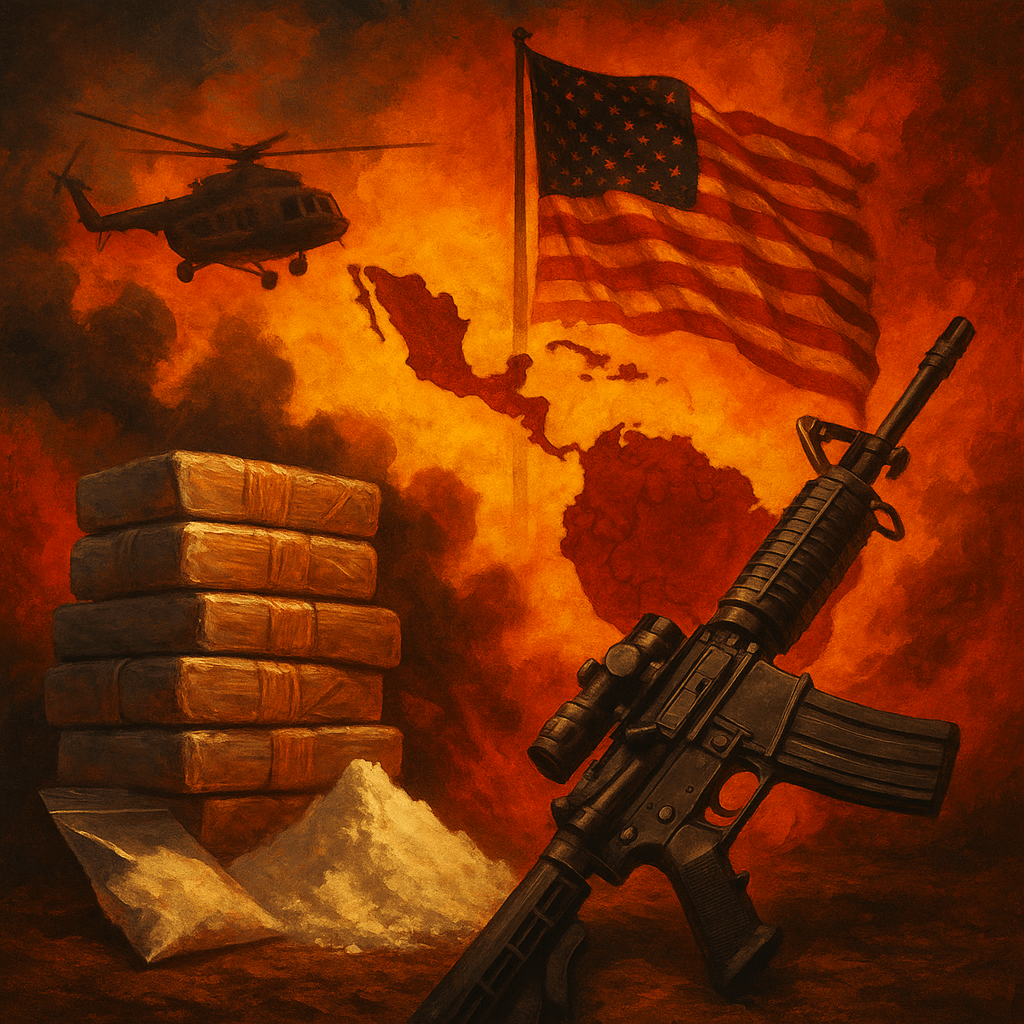
By weaponizing “narco-terrorism” as an instrument of imperial war, the United States protects compliant narco-states, criminalizes sovereign governments, and builds a hemispheric fortress for its coming confrontation with China. This essay exposes the architecture, the alliances, and the lies that hold the American Pole together — from Venezuela to Honduras, from Ecuador to Colombia, from Mexico to the newly recolonized Bolivia.
By Prince Kapone | Weaponized Information | December 2, 2025
Narco-Empire and the Architecture of the American Pole
The Trump 2.0 regime wants the world to believe that Nicolás Maduro runs a “narco-terrorist dictatorship.” They want the hemisphere to treat Venezuela like a cartel bunker. They want the working class of the United States to imagine that the poverty, precarity, and despair manufactured at home are somehow the result of a socialist government 2,000 miles south of the border. This is not merely disinformation. It is the political software of a decaying empire trying to reformat the hemisphere under its control.
Because here is the contradiction they refuse to name: the United States has been the principal architect, financier, protector, and beneficiary of the primary narcotrafficking circuits in the Americas for over forty years. At every nodal point where cocaine, cash, or weapons flow, Washington is present—shaping, managing, laundering, and weaponizing the traffic.
This is the foundation of the American Pole, the hemispheric fortress Washington is rushing to build as the world shifts toward multipolarity. The drug war is one of its load-bearing columns. It provides the legal language, the ideological cover, and the militarized infrastructure to discipline the region into obedience. It allows the U.S. to criminalize sovereign states while protecting compliant narco-governments.
Venezuela defends sovereignty—so it is called a cartel. Honduras under JOH trafficked cocaine with impunity—so it was rewarded. Ecuador launders cocaine through private ports—so it is called a partner. Colombia under Uribe ran a paramilitary narco-regime—so it received billions in U.S. aid. And Mexico, now under President Claudia Sheinbaum, remains structurally trapped in U.S. security architecture that Washington can reactivate at will.
The Trump regime’s claims against Venezuela are not forensic—they are geopolitical. When you peel back the propaganda, what emerges is not a war on drugs but a counterinsurgency doctrine for the entire hemisphere. Narco-terrorism is the empire’s newest alibi for recolonization. This essay traces that alibi from its historical roots to its present deployments, revealing the true function of narcotrafficking in the imperial economy. We begin where the empire insists we must not look: Venezuela, the “narco-state” constructed in the imagination of the State Department and nowhere else.
How to Manufacture a Narco-Dictatorship: The Criminalization of Venezuelan Sovereignty
The United States did not indict Nicolás Maduro to fight cocaine. It indicted him to destroy sovereignty. The so-called “Cartel de los Soles” is not the revelation the Western media pretends it is; it is a U.S. intelligence fabrication designed to transform a political enemy into a criminal target. The Grayzone and numerous Latin American journalists have already traced the origins of the term: a narrative seeded by the DEA, inflated by defectors groomed in Miami, and repeated endlessly until the accusation acquired the appearance of fact.
The Department of Justice offered $15 million for Maduro’s capture—a bounty normally reserved for fugitives, not heads of state. This was not law enforcement; it was regime-change by indictment. Because the U.S. could not defeat Chavismo at the ballot box, could not fracture its military base, and could not break its alliances with China, Russia, and the Global South, it resorted to juridical warfare—the weaponization of U.S. courts as imperial tribunals.
Every element of Washington’s case collapses under scrutiny. Cocaine production in Venezuela is negligible compared to Colombia. The trafficking routes through Venezuela are residual, shaped by geography and U.S. interdiction pressures elsewhere. The “evidence” provided by the Trump administration included testimony from corrupt former officials facing charges in the U.S., DEA-coached informants, and security contractors linked to failed mercenary operations like Operation Gideon.
But the accusation was never meant to withstand analysis. Its purpose was to justify what the U.S. had already done:
- economic warfare via sanctions
- naval encirclement in the Caribbean
- the freezing and theft of billions in Venezuelan assets
- the recognition of a fabricated “interim government”
- the political cover for coup attempts, mercenary raids, and sabotage
Washington’s lie works only when history is erased. Because the true narco-architecture of the hemisphere was constructed not in Caracas but in Langley. And while Venezuela defends its sovereignty with the support of millions, actual narco-states—Honduras under JOH, Ecuador under Noboa, Colombia’s right-wing factions, and paramilitary zones in Mexico—have enjoyed uninterrupted support from Washington.
This is the dialectic the empire cannot allow the world to see: the drug war is not a campaign against narcotics, but a mechanism for selecting which governments may rule and which must be destroyed. Venezuela’s real crime is refusing to fold itself into the American Pole.
Honduras: The Narco-Garrison of Fortress America
If Venezuela is the empire’s manufactured villain, Honduras is its exposed blueprint. No country demonstrates the imperial hypocrisy of the U.S. drug war more clearly. For over a decade, Honduras functioned as a narco-military protectorate of the United States—a key pillar in the construction of Fortress America. The U.S. did not merely tolerate narcotrafficking under Juan Orlando Hernández; it shielded, partnered with, and expanded it.
The 2009 coup against Manuel Zelaya was the first brick in this fortress wall. Approved tacitly by the Obama administration, sanitized by Hillary Clinton’s State Department, and legitimized by the OAS, it opened Honduras to a new era of militarization. The coup was not about corruption. It was about preventing Honduras from joining ALBA, deepening ties with Venezuela, and adopting a developmental model incompatible with U.S. hegemony.
Under JOH, the state transformed into a pyramid of protection: cocaine at the base, oligarchs at the center, the presidency as the capstone, and the U.S. military as the scaffolding. Prosecutors in New York revealed that Hernández orchestrated a state-sponsored cocaine trafficking conspiracy that moved upwards of 400 tons of cocaine northward. His own brother was convicted as a major trafficker. Yet through all of this, Washington continued sending military aid, training Honduran forces, and praising JOH as a “regional partner.”
Why? Because Honduras under JOH served three imperial needs:
- It offered a militarized territory aligned with U.S. strategic command.
- It provided migration flows that Washington used to justify border militarization.
- It allowed the U.S. to manage narcotrafficking routes instead of disrupting them.
Honduras became the empire’s narco-garrison—a forward operating base where narcotrafficking and counterinsurgency fused into a single strategy. Soto Cano Air Base functioned as a semi-permanent U.S. outpost. DEA, CIA, SOUTHCOM, and State Department personnel treated Honduras as a laboratory for security doctrine.
When Xiomara Castro won the presidency, she inherited a shattered economy, a militarized state, and narco-networks woven into every institution. Her government’s attempts to rebalance Honduras toward sovereignty triggered immediate pushback from Washington. Trump 2.0 escalated interference:
- threatening sanctions if Honduras refused to accept mass deportations,
- pressuring the government to maintain U.S. basing arrangements,
- openly signaling support for the right-wing National Party in upcoming elections.
Trump even pardoned JOH—the same man the DOJ had previously condemned as a kingpin—making the political message unmistakable: Loyalty to the American Pole is more important than any crime.
Honduras today is contested terrain. The oligarchs and security forces remain aligned with Washington. Castro governs, but within a structure designed to constrain sovereignty. The U.S. is actively attempting to reinstall a pliant right-wing government in the next elections. If that happens, Honduras will be reabsorbed fully into the imperial apparatus—restored as the narco-garrison of the region.
In this contradiction, Honduras reveals the core truth of the drug war: narcotrafficking is tolerated, managed, and even protected when it serves imperial architecture. It is demonized, weaponized, and criminalized when it threatens to escape that architecture. That is why Venezuela is accused and Honduras was embraced; why sovereignty is punished while obedience is rewarded.
Ecuador: The Technocratic Narco-State of the Pacific Corridor
If Honduras is the empire’s exposed narco-garrison, Ecuador is its gleaming technocratic upgrade — the model narco-state of the Pacific corridor, repackaged as “innovation,” “security reform,” and “democratic stability.” Ecuador is what the American Pole looks like when narcotrafficking, oligarchy, foreign capital, and U.S. strategic command converge behind a youthful, smiling billionaire who speaks the language of “efficiency” and “modern logistics.” The empire calls this modernity. The people living under it call it recolonization.
Daniel Noboa did not rise to power because he was a visionary. He rose because Ecuador’s oligarchy, its private port owners, its U.S.-trained security elite, and the State Department shared a common objective: to turn Ecuador into a militarized export platform for narcotics, commodities, data, and geopolitical obedience. His victory was less an election than an algorithm — a fusion of U.S.-funded NGO networks, foreign “democracy assistance,” elite-controlled media, digital campaigning, and the shadow of political violence engineered to discipline the electorate.
The cocaine routes flowing through Ecuador expanded not in spite of the state, but through it — with private ports functioning as laundering nodes, customs operations penetrated by organized crime, and political parties openly financed by cartels. What the media describes as “Ecuador’s descent into violence” is actually the consolidation of a narco-state that serves U.S. strategic logistics: a Pacific coastline free of Chinese influence, integrated into U.S. naval patterns, and governed by elites whose wealth depends on export infrastructure rather than national sovereignty.
Noboa’s declaration of an “internal armed conflict” — eagerly echoed by Reuters and The Guardian — was not a response to cartel power; it was the legal pretext for militarizing society, embedding U.S. advisors, and reorganizing Ecuador’s security system around counterinsurgency doctrine. Under the guise of fighting crime, Noboa is building an obedient security architecture that serves as a Pacific extension of U.S. Southern Command. Private ports, military-police fusion centers, digital surveillance contracts, and a revamped intelligence structure all converge on the same purpose: securing Ecuador as a hinge in the American Pole.
This is why Washington embraces Ecuador’s narco-oligarchy while denouncing Venezuela’s revolutionary government. The question was never about cocaine. The question was always about obedience. Ecuador aligns seamlessly with U.S. strategy: isolating China, policing the Pacific, facilitating counterinsurgency operations, and ensuring that the logistical corridors from the Andes to the coast remain firmly under imperial control. A narco-state that obeys is called a partner. A sovereign state that resists is called a dictatorship.
The CIA Blueprint: How Washington Engineered the Narco-Architecture of the Hemisphere
To understand the present alignment of Honduras, Ecuador, Colombia, Panama, and Mexico within the American Pole, we must excavate the blueprint that gave rise to the modern narco-state. This blueprint was drafted not by traffickers in the jungle but by analysts in Langley, accountants on Wall Street, and counterinsurgency theorists in the Pentagon. The drug war was never about eliminating cocaine. It was about building loyal states, disciplining insurgencies, financing covert operations, and restructuring entire economies around U.S. hegemony.
Nicaragua was the first test. During the Contra war, the CIA greenlit cocaine trafficking as a mechanism for financing an illegal paramilitary army. When journalists exposed it, they were smeared, blacklisted, and driven into political exile. The lesson was clear: narcotrafficking is permissible if it serves imperial strategy. This logic expanded across the hemisphere.
Colombia became the empire’s laboratory. Under Álvaro Uribe — himself linked to dozens of paramilitary commanders, death squads, and narcotrafficking networks — Plan Colombia fused counterinsurgency with cartel management. The U.S. poured billions into a military-police apparatus that protected oligarchs, massacred peasants, and guaranteed Colombia’s role as Washington’s frontline garrison. Cocaine production soared under U.S. supervision. What Washington wanted was not eradication but control: control of routes, of buyers, of political outcomes.
Panama served as the empire’s “narco-bank.” Noriega was a CIA asset who laundered money, coordinated deals, and ensured that the canal’s logistical flows were aligned with U.S. intelligence. When he ceased to be useful, the U.S. invaded — not to stop drugs, but to reassert total control of the canal and install a government more tightly wired into U.S. command. Today, Panama’s ports and canal zones function as essential arteries of the American Pole.
Mexico, even under new leadership, remains trapped in a security architecture designed by Washington. The Mérida Initiative militarized the state, empowered criminal networks aligned with U.S. intelligence, and transformed northern Mexico into a buffer zone for U.S. industrial reorganization. The cartels the U.S. claims to fight expanded under U.S. supervision, arms trafficking, and financial complicity.
The narcotrafficking system of the Americas did not arise spontaneously. It was engineered. It was shaped through coups, interventions, “security cooperation,” IMF restructuring, and the embedding of U.S. agencies into national institutions. And today, this architecture forms one of the pillars of the American Pole — a hemisphere-wide network of compliant states whose criminal economies are tolerated, protected, or destroyed depending on their geopolitical usefulness.
Narco-Indictments as Imperial Weapons: How the U.S. Selects Which States May Live or Die
When the U.S. accuses a government of “narco-terrorism,” the accusation has nothing to do with narcotics. It is a geopolitical verdict. It is a classification system, a disciplinary mechanism, and a battlefield designation for the American Pole. Washington does not use indictments to pursue cocaine traffickers — it uses them to pursue sovereign governments.
Venezuela, Nicaragua, and Cuba are labeled narco-states not because of evidence but because they reject U.S. command, trade with China, pursue independent development, and refuse to serve as logistical appendages of the U.S. war economy. Meanwhile, Honduras under JOH, Ecuador under Noboa, Colombia’s right-wing factions, and the paramilitary zones of Mexico enjoy immunity precisely because they align with U.S. security doctrine.
This selective prosecution reveals the deeper function of the drug war: to reorganize the hemisphere into compliant and non-compliant zones. The compliant narco-states are integrated into the American Pole and rewarded with military cooperation, diplomatic praise, and economic support. The non-compliant sovereign states are encircled, sanctioned, indicted, destabilized, and isolated.
Narco-indictments serve as multi-purpose weapons:
- They justify sanctions, blockades, and financial theft.
- They provide legal cover for U.S. military presence and naval escalation.
- They delegitimize governments in the eyes of international institutions.
- They intimidate political movements in the Global South.
- They discipline any state that leans toward China, BRICS, or multipolar realignment.
The charge of “narco-terrorism” is not a legal category; it is an imperial instrument. It functions the way “communism” functioned during the Cold War — as a label that transforms a sovereign government into a target for intervention. Today, the term is applied selectively to those who threaten U.S. primacy. This is why Maduro is indicted while JOH is pardoned. Why Venezuela faces naval encirclement while Ecuador receives U.S. weapons. Why Cuba is sanctioned into suffocation while Colombia’s paramilitary state receives diplomatic applause.
The narco-indictment is the empire’s newest mask — a justification for integrating the hemisphere into the American Pole by force. It is not a response to crime. It is a response to sovereignty.
Narco-Fortress or Sovereign Future: The Battle for the Hemisphere
By the time we arrive at this point in the map, a continental pattern becomes visible. The American Pole is not a metaphor; it is a strategic formation. Washington’s hemispheric architecture divides states into two categories: Narco-Fortress States — compliant, militarized, useful — and Sovereign States — disobedient, multipolar, dangerous. What determines the category is not cocaine, but alignment.
Honduras, Ecuador, Colombia’s old guard, paramilitary Mexico, and now the newly recolonized Bolivia sit on one side of the dividing line: states whose internal contradictions are managed through a fusion of oligarchy, security forces, narcotrafficking networks, and U.S. “partnerships.” These are the pillars of the American Pole. Their role is to stabilize export corridors, secure U.S. military logistics, suppress radical movements, and discipline the hemisphere on behalf of Washington’s long-term confrontation with China.
On the other side stand the Sovereign States: Venezuela, Cuba, Nicaragua, and the movements that continue fighting for sovereignty in Colombia, Mexico, Guatemala, Haiti, and — despite the electoral defeat — within Bolivia’s Indigenous, worker, and campesino sectors. These are the governments and movements that refuse subordination. They defend national control over resources, choose their own partners, and favor multipolar integration: China for investment, BRICS for development, South–South corridors for autonomy. Their position within the hemisphere threatens the imperial blueprint — and for this reason, they are the ones Washington calls “narco-states.”
Petro’s Colombia has become the clearest expression of this contradiction. Under Petro, Colombia — once Washington’s most loyal garrison — denounced the drug war at the United Nations, argued openly that cocaine prohibition served U.S. interests rather than Colombian life, and pursued peace negotiations that undermine the counterinsurgency doctrine underlying the American Pole. Petro challenged extraditions, sought diplomatic sovereignty, and opened space for a political reorientation that threatened the military, paramilitary, and U.S.-aligned elites. Immediately, Washington and Colombia’s oligarchy retaliated: lawfare campaigns, Congressional threats, media accusations, destabilization attempts, and pressure to re-militarize the countryside. The empire cannot tolerate a sovereign Colombia — it sits at the hinge of the entire architecture.
Mexico under Claudia Sheinbaum faces a parallel contradiction. Though Sheinbaum inherits a popular mandate from López Obrador, she also inherits the security and economic shackles of U.S. power: nearshoring demands, militarized anti-migration agreements, fentanyl hysteria, and Washington’s escalating pressure to integrate Mexico into its war-preparatory supply chain. Every step Sheinbaum takes — from energy policy to border policy to China relations — unfolds within an imperial cage that threatens retaliation if Mexico strays too far from its assigned role.
Bolivia, meanwhile, is undergoing a rapid transformation. The victory of Rodrigo Paz did not merely shift policy — it repositioned Bolivia inside the American Pole. Paz invites U.S. agencies back into the country, dismantles redistributive reforms, greenlights foreign influence, and opens the door to the recolonization of lithium. In the North Atlantic press, Paz is celebrated as a “modernizer.” In reality, he is restoring Bolivia’s function as a dependent mineral corridor instead of a sovereign industrial project. This is precisely how the American Pole absorbs countries: through technocratic recolonization dressed in the language of stability.
The continent is now polarized between two incompatible projects. The American Pole seeks obedience, militarization, and logistical integration. The Sovereign Hemisphere seeks dignity, multipolarity, and self-determination. The outcome of this struggle will define whether the Americas become a war platform for a declining empire or a continent of free peoples shaping their own future. The battleground is not abstract — it is lived in every strike, every land defense, every port dispute, every mining conflict, every peace negotiation.
The Infrastructure of Empire: Ports, Corridors, Lithium, and the Machinery of Control
The American Pole is not built with speeches or sanctions alone. It is constructed through infrastructure — ports, pipelines, railways, copper grids, lithium corridors, fiber-optic networks, military bases, and satellite links. To the Pentagon and State Department, these infrastructures are not neutral. They are arteries of war. They are the logistical skeleton of the imperial fortress. To understand the narcotrafficking architecture of the hemisphere is to understand how narcotics, logistics, and militarization are woven together.
The Panama Canal is the heart valve of the system: a strategic chokepoint whose control determines global shipping flows during crises. This is why Washington forced Panama out of the Belt and Road Initiative, pressured it to cancel Chinese port concessions, and maneuvered Western firms — including BlackRock, MSC, and U.S.-aligned port operators — into dominant positions. Under the language of “security” and “investment,” the canal has been fully integrated into U.S. wartime planning.
Ecuador’s private ports — Guayaquil, Posorja, Manta — are the Pacific flank of this architecture. The rise of narcotrafficking in Ecuador correlates directly with the privatization of ports and the displacement of state oversight. Cocaine moves seamlessly through logistics zones built by and for oligarchic families whose interests align with global shipping giants, not with Ecuadorian sovereignty. Noboa’s militarization campaign secures these ports not from cartels but for capital.
In the Southern Cone, the Lithium Triangle has become the empire’s battery vault. The Paz administration’s orientation mirrors Washington’s long-term objective: to ensure that lithium is extracted under Western financial control rather than integrated into Bolivian, Chinese, or South American industrialization. Lithium is not a commodity — it is a strategic input for weapons systems, drone fleets, satellites, electric vehicles, and data infrastructure. Whoever controls Bolivia’s lithium controls part of the future battlefield.
The Bioceanic Corridor — connecting Brazil, Paraguay, Argentina, and Chile — is another imperial flashpoint. If used for Chinese cargo, it strengthens multipolarity. If controlled by U.S.-aligned governments and investors, it becomes a logistical spine of the American Pole. Every port concession, every financing agreement, every customs regulation becomes a small battle in a much larger war.
Fiber-optic cables and digital networks are the silent weapons of this new architecture. Washington pressures states to reject Huawei and adopt U.S.-aligned digital standards, not because of “security concerns,” but because digital sovereignty undermines U.S. surveillance capacity. When Rodrigo Paz welcomed Starlink — a Pentagon-adjacent satellite system — he was not modernizing Bolivia. He was placing its communications infrastructure under foreign command.
Across the continent, infrastructure has become class war made concrete. Every corridor built for imperial logistics becomes another corridor used to justify militarization, narcotics crackdowns, police fusion centers, and the suppression of social movements. The infrastructures that move commodities also move repression. The American Pole is built not only with cement and steel but with doctrines, databases, and satellite networks that transform the entire hemisphere into a war platform.
Recolonization vs. Multipolar Sovereignty: The Continent Divides
The deeper contradiction facing the hemisphere is not between left and right, nor between crime and order — it is between recolonization and sovereignty. The American Pole represents a project of hemispheric recolonization: a restructuring of the Americas into a disciplined, militarized, subordinated bloc that provides the raw materials, logistical corridors, and political obedience required for the U.S. to confront China. This project uses narcotrafficking as both shield and sword: shield for its allies, sword for its enemies.
Opposing this project is a growing, uneven, but undeniable push for multipolar sovereignty. This includes governments openly aligned with BRICS; Indigenous nations defending their territories from extractive capitalism; workers resisting austerity, privatization, and U.S. security agreements; youth movements opposing militarization; and countries exploring Chinese partnership as an alternative development model. This is not a unified bloc — yet. But it is a shared direction of movement: away from dependency and toward self-determination.
Venezuela remains the clearest example of multipolar sovereignty in action. The country has survived economic warfare, coup attempts, mercenary incursions, sabotage, and diplomatic isolation by building deep relations with China, Russia, Iran, and the global South. Cuba continues to resist sixty years of economic siege. Nicaragua maintains independence despite sanctions, misinformation, and pressure campaigns. Colombia’s popular movements push against militarism and toward peace. Haiti refuses to accept foreign occupation. Bolivia’s Indigenous and worker movements are already reorganizing for the next cycle of struggle.
Washington fears this sovereignty — not because it threatens “democracy,” but because it threatens the material and logistical foundations of the American Pole. A sovereign hemisphere undermines U.S. war planning, reduces access to strategic minerals, limits military basing, and invites multipolar development. It breaks the premise that the Western Hemisphere is Washington’s “backyard.” The empire cannot tolerate such defiance. That is why narcotrafficking charges, sanctions, blockades, and media warfare fall exclusively on sovereign states.
This is the continental contradiction:
Will the Americas become a war fortress for an empire in decline, or a space of multipolar emancipation for the peoples who live here?
Building the People’s Hemisphere: Toward a Continental Strategy of Liberation
If the American Pole is the empire’s blueprint for recolonization, the People’s Hemisphere must be our blueprint for liberation. This is not a slogan. It is a political, economic, cultural, and strategic project rooted in the struggles already unfolding across the continent. The People’s Hemisphere begins with the recognition that sovereignty cannot survive alone. It requires continental coordination — of workers, campesinos, Indigenous nations, urban movements, radical intellectuals, and governments that refuse to be subordinated.
Workers are at the center of this horizon. Auto workers in northern Mexico, port workers in Chile, miners in Bolivia, oil workers in Venezuela, agricultural workers across Brazil and Argentina — these are the laboring classes whose exploitation underwrites both imperial logistics and multipolar potential. A People’s Hemisphere requires cross-border labor alliances capable of disrupting imperial supply chains and building independent development paths.
Indigenous nations are the strategic vanguard. They stand at the front lines of anti-extraction struggles, water defense, and land sovereignty. They defend the forests, rivers, lithium fields, and Amazonian territories that the American Pole seeks to turn into war resources. Their autonomy, assemblies, and cosmologies offer a radically different vision of development.
Communication infrastructures must be wrested from imperial control. Independent media, community radio, digital collectives, Diaspora networks, and South–South information exchanges are no longer auxiliary — they are central components of continental defense. A People’s Hemisphere cannot rely on corporate platforms owned by oligarchs or U.S. defense contractors.
Political coordination must evolve from episodic solidarity into structural unity — not merely summits, but institutions. ALBA, CELAC, UNASUR, and BRICS offer frameworks that can be expanded, democratized, and radicalized. Multipolarity is not automatically emancipatory, but it opens space for anti-imperialist development that has been structurally impossible under U.S. domination.
Above all, the People’s Hemisphere must act with historical clarity: Washington is preparing the region for a long confrontation with China. If the peoples of the Americas do not organize in advance, they will be drafted into a war that serves no one but the imperial ruling class.
Conclusion: Who Gets Called a Narco-State — and Why
When we step back from the details, a simple, devastating truth reveals itself: the United States does not call a country a “narco-state” because it trafficks drugs. It calls a country a narco-state because it refuses to obey. The empire pardons real traffickers, funds real cartels, collaborates with real oligarchic mafias — as long as they serve the fortress. It criminalizes sovereign governments — as soon as they break from the script.
The drug war is not a moral project. It is a geopolitical instrument. It is the ideological mortar that holds together the American Pole — a hemispheric war formation built for a conflict with China that the peoples of the Americas did not choose. The question before us is the same question confronting every revolutionary movement across the hemisphere:
Will we allow ourselves to be folded into the empire’s war map, or will we build a hemispheric project of our own?
Honduras, Ecuador, Colombia, Panama, Mexico, and now Bolivia stand at crossroads. Their futures — and the futures of their working classes — depend on whether they remain tethered to the U.S. security machine or align with the movements fighting for sovereignty. The empire is preparing its fortress with speed and desperation. The peoples of the Americas must prepare their own counter-fortress: a People’s Hemisphere rooted in dignity, solidarity, and liberation.
In this struggle, clarity is a weapon. Organization is a weapon. Internationalism is a weapon. The truth is a weapon. And the people — from Tijuana to Tierra del Fuego, from Port-au-Prince to Caracas, from Bogotá to La Paz — are the only force capable of breaking the American Pole once and for all. That is the task history has placed before us.
 Weaponized Information
Leave a comment