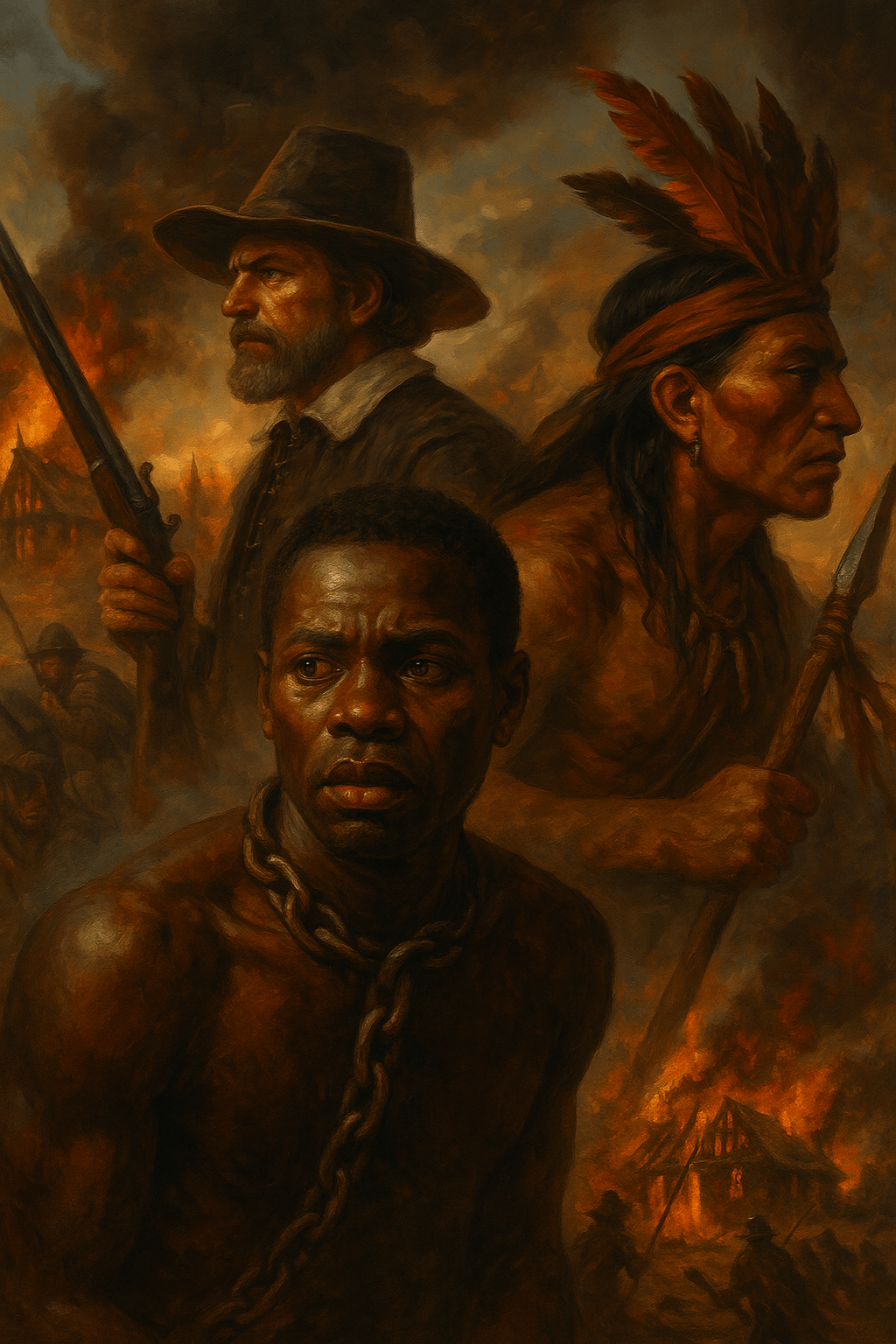
In The Apocalypse of Settler Colonialism, Gerald Horne shows how seventeenth-century England fused racial slavery, Indigenous genocide, and corporate empire into the blueprint for the U.S. settler state — a history revolutionaries must grasp if we intend to overthrow the world that system built.
By Prince Kapone | Weaponized Information | November 30, 2025
From Dawning to Detonation: How England Turned Apocalypse into a System
Gerald Horne doesn’t give us much time to breathe between books. If The Dawning of the Apocalypse was the story of how Europe lit the fuse in the long sixteenth century, The Apocalypse of Settler Colonialism is what happens when that fuse hits the powder. We pick up in the early 1600s with England still a second-tier power, a damp island on the edge of Europe, and by the early 1700s we are staring at a new reality: Great Britain as the emerging world superpower, already preparing to hand the baton to its “revolting spawn” across the Atlantic. Horne’s point is simple and ruthless: you cannot explain that rise without slavery, settler colonialism, and white supremacy.
The introduction lays out the balance sheet in brutal terms. Between the sixteenth and nineteenth centuries, nearly thirteen million Africans are ripped from their homelands, marched to the coasts, branded, shipped, and worked to death for the enrichment of European and Euro-American powers—London not least. Millions of Indigenous people across the Americas are enslaved in parallel, with population losses in some regions reaching up to ninety percent through war, famine, forced labor, and the epidemics that follow conquest. This is not a “dark chapter” in an otherwise noble story. This is the story. The seventeenth century is when the apocalypse stops looking like chaos and starts looking like policy.
Horne is very clear about what changes between the first book and this one. In the sixteenth century, Spain and Portugal are still improvising their empire—violent, yes, but full of contradictions, half-measures, and strange openings: free Black conquistadors, armed Africans, complex racial gradations, and uneasy coexistence with surviving Indigenous nations. England enters late, watches carefully, and decides to remove as many of those contradictions as possible. The result is a different kind of monster: the settler colonial regime, where Europeans do not just rule over others but seek to replace them, root and branch.
The introduction sets the stakes: 1603 to 1714 is not just another slice of early modern history. For Horne, these are “perhaps the most decisive years in English history.” At the start of this arc, England is still overshadowed by Iberia, the Dutch, and even older Mediterranean powers. By the end, Britain has built the naval muscle, the merchant class, and the racial ideology to dominate the Atlantic and to project power deep into North America and the Caribbean. Crucially, the path to that dominance runs through colonies where Indigenous people are being driven off their land or exterminated, and Africans are being turned into the main currency of global wealth.
Horne’s introduction also sharpens something we only saw in outline in the first volume: how whiteness congeals as a political project. In the sixteenth century, religious division—Catholic versus Protestant—still tears Europe apart. But in the seventeenth century, especially in the English world, “white” begins to function as a new glue. English, Scots, Irish, and other feuding Europeans can be united overseas as “white” settlers so long as they agree on two things: Indigenous people must be removed, and Africans must be enslaved. This is the birth of what you and I would call the white republic, centuries before the United States formally declares independence.
At the same time, Horne refuses to let us imagine Africans and Indigenous nations as passive backdrop to England’s ascent. The introduction hints at what the later chapters will show in detail: that the seventeenth century is also a time of massive resistance. Enslaved Africans revolt on ships and plantations; they escape, form maroon communities, and ally with Indigenous nations. Indigenous peoples launch wars that nearly wipe out English settlements. The apocalypse is not just something Europeans do to the rest of the world; it is a battlefield where the oppressed fight back at every step, forcing the empire to constantly revise its methods of control.
From a Weaponized Information standpoint, Horne is doing two things at once in this opening movement. First, he is finishing the demolition job on the fairy tale that capitalism was born in peaceful markets and sober parliaments. He shows, with historical precision, that what we call “modernity” rests on slave ship decks, sugar fields, stolen land, and mass graves. Second, he is prefiguring the U.S. as the real heir to this system. Britain spends the seventeenth century perfecting a technique of rule—racial slavery plus settler colonialism—that will later be taken to its most extreme form in North America.
There’s also a quiet but important polemic here against a certain kind of Western leftism. The same radicals who will celebrate 1688 as the triumph of “parliamentary liberty,” or hail the English Revolution as a bourgeois breakthrough, often treat slavery and Indigenous extermination as side notes. Horne flips the script: the growth of English “freedom” at the center is paid for by a tightening noose of unfreedom at the periphery. When merchants gain more room to maneuver, they use it to expand the traffic in human beings. When parliamentary forces weaken the monarchy, they do it in part to open the door to private profit from conquest and slavery. The more “liberty” you see for Europeans, the more chains you see on Africans and the more graves you find where Indigenous nations once lived.
In that sense, this book—and this review—are not academic exercises. They are manuals for understanding how we got from the seventeenth century to the world of drones, data centers, and technofascist border regimes we live in now. The racial state that Horne tracks in embryo—using law to define whiteness, using whiteness to distribute rights, using those rights to justify dispossession—is the same state structure that will later build Jim Crow, redlining, COINTELPRO, ICE, and the endless wars of the “War on Terror.”
Part I of our review, then, has one job: to set the stage. The apocalypse Horne describes is no longer “dawning” at the edge of the horizon. In the seventeenth century, under English command, it becomes a permanent feature of the landscape. The chapters that follow will walk us through the specific mechanisms: how merchants behead a king and expand the slave trade; how Jamaica and Barbados become factories of human misery and profit; how Dutch rivals are driven off the mainland; how laws are written to harden whiteness into a weapon; how rebellions—African, Indigenous, and sometimes even white—are absorbed and turned into lessons in counterinsurgency. Horne is telling us: if you want to understand the American empire, you have to start here, in the century when the apocalypse stops being an event and becomes a system.
When Jamestown Failed Forward: How England Rebuilt the Colony Around Slavery and Genocide
Horne opens the seventeenth century’s first chapter with a brutally simple truth: Jamestown was never supposed to look the way schoolbooks describe it. It was not a brave little settlement in the wilderness. It was a collapsing military outpost, starving, diseased, besieged on all sides by Indigenous resistance, and held together only by the periodic arrival of reinforcements from England. The colony was a failure by every metric that mattered—until English elites decided to reinvent the entire project around racial slavery and settler colonial land theft.
This is where Horne’s narrative picks up from the last book. In The Dawning of the Apocalypse, Jamestown’s foundation in 1607 was the moment the English apocalypse first put down roots. In this sequel, we watch that seed sprout into a new kind of colonial organism—one built not on coexistence with Indigenous nations, and not on a mixed labor system like Iberia’s, but on two ruthless principles: Africans will be permanent, inheritable property; Indigenous peoples will be driven off the land by terror or annihilation.
Horne makes clear that this shift was not philosophical; it was material necessity. The English simply could not survive without taking Indigenous land. And they could not profit without African labor. The early 1600s reveal a desperate England balancing on the edge of bankruptcy, religious fragmentation, and rising competition from the Dutch. Jamestown was supposed to rescue the Crown’s finances and give England a place in the imperial race. Instead, it became a death trap. Indigenous nations imposed tight food blockades. English settlers died in droves. The “Starving Time” turned colonists into cannibals while Powhatan and allied nations kept the pressure on.
Horne shows us what the English elite learned from this humiliation: if you want a colony to last, you cannot depend on fragile alliances with Indigenous nations or on indentured Europeans who die or desert in large numbers. You need a captive labor force you can work to death and replace, and you need to eliminate the people who stand between settlers and the land they covet. The chapter lays out the cold calculus that produced the racial state: it was cheaper to enslave Africans forever than to import new indentured labor with each generation. It was easier to eradicate Indigenous nations than to negotiate coexistence or power-sharing. Settler survival depended on permanent hierarchy.
This is the key lesson of the early seventeenth century, and Horne delivers it with crystalline clarity: the English apocalypse did not grow out of cultural prejudice. It grew out of economic design. Africans became enslaved not because of “ancient hatreds” but because racial slavery produced stable profits for the Crown and the merchant class. Indigenous people became targets for removal not because of “cultural conflict,” but because they blocked the settlers’ access to land, wealth, and expansion. In other words, white supremacy is not a moral defect—it is a political technology.
Here Horne is also sharpening a point the Western left likes to smudge: early colonial Virginia was not an embryonic democracy; it was a militarized corporation. The Virginia Company ruled like a private army with commercial ambitions. Its charters guaranteed monopolies, extracted labor, and funneled wealth directly into English ruling-class pockets. Jamestown was less “community” and more “company town”—a for-profit dictatorship with muskets.
And yet—and this is where Horne shines—the colony was never uncontested. Africans arrived in small numbers early in the century, and from the moment they touched the soil they resisted in every form: desertion, sabotage, taking up arms, intermarrying with Indigenous nations, and joining maroon communities. Indigenous nations, far from being passive victims, waged total war to stop the colony before it could expand. These struggles shape every decision England makes. White supremacy is codified not in advance, but in response to the fear and fact of Black and Indigenous resistance.
From a WI perspective, this chapter exposes the political origin of the American race-class structure. Early Virginia is where England learns that a settler colony can only cohere if poor whites are bound to the colonial elite through shared racial privilege. Already, you can see the seeds of the later split between white workers and the colonized: white indentured servants may be exploited, abused, and worked to death, but they are not enslaved; they are not landless forever; and they are not Indigenous or African. That difference—violent, artificial, and manufactured—becomes the lever England uses to hold the colony together.
In weaponized terms: this is the birth of the white proletariat as a junior partner in a genocidal project. It is also the birth of Black rebellion as a permanent threat, and of Indigenous sovereignty as the primary obstacle the colony must erase. This is the crucible where the U.S. takes shape—not through constitutions or Enlightenment pamphlets, but through war, hunger, policy, and racial engineering.
By the end of this chapter, the apocalypse has a new set of rules:
Eliminate the Native. Enslave the African. Elevate the European. Expand the frontier.
These are not yet written into law, but they are written into practice. And as Horne reminds us, practice becomes law soon enough.
When Sweetness Became a Weapon: Sugar, Tobacco, and the Birth of the Slave Power
Chapter 2 is where Horne stops treating the early seventeenth century as a chaotic scramble for survival and begins showing us how England discovers the real engine of empire: plantation capitalism. This is the moment when slavery stops being an emergency labor solution for a failing colony and becomes the beating heart of a global economic order. Sugar and tobacco aren’t side crops. They are the pillars on which the English state, the monarchy, and the future American republic will be built.
Horne’s argument is quietly revolutionary: capitalism did not emerge from English workshops, merchants’ guilds, or textile mills. It emerges from the plantation—an institution that Horne correctly describes as a counterinsurgency state disguised as agriculture. Barbados, St. Kitts, Nevis, and later Jamaica become the laboratories where a new kind of economy is engineered: highly militarized, brutally rational, and dependent on the permanent captivity of Africans.
The key transformation in this chapter is not simply the shift from failing Virginia settlements to profitable Caribbean plantations. It is the emergence of the plantation as a total system: land theft as foundation, African labor as machinery, racial hierarchy as operating logic, and the global market as distribution network. Sugar requires capital-intensive mills, constant labor, and round-the-clock supervision. No English laborer could survive the conditions. No Indigenous population remained to be coerced. That left Africans—and England’s ruling class quickly realized that enslaved African labor did more than produce commodities. It produced political stability for the colonial elite and unimaginable profits for London.
Horne traces how this new “slave power” begins to reshape English society itself. As sugar profits surge, Caribbean planters—many of them absentee landlords living in England—grow into a political force capable of directing national policy. The Crown, desperate for revenue in the aftermath of internal crises, leans on the plantation economy to fund the navy, wage continental wars, and stabilize the monarchy. The English poor, once potential allies of the enslaved, are increasingly absorbed into a racialized political identity that offers them crumbs of advantage in exchange for loyalty to the colonial project.
Tobacco plays its own role in this emerging system. In Virginia and Maryland, tobacco becomes the crop that ties mainland North America to the plantation revolution unfolding in the islands. While sugar enriches England at a staggering rate, tobacco creates a stable base of settler society. It is less profitable than sugar but far more likely to produce a white settler class eager to fight for land, defend slavery, and expand the colonial frontier. Horne makes clear that tobacco is not an alternative to sugar—it is sugar’s political accomplice, anchoring a settler population whose expansionist dreams require both Indigenous removal and African enslavement.
What this chapter shows—without romance, without euphemism—is that the English economy becomes structurally dependent on racial slavery. The profits of sugar flow into the banks of London, the shipyards of Bristol, the credit networks of Amsterdam, and the pockets of the aristocracy. The tobacco colonies provide a political base, a settler militia, and a demographic wedge for westward expansion. Together, sugar and tobacco forge an Anglo-Atlantic world in which Africa’s body becomes Europe’s wealth and America’s future.
From a WI standpoint, the significance of this chapter is enormous: this is where capitalism becomes racial in essence, not in accident. The plantation does not merely use race; it produces race. It requires race. The division between “white” and “Black” is engineered to stabilize a system that would otherwise collapse under the weight of its own violence. Without racial slavery, the English economy falters. Without racial ideology, the colonies fracture. Without the plantation, the empire dies before it is born.
Horne’s Chapter 2 also exposes another truth often buried in liberal histories: the enslaved African is not simply the engine of profit but the engine of modernity itself. The global market in sugar, tobacco, and eventually cotton creates the conditions for financial capitalism, naval supremacy, and the industrial revolution. Every ounce of wealth pouring into London originates in the forced labor of Africans whose bodies become the raw material of European “progress.”
This is why it must be understood as a turning point. After this moment, England is no longer improvising a colonial system; it is perfecting one. The apocalypse that Spain unleashed becomes England’s business plan. And the business plan requires that Africans and Indigenous nations be positioned not simply as obstacles, but as resources and enemies—to be exploited, eliminated, or contained.
By the end of this chapter, the “slave power” is not a metaphor. It is a political class, an economic engine, a global system—and the embryo of the American empire. Sugar made the money. Tobacco made the settlers. Racism made the system stable. And all three together made the seventeenth century the moment when capitalism revealed its true face: white, armed, and hungry for land.
When the Empire Panicked: Caribbean Rebellions and the Shattering of English Illusions
Chapter 3 is where Horne rips the mask off England’s fantasy of control. Up to this point in the narrative, English elites convince themselves that plantation capitalism will run smoothly as long as the profits flow and the whip cracks on time. But Horne shows that the seventeenth-century Caribbean is not a stable plantation economy—it is a permanent war zone. Every island is a frontline. Every plantation is a prison camp. Every enslaved African is a potential insurgent. And every English official lives with the creeping terror that the empire they are building is one spark away from burning down.
The chapter’s core truth is simple: the enslaved were never passive, never docile, never resigned. They fought. Everywhere. Constantly. And they fought with sophistication drawn from centuries of African political and military experience. Horne emphasizes that many Africans arriving in Barbados, Jamaica, and the Lesser Antilles came from societies such as Kongo and Ndongo—societies with organized armies, cavalry traditions, siege tactics, and political structures more complex than anything in the early English colonies. In other words, the English bring Africans to the Caribbean not as laborers but as veterans.
That alone would destabilize any empire. But Horne shows something even more explosive: Africans do not fight alone. Indigenous nations—Caribs, Arawaks, Kalinago—survive despite genocidal campaigns and retain control of strategic terrain: mountains, forests, coasts. They know how to navigate the landscape. They know how to wage guerrilla war. And they know that their survival is tied to resisting European domination. The alliance between Africans and Indigenous peoples is not symbolic; it is strategic, material, and devastating to English power.
Horne details wave after wave of rebellion. On Barbados, conspiracies involving hundreds of Africans span multiple plantations. In Jamaica, maroons form large, fortified communities capable of ambushing English troops, rescuing captives, and controlling the interior of the island. On islands like Nevis, Montserrat, and Antigua, uprisings erupt with such frequency that English colonists live in a state of constant dread. The archives Horne draws on read like military dispatches from a losing army: frightened governors pleading for reinforcements, settlers warning of conspiracies timed for Christmas or market days, plantation owners terrified of African communication networks they cannot decipher.
The critical point here—what makes this chapter so pivotal in Horne’s structure—is that these rebellions do more than threaten English profits. They force England to transform the entire architecture of empire. Plantation owners and colonial officials realize they cannot rely on improvisation, personal militias, or ad-hoc violence. They need codified systems of control. They need surveillance networks. They need racial laws that strip Africans of every possible right and criminalize every form of autonomy. They need militias composed of poor whites whose loyalty can only be secured through racial privilege.
This is where the ideological mutation happens: the English stop imagining Africans as a labor force and start imagining them as a permanent internal enemy. Rebellion is not seen as the consequence of violence—it is seen as the essence of Black existence. The result is a shift in law, policing, and daily colonial practice that Horne identifies as the early formation of racial slavery as a full-blown political system. The “Black slave” becomes a legal fiction designed to justify limitless domination. And the “white free person” becomes a political identity created to bind Europeans to the imperial project.
From a Weaponized Information standpoint, this is the chapter that exposes the origin of what we now call the “racial state.” England does not simply react to rebellion; it reorganizes itself around suppressing it. The plantation, as Horne makes clear, is a counterinsurgency regime masquerading as economic enterprise. Every law is a response to African resistance. Every militia formation is a response to African-Indigenous alliances. Every racial category is a political tool designed to break potential solidarity between the oppressed and elevate even the poorest European above the colonized.
And yet—this is the WI dialectic—rebellion is not merely a reaction to oppression. It is a creative force. The maroons invent new social forms. They build autonomous communities. They preserve African political cultures. They prove that Europeans can be defeated. They demonstrate that the enslaved are not a labor supply but a revolutionary class in formation. Horne refuses the colonial narrative of inevitability; he shows that the seventeenth century could have gone differently, and that the empire only stabilizes itself through terror precisely because Africans and Indigenous peoples threaten to overturn it.
By the end of Chapter 3, the English Caribbean is a paradoxical creation: the most profitable region of the empire, and the most ungovernable. The rebellions do not stop the rise of the plantation system—but they determine the form it will take. Without African insurgency, there would be no slave codes. Without Indigenous alliances, there would be no settler militias. Without the terror felt by every English planter, whiteness would not harden into the iron ideology of the seventeenth century.
In short, rebellion is not the antithesis of empire. It is its architect. And England’s fear-filled adjustments to African and Indigenous resistance are what set the stage for the violent, racialized century that follows.
When Capital Put on Armor: Dutch Wars and the Making of England’s Corporate Empire
Chapter 4 is where Horne pivots from the insurgent Caribbean to the geopolitical arena that decides who will control the future: the violent collision between England and the Dutch Republic. This is not a footnote. This is the moment when capitalism stops being a regional experiment and becomes an armed, global, racialized system with England at the helm. The Anglo–Dutch struggle is the crucible in which England learns how to fuse corporate finance, naval power, and the slave trade into a single imperial machine.
Horne begins with an inconvenient truth, one buried under centuries of British self-mythology: in the early 1600s, England is not the world’s rising commercial titan—the Dutch are. Amsterdam is the financial center of Europe. Dutch fleets dominate shipping routes from West Africa to the Caribbean to Southeast Asia. Their companies, especially the Dutch West India Company, control slave forts, sugar islands, and global trade networks with ruthless efficiency. The Dutch have everything England wants and none of the hesitation England still carries from its late start in the colonial game.
The English response is not innovation—it is imitation. Horne shows us how England studies Dutch techniques the way a hungry predator studies a rival’s kill. Joint-stock companies. Naval modernization. Credit markets. Mercantile discipline. Company-state hybrids capable of waging war. The Dutch do not merely trade in slaves—they treat slavery as a logistical science. The English watch, learn, and prepare to steal both the system and the markets.
Thus erupt the Anglo–Dutch Wars. Horne frames them not as abstract power struggles but as slave-trade wars. Every naval clash is about who will control West African forts. Every burned ship is a contest over sugar profits. Every treaty is a negotiation over who will dominate the plantation machine that England has come to depend on. The Caribbean cane fields and the West African coastlines determine European alliances, naval budgets, and political reforms.
This is where Horne delivers one of the chapter’s most devastating insights: the English state evolves into a corporate entity because it is forced to. It cannot compete with Dutch merchant capitalism unless it transforms itself. The monarchy and Parliament respond by empowering corporations of their own—most notably the Royal African Company. This entity is effectively a state-sanctioned slaving cartel with military powers: it builds forts, operates naval convoys, issues stock, commands soldiers, and monopolizes human trafficking. In other words, England does not nationalize capitalism—capitalism nationalizes England.
And as always, race is not incidental—it is engineered. As English elites adopt Dutch financial instruments and maritime strategies, they also refine the ideological weapons that keep their empire intact. The more the slave trade expands, the more violently the English ruling class insists on Black subjugation and Indigenous dispossession as “natural” and “civilized.” Horne shows that the rise of corporate capitalism is inseparable from the hardening of racial slavery. The Royal African Company is not just a business—it is the bureaucratic factory that mass-produces racial hierarchy.
The Dutch Wars also reshape England’s domestic class structure. Plantation owners, earlier just one faction among many, become indispensable to the English state. Their need for guaranteed labor supply, military protection, and market access makes them a political bloc with disproportionate power. Their wealth—extracted through African lives—funds the navy, underwrites loans to the Crown, and shapes Parliamentary policy. London becomes rich because Jamaica bleeds. Bristol becomes a port city because West Africa loses generations to kidnapping.
From a WI analytical lens, this chapter reveals the moment when empire becomes a financial system. England does not win the Caribbean by brute force alone. It wins because it integrates finance, shipping, state power, and racialized slavery into a coordinated engine of accumulation. The slave ship becomes a floating factory; the plantation becomes an investment vehicle; the navy becomes a corporate security force. This is not proto-capitalism. This is capitalism in its purest, most violent form.
Horne never lets the material disappear behind the abstraction. He reminds us that the profits used to build the Bank of England, fund the Royal Navy, and stabilize the monarchy all come from the same place: human beings in chains. What Amsterdam pioneered, London perfected—at a scale only possible through permanent racial slavery and territorial expansion.
By the end of Chapter 4, England has not yet won the war, but it has absorbed the most important lesson the century has to offer: empire belongs to whoever masters the fusion of capital and cannon. And England, newly armed with Dutch techniques and Caribbean profits, is ready to rewire its entire political structure to seize the future. The next chapter will show how the English Revolution—often romanticized as a bourgeois fight for liberty—is bankrolled and shaped by this transatlantic plantation machine.
Revolution in the Metropole, Counterrevolution in the Colonies: How Civil War Forged Racial Sovereignty
Chapter 5 is where Horne rips apart another sacred myth of Western liberalism: the idea that the English Revolution—Cromwell, Parliament, the beheading of Charles I—was some clean, bourgeois leap toward “freedom.” Horne shows the opposite. The revolution that shakes England to its core in the mid-1600s is materially anchored in the plantation complex, financed by Caribbean slavery, and resolved through a political bargain that hardens the racial state in both empire and colony.
The chapter opens with England in crisis. Religion fractures the nation, the monarchy is bankrupt, and class conflict rips through the countryside. But Horne shows us the essential part that standard history erases: the English elite cannot stabilize the metropole without securing the colonies. Barbados, St. Kitts, and the emerging sugar islands are generating wealth on a scale that dwarfs anything England can produce at home. Whoever controls the plantation zone controls the financial arteries of the state. And so the Civil War is fought not only in London, but in Jamaica’s mountains, Barbados’s fields, and the Caribbean Sea.
Cromwell understands this better than anyone. Horne emphasizes that Cromwell’s Caribbean campaigns were not imperial afterthoughts—they were central to the revolutionary project. The English state needed revenue, and the Caribbean was the only place producing it. So the revolutionaries send fleets to capture Jamaica from Spain in 1655, to fortify Barbados, and to ensure that the sugar profits keep flowing to Parliament and not to the exiled royalists. Much of the English Revolution’s financing rests on the backs of enslaved Africans laboring thousands of miles away.
But the transatlantic connection is deeper than revenue. Horne shows that debates in the metropole about “property,” “rights,” and “sovereignty” were shaped by the colonial question of who counts as property. Planters demanded that their “property in man”—enslaved Africans—be protected by the new revolutionary state just as fiercely as any estate in England. Parliamentarians, desperate for Caribbean loyalty, granted increasing legal recognition to the permanent enslavement of Africans. In other words: the fight against monarchy becomes a fight to secure the right to own human beings without interference.
This is where Horne makes one of his most devastating interventions: the English Revolution gives birth to the concept of racial sovereignty. As the old order collapses, elites need a new basis of unity—something sturdier than religion, more flexible than feudal bonds, and capable of binding a fractured nation and a sprawling empire. Whiteness becomes that basis. The revolutionary government implicitly defines political rights as white rights and economic stability as slave-derived stability. Blackness becomes the legal antithesis of sovereignty. Freedom is redefined as something for whites, and slavery becomes the condition that enables that freedom.
Cromwell’s Caribbean interventions intensify this process. As English troops crush Indigenous resistance in Jamaica, displace maroon communities, and fortify settler rule, the revolutionary state absorbs the lessons of the colonies: political order is maintained through racial hierarchy, militarized policing, and the suppression of nonwhite autonomy. These experiments abroad become practices at home. The same Parliament that rails against royal tyranny expands naval patrols, funds slaving companies, and centralizes the administration of empire.
Horne also shows how colonial forces shaped the revolution’s outcome. Regions in England tied to the plantation economy tended to support Parliament. Royalist forces, cut off from sugar revenues, struggled to fund their armies. Caribbean planters used their wealth to buy influence with the revolutionary government, ensuring that any future political settlement protected their interests. When the monarchy is restored later in the century, the planters simply transfer their leverage to the returning king, insisting again that the state must protect slavery.
From a WI perspective, this chapter is a revelation: the English Revolution is not a victory for “popular sovereignty.” It is the consolidation of a new ruling class dependent on colonial extraction. The “rights of Englishmen” expand at the exact pace that the rights of Africans contract. Parliamentary liberty requires plantation despotism. Every gain for white workers and merchants is built on deeper bondage for Black people.
And this is the birth of the racial contract as we understand it today. The revolutionary state produces a political culture in which whiteness becomes the precondition of citizenship and Blackness becomes the justification for militarized exploitation. The colonies are not peripheral; they are constitutive. The English Revolution reorganizes the empire around a single, unifying principle: the sovereignty of the white settler.
By the end of Chapter 5, the stage is set for the next rupture. The Restoration will not bring relief to Africans or Indigenous peoples—it will intensify their subjugation. And it will not weaken the power of the slaveholding elite—it will strengthen it, cementing the racial laws that will govern both the plantation and the emerging settler republic. Horne makes clear: the apocalypse does not pause for the metropole to resolve its disputes. It deepens, matures, and becomes written into the very structure of the modern state.
When the Crown Doubled Down: Restoration, Slave Codes, and the Birth of the White Republic
With the monarchy restored in 1660, England enters a new phase—not a retreat from the horrors of the revolutionary period, but an intensification of them. Horne’s Chapter 6 tracks this transition with precision, showing how the return of Charles II does not weaken the plantation complex or the slaveholding class. Instead, the Restoration government becomes the political instrument through which the empire’s racial architecture is formalized, legalized, and nationalized. If the English Revolution forged the concept of racial sovereignty, the Restoration writes it into law.
The centerpiece of this transformation is the infamous 1661 Barbados Slave Code. Horne stresses that this is not an administrative regulation—it is the axial document of modern racial slavery. It defines Africans as nonpersons, authorizes unlimited violence against them, and requires the complete alignment of the colonial state with the interests of the planter class. It legalizes torture. It criminalizes Black autonomy. It strips the enslaved of any legal standing whatsoever. In short, it becomes the constitutional template for English colonial rule.
What makes the Barbados Code so devastating, and why Horne centers it, is that it does not remain confined to Barbados. It travels. It is exported to Jamaica. It influences Virginia. It shapes South Carolina. It becomes the DNA of the American slave system. White supremacy ceases to be an emergent ideology and becomes a codified global operating system—written by English hands, enforced by English law, and inherited wholesale by the future United States.
The Restoration government actively nurtures this racial regime. Charles II rewards loyalists with Caribbean land grants. The Royal African Company—revived and expanded—receives new privileges, deeper monopolies, and military backing from the Crown. English elites openly invest in slaving ventures. Parliament constructs legal mechanisms to protect the trade. The metropole does not merely tolerate racial slavery; it reconfigures itself to serve it.
Horne draws our attention to a crucial political shift: the rise of whiteness as a formal legal identity. In the decades following the Restoration, colonial courts and assemblies across the English Atlantic begin defining who is white and who is not, who can testify, who can own land, who can serve in militias, and who can be enslaved for life. These laws do not emerge from philosophical debates—they emerge from the need to stabilize a world built on Indigenous dispossession and African labor. Racial hierarchy becomes the glue that binds all European settlers, regardless of class, into a unified political bloc.
This is why the Restoration matters: it marks the legal birth of the white republic. The English state, in its restored form, offers poor whites privileges—land access, legal standing, militia membership, and protection from enslavement—so long as they align themselves with the imperial project. The settler proletariat becomes a racialized political class, disciplined by whiteness and mobilized against any possibility of solidarity with Africans or Indigenous nations. The very people who might have formed a revolutionary class alliance at home instead become the foot soldiers of empire abroad.
Horne deepens this analysis by showing how Indigenous peoples experience this shift. In the 1660s and 1670s, English colonies intensify land seizures, escalate punitive raids, and deploy settler militias across Native territories. Legal doctrines begin to treat Indigenous land as inherently alienable, Indigenous sovereignty as inherently illegitimate, and Indigenous people as inherently targeted. The same state that codifies African enslavement codifies Indigenous elimination.
From a WI vantage point, this chapter reveals the moment when the racial state becomes self-conscious. England no longer relies on ad hoc brutality or improvised violence. It creates a legal and institutional framework designed to protect white life, extract Black labor, and destroy Indigenous autonomy as a matter of national policy. This is the point where the empire’s moral crisis becomes its constitution.
Horne closes the chapter by showing how the legal shift reverberates back into the metropole. English merchants, aristocrats, and politicians derive enormous wealth from the newly fortified plantation system. The monarchy depends on it. London’s financial institutions depend on it. The navy depends on it. White identity—which once held little political meaning in England—becomes a global passport tied to imperial privilege. And the English poor, who once rebelled against landlords and monarchs, increasingly find their class anger redirected toward Indigenous people and Africans.
By the end of Chapter 6, England has not simply returned to normal—it has reinvented itself. The Restoration state emerges more racialized, more corporatized, and more violently committed to colonial domination than any regime before it. And this newly fortified racial order will face its first great stress test in the next decade, when the 1670s unleash the most explosive set of Indigenous wars and African revolts the English empire has yet faced.
The 1670s on Fire: Indigenous Revolt, African Resistance, and the Settler State’s Final Mutation
Chapter 7 is where Horne turns up the temperature of the seventeenth century until the page itself feels scorched. If the Restoration formalized the racial law of the empire, the 1670s are the decade that tests whether the English colonial machine can survive its own contradictions. Everywhere the English set foot, they are met by insurgent forces—Indigenous nations defending their homelands with apocalyptic intensity, and Africans transforming plantations into battlegrounds. The empire does not simply face resistance; it faces simultaneous, coordinated crises that threaten to break its spine.
The centerpiece of this chapter is King Philip’s War, the deadliest conflict in seventeenth-century North America relative to population. Horne refuses the sanitized mythology of “frontier skirmishes.” What erupts in New England in 1675–1676 is a continent-shaking revolt of Indigenous nations—Wampanoag, Narragansett, Nipmuc, and others—led by Metacom (King Philip), who refuse to watch their lands, sovereignty, and lives swallowed by a settler society expanding like a plague. For the English settlers, it is a war of survival; for Indigenous nations, it is a war of existence. And for Horne, it reveals the true nature of the settler project: it cannot coexist, negotiate, or integrate. It can only conquer or die.
King Philip’s War is not an isolated explosion. It is part of a broader hemispheric chain reaction. In the Caribbean at the same moment, maroon communities in Jamaica engage in relentless guerrilla warfare that bleeds the English treasury dry. Barbados faces new conspiracies. Antigua simmers. Nevis braces for revolt. Across the islands, Africans—drawing on West and Central African military formations—launch attacks, sabotage crops, form fortified encampments, and coordinate uprisings. The dream of the docile plantation dissolves completely. Horne shows that Africans are the most disciplined and politically conscious force in the Atlantic world—experienced fighters who turn every plantation into a powder keg.
These dual fronts—Indigenous insurgency in the North and African rebellion in the Caribbean—reshape the English empire. Horne writes with clinical clarity: the 1670s force the English to confront the fact that their empire is built on people who refuse to be conquered. Settlers in New England respond with genocidal violence—burning villages, massacring noncombatants, selling survivors into Caribbean slavery. The war’s brutality reveals the core truth of settler colonialism: it is not an “encounter” between cultures, but a deliberate program of elimination. When settler survival is at stake, extermination becomes policy.
Meanwhile in the Caribbean, the crisis takes a different form: demographic transformation. In island after island, Africans become the majority population by the 1670s. Planters are outnumbered, often ten-to-one. Every English law, every militia formation, every surveillance measure is designed to contain an internal enemy that is growing in size, skill, and solidarity. Horne highlights that demographic reality is the basis of institutional terror: the plantation requires draconian force not because enslaved people are weak, but because they are strong.
From a WI standpoint, this chapter captures the **dialectical heart** of the seventeenth century: the settler regime grows stronger by becoming more violent, but it also becomes more violent because the oppressed grow stronger. Indigenous and African resistance do not merely respond to English aggression—they shape English law, military practice, ideology, and social structure. By fighting for their freedom, Africans and Indigenous nations force the English to reveal the true political character of their empire: a racial-militarized regime incapable of ruling without perpetual war.
Horne shows that the 1670s are not only a turning point on the battlefield—they transform the political imagination of English elites. After King Philip’s War, settlers become convinced that Indigenous people must be removed permanently. After the Caribbean uprisings, planters become convinced that Africans must be enslaved permanently. Racial hierarchy solidifies into a worldview, a religion, a justification for empire. The settler project mutates from colonial opportunism into a fully articulated, racialized state ideology: the world is divided into those meant to rule and those meant to serve.
By the time the 1670s conclude, the contours of the future United States are unmistakable. A settler population armed to the teeth. A legal system engineered to protect whiteness. A plantation economy dependent on African exploitation. A territorial hunger that regards Indigenous life as an obstacle to be cleared. And a capitalist empire learning to synchronize violence, finance, and race into a single machinery capable of global expansion.
Horne’s lesson is precise and uncompromising: the English empire does not rise because the oppressed are weak. It rises because the oppressed are powerful—and must be crushed, contained, or eliminated for the imperial project to survive. The 1670s are the proving ground. The settler state emerges not as a society but as an armed camp, defending stolen land with racial law and defending racial law with genocide.
The next chapter will show how England consolidates this deadly synthesis into a political weapon: the forging of the white proletariat as the empire’s shock troops in Bacon’s Rebellion, the event that permanently fuses class politics to racial domination.
Forging the Settler Foot Soldiers: Bacon’s Rebellion and the Birth of the White Proletariat
Chapter 8 is the chapter where Horne detonates one of the most cherished myths in U.S. popular history—the myth of Bacon’s Rebellion as some proto-democratic uprising of “the people” against elite tyranny. In Horne’s hands, the rebellion becomes what it always was: the moment when the English ruling class manufactures a new political identity—the white proletariat—and deploys it as a weapon of counterinsurgency.
The context is crucial. By the 1670s, the English colonies are under extraordinary pressure. King Philip’s War has devastated New England. African uprisings destabilize the Caribbean. The plantation system is profitable but internally fragile. Settlers are frightened, hungry for land, and increasingly resentful of wealthy planters who monopolize political power. This is the atmosphere in which Nathaniel Bacon steps forward—not as a champion of the poor, but as a frustrated elite demanding open season on Indigenous land.
Horne cuts through the romance: Bacon is not a radical. He is a minor aristocrat who rallies poor whites with a simple, incendiary message—the colony’s survival requires exterminating the Indigenous population and opening their lands to settler expansion. Bacon does not mobilize class struggle; he mobilizes settler desire. He does not rebel against exploitation; he rebels against limits. His audience is not the oppressed; it is the settlers who want the state to unleash them.
What Horne highlights with devastating clarity is that Bacon succeeds because he speaks the language that poor whites have been trained to understand: their path to power is through Indigenous dispossession, not through solidarity. Even before the rebellion, English elites have been granting small privileges to whites—the right to bear arms, legal standing in courts, exemption from lifetime bondage. Bacon exploits this emerging racial contract, convincing the landless that their future depends on aligning with the planter class against Native nations.
When Bacon’s forces burn Jamestown and plunge Virginia into chaos, the colonial elite panics. But they also learn. Horne shows that the rebellion teaches them a lesson more profound than any battlefield defeat: **the settler state cannot survive without buying the loyalty of poor whites**. If poor whites identify with class, they rebel. If they identify with race, they kill on command. The planters choose race.
After Bacon dies of dysentery and the rebellion collapses, the ruling class rewrites the entire political structure of the colony. They expand the privileges of whites across the board. They harden the legal distinction between “white” and “Black.” They remove the last remnants of fluidity in servitude, making African slavery racial, hereditary, and permanent. They criminalize interracial alliances. They create patrol systems. They expand militias. They socialize every white person into the role of overseer and enforcer.
This is the true legacy of Bacon’s Rebellion—not a spark of democracy, but the consolidation of whiteness as class position. Poor whites become a buffer class, elevated just enough to keep them out of solidarity with enslaved Africans and Indigenous nations, and bound tightly enough to the planter class that they will defend the racial order with their lives. Horne’s analysis reverses centuries of propaganda: the rebellion does not threaten the racial state; it produces it.
From a WI perspective, this is one of the most important chapters in the entire book because it explains the historical origin of the white working class’s contradictory position—a class exploited by capital yet materially invested in empire. This is the moment when whiteness becomes a political wage, a form of psychological compensation, and a structural bribe. It is the moment when the colonial bourgeoisie realizes it can rule through division rather than concession.
The aftermath makes the logic unmistakable. As Horne documents, Virginia’s laws change rapidly:
— Whites are granted new access to land.
— Africans are stripped of rights, mobility, and legal recognition.
— Indigenous nations are targeted for removal.
— Class distinctions within the white population soften.
— The political community is racially purified.
Bacon’s Rebellion provides the template for the American racial state: a white polity unified not by shared prosperity but by shared domination. This is why the rebellion matters—not because it challenged elite power, but because elite power absorbed its lessons and built a society around them.
By the time the dust settles, Virginia is no longer a fragile settlement but the prototype of the United States: a republic of settlers, an economy of plantations, a polity of whiteness, and a legal system built on the permanent subjugation of Africans and the elimination of Indigenous peoples.
The next chapter will show how this racial-class formation becomes the foundation of global capitalism as the seventeenth century closes and Carolina, Barbados, and the slaving circuits reshape the Atlantic into a racialized factory for world accumulation.
Plantations Without End: How Carolina, Rice, and the Triangular Trade Forged Global Capitalism
Chapter 9 is where Horne zooms out once again—this time to show that by the final decades of the seventeenth century, the English colonial project has metastasized into something larger, more coordinated, and far more terrifying than anything imagined in 1607. The empire is no longer improvising. It is systematizing. It is no longer reacting to crisis. It is producing crisis. And the plantation is no longer a regional engine of wealth—it is becoming the circulatory system of global capitalism itself.
The centerpiece of this transformation is the founding of Carolina. Not the Carolina of U.S. textbooks—plucky settlers hacking out a life in the wilderness—but the Carolina Horne exposes: a deliberate colonial transplant of Barbadian planter ideology. The men who design Carolina are not farmers; they are slavers. They arrive with Barbados slave codes in their luggage, with African labor in their plans, and with a blueprint for a society that will mirror the most violent and profitable plantation system England has ever built.
Here Horne highlights a devastating truth: Carolina is built as a slave society from day one. There is no transitional period, no experiment with indentured servitude, no ambiguous labor regime. The DNA of the colony is racial slavery. And the colony’s architects know that African agricultural expertise—particularly from West African rice-growing regions—is essential. Enslaved Africans do not simply labor in Carolina’s fields; they design its irrigation systems, cultivate its cash crops, and generate the wealth that cements Carolina as the economic axis of mainland North America.
Meanwhile, in the Caribbean, Barbados and Jamaica continue to function as the empire’s beating heart. Sugar production intensifies, African majorities grow, and the violence required to maintain the system becomes ever more routinized and sadistic. Horne emphasizes that the plantation is no longer a site of extraction—it is a total institution: economic, military, ideological, and political. It produces wealth, social order, white identity, and global markets all at once.
London, now deeply entangled with the plantation complex, becomes the metropolitan nerve center of a world economy built on African captivity. Merchants, lenders, naval contractors, shipbuilders, and investors all come to rely on what the WI framework names openly: the racialized value chain. Sugar feeds the English treasury. Rice feeds the English South Atlantic. Slaving profits feed the Royal Navy. And the Royal Navy, in turn, protects the slaving routes. Every component reinforces the others in a loop of industrialized exploitation.
At the apex of this system is the triangular trade—the most efficient machine of human extraction yet invented. Manufactured goods leave England for West Africa. Captives leave West Africa for the Caribbean and mainland colonies. Sugar, tobacco, rice, and later indigo and cotton flow back to England. The triangle is not simply a trade route; it is an imperial algorithm—a self-replicating circuit that binds continents together through racial domination.
Horne makes clear that by 1700, the scale is unprecedented. The Royal African Company transports tens of thousands of Africans. Carolina’s rice economy becomes a world commodity. Jamaican sugar revenues rival national budgets. London’s financial institutions—proto-banks, insurers, credit brokers—begin to emerge as global powers because they are underwriting the plantation complex. The entire English state, from Crown to Parliament to merchant guilds, orients itself around this Atlantic engine.
From a WI standpoint, this chapter reveals what liberal economists refuse to admit: capitalism is born plantation-deep. It does not arise from market liberty or entrepreneurial creativity. It arises from armed extraction, chattel slavery, Indigenous dispossession, and the logistical brilliance of racial terror. The plantation is both the laboratory and the factory of the modern world-system.
Horne also shows that racial ideology evolves in tandem with economic expansion. As slaving intensifies, white solidarity becomes more aggressively cultivated. Colonial governments pass laws banning interracial marriage, punishing white servants who collaborate with Africans, and granting new privileges to whites regardless of class. The planter elite does not fear Africans alone—they fear the possibility of multi-racial alliances. And so they build a world where whiteness becomes a form of property and a weapon at the same time.
By the close of Chapter 9, the seventeenth century’s transformation is complete. England has become the world’s dominant slaving power. The colonies have become racialized police states with settlers as both beneficiaries and enforcers. Africans have become the central laboring class of the world economy, and Indigenous nations are pushed to the brink of annihilation. The plantation system has grown from coastal outposts to a planetary regime whose logic will define the next three centuries.
What emerges is unmistakable: the prototype of the American empire. A settler republic built on Black labor, Indigenous land, white identity, and capitalist expansion. The eighteenth century will not begin with a blank slate; it will inherit a fully formed racial-capitalist world, engineered in the long seventeenth century and perfected by English hands.
Horne leaves us with a stark conclusion: the global order we inhabit today—its racial hierarchies, its economic inequalities, its systems of policing and surveillance—did not emerge accidentally. They were built deliberately in the late 1600s, through violence so systematic that it became the architecture of the modern world.
The Seventeenth Century Didn’t End—It Became the World We Live In
Horne closes The Apocalypse of Settler Colonialism with a thesis as sharp as a cutlass: the long seventeenth century did not simply precede the rise of the United States—it produced it. The U.S. does not emerge in 1776 as a spontaneous Enlightenment experiment. It emerges as the logical endpoint of a century-long project of Indigenous liquidation, African enslavement, settler militarization, racial codification, and capitalist consolidation. The apocalypse that began in Iberia, migrated to England, and scorched the Caribbean becomes institutionalized, normalized, and globalized under Anglo-American rule.
The concluding chapter is not a summary—it is a revelation. Horne connects the dots we have traveled across the book: the collapse of Indigenous nations in the Caribbean and North America; the transformation of Africans into the core laboring class of the modern world economy; the forging of whiteness as a political and legal identity; the marriage of finance capital, naval power, and plantation regimes; and the emergence of the settler as a global figure whose freedom is inseparable from another people’s unfreedom.
The seventeenth century is the laboratory where the American empire is assembled piece by piece. Virginia’s shift to hereditary slavery. Barbados’s invention of the slave code. Jamaica’s maroon wars. New England’s genocidal campaigns. Carolina’s rice plantations. The Royal African Company’s corporate slaving machine. The Anglo-Dutch naval battles. The English Revolution. Bacon’s Rebellion. King Philip’s War. Each is a component of the same architecture—a racial-capitalist world order with the settler at its center and the rest of humanity arranged in a hierarchy of disposability.
The WI perspective makes the stakes unmistakable: this world-system was not born in rational debate or constitutional convention. It was born in counterinsurgency. It was born in wars of extermination and captivity. It was born in the decision—made again and again in London, in Barbados, in Virginia, in Boston—that the only stable global order was one in which whiteness ruled and Blackness labored, in which Indigenous life was either removed or destroyed, in which settlers were armed, and in which capital had a navy.
What Horne ultimately shows is that the seventeenth century is not a distant past. It is a living infrastructure. Its racial codes mutate into policing doctrines. Its plantation logics mutate into global supply chains. Its settler militias mutate into the U.S. security state. Its maritime corporations mutate into multinational monopolies. Its ideology of white sovereignty mutates into modern nationalism. Its triangular trade mutates into global finance.
The apocalypse did not dawn and fade. It dawned and settled. It planted itself in law, in land ownership, in national identity, in economic institutions, and in the cultural DNA of the Atlantic world. By 1700, the empire engineered in English laboratories is recognizable as the skeleton of the United States that will rise over the next century—an empire that still imagines itself as exceptional, even as it inherits the full lineage of seventeenth-century genocide and extraction.
For revolutionaries today, Horne’s conclusion is not an academic exercise. It is a map. It shows that racial capitalism is not incidental to the American project—it is the American project. That the settler state did not misinterpret its mission—it executed it flawlessly. And that the work of overturning this world cannot rely on appeals to a system founded in slavery and extermination. The fight ahead is not to reform the seventeenth century—it is to finally end it.
As WI, we close where Horne leaves us: the apocalypse of settler colonialism is not a metaphor. It is the foundational architecture of the modern world. And if humanity is to survive, that architecture must be dismantled by the same forces that have resisted it from the beginning—by the descendants of the enslaved, the dispossessed, the colonized, and by those willing to defect from the settler project and take up the long struggle for a world beyond empire.
 Weaponized Information
Leave a comment