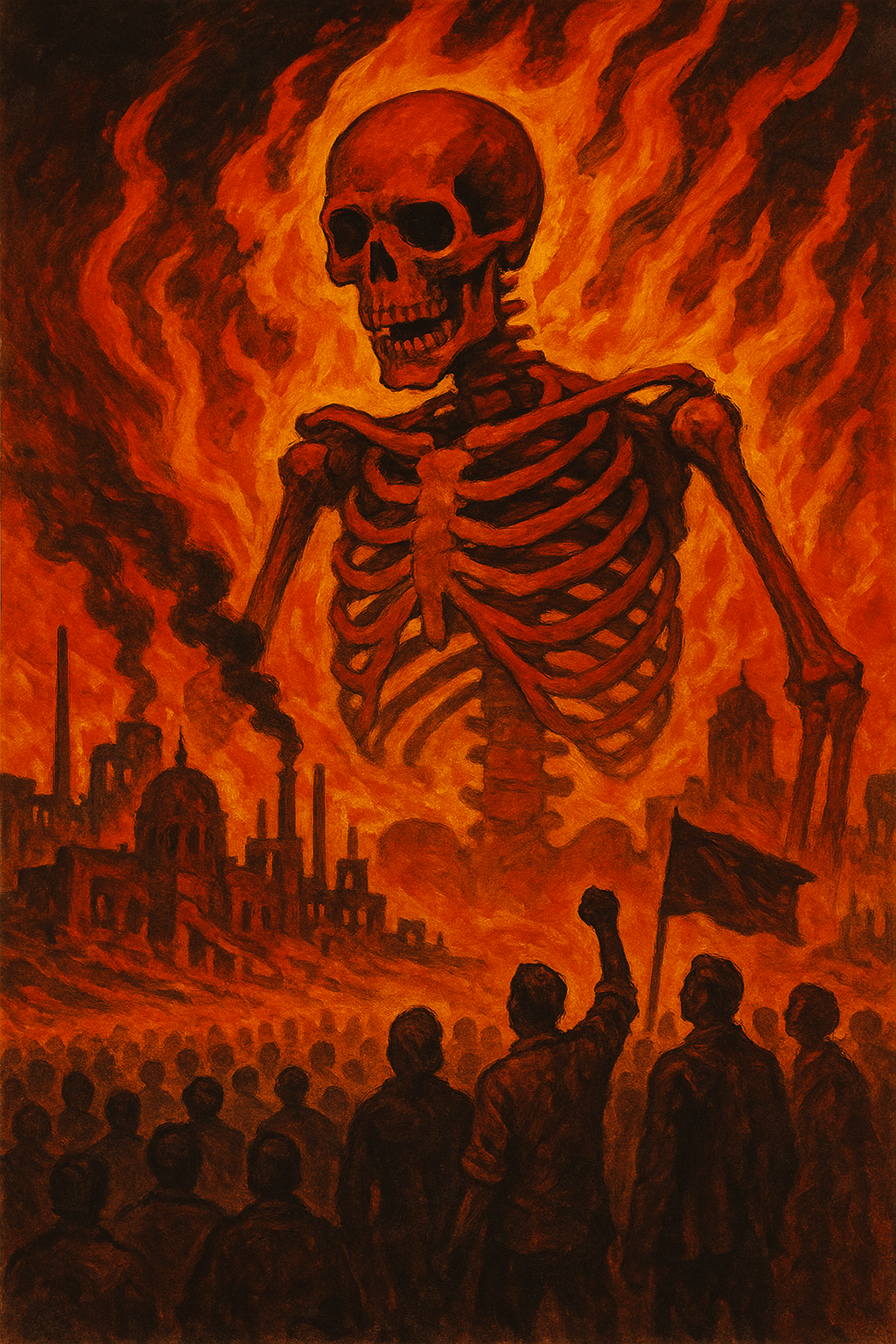
How the Managers of Global Capitalism Diagnose the Crisis They Created—and Offer Solutions That Protect Their Power
By Prince Kapone | Weaponized Information | November 25, 2025
When the Arsonists Write the Handbook on Fire
Let’s start with the obvious, comrades: there is something darkly comic about the G20 commissioning a grand report on global inequality. It is like the owners of the plantations publishing a white paper on why the soil is exhausted, or the men who set the house on fire announcing a blue-ribbon commission on heat management. The governments gathered under the G20 banner are not innocent observers of inequality; they are the steering committee of the system that produces it. Yet here they are, dressed in the robes of “independent experts,” lecturing the world about an emergency they helped manufacture and still profit from.
This report, led by Joseph Stiglitz and stamped with the legitimacy of the South African G20 Presidency, presents itself as a sober, scientific diagnosis of “the scale of the inequality emergency” and a roadmap to a fairer world. It is full of numbers and graphs. It tells us that 83% of countries now live with “high inequality,” that the top 1% captured most of the new wealth of the last two decades, that billions are hungry while billionaires are flirting with trillionaire status. None of that is wrong. In fact, the data often confirm what workers, peasants, and the poor have known in their bones for a very long time: the system is rigged and getting worse. But data, like anything else, can be weaponized to tell a story that stops just short of the truth.
The story the G20 wants to tell is simple and comforting: inequality is a “policy choice.” It is the result of mistakes, bad ideas, unfortunate reforms, and insufficient global coordination. If leaders can just be persuaded by the right evidence, if technocrats can just sit in enough panels and workshops, if the “international community” can just agree on the right set of tweaks, then the ship of global capitalism can be steered back toward calmer, more equal seas. Inequality, in this telling, is not the engine of the system; it is a malfunction. The G20 is not the driver of the problem; it is the mechanic bravely trying to fix what others broke.
Weaponized Information approaches this report from the opposite direction. For us, inequality is not a bug in the code; it is the operating system. Capitalism without inequality is like a plantation without slaves, a mine without miners, an empire without colonies. The whole point of the game is to concentrate wealth, power, and decision-making in fewer and fewer hands, while spreading risk, debt, and suffering across the earth like fertilizer. What the report calls “policy choices” are in fact class strategies, hammered into law by ruling classes who understood exactly what they were doing: smashing unions, privatizing public goods, liberalizing capital flows, enforcing intellectual property regimes, imposing austerity, and using debt as a weapon to keep the Global South on its knees.
This is why we take the G20’s newfound concern with inequality so seriously. Not because they have seen the light, but because they have seen the danger. When inequality reaches the levels documented in this report, the social fabric begins to tear. People stop believing in the fairy tale that hard work will save them. They lose faith in parliaments and presidents. They riot, organize, migrate, rebel. They look for alternatives, and sometimes, if history is kind, they find them in movements that talk about socialism, decolonization, and revolution. That is what scares the G20. The problem, from their perspective, is not only that inequality is high; it is that inequality is becoming unmanageable.
So the first thing this report tries to do is stabilize the narrative. It does this by wrapping the crisis in the language of technical expertise. Everywhere the text insists that what we are dealing with is a complex economic phenomenon requiring neutral, evidence-based “assessment.” The answer, we are told, is not mass struggle or structural transformation, but better data, better modeling, and above all, a new global body of experts: an International Panel on Inequality. The IPCC, but for class society. This panel, we are assured, will not be “advocacy-based” but purely analytical. It will monitor inequality, track trends, and gently nudge policymakers toward wiser decisions.
Think about what that means. The people who sit atop the global hierarchy want to transform a question of power into a question of measurement. They want us to trade barricades for bar graphs, party schools for policy briefs, revolutionary programs for “evidence-based recommendations.” Inequality, in their hands, becomes something to be observed, quantified, and “managed,” not abolished. The class relationship between exploiter and exploited is replaced with a softer vocabulary: “winners and losers,” “high and low deciles,” “vulnerable groups,” “policy space.” Empire becomes “global governance.” Plunder becomes “capital flows.” Colonialism is demoted from an ongoing structure to a historical backdrop, mentioned politely and then ushered off stage.
This is where our work begins. In this analysis, Weaponized Information will walk through the G20’s inequality report piece by piece, not as students grateful for an advanced lecture, but as comrades organizing a cross-examination. We will acknowledge the places where the document’s data clarifies the scale of the disaster; the ruling class occasionally speaks the truth when the numbers are too big to hide. But we will also pay close attention to what is missing, what is buried, and what is carefully reframed. When the report notes that global income inequality has fallen mainly because of China’s rise, we will ask why it never names socialism as the decisive factor. When it laments the way intellectual property rules worsened the pandemic, we will ask why it never calls this by its real name: organized, profit-driven social murder. When it warns that inequality erodes democracy, we will ask which democracy it means—the formal rituals of voting under capitalist rule, or the deeper, collective democracy that can only be built when the working class and oppressed hold power.
We will also situate this report in a broader historical arc. The inequality it describes did not spring from nowhere. It is the latest expression of a long process that stretches from the slave ship to the structural adjustment program, from the Berlin Conference to the Belt and Road Initiative, from the first colonial charter to today’s sanctions regimes and dollar hegemony. The G20 exists to manage that system, to negotiate the internal tensions between different fractions of capital—Yankees, Cowboys, Digerati—while preserving the basic order in which the Global North extracts value from the Global South and from the internally colonized nations inside the imperial core. An “extraordinary committee of independent experts” does not interrupt that function; it helps secure it.
Part I of this essay, then, is not a neutral preface. It is a warning label. As we move through the chapters of the G20’s report—on the “scale of the emergency,” on why inequality matters, on the supposed “drivers” and the policy blueprints—we will treat each section as a contested terrain. We will read their facts against their silences, their proposals against their positioning, their concern for “stability” against our concern for liberation. We are not here to help the G20 save capitalism from itself. We are here to show why the world they describe, with all its charts and panels and declarations, cannot be made humane by design reforms. It has to be overturned.
That is the wager of Weaponized Information. We take their own report as evidence in the case against them. If even the arsonists are now forced to admit that the world is burning, then it is time not only to fight the fire, but to seize the matches, dismantle the fuel lines, and build something entirely different on the ashes. The G20 offers us an International Panel on Inequality. The future demands an international movement to abolish it.
The Numbers Confess, But the Story Still Lies
Before the G20 begins sermonizing about solutions, it spends a great deal of time laying out “the facts.” This is the part of the report designed to appear unimpeachably scientific: charts arranged like confessionals, ratios standing in for revelations, tables that glow with the solemn gravity of objective truth. And on the surface, the facts really are damning. They reveal a world split open by grotesque disparities—a world where the top 1% are sprinting toward trillionaire status while billions of people are falling deeper into hunger, debt, and exhaustion. But numbers are like witnesses in a political trial: they speak, yes, but only within the script handed to them. And this report, from the very outset, hands the numbers a script carefully edited to acquit the system that produced them.
The opening salvo is dramatic: “83% of countries now experience high levels of inequality.” A majority of humanity lives in societies where wealth pools at the top like stagnant water while the bottom dries out. The global Gini coefficient—still an obscene 0.61—barely budges except in places where radical political-economic transformation has occurred. Then comes the most revealing admission in the entire document: the only reason global inequality has declined at all is because China—that stubborn, inconvenient socialist-oriented state—lifted hundreds of millions of its people out of poverty through public planning, state-led industrialization, and a decisive break from neoliberal orthodoxy. And yet the report’s authors speak of China as though it were a statistical anomaly rather than a living indictment of the global capitalist order.
Meanwhile, the top 1% hoarded nearly all the gains of the last two decades. Their wealth rose by an average of $1.3 million per person while the bottom 50% scraped together a few hundred dollars. The report describes this with a kind of clinical neutrality, as if narrating the weather. But anyone who has lived under austerity, watched their wages stagnate, or buried a relative who couldn’t afford medical care knows these inequalities are not natural phenomena—they are engineered outcomes of privatization, deregulation, intellectual property regimes, capital mobility, and the ruthless enforcement of debt.
Hunger is another data point, quantified but never politicized. The report notes that 2.3 billion people—a quarter of humanity—now face some form of food insecurity. This is treated like a regrettable oversight rather than a predictable consequence of a food system dominated by agribusiness monopolies, global supply chains designed for profit rather than nourishment, and Western sanctions that squeeze entire nations by choking off imports. The report tells us hunger has risen by “335 million people since 2019,” as if this were the product of cosmic forces rather than a pandemic that pharmaceutical giants turned into a patent bonanza and a global economy that left the poor defenseless in the face of crisis.
Here’s the deeper problem with the G20’s presentation of the facts: they give you the what but never the why. They will show you the swollen bellies of global wealth and the gaunt ribs of global poverty, but they will not show you the knife. They quantify outcomes while erasing the mechanism: imperialist extraction, monopoly capitalism, and the political decisions of ruling classes who designed the world to look exactly like this. They want you to believe inequality is an accidental imbalance—something a little progressive taxation and a new panel of experts can straighten out—rather than the logical culmination of centuries of stolen labor, stolen land, and stolen futures.
It is no coincidence that the report’s data section repeatedly warns that existing measures often undercount the wealth of the rich. Of course they do. The wealthy hide their money because the entire global financial architecture was built for that purpose: Swiss banks, Cayman shells, London real estate, Silicon Valley equity schemes, corporate secrecy jurisdictions, and the dollarized shadow systems run by the same nations issuing this report. When the G20 laments the difficulty of capturing billionaire wealth, it is like hearing a pickpocket complain about how hard it is to track missing wallets.
Even the framing of inequality itself reveals a profound ideological bias. Everywhere the report contrasts the “bottom 50%” with the “top 10%,” as if these were natural demographic groupings rather than antagonistic classes forged by an economic system that thrives on exploitation. The rich are described with the sanitized vocabulary of distribution: “top shares,” “percentile groups,” “income brackets.” But the working classes of the world—the people whose labor produces all value—are never recognized as historical agents. They appear only as measurements, never as makers of their own destiny. And it is in this erasure of class agency that the G20’s ideological project becomes most visible.
This is why Part II is not just a recitation of the report’s numbers. It is a struggle over interpretation. The G20 tells a story in which inequality is shocking but manageable, severe but reformable, devastating but not fatal to the existing system. Weaponized Information tells a different story: the facts themselves are revolutionary when read without the blindfold. They show a world in which grotesque levels of inequality are not a deviation from capitalism but its final and inevitable expression. They show an international order in which the wealth of the North depends on the exhaustion of the South. They show a ruling class so bloated with profit that even its own economists can no longer hide the depth of the crisis.
The numbers confess the crime. What the G20 cannot allow is that we name the criminal. That is the task of this essay—and the work of every revolutionary struggling to build an order where inequality is not measured, managed, or mildly corrected, but abolished. Part III will take us deeper into the G20’s description of the so-called “inequality emergency,” and expose how even their diagnosis is a strategic maneuver, one built to defend the system by appearing to critique it.
The “Emergency” They Announced After Decades of Arson
By the time we reach the G20’s diagnosis of the “inequality emergency,” the mask is already slipping. The report lays out a picture of a world caught in a tightening vice: collapsing labor shares, surging corporate markups, the cannibalization of public wealth, and a global middle class eroding like a shoreline under relentless waves. At first glance, this section reads like a confession session—an admission that something fundamental has broken in the system. But every confession is selective, and every “emergency” declared by imperial managers is less a call for justice than a signal that the ruling class fears losing control of the situation they themselves engineered.
The report opens this chapter with a deceptively simple admission: global labor shares have been falling in the majority of the world since the 1980s. They say it plainly, almost casually, as if describing a mild temperature drop. But what they are really saying is this: workers have been robbed for two generations straight. Productivity soared, profits ballooned, and the people who made all of it possible were rewarded with stagnation at best and misery at worst. And what does the G20 attribute this to? Technological changes, “market dynamics,” and globalization—never once naming the coordinated assault on labor: union smashing, deregulation, outsourcing, the violent restructuring of the global South through debt and IMF shock therapy, the role of the U.S. dollar as a weapon of discipline.
Then come the corporate markups. From 1980 to 2016, these markups—basically the polite term for price-gouging—shot from 15% to 60%. The report describes this as evidence of “market power,” as though these monopolies were a natural phenomenon rather than the predictable result of neoliberal policies designed to consolidate capital in the hands of global giants. Decades of antitrust retreat, intellectual property expansion, sweetheart deals for corporations, and financial deregulation didn’t “allow” monopolies—they were the blueprint for their rise. Yet the report narrates this as a drift, a structural evolution, as if somehow the world woke up one morning and Amazon, Google, and BlackRock simply happened.
The picture becomes even clearer with their section on public versus private wealth. Public wealth has collapsed across most of the world, while private wealth has exploded at a historic scale. Here the report offers one of its most unintentionally honest observations: private wealth accumulation in the 21st century is “mostly driven by policy choices,” including massive transfers from public balance sheets to private actors. Salary freezes, privatization waves, asset sell-offs, tax cuts for the wealthy, and austerity programs enforced at the gunpoint of global finance—these are not accidents. They are strategies. The G20 gestures at this truth but never follows it to its logical conclusion: capitalism requires the dismantling of public wealth so that private wealth can rule uncontested.
But perhaps the most revealing part of this chapter is how the report discusses the middle class. The tone turns somber, almost elegiac. The global middle class is shrinking; young people are downwardly mobile; entire regions face permanent precarity. The G20 mourns this not out of compassion, but out of fear. A stable middle class is one of the buffers between the ruling class and the poor. When that buffer erodes, the contradictions sharpen. Revolt becomes thinkable. The report frames this as a macroeconomic risk, but what they truly fear is political instability—uprisings, new left governments, anti-imperialist blocs, and the erosion of consent.
This is why the inequality emergency matters to them now. Inequality has been the structural condition of global capitalism for centuries, but only when its consequences threaten the political legitimacy of the system do the managers of empire start to panic. They are not grieving for the loss of human development or democratic participation. They are grieving for the loss of predictability. They are grieving for a world where the poor stop believing in their assigned place. The G20 worries that inequality is now so extreme that people may begin to imagine alternatives to capitalism itself. That is the real emergency.
Weaponized Information reads this chapter as a layered text. On the surface, it is a rare acknowledgment of the scale of the crisis. But beneath the surface, it is a defensive maneuver. By describing the emergency in great detail—labor share collapse, monopoly domination, public sector starvation, and middle-class decline—the report hopes to claim moral authority over the discussion. They want to define the problem so they can define the solutions. They want to diagnose the crisis so they can inoculate the system. They want to signal concern so the poor will not organize, and the global South will not break from the imperial framework.
But our task is different. We are not here to alleviate the anxieties of capital; we are here to understand the crisis as a revolutionary opening. When labor loses share, when monopolies overextend, when public wealth is devoured, when the middle strata collapse—that is not just a diagnosis of decay. It is a map of possibility. It is the moment when the contradictions sharpen to the point where the ruling class can no longer rule in the old way, and the masses can no longer live in the old way. The G20 sees this as an existential threat to the system. We see it as the beginning of something new.
In the next section, we turn to how the G20 explains the social, economic, political, and planetary consequences of inequality. And once again, we will find a narrative that accurately describes the symptoms while carefully avoiding the cause. If Part III was about the scale of the fire, Part IV will show how the G20 explains the smoke—without once admitting that the flames are fed by capitalism itself.
They Name the Smoke, But Not the Fire
By the time the G20 report reaches the section on why inequality matters, the narrative has settled into a rhythm: bold statistics, grave warnings, and a carefully engineered distance from the underlying political structure that produces all this misery. This is the part where the authors lean forward, lower their voices, and attempt to convince the world that their concern is genuine. They tell us inequality undermines democracy, weakens economies, destroys social mobility, and accelerates climate catastrophe. They tell us the stakes are existential. And yet, through all of this, they refuse to utter the central truth: inequality matters because capitalism needs it to function.
The first “risk” they highlight is the erosion of democracy. Inequality, they warn, allows elites to purchase political influence, capture media systems, and shape public policy in their favor. In highly unequal countries, the report says, democratic breakdown is seven times more likely. Seven times! The number lands like a bomb, but the authors quickly smother the fuse. They never ask the obvious question: what kind of democracy exists under capitalism in the first place? When the wealthy own the means of communication, the means of production, and the means of survival, electoral rituals become little more than a market transaction. The G20 laments that inequality “distorts representation,” but representation has always been distorted in capitalist democracies because representation itself is bought, sold, and packaged like a consumer good. They pretend inequality is corrupting democracy, when in reality, inequality is the form that capitalist democracy naturally takes.
Then they turn to economics. Inequality slows growth, destabilizes markets, undermines productivity, hurts health and education outcomes, and makes entire societies more vulnerable to shocks. All of this is true. When people are ground down by low wages, debt, and precarious work, they are not “human capital”—they are exhausted. Exhausted workers are less productive. Exhausted societies are less resilient. Exhausted nations are easily thrown into crisis. But once again, the report frames this as some kind of unintended side effect—an unfortunate bug in the system—rather than the predictable outcome of a global economy built on the systematic transfer of wealth from labor to capital, from South to North, from the poor to the rich.
The discussion of social mobility is even more revealing. The authors admit, almost with a sense of tragedy, that where you are born now determines two-thirds of your lifetime income. They admit that the concentration of wealth has created a world where the children of the rich inherit not only money but stability, while the children of the poor inherit insecurity, debt, and narrowing horizons. They admit that global social mobility is collapsing. But they treat this collapse as though it were a natural regression, a drift toward a less open society, instead of what it truly is: a return to the feudal logic that capitalism always reproduces when its crises reach maturity.
The inheritance boom—$70 trillion expected to change hands in the next decade—is described like a weather pattern, not the consolidation of dynastic oligarchies. The report never names the fact that we are witnessing the formation of a global aristocracy, one with its own courts, its own instruments of power, its own sovereign halls in Davos. They call it “wealth concentration.” We call it what it is: the emergence of a new class of lords in a world that was promised to be modern.
But it is in the climate section where the G20’s ideological contortions become almost painful to watch. They warn that inequality fuels the climate crisis. They admit the richest consume far more carbon and resources than the poor. They concede that unequal societies cannot mobilize effectively for mitigation or adaptation. And yet they studiously avoid naming the three most carbon-intensive actors on earth: the U.S. military, the Western oil giants, and the transnational financial institutions that bankroll environmental destruction. They speak as though climate catastrophe is the result of individual consumption patterns, not the global machinery of imperial extractivism, militarized supply chains, and fossil capital.
What this chapter ultimately reveals is that the G20 understands the dangers of inequality far more clearly than they pretend. They know inequality destabilizes economies. They know it delegitimizes political institutions. They know it fuels extremism, nationalism, rebellion, and revolt. They know it exacerbates pandemics, weakens states, and destroys the social bonds that keep societies governable. The problem is not their analysis—it is their conclusion. For them, the purpose of describing the crisis is not to challenge capitalism; it is to save it.
Weaponized Information reads this section as a battlefield. The G20 seeks to seize the narrative terrain by framing inequality as a collection of policy problems—democratic risk, economic inefficiency, social stagnation, ecological strain—that can be solved through technocratic interventions. They want the world to believe that inequality threatens the social order, and that the best way to preserve the social order is to let the G20 manage the crisis. This is the ideological zen trick of the ruling class: admit the symptoms, deny the disease.
But what if we start from a different premise? What if we take seriously the idea that inequality is not a system failure but a system requirement? What if we understand democracy as incompatible with capital? What if we recognize that the climate crisis cannot be resolved while the world’s wealthiest nations continue to enforce an imperial structure based on extraction, militarism, and financial domination? What if we acknowledge that the only true stability is the stability that comes from justice, not from management?
Part IV ends where Part V will begin: with the question of causality. The G20 has shown us the smoke—political breakdown, social immobility, economic stagnation, ecological collapse. But they refuse to show us the fire. In the next section, we will turn to their analysis of the “drivers” of inequality—a section that flirts with the truth but retreats every time it approaches it. If Part IV named the consequences, Part V will reveal how carefully the G20 avoids naming the cause.
The Drivers They Tiptoe Around, and the One They Dare Not Name
By the time we reach the G20’s grand attempt to explain what drives global inequality, the report has entered its most delicate terrain. This is the part where the authors must perform a kind of ideological gymnastics: they must acknowledge the forces tearing the world apart while stopping short—precisely, strategically short—of identifying the system that binds all those forces into a single logic. They must point to the weapons without naming the war; gesture toward the perpetrators without identifying the class; describe the architecture of plunder without indicting the empire. What follows, then, is a dance: honest admissions wrapped in evasive language, structural insights coated in technical phrasing, near-truths that dissolve the moment they approach revolution.
The chapter begins with a nod toward history, an almost embarrassed acknowledgment that colonialism played a role in producing today’s global disparities. But the report treats colonialism like an old scar—a legacy, a residue, a tragic but completed chapter—rather than the living, ongoing structure of domination that defines the global economy today. Colonialism, in the G20’s telling, is a backdrop. In reality, it is the stage, the script, the lighting, and the director. The plantations became corporations; the empires became financial institutions; the charter companies became multinational conglomerates; the gunboats became sanctions and IMF conditionalities. The G20 speaks of colonialism in the past tense because speaking of it in the present tense would make their entire enterprise illegitimate.
Then the report turns to economic policy. Here, the honesty is startling—but only at first glance. The authors list the culprits like they are reading from a Marxist pamphlet: deregulation, union suppression, privatization, financial liberalization, regressive tax systems, weak competition policies, austerity, and intellectual property regimes. They even admit that these policies were not isolated accidents but convergent global trends, moving in lockstep from the 1980s through today. They catalog the destruction almost perfectly: how unions were crushed, how public assets were sold off at fire-sale prices, how capital was unleashed across the world, how states were told to shrink until they could barely protect their own populations, how pharmaceutical monopolies held entire continents hostage during the pandemic.
And yet, having brought us within a whisper of the truth, the report immediately retreats. These were not, they say, coordinated ruling-class strategies—they were “bad ideas,” “policy experiments,” “market-oriented reforms.” The violence of neoliberal globalization becomes a kind of academic mistake, something that can be corrected with better expertise rather than dismantled through class struggle. The authors cannot allow themselves to acknowledge the obvious: these were not unfortunate reforms—they were weapons. They were designed to transfer power upward, strip states of sovereignty, dismantle working-class organization, and secure the dominance of global capital.
The political section is equally revealing. The report speaks of “elite capture,” “regulatory capture,” and “policy influence,” as though these were technical malfunctions rather than the natural state of capitalist governance. It describes the revolving door between corporations, think tanks, and government as though this were corruption rather than the normal mechanism through which the ruling class governs. Capitalist states, in the G20’s narrative, are basically neutral institutions hijacked by bad actors. But anyone who has studied the history of the modern state—from the British Empire to the United States today—knows better. The state is not captured by capital; it is created for capital. Capture is not a deviation; it is the design.
The report’s section on international architecture is where the truth peeks through most clearly. The authors point to investment treaties that guarantee corporate power; to ISDS mechanisms that let corporations sue sovereign states; to IMF austerity programs that force hunger and unemployment on entire nations; to tax havens that drain public coffers; to global intellectual property regimes that lock the Global South into dependency. They even admit that these systems constrain the policy space of developing countries. And yet, even here, the analysis remains toothless. They say the architecture is flawed. They do not say it is imperial. They say the rules are imbalanced. They do not say they are enforced through coercion, sanctions, coups, proxy wars, and military occupation.
What the G20 cannot say—what it is structurally prevented from saying—is that global inequality is the outcome of capitalism in its imperial stage. The concentration of wealth is not an accident; it is the goal. The underdevelopment of the Global South is not a legacy; it is the strategy. The power of multinational corporations is not unintended; it is protected by armies, financial institutions, media conglomerates, and legal regimes. The system they describe is not malfunctioning—it is working as designed.
Weaponized Information approaches this chapter differently. We take the report’s admissions and push them to their logical conclusion. If deregulation caused inequality, then re-regulation will not solve it unless the power of capital is broken. If unions were destroyed deliberately, then they must be rebuilt deliberately, with political struggle, not polite dialogue. If the international architecture enforces hierarchy, it must be dismantled, not reformed. If the rich captured the state, then the state must be reconstructed under the leadership of workers and the oppressed. If inequality is driven by imperial structures, then liberation must be anti-imperialist at its core.
Part V, then, is the hinge on which the entire argument turns. The G20 has shown us the consequences of inequality. Now they have shown us the drivers. But in both cases, they refuse to identify the system that binds these drivers into a coherent whole. They cannot. Their job is not to expose the system but to preserve it—preferably in slightly more stable form. In the next section, we will see the logical culmination of this avoidance: the proposal for a new International Panel on Inequality, a technocratic body designed not to dismantle the engine of inequality but to monitor it like a doctor assigned to keep a patient sick but stable.
The Technocrat’s Trap: When “Solutions” Become Instruments of Control
If the earlier sections of the G20 report are an elaborate choreography of selective truth-telling, this next move—the proposal for a new International Panel on Inequality—is the pivot where the entire performance reveals its purpose. After diagnosing the crisis and tiptoeing around its causes, the G20 now offers its masterstroke: a permanent global body of experts who will “monitor,” “assess,” and “guide” inequality policy across the world. On paper, it sounds noble. In practice, it is one of the most sophisticated containment strategies the imperial order has produced in years.
The report frames the IPI as a scientific counterpart to the IPCC, a neutral authority to provide synthesized research and evidence-based recommendations. It promises us that this panel will be multidisciplinary, independent, rigorous, and free from political interference. It will track inequality trends. It will review national policies. It will advise governments. It will synthesize global data. It will “depoliticize” the debate. And it will do all of this without taking positions, advocating agendas, or interfering in sovereign decision-making. The G20 wants you to hear the word expert and imagine wisdom, neutrality, and care.
But anyone who has studied modern technocracy—especially in the imperial context—knows what expertise is often used for: to replace political struggle with managerial oversight, to blunt the revolutionary edge of social crises, and to consolidate the authority of the ruling class under the guise of objectivity. The IPI proposal is no different. Its purpose is not merely to study inequality; its purpose is to control the discourse around inequality, and through that control, to protect capital from the demands of the exploited.
Consider what it means for the G20 to position itself as the architect of a global inequality-monitoring body. These are the states that imposed neoliberalism on the world. These are the states that coordinated structural adjustment, privatization, trade liberalization, and financial deregulation. These are the states whose corporations dominate global markets, whose banks own the debt of nations, whose militaries enforce extraction, and whose currencies structure global dependency. To ask them to build a panel on inequality is like asking a cartel to set up a “Commission on Fair Pricing.”
Worse still, the IPI’s mandate—by design—excludes the very thing the world needs most: a political challenge to the power of capital. The panel will gather data but not advocate systemic change. It will advise but not confront. It will measure inequality but not mobilize against it. It will generate reports but not solidarity. It is the perfect neoliberal instrument: all process, no struggle; all analysis, no action. In this sense, the IPI is not a solution to the crisis but an attempt to preempt the emergence of real solutions—solutions rooted in mass movements, revolutionary politics, and the reclaiming of state power by workers and the oppressed.
The technocratic trick is subtle but devastating. When people rise up against inequality, they demand political change—higher wages, land rights, debt cancellation, nationalization of key industries, dismantling of monopolies, sovereignty over natural resources. They demand things that threaten capital. A panel of experts, however, demands only more data. This transforms a structural contradiction into a statistical exercise, a class struggle into a technical problem, a global rebellion into a bureaucratic process. Inequality becomes something to be graphed, tracked, and managed, not something to be overthrown.
The IPI also serves another purpose: it recenters global governance power in the hands of the G20. By establishing itself as the patron of inequality analysis, the G20 claims moral authority over a problem it created. It positions itself as the gatekeeper of legitimate knowledge on inequality. It asserts its right to define what counts as evidence, what counts as reform, and what counts as progress. And because the IPI is framed as neutral, its authority will be difficult to contest—especially for nations in the Global South, which have long been punished for deviating from Western-approved policy frameworks.
Weaponized Information reads the IPI proposal not as a scientific initiative but as a geopolitical maneuver. It is a way for the imperial core to safeguard its ideological leadership at a time when the legitimacy of neoliberalism is collapsing and the multipolar world is rising. It is an effort to contain the radical potential of the inequality crisis by absorbing it into the machinery of technocratic global governance. It is the ruling class’s attempt to put a pleasant administrative mask on a system that is cracking under its own contradictions.
In Part VI, then, we encounter the heart of the G20’s strategy: acknowledge the crisis, avoid the cause, and propose a solution that reinforces elite control. The International Panel on Inequality is not an intervention; it is a diversion. It is not a remedy; it is a restraint. It is not a path to justice; it is a shield against the demands of the oppressed.
And this leads us to the final act of the report: the policy blueprint, the cure-all toolkit, the grand package of “solutions” the G20 insists will undo four decades of engineered inequality—all without threatening the supremacy of capital. In the next section, we will explore these proposals, expose their contradictions, and reveal how every recommended reform is designed to protect the system rather than transform it.
Reforms Without Revolution: The Art of Saving Capitalism From Itself
At last, we arrive at the G20’s grand finale—the section where the arsonists set down their gasoline cans, wipe the soot from their hands, and declare with solemn faces that they are prepared to rebuild the house they burned down. After pages of grim statistics and carefully filtered diagnosis, the report now unveils its sweeping program of “solutions.” This is the part meant to reassure the world that inequality can be reversed, stability can be restored, and the global order can be gently massaged back into functionality without disturbing the hierarchies that define it. And so, we are presented with a thick catalogue of reforms—progressive taxation, industrial policy, debt restructuring, social spending, digital access, global treaty reform, fairer trade rules, intellectual property changes, climate finance, and more.
On the surface, this looks like a radical agenda. It reads like a list assembled from decades of social democratic wishlists and activist manifestos. Some of the proposals are even genuinely compelling: raising taxes on the rich, limiting capital flight, easing the debt burden on the Global South, regulating monopolies, restructuring IMF conditionalities, expanding public services, strengthening labor rights, reforming investment treaties, waiving intellectual property rules during crises, and funding climate adaptation. The report even endorses capital controls—a policy the IMF once treated as sacrilege. If you only skimmed these recommendations, you might think the G20 had suddenly discovered class consciousness.
But as with everything in this report, the devil is not just in the details—it is in the silences. The entire reform agenda is built on a single premise: that capitalism is fundamentally sound, and that inequality is a correctable imbalance rather than a structural feature. This is why every proposal listed here stops precisely where real transformation would begin. The G20 is willing to talk about taxes, but not about ownership. They are willing to mention labor rights, but not worker power. They are willing to tinker with global governance, but not dismantle the imperial hierarchy that gives Western states and corporations control over global markets, debt, technology, and resources.
Consider their proposal for progressive taxation, including global wealth taxes. It sounds bold until you remember that the wealthiest people on the planet do not acquire or store their wealth in ways that traditional taxation can meaningfully reach. Their assets float through offshore havens, shell corporations, private equity vehicles, art markets, real estate vaults, and the shadow banking system—all institutions protected and policed by the very countries producing this report. The G20 knows perfectly well that any serious wealth tax would require dismantling the global financial architecture of secrecy and capital mobility. Instead, they propose “consideration” of global guidelines. They propose “strengthened cooperation.” They propose “frameworks.” They do not propose the one thing that would work: attacking capital where it lives.
Then there is debt reform. The G20 calls for more equitable restructuring, better lending terms, and greater use of Special Drawing Rights. But they refuse to name the fact that the debt system is not an unfortunate constraint—it is a colonial weapon. Debt is how the imperial core extracts tribute from the Global South without the overhead of formal occupation. Debt is how global capital forces states to privatize water, sell off mines, close factories, suppress unions, slash healthcare, and abandon the poor. Debt is how sovereignty is broken. Any meaningful reform would require canceling illegitimate debt, nationalizing banking systems, and imposing public control over finance. The G20 instead proposes “enhanced dialogue.”
Their proposals on social spending and public goods follow the same pattern. They acknowledge that austerity has gutted essential services, but they do not acknowledge who imposed austerity. They call for investments in education, healthcare, housing, and social protection, but they refuse to confront the fact that these sectors were not neglected—they were pillaged, deliberately and systematically, so private investors could take their place. They will not call for reversing privatization or restoring public ownership. They will not call for reclaiming the commons from capital. They will not call for the decommodification of life. Instead, they propose “targeted programs,” “fiscal flexibility,” and “strategic investment plans.”
The same evasion appears in the international section. The G20 suggests reforms to trade rules, intellectual property provisions, competition policies, and global governance structures. But these reforms all assume that the system can be fine-tuned into fairness. They do not consider the possibility that the system is unfair by design. Intellectual property was not created to promote innovation—it was created to guarantee Western monopolies. Trade rules were not written to encourage development—they were written to prevent it. Competition policy did not fail accidentally—it failed because monopoly is the natural outcome of capitalist accumulation. Global financial governance is not imbalanced because of errors—it is imbalanced because empire requires it.
And then there is the climate agenda. The G20 promises climate financing, technology transfers, adaptation support, and sustainable investment. But they refuse to name the main drivers of ecological collapse: fossil capital, agribusiness capital, the U.S. military, and the patterns of extraction that impose the environmental burden of the global economy onto the South. They propose green growth without confronting the impossibility of infinite accumulation on a finite planet. They propose green technologies without challenging the corporations that monopolize them. They propose climate funding without addressing the hyper-imperialist structures that created the crisis in the first place.
This—this entire section—is the purest expression of the G20’s ideological project: to promise the appearance of transformation while protecting the substance of the order that produces inequality. To diagnose capitalism without threatening capitalism. To acknowledge injustice without enabling the struggle against it. To take the anger of the world and redirect it into policy consultations, expert panels, and technocratic processes that produce nothing but time—time for capital to regroup, time for empire to adapt, time for the system to stabilize itself.
Weaponized Information refuses this sleight of hand. We refuse to be lulled by the language of reform when the logic of extraction remains untouched. We refuse to celebrate policy tweaks when the structure of domination remains intact. We refuse to mistake expert-led management for justice. If inequality is a feature of capitalism, then the only true solution is a rupture, not a reform; a transformation, not a recalibration.
The next section will bring the report’s logic to its ultimate conclusion—a summation of its worldview and the ideological project it hopes to advance. But before we reach that end, we must sit with the truth embedded in this reform agenda: the G20 knows that the world is burning. They simply insist that only they have the right to hold the fire extinguisher. And as long as capital controls the emergency response, the fire will never be put out.
The Final Benediction: A World on Fire, and a Priesthood Asking for Our Faith
After hundreds of pages cataloging the symptoms of a system in decay, after proposing a technocratic priesthood to monitor the crisis, after laying out a reform agenda designed to preserve capital rather than confront it, the G20’s inequality report closes with one final act of ideological theater. This is the benediction—the solemn moment where the architects of global inequality present themselves as the guardians of humanity’s future. Here, the language softens, the tone lifts, and the solutions are wrapped in the gentle glow of moral urgency. They speak of hope, of coordination, of global solidarity. They remind the world that inequality is not inevitable, that better choices are possible, that collective action can lead to a fairer tomorrow. It is an ending crafted to leave the reader uplifted, soothed, and pacified.
But behind this warm, conciliatory rhetoric lies a simple truth the report can never admit: the G20 cannot solve inequality because the G20 is the political expression of the very class interests that require inequality to function. It is asking us to believe that the managers of imperialism can dismantle imperialism; that the custodians of monopoly capital can restrain monopoly capital; that the beneficiaries of structural theft can reverse the consequences of their own enrichment. This is not analysis—it is mythology.
In its concluding passages, the report insists that inequality can be overcome with “political will,” “evidence-based policy,” and stronger “global governance frameworks.” It gestures toward a future where governments cooperate, data flows freely, and the international community works together to ensure prosperity for all. It speaks the language of harmony, compromise, and institutional evolution. Yet at no point does it acknowledge that the world is divided into antagonistic classes, antagonistic nations, and antagonistic historical blocs. At no point does it acknowledge that the wealthy nations of the G20 maintain their position through coercion, extraction, financial dominance, sanctions, and military power. At no point does it acknowledge that the impoverishment of billions is not a glitch but a requirement of the global order they administer.
The most striking omission in this final section is the complete erasure of struggle. There is no mention of strikes, uprisings, liberation movements, anti-colonial revolutions, peasant insurgencies, or socialist experiments. There is no recognition that inequality has ever been reduced in history; not by benevolent elites but by organized mass action. The labor rights they champion in theory were won by workers who fought cops in the streets. The decolonization they praise in hindsight was achieved by revolutions they once condemned as extremist. The public sectors they want to “restrengthen” were built by parties they spent decades destabilizing. The G20 speaks of justice as if it were gifted from above rather than seized from below.
And so, in its final gesture, the report offers a worldview completely severed from the realities of class struggle. It asks us to believe that technocratic coordination can achieve what only mass mobilization has ever accomplished. It asks us to believe that the ruling class can regulate itself into irrelevance. It asks us to believe that inequality is a reversible side effect rather than the essential logic of capital accumulation. It asks us to believe that empire will reform itself, that the rich will voluntarily surrender their privilege, and that the managers of global capitalism are capable of building a world beyond capitalism.
Weaponized Information rejects this theology of the status quo. We reject the fantasy that the world can be made just without confronting the system that produces injustice. We reject the idea that expert panels can substitute for revolutionary movements. We reject the notion that inequality can be solved by those who feed off it. And we reject the moral posturing of institutions that speak the language of global solidarity while enforcing the violence of empire.
If the G20 report began by naming the world’s crisis, it ends by obscuring the world’s possibilities. It attempts to define the horizon of political imagination so narrowly that socialism becomes unthinkable, decolonization becomes a metaphor instead of a demand, and revolutionary transformation becomes impractical. Its closing message is simple but deadly: “Trust us. Let the experts handle it.” But history teaches the opposite lesson. When inequality reaches the levels documented in this report—when wealth piles up in the hands of a global oligarchy, when the middle strata collapse, when the poor can no longer survive—experts do not save societies. Movements do. Parties do. The people do.
And so we close this section with the clarity the G20 cannot muster. The world is not experiencing a crisis of inequality. It is experiencing the crisis of a dying system—an imperial, extractive, ecocidal system that cannot be reformed into justice. What comes next will not be determined by panels or policy briefs. It will be determined by whether the global working class, the colonized nations, and the revolutionary forces of this multipolar age seize the opportunity to build a different world entirely. Not a world monitored by experts, but a world governed by the people who produce its wealth. Not a world managed by the G20, but a world liberated from it.
And with that clarity, comrades, we move into the final section: the conclusion—a synthesis, a sharpening, and a call to action that takes the G20’s own admissions and uses them not to repair the system but to bury it.
Conclusion: The Evidence Is Theirs—The Verdict Is Ours
After dissecting the G20’s Global Inequality Report, one truth rises above all others: the ruling class is losing control of its own narrative. They can no longer deny the collapse unfolding across the world—so they have chosen instead to manage the crisis theatrically, confessing the symptoms while absolving the cause. The report tries to wrap four decades of neoliberal devastation in the language of technical error and poor policy design. It tries to frame colonialism as a memory rather than an ongoing machinery. It tries to present capitalism as a system that merely needs “better choices,” rather than a system built on extraction, coercion, and engineered inequality. But after reading their own data, and after watching them dance around every structural truth, the conclusion is inescapable: they know the system is falling apart, and their solutions are meant to save it—not us.
The G20 attempts to reshape inequality into a problem that can be solved with expertise. But experts did not build the welfare states—workers did. Experts did not win land reform—peasants did. Experts did not end apartheid, colonialism, or segregation—revolutionary movements did. The safety nets, the public sectors, the rights and institutions the G20 claims to defend were forged by struggle against the very forces that now claim to protect them. This report is an attempt to rewrite that history, to bury the revolutionary origins of progress beneath a bureaucratic mythology of “evidence-based governance.”
Their vision is a world where inequality is monitored, not abolished. Where the masses are informed, not empowered. Where the International Panel on Inequality replaces the international movements against inequality. They want a world where the G20 remains the central oracle of “global priorities,” the permanent steward of the international economy, the benevolent manager of a machine that continues—quietly, efficiently—to transfer wealth from the laboring billions to the owning few.
But the truth they cannot contain is this: the age of unquestioned imperial authority is ending. The data they present confirms the political horizon shifting beneath their feet. The labor share collapsing across continents, the middle strata hollowing out, the public sector devoured, global monopoly capital tightening its grip—these are not indicators of a system that can be gently corrected. They are indicators of a system reaching the limits of its stability. The G20 offers reforms because it fears rupture. It offers technocracy because it fears power. It offers cooperation because it fears confrontation.
For Weaponized Information, the task is the opposite of the G20’s. We do not seek to stabilize this world; we seek to transcend it. We do not look to experts for salvation; we look to the working class, to the colonized nations, to the movements rising from below. We do not want to manage inequality; we want to end the social system that requires it. Our reading of the G20’s report is not an academic exercise but a revolutionary audit—a reminder that even the most polished documents of empire reveal the fault lines beneath the surface.
The report claims inequality is a “policy choice.” Our conclusion is bolder: inequality is the political logic of capitalism in its imperial stage. And no amount of expert management can reconcile a world where a handful of ruling-class interests control the wealth of nations while billions live one crisis away from ruin. As the multipolar world rises, as new socialist experiments push forward, as the oppressed begin to reject the terms imposed on them, the era of passive acceptance is ending. The G20 is not preparing to solve inequality—they are preparing to govern its consequences.
But history remains open. And the final outcome will not be decided in the closed-door sessions of “global governance” but in the struggles of peoples refusing to be governed by those who stole the world from them. The facts are on the table—from the G20’s own hand. The verdict belongs to us. The future belongs to the movements that refuse technocratic management, refuse imperial salvage operations, and refuse to let the world be organized around the power and privilege of the few. The time has come not to reform the system documented in this report, but to overturn it entirely.
 Weaponized Information
Leave a comment