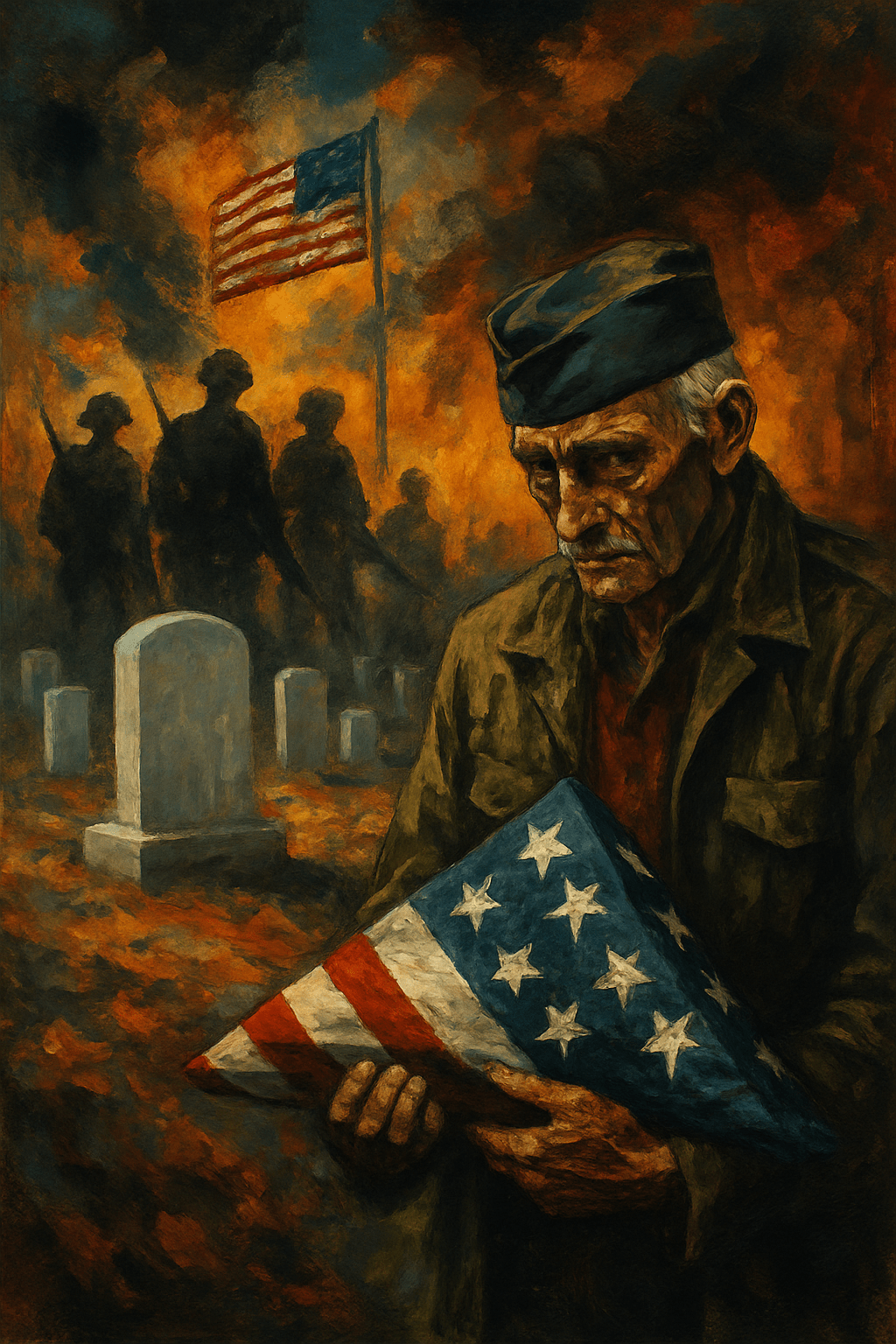
The only way to truly honor veterans is to end the wars that make them. Every folded flag, every corporate parade, every empty thank-you hides a system that sends the poor to kill and die for the profits of the rich. This essay tears the mask off imperial patriotism and calls for revolutionary remembrance—where gratitude becomes struggle, and remembrance becomes resistance.
The Spectacle of Gratitude
Every November, the empire rehearses its favorite lie. It waves flags over fresh graves, calls it gratitude, and calls us unpatriotic if we refuse to clap. Veterans Day has become less a day of remembrance than a national advertising campaign—one where defense contractors buy sincerity by the minute and politicians rent morality by the speech. The Pentagon even pays for the performance: a Senate investigation revealed that the Department of Defense spent $53 million on sports marketing since 2012, with over $9 million going directly to professional teams for those halftime “salutes to service.” Every stadium cheer is subsidized propaganda, every televised tribute a commercial break between bombings.
This is not patriotism—it is public relations. The ruling class thanks veterans for their “service” because the wars never serve the veterans; they serve the corporations that bankroll both the wars and the politicians. The hand on the heart, the tear at the anthem, the flyover that rattles the stadium seats—all of it is part of a machine designed to anesthetize the conscience of the country. The empire depends on sentimentality to disguise its dependence on death. It must glorify war to make it tolerable, must call killing “service” to keep the assembly line of imperialism running.
Beneath the spectacle lies a quieter truth that never makes the newsreel: the soldier’s valor is not the property of the state. It belongs to the people. But the state steals it—packages it into slogans and sells it back to us. Each “thank you for your service” is a coin dropped into the collection plate of militarism. It is the polite way of saying, “We’ll need more of you next time.” The real gratitude, the kind that means something, would be to stop producing more folded flags. But that would require dismantling the business of war itself, and business, in the empire, is booming.
So Veterans Day marches on, a ritual of mass forgetting dressed as remembrance. The generals smile for the cameras, the contractors cash their checks, and the politicians promise that this time the war will be different. Yet behind every speech is the same arithmetic: profit for the few, suffering for the many. To the empire, gratitude is not a feeling—it’s a function. It keeps the machine oiled and the workers quiet. But the truth still bleeds through the bunting: you cannot honor those who fought and died for empire without first ending the empire that made them fight and die.
The Business of War
Behind every flag-draped coffin stands a balance sheet. The U.S. war machine is not fueled by freedom or democracy—it runs on contracts, quarterly earnings, and campaign donations. The top five Pentagon contractors—Lockheed Martin, Raytheon, Boeing, Northrop Grumman, and General Dynamics—received over $771 billion in government contracts between 2020 and 2024. Lockheed alone raked in $71 billion in sales in 2024, boasting a record $179 billion backlog by the third quarter of 2025. This is not “defense”—it is extraction by other means. War has become the empire’s most profitable export.
The bloodletting is not accidental—it is structural. Capitalism in decay must find new markets and new enemies to survive. The imperial economy feeds on destruction; every missile launched is an investment, every invasion a stimulus package for Wall Street. The wars in Iraq, Afghanistan, and now the proxy wars in Ukraine and beyond, all share the same supply chain: bombs from Lockheed, fuel from ExxonMobil, financing from JPMorgan, propaganda from CNN. Soldiers are not defending the people—they are defending profit margins. They are workers in uniform, sent abroad to enforce the property rights of monopoly capital.
The irony is grotesque. The same politicians who chant “support the troops” vote year after year to cut veterans’ benefits while inflating the Pentagon’s budget. The 2025 defense budget topped $900 billion—a sum greater than the military spending of the next ten nations combined. Yet the VA remains underfunded, and homeless veterans still sleep on the streets of the richest country in history. This is not patriotism. It is class warfare disguised as national security.
To understand this machine is to see the logic of imperialism laid bare. The wars are not fought to protect freedom but to discipline labor and secure resources. They are acts of accumulation—primitive and perpetual. The white ruling class, unable to sustain its empire through production, sustains it through plunder. The veteran is both the tool and the victim of that process. Each war recruits the poor to kill the poor in another country so that the rich can stay rich in this one. The medals may be made of metal, but the motive is always money.
In this way, the business of war is also the business of forgetting. The public is trained to see soldiers as heroes, not as workers exploited by the same forces that exploit us all. But when the mask slips, when the veteran returns home and sees the profits he built turned into weapons for another generation, he begins to understand what Marx meant when he wrote that “the ruling ideas of every epoch are nothing but the ideas of its ruling class.” The first step toward peace is to recognize that the empire cannot make peace—it can only make profit.
The Human Cost of Empire
The profits are measured in billions; the losses are measured in bodies. Behind the fireworks of corporate earnings reports lies a cemetery of forgotten lives. The empire salutes veterans when they fight, but abandons them when they fall. The Department of Veterans Affairs’ own data exposes this hypocrisy: in 2022, an average of 17.6 veterans died by suicide every single day—more than 6,400 in one year. The suicide rate among veterans was 57 percent higher than that of non-veterans in 2020, and by 2022, male veterans faced a 44 percent higher risk and female veterans a devastating 92 percent higher risk than their civilian counterparts. These are not the costs of “freedom.” They are the casualties of empire.
The same nation that spends $900 billion on “defense” cannot house its defenders. The latest HUD Point-in-Time count found 32,882 homeless veterans in January 2024—a figure celebrated as “progress” by politicians, even as it exposes the moral bankruptcy of a system that leaves tens of thousands of former soldiers sleeping in the streets of the wealthiest empire in human history. Progress, in their vocabulary, means fewer corpses per fiscal quarter.
Beyond the homelessness and suicide, there is the quiet epidemic of trauma. Among veterans in VA care, roughly 14 percent of men and 24 percent of women live with post-traumatic stress disorder. Over 185,000 veterans in the VA system have been diagnosed with at least one traumatic brain injury, and broader screenings suggest that nearly one in four American veterans may suffer from probable TBI. These are the hidden wounds of empire—the ones not paraded on Veterans Day, the ones that never trend on social media. They are the mental toll extracted to maintain the balance sheet of imperialism.
The ruling class speaks of “the cost of freedom,” but what they mean is the price of obedience. They call it service when the poor enlist, heroism when they die, and collateral damage when their minds collapse under the weight of what they were ordered to do. The politicians who cut ribbons on Veterans Day are the same ones who cut funding for their care. The news anchors who shed tears for “our troops” never ask why so many of them come home broken. They cannot, because to do so would be to indict the system that signs their paychecks.
Every statistic is a story, and every story a contradiction. The veteran who believed he was fighting for democracy learns that democracy never fought for him. The soldier who once guarded oil pipelines abroad now stands in line at the unemployment office. The Marine who saluted the flag in Fallujah now sleeps under one in a tent city outside Los Angeles. The empire’s gratitude ends where its profits begin. What it offers veterans is not rehabilitation, but abandonment; not honor, but neglect. And yet within that neglect lies a dangerous potential—the awakening of a class consciousness forged in betrayal.
For when the soldiers of empire begin to see that the enemy was never the people they were sent to kill, but the interests that sent them, the foundations of the war economy begin to tremble. Every disillusioned veteran is a potential revolutionary. The day they turn their weapons of understanding against the system that made them expendable will be the day the empire meets an enemy it cannot defeat.
From Soldier to Surplus Population
The empire loves its soldiers only while they are useful. Once the shooting stops and the cameras fade, the same state that trained them to kill trains itself to forget them. Veterans return to a homeland that no longer recognizes them—a homeland that can spare $900 billion for war but pleads austerity when it comes to housing, healthcare, or jobs. The soldier is turned into surplus, the living residue of an economy that produces waste at every level: wasted labor, wasted land, wasted life. He is the discarded worker of the war industry, no longer profitable but still haunted by what he was made to do.
Karl Marx once wrote that capitalism produces its own gravediggers. The empire refines this process to an art form: it produces its own veterans. The working class is conscripted to enforce imperial order abroad, then abandoned to unemployment, trauma, and despair at home. The same system that promises social mobility through the military feeds on the poverty it pretends to cure. The recruiter’s pitch—“see the world, serve your country”—is the ideological twin of the boss’s promise—“work hard and you’ll make it.” Both conceal the same truth: your labor, your body, your life exist to enrich someone else.
In every war, the ruling class drafts the poor to kill the poor. They turn workers into weapons, and when the fighting is done, they discard them like spent shells. The veteran’s homelessness is not an accident—it is the logical continuation of his service. He is no longer a soldier but not yet a citizen; he occupies the same liminal space as the unemployed worker, the evicted tenant, the incarcerated poor. In this sense, the veteran is a mirror of the domestic proletariat: disciplined, discarded, and divided from his own humanity by a system that treats both as expendable.
But there is another potential in this contradiction. The veteran has seen the empire from both ends of the gun. He has watched his comrades die for oil contracts and campaign donors, has seen entire nations bombed to rubble in the name of “freedom.” When he comes home to find the same machinery grinding his neighbors into poverty, something clicks. He begins to recognize that the imperial frontier abroad and the social battlefield at home are not separate—they are extensions of the same war for profit. The empire wages war abroad to suppress revolutions, and war at home to prevent one.
The transformation from soldier to revolutionary is not an easy one; it requires unlearning everything the empire taught. It means realizing that the uniform was not a badge of honor but a shackle of servitude, that the real enemies were never in Kabul or Fallujah, but in Washington and Wall Street. The same generals who order drone strikes order budget cuts for the poor; the same corporations that sell weapons to the Pentagon sell debt to the people. Once the veteran understands this, he ceases to be the empire’s instrument and becomes its contradiction.
In that moment, the surplus becomes the spark. The veteran’s disillusionment is not the end of his story—it is the beginning of the empire’s unraveling. When the soldier stops obeying and starts thinking, when he joins hands with the workers he once policed, the empire faces an insurrection born from within its own ranks. The state can survive defeat abroad; it cannot survive consciousness at home.
Revolutionary Remembrance
To truly honor veterans is not to glorify their wars but to abolish the conditions that made those wars necessary. The empire will hold its parades, play its anthems, and plaster its slogans across every billboard, but none of it will feed the hungry, house the homeless, or resurrect the dead. The ruling class speaks of sacrifice because it is the only thing it has ever demanded from the poor. It decorates the corpses it creates and calls that patriotism. But the oppressed have a different kind of remembrance—one that refuses to forget what the flag hides.
Real remembrance is revolutionary. It means naming the system, not sanctifying it. It means understanding that those who died “for freedom” were, in truth, casualties of a class war disguised as national destiny. It means recognizing that the empire’s gratitude is counterfeit, minted in hypocrisy and paid out in neglect. The same state that cuts healthcare for veterans increases subsidies for weapons manufacturers. The same congressman who cries on Veterans Day signs off on another bombing campaign the next week. Every tear shed by the powerful is an investment in the next war.
But there is a different path, one not paved with corporate contracts or imperial lies. The people can honor veterans by making sure no one else becomes one. To fight for peace in a world organized around profit is itself an act of war—a war of liberation, a war for the living. Veterans can and must stand at the frontlines of this struggle, not as symbols of empire but as witnesses against it. They have seen the machinery of death from the inside; they know its gears, its smells, its lies. When they refuse to serve that machine again, the empire’s power begins to crack.
Revolutionary remembrance does not lay wreaths—it lays plans. It builds movements that demand housing instead of missiles, schools instead of prisons, and solidarity instead of slogans. It links the veteran’s trauma to the worker’s exploitation, the refugee’s exile to the colonized world’s resistance. It understands that the war abroad and the war at home are two fronts in the same global campaign of domination. To end one, we must end the other.
The empire will call this treason, but history will call it clarity. As Malcolm X said, “You can’t have capitalism without racism,” and we might add: you can’t have imperialism without human sacrifice. To honor the dead is to fight for the living—to build a world where no child grows up to be a soldier, where no veteran becomes a statistic, and where no people are made to die for another’s profit. Until that world exists, the parades are just noise over the graves.
So let the empire keep its fireworks and folded flags. Let it sing its anthems to the ghosts it created. We will remember differently. We will remember by organizing, by resisting, by transforming mourning into movement. Because the highest form of gratitude is liberation—and the only way to honor the fallen is to ensure there are no more.
To the Living and the Dead
Every generation inherits its wars. Some inherit them as medals, others as nightmares. The empire thrives on this inheritance, passing it down like a family heirloom polished in lies. But the time has come to break that chain. The same veterans whom the empire exploits and discards carry within them the experience and authority to dismantle it. Their awakening—when joined with the organized power of the working class and the oppressed—can turn remembrance into revolution. The uniform that once symbolized obedience can become a banner of resistance.
The ruling class will always seek to turn our grief into consent, to make us salute our own subjugation. But grief can also be weaponized—not against the world’s poor, as the empire prefers, but against the system that creates both the wars and the poverty. Mourning becomes militant when it refuses to be pacified. Every suicide, every eviction, every untreated wound among veterans indicts not a foreign enemy but the domestic one—the state that funds bombs over beds, profits over people. To end that suffering is not charity; it is justice.
Let this Veterans Day mark a different kind of remembrance. One where the workers of the world—soldiers, nurses, teachers, drivers, and dreamers alike—stand shoulder to shoulder, refusing to be divided by the same class that feeds on their labor and their blood. One where veterans speak not as tools of empire but as voices of the people, bearing witness to what war really is: organized theft with a flag wrapped around it. When that truth becomes common sense, the age of empire will end, and the age of humanity will begin.
The empire will not collapse by sentiment or prayer, but by consciousness and courage. Its monuments will crumble not from neglect, but from clarity. And when they do, when the world is finally free of the machine that made war its livelihood, then we will truly be able to honor the dead—not as soldiers of empire, but as victims of it. Their peace will not come from parades or promises; it will come from the people who refused to make new graves in their name.
That is the task of our time: to turn remembrance into resistance, to turn gratitude into struggle, and to make good on the promise every empire breaks—that the next generation will not live and die for the last. Until then, let every Veterans Day remind us not of the glory of war, but of the urgency of peace. Not of those who served empire, but of those who fight to end it.
 Weaponized Information
Leave a comment