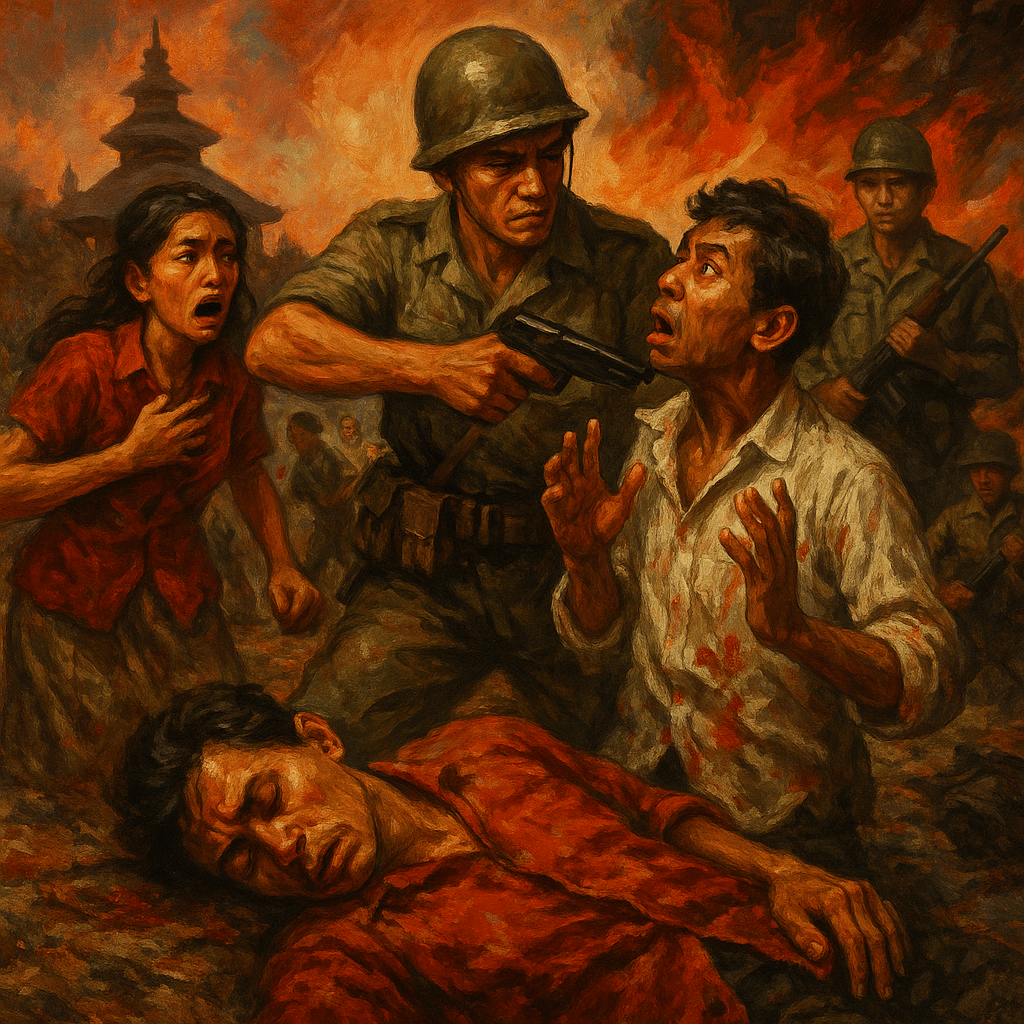
Vincent Bevins exposes how Washington turned mass extermination into foreign policy — from Indonesia’s 1965 genocide to the neoliberal order that still governs our world. This review reads his work as both autopsy and warning: a history of how empire learned to kill revolutions and call it peace.
Weaponized Intellects Booke Review | By Prince Kapone | Weaponized Information | November 2, 2025
Empire’s Hidden Blueprint
In 1965, while the world watched Vietnam burn, another war—a quieter one—was already being won. Not with napalm or armies, but with lists, machetes, and silence. In Indonesia, the United States found what it had been searching for since 1945: a reproducible formula for exterminating socialism in the name of freedom. It was not a civil war. It was not a coup gone wrong. It was an operation—a method—engineered, funded, and justified by Washington as part of its planetary campaign to make capitalism permanent.
Vincent Bevins’ The Jakarta Method strips away the Cold War’s mythology of noble ideals and ideological balance. What he uncovers is not a “clash of systems,” but a one-sided counterrevolution waged across the Global South—a network of massacres, coups, and covert interventions designed to annihilate the very possibility of liberation. Indonesia was the prototype: a CIA-guided extermination of the world’s third-largest communist party, the PKI, and the murder of over a million peasants, teachers, and organizers. It was not an accident. It was a proof of concept.
Bevins does what Western historians rarely attempt: he treats the Global South not as scenery in a superpower drama, but as the front line of the world revolution and its destruction. In the early 1960s, Indonesia under President Sukarno stood as the living continuation of the Bandung spirit—a coalition of anti-colonial states asserting sovereignty, socialism, and South-South solidarity. Guided Democracy, NASAKOM, and the rise of the PKI were not “missteps in modernization.” They were a declaration that empire could be refused. For the United States, that was unforgivable.
The architecture of annihilation was already in place. The CIA had trained Indonesian officers in counterinsurgency at Fort Leavenworth. U.S. propaganda agencies had spent years cultivating the press and clergy to fear “atheistic communism.” Western embassies had mapped the social networks of the Left and the logistical routes of rural organizing. When the killings began, it was not chaos—it was choreography. As Bevins writes, “Jakarta” soon became a code whispered across the Third World: a warning that Washington’s friends had learned how to erase entire movements without firing a shot of their own.
The genius of the method was its deniability. Washington didn’t need to invade Indonesia; it only needed to ensure the right people pulled the triggers. Suharto’s military carried out the slaughter, while the U.S. supplied names, radios, and moral cover. Western journalists called it “the dawn of freedom.” Time magazine called it “the West’s best news in Asia for years.” In that chorus of celebration, Bevins hears the birth cry of our modern order—the merger of violence and virtue that defines imperial propaganda to this day.
The Jakarta Method reads like a dispatch from the imperial laboratory. What it describes is the original form of technofascism: a system that fused intelligence work, psychological warfare, corporate capital, and religious reaction into a seamless machinery of control. This was the imperial operating system of the postwar world—designed not to win wars, but to make revolution impossible. Its logic endures in every sanction regime, every color revolution, every algorithm that polices dissent online.
Bevins’ account dismantles the liberal illusion that the Cold War was fought for democracy. The Cold War was fought against democracy—against the kind of democracy that could end hunger, redistribute land, or break the grip of empire. Indonesia’s socialist experiment had embodied that hope, and for that, it was drowned. The rivers of Java carried away not only bodies but possibilities.
By beginning in Indonesia, Bevins returns the century’s moral geography to its proper axis. The true front of the Cold War was never Berlin—it was Bandung. It was fought not between the White House and the Kremlin, but between the colonizers and the colonized, between those who extracted the world’s wealth and those who made it. Indonesia was where the future of that struggle was decided, and lost.
Bevins’ first chapter is not an introduction—it is an exhumation. It uncovers the corpse beneath the marble of liberal history and forces us to look. What died in Indonesia was not just a party or a president. It was the world that might have been. And what was born from that blood was the one we now inhabit—the neoliberal empire of debt, surveillance, and managed despair.
To understand how the twenty-first century learned to murder truth and call it order, you start here. Jakarta, 1965: where empire learned that the cleanest coups are carried out by someone else’s hands, and where the world that would follow—ours—first took shape in the dark.
A New American Age
They call it the postwar order, as if peace fell from the sky on angel wings. In truth, 1945 opened a new theater of war: an American century built not on liberty but logistics—bases, banks, and backchannels. The old empires bled out; Washington seized the arteries. What it sold as a “free world” was an operating system: rules written in D.C., enforced by soldiers and spreadsheets, with a kill switch for any people who tried to run a different program. This is the ground Vincent Bevins clears in his opening movement: before Jakarta became a synonym for massacre, the United States had already remapped the planet for counterrevolution under the banners of development and security.
Look at the furniture of this new age: the IMF and World Bank as collection agencies for capital; USAID as the velvet glove for regime change; “modernization theory” as the catechism that recoded exploitation as uplift. Elections were legitimate if they delivered clients, “stability” noble if it stabilized profits, and “freedom” sacred when measured by the movement of dollars, not the movement of peasants onto their own land. Where persuasion failed, the quiet parts grew louder: police schools, psywar labs, paramilitary ties, the scorched-earth lessons of colonial rule refined into manuals and seminars. The Cold War wasn’t a debate; it was an infrastructure.
Indonesia enters here not as a footnote to Vietnam but as the first great stress test of the system. A sovereign non-aligned state with a mass communist movement was intolerable precisely because it threatened to work—to yoke national independence to social transformation without kneeling to Wall Street or the Kremlin. In Washington’s calculus, that combination had to be broken before it inspired imitators. So, the “aid” and “advisers,” the business councils and embassy dinners, the friendly press and ominous whisper networks—soft power arranging the hard landing. The message to the Third World was simple: we’ll fund your roads and ports, but we’ll also pick your government, write your curriculum, and decide which unions live or die. Refuse, and you will meet the other hand.
This is why Bevins starts by widening the frame. The massacres that will later define “Jakarta” don’t erupt from nowhere. They grow out of a doctrine that married boardroom bookkeeping to battlefield ruthlessness. The same technocrats who preached productivity and price stability cultivated Catholic reactionaries, monarchist generals, and fascist street gangs as “anti-totalitarian civil society.” The same newspapers that praised land reform in Europe trashed it in Asia and Latin America as communist subversion. The same diplomats who toasted “self-determination” in Geneva greenlit coups in Tehran, Guatemala City, and, soon enough, Jakarta. The hypocrisy isn’t a glitch; it’s the grammar.
What makes this chapter vital for organizers today is not nostalgia; it’s pattern recognition. We still live inside that operating system. The acronyms have multiplied, the jargon has been debugged, the weapons moved from napalm to sanctions and algorithms—but the logic holds. When a people threatens the flow of profit, out come the think pieces, then the “NGOs,” then the judges, then the guns. When a government refuses to play colonial middleman, out comes the language of “corruption,” “human rights,” and “restoring democracy,” followed by the midnight knock and the river full of bodies. The lesson Bevins surfaces is the one the Bandung generation learned in blood: empire will use the ballot and the bayonet in the same breath, because both serve the same god.
So we enter the story of Indonesia with our eyes open. “A New American Age” isn’t a history class—it’s the stage directions for the rest of the book, and for the world we’re still fighting in. The empire built pipelines for oil and pipelines for consent. It laid cables across the sea and wiretapped the unions. It tethered food to obedience and debt to destiny. And when the poor insisted on writing their own future, it showed them what “freedom” means in the empire’s dictionary. Before Jakarta became a method, America built the world where that method could rule.
Independent Indonesia — Sukarno’s Unforgivable Experiment
Indonesia wasn’t supposed to choose itself. Fresh out of formal colonialism, it dared to walk a third road—neither Washington’s market orthodoxy nor Moscow’s command over its line. Sukarno called it Guided Democracy; the masses called it independence they could touch. The PKI grew not as a conspiratorial sect but as a national movement with unions, women’s organizations, cultural fronts, and millions of affiliates woven into daily life. In other words: a people learning to govern from the bottom while a postcolonial state held the ring. To the empire’s managers, this was the nightmare—socialism with roots, sovereignty with numbers.
Bevins shows how this experiment assembled its own language: NASAKOM (nationalism–religion–communism) as a pact against recolonization; SOBSI as the trade-union backbone in factories and workshops; party schools and popular culture that made politics legible to the newly literate. This was not some foreign implant. It was Indonesia’s revolution, improvised from its own history, its own contradictions, its own social alliances. In Jakarta’s squares and campuses, anti-imperialist rallies made the claim plain: independence meant land for peasants, wages for workers, culture for the people—without permission slips from Washington or The Hague.
Washington read the same map and saw a different headline: contagion. A non-aligned giant with the world’s third-largest communist party was proof that parliamentary roads to socialism could work in the South—and worse, that they could work while cooperating with a nationalist head of state. The U.S. responded the way it always does when democracy threatens property: with a pincer of soft power and covert force. Development money arrived with ideological strings; embassy circuits curated the “responsible” elite; media networks rehearsed the storylines of communist menace. Inside the diplomatic cable traffic, the mask slips: move quickly, back the army, flood the zone with the narrative that the PKI is guilty, treacherous, and inhuman.
Bevins reconstructs the mounting pressure: the “modernizers” and economists who promised order without justice; the security ties that trained an officer corps to see the popular classes as enemies; the religious and business hierarchies wired into anticommunist crusades. In the countryside, unresolved land reform sharpened class antagonisms; in the barracks, the promise of authority—plus American backing—hardened ambitions. Western officials and outlets were already workshopping the alibi: if violence came, it would be “necessary,” “preventive,” a correction to a supposed PKI overreach. The stagecraft of counterrevolution preceded the act.
Inside the socialist camp, Indonesian communists debated strategy under conditions none of their European critics ever faced. They stayed close to Sukarno, pushed for elections even within Guided Democracy, and tried to expand mass influence without provoking direct confrontation with the army56. Contrary to Cold War mythmaking, Bevins’ sources and the specialist literature he engages show no evidence that Beijing scripted a putsch; even scholars of China–Indonesia ties underline that Mao was not the architect of September 30, and that the PKI’s line remained rooted in Indonesia’s concrete balance of forces.
What made Indonesia unforgivable wasn’t “Soviet puppetry.” It was the prospect that a vast postcolonial nation could braid together national independence, Islamic currents, and a legal-mass communist movement into a viable alternative to dependency. If that synthesis held, it would radiate across Asia, Africa, and Latin America—Bandung with teeth. For the empire, this was the red line. And so the trap was baited: prepare the army, seed the narrative, isolate the Left, and wait for the pretext. When it came, the rivers would tell the rest.
Bevins’ chapter on this moment is a lesson in material analysis. He doesn’t romanticize the contradictions—he maps them. He shows a society in motion, a state straining to be sovereign, a party embedded in daily life, and an empire assembling an answer. Indonesia’s experiment threatened to normalize what the U.S. intended to make unthinkable: that the wretched of the earth could govern themselves and feed their children without offering up their future to Wall Street. That is why Jakarta had to be turned into a verb.
Feet to the Fire, Pope in the Sky — The Imperial Theology of Control
Before the bodies, there was the creed. Bevins peels back the sermon of the “Free World” and shows it for what it was—a theology of obedience wrapped in the rhetoric of salvation. Washington did not simply arm coups; it anointed them. Development became the new gospel, modernization theory its scripture, and the missionary class of economists, anthropologists, and “advisers” its priesthood. Their task was to convert postcolonial societies to the faith of perpetual subordination: first-world markets as heaven, socialism as hell, and the U.S. embassy as the church that decided who entered paradise.
“Feet to the fire, Pope in the sky”—that was how the system governed. The fire was debt, trade leverage, and covert terror. The Pope was the moral authority of empire—the myth that U.S. power was inherently benevolent, that its bombs and budgets carried a divine mandate to save backward nations from themselves. Bevins chronicles how this catechism spread through the veins of the newly independent world, sanctified by think tanks and Sunday editorials.
He retraces the intellectual apparatus built to smother decolonization. Walt Rostow, the high priest of modernization, preached that all nations must ascend the same capitalist ladder to “takeoff.” The job of the U.S. was to shepherd them—by guidance if possible, by bayonet if necessary. In this view, the Bandung line—self-reliance, socialism, and South-South cooperation—was heresy. The heretics had to be disciplined, and if excommunication failed, burned. Indonesia became the trial of faith.
Bevins details how the Cold War’s soft power met its sharp edge. The Ford Foundation and USAID poured resources into universities and ministries to train “rational planners,” grooming a domestic technocracy loyal to Western capital. At the same time, the CIA’s political officers cultivated the army and conservative religious networks as parallel centers of authority. The result was a dual state: an Indonesia of slogans and sovereignty on paper, and an Indonesia of generals, missionaries, and bankers in practice. Sukarno’s balancing act—NASAKOM—was brilliant but brittle; the empire only had to keep pushing until it cracked.
Religion and reaction moved hand in hand. The Vatican and major Protestant organizations, terrified of communist influence, blessed the crusade against the PKI as a moral duty. Western embassies funded “anti-atheist” cultural campaigns and quietly distributed lists of activists to church networks already primed to believe that socialism was Satan’s work. Bevins doesn’t sensationalize this—it’s enough to quote the missionaries who later boasted of their role in “cleansing” villages of communist influence. Ideological counterinsurgency always begins with the word “cleanse.”
By the early 1960s, Indonesia was ringed with bases and bound by invisible wires. U.S. intelligence monitored trade unions, infiltrated youth organizations, and mapped every PKI branch office. American diplomats wrote reports so detailed they read like manuals for extermination: which districts were vulnerable, which officers could be trusted, which propaganda themes resonated best with rural religious leaders. When Washington’s psychological warfare divisions trained Indonesian officers in “civic action,” they were teaching a new language—how to kill politically first, physically later.
Bevins connects this imperial catechism back to the global class project: keep the Third World in a permanent state of “takeoff,” never allowed to arrive. Washington didn’t need direct colonies; it needed dependent elites. Those who obeyed were rewarded with loans and legitimacy. Those who didn’t were fed to the fire. Sukarno, with his independence, his alliances with Beijing and Havana, his insistence that culture and land belonged to the people, had put his feet on the altar. The Pope in the sky watched as the torches were lit.
This chapter cuts through the myth of a “Cold War” as equal contest. What Bevins exposes is the machinery of moral cover—the way empire baptized slaughter in the language of progress. The murderers who would later fill the rivers of Java believed they were saving the nation, not killing it. They had been taught that development required purification, that history demanded sacrifice, that Washington’s will was God’s. Counterrevolution doesn’t start with bullets. It starts with belief.
By the time the September 30th Movement erupted, every lever was already in place. The generals had the weapons; the missionaries had the moral script; the press had the headlines prewritten. Indonesia had been prepared like a field before a burn—fertile, full of promise, and soaked in gasoline. The match was only a matter of time.
The Alliance for Progress — Latin America as Laboratory
Bevins turns westward. By the early 1960s, Latin America had become the empire’s testing ground for the very model that would later incinerate Indonesia. The slogans were familiar—“Alliance for Progress,” “modernization,” “hemispheric partnership.” But behind the diplomatic smiles was a continental counterinsurgency plan: a coordinated, U.S.-funded, CIA-supervised project to prevent another Cuba. The lesson drawn from Havana was not “reform or revolution,” but “repression or ruin.” Every government from Mexico to Montevideo was told the same thing: join Washington’s crusade against communism or face Jakarta before Jakarta even had a name.
The Alliance for Progress was Kennedy’s masterpiece of deception. Publicly it promised billions in development aid; privately it funded the police and intelligence networks that would destroy reform movements across the hemisphere. What the empire could not learn to tolerate in Asia—neutralism, sovereignty, land reform—it would not tolerate in the Americas either. In Guatemala, the 1954 CIA coup against Jacobo Árbenz had already demonstrated that the price of independence was annihilation. Brazil would soon refine the operation, Indonesia would perfect it, and Chile would export it back to the continent like a finished product.
Bevins shows how the ideological front preceded the physical war. U.S. universities and think tanks trained a generation of Latin American elites in “counter-subversion” and “economic stabilization.” These technocrats returned home to preach that inequality, not exploitation, was the problem; that Marxism was foreign infection; that only disciplined growth under U.S. supervision could save their nations. It was a catechism identical to the one being taught in Jakarta and Dar es Salaam: development as dependency, democracy as obedience, modernization as counterrevolution.
On the streets, however, the reality was different. In Brazil, peasants seized plantations. In Colombia and Peru, workers struck for control. In Chile, miners demanded nationalization. Washington read these movements as Soviet infiltration rather than social eruption. It responded by unifying the hemispheric intelligence services into a single body of repression—the embryo of what would become Operation Condor. From Panama’s School of the Americas to the torture chambers of Rio de Janeiro, counterinsurgency was now the lingua franca of the hemisphere. Indonesia had not yet burned, but the method was already in rehearsal.
Bevins’ narrative is devastating in its precision. He lists not abstractions but names: the USAID “Public Safety Program” that trained secret police in interrogation and propaganda; the CIA’s Office of Public Safety that armed them; the Rockefeller and Ford Foundations that funded their ideological “community development” fronts. He details how evangelical and Catholic networks—repackaged as moral guardians of the “Christian West”—became transmission belts for anticommunist doctrine. The old conquistador’s sword was reborn as the catechism of modernization.
And just as in Asia, the media carried the torch. Latin American and U.S. newspapers demonized agrarian movements as mobs, student movements as chaos, and leftist leaders as “authoritarian.” The contradictions were never theirs to solve. The imperial press served as the nervous system of the new order, ensuring that every act of repression appeared as rescue. To the public, Brazil’s 1964 coup was “restoration of democracy.” Guatemala’s massacres were “counterterror.” In Indonesia, these same headlines would later be recycled verbatim.
Bevins draws the line clearly: the Jakarta Method was not an Indonesian phenomenon—it was a franchise of empire, its manuals drafted in Washington, its first clients in Latin America. The coup against Goulart in Brazil served as a proof of concept. Once the generals learned that mass arrests, assassinations, and propaganda could stabilize markets and win U.S. aid, the model spread like wildfire. Indonesia would soon absorb the lessons and return them with interest.
From the imperial perspective, this was the real “Alliance for Progress”—an alliance for policing progress out of existence. The people’s movements that dared to imagine socialism with Latin American characteristics were branded as cancers on the hemispheric body. Doctors trained at Fort Benning prescribed surgery. By 1965, the treatment protocol was global. The continent had been converted into a rehearsal space for the apocalypse that was about to unfold in Java.
What Bevins captures here is not just continuity but intent. The Jakarta Method didn’t emerge from panic—it was policy. Empire learned through practice that exterminating the Left could be marketed as modernization, that fascism could wear the suit of liberal democracy, that “security cooperation” could replace colonial occupation. This was the genius of the system: to perfect mass murder as bureaucracy, to baptize genocide in the language of reform. Latin America was the prototype, Indonesia the premiere.
In tracing this lineage, Bevins doesn’t reduce Latin America to prelude; he restores its agency. It was the militants of the continent—the peasants, workers, teachers, and students—who taught the world what imperialism feared most: organized hope. The empire responded with a new science of despair. The Alliance for Progress was the lab where the formula was tested: capital plus coercion equals control. Indonesia would be the demonstration.
To Brazil and Back — Rehearsing the Kill
Before Indonesia’s rivers ran red, the rehearsal was held in Brazil. In 1964, João Goulart, a reformist president, tried to steer his country toward land redistribution, union power, and foreign policy independence. He wasn’t a communist; he was a nationalist with too much sympathy for workers and not enough obedience to Washington. For the empire, that was enough. Brazil had to be broken—not because it was socialist, but because it could have been. The coup that followed became the first full-dress rehearsal for the Jakarta Method: a textbook of “democratic” overthrow, crafted in Langley, executed by local generals, and justified as a rescue from chaos.
Bevins reconstructs it like an autopsy. The plan began years earlier in the U.S. Embassy’s back rooms, where CIA officers and corporate executives identified Brazil’s “problem areas”: the militant peasantry in the northeast, the powerful unions in the industrial south, the nationalist officers in the army. “Problem areas” meant people who refused to starve quietly. American “civic action” programs trained Brazilian military officers in counterinsurgency, psychological warfare, and crowd control. The language of reform—“anti-corruption,” “stability,” “restoring order”—was rehearsed in pamphlets and press briefings until it rolled off tongues like scripture.
When the tanks moved on Rio, the U.S. Navy’s Fourth Fleet was already stationed offshore, ready to intervene if resistance proved stubborn. It didn’t need to. Goulart fled, and the generals took power with Washington’s blessing. Overnight, Brazil was baptized into the global counterrevolution. The first decrees outlawed the Communist Party, purged left-wing teachers, arrested thousands, and installed a permanent national security state. U.S. newspapers celebrated “democracy’s rescue.” Time Magazine crowned it “the most popular coup in history.” The world barely noticed that the first of many laboratories for extermination had just opened for business.
Bevins connects every wire: the advisors who trained Brazil’s DOI-CODI torture units, the technocrats who replaced elected officials with “efficient managers,” the networks of anticommunist youth groups funded by the CIA through front organizations like the American Institute for Free Labor Development. This was not improvisation—it was choreography. The generals danced to a rhythm composed in Washington, set to the drumbeat of free-market discipline. Brazil’s dictatorship would last twenty-one years, during which it exported its model across the hemisphere.
Jakarta learned from Rio. Indonesian officers trained in the United States studied Brazil’s “revolution of order.” American officials rotated between both theaters. The manuals for civic action, psywar, and ideological mobilization were almost identical—down to the language describing opponents as “virus,” “infection,” and “subversion.” These were not metaphors; they were blueprints for extermination. Kill the carriers, save the patient.
What Bevins lays bare is how the Brazilian coup transformed the very grammar of imperial control. Before 1964, the United States still clung to the illusion of liberal tutelage: build institutions, encourage reform, cultivate loyalty. After Brazil, that mask slipped. The lesson absorbed by the security state was ruthless and clear: mass participation breeds instability, democracy breeds danger, and if annihilation is what it takes to protect capital, then annihilation is progress. Indonesia would prove how far that doctrine could go when applied with total force.
Bevins doesn’t write as a polemicist, but the evidence condemns itself. The same men who cheered Goulart’s fall applauded the Indonesian slaughter a year later. The same officials who wrote the Alliance for Progress memos congratulated Suharto’s “decisive action.” The same editorial boards that celebrated “restored stability” in São Paulo described rivers of corpses in Java as “a hopeful sign.” In the quiet continuity of language lies the real continuity of empire. Once the formula worked, it was franchised.
To Brazil and back—that’s how the circuit ran. Ideas born in the colonial peripheries of Europe traveled through Washington’s think tanks, were tested in Latin America, perfected in Indonesia, and then reimported as universal policy. Counterrevolution became globalization by another name. Bevins ends this section by showing the flow of personnel and ideology: Brazilian intelligence officers training Chileans and Argentines; U.S. advisers linking South American juntas to Asian anticommunist regimes; and through it all, the unbroken thread of Washington’s approval. The Jakarta Method was no spontaneous contagion—it was the deliberate export of a perfected technique.
For the people of the global South, this was the warning: when Washington promises modernization, prepare for mourning. When it funds “security assistance,” dig graves. Brazil was the pilot program, Indonesia the proof, Chile the franchise, and the world the market. In the name of peace, the U.S. had found a way to institutionalize war.
And the revolutionaries—those who still dreamed of land, literacy, and life without landlords—were made into what the empire most feared and most needed: ghosts. The ghosts of Brazil would travel east, whispering through the fields of Java: We tried. They killed us. Learn from us—but move faster.
The September 30th Movement — Birth of the Method
It began, as Bevins tells it, not with a battle, but with confusion—a mutiny without a clear chain of command, an “attempted coup” whose architects were never fully identified. In the early hours of September 30, 1965, a small group of middle-ranking Indonesian officers abducted and killed six generals. Within hours, the army’s high command—under General Suharto—claimed that the Communist Party of Indonesia (PKI) had orchestrated the plot. The pretext the empire had been waiting for had arrived.
Bevins’ narrative cuts through the fog of propaganda and asks the forbidden question: who benefited? Not the PKI, which was caught flat-footed and unarmed; not Sukarno, who had no reason to risk his entire state on a handful of rogue soldiers. The only winners were Suharto’s faction of the military and their foreign patrons. From the moment the blood hit the ground, Washington’s communications lit up with excitement. One State Department cable described the events as “an opportunity.”
Within days, the CIA and the U.S. Embassy moved to assist Suharto’s “restoration of order.” Lists of alleged communists—compiled by American intelligence and updated by embassy staff—were handed to the Indonesian army. The army, in turn, coordinated with civilian militias, conservative Islamic organizations, and criminal gangs to conduct what the embassy later called “the elimination of the PKI.” This was no spontaneous riot. It was a campaign of extermination, systematized from above and justified from abroad.
Bevins painstakingly reconstructs the mechanism of the massacre. The army established “interrogation centers” in nearly every district, often using schools or warehouses. Suspected PKI members and sympathizers—teachers, farmers, union organizers, women’s leaders—were rounded up, questioned, and executed without trial. Rivers turned red with blood. Villagers were ordered to dig trenches for their neighbors. The army distributed knives and machetes to vigilante groups, urging them to “cleanse the nation.” Religious preachers declared the killings holy work. Newspapers—fed information by army psychological warfare divisions and foreign advisers—framed the slaughter as a national purification.
The U.S. press followed suit. Time Magazine called it “the best news for the West in Asia for years.” The New York Times celebrated Indonesia’s “rebirth of freedom.” The BBC described the massacre as “a spontaneous reaction to communist violence.” None of them mentioned the lists, the logistical support, or the diplomatic cables congratulating Suharto’s officers on their “efficiency.” What was happening was nothing less than the foundational act of the modern counterrevolution—the fusion of ideology, bureaucracy, and genocide into a reproducible formula.
Bevins’ chapter forces the reader to confront how methodical it all was. The pattern of propaganda, mass participation, and plausible deniability was no accident—it was the product of decades of U.S. experimentation in psychological warfare and colonial policing. The Jakarta Method was born not only in rivers of blood, but in filing cabinets, press rooms, and diplomatic dispatches. It was the point where counterinsurgency ceased pretending to reform hearts and minds, and began openly annihilating them.
For the revolutionaries of the Global South, the lesson was horrifyingly clear. If Guatemala was the pilot and Brazil the rehearsal, Indonesia was the masterpiece. The world’s largest communist party outside the socialist bloc—millions strong, built patiently through legal struggle and mass work—was erased from existence in less than six months. The empire had discovered that it no longer needed to win wars. It could win by erasing entire social movements from memory.
Bevins gives voice to the survivors, the widows, the exiles. A teacher describes seeing his students dragged away. A village woman recounts being forced to cheer while her husband was shot. A worker remembers the silence afterward—the way people stopped speaking the word “PKI,” the way history itself became taboo. Suharto’s regime called it the “New Order.” The world called it stability. The price was a million dead and a generation taught to forget.
From a Marxist standpoint, this was not simply repression—it was counterrevolution as class project. The destruction of the PKI meant the destruction of unions, peasant leagues, and women’s organizations that had fought for land and literacy. Western corporations flooded in to claim Indonesia’s oil, copper, and plantations. Suharto opened the economy to foreign capital under the guidance of U.S.-trained economists—the “Berkeley Mafia.” The blood had barely dried when IMF officials arrived with blueprints for privatization.
Thus, the massacre was not the tragic excess of a Cold War proxy; it was the violent birth of neoliberal globalization. Indonesia was the proof that capitalism could reassert itself in the Global South not through persuasion or reform, but through extermination. The Jakarta Method was both a physical and ideological cleansing: kill the communists, sanctify the market, and sell the ashes as freedom.
This is where Bevins’ title earns its weight. “The Jakarta Method” was more than a code whispered among generals—it became a strategy adopted across continents. In the years that followed, the same logic would be invoked in Chile, Argentina, and the Philippines. In graffiti across Santiago, right-wing militants scrawled “Jakarta is coming.” It wasn’t prophecy—it was policy. Indonesia had proven that you could destroy a revolution without a war, and that the West would applaud the bloodbath as progress.
Bevins’ account is both indictment and requiem. It indicts the empire that perfected annihilation as administration, and it mourns the millions whose lives were erased to preserve the illusion of order. But it also illuminates the truth the killers feared most: that the oppressed had glimpsed their power, and that even drowned in silence, that knowledge would resurface.
The September 30th Movement marked the beginning of the end for the Bandung dream—but it also exposed the empire’s soul. The U.S. could no longer claim to defend democracy. It could only defend capitalism by destroying democracy wherever it appeared. And from Jakarta forward, every government in the Global South understood what that meant. The “Free World” was free only of revolution.
Extermination — The Blueprint Perfected
Indonesia was not chaos. It was choreography. What Bevins documents next is how extermination became a national policy—an assembly line of death engineered with bureaucratic precision. From October 1965 through mid-1966, the army under Suharto, guided by Western advisers and sanctified by propaganda, executed the most comprehensive political genocide of the twentieth century outside of war. The Jakarta Method was no longer metaphor—it was manual.
Every province had its rhythm. The army supplied lists of suspects, the militias provided manpower, and the religious leaders provided absolution. In Java, Bali, and Sumatra, the killings took on a ritual character. Men were forced to denounce themselves before execution. Women’s organizations were accused of witchcraft and sexual deviance—a lie spread by army psywar units to turn patriarchal rage into counterrevolutionary fervor. The army reported “cleansing operations.” Western embassies called it “the restoration of stability.” Washington’s intelligence updates read like harvest reports: “Thousands more eliminated.”
Bevins reveals the structure beneath the horror. The military’s central intelligence unit, Kopkamtib, coordinated local commands through daily briefings. U.S. communications satellites relayed intelligence between Jakarta and Washington. American oil companies and banks resumed operations almost immediately after the mass arrests began. The International Monetary Fund dispatched consultants before the graves were even covered. The bloodbath wasn’t collateral—it was capitalization.
The ideological dimension was equally precise. U.S. Information Service officers fed international journalists sanitized dispatches. The CIA-financed Asia Foundation distributed pamphlets praising the “anti-communist revolution.” Hollywood’s newsreel agencies and Western photojournalists shot smiling images of “new Indonesia.” The spectacle of death was concealed beneath the choreography of rebirth. This was the new grammar of empire: terror translated into narrative, genocide converted into a success story for the “Free World.”
Bevins writes without ornament, letting the contradictions speak for themselves. While hundreds of thousands rotted in prisons, U.S. officials toasted Suharto’s “restoration of confidence.” The World Bank declared Indonesia open for investment. Corporations like Freeport-McMoRan secured contracts to mine Papua’s copper; Goodyear expanded its rubber plantations; Caltex reopened its oil fields. For the peasantry and working class who had supported the PKI, the reward for a decade of organizing was annihilation. For imperial capital, it was a windfall.
In the countryside, silence became survival. Villages erased names from family records. Parents warned children never to ask why an uncle or teacher had disappeared. The New Order’s schools rewrote the story as national salvation. To this day, Bevins notes, most Indonesians under fifty learned of 1965 not as genocide but as deliverance from a communist plot. The Jakarta Method included memory control: erase the class struggle, criminalize remembrance, and reward complicity with crumbs of stability.
Bevins’ interviews with survivors cut through the decades of terror. An old woman recalls washing blood from her doorstep each morning before soldiers returned. A former teacher tells him, “We thought the U.S. loved democracy. They loved our killers.” These testimonies are not sentiment—they are historical data, proof of the system’s efficiency. When the U.S. State Department finally declassified its cables, they showed not ignorance but satisfaction. “It is now apparent,” one diplomat wrote, “that the Army is achieving its objective.”
The killings were so total that Western analysts began to celebrate them as a model for other nations. Reports circulated in the CIA and State Department titled “Lessons from Indonesia.” The message: a mass left-wing movement can be wiped out swiftly if the army is organized, religion is mobilized, and propaganda defines the enemy as subhuman. In bureaucratic language, they had discovered the algorithm of annihilation. “Jakarta” became code among right-wing officers in Latin America and Southeast Asia: a promise, a threat, a method.
Bevins makes a crucial analytical leap here: the extermination of the PKI was not simply an anti-communist purge—it was the foundation of the neoliberal order. Suharto’s regime became the template for the world to come: authoritarian rule, open markets, and total submission to U.S. strategic interests. It was a counterrevolution that succeeded so completely it remade the global economy. The workers’ organizations that might have resisted privatization were gone. The peasants who might have demanded land reform were dead. The intellectuals who might have written the story differently were in exile or prison. Indonesia was a tabula rasa for capital, scrubbed clean with blood.
The scale of Western complicity cannot be overstated. The British broadcast fake radio programs from Singapore calling for the murder of “communist traitors.” The Australians spread disinformation to justify the massacre. The U.S. Embassy delivered logistical support and congratulated Suharto in diplomatic communiqués. “The new government of Indonesia,” one memo crowed, “is a gleaming example of what can be achieved.” In the libraries of Washington, Jakarta became shorthand for efficiency.
Bevins closes this chapter with an image that sears itself into memory: a river near Surabaya, thick with bodies, where locals still whisper that ghosts cry at night. The ghosts are not superstition—they are the living archive of what imperialism calls order. Indonesia’s extermination wasn’t just a crime against a nation; it was a crime against history itself. The working class of an entire country was erased so that capital could proclaim peace.
From a revolutionary standpoint, this is where the mask falls away. The so-called “free world” revealed its true face: a planetary system willing to burn millions to preserve markets. What the empire called development was depopulation; what it called stability was silence; what it called freedom was the absence of resistance. The Jakarta Method was not an episode of the Cold War. It was the operating principle of imperialism in its mature form—a merger of murder and management, propaganda and profit.
And as Bevins warns, the blueprint did not stay in Indonesia. From the ashes of the archipelago, its disciples would carry the method to Chile, Argentina, Guatemala, and the Philippines. “Jakarta is coming,” they would whisper. It already had.
Around the World — When “Jakarta” Became a Verb
By 1967, the smoke over Java had barely cleared, yet in embassies and barracks from Bangkok to Buenos Aires a new phrase had entered the political vocabulary: to do a Jakarta. It meant to kill the Left until none were left. It meant to disappear the unions, liquidate the peasantry’s leadership, and erase the very idea that socialism could emerge from the soil of the Global South. What Bevins names with surgical precision is how this “method” metastasized—no longer an Indonesian tragedy but an imperial franchise, marketed through the circuits of Cold War diplomacy and military cooperation.
Everywhere Washington’s writ ran, Jakarta followed. In Thailand, the military invoked Indonesia’s “example” to justify the slaughter of students and rural activists in the 1970s. In the Philippines, Marcos built his dictatorship on the same triad—anticommunism, Christianity, and capital—and received shipments of Indonesian intelligence manuals as gifts. In Iran, the Shah’s SAVAK police studied Jakarta’s “civic action” model, while the CIA shared best practices in psychological warfare and “public order” operations. Across Latin America, the term became a password of power. “Jakarta is coming,” Chilean generals warned in graffiti even before Pinochet’s coup. In Guatemala and Argentina, it was whispered by torturers as prophecy fulfilled.
Bevins traces this diffusion with the calm of a forensic pathologist. Through declassified cables and interviews with former officials, he shows how the network cohered: conferences of police chiefs under the banner of “anti-subversion,” exchange programs for interrogators, counterinsurgency academies in Panama and Saigon, and the circulation of military journals that presented genocide as modernization. The U.S. didn’t have to command every massacre; it standardized them. Jakarta was the software, and empire the operating system.
In the Western press, each slaughter was treated as an isolated miracle of anti-communism. In Thailand, mobs baying for blood were called “patriots.” In Chile, the mass graves were “tragic necessities.” In Argentina, the “Dirty War” was framed as a defense of civilization. The global chorus sang in unison: wherever the Left dies, democracy is reborn. What Bevins exposes is that the moral architecture of these stories was constructed in advance—the same rhetoric, the same headlines, the same celebration of “decisive action” against “chaos.” From the Red Scare in the U.S. to the coups in Seoul, Saigon, and Santiago, language itself became an accomplice.
The material connections were as tight as the ideological ones. After 1965, U.S. arms exports to friendly regimes spiked. Training programs in counterinsurgency and intelligence multiplied. Private capital followed the blood: American, British, and Japanese corporations rushed into the territories cleansed of labor movements. Indonesia’s success at “restoring order” proved that a nation could be opened like a market once its people had been closed into fear. The technocrats of finance learned that terror could do what tariffs could not.
Bevins doesn’t let Europe off the hook. West Germany, newly reconstructed as a bulwark of the Free World, sent advisers and funds to Suharto’s Indonesia and later to Latin American juntas, often under humanitarian cover. British and French intelligence shared lists of exiled militants. The old colonial powers had found their redemption: if the age of direct empire was gone, they could now subcontract repression to loyal generals, earning dividends from every corpse.
By the late 1970s, the Jakarta Method had matured into an international doctrine of “internal security.” The United Nations passed resolutions on “terrorism” that conveniently excluded state terror. The World Bank and IMF perfected “structural adjustment,” turning economic strangulation into a quieter form of extermination. In conference halls from Washington to Geneva, the empire learned to speak of genocide in the dialect of policy: “rationalization,” “population management,” “stabilization.” Bevins’ insight is brutal and irrefutable—Indonesia was not a closed chapter, but a prologue to neoliberal globalization. The method outlived the massacre because it was profitable.
For organizers and revolutionaries today, this section reads like a map of warning lights. Every time a socialist experiment is overthrown and replaced by a “technocratic” regime, every time a strike is demonized as extremism or a movement for sovereignty branded as “terror,” we are seeing Jakarta’s ghost. When the empire cannot co-opt, it exterminates; when it cannot exterminate openly, it sanitizes the death under paperwork. The method adapts. Its vocabulary changes, its instruments evolve, but its purpose—preserving imperial capital—remains constant.
Bevins closes the chapter by returning to the survivors. He interviews Chilean and Argentine refugees who realized only in exile that their tormentors had spoken of Indonesia as a model. He listens to Thai students who grew up hearing that the army “saved the nation” from communism, only to find the same lie in Jakarta’s official history books. The revelation is chilling: the victims across continents had never met, yet their killers shared a curriculum. The same manuals, the same speeches, the same blessings from Washington.
By the 1980s, Jakarta had ceased to be a word and become a world—a world where capitalist order required permanent counterinsurgency, and where the line between development and death had vanished. The U.S. no longer needed to invade countries; it could simply “advise” them into slaughter. The age of coups gave way to the age of technocrats, but the foundation was the same field of bones.
This is the heart of Bevins’ revelation: the Cold War was not fought to contain communism—it was fought to contain emancipation. The West’s true victory was not ideological but anatomical: it cut out the organs of revolution from the body of the Third World and called the corpse peace. Indonesia was the first incision. The scars stretch across the globe.
To the ruling class, “Jakarta” meant efficiency. To us, it must mean memory. Because to name the method is to refuse its erasure. To see its pattern is to begin dismantling it. The ghosts of Java, Santiago, and Bangkok are not silent; they are singing the same refrain: *Remember us. The method lives, but so does resistance.*
Jakarta Is Coming — The Terror Exported
By the 1970s, the word “Jakarta” was no longer a place. It was a signal—a whisper passed among generals, a threat scrawled on walls, a promise to the ruling class that the contagion of revolution could still be cured by massacre. Bevins shows how this phrase, born in the ashes of Indonesia, became a global code for extermination. It traveled through embassies and barracks, through the CIA’s archives and the corridors of the World Bank, until it appeared as graffiti in Santiago and Buenos Aires: “Yakarta viene.” Jakarta is coming.
In Chile, the meaning was unambiguous. The Allende government’s experiment in democratic socialism had electrified the world: copper nationalized, workers’ councils forming, milk programs feeding every child in the nation. It was Indonesia all over again—a peaceful, sovereign road to socialism, this time in the Americas. The U.S. response was identical. Nixon and Kissinger choked Chile with economic warfare, funneled funds to right-wing media, and courted a military already trained in the gospel of Jakarta. On September 11, 1973, the Chilean Air Force bombed the presidential palace, and Allende died at his desk with a rifle in his hand.
The aftermath was a mirror image of 1965. The Chilean Left was hunted, tortured, and “disappeared” in their tens of thousands. Washington celebrated Pinochet as a savior. The New York Times called his dictatorship a “stabilizing influence.” The Chicago School economists descended on Santiago with their blueprints for privatization, repeating the Indonesian miracle in Latin form: kill the workers, sell the state, call it reform. The world applauded another “return to order.” Jakarta had arrived in the Andes.
From Chile, the method radiated outward. Bevins maps the blood geography with chilling precision: Operation Condor, the transnational terror network that bound Chile, Argentina, Uruguay, Paraguay, and Brazil into one apparatus of repression. Its architects openly cited Indonesia as inspiration. Meetings in Brasília and Santiago discussed “preventive cleansing.” CIA liaisons provided intelligence, technology, and funds. Death squads crossed borders with impunity. The result was a hemisphere of silence, where to speak of socialism was to vanish.
But Latin America was only one front. The “Jakarta model” appeared in East Timor, where Suharto’s army slaughtered a third of the population with U.S.-supplied weapons. It surfaced in Iran, where the Shah’s security forces crushed leftist students in the name of modernization. It echoed in the Philippines under Marcos, where martial law was justified as a “shield against subversion.” It even reached Europe’s doorstep: in 1968 Greece, the colonels’ coup invoked the same logic of “national purification.” What linked these episodes was not ideology but infrastructure—a global network of counterinsurgency that blurred the line between capitalism and fascism.
Bevins’ archival work is merciless. U.S. intelligence memoranda describe these regimes as “maturing democracies.” Aid packages flowed to their armies; trade agreements rewarded their obedience. Indonesia’s slaughter had demonstrated that mass murder could be normalized as economic stability. Washington learned the lesson by heart. Every country that followed the script—opening markets, suppressing labor, criminalizing the Left—was welcomed into the fold of the Free World.
Meanwhile, the international media machine—trained in Jakarta’s laboratories of perception management—did its part. Pinochet’s Chile was rebranded as an “economic miracle.” Brazil’s dictatorship was portrayed as a model of “efficiency.” The victims were erased twice: first by bullets, then by headlines. The empire had perfected what George Orwell once called “the memory hole.” To tell the truth became treason.
Bevins refuses the comfort of closure. He insists that these were not disconnected atrocities, but iterations of a single historical program: the militarization of capitalism under U.S. supervision. The Jakarta Method, exported and refined, built the foundations of the neoliberal world order. When Reagan and Thatcher rose to power, their project—the wholesale privatization of life itself—rested on the extermination of those who might have opposed it. Before the Chicago Boys could restructure economies, Jakarta’s ghosts had to empty the streets.
And yet, Bevins never lets the reader forget the cost in human flesh. He recounts stories from survivors across continents: a Chilean mother searching for her son’s bones; a Thai student remembering the smell of burning bodies; a Timorese rebel describing the roar of American bombers overhead. Their testimonies tie together a world where empire speaks many languages but kills in one. Their memories are the map of the method itself.
By the close of this chapter, “Jakarta is coming” ceases to sound like a threat and becomes a prophecy fulfilled. The method no longer requires coups or overt terror. It has become the everyday logic of global capitalism—the invisible hand with a knife in it. When workers’ movements are crushed by austerity, when sanctions starve nations into submission, when corporate media sanctifies every new “transition to democracy” built on rubble, the echo is unmistakable. Jakarta never left. It adapted.
Bevins leaves us with an image that could stand for the entire twentieth century: a hand-painted sign on a Santiago wall, faded but legible, decades after Pinochet’s fall. It reads simply: *Yakarta vive.* Jakarta lives.
And so it does—in the algorithms of surveillance, in the rhetoric of humanitarian war, in the “anti-extremism” laws that turn dissent into crime. The names change—“stability,” “security,” “market confidence”—but the logic remains: annihilate resistance, rename it peace, and move the profits offshore. What the empire built in Indonesia was not a single atrocity. It was a template for eternity.
Bevins closes this section not with despair but with recognition: to fight empire today, one must understand Jakarta not as history but as structure. It is the logic of domination translated into policy, the quiet consensus of murder in defense of order. And once you see it, you cannot unsee it. Every “crisis of democracy,” every “war on terror,” every coup wrapped in the flag of freedom is just another verse in the same hymn. Jakarta is always coming. Until we stop it.
Back Up North — When the Empire Brought the Method Home
Bevins’ final movements turn the mirror on the metropole. The Jakarta Method, he argues, was never confined to the jungles of Java or the slums of Santiago. It came home. The same techniques tested on peasants and trade unionists abroad—surveillance, psychological warfare, propaganda, and the criminalization of dissent—were repatriated to discipline the populations of the imperial core. The export of terror had always implied its return. You cannot industrialize mass murder without importing its logic.
In the United States, the counterinsurgency laboratories of the Cold War—the CIA, RAND Corporation, and Pentagon think tanks—turned their gaze inward. The rebellions of the 1960s frightened the ruling class precisely because they smelled like Bandung: multiracial, anti-imperialist, and working-class. From Watts to Detroit, from the anti-war movement to the Black Panthers, Washington saw the same danger it had annihilated abroad—the poor discovering their unity. The response was textbook Jakarta: surveillance, infiltration, and the systematic destruction of revolutionary capacity. The FBI called it COINTELPRO. The CIA called it CHAOS. Both were domestic versions of the same global doctrine: kill the movement before it becomes a party.
Bevins doesn’t overreach; he shows the throughline. The psychological operations perfected in Southeast Asia were repurposed as “law and order” campaigns in American cities. Police departments adopted counterinsurgency manuals designed for Vietnam and Indonesia. Universities, once hotbeds of radicalism, were absorbed into the security state through research contracts and foundation grants. The language changed—“public safety,” “crime prevention,” “national security”—but the substance was pure Jakarta: identify potential insurgents, isolate them socially, destroy their networks, and rewrite the narrative before anyone notices.
The empire learned from its colonies. The very same modernization theorists who justified anticommunist purges abroad now advised presidents on managing domestic unrest. Urban ghettos were treated as “underdeveloped zones.” Poverty programs doubled as intelligence-gathering schemes. The counterinsurgency model that had once annihilated peasants now targeted the urban poor, especially Black communities. The result was the carceral state: a permanent occupation force disguised as policing, a prison system functioning as social control. Indonesia’s “cleanse and repress” had become America’s “stop and frisk.”
Bevins’ insight here is devastating: imperialism doesn’t just exploit the periphery; it transforms the core to resemble it. The neoliberal order birthed in Suharto’s Indonesia was not an export—it was a prototype. Deregulation, privatization, and mass surveillance became the governing logic of Western democracies. The managerial class that once staffed the colonial ministries now staffed corporate boards and intelligence agencies. The free world inherited Jakarta’s nervous system.
The ideological apparatus evolved alongside the hardware. The same propaganda machine that had celebrated the annihilation of the PKI now rebranded itself as the guardian of “human rights.” The CIA’s cultural front, once waging psychological warfare against communism, reappeared as a network of NGOs promoting “democracy assistance.” Liberalism, Bevins reminds us, has always been the velvet glove on the fist of counterinsurgency. Every time empire modernizes its vocabulary, the method remains. The empire that once murdered the Left in Indonesia now smothers it with grants, foundations, and algorithms. The kill switch just moved online.
In one of his most prescient sections, Bevins draws a line from the “dirty wars” of the 1970s to the digital surveillance regimes of the 21st century. The architecture of control built to track and annihilate communists abroad became the infrastructure of the global internet. Companies like IBM, Raytheon, and Lockheed—veterans of the Cold War counterinsurgency complex—developed the data systems that now monitor entire populations in real time. The Jakarta Method, reborn through technology, no longer needs machetes or militias. It disciplines through visibility. Where once the poor were made to disappear, now they are made to appear everywhere, tracked, tagged, and preemptively contained.
Bevins’ argument cuts deeper than nostalgia for the lost revolutions. He shows that the liberal-democratic order’s apparent stability rests on a permanent state of global counterinsurgency. The empire no longer distinguishes between internal and external threats, between Jakarta and Detroit, between Santiago and Chicago. It is one continuum of control, sustained by fear and forgetfulness. The method’s ultimate victory is not its ability to kill, but its ability to convince the living that nothing can be done.
And yet, as Bevins closes his investigation, he listens to those who refuse silence. Survivors of Indonesia’s massacres, Chilean exiles, former revolutionaries from Latin America, Southeast Asia, and Africa—all testify to the persistence of memory. Their lives are proof that even in the heart of darkness, the method never fully succeeds. A young Indonesian activist tells Bevins, “They tried to erase our history. Now we teach it on our phones.” A Chilean organizer adds, “They taught us to whisper. Now we shout.”
“Back Up North” is not merely a warning—it is a diagnosis. The empire that perfected extermination abroad now uses it metaphorically at home: through eviction, incarceration, poverty, and propaganda. It doesn’t need to kill millions to neutralize rebellion; it only needs to convince the oppressed that rebellion is impossible. The Jakarta Method lives not just in coups, but in cynicism. Its final victory would be the death of imagination.
Bevins refuses to grant it that victory. His closing insight is as clear as it is revolutionary: if the empire globalized repression, the oppressed must globalize resistance. The ghosts of Jakarta, Santiago, and Detroit belong to the same history, the same class, the same unfinished struggle. The method began in blood, but it can end in memory—memory organized into consciousness, consciousness into power.
The world we live in is not post-Jakarta. It is Jakarta digitized, Jakarta financialized, Jakarta with better public relations. To break it, we must first name it. And that is what Bevins has done. He has named the system’s most sacred secret: that the freedom of the imperial citizen rests on the silence of the colonized dead. To read The Jakarta Method is to tear that veil away—to see the architecture of terror not as anomaly, but as design.
Bevins ends not with despair, but with solidarity. The method may live, but so do its enemies. The same global networks that once spread counterrevolution now connect the discontented. The same technologies that monitor can be used to mobilize. The same history that empire buried can be exhumed and weaponized. The ghosts of the twentieth century are not haunting us—they are recruiting us.
In the end, Bevins leaves us where all revolutions begin: at the threshold of recognition. Once you understand that Jakarta was not the exception but the rule, you are no longer an observer. You are a participant. You must choose. Because Jakarta is not just history—it is a world order. And the only way to end it is to make a new one.
We Are the Champions — The World They Built
When the smoke cleared, when the rivers had carried away the last bodies, the victors wrote the anthem of a new age. Suharto’s generals called it the “New Order.” Washington called it progress. The financiers and oil barons called it opportunity. It was, in truth, the consolidation of a counterrevolution so total that it redefined the meaning of peace itself. Bevins names it without euphemism: a global capitalist order constructed atop the bones of the twentieth century’s socialist movements. What followed Indonesia’s annihilation was not the end of violence, but its institutionalization—the making of a world safe for markets and unsafe for the poor.
Bevins sifts through the record. By the mid-1970s, the U.S. had achieved what its Cold War architects had only dreamed: a planet stitched together by debt, trade, and fear. Every region had its Suharto, its Pinochet, its Marcos—a local warden for the global plantation. The military regimes that murdered their own citizens were hailed as “modernizing forces.” The generals received IMF loans; the economists they trained in Chicago and Berkeley became the bureaucrats of a new order. Neoliberalism was baptized in blood and marketed as rebirth.
Indonesia’s transformation became the blueprint. Within a decade, its massacres were recoded into macroeconomic success. The “Berkeley Mafia”—a circle of U.S.-trained technocrats—implemented sweeping privatizations and austerity measures. Western capital flooded in, hungry for cheap labor and docile unions. The World Bank gushed that Indonesia had become a “miracle of development.” The miracle was measurable in GDP, not in graves. The very efficiency that made the killings possible became the managerial model for the global South: bureaucratic precision, ideological consensus, and an absolute intolerance for dissent.
Bevins links this moment to the dawn of the neoliberal age. The collapse of the socialist bloc decades later did not create globalization; it only removed the last obstacles to its totalization. The true foundation had been poured in the 1960s and 70s, when the empire learned how to destroy revolutions preemptively. The Jakarta Method was the womb of neoliberalism. It provided the proof that capitalist restoration could be accomplished not through reform but through annihilation—and that the world would cheer if the annihilation was marketed as modernization.
In this section Bevins is unsparing toward the self-congratulating mythology of the West. He notes how the architects of the bloodbath—men like Kissinger, McNamara, and their corporate patrons—spent their twilight years touring universities, preaching about ethics and democracy. Suharto himself, responsible for genocide in Indonesia and East Timor, died peacefully, never tried, still honored as a father of development. Their crimes had not only gone unpunished; they had been converted into policy success. History itself had been privatized.
But the system they built was not stable. Its prosperity rested on silence, its peace on terror deferred. Bevins shows how the very networks of repression that secured empire abroad hardened into the structures of inequality we live under now. The global South was emptied of its revolutionary potential; the global North was pacified with cheap commodities and spectacle. The empire, having destroyed its enemies, turned its methods inward to manage its citizens through debt, surveillance, and despair. The Jakarta Method became the common sense of the world economy.
The journalists who parroted the rhetoric of the “Free World” rarely saw the pattern, or refused to see it. They wrote of “transitions to democracy” as juntas fell, never noting that each transition preserved the same hierarchy: capital on top, workers and peasants below, Washington at the helm. Even after the fall of the Soviet Union, when the empire declared itself “the champion of history,” the invisible method remained—stripped of ideology, clothed in technocracy. The tanks gave way to trade agreements; the blacklists became credit ratings; the terror turned bureaucratic.
Bevins’ title for this chapter—borrowed from the smug self-confidence of the victors—is laced with irony. “We are the champions,” they sang, but the chorus drowned out the moans from the mass graves. The global elite celebrated the end of ideology while living off the spoils of ideological murder. They believed they had buried the revolutionary century. But what they had buried was only its body; its spirit had migrated into every strike, every riot, every act of defiance against the neoliberal world they built.
From a revolutionary standpoint, Bevins’ analysis lands like a warning shot. What the empire calls peace is merely the pause between purges. What it calls progress is the perfection of exploitation. What it calls democracy is the dictatorship of markets maintained by invisible terror. The Jakarta Method was not abolished when the Cold War ended—it was institutionalized. The police states of the global South became the model for a planetary regime of surveillance capitalism. The corporations that once extracted tin and rubber now extract data and attention. The continuity is unbroken.
And yet, as Bevins reminds us, history is never finished. The very success of the system it built has produced new contradictions. The masses who were silenced are speaking again—in the streets of Santiago and Jakarta, in the factories of Shenzhen, in the refugee camps of Gaza and the prisons of America. The ghosts of 1965 have not gone away; they have gone online. Every new wave of rebellion—Black Lives Matter, Chile’s 2019 uprising, the farmers’ protests of India—carries the same DNA of resistance that the empire thought it had eradicated. The Jakarta Method was designed to prevent these movements. Its failure is that they keep returning.
“We are the champions,” Bevins writes with deliberate sting, “but of what?” Of hunger, inequality, ecological collapse, and spiritual exhaustion. The victors of the Cold War inherited a world they cannot sustain. The same logic that killed the Indonesian Left now kills the planet itself. The neoliberal order, triumphant and terminal, reveals the last contradiction of empire: it can destroy everything except its own need for destruction.
Bevins ends the chapter not with closure, but with confrontation. The Jakarta Method is not an event to be mourned—it is a mirror. Look into it long enough, and you see our own reflection: a civilization built on managed amnesia, congratulating itself for surviving the apocalypse it created. To remember the dead of Indonesia is to remember what capitalism truly is. To forget them is to accept that it deserves to live forever.
Where Are They Now? — The Ghosts, the Survivors, and the World They Left Us
In his closing movement, Bevins returns to the human level — to the people who survived history’s deletion. The book that began with empire’s machinery ends in whispers: fragments of lives pieced together from exile, silence, and fragments of memory. The global Cold War, he reminds us, was not a chessboard of abstractions; it was a graveyard of workers, peasants, and dreamers whose only crime was to imagine the world otherwise. The Jakarta Method’s final act was not killing — it was forgetting. Bevins’s closing question is therefore the simplest and hardest: *what happens to the world when memory itself has been exterminated?*
He searches for the answer in the voices of survivors. In a small village in Central Java, an old woman points to an empty field where her husband and sons were buried without names. She still plants rice there every season, “so that something grows.” In Santiago, a former student militant tells him that his disappeared comrades “live in our silence.” In São Paulo, an exiled Indonesian remembers the day his party comrade vanished, then adds softly, “They wanted to kill an idea, but they didn’t know ideas have children.” Bevins allows these testimonies to reclaim history from the abstraction of geopolitics. It is here, in the trembling persistence of memory, that the book’s true revolution begins.
“Where are they now?” The question is rhetorical and haunting. The answer: everywhere. The descendants of those massacred in Indonesia now labor in sweatshops that replaced their unions. The grandchildren of those “cleansed” in Latin America staff call centers outsourced to the same corporations that sponsored the coups. The migrants fleeing climate catastrophe cross borders policed by regimes trained in the very counterinsurgency tactics tested during the Cold War. The Jakarta Method did not end — it globalized.
Bevins insists that to reckon with this history is not an academic exercise, but an act of political resurrection. He reminds us that the very notion of a “post-Cold War” world is propaganda. The Cold War’s methods were never dismantled; they were absorbed into the circuitry of globalization. The informant became the data broker, the coup became the trade agreement, the executioner became the consultant. The modern world, Bevins shows, is built on continuity disguised as change.
Yet the final pages refuse despair. The ghosts do not simply haunt — they organize. In Indonesia, young activists are unearthing mass graves and demanding truth commissions. In Chile and Argentina, families of the disappeared march every year, chanting the names of the dead. In Brazil, peasants reclaim the land under banners bearing the faces of those executed in 1964. Memory has become its own insurrection, proof that the dead were not silenced, only delayed. “The Jakarta Method failed,” Bevins writes, “not because it was stopped, but because it could not stop everything.”
His closing reflections are an indictment wrapped in tenderness. The same empire that celebrated itself as the defender of democracy has given us a planet ruled by debt, surveillance, and climate collapse. The same corporations that profited from Suharto’s massacres now brand themselves as green and progressive. The same universities that trained the architects of counterrevolution now teach “global ethics.” The empire has perfected moral laundering: it sells absolution at market price. But beneath the polished language of policy, the scream remains.
Bevins writes of visiting the grave of an Indonesian activist whose name he cannot publish because his family still fears reprisal. He leaves a single flower and observes that the ground itself feels heavy, “as if history were pressing from below.” That image captures the book’s essence. History is not past. It is buried alive, waiting for the living to dig. The Jakarta Method’s greatest illusion was that terror could end history. But history, like revolution, does not die; it waits.
The survivors Bevins meets do not speak of vengeance. They speak of truth. One woman tells him, “We don’t want revenge. We want the world to know who we were.” Another, a man who fled to Sweden in 1966, adds, “If they remember us, we win.” This is the moral of the book, and the challenge to the reader. To remember is to resist. To tell the story is to reopen the wound empire wanted to seal. To read *The Jakarta Method* is to inherit a duty — to make sure the ghosts never have to whisper again.
Bevins ends not with an elegy but with a reckoning. The U.S. called itself the champion of freedom, but the freedom it delivered was the freedom of markets from humanity. The “victory” of the Cold War was a victory over memory, solidarity, and imagination. What the empire destroyed in Indonesia was not just a party — it was a possibility. And that possibility is what every generation must now fight to reclaim.
In the last paragraph, Bevins writes that every society faces its own Jakarta — the moment when power demands silence and truth demands speech. Ours is now. The lesson of 1965 is not only how easily the oppressed can be destroyed, but how indestructible the desire for liberation remains. History’s executioners have always declared themselves the champions. The task of the living is to prove them wrong.
Because the Jakarta Method was never simply about killing communists. It was about killing hope. And yet hope, like revolution, has a habit of returning. The ghosts have begun to speak again, and this time, they are not alone.
Jakarta’s Children — The Return of the Method
The ghosts are walking again. Six decades after Suharto’s massacres made Indonesia the empire’s poster child for “stability,” the same class that inherited his spoils is resurrecting his system. Bevins’ history, when read against today’s Indonesia, stops feeling like a warning from the past and begins sounding like a dispatch from the present. The method never died; it metastasized. What began as the annihilation of a socialist movement has matured into a neofascist economy—an alliance of generals, bureaucrats, and businessmen managing capitalism through fear, debt, and discipline.
President Prabowo Subianto—himself a Suharto-era general implicated in human rights crimes—now governs a nation where soldiers farm rice, deliver food aid, and patrol civilian ministries in the name of “modernization.” Over a hundred new battalions have been mobilized, not for defence but for administration, logistics, and welfare—functions that were once the terrain of civilian life. Behind this militarised social policy stands a skyrocketing defence budget: fifteen billion dollars this year, twenty-two billion projected for next. A 166% increase since 2021. This is not modernization; it is reincorporation. The barracks are not knocking at the door of civilian power—they are already inside, wearing civilian clothes.
The economic logic is clear. The same “dual function” doctrine Suharto used to fuse army and economy has been quietly restored. Military men now occupy key positions in disaster management, infrastructure, even the attorney general’s office. Food estates, “free-meal” programs, and social aid are run by soldiers who double as contractors, distributors, and enforcers. What appears as welfare is warfare by other means: the militarization of hunger, the conversion of basic needs into political obedience. The social wage is no longer a right—it’s a ration, delivered at gunpoint.
This is the Jakarta Method’s neoliberal afterlife. Where the old regime used open terror, the new order uses technocratic encirclement. Where Suharto deployed firing squads, Prabowo deploys fiscal policy. The result is the same: the public sphere shrinking under the weight of an omnipresent security apparatus, dissent criminalized as treason, and fear normalized as governance. The August uprising—sparked by parliamentary corruption and the murder of a young delivery driver beneath a police vehicle—was answered with the same choreography Bevins chronicled: bullets, curfews, and the media’s chorus about “stability.” Nearly a thousand people sit in prison today for daring to demand bread, while lawmakers reward themselves with salaries ten times the minimum wage. Jakarta has learned to kill quietly.
The re-militarization of Indonesia’s economy mirrors the pattern Bevins described across the Cold War’s “Free World”: authoritarianism marketed as modernization, national sovereignty redefined as loyalty to capital. Each legal revision widening the army’s role in civilian life is a slow-motion coup, a legislative version of 1965’s purge. The new generals have discovered that they don’t need to dissolve parliament to rule it; they can simply sit inside it, wearing suits, managing procurement contracts, and writing laws that guarantee their immunity. Reformasi’s promise—to put the military back in the barracks—is being dismantled clause by clause.
The empire no longer needs to issue commands. Indonesia’s elites learned the method so thoroughly they now administer it themselves. The 1998 democratic movement that toppled Suharto disarmed the generals but never dislodged their economic power. Today, that power has matured into a hybrid regime: capitalists in the cabinet, officers in the ministries, oligarchs in parliament. The same families who profited from the 1965 massacres are once again the “stabilizing” force of the nation. The cycle has completed itself.
The consequence is not just political regression but social decomposition. When the state brands protest as “treason” and throttles social media to silence dissent, it sends a message older than Suharto: resistance is criminal, and obedience is patriotic. Fear becomes the new minimum wage. This is how counterrevolution operates under neoliberalism—not with tanks, but with throttled bandwidth; not through mass arrests alone, but through debt, inflation, and propaganda convincing the poor that survival requires submission.
Bevins warned that the true danger of the Jakarta Method was not its brutality but its plausibility. It taught ruling classes everywhere that you could destroy democracy while keeping its architecture intact—hold elections, print newspapers, even tolerate opposition parties, as long as none could threaten the foundations of capital. That is Indonesia today: a democracy in form, a garrison in function. The generals have learned the grammar of legitimacy. They no longer call it a coup; they call it governance.
Yet the people remember. Students invoke the Malari protests of 1974 and the uprising of 1998 as living warnings. Workers strike, farmers march, youth fill the streets despite live ammunition and digital censorship. They know what Bevins’ history makes plain: that every dictatorship begins with exceptions, that every normalization of fear carries the echo of 1965. Indonesia’s new regime may control the airwaves, but it cannot yet control memory. The ghosts of the past are marching beside the living again.
To tie Bevins’ history to the present is to see Indonesia not as a democracy in crisis but as a case study in imperial recursion. The same ruling class that once served as Washington’s executioner now serves global capital on its own account. The method has become self-replicating: a local elite perfecting empire’s old design, turning repression into routine, and calling it development. The Jakarta Method has come full circle. It was born in Indonesia, exported to the world, and now returns home as its own offspring — Jakarta 2.0, neofascism with better branding.
The empire built the machine. The Indonesian elite keeps it running. But the working people—those who buried the dead of 1965 and raised the flags of Reformasi in 1998—are learning once again to jam the gears. The barricades rising in Jakarta today are not spontaneous. They are historical memory made flesh. They are the children of those who were meant to vanish.
History is closing its circle. The same streets that once celebrated Suharto’s fall now echo with chants demanding that his system fall with him. The generals may hold the budgets and the guns, but the people hold something older and harder to kill: the knowledge that no regime of silence lasts forever. The Jakarta Method was a promise of permanent control. The protests of 2025 prove that even permanence can crack.
In the end, Indonesia stands as both tomb and cradle—the place where empire buried a generation and where a new one is learning to rise. The struggle now is not to repeat 1998 but to finish what it began: to dismantle the method itself, root and branch, and to reclaim the meaning of democracy from the generals who wear it like a mask. Bevins showed us where the method came from. The Indonesian people are showing us how it ends.
 Weaponized Information
Leave a comment