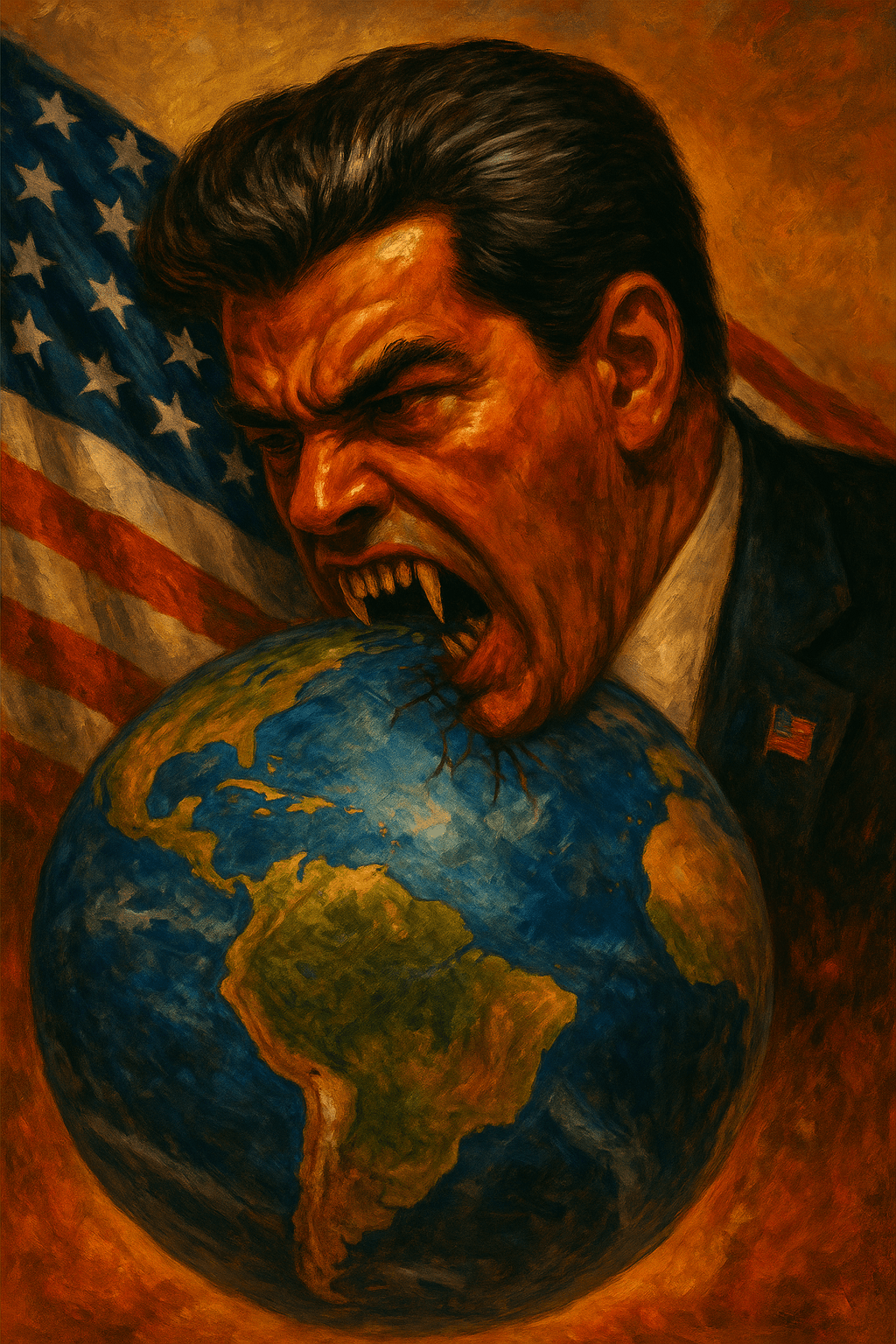
How U.S. Media Reveals the Machinery of Sabotage and Still Calls It Peace
By Prince Kapone | Weaponized Information | October 31, 2025
How the Story Teaches You What to Feel
The article under examination is CNN’s report, “CIA cyberattacks targeting the Maduro regime didn’t satisfy Trump in his first term. Now the U.S. is flexing its military might.” It presents itself as straightforward political reporting: an inside look at how the Trump administration, frustrated with previous outcomes in Venezuela, is now pursuing a more aggressive posture, including confirmed cyberattacks and a visible military buildup in the Caribbean. The tone is calm, measured, and professional. It does not announce alarm. It does not argue openly. It simply reports. And yet, reporting is never neutral. The structure of a story teaches you how to understand the world before you even begin to think about it.
The first move the article makes is to normalize what should shock. The CIA disabling another nation’s intelligence infrastructure is presented as routine—an operation described as “perfectly successful” but strategically disappointing, like a business venture that underperformed in a quarterly review. The violence of the act is hidden under the grammar of management. When power is narrated in this tone, the extraordinary becomes procedural, and the procedural becomes acceptable.
The second move is inevitability. Cyberattacks lead to pressure campaigns lead to troop deployments lead to bomber flights. Each development is written as the next logical step rather than a decision that could have been rejected. A sequence of choices is rearranged as a chain of consequences. The reader is guided through escalation as if it were weather rather than strategy.
The third move is to center the emotional arc of the U.S. executive as the engine of world events. The story lingers on Trump’s frustration, disappointment, and desire for results. The president’s impulse becomes the narrative hinge, turning foreign intervention into a psychological drama. Venezuela appears not as a sovereign nation but as a stage for the internal moods of U.S. leadership. Policy becomes personality. War becomes feeling.
The fourth move is performed through language. Venezuela is described as ruled by a “strongman” and a “regime.” The military build-up is described as a “mission.” The attackers are institutional and rational; the attacked are emotional and illegitimate. Word choice performs sovereignty transfer silently. It tells the reader who is allowed to govern and who is not, without ever saying that it is doing so.
The fifth move is to present justification without argument. The stated rationale for the U.S. military posture is “counternarcotics operations.” No evidence is provided. No sourcing is demanded. The phrase is simply placed in the reader’s hand and left there, as though its meaning and appropriateness were self-evident. Euphemism becomes evidence. Evidence becomes unnecessary.
The sixth move is ambiguity. The story ends by noting that the “end game” is unclear. That uncertainty is not neutral. It serves to keep all future actions on the table without requiring the reader to consent to any specific one. Ambiguity absorbs dissent. If anything could happen, then nothing can be opposed yet. The article opens the door, steps aside, and leaves the reader to walk through it.
In this way, the article does not argue for intervention. It makes intervention appear already in motion, already reasonable, already familiar. It narrates escalation as continuation. It narrates domination as administration. It narrates war as tidying up unfinished business. The persuasion is in the framing. The framing is in the tone. And the tone teaches the reader not what to think, but what to accept.
What the Article Says, and What It Refuses to Say
To understand what is at stake, we have to separate what the CNN article actually states from what it quietly steps around. The article reports that, during Trump’s first term, the CIA executed a cyberattack that disabled the computer networks of Venezuela’s intelligence services. It says this in passing, as if discussing routine maintenance at a federal building. It states that the operation was considered “successful” in technical terms, but insufficient in achieving the political outcome the administration desired. It describes internal disagreements between White House staff pushing for more aggressive action and intelligence and military officials who were reluctant to escalate. It also confirms a present U.S. military buildup in the region: roughly 10,000 troops, an aircraft carrier group, and bomber overflights, all presented under the banner of “counternarcotics operations.”
The article recounts that the U.S. recognized Juan Guaidó as Venezuela’s “legitimate leader” in 2019 and acknowledges that the attempt to transfer power failed when the Venezuelan military did not defect. It cites officials who believed the opposition movement would break the state from within. It notes that this did not happen. The narrative suggests that what we are seeing today is not a new strategy, but a second attempt—less intermediated, more direct. These statements need no interpretation; they are the surface-level facts of the report.
But the omissions are equally real, equally documented. Nowhere does the article mention that, for years, both Hugo Chávez and Nicolás Maduro publicly stated that the U.S. was pursuing regime change and destabilization inside Venezuela. These claims were not quietly ignored—they were ridiculed. They were framed across mainstream Western outlets as paranoia, delusion, and opportunistic dramatics — as in Reuters coverage during the 2019 blackout that treated Maduro’s sabotage accusation as unsubstantiated. And yet, the very operations they were denounced for naming are now described in CNN’s article as historical fact. The contradiction is not theoretical; it is chronological.
During the worst period of Venezuela’s economic crisis, the national electrical grid experienced repeated nationwide blackouts that disrupted hospitals, water systems, public transit, and communications. The Venezuelan government stated that the Guri hydroelectric complex had been targeted through cyber and physical sabotage. U.S. Secretary of State Mike Pompeo denied U.S. involvement in CNN’s own coverage at the time. Now, we see confirmed cyber operations targeting Venezuelan state systems in the same operational space, in the same historical window.
The article also omits the role of U.S. sanctions, banking restrictions, and foreign asset seizures in shaping the crisis. Sanctions targeted PDVSA, the primary generator of public revenue. Billions in Venezuelan sovereign funds were frozen abroad. These measures reduced state income, impaired infrastructure maintenance, and obstructed access to imported medicine, machinery, and food. Independent research documented that these sanctions caused measurable harm to civilians. The relationship between blockade and scarcity was not simply excluded—it was severed.
Nor does the article situate U.S. cyber operations in global context. The U.S. previously deployed the Stuxnet attack on Iran’s nuclear infrastructure, establishing offensive cyberwarfare against sovereign systems as standard practice.
Meanwhile, the U.S. regularly condemns Russia, China, and the DPRK as destabilizing actors for the very same type of activity now acknowledged here.
A final omission concerns the international landscape. Venezuela has developed economic and military relationships with states outside U.S. control, including China, Russia, and
Iran. These ties involve energy cooperation, credit agreements, technical development, and security coordination.
Venezuela is also a participant in regional projects like ALBA. These relationships are not mentioned because to mention them would clarify the stakes.
This section draws no conclusions. It simply establishes that the article reports covert cyber operations, military escalation, internal disagreements, and a failed regime-change attempt; and it also suppresses Venezuela’s own documented warnings, the role of sanctions and asset seizure in producing crisis, the sabotage claims made during the blackout, and the geopolitical alignments shaping the confrontation. These are the facts. Interpretation comes next.
The Empire Shows Its Teeth Because It Has Lost Its Mask
Now we can speak plainly. Once the facts are laid out, the pattern is not complicated. The United States did not discover chaos in Venezuela and feel compelled to respond. It manufactured the conditions for collapse—economic strangulation, infrastructure sabotage, political isolation—and then pointed to the very crisis it engineered as evidence that Venezuela was unfit to govern itself. The blackout becomes proof of incompetence only if the sabotage is erased. The shortages become proof of socialism’s failure only if sanctions disappear from the frame. The narrative works only if the cause is amputated from the effect. The CNN article is a crack in that operation: an admission delivered casually, without shame, because the empire no longer cares whether the lie is believed—only that its power is feared.
What we are seeing is not confidence. It is exposure. When a system is certain of its authority, it hides its violence behind moral language and humanitarian pretexts. It insists that domination is benevolence. But when a system feels its grasp weakening, when it senses that its legitimacy is fraying, it stops pretending. It acts openly. It says: Yes, we did it. And we will do it again. And who will stop us? This is the empire standing naked, the costume of necessity dropped, the costume of legality discarded. It has no clothes not because the garments were torn away, but because it no longer finds them useful.
The point is not merely that the United States lies. All states lie. The point is that the United States lies as an organizing principle. It lies to collapse economies while blaming the victims for starving. It lies while freezing sovereign funds and then accuses the impoverished of fiscal irresponsibility. It lies while hacking electrical grids and then mocks the darkened cities for their inability to keep the lights on. And when the suffering becomes severe enough, when the sabotage has done its work, it announces itself as the cure to the disease it injected. It arrives as doctor, executioner, creditor, and savior in one.
There is a structural logic at work. The U.S. cannot allow a resource-rich country to build an economic system not subordinated to U.S. capital. It cannot allow alternative development to become visible, legible, and reproducible. The threat was never that Venezuela would fail. The threat was that Venezuela might succeed. A sovereign oil industry linked to social spending and regional cooperation is a model that travels. It can be studied, adapted, defended. It can inspire. And inspiration is the one export the empire cannot permit.
The empire fears not the collapse of its enemies but the memory of an alternative. It must ensure that attempts at sovereignty are not merely defeated—they must be discredited. The population must not only suffer; they must be made to believe that they suffer by their own hand. This is why sabotage must be concealed at the moment it is committed and admitted only after the damage is done. The revelation is not a misstep. It is a phase change. Denial is useful when the goal is to break a society from within. Admission is useful when the goal is to intimidate the rest of the world.
But this is where the empire miscalculates. The admission does not only intimidate; it also teaches. It exposes the method. It makes clear that the same script has been used in Haiti, Iran, Cuba, Iraq, Libya, Chile, Nicaragua, Palestine, the Congo, and everywhere else the global South has dared to breathe without permission. And when a method is exposed, it can be recognized. When it is recognized, it can be anticipated. When anticipated, it can be countered. The empire has unveiled itself not as omnipotent but as predictable.
And beneath this predictability is something else: desperation. For two decades, the United States has attempted to prevent the formation of new political and economic alignments outside its orbit. Yet here we are: Venezuela integrated economically with China, militarily with Russia, energetically with Iran, diplomatically with ALBA, and increasingly within the orbit of BRICS+ coordination. The U.S. is not escalating because it is strong; it is escalating because it is losing ground. It must now act more openly, more aggressively, and more visibly, because its power is no longer assumed. Power that must be demonstrated is already eroding.
This is the contradiction at the heart of the moment. The empire reveals its violence to frighten the world into submission. But in revealing its violence, it also reveals the illegitimacy of its authority. It stands exposed not as guardian of international order but as its saboteur. Not as defender of democracy but as its executioner. Not as the architect of stability but as the producer of collapse. The emperor is not simply without clothes—he is drenched in gasoline and holding a match.
To see this clearly is not to despair. It is to understand that the veil has already fallen. The task ahead is not to prove anything to anyone. The proof is printed in CNN, in the most ordinary language, as if discussing weekend weather. The task now is to name what has been revealed and to act on that knowledge. The story is not about Venezuela alone. It is about how empire behaves when its horizon is closing. And it is about what becomes possible when the world knows the empire can bleed.
What We Do With a World That Now Sees the Wound
The revelation itself is not enough. Power does not collapse because it is exposed; it collapses when the exposed truth becomes the ground of collective action. The empire has shown its face, but a mask falling does not end domination. It only ends the myth that domination was ever anything else. The question now is how working people, colonized nations, movements for sovereignty, and those building the new world respond to the moment when the old world admits its crimes openly. We are past the phase of asking whether the United States interfered in Venezuela. The answer is printed in a mainstream outlet in the cool tone of routine. The task now is to understand that this is not only a Venezuelan struggle. This is the blueprint of how the empire governs. To defend Venezuela is to defend the possibility of a world beyond imperial rule.
And Venezuela is not facing this alone. There are grassroots formations already in motion—communal councils defending food distribution networks under blockade, worker brigades repairing refineries without corporate oversight, Afro-Indigenous land defenders holding territory against extraction agreements imposed from abroad. There are internationalist media collectives, like Tatuy TV and community radio networks, translating the silenced narrative into the world’s languages. In the diaspora, there are solidarity committees that never ceased organizing even when the headlines shifted and the world was instructed to forget. The infrastructure of resistance is not hypothetical. It is lived, disciplined, and ongoing.
The task for those in the United States and the imperial core is different, but no less urgent. The empire does not function because the state alone wills it. It functions because logistics workers transport the weapons, because telecom workers maintain the military networks, because educators repeat the imperial narrative, because voters are told to see sabotage as benevolence and intervention as duty. When we say the working class has a world to win, we mean it literally: the empire is held up by labor. When workers refuse, even partially, even in one strategic artery, the machinery groans. The greatest contribution to Venezuela’s sovereignty from the heart of empire is not empathy—it is interruption.
This can take many forms, none of them abstract. Spread the truth of what has been admitted, not to persuade the empire’s faithful but to reach those who already know something is wrong and needed confirmation. Support Venezuelan communal and worker institutions materially, especially those targeted by sanctions. Back the organizations in the U.S. already fighting sanctions regimes, deportation raids, military recruitment, and foreign base expansion. The point is not symbolic solidarity but structural refusal. Every port that delays arms shipments, every telecom worker who refuses to maintain surveillance infrastructure, every student who forces their campus to disclose defense contracts, shifts the balance in tangible ways.
There is also the deeper work: the work of reorganizing consciousness around the understanding that empire is not stability—it is enforced dependence; that sovereignty is not chaos—it is the beginning of self-determination; that the future is not written by those who hold the weapons but by those who hold the capacity to stop them from being used. Power does not only reside in the office of the president or the command of a carrier group. It resides in the hands of the people who make the carriers move, who manufacture the jet parts, who extract the fuel, who code the targeting systems, who load and unload the vessels. When they understand themselves as participants rather than spectators, the coordinates shift.
The empire wants the world to read the CNN report as demonstration. We read it as confession. They want to show power. We see vulnerability. They want obedience. We recognize opportunity. What happens next depends on whether that recognition becomes organization. The world is not waiting for permission to change. It is already changing. The question is whether we stand inside that change as witnesses, as casualties, or as builders. Venezuela has been forced to learn how to survive the storm. We have now been shown the storm’s machinery. The time to act is not when the empire falls, but while it is still trying to prove that it cannot.
 Weaponized Information
Leave a comment