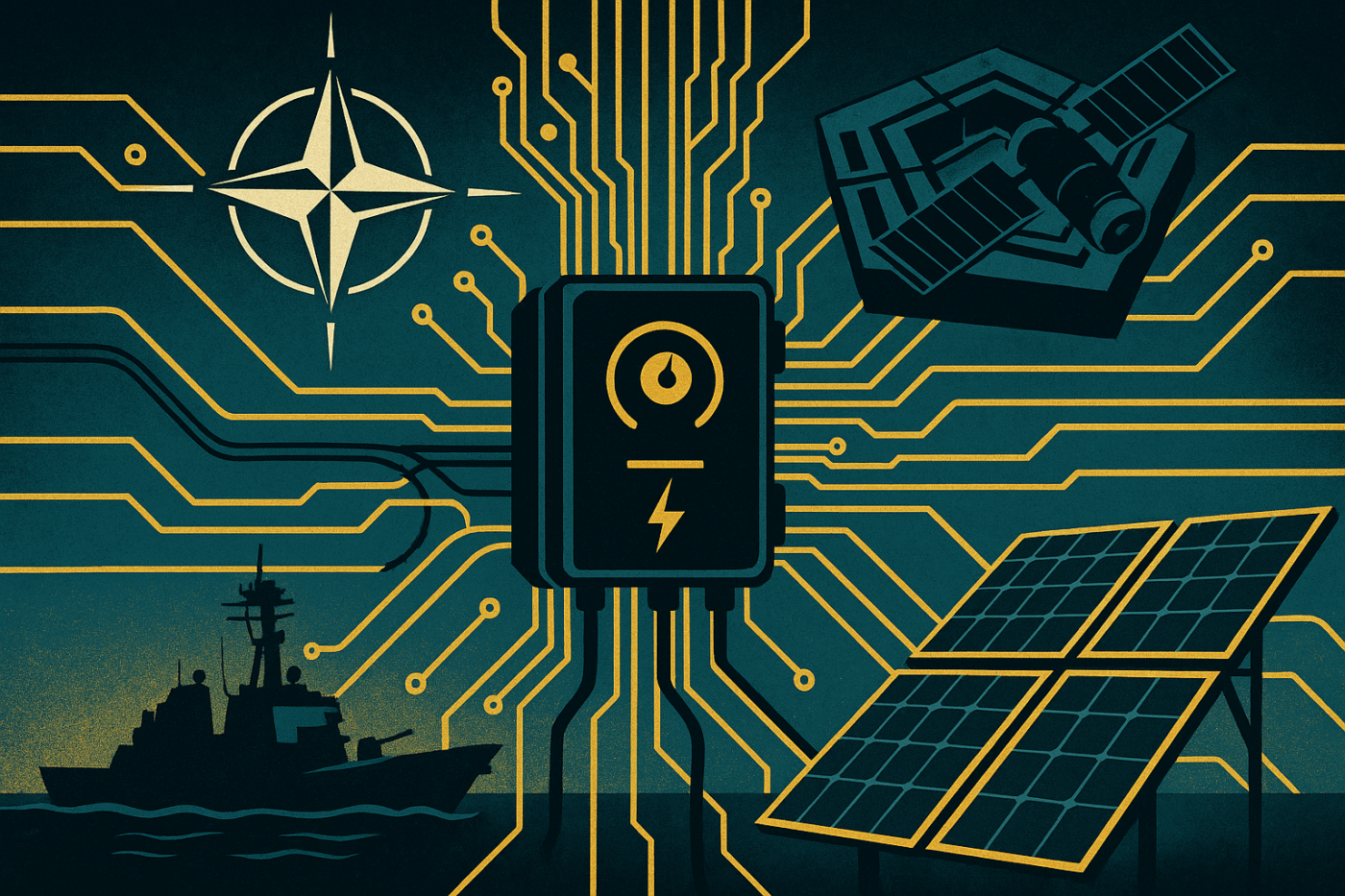
How the West manufactures a solar “security” panic to protect fading chokepoint power
By Prince Kapone | Weaponized Information | October 24, 2025
How to Build a Scarecrow and Call It China
Politico’s latest hand-wringing over Huawei reads less like journalism and more like a stage play commissioned by the Atlantic Council: dim the lights, cue the ominous music, and bring the yellow peril back for its encore. In their October 24th article warning that Huawei could “turn the lights off” in Europe, Sam Clark and Jordyn Dahl assemble the perfect scarecrow — a stitched-together caricature of a techno-boogeyman — and then congratulate themselves for bravely sounding the alarm against their own straw creation. The story is sold as sober analysis about the “security risks” of Chinese solar inverters, but every line of its script is tailored to make readers shiver on command.
The narrative logic is simple enough for a NATO press intern to diagram: China builds solar equipment → Europe buys it → therefore China can flip a switch and plunge the continent into darkness. It is a fantasy dressed up as inevitability, an esoteric ghost story in which the villain lurks in every circuit, modem, and port. Instead of engineering analysis, we are fed mood. Instead of technical evidence, we are fed suspicion. Instead of history, we are fed amnesia. Like all effective propaganda, it works by rhythm: a slow drumbeat of danger, dependency, and disaster, repeated until the echo itself sounds like truth.
To make the fear stick, Politico relies on the oldest trick in the empire’s storytelling handbook: invent a threat, strip it of context, and surround it with credentialed ventriloquists. The article quotes European lawmakers, Western security experts, and even a U.S. Mission briefing — the journalistic equivalent of interviewing three ventriloquist dummies from the same puppet theater. Not a single engineer, grid operator, independent cybersecurity lab, or Global South voice is permitted to contaminate the script. It is a closed echo chamber — Western officials citing Western fears to justify Western policy — and Politico simply amplifies the feedback.
Omissions do the rest of the heavy lifting. By refusing to mention who actually controls most of Europe’s digital infrastructure, who actually runs the most notorious global spying apparatus in human history, or who actually has a paper trail of hacking allies and enemies alike, the article turns silence into argument. In this upside-down world, the West has no agency, only anxieties; China has no legitimate industry, only sinister motives; and Europe is reduced to a helpless victim in need of American security chaperones. The passivity is intentional. “Europe became dependent,” Politico sighs, as if dependency were a natural disaster — not a decades-long policy choice crafted by European elites and their corporate patrons.
Language does the rest. Solar “inverters” — unglamorous pieces of engineering — are recast as potential doomsday triggers. Remote updates become “backdoors.” Trade competition becomes “high risk.” Protectionism becomes “de-risking.” Imperial policy is smuggled in through euphemism, and the only thing the reader is never permitted to imagine is the possibility that Europe’s energy future could be cooperative, multipolar, or sovereign. By the end of the piece, the reader is expected to nod along: yes, it is reasonable to fear the scary foreign machine. Yes, we must ban it. Yes, we must rally behind the same governments and corporations that spent 30 years outsourcing Europe’s industrial base — because now, suddenly, they are the guardians of security.
Politico is not chronicling a threat. It is manufacturing consent for a foregone conclusion. This is not about solar panels, cybersecurity, or grid stability. It is about narrative stability — the stability of a worldview in which the West must remain the permanent gatekeeper of infrastructure, technology, and modernity itself. To defend that worldview, the article builds a scarecrow, calls it China, and invites us to be grateful when the torches are lit. But like all scarecrows, it collapses the moment someone walks up and touches it. And that is where our excavation turns next.
What the Empire Erased from the Record
Politico presents a story in which Europe is supposedly vulnerable because Chinese companies supply critical solar technology. The article’s stated facts are straightforward: firms like Huawei and Sungrow hold major market shares in solar inverters; these devices are connected to the grid; and some European politicians want restrictions on “high-risk vendors.” Taken on their own, those details are not controversial. China does dominate global solar manufacturing, and Europe does import much of its inverter hardware. But by stopping there, Politico constructs only a half-truth. The material context that gives those facts meaning is deliberately stripped away. What remains is a selective snapshot designed to frame Europe as naïve, China as dangerous, and Western governments as reluctant guardians of continental security.
A full factual record begins with what Politico omits. The only proven acts of cyber-sabotage against critical infrastructure in the past two decades have come not from China, but from the United States and its closest allies. The Stuxnet operation, jointly deployed by U.S. and Israeli intelligence, remains the most famous example: a malicious program that infiltrated Iranian industrial systems and physically damaged equipment. This was not espionage; it was offensive cyberwar. It marked the first known case of a state using malware to sabotage another country’s infrastructure. That attack was part of a broader U.S. program of covert digital strikes, demonstrating both capacity and willingness to target civilian systems. Even today, U.S. cyber operations are still aimed at foreign critical infrastructure. Chinese authorities recently stated that the NSA attempted to breach their national timing system, claiming “irrefutable evidence” that Washington sought to compromise the servers that synchronize telecom, finance, and power grids. Whether Europe chooses to believe China’s allegations is secondary. The point is clear: the only actors with a documented track record of sabotaging infrastructure are the same governments Politico portrays as Europe’s protectors.
The record on surveillance is just as one-sided. Thanks to the Snowden disclosures, the world knows that the NSA and its Five Eyes partners conduct global dragnet monitoring of communications. Programs like PRISM and XKeyscore intercepted the data of entire populations, including Americans and Europeans. Western agencies went so far as to spy on allied heads of state, including German Chancellor Angela Merkel, as confirmed by Der Spiegel. At the hardware level, the NSA planted backdoors in major U.S.-made networking equipment, documented in the ANT Catalog leaks. In other words, the governments sounding the alarm about “Chinese backdoors” are the ones that have already built and deployed them at planetary scale. Politico’s silence on this point is not oversight. It is narrative design.
Jurisdictional control of data tells a similar story. Through the CLOUD Act, the United States asserts the legal right to seize data from any server operated by a U.S. company, no matter where that server is physically located. Added to this is Washington’s long-standing influence over core pieces of the internet’s architecture, including the governing bodies connected to domain infrastructure. This means Europe is already structurally dependent on foreign command over crucial layers of the digital stack—but in this case, the power sits in Washington, not Beijing. None of this appears in Politico’s retelling.
The same omissions appear in the relationship between Western intelligence agencies and Silicon Valley. Tech giants such as Amazon, Microsoft, Google, and Palantir have become infrastructure contractors for the security state. Major NATO and intelligence systems are hosted on their cloud architecture. These companies are not neutral vendors; they are enmeshed in military, intelligence, and law-enforcement operations and profit from that integration. When Politico warns that Chinese companies could influence European infrastructure, it ignores the fact that U.S. companies already do. The difference is not capability. It is allegiance.
Even the question of “dependency” is inverted. Europe’s reliance on Chinese solar hardware did not appear by accident. It was the product of policy. After years of deregulation, austerity, and trade decisions that gutted Europe’s own solar industry, China filled the void by scaling production and driving down global prices. The result was cheap solar, rapid deployment, and declining installation costs. Europe embraced these benefits until Washington launched its latest tech containment campaigns. Now Politico recasts a trade reality as a security crisis, as if European governments and manufacturers played no role in creating the very conditions they now lament.
Laid out plainly, the record contradicts the narrative Politico advances. Western governments have sabotaged infrastructure. Western agencies have built global backdoors. Western law asserts extraterritorial data control. Western companies run key pieces of Europe’s digital and security networks. And Western policy decisions dismantled Europe’s renewable manufacturing base. These are not opinions. They are the documented conditions surrounding the very story Politico claims to explain. By stripping these facts from view, the article presents a world that does not exist. Restoring the material record is not analysis. It is merely the first step toward seeing clearly.
Empire Fears the Sun It Cannot Command
When the facts are restored to the record, Politico’s narrative reveals its true purpose. The panic over Huawei is not about sabotage, safety, or sovereignty. It is about control—control over the chokepoints of the post-fossil energy system, and control over the political and economic future that such a system makes possible. For two centuries, the West ruled by commanding the bottlenecks of global infrastructure. Gunboats on shipping lanes, monopolies over oil routes, IMF control over budgets, and Silicon Valley control over information flows: the method never changed, only the technology did. Now, as the world transitions from fossil dependency to renewable generation, the imperial core is determined to seize the commanding heights of the solar age before they slip permanently from its grasp.
Europe’s political class understands what it cannot say outright: whoever controls the inverter, the grid, and the digital nervous system of energy distribution will control the development paths of entire nations. An oil empire can blockade ports. A renewable empire can throttle electrons. In both cases, domination flows from chokepoints. What unnerves Brussels and Washington is not that Huawei might “turn off the lights,” but that they themselves may no longer possess that ability. The West is accustomed to being the hand on the switch, the gatekeeper to modernity, the custodian of crisis and permission. The emergence of a multipolar energy system threatens this identity at its root.
And so the propaganda story is born: Europe is in danger, China is the threat, and only a reinvigorated Atlantic alignment can provide protection. This is the same narrative architecture that justified coups in the age of copper, invasions in the age of oil, and sanctions in the age of semiconductors. Huawei is merely the latest proxy in a very old struggle over who commands the material basis of life. Politico’s article functions as its cultural instrument—preparing public opinion, laundering talking points, and framing dependency not as the outcome of Western policy, but as the fault of an external menace. The empire accuses China of plotting the very forms of domination that Western power has already perfected and deployed across continents.
For the working classes of Europe, this manufactured panic offers no security and no future. It is a smokescreen to preserve a corporate order that privatized their grids, outsourced their industries, and now demands loyalty as it lines up behind Washington’s containment strategy. For the Global South, the stakes are even clearer. Affordable Chinese solar technology offers a rare opportunity to break from the colonial energy chain, where Western firms dictated prices, access, and terms of development. What Politico brands as “risk” is, for much of the world, the first real opening toward energy sovereignty in a century. A grid that cannot be dictated by Washington or Brussels is a grid that can power independent paths of development—something empire has never tolerated.
This is why the narrative must be enforced. If the public were allowed to see the truth—that Western intelligence agencies built the backdoors, that Western governments sabotaged infrastructure, that Western corporations already control Europe’s digital bloodstream—the entire security argument would collapse overnight. The issue was never about safety. It was about supremacy. It was about ensuring that the sun itself, in all its abundance, could not become a commons that weakens the geopolitical hierarchy. Empire fears a world it cannot blackmail with energy. It fears a future in which electrons do not answer to empire. It fears the sun it cannot command.
The transition from fossil capitalism to renewable infrastructure could have opened the door to global cooperation, shared development, and ecological rationality. Instead, the West has chosen to approach the solar era the same way it approached the oil era: as a battlefield to be conquered, a network to be captured, and a weapon to be aimed. Politico’s article is a minor note in this larger symphony of containment, but it is a revealing one. No amount of euphemism can conceal the underlying truth: this is not a struggle over technology. It is a struggle over power, sovereignty, and the right of nations and peoples to control the energy that sustains their lives.
Build Power Where We Live: From Panic to Public Energy
We have already exposed the script, put the record back on the table, and named the game, so the next step is simple: organize. Not as a hashtag, but as living structure—unions, tenants, farmers, students, migrants, tech workers, neighbors—pulling together around one clear objective: take the grid back from private hands and imperial gatekeepers, and make it serve the people who actually keep the lights on. The panic Politico sells is meant to freeze us. Our answer is movement, steady and practical. We don’t need permission to act. We need coordination.
Start where we stand. In Europe, that means fighting for public ownership of energy and the digital systems that run it, not another round of handouts to the same firms that outsourced industry and hiked bills. Link up with the campaigns already pushing in this direction—union locals organizing power-sector workers; community energy co-ops; national efforts for remunicipalization and democratic utilities; research and advocacy outfits that have been mapping public alternatives for years. Wherever there’s a fight against privatized grids, billing chaos, or “security” theater that sluices money to contractors, fold in and widen the front. Make every town hall and works council a node in a larger push: affordable power, public control, transparent software, and the right to interconnect new renewables without corporate toll booths.
Tie climate to bread-and-butter. Workers don’t live on abstractions. We build support by winning concrete gains: caps on household energy costs; debt relief for arrears; union jobs for installation, grid maintenance, and local manufacturing; training pipelines for youth; and community ownership stakes in solar and storage. When we show that public power cuts bills, stabilizes the grid, and hires locally, the “security” scare collapses on contact. Build strike-ready capacity where necessary, and back the people who risk their jobs to keep energy a public good—lineworkers, grid techs, call-center staff, logistics crews. Make it normal that the people who run the system have a democratic say in how it’s run.
Internationalism isn’t a slogan here—it’s the wiring diagram. Connect with Global South initiatives that are already scaling affordable renewables and grid modernization. Build exchanges between municipal utilities, worker co-ops, and public research institutes across borders; share templates, specs, and governance models; pool procurement so no town is price-gouged on hardware or software. Where multipolar platforms and regional alliances are opening space for cooperative energy development, meet them with people-to-people projects: training delegations, open technical standards, and joint pilots that cut through the middlemen. Every city that proves public, reliable, low-cost solar is another hole in the old order’s net.
None of this works if the network layer stays captured. Push for open, audited code in grid management; local data sovereignty for utilities; and strict limits on vendor lock-in. Demand that public bodies—not private contractors—control firmware updates, credentialing, and remote access. Insist on transparent risk assessments that include the documented history of Western backdoors and sabotage, not just the fear of a foreign logo. When they shout “security,” answer with standards we write in the open and enforce together. When they say “de-risking,” answer with de-monopolizing—break the choke points, diversify supply, and make public capacity the backbone, not the afterthought.
Finally, stitch the fronts together. Climate movements, labor federations, anti-austerity networks, digital rights groups, and anti-war coalitions share the same antagonist wearing different badges. Coordinate calendars. Share media lists. Cross-endorse actions. If a union is bargaining over grid jobs, climate groups should be on that picket line; if tenants are fighting winter shut-offs, tech workers should be there demanding open systems that prevent predatory billing; if communities are blocking another round of “securitization” contracts, peace organizations should be at the mic naming the war economy behind it. Make it one struggle with many doors.
Empire wants a frightened public and a fragmented opposition. Give it the opposite: confident neighbors who know their power, workers who know their leverage, and an internationalist movement that refuses to let the sun be fenced off by the same hands that sold us darkness. We don’t wait for better headlines. We make them—by building public energy, defending the people who build and maintain it, and setting the terms of a future where the grid belongs to those who live on it. Organize locally, connect globally, and keep going until the scarecrows fall over by themselves.
 Weaponized Information
Leave a comment