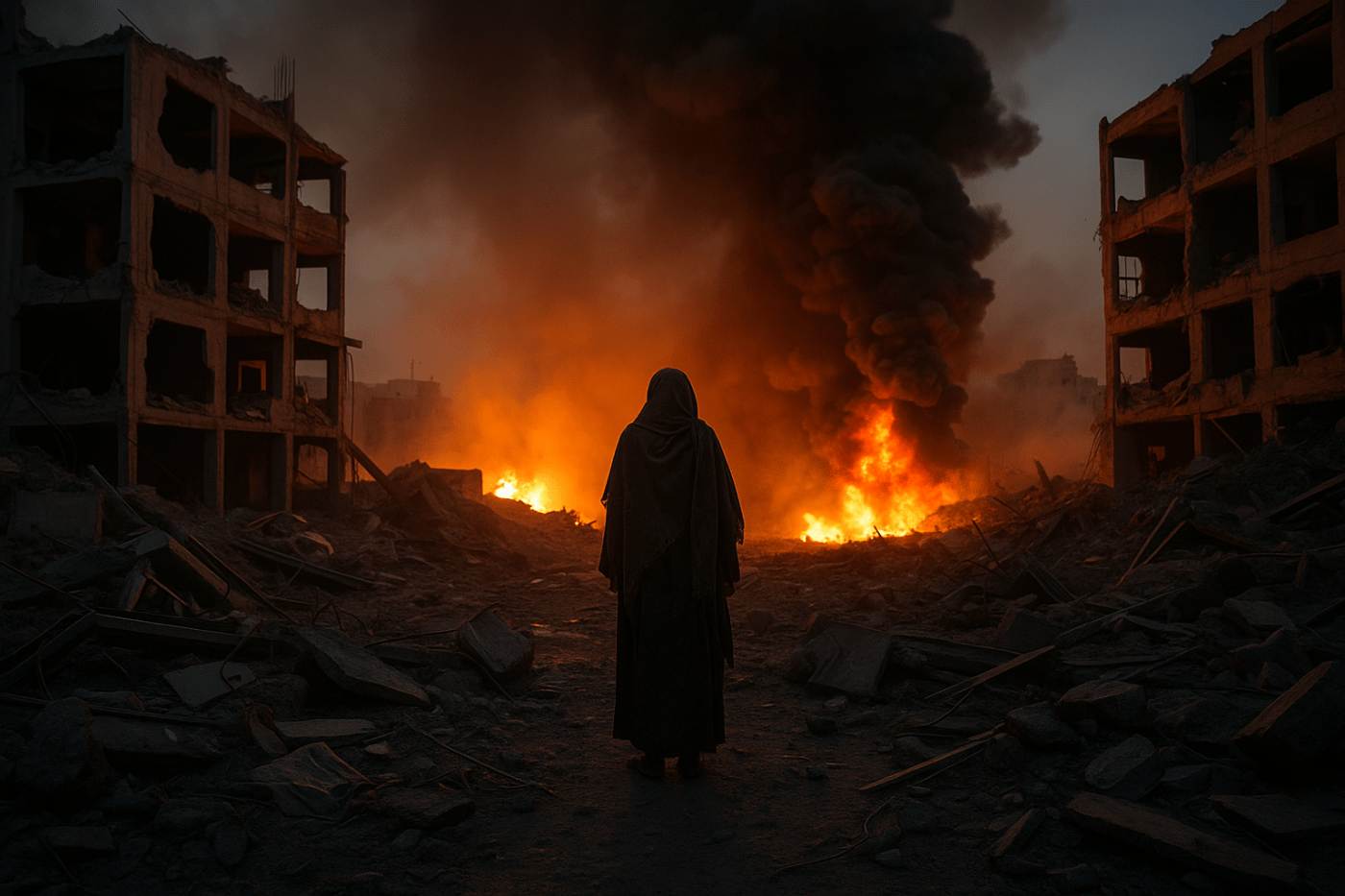
How the United States uses Israel as its armed garrison in the Middle East—funding genocide, erasing Palestine, and sanctifying empire through religion, profit, and lies.
By Prince Kapone | Weaponized Information | October 15, 2025
The Stage-Managed Peace of Empire
On October 13, 2025, two speeches were delivered in Jerusalem that together revealed the full anatomy of empire in our time. U.S. President Donald Trump addressed the Israeli Knesset, delivering what he called “the dawn of a new Middle East,” a performance dripping with biblical grandiosity and imperial arrogance. His full address,, published by The Times of Israel, framed Israel’s total war on Gaza as a divinely sanctioned victory and an opening for capitalist reconstruction. Immediately following, Prime Minister Benjamin Netanyahu’s speech, before the same chamber, broadcast on CNN, praised Trump as “the greatest friend Israel has ever had in the White House” and celebrated the campaign of extermination against Palestinians as the foundation of a new regional order. Together, these speeches form a sacred text of modern imperialism: the fusion of religion, militarism, and capital into a single doctrine of domination.
The Knesset that night looked less like a parliament and more like a theater of empire. Every light, every camera angle, every standing ovation was choreographed to deliver a single message: Israel stands as the proud gatekeeper of U.S. power in the Middle East. Donald Trump, grinning beneath the floodlights, told the audience, “You’ve won. You can’t beat the world. It’s time for peace.” And just like that, genocide was repackaged as victory, occupation as peace, and imperial domination as divine destiny.
Nothing about this “peace” was spontaneous. It was a ritual. The empire was blessing its favorite client. When Netanyahu called Trump “the greatest friend that Israel has ever had in the White House,” it wasn’t flattery—it was tribute. Trump bragged that Netanyahu would call him “so many times” asking for weapons: “Can you get me this weapon, that weapon?” And Trump obliged, boasting, “We’ve given a lot to Israel.” That wasn’t generosity; it was maintenance. The United States doesn’t fund Israel because of shared “values.” It funds Israel because it’s a fortress—an armed subcontractor defending Western capital’s grip on the region.
The alliance runs deeper than weapons. The United States guarantees Israel’s loans, stores its munitions, and shields it from the world’s outrage. Every time the U.N. tries to pass a resolution condemning the slaughter, Washington vetoes it. Every time global civil society cries for a ceasefire, American ships unload another round of ammunition. It’s a simple division of labor: Washington funds, Israel fires, and the media calls it self-defense.
That’s why Trump could stand there and call it “the dawn of a new Middle East.” He wasn’t describing peace; he was describing a market. His “Abraham Accords” and “Board of Peace” aren’t treaties—they’re business plans. They tether Arab monarchies, Israeli tech firms, and U.S. defense contractors into a single imperial supply chain. Trump’s line—“Instead of making weapons and missiles, the wealth of this region should flow to artificial intelligence”—wasn’t a joke. It was the blueprint of twenty-first-century empire: turn war into data, and data into profit. It’s colonialism with a touchscreen.
This is what we mean when we say technofascism: the merger of monopoly capital, high tech, and militarized state power under the illusion of progress. Israel is the prototype—a settler-colonial lab wrapped in Silicon Valley branding, where every act of surveillance and every new weapon is tested on a captive population before being sold worldwide. Trump called it “a miracle in the desert.” In reality, it’s the same old miracle of capitalism—prosperity for the few, ashes for the rest.
And yet, when Netanyahu clapped and Trump grinned, you could feel the self-congratulation in the air. They called it “the end of terror,” as if terror ended when its victims were buried. They called it “peace,” as if peace were something handed down from above by men who profit from war. The Knesset’s cheers that night were not for peace but for the permanence of empire. The empire funds, the client kills, and together they call it civilization.
That’s what “the stage-managed peace of empire” really means: a peace built on ruins, a peace without justice, a peace that demands silence from the living and obedience from the dead. Trump and Netanyahu weren’t closing a chapter—they were announcing the next one. The cameras loved it. The investors loved it. And somewhere beneath the rubble of Gaza, the empire’s next product line was already being tested.
The Outpost of Empire: Dependency Disguised as Alliance
Trump likes to talk about Israel as if it were a fellow superpower—two “great nations,” bound by faith and friendship. But peel back the rhetoric and what you see is not partnership; it’s dependency. Israel is the outpost, the forward operating base of the U.S. empire—a small but vicious state whose firepower is rented from Washington. Every missile it fires, every jet that screams over Gaza, every tank that rolls through the ruins of Rafah is stamped “Paid for by the United States of America.” And that’s not a metaphor. It’s an itemized budget line.
Since its founding in 1948, Israel has received nearly $174 billion in U.S. aid. That’s more than any other country on Earth. Under the current ten-year memorandum of understanding, signed in 2016, Washington guarantees Israel $38 billion—$3.3 billion a year in direct military financing, plus half a billion for missile defense. This doesn’t even include the billions more flowing through emergency “supplementals,” or the stockpiles of U.S. weapons stored on Israeli soil in the so-called War Reserve Stockpile Allies–Israel program. Those bombs and bullets can be withdrawn at a moment’s notice—no congressional vote, no public debate, just a handshake between generals. In short, Israel fights on credit, and the tab is charged to the American taxpayer.
The United States calls this “foreign military financing.” But that’s just bureaucratic code for imperial outsourcing. Washington pays for the hardware; Israel field-tests it on Palestinians; and then U.S. arms manufacturers advertise the results as “combat-proven.” Lockheed Martin, BAE Systems, and Raytheon all profit from this arrangement. It’s an assembly line of death where Gaza is the quality assurance department. Trump’s own words at the Knesset stripped away the pretense: “Bibi would call me so many times, ‘Can you get me this weapon, that weapon?’ And they are the best. But you used them well.” In that single boast, Trump confessed the entire logic of the alliance—he supplies the weapons; Netanyahu supplies the war.
Israel’s so-called sovereignty depends on this pipeline of cash and cargo planes. Over two-thirds of its imported weapons come directly from the U.S. It enjoys privileges no other client state has ever received: interest-bearing financing accounts, long-term advance purchasing, and the right to spend portions of its aid within its own military industries. And if that weren’t enough, Washington even guarantees Israel’s loans—effectively turning Wall Street into the empire’s back office for occupation. The fiction of independence collapses under the weight of those numbers. Israel is not America’s equal; it’s America’s garrison.
This dependency runs deeper than economics—it’s ideological. When Netanyahu stands beside Trump and says, “With your enormous help, we rolled back Iran’s nuclear program,” he’s speaking the truth. Israel’s victories are Washington’s victories; its wars are America’s experiments. The IDF operates as an extension of U.S. military doctrine, armed with Pentagon weapons, guided by U.S. satellite intelligence, and sustained by American logistics. The partnership is colonial in every sense but name.
Every time a U.S. veto silences the United Nations, every time American cargo ships replenish Israeli arsenals, every time a drone made in California annihilates a family in Khan Younis, the hierarchy is reaffirmed. Empire speaks; the outpost obeys. The alliance is just the polite word for that obedience.
But obedience has its rewards. In return for its loyalty, Israel acts as the empire’s laboratory—a testing ground for counterinsurgency, surveillance, and urban warfare. The technologies of repression perfected in Gaza will soon be deployed in the streets of Los Angeles, London, or Paris. The “Iron Dome” is not a shield; it’s a prototype. What Israel refines today, empire globalizes tomorrow.
So when Trump declared, “We’ve given a lot to Israel,” he wasn’t exaggerating. The United States has given Israel the means to wage endless war and the license to call it peace. In return, Israel has given Washington what every empire needs—a loyal executioner who never runs out of bullets. Together, they have built a system where dependency is sold as friendship, and domination as destiny. That’s not an alliance. That’s feudalism with better branding.
The Holy War of Capital: Zionism as Imperial Faith
Every empire needs a theology—a story that transforms conquest into destiny and plunder into divine duty. For the United States and Israel, that theology is Zionism reborn as imperial faith. In the Knesset, Trump spoke not as a statesman but as a preacher of empire, calling on “the Almighty God of Abraham, Isaac, and Jacob” to bless the union of the sword and the dollar. Netanyahu nodded in agreement, declaring that “Abraham’s children will work together to unite civilization against barbarism.” There it was—the gospel of the new crusade. Civilization meant the West. Barbarism meant anyone standing in its way.
This is the old colonial script, dressed in modern clothes. The British once called it the “white man’s burden.” Now it’s “peace through strength.” The vocabulary changed; the hierarchy didn’t. Zionism, once a nationalist movement, has been fully absorbed into the ideology of empire. It no longer pretends to be about a homeland for the oppressed. It’s about the sanctification of domination. In Trump’s hands, Israel’s story becomes America’s story—manifest destiny reborn in the desert. The settler state recognizes its reflection in another settler state, and both claim divine license to rule.
Trump’s own language revealed the theology behind the politics: “We give thanks to the Almighty… this is the beginning of the age of faith and hope and of God.” When empire starts invoking God, it means the bombs are already blessed. Religion becomes the anesthetic for conscience, the moral detergent that washes blood into purity. The same Christianity that once sanctified colonialism in the Americas now fuses with Zionism to justify the domination of the Middle East,. The holy land becomes a testing ground for holy war.
Netanyahu’s rhetoric completed the sermon: “We achieved this historic moment with your unmatched global leadership.” He spoke of Trump as if speaking of a prophet, the chosen guardian of “civilization.” The two men turned mutual flattery into a kind of political liturgy—Trump the savior of Israel, Netanyahu the executor of prophecy. Together, they reimagined the alliance as a covenant between God and Empire, with capitalism as the Holy Spirit hovering over a sea of ruins.
This merging of religion and power isn’t accidental—it’s functional. The empire needs faith because faith conceals violence. It makes the slaughter of the colonized sound like a spiritual triumph. It turns the plunder of Arab land, oil, and data into “fulfilling prophecy.” That’s why Trump’s speeches sound more like revival meetings than policy briefings. He isn’t governing; he’s evangelizing. His version of Zionism is the theology of the market—God’s chosen people armed with Lockheed Martin contracts and guided by Nasdaq prophets.
Israel, in this scheme, becomes more than a state—it becomes a symbol. Its existence justifies Western militarism, its wars sanctify Western weapons, its ideology provides moral cover for the imperial order. The American right worships it not for its democracy but for its discipline, not for its freedom but for its power. To them, Israel represents what empire wants to be: a small nation that dominates through technology, faith, and fear.
So when Trump called Israel “the miracle in the desert,” he was really describing the miracle of monopoly capital—a system that can turn faith into war, war into profit, and profit into virtue. The miracle is not that Israel survives, but that its survival is sold as proof of divine order rather than imperial sponsorship. The theology of Zionism now serves the same purpose Christianity once served under empire: to bless inequality, excuse genocide, and keep the oppressed praying while the powerful count their money.
In the end, the God invoked in these speeches is not the God of justice or peace—it’s the God of property and power. He is the landlord of history, the shareholder of every war, the invisible hand that signs the checks. Trump and Netanyahu merely speak in His name. They are the high priests of a new imperial religion, preaching salvation through firepower, redemption through reconstruction contracts, and eternal life for capital itself.
Genocide Rebranded as Peace: The Erasure of Palestine
Empires have always relied on two weapons: the sword and the story. The sword kills, and the story erases the evidence. In Gaza, both are working overtime. When Trump and Netanyahu stood in the Knesset declaring “peace,” the dust of Gaza still hung in the air. But in the imperial imagination, Palestinians do not exist as a people—they are merely an obstacle, a security problem, a statistic to be managed. Their erasure is not a byproduct of war; it is the purpose of it.
By October 2025, the United Nations estimated nearly 67,000 Palestinians killed and about 170,000 injured. While roughly 90 percent of Gaza’s 2.3 million people have been displaced at least once, and satellite imagery shows 83 percent of Gaza City’s structures damaged or destroyed. Water access has collapsed to just over eight liters per person per day, and over 80 percent of croplands are ruined. Israel even halved the number of aid trucks allowed in during the supposed “ceasefire”. These are not incidental damages—they are the architecture of extermination. Yet in Washington and Jerusalem, this destruction is sold as “the dawn of a new Middle East.”
Trump told the Knesset that Gaza would be “demilitarized” and that wealthy Arab states would “fund the rebuilding.” The empire kills with one hand and offers reconstruction loans with the other. This is not peace—it’s colonial redevelopment. A destroyed Gaza is a profitable Gaza: reconstruction contracts, privatized utilities, surveillance infrastructure, and AI-driven border control. The same companies that supply the bombs will supply the bricks. It’s genocide as a business model.
Netanyahu’s version of events is even more chilling. “We did what we had to do,” he told the world. “Israel will have peace.” Peace, in his lexicon, means the total submission of the colonized. The tens of thousands of dead are airbrushed out of existence. The survivors are reclassified as humanitarian problems, to be managed by NGOs and Gulf donors under the watchful eye of Israeli drones. The living are confined to refugee camps; the dead are confined to memory; and both are ruled out of history.
Trump’s “Board of Peace” makes this system official.
The plan links Tel Aviv to Dubai, Haifa to Beirut, Jerusalem to Damascus—a map of a new imperial order with Israel at the center and the Palestinians nowhere at all. It’s marketed as a postwar “integration project,” but in practice it’s the economic annexation of the region. Every Arab monarchy that joins becomes a subcontractor of occupation, every reconstruction fund a payoff for silence and complicity. The “new Middle East” is the old colonial one, managed through apps, drones, and foreign direct investment.
What’s unfolding in Gaza is not merely the destruction of a city—it’s the destruction of a narrative. The Palestinian right to exist, to resist, to return, is being systematically deleted from global consciousness. The media calls it a “conflict.” The politicians call it “defense.” The empire calls it “peace.” And yet, every child pulled from the rubble testifies to the truth: this is not defense; it’s domination. Not peace, but pacification.
In this stage-managed spectacle, language itself becomes a weapon. “Demilitarization” means disarmament of the oppressed; “stability” means the absence of resistance; “rebuilding” means privatizing what’s left. The empire’s rhetoric transforms mass murder into philanthropy. This is the final act of genocide—not the killing, but the forgetting.
But history remembers what propaganda tries to bury. Beneath the rubble of Gaza lies the most damning evidence of all: that the so-called “peace of empire” can only be built atop the graves of the colonized. Trump and Netanyahu may claim to have ended a war, but all they’ve done is rename it. The bombs fall, the aid flows, the cameras roll, and the empire smiles for the photo. The only thing left “rebuilt” is the lie itself.
The New Imperial Order: A Greater Israel for a Divided World
Trump’s Knesset speech was less a peace address than a business proposal—a blueprint for reorganizing the Middle East under U.S. management. He called it the “Board of Peace,” a network linking Tel Aviv, Dubai, Haifa, Beirut, and Jerusalem to “usher in an age of prosperity.” In the language of empire, prosperity means privatization. The map he drew wasn’t about coexistence; it was about integration—turning Arab economies into appendages of Israeli high tech and U.S. capital. The Palestinian question disappears, replaced by investment zones, free trade corridors, and digital border walls. This is what the empire calls “peace.” The so-called “new Middle East” he promised is the old colonial order, automated. Israeli defense firms will guard Gulf pipelines; U.S. banks will finance “reconstruction”; and Arab monarchs will pay the bills to stay in Washington’s favor. Netanyahu praised this arrangement as “expanding the circle of peace,” but the circle is just a chain—every link another client regime bound to the imperial center. The Abraham Accords were the first draft; Trump’s “Board of Peace” is the final copy.
In this system, Israel becomes more than an ally—it’s the regional headquarters of empire. Its role is to secure the flow of oil, data, and capital through military force and surveillance. Washington calls this stability. Gaza, Lebanon, Iran—these are the “instabilities” to be managed by drone and sanction. The United States doesn’t need permanent bases in every desert when it has Israel as its armored embassy.
This is why Israel’s military budget is written into the U.S. defense bill itself. The empire’s frontier has been franchised. The occupation becomes a business model exported worldwide: facial-recognition checkpoints from Hebron to Houston, predictive-policing algorithms tested on Palestinians before being sold to American cities. Gaza is the R&D wing of imperial capitalism.
Trump’s “vision” is simple—an imperial marketplace policed by technology and sanctified by faith. Israel guards the walls; the Gulf funds the projects; America owns the code. This is the real meaning of the “new world order”: not freedom, not peace, but a digitally networked colonialism where the oppressed become data points and the conquerors become investors.
So when Netanyahu hailed Trump for “unmatched global leadership,” he wasn’t exaggerating. He was acknowledging the architecture of dependence—the hierarchy of empire rebranded as partnership. The so-called “Greater Israel” isn’t just territorial; it’s structural. It’s the web of financial, technological, and military power that keeps the region chained to Washington. The Knesset applauded because they understood perfectly: the occupation has gone global, and the empire has found a new way to sell it.
Messianic Zionism: Trump’s Holy Empire
When Trump stood before the Knesset and declared himself “the best friend Israel has ever had,” it wasn’t diplomacy—it was devotion. This wasn’t a president talking; it was a prophet of profit, announcing a new faith where capitalism and Zionism share the same altar. The applause that followed was liturgical. Netanyahu, flushed with triumph, called him “the greatest friend the state of Israel has ever had in the White House,” and went even further—nominating Trump for the Israel Prize. The crowd rose in a standing ovation. You could feel the sanctimony in the air, thick as incense: empire reborn as religion.
Trump boasted of the trophies he had delivered to Zionism—moving the U.S. embassy to Jerusalem, recognizing Israeli sovereignty over the Golan Heights, and “obliterating Iran’s nuclear sites” with fourteen bombs. Each act violated international law, but the law was never meant for the empire. For Trump, these weren’t policy decisions; they were sacraments. In his mind, he wasn’t just leading a nation—he was fulfilling prophecy.
This is Trump’s genius and his danger: he fuses religion, nationalism, and capital into one combustible ideology. He speaks the language of divine destiny but serves the logic of imperial investment. His “love for Israel” is not about faith; it’s about the fusion of two ruling classes—the American white ruling class and the Israeli settler elite—bound by mutual interests and shared paranoia. The holy land becomes the holding company; God becomes the brand.
Netanyahu, for his part, understands the value of a messiah. His regime thrives on divine endorsement. Trump’s evangelical base, conditioned by decades of apocalyptic propaganda, sees Israel not as a state but as the stage for the end of days. Their support is absolute, not political but metaphysical. And so Zionism finds its most fanatical defenders among those who would rather watch the world burn than admit that empire bleeds.
The irony is brutal. The same man who built casinos and sold his name to reality television now sells himself as a servant of God. “We have waged war together,” he told the Knesset, “and perhaps most beautifully of all, we have made peace together.” The line sounds holy until you realize what it means: peace as the absence of resistance, salvation through submission. Trump’s theology is pure imperial pragmatism—it offers redemption to the oppressor and silence to the oppressed.
This is the real face of Messianic Zionism: a merger of imperial narcissism and colonial violence, washed clean by religious imagery. Trump’s vision of Israel is not spiritual—it’s strategic. It gives moral sanction to domination and eternal life to capital. His “love for Israel” is the same love the master has for his estate—the kind born of ownership, not kinship. He loves Israel the way the empire loves its outpost: as a weapon, as an investment, as proof of its own divinity.
And yet, there’s a strange poetry in his arrogance. Trump’s claim—“I’m with you all the way”—rings true, but not in the way he meant it. He is with them all the way: down the same road of moral decay, the same path of militarism disguised as faith, the same spiral into barbarism that every empire walks before it collapses. What he calls devotion is really desperation—the desperate faith of a dying empire trying to sanctify its decline.
When Netanyahu clasped Trump’s hand that night, it was less a gesture of gratitude than of recognition. Both men understood the script. The empire needs its prophet, and the prophet needs his stage. Together they preached the gospel of power to a world already on fire. And the congregation—corporate, military, evangelical—rose to its feet and shouted amen.
The Mirage of “Peace”: Israel as Empire’s Arm and America’s Reflection
What Trump called “peace” was nothing more than empire speaking through a different accent. His Knesset sermon did not end a war—it rebranded conquest. “You’ve won,” he told Israel. “Now it’s time for peace.” The line sounded biblical, but its meaning was imperial: the colonizer has secured dominion, the colony must now accept order. This is what empire calls “the end of an age of terror”—when the last resistance has been buried beneath the rubble it created.
Netanyahu echoed this gospel of victory: “Israel did what it had to do.” The thousands of dead were not crimes but “necessary acts.” The cities turned to dust were not atrocities but “military triumphs.” Together, the two leaders spoke as if Palestine had never existed—as if Gaza were a blank space on which the empire could inscribe its vision of order and development. Trump even bragged that “the wealth of this region should flow to schools, medicine, and artificial intelligence.” He meant Israeli and American industries, of course—the same corporations that profit from the weapons used to erase Gaza now reap contracts to rebuild it. This is colonialism’s oldest trick: destroy a people, then sell them their own reconstruction.
Behind Trump’s grin and Netanyahu’s applause lies a structural truth: Israel cannot exist as it does without imperial subsidy. The United States has guaranteed $38 billion in military aid through 2028, in addition to the $21.7 billion surge in weapons and cash since October 2023. Two-thirds of Israel’s imported arms come directly from the U.S. The empire has literally built the occupation from the ground up—financing its bombs, replenishing its ammunition, and protecting it diplomatically at the United Nations. By September 2025, Washington had cast its sixth veto blocking a Gaza ceasefire resolution. Every Palestinian death comes with a made-in-America stamp.
The dependence runs both ways. Israel is not simply a client—it is a mirror. It performs the imperial functions that America now outsources: surveillance, counterinsurgency, and racial control. The wall around Gaza is the prototype for every border wall, every migrant detention camp, every police algorithm the U.S. deploys against its own poor. The colonization of Palestine and the policing of Black and Brown America share a single logic: domination justified as defense, cruelty sanctified as civilization.
What Trump and Netanyahu offered that day was not peace but a joint declaration of permanence—the promise that empire can last forever if it baptizes its violence in religion and development. “The State of Israel is strong and will live and thrive forever,” Trump said. “And that is why Israel will always remain a vital ally of the United States.” It was not a pledge between equals but an oath between rulers: America as the father of empire, Israel as its most faithful son.
But the contradiction is already eating them from within. An empire that calls genocide peace is an empire nearing moral bankruptcy. An outpost that survives only through foreign arms and aid is not sovereign—it’s a dependency wrapped in a flag. The more they celebrate their “victory,” the more fragile the illusion becomes. For beneath every speech, every deal, every photo-op, one truth endures: Palestine lives. And as long as Palestine lives, empire will never know peace.
Epilogue: The Empire’s Mirror Cracks
Every empire ends the same way—preaching eternal peace as it bleeds itself dry. The United States, in embracing Israel as its reflection, has bound its fate to a state that survives only through permanent war. The Zionist project and the American project are two sides of the same coin: settler colonies built on extermination, sanctified by scripture, and sustained by lies. When Trump declared in the Knesset, “I love Israel, I’m with you all the way,” he was not pledging solidarity between nations but confessing kinship between empires.
The architecture of occupation is not limited to Gaza or the West Bank—it extends into the global system itself. The drones that patrol Rafah are the prototypes for those that monitor migrants in the Mediterranean. The algorithms trained to flag “threats” in East Jerusalem are refined for use by American police in Black neighborhoods. The tear gas that clouds the skies of Nablus is the same formula that chokes protesters in Atlanta. Imperialism exports its weapons and imports its methods; Gaza is merely the testing ground.
But even the most powerful illusions collapse under their own contradictions. The “peace” that Trump and Netanyahu claim to have delivered is a fragile truce between capital and conscience—a propaganda campaign written in the language of scripture and profit margins. The empire can rename genocide as reconstruction, but it cannot disguise the stench of death. Every child buried in Gaza is a line added to the indictment against the system itself.
The material dependence of Israel on U.S. imperialism is not a partnership—it is proof of parasitism. Over $174 billion in lifetime assistance has made Israel the most subsidized settler colony in modern history. Each American veto at the UN is a diplomatic airstrike, shielding Israel from accountability. The relationship is not one of equals; it is one of master and servant, investor and asset. Israel’s survival is guaranteed not by divine favor but by imperial necessity. And like all clients of empire, it will be abandoned the moment it ceases to serve.
But the struggle for Palestine is not only a struggle for land—it is a struggle for truth. It exposes the moral rot of the entire imperial order: the complicity of the West, the cowardice of liberal institutions, the bankruptcy of so-called democracy. When the bombs fall on Gaza, they fall on the illusion that capitalism can coexist with justice. When the rubble buries Palestinian children, it also buries the last moral pretense of Western civilization.
History has not yet closed this chapter. The same forces that built the occupation can be dismantled by those who refuse to believe the lie. Every act of resistance in Palestine, every protest in the streets, every voice that refuses silence, chips away at the empire’s facade. The oppressed of the world—Black, Brown, Indigenous, Arab, Asian, and working class—see in Gaza their own reflection. They see that the enemy is not one nation but a system. And they know that systems, no matter how powerful, can fall.
The empire’s mirror is cracking. Its prophets of profit preach “peace,” but the world no longer listens. The oppressed are finding their voice again—in Ramallah, in Caracas, in Johannesburg, in Chicago. The future will not belong to the empire of lies, nor to its outposts and clients. It will belong to the wretched of the earth who refuse to disappear. And when the history of this age is written, Gaza will not be remembered as the graveyard of peace—but as the birthplace of a new world struggling to be born.
 Weaponized Information
Leave a comment