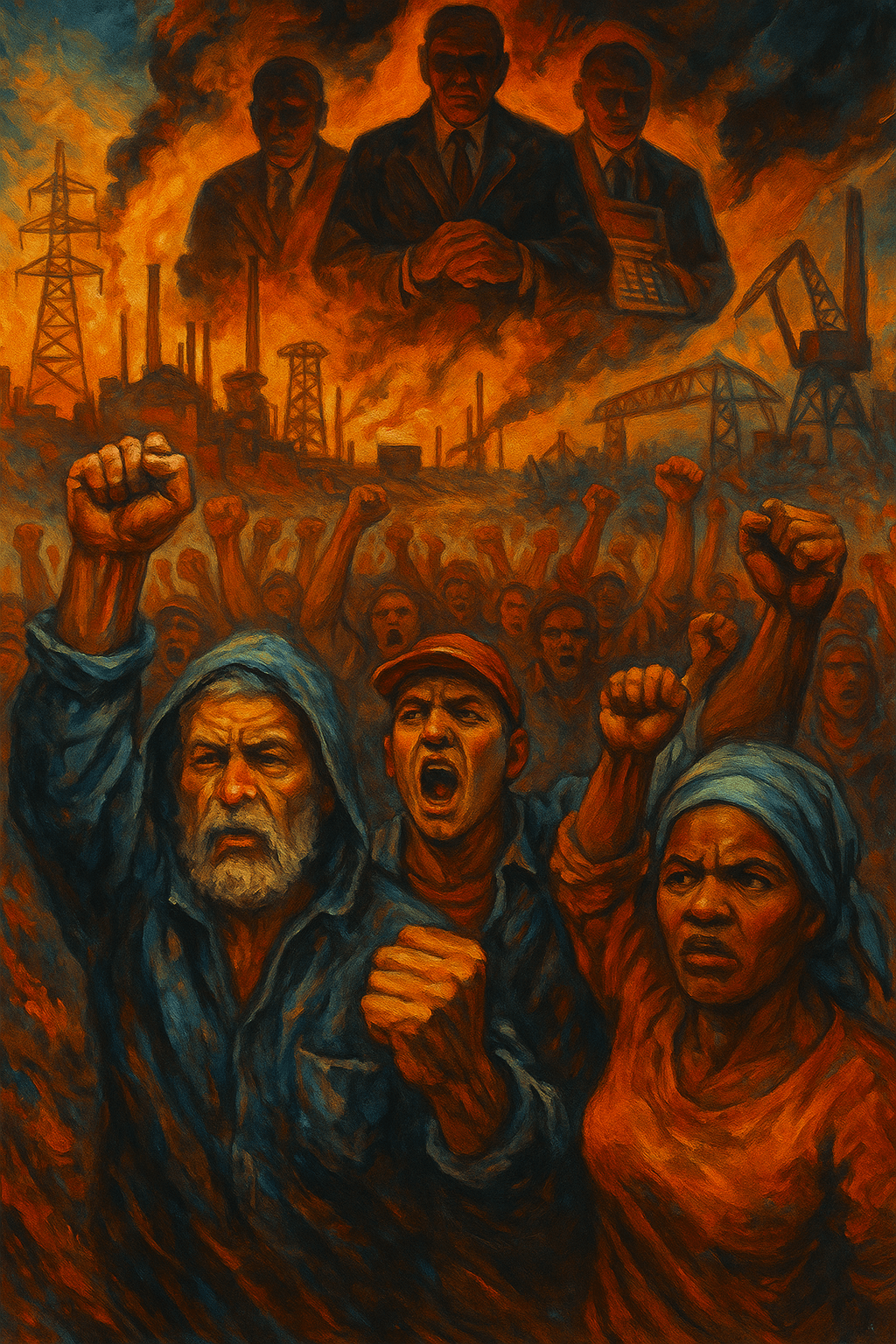
As the International Monetary Fund blesses the numbers and Bloomberg writes the sermon, the empire counts its decline as growth—and calls the corpse of capitalism “resilient.”
By Prince Kapone | Weaponized Information | October 2025
The Gospel of Managed Decline
On October 14, 2025, Bloomberg published “IMF Warns of Dim Outlook for World Economy Hit by Rolling Shocks”, written by senior economics correspondent Enda Curran. The article announces that the world economy “faces dim prospects” amid U.S. tariffs, debt, and protectionism, yet insists that growth “has held up better than expected.” With projections of 3.2 percent growth in 2025 and 3.1 percent in 2026, the piece performs the familiar IMF ritual: diagnose crisis, distribute blame evenly, and reassure readers that technocratic management—armed with spreadsheets and stoicism—can still steady the ship. In this telling, the planet’s economic malaise becomes little more than a passing storm, its winds measured, forecasted, and ultimately harmless to those steering from above.
Curran, a longtime messenger of finance capital, writes from inside the echo chamber of the world’s managerial class. His career through The Wall Street Journal and Bloomberg Asia reflects a seamless allegiance to Western monetary orthodoxy, where the IMF, World Bank, and OECD are treated as oracles rather than enforcers. His prose carries the calm assurance of a central banker—precisely the tone required to domesticate panic when empire’s arithmetic no longer adds up. Behind the veil of neutrality stands the journalist as midwife of illusion, tasked with translating economic pain into polite euphemism for the investor class.
The outlet itself, Bloomberg L.P., is capitalism’s information armory, privately owned by billionaire Michael Bloomberg and welded to Wall Street through the arteries of data, speculation, and belief. It is not a newspaper so much as an early-warning system for capital: it tells investors when to flinch and when to pounce. Every chart, every headline, every “market wrap” serves a singular purpose—to protect confidence, the lifeblood of the system, even as its organs rot. When Bloomberg reports on crisis, it does not reveal collapse; it performs stability.
The IMF report that anchors Curran’s article is amplified through the usual imperial megaphones—Reuters, the Peterson Institute, the Atlantic Council—ensuring that Washington’s anxiety over losing control of the world economy is repackaged as global concern for “stability.” What passes for journalism here is really a coordinated press release from empire’s financial priesthood, echoing from D.C. to Davos.
Read closely, the propaganda operates with surgical subtlety. The article begins with fear—“dim prospects”—only to soothe it with the promise that things are “better than expected.” The crisis is transformed into a performance of competence, the high priests of the IMF presiding over turbulence with serene inevitability. By describing economic turmoil as a series of “rolling shocks,” Curran removes human fingerprints from the crime scene. The collapse of livelihoods, the shuttering of factories, the hunger spreading across continents—these are not the outcomes of policy but the weather of history, unpredictable and cruel yet somehow blameless. This is the theology of market fatalism: God moves through supply chains.
In Curran’s telling, IMF Chief Economist Pierre-Olivier Gourinchas emerges as the voice of calm reason. He does not command armies or impose austerity; he merely observes. “Not as bad as we feared,” he says, as if the institution he represents were not one of the architects of that fear. The language of probability and projection masks power: it turns the agents of misery into analysts of misfortune. Crisis becomes diagnosis, and diagnosis absolves the doctor.
Notice how the temporal framing works. The near term is “resilient,” the future “dim.” By placing collapse just over the horizon, the narrative buys time—time for investors to reposition, time for policymakers to pretend control, time for readers to grow numb. This is capitalism’s favorite anesthetic: tomorrow will hurt, but not yet. Meanwhile, the immediate is padded with comforting data—tables, charts, projected growth rates—numbers performing objectivity, impersonating truth. Data in Bloomberg is not information; it is ideology quantified.
The most striking element is the moral neutrality with which empire’s violence is discussed. U.S. tariffs are described as “sweeping,” not aggressive; trade wars become “policy shifts”; sanctions are “headwinds.” The article reduces economic warfare to a vocabulary of meteorology. Capitalism commits its crimes in passive voice. The United States does not wage economic war; the global economy simply “faces challenges.” No culprits, no victims—only forces. In that moral vacuum, exploitation ceases to exist, replaced by the language of balance and adjustment.
By the final paragraph, the reader has been lulled into the desired emotional state: concerned but compliant. The fear of collapse has been replaced with faith in management. The phrase “partial recovery” lands like a sedative. The system may be sick, but the experts are on duty. That is the central promise of the piece and of the institution it defends: there is no alternative, only adjustment. Bloomberg’s article is not a warning about economic decline—it is a sermon on obedience, a gospel of managed decay preached in the calm tones of empire’s accountants.
The Arithmetic of Empire’s Mirage
The International Monetary Fund’s October 2025 World Economic Outlook announced a “slight improvement” in global growth—3.2 percent this year, slipping to 3.1 the next. The numbers were meant to calm markets, not inform them. Even the report itself concedes that the early-year surge came from “front-loaded imports and inventory accumulation,” the kind of statistical sugar rush that fades the moment warehouses fill and consumption stalls. What Bloomberg described as “better than expected” was, in reality, the echo of panic before another contraction. Beneath the decimal points, a truth was trembling: there is no recovery, only rebranding.
The machinery behind that illusion is vast. Since Trump’s return to office, tariff collections have surged — the Peterson Institute tallies $122 billion in revenue by July 2025, with full-year intake modeled at about $171 billion for 2025. Even as the UN trade agency warns that the new regime weaponizes uncertainty and urges exemptions for vulnerable countries, Washington’s tariff wall hardens under the banner of “reciprocity.” These measures have forced global suppliers to reroute shipments, lengthening supply chains and raising costs across Asia, Africa, and Latin America. It is the economic geography of coercion: trade lanes redrawn at gunpoint. To call these “rolling shocks,” as the IMF and its stenographers at Bloomberg do, is to rename sabotage as weather. The article’s moral neutrality hides a deliberate siege—one that turns economic gravity itself into an imperial policy tool.
Meanwhile, the same institutions lament “rising debt levels” with crocodile sympathy. A press release from Debt Justice exposes a group of 11 countries with long-term IMF programs where public outlays have been squeezed—health spending down 18% per person and education down 10% over their program periods. And as of February 2025, the IMF itself listed 22 active loan programs plus 5 precautionary credit lines, underscoring how austerity conditionality remains the default operating system. In Ghana, public-sector wages have been frozen; in Pakistan, fuel subsidies dismantled; in Zambia, farmland sold to hedge funds for “debt swaps.” The Bloomberg piece cites none of this. Its concern for debt “sustainability” reads as moral virtue, but what is being sustained is the circulation of tribute. The working poor pay with hunger so the imperial center can measure solvency.
Even the so-called bright spots are mirages. The IMF attributes short-term buoyancy to an “AI investment boom,” but OECD analysts warn that much of AI deployment is concentrated in large firms with high capital intensity, while adoption among smaller and less resourced firms remains low. Emerging Divides in the Transition to AI highlights how AI benefits are unevenly distributed, often amplifying rather than closing structural inequality. It is the old pattern of monopoly capitalism reborn as digital theology: the machine will save us, someday. In the meantime, workers vanish, profits concentrate, and data replaces steel as the fetish object of accumulation.
The IMF’s democratic pretensions collapse under the weight of its own structure. By its own admission, the United States holds 16.5 percent of total voting power—a built-in veto over any policy that contradicts Washington’s interest. The Fund’s globalism, then, is provincial: it speaks the language of international cooperation while enforcing the logic of a single empire. When Bloomberg quotes IMF economists calling for “coordinated policy responses,” it is quoting a hierarchy, not a dialogue. The coordination is vertical, from North to South.
Nowhere in the article is there mention of the alternative world taking shape beyond Washington’s reach. The Dossier 63: Life or Debt describes how many African states are deploying local-currency central bank swap arrangements, turning to non-IMF lenders and regional finance mechanisms to insulate themselves from dollar rule and structural adjustment. IMF–ECB trade-invoicing data show the dollar’s dominance remains broadly stable, with renminbi use expanding beyond Asia but still modest—far from a wholesale shift out of the dollar. (See here: IMF working paper (2025) and here: ECB analysis (2025))
Yet in the empire’s newsrooms, this tectonic shift registers as background noise. The “dim outlook” is not global; it is imperial.
The real omission, though, is historical. Long before the IMF rebranded stagnation as “headwinds,” Marxist economists Paul Baran and Paul Sweezy had already diagnosed the disease. As Michael Meeropol and Howard J. Sherman reminded readers in Monthly Review, the tendency of monopoly capitalism is toward secular stagnation: an excess of capital with nowhere productive to go. What the postwar world disguised through militarism, what the neoliberal era hid under finance, now returns as a chronic condition. Bloomberg calls it a slowdown; Sweezy called it the system working exactly as designed.
Even the IMF’s own numbers betray the pattern. Historical data from its 2009 World Economic Outlook: Crisis and Recovery reveal that global output never returned to its pre-crash trajectory. The 2025 projections are not deviation but continuity—an unbroken curve of decline stretching from the Great Recession through the pandemic to today’s tariff wars. The crisis is not cyclical; it is structural. The capitalist core has entered a long winter, and the institutions charged with maintaining the illusion of perpetual growth now function as weather forecasters for a storm they created.
By the time Bloomberg declares the global economy “resilient,” the facts tell another story: According to UNCTAD’s Review of Maritime Transport 2025, global seaborne trade is barely growing—up just 0.5 percent in 2025 after 2.2 percent the year before. Freight routes have lengthened as ships avoid conflict zones, driving ton-miles up nearly 6 percent and pushing freight costs toward record highs. The Suez Canal still handles 70 percent less traffic than in 2023, while developing nations shoulder the burden through higher transport costs and delayed deliveries. UNCTAD calls the pattern “uncertainty, volatility, and rising costs”—the polite diplomatic language for breakdown. What Bloomberg presents as “resilience” is in fact exhaustion: a world economy running on detours and debt.
The Empire That Can No Longer Grow
The numbers do not lie, but they do conceal. Once the data is stripped of its ideological casing, a clearer picture emerges: the world economy is not suffering from turbulence—it is suffocating under the weight of a system that can no longer expand without devouring itself. What the IMF and its stenographers at Bloomberg present as “dim prospects” is the visible surface of a deeper contradiction: capital’s historic exhaustion. For two centuries, growth was the system’s religion; now it is its hallucination.
In earlier ages, stagnation could be disguised through conquest. Industrial surpluses were dumped on colonies, while raw materials were pulled from enslaved and subjugated lands. But the old imperial circuitry has corroded. The United States, once the undisputed metropole of production, now survives on the rents of finance, data, and war. Its tariffs are not expressions of strength but symptoms of decay—the reflex of an empire losing the capacity to command production and thus reverting to punishment. When Bloomberg describes Washington’s trade war as a mere policy adjustment, it erases this historical truth: protectionism is not new strategy but old desperation.
The IMF’s entire role within this architecture is disciplinary. It exists to manage the political consequences of stagnation, ensuring that the costs of crisis never migrate upward. Each austerity package, each debt restructuring, each “recommendation” to cut public spending is an act of class containment. The working poor of the Global South are made to absorb the shockwaves of falling profitability in the North. The institution’s power lies precisely in this transference—it globalizes austerity while privatizing recovery. In the polite language of technocracy, this process is called “adjustment.” In the lived language of the colonized, it is called theft.
To understand the IMF’s rhetoric of “resilience,” one must see it as counterinsurgency on the economic front. “Resilience” is not strength; it is the capacity to endure injury without resistance. The Fund’s optimism is a weapon designed to preempt rebellion. When its reports predict steady if modest growth, they are issuing a psychological directive to the markets: remain calm, keep faith, the system endures. But underneath that faith, nations are collapsing in slow motion. Debt service exceeds health budgets; unemployment erodes entire generations; hunger reappears as fiscal metric. The numbers are tidy; the people are not.
Historically, this is the condition that Marxist economists described as secular stagnation: an economy dominated by monopolies, flooded with idle capital, unable to find profitable investment in production. The result is speculative fever and permanent militarism—two artificial respirators that keep the system twitching. Today’s “AI boom” is merely the latest bubble of fictitious capital, while the perpetual war economy remains the final stimulus package for a dying empire. Both are symptoms of a structure that must generate crisis to feel alive.
This stagnation does not exist in isolation. It is entwined with the machinery of imperial power. The IMF’s voting system, where the United States holds a unilateral veto, institutionalizes colonial hierarchy within global finance. Washington dictates policy through the Fund; the Fund enforces policy through debt; and the media, from Bloomberg to the Financial Times, manufactures consent for the process by naming it “stability.” The flow of value is imperialism’s circulatory system—blood extracted from the periphery to feed the pale heart of the core.
The so-called “rolling shocks” are thus neither random nor natural. They are the synchronized convulsions of a world economy organized around parasitism. Tariffs, sanctions, speculative bubbles, and debt crises all express the same logic: the empire’s attempt to preserve accumulation through destruction. The United States now behaves not as a producer but as a warden, enclosing markets and punishing dissenting nations. Its economy expands by confiscating the future of others. Every IMF forecast is therefore a coded threat: conform or collapse.
Yet beyond this suffocation, a countercurrent is forming. The very nations that the IMF calls “vulnerable” are developing their own instruments of survival. BRICS+ currency arrangements, local clearing systems, and regional development banks are not mere economic experiments—they are acts of sovereignty. They mark the slow emergence of a new world logic, one that measures prosperity not by stock indexes but by food, land, and labor. For the imperial core, this is what the “dim outlook” truly means: the twilight of its economic dominion.
From the standpoint of the global working class and peasantry, the path forward is neither austerity nor obedience. It is reclamation. The wealth drained through debt must be socialized; the technologies monopolized by capital must be liberated for human use; the institutions of empire must be rendered obsolete by the creation of new ones. The IMF’s projections of modest growth are projections of managed decline. What they call equilibrium is the exhaustion of a system that has reached its historical limit. Beneath the language of the markets, a new dialect is already being spoken—from Caracas to Johannesburg, from Beijing to Havana—the dialect of sovereignty.
In this light, the IMF’s “dim outlook” is not prophecy but confession. The empire can no longer grow; it can only enforce stagnation on the world around it. The task of history is to ensure that this enforced stagnation becomes the burial ground of the system itself, and that from its ruins emerges not another managed crisis, but the first dawn of liberation.
From Forecast to Frontline
The figures, charts, and projections of the IMF are not neutral descriptions of the world—they are blueprints for continued exploitation. Their language of “dim prospects” disguises an order in which the wealth of the many is siphoned upward, and the misery of the periphery is rendered invisible. If this system can no longer grow, then the task before humanity is clear: to organize its funeral. But the gravediggers are not the economists or the experts—they are the workers, the farmers, and the dispossessed who already live within the wreckage of empire’s arithmetic.
All over the world, that resistance is taking form. Across Africa and Latin America, movements for Debt for Climate are linking ecological survival to economic liberation, demanding the cancellation of illegitimate debts that finance both poverty and planetary destruction. In Asia, unions and peasant federations—from the Kilusang Magbubukid ng Pilipinas to India’s All India Kisan Sabha—are fighting privatization and the financialization of agriculture that IMF policy calls “modernization.” In Latin America, the Via Campesina network defends the right to land, seed, and food against the corporate enclosures of agribusiness. And from the factories of China to the ports of South Africa, the informal and industrial working classes are discovering that their struggles are already connected through the veins of the same global system they are forced to feed.
In the imperial core, cracks are widening too. The inflation and austerity that the IMF calls “fiscal discipline” are now the lived reality of the Western working class. Rent strikes, labor stoppages, and community defense networks have reappeared as instruments of necessity. Campaigns like Progressive International and the Black Alliance for Peace are drawing the links between domestic austerity and global militarism, insisting that every dollar spent on war is a dollar stolen from housing, education, and health. The contradictions of empire are no longer abstract—they are visible in every grocery bill and eviction notice.
These movements are not isolated acts of defiance; they are the embryonic infrastructure of a new world. To the workers of the North, the lesson is not charity but solidarity: your falling wages are connected to the debts of the Global South, your unemployment to the automation financed by imperial profits, your surveillance state to the technologies first tested on colonized peoples. Solidarity begins with understanding that the same institutions exploiting Jakarta are disciplining Detroit. To the colonized nations, the call is sovereignty: control your resources, your currencies, and your futures. To the socialist and multipolar forces rising across Eurasia, Africa, and Latin America, the call is unity: integrate your projects of survival into a common architecture of liberation.
Every crisis documented by the IMF—debt distress, inflation, stagnation—is also an opening for coordination. The task is to transform despair into direction. The struggle for debt cancellation must become a struggle for economic self-determination. The fight against inflation must become a fight against profiteering. The campaign for ecological survival must confront the financial institutions funding planetary ruin. Movements for peace must expose how “market stability” is maintained through war. The people must turn the technocrats’ vocabulary inside out and speak their own language of power.
The next phase of struggle will not be waged on trading floors or summit stages but in the workplaces, neighborhoods, and farmlands where the system’s numbers meet real lives. It will require networks of study and organization that can pierce the fog of propaganda—collectives that read, analyze, and act in common. The digital tools that capitalism built for surveillance can be repurposed for coordination. The borders it enforces can be crossed through solidarity. What the IMF sees as “risk contagion” is, in revolutionary terms, the spread of consciousness.
This is not a call to utopian abstraction but to concrete participation. Join the peasant movements that are reclaiming food from speculation. Support the unions and worker councils challenging austerity. Strengthen the anti-imperialist and ecological fronts that are already building alternatives—whether under the banner of BRICS+, the Bolivarian Alliance, or the Pan-African renaissance. Each act of cooperation between these forces erodes the economic architecture of domination. Each new collective formed across borders is a line of code in the program of emancipation.
The IMF has forecast a world of “dim prospects.” Let us prove them right—by dimming the prospects of empire itself. The world they predict is one of managed decline; the world we build can be one of organized defiance. In the end, history does not obey markets—it obeys the mobilized will of those who refuse to be managed. The task before us is to turn their outlook into our uprising, their crisis into our creation, and their decay into the dawn of something altogether new.
 Weaponized Information
Leave a comment