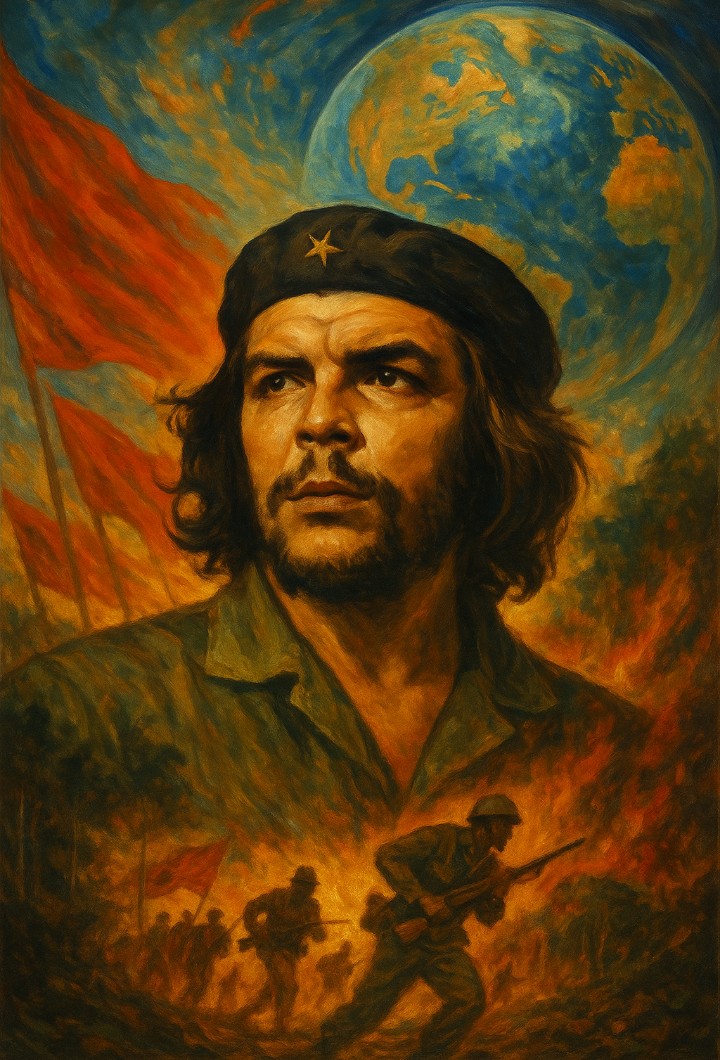
The Living Fire of Theory: Che’s Marxism Against the Machinery of Death
By Prince Kapone | Weaponized Information | October 9, 2025
History rarely pauses for philosophers, but it listens when one of them picks up a rifle. When Che Guevara crossed from Argentina into the jungles of Cuba, he carried no blueprint for socialism — only a conviction that theory meant nothing unless it could bleed. What emerged from that wager was not another school of Marxism but its resurrection: the recovery of thought as weapon, of philosophy as a living force capable of setting the world ablaze. His Marxism was neither European nostalgia nor Soviet catechism. It was a rebellion against both — the rediscovery of Marx’s method in the body of a revolutionary who refused to separate understanding from transformation.
Che entered history at a time when revolution risked becoming routine. Stalinism had turned dialectics into bureaucracy; the United States had turned freedom into advertising. The twentieth century was a century of machines: machines of production, machines of propaganda, machines of death. Even the socialist camp, in its attempt to compete with capitalism, began to imitate its logic — measuring progress in tons of steel and kilowatts of electricity rather than in consciousness or dignity. Che saw the danger before it was too late: the mechanization of Marxism itself. “The machine,” he warned, “is not neutral. If it is not commanded by human purpose, it commands humanity instead.” His struggle, then, was not just against imperialism but against the cold reduction of human life to numbers, statistics, and plans.
What he called for was not a new doctrine but a new spirit — to bring Marxism back to life as a method of struggle. For Che, the dialectic was not a formula but a pulse: the heartbeat of a people discovering themselves through revolt. It was not “theory first, then practice,” but a constant current between the two, where each illuminates and corrects the other. The Sierra Maestra became the proving ground of this truth. There, surrounded by hunger and disease, Che watched peasants learn to read and fight in the same breath, turning necessity into knowledge. That was the dialectic in motion: the transformation of conditions through consciousness, and consciousness through struggle. From this soil he drew the essence of revolutionary science — that freedom is learned through doing.
Che’s Marxism grew out of confrontation — with the old colonial order and with the new bureaucratic one. He refused both the Western fetish of individual freedom without justice and the Soviet fetish of justice without freedom. To the former he replied that liberty under empire is a joke told by those who own the punchline; to the latter, that socialism without moral autonomy is merely the state version of slavery. His method was to expose contradiction, not hide it. Revolution, he insisted, must embrace its own tensions — between spontaneity and organization, passion and discipline, matter and mind. It is through those contradictions, not in spite of them, that a new humanity is forged.
That is why Che rejected the sterile comfort of the scholar and the bureaucrat. Both live off the labor of others: one abstracts it, the other administers it. Che lived it. He turned Marxism back into what it was meant to be — the self-consciousness of the exploited. He refused to speak of “the masses” as an object to be managed; he spoke instead of a people capable of transforming themselves. The revolution was not something done for them but by them, and through them, for all. To Che, the role of the intellectual was not to interpret the world from a safe distance but to translate the people’s struggle into clarity. To lead, then, was to listen — to the sound of the earth rising beneath your feet.
By the early 1960s, when he entered the Cuban government, Che was already wrestling with the deeper contradiction of victory: how to prevent the revolution from devouring its own spirit. Power, he knew, has a way of corrupting even the most honest intentions. The same guns that liberated can soon enforce obedience. The same slogans that inspired can harden into laws. The task, therefore, was not simply to win state power but to transform the people who would wield it. “We are building socialism,” he said, “but we must also build the human being who can live in it.” That sentence contains the entire architecture of his thought. The economy was not separate from ethics, and production was not separate from consciousness. The revolution was not the end of struggle — it was the beginning of a new one: the struggle to humanize power itself.
This is where Che parted ways with the orthodox Marxists of his time. For them, material development was the engine of history. For him, the human being was. Machines could raise productivity, but only consciousness could raise humanity. He did not romanticize poverty; he despised its degradation. But he knew that industrial abundance alone would not abolish alienation. The real measure of socialism was not how much a society produced, but what kind of people it produced. Without moral transformation, socialism would simply inherit the old capitalist soul. “If we use the tools of the past,” he warned, “we will reproduce the past.”
To recover Marxism’s revolutionary core meant returning to its first principle: that the emancipation of the working class must be the act of the working class itself. Che extended that principle to the entire colonized world. Latin America, Africa, and Asia were not waiting rooms for modernity; they were the living engine of global transformation. It was from the Global South, not the industrial North, that Marx’s prophecy of universal emancipation would be fulfilled. In that sense, Che’s Marxism anticipated the world we inhabit today — a world where the old empires decay under their own weight, and the future is being written in the languages of the formerly colonized.
When he died in Bolivia, they said the revolution died with him. They were wrong. What died was the illusion that history could be managed by experts. What lived was his example: that theory must walk on two feet — one planted in the mud of reality, the other stepping toward the horizon of the possible. Che Guevara’s Marxism was never meant to be quoted; it was meant to be lived. It remains, even now, a living fire against the machinery of death — a reminder that the true task of revolution is not to build a new machine, but to reclaim the human being from the ruins of the old.
The Moral Logic of Revolution: Humanism Against the Machinery of Empire
If Part I is the ignition of Che’s thought, this next movement burns through its moral atmosphere—the place where Marxism becomes flesh, where philosophy takes on the weight of hunger and history. For Che, the revolution was not only about property; it was about people. It was not merely about who owned the factories, but about who the worker became when he walked through the gates. He recognized that imperialism was not sustained solely by armies or capital—it was sustained by the corrosion of the human spirit. The colonized were taught to see themselves as inferior, and the imperialist as eternal. To defeat empire, Che argued, we must defeat that idea inside ourselves. “Our struggle,” he said, “is not only against the exploiters of men, but against the man who exploits.”
It was not a moral sermon. It was a science of liberation. Che’s humanism was not born of pity; it was born of method. He observed that the capitalist system produces a specific kind of human being—competitive, fearful, fragmented, trained to survive rather than to live. To build socialism without transforming that psychology would be to reproduce capitalism’s anatomy under a different name. He saw the same sickness creeping into the socialist bloc, where bureaucrats quoted Marx but acted like accountants. This was not socialism; it was the state managing alienation. “There is no such thing as socialism if the spirit of man does not change,” he warned. In those words, he diagnosed what would later destroy the USSR: not imperial invasion, but moral exhaustion.
The moral question, for Che, was therefore a material one. It was about how human beings could become producers of their own humanity. He called this the creation of the “new human being.” Not a saint, not an angel, but an ordinary person capable of living without exploitation. He knew such a transformation could not come from decrees. It had to come through practice—through participation in collective labor, through struggle, through mistakes and their correction. Each act of voluntary work, each literacy campaign, each decision to share instead of hoard, was a rehearsal for this new humanity. The revolution was not a finished event; it was a permanent school.
Che’s insistence on voluntary labor was not romanticism—it was pedagogy. It was the materialization of his belief that socialism must rely on moral incentives, not merely material ones. The capitalist works for a wage; the revolutionary works for the world. To the cynic, this sounded naïve. To Che, it was the only realism worthy of human beings. He had seen what happens when socialism adopts the profit motive: the factory becomes a prison, the plan becomes a cage, and the revolutionary becomes a manager. In his speeches as Minister of Industry, he fought against the infection of “enterprise autonomy,” where socialist enterprises began to compete with each other for profit. “We must choose,” he said, “between the market and man. Both cannot survive.”
That choice still defines our century. Che understood that every social system produces not only its own economy but its own ethics. Capitalism produces greed and calls it ambition; imperialism produces plunder and calls it development. Socialism, if it is to be anything more than a slogan, must produce a new morality—a morality that makes solidarity the measure of success. This was not moral idealism; it was the only practical foundation for a collective society. The revolution could not rely on the whip of necessity; it had to awaken the will of consciousness.
Che’s humanism, then, was not a retreat from Marxism but its renewal. He returned to the young Marx’s warning that under capitalism, man becomes “an appendage of the machine.” In Che’s time, that machine had expanded from the factory floor to the entire world market. He saw how imperialism had turned human life itself into raw material. His answer was to restore humanity as the measure of all things—not abstractly, but through the reorganization of production, education, and daily life. A revolution that did not elevate the human being, he said, was not a revolution but a transfer of management.
This was the ethical frontier of his thought: to reconstruct the human condition from below. It was a confrontation with centuries of colonial degradation and capitalist cynicism. The guerrilla was not only a soldier but a prototype—the living evidence that a different kind of person could exist. Every revolutionary collective, no matter how small, was a laboratory for this transformation. “In the heat of struggle,” he wrote, “the human being grows beyond himself.” That was not mysticism; it was dialectics. The conditions of life shape consciousness, but collective action reshapes those conditions. The revolution teaches the people how to govern because it requires them to govern themselves.
If the first act of revolution is to seize power, the second—and more difficult—is to seize back our own humanity. Che lived and died between those two acts. His philosophy was a declaration that the human being is not an instrument of history but its author. Against the empire’s logic of death, he offered a new logic of life: the belief that history could be rewritten by those who were never meant to write it. That belief, that moral logic, is what makes his Marxism immortal. It is not a relic of the Cold War; it is the living consciousness of a world still struggling to be human.
The Battle for the Future: From Revolutionary Morality to Socialist Construction
Every revolution faces the same paradox: once it wins, it begins to die. The people who storm palaces to tear down tyrants must learn how to build homes, farms, and factories; how to organize, distribute, and plan. And in that transition, the passion of the insurgent threatens to harden into the routine of the administrator. Che Guevara faced this contradiction at the height of Cuba’s revolutionary momentum. Victory in 1959 had turned insurgents into ministers and guerrillas into managers. The question was not whether Cuba could survive, but whether it could remain revolutionary while doing so.
Che’s answer was clear: only through revolutionary morality could socialism avoid becoming bureaucracy with better slogans. He knew the dangers of institutional triumph—that the revolutionary state could reproduce the very alienation it had fought to destroy. For him, socialism was not simply an economic system to be managed but a process of collective self-creation. The revolution had to generate new social relations, new motivations, new desires. If not, the revolution would become its own counterrevolution.
In the Ministry of Industry, Che turned his philosophy into experiment. The Budgetary Finance System (BFS) was his attempt to build an economy without a capitalist soul. He sought to replace competition with coordination, profits with planning, and self-interest with social consciousness. Each enterprise, instead of hoarding its own surplus, would operate as part of a single national plan, its purpose not to generate profit but to fulfill collective need. The state, in Che’s conception, was not an accounting office but a conductor of human energy. The point was to liberate production from the tyranny of the market and to make work itself an instrument of human education.
His critics in the Soviet bloc called him naïve. They accused him of “moral voluntarism,” of ignoring the economic “laws” of socialism that supposedly required profit incentives and enterprise autonomy. Che saw through the condescension. What they called “laws” were simply habits of capitalism carried into socialist planning. “If we keep one foot in the past,” he said, “we will walk in circles.” He refused to believe that socialism required bribing people with the same greed that had corrupted them under capitalism. For him, the transformation of material life had to go hand in hand with the transformation of moral life. “The revolution,” he insisted, “is not a change in masters, but a change in values.”
The BFS was never just an accounting method. It was a moral vision codified in policy—a wager that collective consciousness could guide production more effectively than the market’s invisible hand. And it worked, but only up to the point where Cuba’s isolation and underdevelopment collided with the blockade. The revolution was building a new society with limited tools and under siege. Che’s response was not despair but experimentation: he turned shortages into lessons in solidarity, treating austerity as a test of will rather than an obstacle to dignity. “We have no machines,” he told the workers, “but we have people—and people can be more powerful than machines.” It was not blind optimism; it was scientific faith in humanity’s creative potential.
Che’s debates with Soviet economists reveal how deep his moral realism ran. They argued that the law of value—the logic of commodity exchange—would persist under socialism for generations. Che countered that every time socialism obeyed that law, it bowed to its old master. For him, to concede the permanence of the market was to concede defeat in advance. History, he said, is not ruled by economic laws but by human decisions. That was not idealism but historical materialism at its sharpest: the recognition that people make their own history, but not under conditions of their choosing—and that to change those conditions, one must first believe they are changeable.
It was this conviction that made Che dangerous to both imperialists and bureaucrats alike. To Washington, he was a symbol of insurrection—a doctor who traded the security of comfort for the uncertainty of revolution. To Moscow, he was an inconvenient reminder that socialism without ethics was just capitalism by decree. To both, he was proof that the Global South could produce its own theory, its own models, its own intellectual leadership. His insistence on moral incentives and conscious planning was a threat not because it was unrealistic, but because it exposed the hypocrisy of both systems: one built on profit, the other on obedience.
Che understood that a revolution that loses its moral center will soon lose its material gains. In one of his final speeches before leaving Cuba, he warned, “We must always remember that we are not building socialism if we destroy the moral fiber of our people.” The revolution’s endurance would depend on its ability to link technical progress to human development—to teach people not only how to produce more, but how to live better. “Better,” in Che’s language, did not mean richer. It meant freer. It meant conscious of one’s role in the collective project of history. It meant the ability to look at one’s labor not as servitude but as self-expression.
The tragedy of Che’s time was that such clarity could not coexist with the world as it was. The revolutionary who measures success in consciousness cannot survive in an age measured by GDP. Yet his brief tenure as minister remains a living contradiction: proof that socialism can be both efficient and humane, that the economy can serve morality without collapsing into sentimentality. He left Cuba not out of disillusionment but out of fidelity—to take his ideas beyond the island, to carry the experiment to the world stage. The question that haunted him was not whether Cuba could survive, but whether humanity could. The revolution he imagined had no borders because the moral decay he opposed had none either.
Che’s economic theories were therefore not blueprints for administration but manifestos for civilization. They insisted that socialism’s true task is to rescue humanity from its reduction to commodity and statistic—to restore the human being as the measure of progress. In the wreckage of the twentieth century, when both capitalism and bureaucratic socialism had betrayed that measure, Che’s ideas remain insurgent. They remind us that revolutions fail not because they dream too much, but because they stop dreaming before they are done building.
The Guerrilla as Teacher: The Ethics of Struggle and the Birth of the New Humanity
If Che’s work in the Ministry was an experiment in socialist construction, his return to guerrilla struggle was an experiment in socialist pedagogy. The battlefield, for him, was never only a place of death—it was a classroom where the human being learned how to live. The guerrilla was not simply a fighter with a rifle, but a new moral prototype: the disciplined, selfless, collective being that capitalism could neither produce nor comprehend. In a world suffocated by alienation, the guerrilla was proof that another type of person could exist—one who acts not for gain, but for meaning.
This is why Che called the guerrilla “a social reformer with a rifle.” The rifle was not the essence—it was the instrument of pedagogy. In the mountains of the Sierra Maestra, the revolution was built on education as much as arms. The same men who learned to shoot also learned to read; the same peasants who fought to survive began to govern their own communities. Power was not handed to them—it was discovered within them. The guerrilla column, in this sense, was a microcosm of the society to come. It operated through voluntary discipline, shared risk, and mutual care. There were no overseers, no foremen, no bosses. There was only the moral authority earned by example. In this way, the guerrilla movement became the first workshop for the “new human being” in motion.
Che’s theory of revolutionary leadership followed the same principle. Authority, he argued, could not be imposed from above—it had to emerge from participation. “The leader,” he wrote, “is the one who, after showing the path, walks it first.” It was not a metaphor but a method. In the guerrilla war, every action—every shared hardship—taught a collective lesson. To exploit the people was to betray them; to live among them was to learn from them. The guerrilla leader was not a general but a servant, and the people were not the led but the learners. This was revolutionary humanism translated into practice.
For Che, war itself was never the goal. It was the crucible where character was formed, where old habits of subservience burned away. Every guerrilla struggle contained the embryo of a new social order because it demanded cooperation in the most extreme conditions. Hunger, fear, and danger exposed what capitalism concealed: that survival is collective or not at all. The discipline of the guerrilla was therefore moral, not mechanical. It was the discipline of love—the recognition that one’s own life gains meaning only through others. “At the risk of seeming ridiculous,” Che said, “let me say that the true revolutionary is guided by great feelings of love.” That was not sentimentality. It was a declaration of method: love as the highest form of political intelligence.
The imperialists and cynics have always mocked this line. They cannot fathom love as a force in history because they have only known it as a commodity. To them, love belongs to the private sphere—cheap emotion in a world ruled by transaction. Che shattered that division. In his hands, love became the motor of revolution: the glue of solidarity, the antidote to fear, the seed of consciousness. He did not preach forgiveness for the oppressor; he preached loyalty to the oppressed. To love, in Che’s sense, was to fight without hatred and to die without despair—to see in every comrade the reflection of the humanity still struggling to be born.
That moral clarity was not without its contradictions. Che’s insistence on discipline sometimes clashed with the romantic spontaneity of his followers. He demanded self-critique, sacrifice, and ideological rigor in equal measure. The guerrilla, he believed, had to live according to the ethics of the world he sought to create. There could be no exploitation, no personal privilege, no distinction between leader and soldier. The revolution would either be ethical or it would be nothing. In this, Che was as ruthless with himself as with others. He held himself to the same standard he imposed on the movement. When he saw corruption, arrogance, or cowardice, he denounced it as betrayal not of the party but of humanity itself.
This ethic of struggle extended beyond national borders. Che’s internationalism was not charity—it was dialectics. He saw the world as a single, uneven battlefield where imperialism exploited some nations to pacify others. To fight only for one’s country, he argued, was to misunderstand the nature of oppression. “The duty of every revolutionary,” he declared, “is to make the revolution.” From the Congo to Bolivia, he sought to universalize the Cuban example—not as export, but as solidarity. He knew that the fate of one liberation movement was bound to all others. The revolution, to survive, had to become planetary.
The tragedy of Che’s final campaign in Bolivia is often told as failure. But to reduce it to defeat is to misunderstand his purpose. Che’s death was not the end of his project but its revelation: that the revolution he dreamed of was larger than any one movement, and that the birth of the new humanity would require more than one generation. He once wrote, “I know that I will die with the revolution on my lips.” And so he did—executed in a schoolhouse by a frightened soldier, watched over by agents of the same empire he had spent his life confronting. But if history has any poetry left, it is that the man they tried to erase became a symbol for all who refuse to be erased.
The guerrilla, in Che’s philosophy, is not an occupation—it is a stage in the moral evolution of humanity. It is the bridge between the old world and the new, between oppression and self-mastery. To fight is to learn. To sacrifice is to affirm that life has a value beyond consumption. The guerrilla is not born; he is made—and in that making, he remakes the world. When Che died, the empire celebrated a death. What they did not understand was that he had already multiplied beyond control. His body could be buried, but his method—this fusion of ethics and insurgency—remains the most dangerous idea on earth: that human beings, united by conviction rather than profit, can change everything.
The New Human Being: Consciousness as the Engine of History
The revolution that Che Guevara envisioned was not only about toppling the old order—it was about creating a new kind of human being who could sustain the new world. He believed that capitalism, through centuries of conquest and exploitation, had colonized not just land and labor, but the very soul of humanity. The “new man,” as he called him, was not a superhuman ideal but an emancipated being—a person whose humanity had been restored through struggle, whose capacity for solidarity outweighed the reflexes of self-interest. The old human being, shaped by fear, greed, and competition, could not build socialism. “Society and man are in the process of mutual creation,” Che wrote, and he meant it literally. The revolution had to produce not only different social relations, but different people.
In Che’s philosophy, consciousness was not a byproduct of history—it was its engine. He rejected the mechanical Marxism that reduced social change to a series of economic laws. To him, human will and moral conviction were themselves productive forces. Without them, the revolution would degenerate into administration, and socialism would become an empty word on official letterhead. That is why he viewed voluntary labor as more than economic contribution—it was the laboratory of the new consciousness. When a worker labored not for a wage but for the collective good, he was not merely producing material goods; he was producing himself. “Man truly achieves his full human condition when he produces without being compelled by physical need to sell himself as a commodity,” Che wrote. It was both a moral statement and an economic law of his own: a declaration that socialism begins not with machinery, but with meaning.
He understood that the capitalist system manufactures alienation as its most profitable export. It teaches people to see the world as a collection of things, not relations; to measure life by accumulation rather than by contribution. In such a system, even rebellion risks becoming commodified—an attitude sold back to the oppressed as fashion. Che’s concept of the new human being was the antidote. It demanded a transformation in how people think, work, and relate to one another. It meant learning to see oneself not as an individual competitor but as a social being. It meant rediscovering joy in collective effort, pride in solidarity, and dignity in simplicity. This was not moral asceticism but revolutionary abundance: abundance of purpose, consciousness, and freedom.
For Che, education was the key to this metamorphosis—but not the education of the classroom alone. The revolution itself was the teacher. “The revolutionary process,” he said, “educates the people and, in turn, the people educate the revolution.” Every factory, every farm, every militia became a school in which the old human being—the one trained to obey, to calculate, to fear—was unlearned. In these spaces of creation, the masses developed what he called “revolutionary consciousness,” a collective awareness of their own power to shape reality. The task of the revolutionary, therefore, was not to speak for the people but to help them discover their own voice. Once the people understood that power did not descend from above but arose from within, the revolution would become irreversible.
This is what made Che’s Marxism so dangerous to both capitalists and bureaucrats. He blurred the boundary between theory and spirituality, between political economy and moral awakening. He understood that revolution was not merely a transfer of ownership—it was a transfiguration of consciousness. In that sense, he was not a utopian dreamer but a historical realist. The existing order, he knew, could reproduce itself indefinitely by keeping humanity asleep. His project was to awaken it. “To be a revolutionary,” he said, “is to be guided by great feelings of love.” Not the sentimental love of romance, but the love that moves mountains—the recognition of our shared destiny, the awareness that liberation is collective or not at all.
Che’s insistence on consciousness as the foundation of socialism was not naïve. It was rooted in observation. He saw that technological progress under capitalism had not liberated humanity; it had enslaved it more efficiently. Machines replaced toil, but the worker remained chained. The more productive society became, the less control human beings had over their own labor, their time, their lives. Che believed that socialism had to invert this logic: technology should serve humanity, not the reverse. The “new man” was not anti-modern but post-capitalist—a being who could command technology without being commanded by it. In this, Che’s thought prefigured our own age, when artificial intelligence and algorithmic control threaten to extinguish the last traces of freedom left in the human spirit.
But the new human being was never an individual project—it was collective creation. The transformation of consciousness required social institutions that embodied the values of the future: education rooted in cooperation, labor rooted in solidarity, governance rooted in participation. This was why Che fought so hard against bureaucratic inertia. He knew that the longer people were treated as instruments of the plan rather than its authors, the more the old human being would return. “We must never forget,” he said, “that the revolution is made through men, but men must forge their revolutionary spirit day by day.” In other words, socialism is not inherited—it is practiced.
The tragedy—and triumph—of Che’s vision is that it remains unfinished. He died before his experiment could ripen, but perhaps it could not have ripened in a single lifetime. The new human being cannot be decreed by law, nor born of war alone. It must arise through generations of struggle, through victories and reversals, through the collective effort of those who refuse to surrender to cynicism. It is the ultimate wager of socialism: that humanity can change itself. Che believed that every revolution begins with the act of believing that such a transformation is possible. And in that belief—dangerous, defiant, and incandescent—he gave us the most radical definition of hope: hope not as waiting, but as work.
In our time, when the cult of the individual has reached its most sophisticated form—when the algorithm has replaced the overseer, and consumption has replaced citizenship—Che’s vision returns as both prophecy and challenge. The new human being has yet to be born, but the conditions of its birth surround us: the exhaustion of empire, the decay of moral authority, the reawakening of the global South. Che’s words echo now not as nostalgia but as command: “Let us be realistic, and do the impossible.” He understood that the real utopia is the world we inhabit today—a world that calls barbarism progress while humanity starves in its shadow. Against that barbarism, the new human being still struggles to emerge, half-buried in the rubble of history, reaching for air.
The Mirror of Contradiction: Che’s Self-Critique and the Ethics of Revolutionary Clarity
Every revolution, like every human being, contains its contradictions. Che Guevara understood this better than anyone. By 1965, he had become one of the most recognizable figures on earth—the face of victory, of Cuba, of a world in revolt. Yet behind the triumph, he saw danger. The revolution that had promised to create a new human being risked becoming a new routine, a new bureaucracy, a new worship of efficiency over spirit. And so, in one of the most extraordinary documents of the twentieth century, Che turned his critique inward. His “Other Farewell Letter” to Fidel Castro was not a renunciation but a reckoning—a revolutionary’s confession written not in despair but in fidelity to truth.
In that letter, Che diagnosed what he called “the policy of lurches,” the habit of improvisation born from enthusiasm but untempered by organization. Cuba’s young revolution had achieved miracles, but it was not immune to old errors: subjective decision-making, weak coordination, misplaced priorities. “Our problems,” he wrote, “arise not from a lack of good intentions, but from a lack of method.” It was a line that could serve as epitaph for countless movements before and after his own. Che saw that victory had blinded some to discipline. The revolution, intoxicated by its own success, risked forgetting that socialism requires not only courage but coherence. To change the world, he warned, is not only to fight but to think. Without rigorous planning, moral enthusiasm becomes chaos; without moral clarity, planning becomes coercion.
His self-critique was not the retreat of a disillusioned man but the act of a revolutionary determined to preserve the revolution’s integrity. In his farewell to Fidel, Che refused self-pity. Instead, he offered analysis. He had made mistakes, he admitted—errors of haste, of idealism, of judgment—but these were the errors of one who had dared to experiment, to move history rather than manage it. “The revolution,” he wrote, “is not infallible. But it corrects itself by walking.” For Che, the dialectic was not an abstract principle—it was lived experience, the process of trial and correction through which truth becomes collective.
It was precisely this honesty that made Che’s Marxism so rare. In a political culture where self-criticism often meant ritual humiliation, his was a genuine act of reflection. He refused to treat mistakes as personal guilt or divine punishment. Instead, he saw them as necessary symptoms of experimentation. “To err,” he implied, “is the privilege of those who act.” For Che, the revolution’s greatest enemy was not failure but hypocrisy—the moment when a movement lies to itself in order to preserve its illusions. Better a revolution that stumbles forward than one that stands still out of fear of contradiction.
This moral discipline distinguished Che from both opportunists and fanatics. He rejected the idea that purity meant perfection. The true revolutionary, he believed, must be ruthless with power and merciful with error. He must never become intoxicated by the symbols of victory nor paralyzed by the wounds of defeat. “We must not fear criticism,” he told Cuban youth in 1964, “for the day we do, we will have ceased to be revolutionaries.” His self-critique was not self-flagellation but self-defense—an effort to keep the revolution alive by purging it of pretense.
What emerges from Che’s “Other Farewell Letter” is a portrait of revolution as moral labor. It reveals a man who understood that the hardest battles are fought not against the enemy, but within the movement itself—against complacency, corruption, and cynicism. He knew that revolutions are not destroyed by the bullets of their opponents but by the comforts of their own victories. “Every revolution evaporates,” Marx had once written, “leaving behind only the slime of a new bureaucracy.” Che was determined to prove Marx wrong. His letter was an attempt to halt that evaporation by re-centering the revolutionary on his ethical axis.
In that sense, his critique of Cuba was also a critique of the socialist project as a whole. He saw the danger of imitating capitalist methods in the name of efficiency—the danger of treating socialism as a technical problem rather than a human one. He warned that without a conscious moral foundation, socialism would decay into the management of scarcity. His words anticipated the collapse that came decades later. The Soviet Union, bloated with administrators and drained of purpose, would perish not because of capitalism’s strength but because of its own exhaustion. Che’s diagnosis had been prophetic: the disease of bureaucratization, left untreated, becomes terminal.
Fidel Castro later said that Che’s criticism came from “the most loyal heart.” It was loyalty not to personalities, but to principles; not to comfort, but to conscience. In that letter, Che stood as both participant and judge of the revolution he helped create. He reminded his comrades that the essence of socialism was not found in policies or decrees, but in the honesty to confront contradiction. In his willingness to critique himself, Che embodied the very new human being he imagined—a person freed from the cowardice of false certainty, committed to truth even when it hurts, devoted to a future that no single generation could complete.
When he left Cuba soon after, the world called it departure; in truth, it was continuation. Che carried his critique into the world as living principle. His farewell was not the withdrawal of faith but the renewal of it—the understanding that revolution, like the human being, is a process of endless self-correction. “Revolutionary morality,” he once said, “does not mean never erring—it means never ceasing to learn.” And so he left, not as a symbol of Cuba’s limits but as a mirror for humanity’s potential, knowing that the only revolutions that survive are those honest enough to evolve.
The World to Come: Che’s Humanism in the Era of Imperial Decline and Multipolar Renewal
Che Guevara did not live to see the empire crack, but he felt its fractures long before they reached the surface. His struggle unfolded at the height of U.S. dominance, when capitalism still masqueraded as destiny and the socialist bloc was beginning to ossify under its own weight. Yet within that contradiction—the arrogance of empire and the fatigue of socialism—Che glimpsed the outline of a new epoch. The old world, he knew, could not last forever. A system built on exploitation, alienation, and permanent war carries its own suicide note in every triumph. “The imperialists may seem invincible,” he said, “but they are only giants with feet of clay.” History has since proved him right.
Today, the clay is cracking. The Western project of global supremacy—the long arc that began with colonial conquest and matured into dollar hegemony—is collapsing under its own contradictions. The wars meant to preserve it have bankrupted its moral authority; the technologies meant to control the world have exposed its emptiness. The empire that once claimed to represent civilization now exports chaos in its name. As the centers of Western power decay, new poles of sovereignty are rising—China, Russia, the expanded BRICS+, and the movements of the Global South that refuse to be ruled from Washington or Brussels. The era of unipolar dominion is over. We stand in the transition from imperial order to multipolar renewal, a shift Che could not witness but would have recognized instantly as the unfolding of the very historical logic he lived and died for.
This global transformation is not merely geopolitical; it is moral and civilizational. The decline of the West is not only the fall of its armies or its currencies—it is the collapse of its claim to universality. The liberal ideal of “freedom” has been exposed as the freedom of capital, not of humanity. Its democracy is the democracy of markets; its morality the morality of empire. Che’s life was a long defiance of this masquerade. He believed that the true measure of freedom was not the right to consume, but the right to live with dignity. In that sense, his socialism was not a rejection of modernity but its rescue—the attempt to redeem progress from the blood it was built on.
In this moment of imperial unraveling, Che’s revolutionary humanism regains its full force. It reminds us that multipolarity will mean little if it reproduces the logic of domination under new flags. The task is not to build a world of competing empires, but a world where peoples command their own destinies. The decline of the West opens space for that possibility, but only consciousness can fill it. Che’s insistence on the moral dimension of revolution—on the unity of economics and ethics—offers the compass we need to navigate this transition. Without revolutionary consciousness, multipolarity risks becoming a rearrangement of the same imperial chessboard. Without a new human being, no new world can endure.
The forces that now challenge Western hegemony carry forward, knowingly or not, the unfinished work of Che’s generation. The socialist projects of the twenty-first century—Bolivia, Venezuela, Nicaragua, China’s experiments in socialist market management, Russia’s reassertion of sovereignty—are laboratories of historical transition. Each, in its own way, grapples with the contradiction Che identified: how to wield modernity without being consumed by it; how to advance technologically without reproducing the alienation of capitalist development. They prove that revolution is no longer the property of one ideology or one region. The spirit of Bandung breathes again in the corridors of BRICS and the alliances of the Global South. History, once monopolized by the West, has become multipolar.
Yet Che would have warned that victory brings its own temptations. The same moral corrosion he saw in the socialist bloc could return if the new powers mistake sovereignty for justice or mistake modernization for emancipation. Multipolarity is a condition; socialism is a purpose. The first can emerge through the decay of empire; the second must be built through the awakening of humanity. Che’s thought belongs to that higher horizon. He would remind us that the end of empire is not the end of struggle—it is the beginning of responsibility. The world that rises from the ruins of the West must not replicate its hierarchies, its cult of consumption, or its worship of profit. It must be governed by a different logic: the logic of solidarity, cooperation, and shared human destiny.
The tragedy of Che’s death was that he did not live to see the conditions that might vindicate him. The triumph of his ideas, however, lies precisely in their endurance. The empire that killed him now kills itself—through endless wars, through decadence disguised as freedom, through the alienation of its own people. The forces he fought for—the poor, the colonized, the disinherited—are once again remaking the map of the world. They do so not in his name but in his spirit: the spirit of defiance, of creation, of revolutionary humanism.
Che’s Marxism survives because it speaks to moments like this—moments of collapse and birth, of crisis and construction. It refuses despair. It reminds us that the decline of the old order is not the end of history but the renewal of it. The task before us is the one Che left unfinished: to build a socialism equal to the scale of the human being and a human being equal to the scale of the planet. For that, we do not need new gods or new slogans. We need courage, memory, and clarity. We need to remember that every empire has fallen, but no revolution that dignified humanity has ever truly died.
In the ruins of imperial arrogance, in the surge of multipolar creation, the figure of Che returns—not as a saint or a statue, but as a method. To read him today is to feel the pulse of history quicken, to sense that the “new human being” he dreamed of is still struggling to be born. His death in Bolivia was not a conclusion but a prelude. The empire that buried him now buries itself. And from that soil, fertilized by centuries of resistance, humanity once again begins the long, unfinished march toward liberation.
 Weaponized Information
Leave a comment