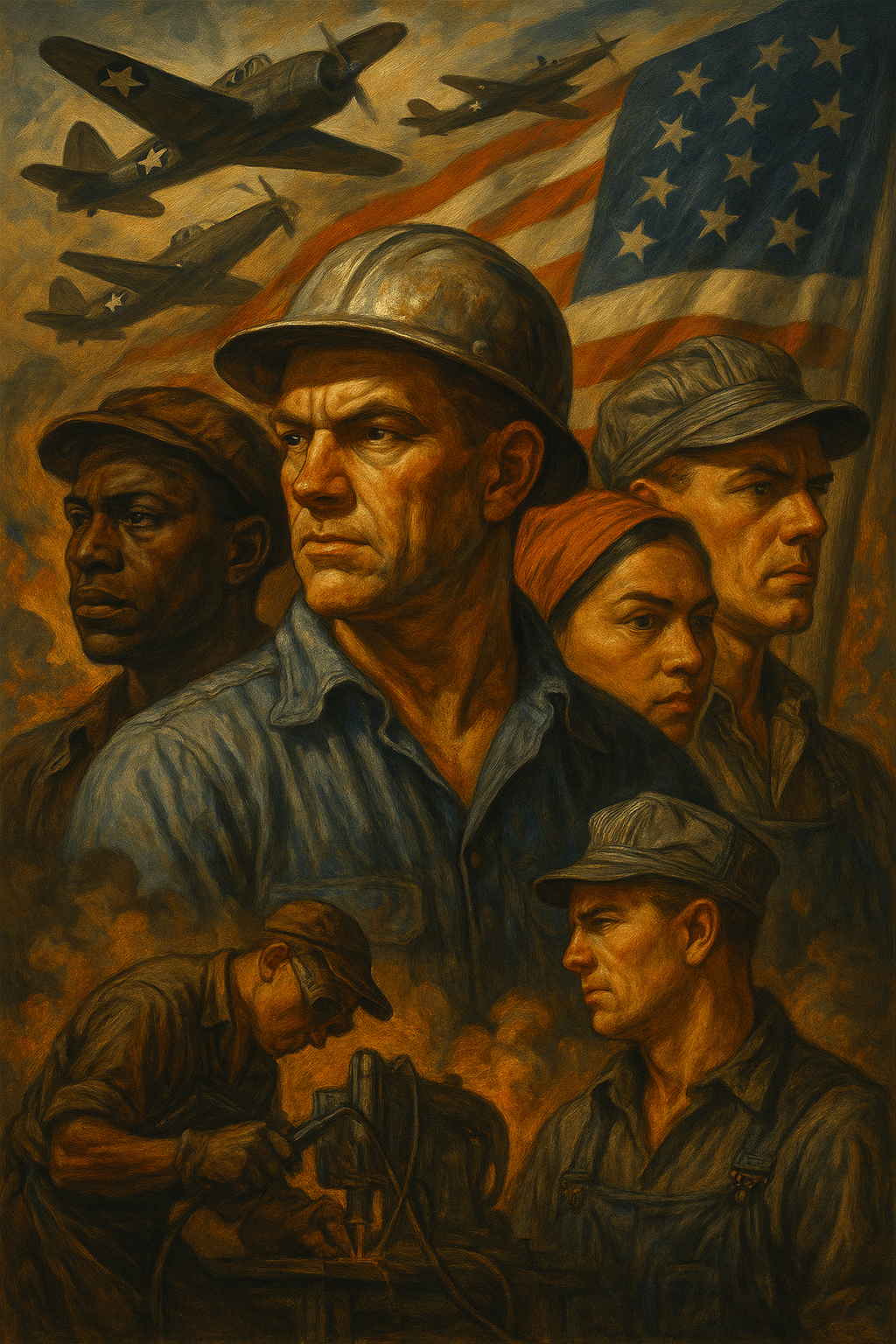
How the AFL-CIO Became the Empire’s Labor Army and Why Revolutionary Labor in the U.S. Requires Rupture With the Settler Bargain
By Prince Kapone | Weaponized Information | October 3, 2025
Imperial Unions, Imperial Wages
Jeff Schuhrke’s Blue-Collar Empire lifts the lid on a history the U.S. labor establishment would prefer remain buried: the story of the AFL-CIO as a willing arm of empire. He piles up the archival evidence—union leaders dining with State Department officials, CIA funds quietly funneled into “free trade union” projects, solidarity reduced to sabotage. The record is clear enough. What Schuhrke sometimes frames as hypocrisy or corruption—unions betraying their ideals abroad—appears in the documents as a matter of routine. This was not a noble labor movement tragically led astray. This was an imperial labor machine doing exactly what it was built to do.
The mistake of the liberal historians and the Western Marxists alike is to begin the story in 1945, as if American labor had once stood outside empire and only later fell into its grasp. But from the beginning, the working class in the United States was not simply a proletariat in Marx’s sense; it was a settler labor aristocracy. It was born from the theft of Indigenous land and the enslavement of Africans, and it grew fat on the superprofits of colonial plunder. This is why the AFL-CIO’s overseas counterinsurgency campaigns were not a deviation from the script of labor history but its continuation. The union bureaucracy of the Cold War was merely the most polished version of what white workers had been doing since the first strikebreakers and militia volunteers helped crush uprisings of the enslaved and dispossessed.
Schuhrke’s research shows the mechanics—funding streams, personalities, the global networks of labor diplomacy. Our task is to strip away the last illusions. The AFL-CIO was never a vehicle of proletarian solidarity; it was the organized expression of a class tied by material interest to the empire itself. To call this betrayal is to miss the point. Betrayal suggests there was once loyalty. But the record shows no such thing. There was, instead, a bargain: empire offered wages, pensions, and the psychological wage of whiteness; in return, white labor offered its loyalty against the colonized and against revolution. That bargain is what made it possible for American union officials to overthrow radical unions abroad with the same ease that their predecessors excluded Black and immigrant workers at home.
So let us be plain from the outset: Blue-Collar Empire is not the story of a fallen labor movement. It is the story of a labor movement fulfilling its historical role in the settler empire. Schuhrke gives us the archive; we must wield it as a weapon. If we treat this history as an error to be corrected, we are lost. If we grasp it as the class essence of U.S. labor, we begin to see what must be done. No reclamation, no reform, no romance. Only rupture with the mythology of the white proletariat and a turn toward the internationalism of the colonized. That is the horizon this book forces us to confront, whether Schuhrke admits it or not.
From Settler Colonies to Cold War Unions
To understand why the AFL-CIO functioned as an arm of empire, we cannot start in 1945 or even 1935. We must begin at the beginning: the settler colony. The so-called “American working class” was never simply a collection of exploited laborers confronting capital on equal terms. From its birth it was a labor aristocracy, constructed on the bones of Indigenous nations and the backs of enslaved Africans. White workers were not only exploited by capital—they were also the junior partners in a colonial project that promised them land, wages, and a cut of the loot. This history matters because it explains why, a century later, those same workers had no qualms about sending their unions to fight socialism abroad. They were not betraying their class—they were defending it. Their class position was already bound up with empire.
Every major labor formation in U.S. history reflected this settler foundation. The craft unions of the nineteenth century that excluded Black workers, the militias of white labor that volunteered to put down slave revolts, the immigrant unions that clamored for westward expansion—all were woven into the project of colonial plunder. The “American dream” of the worker’s house and wage was financed not only by their own sweat but by the theft of land, cotton, gold, and oil from colonized peoples. By the time the CIO came to life in the 1930s, even its more militant currents were framed within a system that already treated the colonial contradiction as untouchable. A century of settler privileges had made solidarity with the colonized the exception, not the rule.
This is the ground on which the Cold War AFL-CIO stood. Schuhrke traces the merger of the AFL and CIO into a global labor foreign policy machine, and he shows how deeply it was tied to the State Department and CIA. What he presents as “corruption” or “capture” we recognize as structural logic. A labor aristocracy rooted in colonial privilege at home could only reproduce that logic abroad. The AFL-CIO’s officers, jetting off to sabotage unions in Chile or Korea, were not going rogue. They were acting out the historic role of U.S. labor: to police the boundaries of empire and secure the flow of spoils that kept white workers at home pacified and loyal. The Cold War was new in its technologies, but not in its social contract.
This is why appeals to “reclaim” the labor movement are illusions. The AFL-CIO cannot be reclaimed for revolution any more than the settler colony itself could be reclaimed for the nations it destroyed. The very structure of U.S. labor has always been built on the denial of solidarity with colonized peoples. Schuhrke provides the evidence of the Cold War moment, but the truth stretches further back: from Plymouth Rock to the CIO, the white working class has been a class inside empire, not against it. Only when this history is confronted can we understand why labor imperialism was not an error but the fulfillment of its essence.
Latin America: The Counterinsurgency Laboratory
Latin America was the proving ground where the AFL-CIO perfected its role as empire’s friendly face. Schuhrke shows how, under the banner of “free trade unionism,” U.S. labor officials fanned out across the continent to undermine radical unions and neutralize socialist currents. Chile, Brazil, Venezuela—everywhere liberation movements surged, the AFL-CIO was there to splinter, to derail, to funnel CIA funds through union channels, to prop up tame leaders who would not threaten U.S. capital. In Chile, their programs laid groundwork for the coup against Allende; in Brazil, they weakened labor’s left before the generals seized power in 1964. Schuhrke names the institutions, the training centers, the “parallel unions” designed to divert working-class energy into safe channels. What he describes as duplicity, we recognize as class function.
It is here that the myth of betrayal collapses. The AFL-CIO was not betraying international solidarity—it was carrying out the solidarity it truly believed in: solidarity with empire, solidarity with the settler class back home whose wages and pensions were subsidized by the cheap copper of Chile, the cheap coffee of Brazil, the stolen wealth of the South. White U.S. workers were not fooled by their leaders; they were represented by them. The house in Detroit, the Buick in the driveway, the vacation at Niagara—these comforts were bought by draining the labor of Latin America. The AFL-CIO’s counterinsurgency missions were simply the mechanism that made this drain possible. This is not hypocrisy. This is the wages of empire in motion.
Schuhrke’s account, rich in documentation, also exposes the ideological trick: calling it “labor diplomacy.” Western Marxists still sigh over this era as if American labor had lost its way, as if some true proletarian internationalism was waiting to be recovered. But the facts tell us otherwise. From the first land grabs of the settler colony to the CIA-union pipeline of the Cold War, the white working class consistently chose empire over solidarity. The AFL-CIO’s Latin American programs only confirmed what centuries had already taught: that the so-called American proletariat was not an exploited class struggling for emancipation, but a labor aristocracy determined to guard its cut of imperial plunder.
Chile and Brazil were not accidents; they were the natural outcome of a class relationship. And that is the lesson Schuhrke’s material hands us, if we dare to draw it. The AFL-CIO abroad was not corruption, not betrayal, not tragic hypocrisy. It was the empire’s counterinsurgency laboratory—built on the back of settler labor at home, deployed against colonized workers abroad. To see it otherwise is to remain trapped in the mythology of a white proletariat that never was.
Africa and Asia: Policing the Global South
Once the AFL-CIO had tested its methods in Latin America, it carried the counterinsurgency playbook into Africa and Asia. Schuhrke traces how U.S. labor officials set up institutes, training schools, and “solidarity centers” from Ghana to Kenya, from the Philippines to South Korea. The formula was simple and devastating: identify militant unions aligned with anti-colonial struggles, isolate them, and build parallel organizations loyal to Washington. Embassy officials and CIA handlers were never far away. The AFL-CIO became the velvet glove of empire, selling union-building as a gift while delivering sabotage. In Africa, this meant undercutting unions that linked workers’ struggles to liberation wars. In Asia, it meant constructing “moderate” unions to prop up U.S.-backed dictatorships and keep the flow of cheap labor, oil, and raw materials unimpeded.
Schuhrke provides the receipts, and they are damning: union officers working hand in hand with the State Department to ensure the “right” kind of leaders rose within African labor federations; U.S. funds poured into Philippine unions that sided with Marcos against radicals; South Korean workers taught “responsible” unionism while their militant comrades were jailed, beaten, or killed. But what he frames as the AFL-CIO “losing its way” abroad, we must read as the logic of settler labor aristocracy applied globally. The same white working class that built its house on Indigenous land and Black labor at home now defended its privileges by policing colonized workers overseas. Africa and Asia were not exceptions. They were the empire’s frontier, and U.S. labor served as its police.
Seen in this light, the AFL-CIO’s operations foreshadow what we now know as the NGO-industrial complex. Before USAID and the National Endowment for Democracy became synonymous with regime change, U.S. labor had already pioneered the model: cloak imperial intervention in the language of “capacity-building” and “civil society,” siphon resources to loyal intermediaries, and strangle revolutionary movements with the rope of foreign aid. Schuhrke helps us see the mechanisms; we must drive home the meaning. What American labor exported to the Global South was not solidarity but counterinsurgency—dressed up in the vocabulary of democracy, while workers who resisted were crushed under dictatorship and U.S. firepower.
Here again the myth of betrayal collapses. The AFL-CIO abroad did not act against the interests of its base—it represented them. The Detroit autoworker and the Pittsburgh steelworker who cashed in on the stability of empire were materially tied to the disciplining of workers in Accra, Manila, and Seoul. Their pensions, mortgages, and consumer goods were subsidized by the very repression the AFL-CIO helped organize. To call this hypocrisy is to insult the colonized who paid the price. The truth is simpler, sharper, and harder: the AFL-CIO abroad was settler labor at home, exported. The labor aristocracy wore a new suit, spoke of democracy, and carried the empire’s banner wherever workers dared to fight for freedom.
Business Unionism and the Wages of Conservatism
Schuhrke makes the crucial turn back home: the same unions that acted as Cold War missionaries abroad were, domestically, champions of “business unionism.” In practice, this meant stripping labor of revolutionary ambition and reducing it to a service agency for wages, pensions, and grievance procedures. In Schuhrke’s framing, this conservatism explains why union leaders were so easily integrated into U.S. foreign policy—they were already in the business of collaboration. The AFL-CIO bureaucrats who sabotaged socialism overseas were the same men who cut deals with the bosses at home, defending contracts instead of building class struggle. They exchanged the vision of emancipation for a steady paycheck and a reserved seat at the negotiating table.
But we cannot stop at the level of bureaucracy. Business unionism was not just an ideological choice—it was the organic expression of a labor aristocracy living off empire’s spoils. The reason American unions could afford to abandon revolutionary struggle was because imperialism guaranteed them a share of the loot. Superprofits extracted from Latin America, Africa, and Asia flowed back into the U.S. economy and subsidized the wage levels, mortgages, and consumer comforts that business unionism promised to defend. The “middle-class” lifestyle of the unionized worker was not created by his own collective bargaining power alone; it was propped up by the colonial plunder that the AFL-CIO itself helped enforce.
This is the truth Western Marxists cannot face. They lament the “bureaucratization” of U.S. unions as if the problem were only corrupt officials or ossified leadership. But bureaucracy was the symptom, not the disease. The disease was structural: a settler working class materially bound to imperialism, with unions functioning as the political form of that bond. What Schuhrke calls “business unionism” we must name for what it really was: the consolidation of a labor aristocracy. Its conservatism was not a failure of imagination—it was the defense of privilege, at home against colonized workers locked out of the unions, and abroad against revolutionary labor movements threatening U.S. supremacy.
The AFL-CIO’s deals with the bosses, its retreats from struggle, its bureaucratic machinery—all of this was the domestic mirror of the sabotage it carried out overseas. And just as in Chile or Ghana, the price was paid by the colonized: Black workers frozen out of skilled trades, Mexican and Puerto Rican workers relegated to the most dangerous jobs, Indigenous peoples dispossessed from land turned into industrial sites. Business unionism was not just conservative—it was counterrevolution by another name. Schuhrke helps us see the connections; our task is to recognize that they were never accidental. They were the class essence of American labor under empire.
Radical Currents and Systematic Repression
Schuhrke does not ignore the rebels inside U.S. labor. He recounts the stories of communists, rank-and-file militants, and internationalists who tried to chart a path of genuine solidarity with colonized workers. These were the longshoremen who refused to load cargo for fascist regimes, the steelworkers who opposed segregation on the shop floor, the radicals in the CIO who linked the Black freedom struggle to the fight against capitalism. Their vision was clear: the American working class could not be free unless it stood with the oppressed worldwide. And for a brief moment, these currents flickered brightly, offering a glimpse of what a revolutionary labor internationalism might have looked like inside the empire.
But Schuhrke shows how swiftly and brutally they were repressed. The state unleashed the Taft-Hartley Act, the Smith Act, and McCarthyism to purge radicals from the unions. The FBI infiltrated, hounded, and jailed militants. The mainstream labor bureaucracy expelled left-led unions from the CIO, smothering them in the name of “democracy.” And just as important, the majority of white workers themselves lined up with this purge, choosing stability and whiteness over solidarity. The defeat of the radicals was not only the work of Hoover and the CIA—it was also the collective choice of a settler labor aristocracy that saw its privileges threatened by the revolutionary politics of its own comrades.
This is where Schuhrke’s narrative and our framework converge but diverge in emphasis. He presents the repression of radicals as a tragedy, a betrayal of the labor movement’s best traditions. We must insist it was more than that: it was inevitable. A working class materially bound to empire could not allow internationalism to take root within its ranks. The communists who fought for Black equality and stood with decolonization movements were not simply marginalized—they were targeted precisely because they threatened the foundations of the settler bargain. Their defeat was the condition of the labor aristocracy’s survival.
And yet, as Schuhrke reminds us, those radicals left behind a legacy of struggle that we cannot discard. They remind us that solidarity with colonized peoples is possible, but only at the cost of rupture with whiteness and empire. They show us that revolutionary currents inside the U.S. did not die because their ideas were wrong but because the class around them was too invested in imperial privilege to follow. This is the bitter but clarifying lesson: within the U.S., revolutionary labor will never emerge from the labor aristocracy as a whole. It can only emerge from the colonized, the excluded, and the defectors willing to betray the settler order. The repression of radicals proves the rule, but their resistance still shows us the way.
From Free Unions to NGO Democracy
By the 1990s, the AFL-CIO had traded its Cold War trench coat for an NGO’s blazer. Schuhrke details how its foreign policy arm rebranded under the banner of “democracy promotion,” now working hand in glove with the National Endowment for Democracy and USAID. The language changed—“capacity building,” “civil society,” “human rights”—but the function remained identical: intervene where unions threatened imperial interests, cultivate compliant leaders, and smother radical labor under a flood of foreign funding. From post-Soviet Eastern Europe to South Africa and Venezuela, the AFL-CIO served as the velvet front line of neoliberal globalization, securing the free flow of capital and breaking the back of labor movements that threatened to resist.
Schuhrke shows the continuity, but he still hesitates at the edge of its meaning. This was not the AFL-CIO losing its way in a new global order—it was the logical adaptation of the settler labor aristocracy to neoliberalism. Just as the white working class once accepted higher wages at home in exchange for sabotage abroad, so too did its institutions embrace the NGO mask in exchange for relevance and funding. The labor officials who once flew to Santiago or Seoul as Cold Warriors now flew to Kiev or Johannesburg as “democracy builders.” They were doing the same job, with a new vocabulary suited to the age of free markets and globalization. The wages of empire had shifted form, but the contract remained.
What Schuhrke describes as the NGO-ization of labor was in fact the next stage of counterinsurgency. By embedding itself in the machinery of “civil society,” the AFL-CIO pioneered strategies of domination that now define neoliberal imperialism. It learned how to kill unions with kindness, how to replace direct repression with suffocation under donor projects, how to manufacture “independent” federations that were anything but. This was not an accident—it was the refinement of a century-old role. Just as settler labor once enforced white supremacy at home and sabotaged revolutions abroad, so too did its institutions in the neoliberal era weaponize democracy talk as a cover for empire’s iron fist.
Here again the mythology of the white proletariat works overtime. Western Marxists can admit the AFL-CIO’s ties to the CIA, but they struggle to face the truth that the rebrand into “civil society” work was not betrayal—it was the labor aristocracy modernizing its toolkit. The cheap electronics, the oil pipelines, the global supply chains of the 1990s and 2000s depended on this very sabotage. And American labor, still feeding on imperial surplus even as its own position eroded, lent itself to the job willingly. The lesson is clear: the form may change, but the function remains. Whether as Cold War missionaries or NGO “capacity builders,” U.S. unions have been the empire’s unions, defending the empire’s wages.
Technofascism and the Settler Labor Aristocracy Today
Schuhrke ends his history before the present crisis, but the road leads directly here: Trump’s America, where labor imperialism mutates into technofascism. The old Cold War bargain is collapsing. The AFL-CIO no longer secures rising wages and pensions on the back of empire’s superprofits. Instead, it presides over decline while demanding loyalty to a new authoritarian project. Protectionist tariffs, anti-China hysteria, and border militarization are dangled before white workers as substitutes for the prosperity they once enjoyed. As in the past, the settler labor aristocracy is politically mobilized to defend empire—but this time, it is mobilized without reward. Its role is no longer to share in the plunder but to absorb austerity while cheering the flag.
This is the essence of technofascism: a ruling class composed of monopoly finance, fossil capital, and Big Tech, fusing digital and military power to discipline society. White labor, once bribed with imperial crumbs, is now disciplined with surveillance algorithms, precarious gig contracts, and police drones. The promise of stable wages and mortgages has given way to the reality of debt peonage and algorithmic management. Yet the mythology persists. Trump and his enablers feed the settler fantasy of national renewal—“jobs back from China,” “the wall,” “America first”—while in practice gutting labor protections, expanding corporate power, and handing the spoils of empire to oligarchs. The labor aristocracy is called to march, even as its own bread is stolen.
Schuhrke’s history shows us the template. Just as the AFL-CIO once betrayed Chilean workers in the name of “free unionism,” today it betrays migrant workers in the name of “job security.” Just as it once split African unions to protect imperial access to resources, today it falls in line with protectionist tariffs and anti-China propaganda that serve only capital. The settler working class is courted at the ballot box and abandoned in the factory, disciplined in the warehouse, surveilled on the job. The continuity is brutal but clear: empire still needs its settler base politically, but it no longer needs to pay them materially. In the digital age, consent can be managed and dissent crushed without the same wages of whiteness that stabilized the twentieth century.
This is the trap of the present conjuncture. The white labor aristocracy, once the accomplice who feasted on imperial scraps, now finds itself a pawn with little to gain and much to lose. But instead of breaking with empire, it doubles down—clinging to nationalism, racism, and xenophobia as consolation prizes. The task for revolutionaries is to refuse the illusion that this class can be redeemed. Schuhrke shows us the archive of betrayal; our time shows us its culmination. The settler labor aristocracy is mobilized, betrayed, and discarded in the same breath. Only by breaking from the settler bargain, by joining hands with the colonized and the oppressed, can any worker in the U.S. escape the fate technofascism has prepared for them.
Breaking with Empire
Schuhrke has done the work of excavation. He opens the files, traces the money, names the institutions. What he gives us is an archive of betrayal—proof that the AFL-CIO was not a victim of manipulation but a partner in empire. Yet to stop there, as he often does, is to miss the deeper truth. This was never simply the story of corrupt leaders or bureaucratic missteps. It was the story of a settler labor aristocracy fulfilling its historic role. From the cotton fields and stolen land that birthed the first “American workingmen,” to the Cold War functionaries sabotaging unions in Santiago and Seoul, to today’s protectionist rhetoric masking austerity—there is a continuous line. The white proletariat has never been a revolutionary subject in the United States. It has been the empire’s accomplice, clothed in overalls.
To call the AFL-CIO’s history a “betrayal” is to indulge a mythology. Betrayal implies there was once loyalty to a greater cause. But as the colonized of this land and the Global South know too well, there was no such loyalty. The American working class, in its majority, has chosen time and again to defend its privileges within empire, even at the cost of global solidarity and its own long-term survival. What Schuhrke shows us in case after case—the sabotage of revolutionary unions abroad, the embrace of business unionism at home, the complicity in neoliberal “democracy promotion”—is not an error. It is the class essence of U.S. labor under settler colonial capitalism.
This conclusion matters because it strips away the last illusions of Western Marxism and the white left. There will be no revitalization of the AFL-CIO into a revolutionary vehicle. There will be no redemption of the white labor aristocracy through moral appeals or bureaucratic reforms. The myth of the white proletariat as universal liberator is exactly that—a myth, a weapon of ideology that blinds us to the colonial contradiction at the heart of U.S. capitalism. To cling to it is to chain ourselves to a corpse. To break from it is to finally see where revolution in this land can and must come from.
The path forward lies not in reclaiming empire’s unions but in joining the struggles of those it has always betrayed: Black, Indigenous, Chicanx, and immigrant workers; the colonized abroad who have resisted U.S. labor imperialism; and defectors from the settler class who choose treason to whiteness over loyalty to privilege. Blue-Collar Empire arms us with evidence. Our task is to wield it with clarity. The lesson is not reform but rupture. Not nostalgia but betrayal of the settler bargain. Not faith in the white proletariat but faith in the colonized and the international working class. Only on that basis can a revolutionary labor movement be forged. Only on that basis can the wages of empire be finally abolished.
 Weaponized Information
Leave a comment