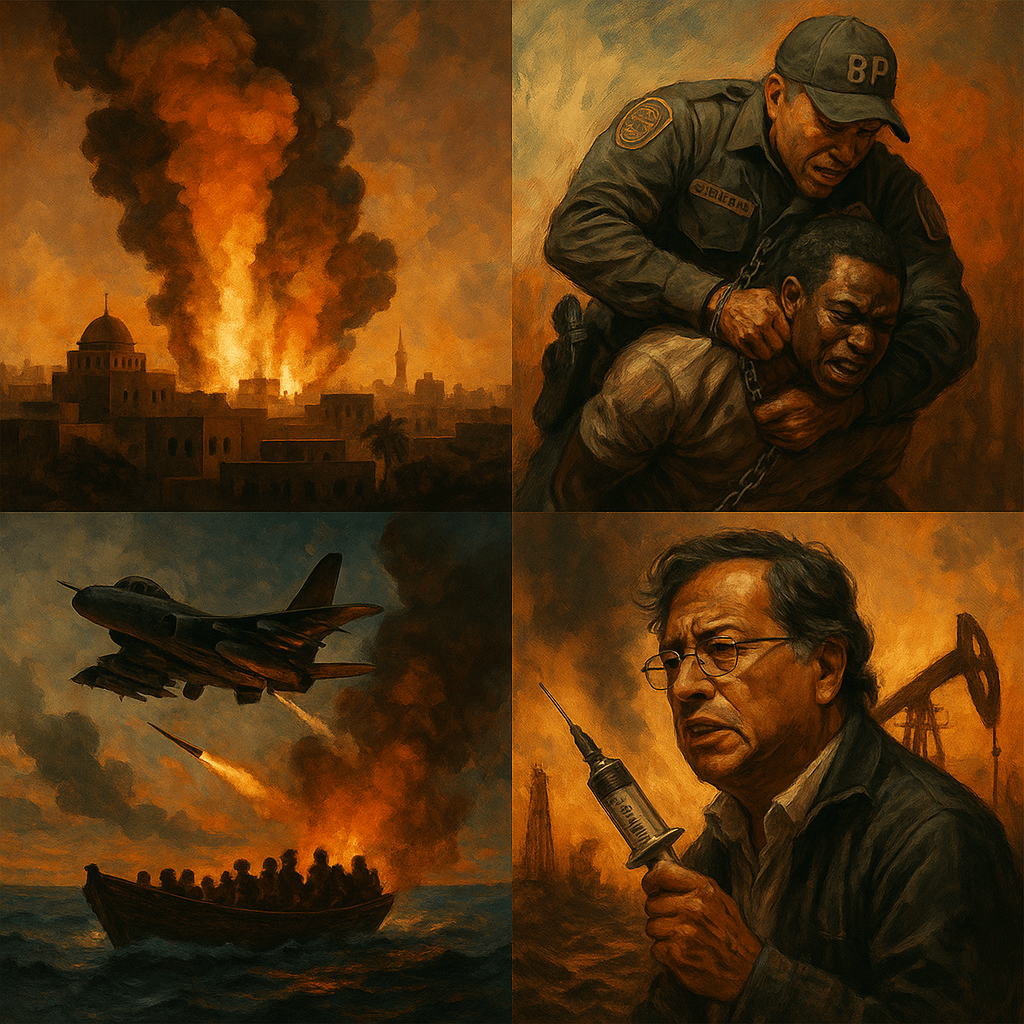
The crisis of imperialism and the war on the poor — from fentanyl to fossil fuels, from blockades to bombs
By Prince Kapone | Weaponized Information | September 25, 2025
Introduction
Gustavo Petro walked into the UN and did what most heads of state never dare: he said out loud what everyone already knows. The bombs that fall on kids in Gaza, the missiles that ripped through unarmed youth in the Caribbean, the chains slapped on migrants at the border, the fentanyl epidemic hollowing out U.S. cities, the refusal to fund clean energy in the South—these aren’t separate “problems.” They’re one system of domination, stitched together by greed, defended by war, and carried out under the banner of “democracy.”
Petro wasn’t making a polite speech to be filed away in some diplomat’s folder. He was indicting the whole order. He called the “war on drugs” what it is: a racket run from Washington, not about public health but about disciplining the South. He called Gaza what it is: genocide, and reminded the world that the very building he spoke from is guilty of covering for it. He exposed the climate “debate” for what it is: a refusal of the rich North to pay for decarbonization, not because the money isn’t there but because shifting power southward terrifies them more than the extinction of humanity.
We don’t publish this speech because Petro is some savior. We publish it because he maps the terrain clearly. Technofascism at home. Hyper-imperialism abroad. The war on the poor as the connective tissue that binds it all together. Whether it’s a missile, a blockade, a prison, or a veto at the Security Council, it’s the same boot pressing down on the same necks.
So read this speech the way it was meant to be read—not as a diplomatic address, but as a weapon. It’s a reminder that the system can still be named, and that naming it is the first step to tearing it down.
Petro Gustavo, President Of Colombia | Address to the 80th Session of the United Nations General Assembly | New York, September 23, 2025
New York, September 23, 2025
Mr. President, this is my last speech here as President. It is already my fourth. In my first address, I warned this Assembly that alongside the war in Ukraine, a conflict could break out in Palestine. I called for a peace conference.
Those of us without bombs or giant budgets are not heard here. Yet four years later, the horror in Palestine leads me to think that something similar—almost the same—could happen in the Colombian Caribbean, when missiles are fired at unarmed young people at sea.
We now face a different, perhaps more global situation. Today’s barbarism is global; it falls upon all of humanity. Missiles strike 17 unarmed young people in Caribbean waters—perhaps some of them Colombians. Millions of migrants are persecuted, imprisoned, shackled, and expelled. Missiles rain down on the 70,000 people of Gaza and kill them.
Inaction on the climate crisis—its very language erased at Trump’s orders—is tied to, and stems from, the same cause. Migration is used as an excuse by a rich, white, racist society to imagine itself a superior race and to ignore the fact that its leaders are driving it, and all humanity, to the brink of extinction.
They say the missiles in the Caribbean were launched to stop drugs. That is a lie. It was said here, in this very forum, that 2023 and 2024 were the years with the largest cocaine seizures, and that more than 700 drug lords were extradited to the United States and Europe. I extradited them, and my government seized the cocaine.
We did not fire a single missile or kill a single young person. In those years, I proved that voluntary crop substitution for coca is more effective than forced eradication with glyphosate and repression against poor Colombian farmers. I replaced the failed and violent “war on drugs” with an effective counter-narcotics policy—one that does not confuse a dead substance with the living greed that profits from it.
But violence is needed by those who seek to dominate Colombia and Latin America. They need to destroy dialogue and impose deadly missiles on poor young people in the Caribbean. Their anti-drug policy is not about stopping cocaine from reaching the United States.
Their anti-drug policy is about ruling over the peoples of the South. It does not truly focus on drugs; it focuses on power and domination. That is why I speak before you as a president who has been deserted—abandoned—by President Trump himself, without any right, human or divine, and without any rational justification.
They want to violate and coerce tens of thousands of our farmers from the vantage point of the U.S. government—under the influence of powerful Colombian political mafias.
Hundreds of thousands of Colombian peasants have been massacred, just as children are massacred in Gaza.
The massacres in Colombia were orchestrated by politicians—senators, presidents, ministers—linked to and bribed by the Colombian drug mafia.
They have long been allied with the far right in Florida in the United States, now allied with the Trump administration—decades-long allies of Colombia’s cocaine kingpins. True malandrini, as Italians would say—vile scoundrels.
Anti-drug policy is made in Washington, in alliance with the cocaine mafia. I do not know if Trump realizes that his foreign policy toward Colombia, Venezuela, and the Caribbean is being advised by Colombians who are political allies of narcotraffickers.
I myself denounced these paramilitary narco-politicians, personally and over a decade in the Senate. They tried to kill me many times for it. They wanted to prevent me from becoming president, to silence me—and now they want to prevent a new progressive government from continuing. And for that, they smear me and defame Colombia.
The largest quantity of cocaine in the world’s history has been seized in Colombia—and it was this government that did it—and yet they try to isolate me diplomatically.
In Colombia we managed to curb the growth rate of coca crops. Under President (Iván) Duque, they were growing at 43% per year; this year I reduced that rate to 3%. They did not isolate Duque—whose campaign had a drug-trafficking financier—but they isolate Petro because he speaks and tells the truth.
Therefore, their anti-drug policy is not about public health; it is about politics and power. They do not want light to shine in Latin America, nor for the hour of the people to return. The young people killed by missiles in the Caribbean were not members of the “Tren de Aragua”—a name that perhaps nobody here even knows—nor of Hamas; they were Caribbean youths, possibly Colombians.
And if they were Colombians, with apologies to those who dominate the United Nations, criminal proceedings should be opened against the U.S. officials involved—even if that includes the highest official who gave the order, President Trump—who allowed missiles to be fired at young people simply trying to escape poverty. If those young people at sea carried illicit cargo, they were not drug traffickers; they were simply poor youths from Latin America with no other choice.
Drug traffickers live elsewhere—not in Latin America. Trump fires missiles at unarmed migrant boats and accuses them of being drug traffickers and terrorists, even though they have no weapons to defend themselves. The drug traffickers live in New York, just blocks from here, and in Miami.
They cut deals with the DEA—deals that let them traffic in Africa, Europe, Russia, or China, but not in the United States. Meanwhile, the U.S. “stops” the growth of cocaine consumption without actually reducing it—only because its sick addicts have moved to consuming the deadliest drug of humanity’s counterculture in this age of climate crisis: fentanyl.
That fentanyl is produced in the industrial apparatus of the United States, here, nearby. It is American-made for American consumers—a grim testament to the worst understanding of drugs in human history since wine, alcohol, or beer were first known.
Fentanyl and gasoline addicts—two total poisons of life on Earth. Gasoline is worse than fentanyl.
Only Black people here—ancestral here for more than 20,000 years—only the youth, only the women who refuse to see their children die en masse; white, Black, of every color who still think; people who still think and do not sleep under fentanyl or the lies of television—they can stop the tyranny within the United States itself.
And all over the world, citizens have taken to the streets—in California, New York, Philadelphia, where the bell of liberty once rang—even as Trump sends troops against his own people to intimidate them. In states of free citizens—states that are no longer united today in the face of the tyranny of evil—the worst kind: the President of the United States.
Do you not see that a million Latin Americans have murdered one another—most of them Colombians? And that another million Americans will die from fentanyl?
Ten years ago, cocaine killed 3,000 people a year in this country—due to the poisons mixed with it. Today fentanyl kills 100,000—33 times more. After 50 years of absurd policies, the United States has “improved”—or worsened—leading its society into the Dantean death of a drug that kills brain and lungs—one more face of humanity’s death in this age.
Genocide in Gaza
Trump not only allows missiles to fall on youths in the Caribbean, not only imprisons and shackles migrants—he also allows missiles to be fired at children, women, and the elderly in Gaza. He makes himself complicit in genocide—because it is genocide—and we must shout it again and again.
This building is a silent witness—and accomplice—to genocide in today’s world. When we thought that crime belonged to Hitler alone, Trump comes and speaks not of democracy, nor of the climate crisis, nor of life. He only threatens and kills, and allows tens of thousands to be killed.
Yet in Colombia, under my administration, homicide has not increased. We have the lowest unemployment of this century, the lowest poverty rate of the century according to our statistics. We grew agriculture by 10% annually and industry by 5% annually. Millions of tourists came—more than ever before—to marvel at our immense beauty.
In a land of vast natural, human, and cultural diversity, we seek peace by talking with drug traffickers and rebels. I am not ashamed to talk, to talk always—if talking saves lives—putting first the total eradication of illicit economies and the eradication of coca crops by the free decision of peasants who are tired of violence.
We do not allow ourselves to be bribed by drug traffickers, as happened under previous governments, and we have already eradicated 25,000 hectares voluntarily. Our policy is succeeding—not because it is “about drugs,” but because it targets drug trafficking, which is different.
We are grateful to the countries that have helped us sow peace: Qatar, Cuba, Mexico, the Vatican City, Norway, Brazil, and Venezuela. We are not grateful to those who want to push us into war among ourselves.
Listen, ladies and gentlemen of the world: Latin America is not only cocaine, terrorists, and traffickers. Latin America potentially has 1,400 gigawatts of clean electricity capacity each year from water, wind, and sun. The United States, to the north, demands 1,200 gigawatts each year—of which 70% today is fossil—coal, gas, oil.
If Latin America develops its clean energy potential, it could cleanse the entire U.S. fossil energy mix. All that is missing is the money—and that would be the greatest single contribution to overcoming the climate crisis.
Today, even with little progress, Latin America—thanks to its clean-energy potential and the immense carbon sink that is the Amazon—is the vanguard of humanity, able to take the first decisive step to save the planet and all humankind. It would take $600 billion to develop this potential.
Africa can do the same for Europe. Together, this fundamental decarbonization would cost $1.2 trillion. That money already exists in the coffers of the United States, Europe, and China. But not a single dollar moves—because it is “not profitable.”
Or worse: it may be very profitable in terms of human life—including life in the United States, Europe, and China—but they do not want interdependence with Latin America and Africa. They know that linking Latin America and Africa’s clean energy to the North’s fossil economies would not only decarbonize and save the planet; it would also shift global power.
Whoever speaks here occasionally but speaks every day—in deeds—is doing so with bombs, not words. Decarbonization would bring back global democracy and change relations of production, because life and humanity would take precedence over greed.
Greed is the poison of life. It is the antagonistic contradiction—as Mao Zedong once said—not between bosses and workers this time, but between greed and the life of planet Earth itself.
Science tells us we have 10 years before the point of no return. Ten years. And once we reach it, nothing can be done. We will only watch the catastrophes, and feel them—even in our own families—because the extinction of life, including human life, will be, if you will forgive the redundancy, irreversible.
Irreversibility: no technology, no political or social force, no human mind will be able to stop the collapse—and we have ten years left, says science. But here they do not believe in science. One of the most powerful people in the world says he does not believe in science. That is called irrationalism—and Germany, the land of great philosophers—Feuerbach, Hegel, Kant—once succumbed philosophically to irrationalism.
Today the United States is filling itself with irrationalism. It was the prelude to Hitler in 1933.
The solution is to stop consuming coal, oil, gas—hydrocarbons—and move quickly to water, sun, wind, green hydrogen. Yet the word “decarbonization” now sounds subversive in gatherings of powerful nations—the G7, the G20—and in Davos among the mega-rich, just as the word “democracy” sounded subversive five centuries ago.
Investing in Decarbonization
Even here—in New York, Cartagena, Bogotá, Paris, and even more in Madrid—the sums I speak of—$600 billion, $1.2 trillion—are one or two zeros greater than the paltry amounts “promised” by developed countries.
Alms—unfulfilled since the Paris COP—because they are not interested in decarbonization. And the meager loans from multilateral banks are padded with zeros—mere innocent alms, pure ideology—pretending that the profitability of capital will cleanse the atmosphere and save lives. Lies—ideological phantoms—fetishes to keep us from looking up and acting as humanity.
The climate crisis requires prioritizing investment in decarbonization and adaptation in every public budget. It requires a completely different global financial policy and the elimination of the “country risk premium.”
Who decreed that the world’s biggest emitters—like this one, the first or second on Earth—are “safe,” while the countries that absorb CO₂ with jungles and abundant waters in the South are “risky”? If the market says otherwise, then the market is wrong and is heading toward life’s abyss.
We must forgive debts in the poorest countries and swap foreign-debt payments for investments in adaptation and mitigation. Gentlemen of China, Germany, the United States, Wall Street, Paris, and London—if you insist on collecting interest on our foreign debts, you will find cemeteries and corpses; and when you come to collect, you too will find cemeteries and corpses. Money is useless among the dead.
Here is another “subversive” word: plan—global plan. The market tried to erase the word. They told us planning was unnecessary. When planning is for human beings, they call it anathema. So much religious, false belief was unleashed around the market—a fundamentalist creed that the market leads to happiness. Walras—the Swiss economist—promised happiness, and we got the abyss.
The market does not lead to happiness, but to death and the abyss—as we see today. Walras was wrong; neoliberalism was wrong from the start. For 50 years we have guided our countries with completely errant and unscientific formulas—and we have not changed course.
A plan—binding on nation-states—must be carried out through global democracy and supervised by the Security Council—without vetoes. Let us finally admit: the market will not solve the climate crisis. Capital itself created it—an unequal social relation between those who own the machine that devours coal and oil and the wage-earner who must produce more and more commodities for the owner to sell—commodities made with a machine that demands ever more oil—thus producing the climate crisis.
Produce more, sell more, earn more—ever more—consuming ever more coal and oil. That has been the rule—until today. But not for eternity. Oil and coal have reached their end—perhaps the end of capital. If not the end of capital, then the end of humanity and life.
The owner of capital is a powerful human being—not a thing, not a fetish. That human being, enslaved to greed, will come here seeking approval—to search for ever more oil, in every country—regardless of how it poisons the atmosphere with CO₂, the poison of all life on Earth.
“Drill, drill, and drill,” they say, without mercy. So: capital or life, my friends. Greed or life. Barbarism or democracy—local and global. Freedom or death, as Bolívar said—raising the red, the black, and also the white flag: red for freedom, black for death, white for peace.
A World Revolution
A global revolution of the people is possible. To overcome the climate crisis positively—and prevent it from descending from crisis to collapse—we need a revolution of united peoples, of civilizations—who must engage in dialogue even more than states. A revolution of humanity to remain alive on this planet and free—perhaps allied with some governments willing today to defend life.
The United Nations sees its crisis and the need to transform. Here gather nation-states that no longer hold power, and no matter how much they vote, they are ignored—because the nation-state too is in decline, perhaps its final decline.
It was invented centuries ago; it no longer works—because capital has become global, not state-based. Stalin’s socialism should have become global rather than state-based. But Stalin lacked the understanding; he bet on the tribe. At Yalta he condemned world revolution—in Spain, in Italy, in Greece—and perhaps in Latin America and beyond.
Humanity itself is the new political subject that appears—not the nation-state. The United Nations must transform into a union of humanity—united though diverse. A new political subject is emerging in human history—and it is spectacular: we are moving beyond the nation-state toward humanity as such.
But for humanity to be united—in action—it must be democratic throughout. It must sustain permanent dialogue amid diversity. In difference lies the engine for effectively coordinating action on a global scale—humanity in dialogue.
Yes—civil humanity; yes—deeply democratic humanity; yes—one hopes, a humanity of free people, because “enslaved humanity” is a contradiction in terms. Enslaved humanity is not humanity—it is bestialization. Bestial is the one who enslaves—who shackles migrants, launches missiles at youths, and riddles children with bullets in a town not far from where Jesus was born.
This can no longer be solved by states that talk but do not act, by rulers bribed by oil and ready to rain missiles on the peoples of the South. A new political entity emerges: humanity—united and diverse in its cultures. As collapse approaches, and as the old white societies of Europe and the United States applaud their new fashionable Hitlers, they listen neither to their youth, nor their children, nor humanity, nor the stars, nor their grandparents who died as heroes on Europe’s fields, truly fighting Hitler and his criminal idea of a superior race.
Today they repeat the same: they build concentration camps for migrants and win elections by declaring migrants an inferior race—collectivizing guilt just as they did to the Jews—calling them terrorists, inferior, thieves—“all drug traffickers,” they say. When most drug traffickers are blond and blue-eyed, and stash their fortunes in the world’s biggest banks—not in Bogotá, Caracas, the Caribbean, or Gaza, but in Miami, neighbors of the U.S. President, and in New York, Paris, Madrid, Dubai. They live where there is luxury, not poverty—yet they fire missiles where there is poverty, not where there is luxury. It’s a lie that the Tren de Aragua is a terrorist organization—it is a common criminal gang, swelled by the foolish policy of blockading Venezuela and seizing its heavy, already poisonous oil.
Migrants are not criminals. They should not be hauled into concentration camps and expelled in chains. Migration is a product of blockades against poorer countries—like Iraq, Iran, Cuba, Venezuela. Economic blockades amount to genocide.
Migration is a product of the impoverishment of poor countries by unpayable, greedy debts. Migration is a product of wars and oil-fueled invasions unleashed by the United States and Europe. Migration is a product of the climate crisis, driving us toward collapse and leaving tropical lands without water as the vital liquid evaporates under rising heat.
The solution to migration is not chains, prisons, or missiles. There is no superior race, gentlemen. There is no “chosen people of God.”
Neither the United States nor Israel. Only ignorant far-right fundamentalists think like that. God’s chosen people is all humanity.
Migration is used as an excuse to do nothing about the climate crisis that erases life day by day. It is leveraged to win votes among whites and elderly men and women; meanwhile, the need to end coal and oil is hidden from power—while drilling, drilling, drilling is incentivized. The UN must change now.
A different, humane UN must first stop the genocide in Gaza. Humanity cannot allow one more day of genocide, nor allow Netanyahu’s genocidaires and their allies in the United States and Europe to remain unpunished. The United Nations must uphold the international courts of justice and international law—the foundation of civilization, the distilled wisdom of humanity—and enforce their judgments.
Diplomacy has already run its course in Gaza, gentlemen. It could not solve it. It is not true—and forgive me, Macron—that we can just keep talking and talking while every second another missile falls and shreds the bodies of innocent babies—boys and girls—in the Arab country of Palestine.
Every day, emotions are vetoed in the Security Council; every passing day means more children bombed; every bomb dropped means more dead. Whoever wields the veto must not be a mother or father—must not be alive—perhaps sprung from dark forces, a robot without a heart. The genocide must be halted by what comes after diplomacy.
That means a vote of the UN General Assembly—not the Security Council that vetoes. A “Uniting for Peace” for Palestine—forming an armed force to defend Palestinian lives. Today it is about words and weapons.
Not blue helmets—untrained and sometimes unwilling to do what is necessary. A powerful army of countries that do not accept genocide. Therefore I invite the nations of the world—and above all their peoples, as humanity—to unite their armies and their weapons.
Palestine must be freed. I invite the armies of Asia; of the Slavic peoples who so heroically defeated Hitler; the Latin American armies of Bolívar; of Garibaldi—who also raised one in Italy; of Martí, of Artigas, of Santa Cruz. Words are no longer enough in Bolívar’s hour of the sword of freedom or death—because they will bomb not only Gaza, not only the Caribbean (as they already do), but humanity itself which cries out for freedom—because from Washington and NATO they are killing democracy and reviving tyranny and totalitarianism on a global scale.
We must raise the red and black flag of freedom or death that Bolívar raised—without forgetting the white beside it, the color of peace and the hope of life on Earth and in the heart of humanity. The United States no longer teaches democracy; it kills it—with its migrants and its greed. The United States teaches tyranny.
The UN must begin its transformation by stopping the genocide in Gaza with the effectiveness of a world-saving army, approved by the General Assembly without veto. After saving Gaza, we will move on to a plan to decarbonize the world economy—a democratically constructed global project that establishes global democracy. The body overseeing its rapid implementation will be the Security Council—without vetoes. It must be binding on the WTO, the World Bank, the IMF, and the private financial system—given the enormous capacity of national and global finance to centralize capital. From there, humanity can regulate capital—subordinating it to life and to the people: capital regulated and subordinated to life.
Along this path, the United Nations will evolve from an alliance of states into an alliance of diverse peoples and cultures that make up humanity. If we overcome the climate crisis—and we will only do so united as humanity—we will also achieve the UN’s transition toward an assembly of peoples, seeking the freedom of every person on Earth, seeking that each mind reaches its full potential and interconnects across the planet. For that great mind of humanity—as a powerful intelligence, illuminated by ever-deepening science—will be able not only to save life on Earth, but also to fulfill humanity’s mission: expanding life to the stars.
A united and free humanity can look to the stars and reach them, just as Roman legionaries once dreamed when they coined the Latin words ad astra—to the stars—always at the hour of freedom or death. Death by missiles is real—but so is freedom in the human heart and its capacity for unity, rebellion, and existence.
Thank you very much.
 Weaponized Information
Leave a comment