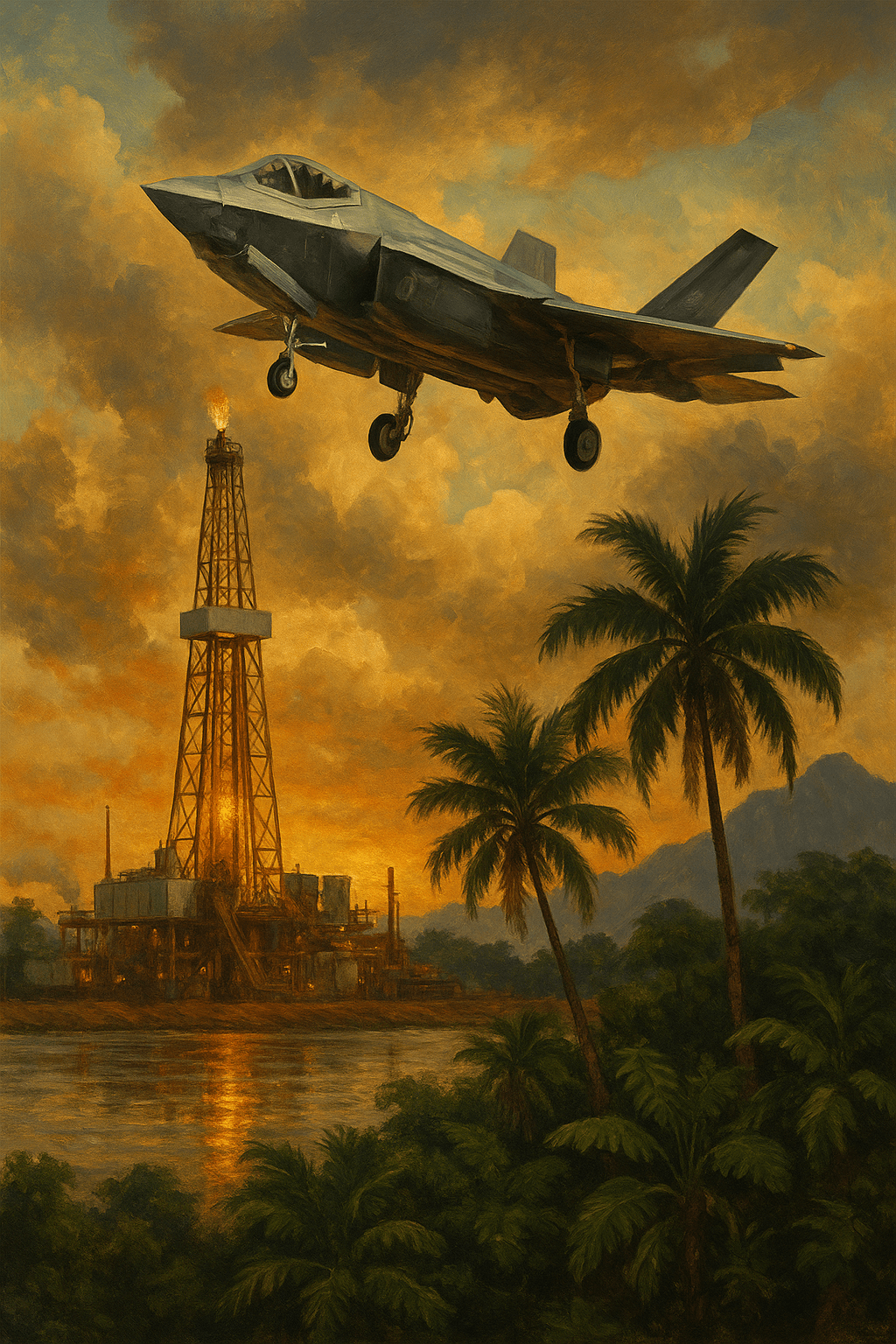
Washington flies warplanes to guard Exxon’s contracts, calls it “stability,” and smears Venezuela as the aggressor. Yet beneath the noise lies the real contradiction: a people’s fight for sovereignty against the Fortress Americas project in a world breaking toward multipolarity.
By Prince Kapone | Weaponized Information | September 12, 2025
Investor Calm at the Barrel of a Jet: Excavating Oilprice’s Guyana Dispatch
The object on the table is Oilprice.com’s “U.S. Jets Deployed to Guyana as Oil Boom Raises Caribbean Stakes”, filed by its Editorial Department. Read it once for the plot, twice for the language. On the surface, it’s a tidy bulletin: fighter jets appear, output climbs, elections conclude, “stakes” rise. But listen to the rhythm and you hear the real subject: not people, not history, not law—risk. The prose is built to soothe the pulse of capital while warplanes idle on the runway. In this story, jets do not escalate; they “signal backing.” Oil does not shape lives; it “commands premiums.” Elections do not debate futures; they “reinforce continuity.” The verbs are chosen the way insurers price storms: to make the weather of power feel inevitable and safe for those holding the paper.
The piece opens by sliding the military into the market like a hand into a glove. The deployment is presented as a measured adjustment to a “changing balance of power,” not a choice with consequences. The sentence breathes in the passive voice—no one decides, things simply “draw” and “escalate”—so that hardware arrives as climate, not policy. What follows is a parade of numbers and superlatives—“fastest-growing,” “hottest frontier,” “immediate global implications”—that convert a living coastline into a ticker. The adjectives carry the load: they do the work of urgency without ever having to name who is pressed, who is priced out, or who will pay when something blows.
Notice how politics is handled. The election is mentioned the way a banker notes a signature: proof that the terms will hold. “Reinforcing a mandate,” we are told—shorthand for continuity in energy policy—then the narrative moves on. No labor, no opposition, no social demands; the ballot is treated as an executive summary for investors. The article’s people are different people: “analysts,” “executives,” “officials.” When they speak, the lines arrive padded with hedges—“privately warn,” “frame deployments,” “note that”—so that capital can ventriloquize caution while muscle takes its place on the stage. It is a neat trick: the market worries aloud, and the military answers before anyone else can.
Now watch the treatment of the neighbor. Venezuela is given a role with a single coat of paint: “revived claims,” “military exercises,” “armed struggle.” The quotes chosen are heat without context, placed to justify the cooling effect of jets. There is no need to explain; the function is to dramatize, then normalize the response. Even the geography obeys the logic: “overlaps,” “adjacent,” “sector,” “discoveries since 2015.” Lines that once meant borders and communities now describe a production map. It is cartography for cargo holds.
The sleight of hand is clearest where motives should be. The deployments are “part of a broader counter-narcotics mission,” a phrase that does two things at once: it wraps the move in moral gauze and files it under routine. The piece does not have to persuade you; it only has to place the action in a familiar cabinet so you will not reach for another. And when the writers finally nod at risk, it is never the risk of fishermen, or nurses, or coastal villages—it is “insurance costs” and “investor sentiment.” In a different century they called this “civilization”; here it is simply the balance sheet in uniform.
The cumulative effect is a choreography where every player hits their mark. Jets appear as reassurance, not pressure. Oil arrives as destiny, not decision. Elections certify policy, they do not contest it. The neighbor menaces; the fleet steadies; the market hums. You can almost hear the metronome. The craft is not in what is said loudly but in what is kept soft: the passive verbs that launder agency, the promotional adjectives that turn a frontier into a foregone conclusion, the carefully curated voices that speak only in the grammar of risk. Strip away the polish and the piece reads like a prospectus with afterburners—stability at the barrel of a jet, priced to move.
Tracing the Record: Jets, Oil, Elections, and What Lies Beneath
Having dissected the rhetorical scaffolding, we now lay out the raw record—the claims Oilprice makes, the facts it selects, and the context it buries. This is where propaganda is most effective: not by fabricating, but by arranging. Our task is to repossess the data, bring in what’s missing, and set the whole picture in view so that the people of Guyana, Venezuela, and the Caribbean can weigh the stakes on their own terms.
The article states clearly that the U.S. deployed fighter jets to Guyana in September 2025, drawing its military footprint into what it calls the “world’s fastest-growing offshore oil province.” It ties this directly to Guyana’s oil trajectory, noting that production exceeded 650,000 barrels per day in 2024 and that output is forecast to reach 1.3 million barrels per day by 2027. It points to President Irfaan Ali’s victory, emphasizing that his reelection campaign linked social spending directly to petroleum revenues, and presents this as continuity for investors. Venezuela has revived its claim over Essequibo, and President Nicolás Maduro warned that if Washington keeps escalating—jets, warships, the whole show—it will trigger armed resistance. As Reuters reported, U.S. deployments in the southern Caribbean have already stoked tension. Empire calls it reassurance; Venezuela calls it provocation. Finally, it frames Pentagon activity as routine, noting that F-35s were repositioned to Puerto Rico under a counter-narcotics mission, even as their area of operation overlaps directly with Guyana’s offshore oil sector.
What is missing is as important as what appears. The foundation of Guyana’s oil boom is not geology but a contract: the 2016 Production Sharing Agreement with ExxonMobil and its partners, which delivers just 2% royalties to the state, permits 75% cost recovery, and locks in stabilization clauses that prevent future governments from changing fiscal terms. This is not a footnote—it is the engine that determines whether oil pays for schools or for shareholders. Left unspoken too is the colonial baggage of the Essequibo: the 1899 Paris Arbitral Award that handed Britain control, the 1966 Geneva Agreement that reopened the dispute at independence, and the 2023 International Court of Justice ruling asserting jurisdiction. Oilprice reduces this to “revived claims,” cutting out the century of colonial and legal history that shapes the conflict.
The socioeconomic risks are also blurred. The Inter-American Development Bank warns of Dutch Disease in Guyana, pointing to Trinidad and Tobago as a cautionary tale of manufacturing collapse and dependence on hydrocarbons. Academic research echoes this: a 2024 review by University of Guyana scholars identifies early signs of sectoral distortion, with agriculture and industry under pressure even as GDP soars. Poverty and inequality persist, yet the Oilprice narrative treats them as secondary to “investor sentiment.”
Militarization is where omissions become strategy. The article mentions F-35 deployments but softens them as counter-narcotics maneuvers. In fact, U.S. stealth fighters were explicitly deployed to Puerto Rico as part of escalating tensions with Venezuela, not just drug interdiction. In parallel, the U.S. Navy and Marines were deployed across the southern Caribbean in August 2025 under the banner of fighting “narco-terrorist groups”. On September 2, a U.S. drone strike sank a vessel allegedly tied to the Venezuelan gang Tren de Aragua, killing eleven. These actions were read in Caracas as direct threats, part of a tightening military encirclement of Venezuela. To present them as “counter-narcotics” is to disguise a forward deployment architecture under humanitarian pretext.
Even the environmental ledger is blank. Guyana’s coastline is already among the most vulnerable in the world to sea-level rise—yet neither the World Bank’s own warning that rising seas threaten the country’s coastal agriculture and cities nor the WWF-Guianas’ alarm over mangrove loss, biodiversity threats, and the risks of oil expansion appear in the Oilprice account. Offshore flaring and spill risks are absent, even though they shape the daily lives of fishers and farmers more than “insurance costs” ever will.
Step back, and the contradictions sharpen. Oilprice delivers numbers and headlines, but it strips away the contracts, the colonial history, the social impacts, the environmental dangers, and the regional militarization that give those numbers meaning. In their place, it installs the vocabulary of investor reassurance: “signals,” “backing,” “premiums,” “sentiment.” That is the factual terrain we must repossess before reframing what is truly at stake in Guyana and the wider Caribbean.
Guyana as Chokepoint in Fortress Americas
To reframe this story, we need to see Guyana not as a blip on the oil map but as a pillar in Trump 2.0’s hemispheric design. The jet deployments Oilprice dresses up as “signals of backing” are in fact building blocks of what we’ve called the Fortress Americas strategy: welding the hemisphere into a captive pole of empire in a multipolar world. The Pentagon is not improvising; it is embedding Guyana into a regional garrison where military exercises, legal maneuvers, and oil contracts form one architecture of control. “Stability” here is not a gift—it is counterinsurgency in slow motion, aimed at disciplining Guyana before sovereignty can even be claimed.
This is why Sovereignty Theater looms so large. Ali’s reelection is narrated by Oilprice as “continuity”—a stage cue for investors that Exxon’s sweetheart deal will survive. The people’s vote becomes a backdrop, stripped of agency, while real sovereignty is written in the fine print of production-sharing agreements and enforced by U.S. fighter jets on Caribbean runways. It is the same script we’ve seen across the region: ballots and ceremonies up front, stabilization clauses and Pentagon deployments in the wings. Sovereignty reduced to a performance while recolonization proceeds behind the curtain.
To secure that performance, empire turns to Lawfare and Militarized Imperialism as twin instruments. The Essequibo case at the ICJ is sold as neutral arbitration, but in practice it locks Guyana inside a colonial legal frame while buying time for Exxon to pump unchallenged. At the same time, the U.S. builds out its Forward Containment Architecture—F-35s in Puerto Rico, naval patrols under “counter-narcotics” banners, Marines cycling through the southern Caribbean. These deployments are not about drug lords; they are about encirclement, about making sure Venezuela’s defiance is hemmed in and Guyana’s oil flows uninterrupted.
The propaganda glue is what we’ve called the narco-smear pipeline: the framing of Venezuela as a “narco-state” to justify sanctions, asset seizures, and now military encirclement. Oilprice plays its part, smoothing over the F-35 deployment as part of a “broader counter-narcotics mission.” The trick is simple but effective—rebrand aggression as law enforcement, turn jets into neighborhood patrols, and you’ve softened the ground for escalation. This is Cognitive Warfare targeted at both investors and publics: investors hear reassurance, the public hears crime-fighting, and empire quietly builds its war footing.
From the standpoint of the people—the workers of Guyana, the Indigenous communities of Essequibo, the besieged citizens of Venezuela—the picture is clear. This is not about narco-traffickers or insurance premiums; it is about the Crisis of Imperialism. A unipolar system in decay can no longer guarantee compliance through myth alone; it must chain every oil boom to contracts, every border dispute to courts, and every investor worry to the roar of jets. Essequibo is not just a disputed territory—it is a chokepoint in the new cold war, where empire tests its Fortress Americas strategy against the stubborn reality of multipolarity.
To call things by their name: these jets are not insurance, they are empire’s desperation in flight. This election is not continuity, it is sovereignty theater for capital. These contracts are not development, they are financial piracy sanctified by law. And these deployments are not about narcotics, they are the militarized scaffolding of recolonization. The instability here does not come from Guyana or Venezuela—it comes from a system of domination that can no longer rule without gunboats, lawsuits, and smears. That is the reframing, and it is the only lens that makes sense from below.
From Exposure to Solidarity: Joining the Struggles Already Moving
We’ve taken apart the spin and traced the architecture behind it. Now the question is not what clever strategies outsiders can sketch, but how we stand with those already moving. The forces are clear. In Guyana, trade unions and grassroots groups have been pressing for oil revenues to be ring-fenced for schools, clinics, and housing instead of vanishing into Exxon’s ledgers. Indigenous communities across Essequibo continue to fight land grabs, demanding recognition of their right to decide what happens to their forests, rivers, and territories. These aren’t abstract positions—they are living struggles, carried out by people whose futures are on the line while CNN and Oilprice turn them into footnotes.
In Venezuela, the battle over Essequibo is not only a map dispute—it is tied directly to the wider fight against sanctions, asset seizures, and economic strangulation. The same communal organizations that distribute food under blockade, the same barrio assemblies that organize survival in a siege economy, are the ones who insist that borders, resources, and futures cannot be dictated by Washington. Their mobilization is not reducible to government talking points; it is a people’s insistence on dignity and sovereignty in the teeth of empire’s campaigns.
Regionally, formations like CARICOM and CELAC hold space for diplomacy, however cautious. They show that the Americas are not destined to be folded into a Fortress Empire without resistance. Their work gives cover for popular and revolutionary forces to insist on peace without recolonization. Beyond the Caribbean, the widening fabric of BRICS+ and South–South initiatives offers fragile but real openings for states like Guyana to escape total dependence on U.S. finance and force. None of these mechanisms are pure, but they are cracks in the wall of empire, spaces where pressure from below can make a difference.
For those of us in the North, solidarity means tuning into these currents instead of drowning them out. It means amplifying the voices of Indigenous communities in Essequibo fighting to protect their territories. It means echoing the demands of Guyanese workers for contracts that actually serve the people. It means lifting up Venezuelan movements that expose sanctions and asset theft as the real destabilizers of the region. And it means countering the narrative machine that frames jets and warships as lifeguards rather than enforcers.
None of this is charity. It is duty. The ruling class already has its networks—oil consortiums, Pentagon exercises, think-tank reports. Our side must knit together the unions, the communal councils, the Indigenous assemblies, and the regional alliances already in motion. They are the ones building the scaffolding of another future, brick by brick. Our task is to join them, to amplify them, to strengthen them. Not to prescribe from above, but to stand alongside from below.
Oilprice tells us Guyana is a stage for U.S. reassurance. We say Guyana is a frontline where the people themselves are refusing to be reduced to props. To be in solidarity is to place ourselves on that same ground: not as spectators, but as comrades. The time is not later—it is now, with those who are already reshaping the horizon in the face of empire’s jets and contracts.
 Weaponized Information
Leave a comment