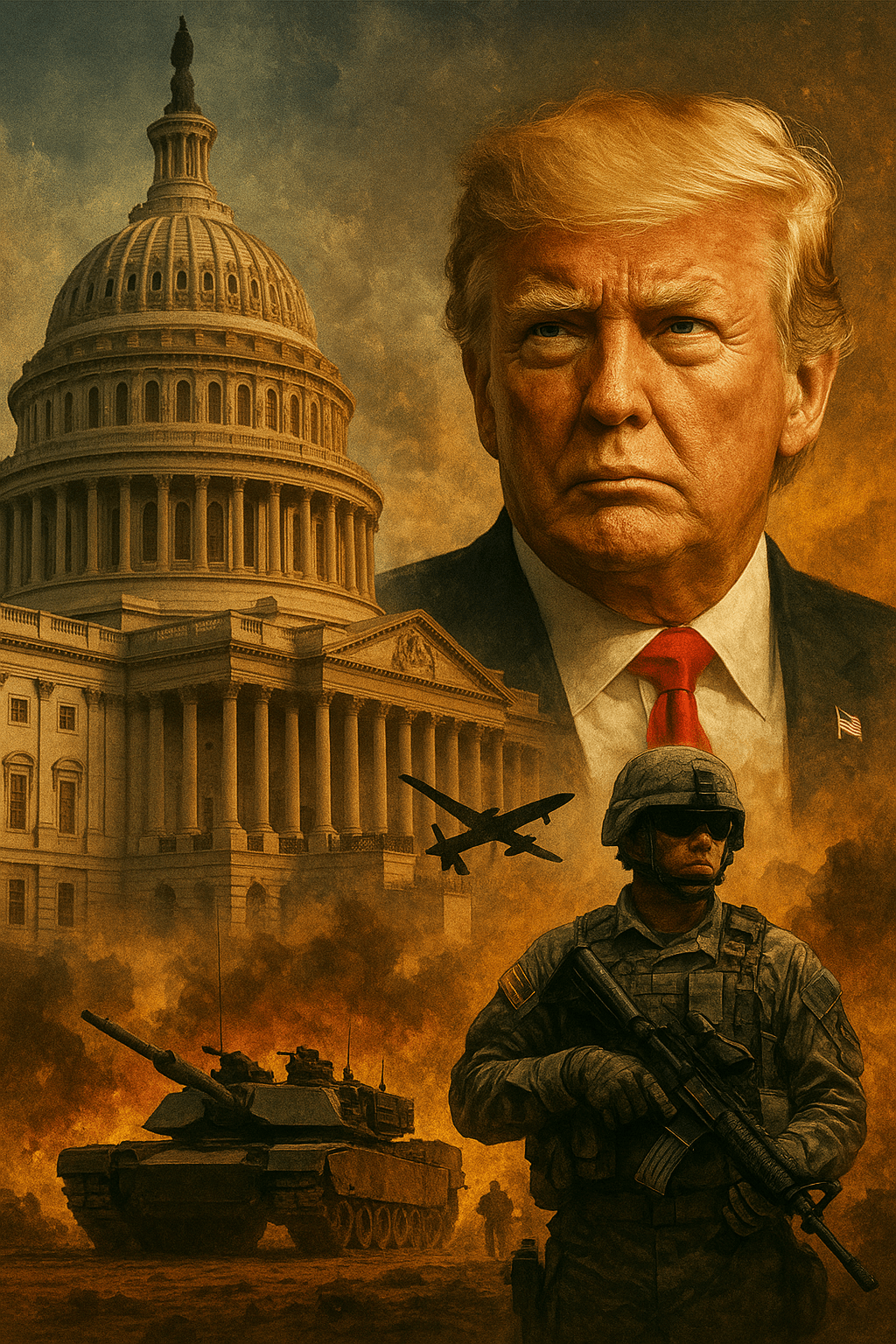
The House vote to roll back old war powers signals not restraint but spectacle—masking bipartisan complicity, a trillion-dollar war economy, and the contradictions of technofascist consolidation.
By Prince Kapone | Weaponized Information | September 12, 2025
Oversight Theater: How ‘Forever Wars’ Become Forever Narratives
On September 11, 2025, Common Dreams ran a piece by staff writer Stephen Prager announcing that the U.S. House voted 261–167 to repeal two aging war authorizations (1991, 2002). The story reads like a sigh of relief: at last, Congress is “taking back” war powers after “years of neglected oversight.” It’s a familiar script—solemn date, bipartisan vote, quotes from respectable experts—crafted to reassure readers that the machinery of empire can be corrected by procedure if we just keep the faith. But propaganda doesn’t always dress in flags; sometimes it wears the soft cardigan of reform. This is oversight theater: the spectacle of restraint that leaves the structure of war intact.
Let’s start with the byline. Prager is presented as a progressive reporter, and he is: see his author page at Common Dreams. The outlet itself is reader-funded and nonprofit, proudly independent of ads and corporate money—read its own description here: Ownership & Funding. None of that is the problem. The problem is class position and horizon. Progressive journalism in the imperial core often lives inside a safe perimeter: it can oppose “forever wars” and cheer “reforms,” but it rarely interrogates the deeper circuitry of militarism—budgets, bases, sanctions, tech platforms, finance—and how those circuits run regardless of which authorizations survive on paper. That horizon shapes how the narrative is built: the system malfunctioned; the system fixed itself; democracy works (again).
Look at who confers legitimacy in the piece. The article cites the “restrainers,” the expert class of cautious dissent—think tankers and advocates whose critique stays well within elite policy lanes. The Quincy Institute’s Adam Weinstein (profile: Quincy Institute) and the Center for International Policy’s Dylan Williams (bio: CIP) appear as the conscience of Washington: critical, credible, and above all compatible with the idea that Congress can be nudged back into its constitutional role. They play a real part in policy discourse. But they also function as stabilizers—interpreters who translate structural domination into “neglected oversight,” a technocratic hiccup with an institutional solution.
This is how the narrative is engineered. First move: framing by relief. The headline promises a break with the past—after “years of neglected oversight,” we finally have a course correction. Second move: personalization without system. Presidents “abused” authorizations; therefore repealing authorizations heals the abuse. Third move: the expert benediction. Think-tank voices bless the moment as a “major development,” which converts a tactical vote into a civil religion sacrament. Fourth move: the vanishing act. What disappears is the living architecture of U.S. war power—appropriations, bases, covert programs, drone doctrines, executive instruments, allied proxies—everything that does the killing while Congress debates the paperwork. Fifth move: the moral offset. The piece acknowledges that strikes still happen without Congress, but the balm is the vote itself—proof that the institution is awake, even if the bombs are still flying. The reader is meant to exhale.
There are other quiet maneuvers. The calendar is weaponized: publishing on 9/11 folds emotion into the copy, coding the repeal as a ritual of democratic purification. The bipartisan tally flatters an exhausted public—if even this Congress can do the right thing, maybe the ship still turns. The article’s moral arc is tidy: authorizations once narrow became stretched; therefore trimming the legal overgrowth restores order. What never gets named is the deeper order—the permanent war economy and its auxiliaries in finance, tech, and logistics—that does not depend on a single page of statutory text to reproduce itself. The result is a soft illusion with sharp edges: the story calms the conscience while the structure remains untouched.
None of this requires malicious intent. Progressive outlets like Common Dreams do real work, and reporters like Prager write under pressure to capture the news cycle. But ideology is not just what you say; it’s what the form of your story cannot admit. When “oversight” is the hero, empire becomes a wayward pupil who can be corrected by the right lesson plan. When “repeal” is the catharsis, the trillion-dollar appropriations and borderless strike doctrines fade into tasteful background. The think-tank citations are not lies; they are liturgy for a politics that wants empire’s excesses curbed without confronting empire’s core. The audience is invited to feel governed again.
So we file this under “gentle propaganda”—not because it shouts for war, but because it sutures the wound with ceremony. The piece tells us that democracy blinked, then opened its eyes. A Marx with a smirk would ask: whose eyes, and who is dreaming? A Chomsky would note the filters: acceptable dissent flows through credentialed sources, while structure stays offstage. A Rodney would insist we track the material base: war budgets, corporate beneficiaries, coercive instruments. Our task, then, is not to scold the reporter but to refuse the trance. The story of repeal is a scene, not the play. The theater of oversight must be excavated until the stage collapses and we can see the machinery beneath.
The Machinery Behind the Curtain: What Repeal Leaves Intact
Strip away the glow of headlines and you find the ledger that matters. Yes—the House voted 261–167 to repeal the 1991 and 2002 war authorizations. But repeal is not law until it clears the Senate, survives conference, and gets a presidential signature (or a veto-proof majority). The Senate can amend or bury the provision, and conference negotiators routinely strip “controversial riders” from the final defense bill. Even the Washington Post and CBS News note that it is unclear whether repeal will survive. In other words, the pageantry came first; the power calculus comes later.
Even if it did survive, the spine of the “forever war” framework remains: the 2001 AUMF. That single statute has been invoked across at least 22 countries by administrations of both parties. It is the legal mule that carries drone wars, special operations, and global “associated forces” justifications wherever the map demands.
Follow the money and the picture sharpens. In the same breath that the House staged “oversight,” it advanced a defense budget that, when combined with related expenditures, would push U.S. military spending beyond $1 trillion for the year. Globally, military spending surged to approximately $2.7 trillion in 2024, with the United States accounting for nearly 37% of that total. Oversight theater changes the headline; appropriations change the world.
The architecture of executive power has also widened year after year—with Congress’s help. A landmark example was the 2012 National Defense Authorization Act, which for the first time codified worldwide indefinite military detention without charge or trial into U.S. law under the banner of counterterror policy. Civil-liberties advocates warned then (and now) that these legal tools migrate inward, a warning underscored by challenges such as Hedges v. Obama.
Across a quarter-century, both parties have renewed, extended, or worked around constraints while raising the Pentagon’s baseline—proof that the machine runs on bipartisan fuel even when the rhetoric du jour says “reform.” In 2025, portions of a Senate reconciliation bill would give the President renewed authority to reorganize agencies broadly and bypass some traditional legislative oversight. Meanwhile, Executive Order 14215 requires independent regulatory agencies to align with White House priorities and submit significant regulations for OMB review, a move described as putting once-independent bodies under direct presidential control.
The war economy is not kept alive by hope—it is kept alive by those sitting in power, often with direct stakes in the spoils. Take Stephen Feinberg, now Deputy Secretary of Defense, who co-founded Cerberus Capital Management—an investment firm with holdings closely aligned with national security priorities—and now helps steer contracts and budgets for those same domains. Russell Vought, one of the architects of Project 2025, has been placed in key administrative roles precisely to institutionalize policies that strengthen the militarized industrial complex’s hold over procurement and regulation. Meanwhile, firms like Palantir are not just vendors—they’re laboratories of policy: expanding in data, surveillance, analytics, and border control contracts in full alignment with Trump’s security agenda. These are not anomalies, but nodes in a network: executive leadership, policy architects, venture funds, and private firms, all with overlapping stakes and incentives. The “personnel question” is thus a structural question: about who draws the patronage lines, who fills the pipelines, and who profits from permanence.
Meanwhile, real-time practice keeps exposing the legal theater. Strikes outside declared war zones continue to be justified on shifting theories of self-defense and interdiction, often without prior congressional authorization—now extending beyond the Middle East into Latin America. Trump’s drone strikes in Venezuela made headlines in September, just weeks after U.S. strikes against Iran. Regional blocs like ALBA-TCP condemned recent U.S. military deployments in the Caribbean, calling them violations of sovereignty and international law, underscoring that “forever war” has not ended but simply mutated.
Put plainly: a House vote to retire two aging authorizations changes the costume, not the choreography. The statute that matters endures; the budgets expand; the executive toolbox grows; the revolving door spins; and operations continue wherever the map is marked “interests.” The press calls it a step toward restraint. Workers, veterans, and the Global South know better: restraint is measured in bombs not dropped, dollars not diverted, and powers actually revoked—not in ceremonial gestures that leave the war machine humming.
Repeal as Ritual: Fracture, Spectacle, and the Hard Truth of Continuity
Let’s be clear from the outset: technofascism is not Trump’s invention. It is a class project. The white ruling class, across its factions, elevated him to preside over consolidation, to give flesh and fury to the policies they had already charted. Militarism, surveillance, austerity, repression—these are not partisan quirks but bipartisan imperatives. The Democrats and Republicans are two hands on the same lever, and the lever pulls toward empire.
Into this reality steps the House vote on repealing the 1991 and 2002 AUMFs. On the surface, it looks like dissent, a break in consensus, a blow against Trump’s war prerogatives. But dig deeper and the lines blur. Everyone knows the bill is unlikely to survive the Senate. Even if it did, the 2001 AUMF—the true backbone of “forever war”—remains untouched. Meanwhile, Congress continues to shovel record sums into the Pentagon, handing Trump more tools to wage war than any of his predecessors. What looks like fissure is often just spectacle, the appearance of restraint to protect legitimacy at home.
Here the colonial contradiction comes into sharp relief. Abroad, the United States maintains its permanent wars of domination. At home, it must pacify its internal colonies and keep the broader working class in line. The House repeal offers the image of accountability, a gesture toward “rule of law,” while war powers remain intact. And even as that vote passed, Trump was deploying the National Guard to “restore order” in targeted cities with heavy concentrations of Black, Indigenous, and Latino populations. For colonized peoples both inside and outside U.S. borders, the message is the same: the spectacle changes nothing material. The same machinery that bombs villages abroad now patrols neighborhoods at home.
The very need for this spectacle signals the crisis of imperialism. Multipolarity advances, legitimacy frays, and the empire leans ever harder on coercion to maintain control. Congress stages dissent not to restrain power but to cover its complicity in expanding it for a quarter century. This contradiction—appearance of restraint versus reality of expansion—isn’t an anomaly. It is the symptom of a system that cannot survive without masking its own decay.
Trump 2.0 embodies the hard consolidation of technofascism. Not every faction of the ruling class is equally comfortable with his blunt methods. Some prefer the cover of “soft power,” of procedure and diplomacy. Others want the open prerogative of war. The House repeal reflects these tactical differences, but not a strategic break. In the end, all factions remain invested in U.S. hegemony. Their only disagreement is over how naked the exercise of power should be—whether to cloak it in ceremony or to flaunt it as force. Either way, the outcome is the same: a permanent war economy at home and abroad, sold as resilience, delivered as domination.
From Spectacle to Struggle: Mobilizing Against the War Machine
The repeal vote in the House is a spectacle, but the contradictions it exposes are real. For the people of the world, the lesson is not that Congress has rediscovered its conscience, but that the U.S. ruling class is forced to stage rituals of oversight precisely because its legitimacy is cracking. This is where mobilization begins—not with faith in the imperial legislature, but with solidarity among the forces already resisting its endless wars. Across the Global South, states and movements are building alternatives: BRICS+ experiments with cross-border payment systems, G77 declarations against sanctions, and the refusal of Africa’s Sahel alliance to bend to NATO’s dictates. These are not abstract gestures; they are live counterweights to Washington’s war economy, rooted in the demand for sovereignty and multipolar cooperation.
In the Global North, responsibility falls on us to weaken the war machine from within. The military-industrial complex is not an abstraction—it is Lockheed Martin, Raytheon, and Northrop Grumman cashing trillion-dollar checks approved by “anti-war” liberals as well as fascist Republicans. Campaigns demanding divestment from weapons corporations, like those led by CodePink’s Divest from the War Machine initiative, point one direction forward. Unions of teachers, transport workers, and healthcare staff—already suffocated by austerity—can refuse to carry the burden of war budgets that rob schools and hospitals to feed contractors. Tech workers, who see their algorithms weaponized for drone strikes and surveillance, can build on the precedent of the Google Project Maven walkouts to expand a proletarian refusal inside the digital battlefield.
And for colonized nations within the empire, the struggle is already in motion. From Native resistance to militarized land seizures, to Black communities targeted by National Guard “cleanup” deployments, to immigrant movements fighting deportations and raids, the frontlines of empire run straight through the neighborhoods of the oppressed. Linking these internal colonies to the wider world of anti-imperialist struggle is not charity—it is necessity. The same drones that hover over Gaza were tested in Ferguson. The same financial blockades strangling Venezuela also keep Puerto Rico in debt peonage. Every struggle here contains the seeds of a global front.
The House can repeal this or that authorization, but it cannot repeal the will of the people to rise. The real answer to Trump’s war powers is not parliamentary procedure—it is mass refusal. Refusal to pay for the bombs, refusal to build the weapons, refusal to staff the wars. Resilience, in the hands of the people, is not the empire’s buzzword—it is the stubborn insistence on life, on liberation, on a socialist horizon. From São Paulo to Bamako, from Manila to Minneapolis, the call is the same: turn the crisis of imperialism into the graveyard of empire, and build a world fit for the living.
 Weaponized Information
Leave a comment