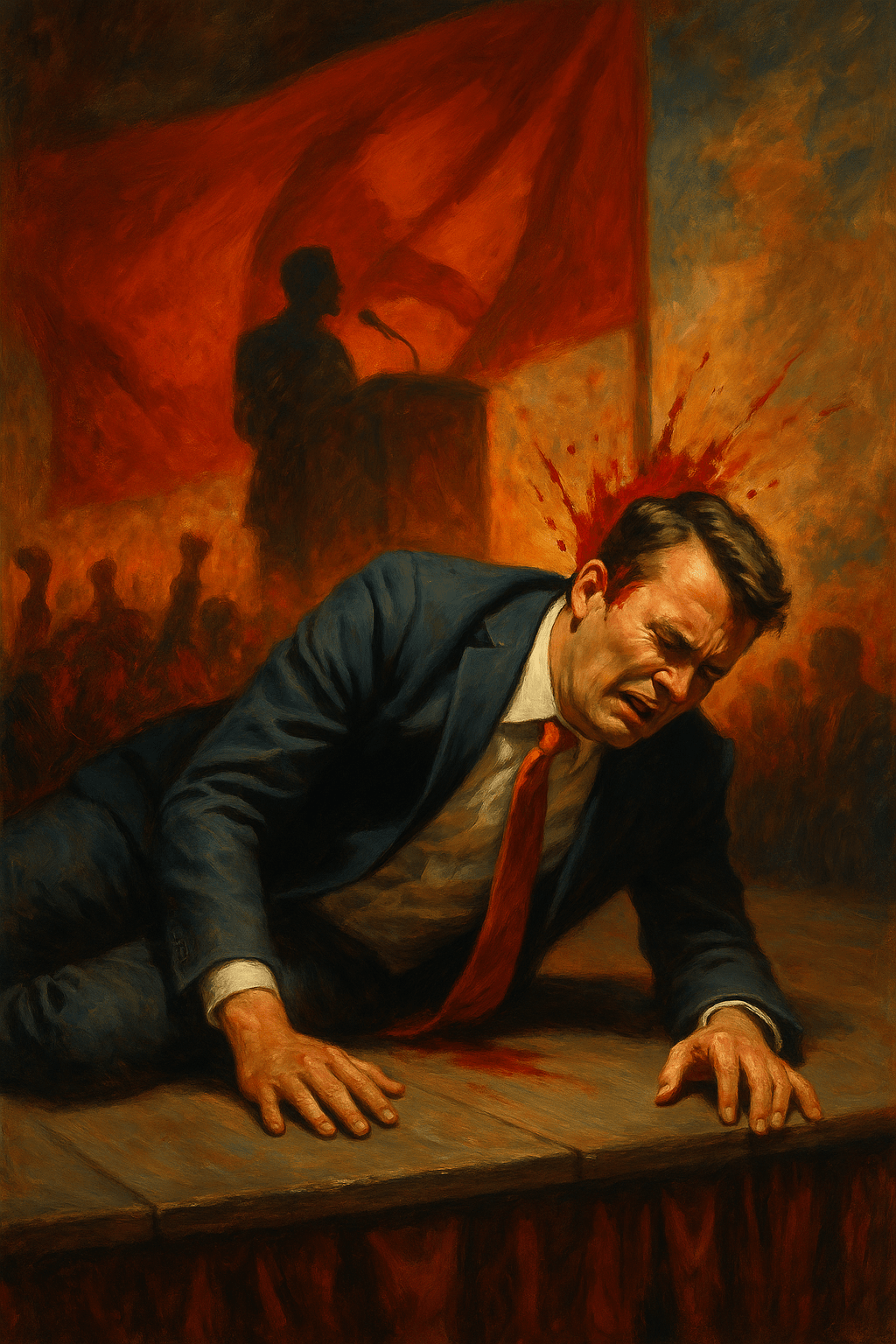
His life was an arsenal of propaganda, his death a gift to the ruling class. The empire mourns its guards while erasing its captives. Liberalism launders violence into opinion, reaction recasts repression as free speech. Breaking the spell means naming the violence and standing with the oppressed.
By Prince Kapone | Weaponized Information | September 11, 2025
The Meaning Will Be Decided From Above
The gunfire that ended Charlie Kirk’s life was quickly drowned out by a louder machinery: cameras, headlines, and statements that tell the public what to feel. From the first alerts, the story hardened into a script—shock, grief, a “nation on edge.” But spectacle is not meaning. Meaning is produced by those who own the microphones, and they are already busy converting a man’s death into political leverage.
In life, Kirk’s job was to make empire feel like common sense: to take the rough metal of state violence and lacquer it with words like “security,” “order,” and “freedom.” He disciplined the white petty bourgeoisie into loyalty through culture war parables, turning fear into a civic virtue and cruelty into responsibility. In death, the same function continues with higher voltage. He will be recoded as a martyr of “free speech,” as though the targets of his rhetoric were not real people but abstract ideas. The apparatus will invert cause and effect, washing away the harms his work normalized and foregrounding only the harm done to him.
This is not a rupture; it is an accelerant. A propaganda state thrives on sanctified casualties, especially when the fallen served as its ideological police. The narrative will not ask who bled under the policies he advanced; it will ask how quickly new laws, new budgets, and new digital walls can be justified in his name. The conclusion writes itself in their lexicon: tighten the net, crush dissent, declare the enforcers victims and the victims suspect. That is how meaning is decided from above—and why we must refuse their script.
Kirk as Infrastructure of Ideology
To treat Charlie Kirk as a man with “different opinions” is to miss the point entirely. He was not a quirky pundit in a marketplace of ideas; he was infrastructure—an assembly line foreman in the manufacture of consent. The job was simple and ruthless: convert anxious students and suburban parents into reliable foot soldiers of empire, one clip, one campus, one conference at a time.
Turning Point USA functioned like a cultural factory. It scouted, trained, and distributed talking points with the efficiency of a logistics firm. Ten-second videos carried pre-polished arguments into millions of feeds; campus events recruited cadres; donor circuits underwrote scale. Kirk’s value wasn’t originality—there was none—but throughput. He translated blunt instruments into dinner-table language: deportations as “border security,” surveillance as “safety,” classroom gag orders as “parental rights.” By laundering the state’s coercion into everyday virtue, he helped reroute the white petty bourgeoisie away from solidarity and toward disciplined reaction.
Seen this way, Kirk was less a personality than a relay. The current flowed from boardrooms and war rooms through his circuits and into households where policy becomes instinct. And that is why his death matters to the ruling class: you don’t just lose a commentator; you risk a gap in the conveyor belt. The logical response from above will be to memorialize the relay and expand the plant—more funding, tighter laws, louder sirens—so the line never stops. Our response must be the opposite: expose the factory, break the spell, and rebuild the instinct for solidarity that his operation was designed to erase.
Kirk’s Arsenal of Ideological Violence
Charlie Kirk’s power did not lie in invention but in repetition. His speeches, tweets, and soundbites were less arguments than weapons—ideological munitions mass-produced for endless deployment. To his followers, they looked like common sense; to the targets, they carried the sting of delegitimization and exclusion. What he built was not a library of ideas but an arsenal of violence, stocked with slogans sharp enough to wound but simple enough to memorize.
Central to this arsenal was the “Great Replacement” lie, a paranoid fantasy that cast demographic change as an existential threat to white America. Wrapped in populist cadence, it transformed migration into invasion and neighbors into enemies, normalizing the politics of exclusion. He coupled this with relentless revisionism: denying white privilege, twisting Civil Rights into a story of national redemption rather than colonial rebellion. In this frame, the oppressed became ingrates, and the arc of U.S. history bent not toward justice but toward absolution for the settler. His attacks on Diversity, Equity, and Inclusion policies followed the same pattern—mocking “qualified Black pilots” was not a joke but a cultural signal that competence itself was racialized, that safety meant exclusion, that trust belonged only to whiteness. Add to this his disparagement of George Floyd, Martin Luther King Jr., and any figure who embodied resistance, and the pattern is clear: assassinate reputations to weaken movements. For Muslims, immigrants, and refugees, his words were even blunter: Islamophobia painted them as civilizational enemies, legitimizing surveillance and militarization at home and abroad.
None of this was abstract. Words condition action. By teaching audiences to laugh at colonized competence, to sneer at Black resistance, to fear demographic change, Kirk’s rhetoric prepared the ground for policies that cage, deport, disenfranchise, and kill. To call this “different views” is like calling artillery “debate.” It is ideological violence—violence that travels by meme and microphone but lands in laws, prisons, and graveyards. His arsenal did not gather dust; it was fired daily into the fabric of public life, softening the ground for harder weapons to follow. That is the measure of his role: not a man of ideas, but a man of ammunition, manufacturing consent for the empire’s permanent war against the oppressed.
Liberal Laundering of Violence
After the smoke cleared, the media began its alchemy. Charlie Kirk, who spent his career sharpening words into blades, was swiftly recast as a man of “different views.” News anchors spoke of disagreement, not domination; of debate, not discipline. The narrative slid effortlessly from the brutality of his rhetoric to the banality of political difference. This was not sloppy journalism but deliberate laundering, the liberal specialty of taking reactionary violence and rinsing it into the language of pluralism.
In this sanitized frame, the assassination is treated as an assault on democracy itself. To kill Kirk, they tell us, is to attack the right to speak freely. But what gets erased is who he was speaking against, and what his speech was meant to secure. The young migrants hounded by ICE, the Black workers policed into poverty, the queer students stalked by censorship laws—all disappear from the storyline. Liberalism’s great trick is to flatten the field: Kirk becomes a voice in the “marketplace of ideas,” and those he targeted vanish as though they were never there. By turning repression into opinion, liberal discourse extends the reach of the very violence it claims to oppose.
The result is an inversion. A man who legitimized the surveillance, exclusion, and humiliation of the oppressed is now painted as a casualty of intolerance. His speech is framed as precious, his life’s work reframed as a contribution to democracy. This laundering operation ensures that the propaganda cycle continues: Kirk’s death is not about the colonial violence he championed, but about the supposed fragility of dissent in America. By hiding the substance of his words and highlighting only the fact of his silencing, the liberal narrative grants him a halo. And in doing so, it hands the ruling class the perfect weapon: the ability to defend reactionary violence as free expression, and to brand resistance to it as authoritarian.
The Colonial Contradiction Laid Bare
The spectacle of Kirk’s assassination has revealed a truth that is usually hidden: in America, not all lives carry equal weight. His death was treated as a national crisis, an emergency that shook the republic. Candlelight vigils, urgent press conferences, and wall-to-wall coverage announced his value to the system. But contrast this with the silence surrounding the lives cut short in Gaza, the migrants who suffocate in trucks at the border, the children gunned down by police in U.S. streets. Their deaths are not met with vigils or prime-time eulogies. They are normalized, forgotten, folded into the cost of doing business in a settler empire. The calculus is stark: the life of an ideological enforcer is sacred, the lives of the colonized are disposable.
This asymmetry is not accidental—it is the operating principle of technofascism. Kirk’s death is inflated into proof that the system itself is under siege, while the structural violence he amplified disappears into background noise. His martyrdom masks the blood that built the foundations of this society: the enslaved Africans who generated its wealth, the Indigenous nations driven to near-erasure, the migrants funneled into precarious labor, the foreign civilians vaporized by drones. When the empire mourns Kirk, it is mourning one of its own guards, not one of its captives. His death is treated as evidence of disorder, while their deaths are the maintenance of order.
To name this contradiction is to expose how legitimacy is secured. By grieving its enforcers and ignoring its victims, the system naturalizes its violence and sanctifies its agents. The colonial contradiction—where the colonizer’s life is precious and the colonized life expendable—is what allows technofascism to claim moral high ground even as it tightens the chokehold. Kirk’s assassination lays this bare: his life becomes a symbol for the fragility of “democracy,” while the uncounted dead of empire remain invisible. If we accept this script, we accept the inversion of reality. If we break it, we refuse to let the blood of the colonized be erased in service of the colonizer’s mythology.
The Assassination’s Propaganda Afterlife
The assassination itself was a single act, over in seconds. Its afterlife, however, is designed to endure. From the moment Kirk’s body hit the floor, the gears of propaganda began turning, scripting his death into a parable. The refrain was immediate: a “nation on edge,” a democracy imperiled, dissent itself under attack. The framing was not about what Kirk represented in life, but about how his death could be weaponized in the struggle for control of the narrative. His silencing was rewritten as a warning, a rallying cry, a justification for intensifying repression.
Already his absence is being recoded into proof that reactionary voices are unsafe, that to hold “conservative” views is to risk martyrdom. The inversion is complete: those who built careers silencing and delegitimizing the oppressed are cast as the silenced, the endangered. This mythology becomes fuel for new campaigns—more surveillance on campuses, tighter censorship online, harsher punishments for protest. The ruling class knows how to turn grief into policy, and Kirk’s death provides the raw material for another round of law-and-order politics dressed in the language of protection. By making his death the centerpiece, the state gains permission to expand its arsenal against those who resist, while elevating his life as a model worth defending.
In this way, Kirk does not vanish with the grave. He multiplies. His image circulates with greater reach than his speeches ever did, his voice replayed as a symbol of fragility rather than force. The propaganda machine ensures that his ideological project is amplified, not interrupted. To understand this is to see the true danger: the man is gone, but the apparatus has been fed a perfect narrative—one it will use to tighten the noose around dissent while presenting itself as the victim. That is the afterlife of assassination under technofascism: death turned into legitimacy, violence transmuted into sanctity, the empire strengthened by the blood of its own enforcers.
Ramifications and Strategic Lessons
The assassination of Charlie Kirk is not an isolated rupture but a symptom of U.S. political decay. A republic built on settler violence and imperial plunder is staggering under its own contradictions, and the ruling class is scrambling to manage the fallout. Kirk’s death provides them a convenient accelerant: an excuse to intensify repression, militarize culture, and reinforce the very order he helped secure in life. What looks like chaos on the surface is, for those in power, an opportunity to tighten the screws.
Within the ruling class itself, the factions move in predictable formation. The Cowboy–Digerati bloc, already ascendant under Trump 2.0, seizes the chance to rally the white petty bourgeoisie around law-and-order politics. They turn Kirk’s image into a rallying flag, proof that their foot soldiers are under attack and must be defended at all costs. The Yankee bloc, wary of uncontrolled polarization but equally invested in stability, lends cautious support. For them, martyrdom politics risks destabilizing the system, but they will not stand aside when their rivals use the crisis to expand surveillance and repressive tools that serve the whole class. In this sense, Kirk’s death becomes a point of convergence: factions may disagree on tactics, but they share an interest in ensuring that ideological enforcers are sanctified, not scrutinized.
The danger lies in the mythology of martyrdom itself. Once canonized, Kirk’s ideological project lives on with greater force than his speeches could ever achieve. His arsenal of ideological violence is preserved, but now wrapped in the aura of sacrifice. This demands clarity from below. The strategic lesson is simple but urgent: we must refuse to treat ideological violence as opinion, refuse to mistake propaganda for debate, and refuse to let the death of an enforcer obscure the lives destroyed by the empire he served. The path forward requires exposing ideological violence for what it is—violence—and organizing against the apparatus that launders it into legitimacy. Only then can we prevent his memory from becoming another weapon in the arsenal of technofascism.
Breaking the Spell
Charlie Kirk’s assassination is already being woven into the fabric of empire, not as a reckoning but as a reinforcement. In life, he practiced ideological violence: teaching Americans to see immigrants as invaders, Black resistance as criminality, and dissent as treason. In death, he is being polished into a martyr of “free speech,” a symbol that erases the lives he helped target and sanctifies the system he defended. The contradiction is grotesque but familiar: the empire mourns its guards while ignoring its captives.
To accept this framing is to live under hypnosis. Liberal discourse whispers that Kirk was just a man of “different views,” while reactionaries scream that he was struck down for daring to speak the truth. Both versions obscure the reality that his words were weapons, that his speeches conditioned violence, that his career was an assembly line for reaction. To call this free expression is to call the whip a form of dialogue. Breaking the spell means refusing their definitions, refusing their flattening, and naming what Kirk represented: an ideological relay for a system built on colonial domination.
The real struggle has never been between “opinions.” It is between an empire enforcing colonial violence and the global working class fighting for liberation. Kirk’s life was a reminder of how ideology is weaponized to discipline the petty bourgeoisie and criminalize the oppressed. His death is a reminder of how the ruling class turns even tragedy into leverage. To honor the truth is to resist both: to strip away the halo, name the violence, and commit ourselves to the side of the oppressed. Only then do we break the spell that propaganda has cast over his life, his death, and the future they want to build from it.
 Weaponized Information
Leave a comment