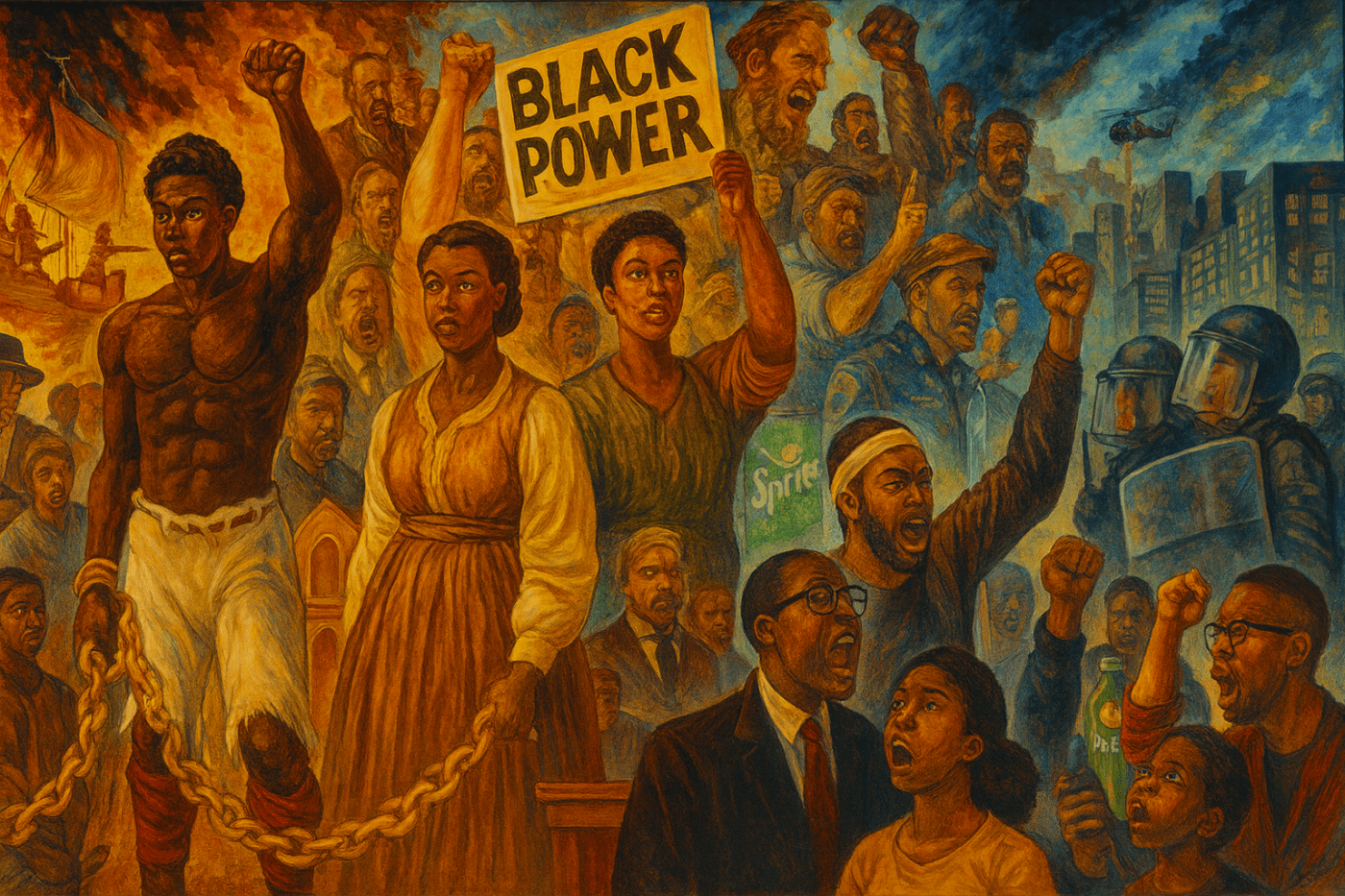
From genocide and slavery to neoliberal globalization and Trump 2.0, the United States has never been a multiracial democracy—it has been a settler empire. To fight it demands clarity: nation and class cannot be separated.
By Prince Kapone | Weaponized Information | September 8, 2025
Preface
This essay is a preliminary sketch of what I have spent my life preparing to write. Ever since I first became radicalized, I have recognized the race/class dialectic as the central problem of building a revolutionary movement inside the United States. No other contradiction so decisively shapes the terrain of struggle. From the birth of the republic in genocide and slavery, to the betrayals of Reconstruction, to the rebellions of the 1960s, and now to the crisis of technofascism, the entire development of this empire has been conditioned by the way race and class have been fused into one structure of colonial domination.
To understand the United States is to understand this dialectic. The settler nation has always been the main base of reaction, and the colonized nations have always been the vanguard of resistance. The tragedy of the U.S. left has been its failure—time and again—to grasp this reality, to place national liberation at the center of class struggle, and to recognize that solidarity is not sentimental but material, not rhetorical but revolutionary. This failure has cost generations of movements their chance at victory.
And yet, history is not static. The objective conditions of our moment are new. The settler compact is breaking down, the ruling class is unified only through fear, and the colonized remain ungovernable despite prisons, borders, and surveillance. For the first time in decades, the possibility of a multinational, anti-colonial, socialist rupture inside the empire is no longer a dream but an objective tendency. To seize it requires clarity, courage, and organization.
This essay is my modest contribution to that struggle. It does not pretend to be final, nor to speak for all who have carried this fight. It is offered as a weapon, forged from history and sharpened by theory, in service of the oppressed. If it helps even a few to see more clearly, to fight more fiercely, and to defect from the settler order into solidarity with the colonized, then it will have done its work. The rest belongs to struggle itself.
The Urgency of Clarifying Nation and Class in 2025
Welcome to America, 2025: a settler empire staggering under the weight of its own contradictions. The economy buckles, the empire’s reach shrinks, and the ruling class responds with its oldest reflexes—more repression at home, more plunder abroad, and a blizzard of propaganda to keep people divided, pacified, and confused. The mask of democracy is cracked, and what seeps out is not freedom but counterinsurgency.
Liberal politicians and corporate managers insist the “racial problem” can be solved with cosmetics: another diversity hire, a rainbow flag hung over Wall Street, or a Black CEO running a weapons firm that bombs the Global South. Chevron sponsors Juneteenth, Raytheon preaches equity, and Lockheed Martin waves the Pride flag while raining fire on Yemen. That is liberalism’s bargain: representation without liberation, spectacle without substance. The seating chart changes, the empire remains.
On the other side, the class-reductionists—mostly white, mostly male, endlessly insistent that “race is a distraction”—pretend history begins when the white worker clocks in. Everything before—the genocide of Indigenous peoples, the chains of slavery, the annexation of Mexico—is treated as unfortunate preface. They tell us the Euro-American settler is as exploited as a Congolese cobalt miner or a Bangladeshi garment worker, as if centuries of colonial plunder never happened. This is not Marxism. It is historical amnesia dressed up as class analysis.
Both of these positions collapse under scrutiny. They erase how capitalism and empire actually function. What is called “race” in the United States is not a misunderstanding of skin color—it is the political architecture of colonial domination. The U.S. was never a “multiracial democracy.” It has always been a prison house of nations, where the Euro-American settler nation rules over colonized nations—African (New Afrikan), Indigenous, Chicano/Mexicano, Puerto Rican, and others.
From the beginning, “whiteness” was not biology—it was allegiance. It was the bribe offered to poor Europeans: you will not be enslaved, you will not be exterminated, you will be made a settler. That is why Euro-American workers became strikebreakers, lynch mobs, and slave patrols. Whiteness was not color but contract—signed in blood, enforced in law, and paid out in stolen land and wages skimmed from the oppressed.
And yet—that allegiance was never total. Some poor Europeans defected: they fled to maroon communities, aided fugitives, or stood with the colonized. John Brown and his comrades struck slavery’s heart at Harpers Ferry. Abolitionists defied families and governments to smuggle the enslaved to freedom. In the 20th century, white radicals joined hands with Black, Chicano, Puerto Rican, and Indigenous militants—the Young Patriots in the Rainbow Coalition, Wobblies on the docks with Ben Fletcher, the May 19th Communist Organization, the George Jackson Brigade. They were never the majority, but they mattered. They proved allegiance is historical, not biological; contingent, not destiny. A Euro-American cannot shed their skin, but they can shed their contract. That is the measure of redemption.
This first installment of our Race/Class 101 series equips us with that clarity. We trace how capitalism was born in genocide and slavery, how it organized nations into rulers and ruled, and how it has reinvented itself—from plantation to prison, overseer to algorithm, Jim Crow to technofascism. We dismantle false debates, expose ruling-class lies, and sharpen the tools we need to fight.
Because the ruling class already knows what too many on the left deny: nation and class cannot be separated. The colonized have always been the vanguard of struggle. The Euro-American settler has always been the main base of reaction. But history is not fate. Cracks can widen into rupture. And rupture will not come from abstract appeals to “class unity.” It will come from national liberation inside the empire, and from settlers choosing defection over loyalty.
That is why we write. That is why we fight. And that is why we begin here.
Capitalism Born in Blood
Capitalism did not sprout from Europe like a tree nurtured by thrift and ingenuity. It was baptized in fire, born in the genocidal conquest of Indigenous nations, the kidnapping and enslavement of Africans, and the pillage of Asia and the Americas. The fairy tale taught in business schools—that free markets flowered naturally from feudal soil—is a lie. Primitive accumulation was not thrift. It was armed robbery on a planetary scale.
Europe declared itself “civilization” while waging a world war against humanity. Its ships crossed oceans with cannons and crosses, enslaving millions, plundering cities, and hauling mountains of silver and gold across the Atlantic. Thriving societies were shattered so that London’s banks and Amsterdam’s merchants could swell their treasuries. The Aztec and Inca empires, the great civilizations of the Americas, were annihilated. Africa was carved up, not because it lacked history, but because it was rich in land and people who could be stolen, sold, and worked to death. Asia was ransacked, not because it was backward, but because it was too advanced—too powerful to tolerate—and so had to be broken so that Europe’s capitalist upstarts could rise.
In the Americas, settler colonialism was not migration. It was invasion. The Euro-American nation was forged in the extermination of Indigenous peoples and the enslavement of Africans. These were not tragic side effects. They were the foundation stones of capitalism itself. Without stolen land and stolen labor, there would be no “West.” What Marx called “primitive accumulation” was, in truth, a global counterrevolution: the violent interruption of communal systems, the smashing of societies that had fed and clothed themselves without landlords, stock exchanges, or hedge funds.
And yet every lash of the whip, every enclosure of land, every massacre bred its opposite. Africans and Indigenous fugitives built maroon communities in swamps and mountains, defying empire. Revolts erupted on slave ships, plantations, and in colonial towns. Indigenous nations fought back from the Andes to the Great Plains. Pirates turned their guns on the very empires that birthed them, carving fragile commons on the high seas. Even some Europeans—runaway servants, deserters, religious radicals—defected to join maroons or Indigenous communities. These cracks, though small, proved that loyalty to empire was not natural law but enforced allegiance, and that betrayal of whiteness was always possible.
The European assault on the world did more than fill treasuries. It built the racial-national order we still live under. The Euro-American settler nation consolidated itself as both beneficiary and enforcer of global theft. The African Nation in America was forged in chains, denied sovereignty, yet became the indispensable proletariat whose labor built the wealth of empire. Indigenous nations were targeted for extermination but survived centuries of war, still fighting for sovereignty. The Chicano/Mexicano nation was born of annexation and dispossession, its labor conscripted under settler rule. These were not abstract “races.” They were nations, forged in the furnace of colonial domination, still living within the prison house of empire.
Capitalism was not born clean. It was born drenched in blood. And the blood still runs. To understand its evolution, we must hold to this simple truth: the so-called modern world was built on corpses—overwhelmingly the corpses of the colonized. Yet alongside the graves, cracks in empire’s wall endured: the maroons, the rebels, the defectors. Even at capitalism’s birth, resistance lived, and history remained contested.
Whiteness Forged: Settler Colonialism and the Birth of the Euro-American Nation
The conquest of the Americas did not simply create colonies—it created a new people. The poor Europeans who crossed the Atlantic did not remain peasants, servants, or wage laborers. They were drafted into a project larger than themselves: they became settlers. The Euro-American nation was not born of shared culture or skin tone. It was forged as a political allegiance, a bargain between capital and the European underclasses: side with empire and you will be lifted above the colonized; resist, and you will be crushed with them.
This was no metaphorical bargain. It was carved into law and enforced in blood. In the earliest decades, Africans, Indigenous peoples, and European servants sometimes resisted together—running away, fighting side by side, even forming maroon societies. But after Bacon’s 1676 rebellion—a settler uprising demanding not equality but more genocide of Indigenous nations—the colonial elite drew their lesson. Their solution was the invention of whiteness: permanent African slavery paired with privileges for Europeans, however poor.
Laws codified the line. Africans could be enslaved for life; Europeans served fixed terms. Africans’ children inherited bondage; Europeans’ children inherited freedom. Africans were stripped of arms; Europeans were armed to the teeth. To the planter class, the message was clear: bind poor Europeans to empire by giving them status above the colonized. They were conscripted not only as workers but as a militia—armed patrols, lynch mobs, and colonial police. From this moment, the “white working class” was not simply a class in conflict with capital. It was the junior partner of a settler project, rewarded for its loyalty with stolen land and the right to stand above the colonized.
And yet—even here, cracks appeared. Some Europeans rejected the bribe. Runaway servants joined maroon communities; Irish and Scots fugitives fought alongside Africans; dissident sects resisted the colonial order. They were never the majority, but their defiance proved that whiteness was not destiny. It was a contract, signed under duress, upheld by law, and backed by terror. Those who defected showed that betrayal was possible, even in the system’s infancy.
Still, the dominant tendency held firm. Most settlers accepted the bargain. They became slave patrols, lynch mobs, militias, strikebreakers. They policed plantations, expelled Indigenous nations, and crushed labor uprisings that dared to cross the color line. The material bribes of whiteness—land allotments, legal protections, wages pried from the colonized—were too powerful a tether. This was the original “American Dream”: even the poorest European could rise above the colonized so long as they clung to the settler nation.
This is how the Euro-American nation was born—not as a biological race, but as a colonial project. Its working class was shaped less by solidarity with the oppressed than by complicity in their subjugation. And yet, from the very beginning, cracks in the edifice proved allegiance was never absolute. What history makes, history can unmake. The settler contract was powerful, but it was not eternal.
Nineteenth Century: Slavery, Indigenous Wars, and the Making of a Prison House of Nations
By the nineteenth century, the architecture of U.S. capitalism stood revealed in blood and iron. The African Nation was shackled to the plantation, producing the cotton, sugar, and tobacco that fed both the mills of New England and the factories of Britain. Indigenous nations were locked in a rolling war of extermination sanctified as “Manifest Destiny.” And when the United States seized half of Mexico’s territory in 1848, it created yet another colonized people within its borders—the Chicano/Mexicano Nation—dispossessed of land and conscripted into the lowest rungs of labor. What textbooks call “westward expansion” was, in fact, empire expanding inward, swallowing nations whole.
Slavery was no regional anomaly. It was the beating heart of global capitalism. New England’s textile mills devoured Southern cotton; Northern banks financed plantations and insured enslaved people as property; Wall Street speculated on slave-backed mortgages. Every bale of cotton shipped from New Orleans was a transfusion of blood into the arteries of Yankee capital. The wealth of the U.S.—North and South alike—was built on the backs of an African proletariat chained in bondage.
Meanwhile, Indigenous nations faced annihilation at the barrel of a settler gun. The Seminole Wars, the Trail of Tears, the Long Walk of the Navajo, the extermination campaigns in California—each was another chapter in a single war of conquest. Treaties were lies, coexistence a prelude to expulsion. The slogan of the settler republic was clear: the only good Indian is a dead Indian. And yet, from the Great Plains to the Pacific, Indigenous nations resisted with fire and defiance, refusing to vanish as empire demanded.
The conquest of Mexico revealed the same logic. One day communities were landowners; the next they were squatters on their own soil. Mines, ranches, and farms were seized by settlers; Mexican labor was racialized, made cheap and disposable. The Chicano/Mexicano Nation was not born of migration but of conquest, its people forced into colonial subordination within a settler state that pretended they were foreigners.
The Civil War laid bare these contradictions. It was not a noble crusade but a clash between two capitalist models: the slave oligarchy of the South and the wage-labor regime of the North. Emancipation came not from Lincoln’s benevolence but from the enslaved themselves. Hundreds of thousands escaped plantations, joined Union lines, and turned a war for union into a war for freedom. They were the revolution within the revolution. As Du Bois would later insist, the general strike of the enslaved was the decisive blow that toppled the Confederacy.
Yet the settler masses largely clung to whiteness. Irish immigrants in New York rioted against the draft, lynching Black people rather than risk solidarity. Union soldiers occupied the South not to build Black sovereignty but to secure settler expansion. Still, cracks appeared: abolitionists on the Underground Railroad, John Brown at Harpers Ferry, William Lloyd Garrison denouncing his own class, the Grimké sisters turning against their planter kin. These acts were fragile, rare, but they mattered—they proved that betrayal of whiteness was possible even in the century most defined by settler domination.
The nineteenth century left no illusions. The United States was never a free union of citizens. It was a prison house of nations. The African, Indigenous, and Chicano/Mexicano peoples resisted in fire and blood, while the Euro-American settler nation entrenched its allegiance to empire. And yet, history insists: the colonized were never passive victims. They were the motor of revolution. Every gain—from emancipation to Reconstruction—was pried not from generosity, but from struggle, aided at the margins by settlers willing to burn their contract with empire.
Reconstruction and Counter-Reconstruction: A Revolution Betrayed
The end of the Civil War opened the most radical experiment in U.S. history. For the first time, the African Nation—long enslaved, long colonized—stood on the threshold of sovereignty. Reconstruction was not about stitching the Union back together. It was about redefining power itself. Four million Africans emerged from slavery not as scattered individuals but as a people demanding land, dignity, and the fruits of their labor. In the ashes of the plantation system, they built schools, cooperatives, churches, militias, and governments. They did not beg for inclusion. They moved to seize power.
The Freedmen’s Bureau, underfunded and sabotaged, still became a laboratory of liberation. It redistributed abandoned land, defended labor contracts, built hospitals and schools. Reconstruction governments—anchored by freedpeople, Radical Republicans, and some poor white farmers—rewrote constitutions, expanded suffrage, and created the South’s first systems of public education. Black representatives, many formerly enslaved, took seats in state legislatures and Congress. In South Carolina, a Black-majority legislature passed reforms unmatched until the 20th century. Armed Black militias defended communities against planter terror. This was not charity from above. It was revolution from below.
But the revolution faced a fatal contradiction: the Euro-American settler nation—North and South—would not accept Black sovereignty. Northern capital wanted profits, not freedom. Poor Euro-Americans, given the choice between solidarity and whiteness, chose whiteness. They joined the Ku Klux Klan, the White Leagues, the Red Shirts. They became foot soldiers of counterrevolution, torching schools, lynching teachers, massacring militias. In 1873 at Colfax, Louisiana, more than a hundred Black defenders of a multiracial government were slaughtered. This was not an exception. It was the template for Redemption.
Still, cracks appeared. Some poor whites, radicalized by war and poverty, stood with Black communities. Radical Republicans defended Black suffrage and land redistribution in Congress. White teachers risked death to spread literacy. Union veterans joined Black militias in defense. These alliances were fragile, often drowned in blood, but they proved settler allegiance was not unbreakable under revolutionary pressure.
The federal state faltered, then retreated. The 14th and 15th Amendments promised equal protection and voting rights, but without enforcement they were paper shields. In 1877, the Compromise traded the presidency for troop withdrawal. Reconstruction was not abandoned because it failed. It was abandoned because it succeeded too well. The African Nation had risen, and the settler order struck back.
Counter-Reconstruction came swift and brutal. Jim Crow locked Black people into a caste system of colonial domination. Sharecropping and debt peonage replaced slavery, binding families to land they did not own. Convict leasing turned prisons into slave markets under another name. Lynch mobs enforced terror, ensuring the African Nation remained chained even after emancipation. The dream of “forty acres and a mule” was buried under white violence and Yankee capital.
Yet Reconstruction left a scar that never healed. It proved another America was possible—an America where the colonized seized power, where multiracial democracy was reality, not rhetoric. For twelve years, the African Nation rose as a revolutionary subject. It was betrayed not by weakness, but by the unbroken loyalty of the Euro-American nation to empire. That loyalty, enforced by terror and rewarded with privilege, crushed the most radical democratic project in U.S. history.
Reconstruction ended in counterreconstruction. But its lessons endure: the colonized cannot rely on the settler state for freedom. Solidarity with Euro-American workers is possible, but never guaranteed. It must be fought for against the weight of history. For every betrayal, there were cracks—Radical Republicans, poor whites in Black militias, teachers spreading literacy. Fragile, yes—but real. Reconstruction was drowned in blood, but not erased. Its ghost still walks, haunting every claim that the United States was ever a democracy.
Racial Capitalism Consolidated: 1877–World War I
With Reconstruction drowned in blood, the United States entered a long night of racial dictatorship. The African Nation was locked into Jim Crow segregation, debt peonage, and terror. Indigenous nations were herded onto reservations at gunpoint. The Chicano/Mexicano Nation endured systematic land theft and economic displacement after annexation. Meanwhile, the Euro-American settler nation—from its working class to its elite—tightened allegiance to empire. The period from 1877 to the First World War was not a flowering of democracy but the cementing of a prison house of nations.
For the African Nation, the counterrevolution was ruthless. Sharecropping and convict leasing replicated slavery in new forms. Railroads and mines were built on Black laborers shackled by debt or leased out of prisons. Terror was the enforcement mechanism: between 1880 and 1930, thousands were lynched in public spectacles of settler power. The Wilmington coup of 1898 laid the truth bare: when Black-led governments threatened white supremacy in North Carolina, mobs—backed by elites—burned them out, massacred resisters, and installed white rule at gunpoint. Democracy was not denied. It was overthrown.
The Euro-American working class was not bystander but accomplice. Unions were built to exclude. The American Federation of Labor hardened the color line, protecting white wages while locking out Black, Mexican, Chinese, and Indigenous workers. When class anger boiled over, it was often deflected into settler violence. In 1908, white workers in Springfield, Illinois torched Black neighborhoods and lynched Black residents. This was no accident. It was the pattern: class struggle rerouted into racial pogrom, preserving capital while crushing solidarity.
Even the celebrated socialists of the age were trapped by whiteness. Eugene Debs thundered against capitalism but sidestepped Black self-determination, treating the “race question” as a distraction. His unions enforced Jim Crow, his campaigns spoke of workers’ republics while ignoring the nations ground underfoot. Debs was not an exception to settler socialism—he was its embodiment. Radical in form, loyal in substance.
And yet, resistance endured. Callie House, once enslaved, built a movement of hundreds of thousands demanding pensions and reparations in the 1890s, spreading despite surveillance and imprisonment. Marcus Garvey, in the following generation, raised the banner of Pan-African pride and independence through the UNIA, planting seeds for global Black revolt. Indigenous nations resisted annihilation—the Ghost Dance at Wounded Knee, though crushed in blood, expressed spiritual defiance and continuity. In the Southwest, Las Gorras Blancas waged guerrilla war against fences, railroads, and settler encroachment, defending communal land with fire and axe. These were not isolated sparks. They were living proof the colonized refused erasure.
Among Euro-Americans, genuine cracks were rare but real. The Industrial Workers of the World stood almost alone in challenging the color line. By 1910 they published leaflets directly to Black workers, declaring that as long as the color line held, the bosses would win. Their slogan—“An injury to one is an injury to all”—was more than rhetoric. Ben Fletcher, a Black dockworker, co-led IWW Local 8 in Philadelphia, uniting Africans, Irish, and immigrants in one of the most militant interracial unions of the age. White Wobblies in this local accepted Black leadership—an extraordinary rupture in the settler compact. It did not last, but it mattered.
Globally, U.S. expansion carried Jim Crow abroad. In 1898, the Spanish-American War delivered Puerto Rico, Guam, and the Philippines to U.S. control. In the Philippines, independence fighters were massacred by the hundreds of thousands, waterboarded, herded into concentration camps. Puerto Rico was reduced to colonial dependency, its economy gutted for Yankee capital. These were not anomalies. They were extensions of the same racial-colonial order that ruled Mississippi and the Dakotas. Jim Crow at home, empire abroad—two faces of one system.
By the eve of World War I, racial capitalism had hardened. The African Nation was shackled, Indigenous nations beaten down but unbroken, Chicano/Mexicano people resisting dispossession, Puerto Ricans and Filipinos trapped in colonial rule. The Euro-American working class, though itself exploited, clung to whiteness. The system endured not by justice but by terror, exclusion, and betrayal. And yet, cracks endured—Callie House, Garvey’s early flame, Las Gorras Blancas, Wobbly locals. Fragile, yes, but undeniable. Even in consolidation, empire was never beyond contestation.
Black Scare, Red Scare: Counterinsurgency at Home and Abroad, 1917–1954
The first half of the twentieth century was a crucible. The African Nation, uprooted from Southern fields by Jim Crow terror and drawn into Northern factories by industrial demand, transformed into an urban proletariat. The Great Migration was not just demographic—it was revolutionary. Millions left cotton fields for steel mills, auto plants, and shipyards. They carried defiance with them, forging a working class at the heart of empire that could not be ignored.
The settler nation struck back with violence. In 1917, white workers in East St. Louis massacred Black strikebreakers and their families, torching homes and lynching residents. In 1919, the “Red Summer” swept the country: pogroms in more than thirty cities, culminating in Chicago, where white mobs battled armed Black self-defense groups. In 1921, Tulsa’s Greenwood District—“Black Wall Street”—was obliterated by white mobs, aided by police and even aerial bombardment. These were not random outbursts. They were counterinsurgency campaigns: domestic wars against a rising African proletariat.
From this crucible emerged the African Blood Brotherhood in 1919. Small in number but sharp in vision, the ABB organized clandestine self-defense against pogroms and tied Black liberation to the international communist movement. They insisted that Harlem and Moscow, Tulsa and the Caribbean, were fronts of the same struggle. Their cadre later helped shape the Communist Party’s Black Belt thesis, which affirmed the African Nation as an oppressed nation with a right to self-determination. Though infiltrated and repressed, the ABB proved the colonized were already drawing the lesson of the era: settler terror could only be answered with organized resistance and internationalist clarity.
Globally, U.S. empire expanded in parallel. Marines occupied Haiti and the Dominican Republic, crushing nationalist uprisings. The Philippines remained under colonial occupation. At home, repression fused “Black agitation” with “Red subversion.” The Palmer Raids of 1919–1920 targeted anarchists, communists, and Black radicals alike. The state understood what many socialists denied: Black liberation and proletarian revolution were not separate threats, but converging forces.
From this repression rose leaders who tied Black struggle to global decolonization. Paul Robeson declared that Black freedom in the U.S. was inseparable from freedom in Africa and Asia. W.E.B. Du Bois moved from liberal integrationism to militant socialism, exposing colonialism abroad as the twin of Jim Crow at home. Claudia Jones, a Trinidadian-born communist, developed the theory of triple oppression—race, class, gender—as a weapon for revolutionary praxis. Each was surveilled, blacklisted, imprisoned, or exiled because they named the truth: Harlem and Accra, Chicago and Delhi, Mississippi and Shanghai were battlefronts of the same war.
In 1951, the Civil Rights Congress carried this truth to the world with We Charge Genocide, a petition to the United Nations documenting state violence against Black people. It catalogued lynchings, police murders, and mass incarceration as deliberate acts of genocide. Washington’s outrage was telling. The U.S. denounced the petition, harassed its authors, and silenced Robeson and Du Bois. But the damage was done: the “leader of the free world” stood exposed as jailer and executioner of its colonized people.
Among Euro-Americans, cracks were rare but real. In the 1930s, the Communist Party took the Black Belt thesis seriously, organizing sharecroppers across racial lines in Alabama, defending the Scottsboro Boys, and placing Black liberation at the center of international working-class struggle. William English Walling, horrified by the Springfield pogrom of 1908, had already called for the revival of abolitionist spirit, declaring that full equality for Black people was the only safeguard against future racial war. White radicals who entered this struggle risked prison and death not for “integration” but for revolutionary unity. Fragile exceptions, yes—but proof that defection was possible.
Still, the dominant allegiance held. Most white workers clung to the wages of whiteness, joining mobs rather than unions that welcomed Black labor. The New Deal offered bread to Euro-Americans while excluding Black sharecroppers, domestics, and veterans. The GI Bill built a white middle class by systematically denying benefits to Black families, cementing the racial wealth gap. Even the CIO, more militant than the AFL, policed the boundaries of solidarity when settler loyalty was tested.
McCarthyism sealed the compact. Anti-communist witch hunts decapitated radical leadership, criminalized solidarity, and fused anti-Black repression with anti-red hysteria. Robeson was silenced, Du Bois exiled, Claudia Jones deported. The Black Scare and Red Scare were not separate panics. They were one doctrine: prevent the colonized from consolidating power, prevent Euro-American workers from defecting, and preserve empire at home while it expanded abroad.
By 1954, the lines were clear. The African Nation had become a powerful urban proletariat, radicalized and internationalist. The Euro-American settler base had consolidated its allegiance with New Deal bribes, suburban homes, and GI Bill privileges. The ruling class had perfected its strategy: fuse counterinsurgency against Black revolt with Cold War hysteria, discipline the colonized within while disciplining the globe without. And yet, in churches, unions, and underground networks, resistance smoldered, waiting for ignition. The storm gathering in Montgomery, Birmingham, Watts, and Detroit was already on the horizon.
The Revolt of the Internal Colonies: 1954–1969
By the mid-1950s, the African Nation’s simmering defiance burst into open revolt. The Montgomery Bus Boycott of 1955 was not a polite plea for “civil rights”—it was a strike against colonial rule. The marches in Birmingham, the sit-ins in Greensboro, the Freedom Rides through the South—these were not simply about integrating lunch counters. They were insurrections against a racial-national dictatorship enforced by Euro-American allegiance and backed by state terror.
The ruling class answered with fire and steel. Children in Birmingham were mauled by dogs and blasted with hoses. Medgar Evers was murdered in his driveway. The Mississippi Freedom Democratic Party was locked out of the 1964 Democratic Convention. Every step forward was met with assassinations, bombings, and betrayals. Yet the African Nation pushed on. From Montgomery to Selma, it forced concessions that shook the foundations of settler rule. The Civil Rights Act of 1964 and the Voting Rights Act of 1965 were not gifts from benevolent presidents. They were victories seized in blood by a colonized people in motion.
But even as these victories came, the limits became clear. Legal rights did not equal liberation. Integration into the settler nation was not sovereignty. Malcolm X cut through illusions: civil rights were crumbs, human rights were the goal, and only national self-determination could deliver them. His assassination in 1965 was not the silencing of a man but the attempted assassination of an idea: that the African Nation could not be folded into U.S. democracy but had to break free of it.
That same year, Watts erupted. The 1965 Los Angeles rebellion, sparked by police brutality but fueled by decades of colonial neglect, was the opening salvo in a nationwide wave of uprisings—Detroit and Newark in 1967, more than a hundred cities in 1968 after King’s assassination. These were not riots. They were urban insurrections. Tanks rolled down American streets, soldiers patrolled ghettos, yet the flames rose higher. The colonized declared war on their conditions and made it clear: the United States could not govern its internal colonies except by force.
From this fire emerged the Black Panther Party in 1966. Huey Newton and Bobby Seale took Malcolm’s lessons and made them program: armed self-defense against police occupation, survival programs for the people, and a vision of socialism rooted in African sovereignty. Free breakfasts, community clinics, liberation schools, and armed patrols were not charity. They were embryonic organs of dual power—an effort to build liberated zones within empire’s core. The Panthers represented a break from begging for rights and a move toward building power on colonized terms.
The revolt spread across nations. Puerto Ricans formed the Young Lords. Chicanos organized the Brown Berets. Indigenous militants rose in the American Indian Movement. Together, they transformed the so-called civil rights struggle into a multinational anti-colonial rebellion. For the first time since Reconstruction, a front of colonized nations challenged the empire from within. The possibility of rupture was real.
The state struck back with counterinsurgency. COINTELPRO infiltrated, disrupted, and assassinated. Fred Hampton, who forged the Rainbow Coalition, was murdered in his bed by Chicago police in 1969. Malcolm had been shot in 1965, King in 1968. Panthers were killed, imprisoned, or exiled. The goal was clear: decapitate the colonized revolt, prevent it from consolidating, and deny Euro-American workers the chance to defect in significant numbers.
Among Euro-Americans, cracks appeared but remained small. Students for a Democratic Society mobilized white youth against the Vietnam War and sometimes aligned with colonized struggles. The Young Patriots—poor whites in Chicago—broke openly with whiteness by joining Hampton’s Rainbow Coalition. The Weather Underground carried defection further, waging armed struggle in solidarity with Vietnam and Black revolutionaries at home. These were not mass shifts, but they mattered: proof that settler allegiance could break under revolutionary pressure, even if only for a minority.
By decade’s end, the internal colonies had proven their strength. They shattered Jim Crow’s legal framework, built organizations that pointed toward dual power, and forced the world to see the U.S. not as democracy but as settler empire. They also revealed the ruling class’s deepest fear: not separatism or integration, but the prospect of a revolutionary alliance between colonized nations and Euro-American defectors. That fear was drowned in blood—but not destroyed. Its lessons remain, etched in memory, waiting for resurrection.
The 1970s: Counterinsurgency by Displacement
The 1970s opened on the smoking ruins of the 1960s. Panthers hunted down, AIM encircled, Puerto Rican revolutionaries imprisoned, Chicano militants crushed—COINTELPRO had filled the prisons with colonized militants and turned assassination into state policy. The rebellions were drowned in blood. But repression alone could not stabilize the system. The problem for capital was deeper: the African Nation and the internal colonies had proven themselves ungovernable. The very labor force that once powered U.S. industry had become a battlefield of insurrection. Capital needed a new strategy. Its answer was displacement.
Factories did not close in Detroit, Gary, Buffalo, and Philadelphia because of “efficiency” or “technological progress.” They closed because colonized workers had made them unprofitable—unprofitable not in dollars, but in stability. Black and Brown workers in auto, steel, and shipping rose in wildcat strikes, caucuses, and formations like DRUM and the League of Revolutionary Black Workers. Faced with revolt at the core of production, capital confronted a choice: replace colonized labor with white workers at inflated wages, cut white wages and risk tearing apart the settler pact, or move production elsewhere. It chose the third. Offshoring was not globalization. It was counterinsurgency by other means.
The dual wage system that had kept settlers loyal—super-exploitation of colonized labor paired with bribes for Euro-Americans—collapsed under the pressure of revolt. Once Black labor became unreliable, the bribes could not be sustained. But rather than defect, Euro-American workers clung tighter to whiteness. They believed capital’s promise of a new “knowledge economy.” They believed because their material position demanded belief. They were not a proletariat in revolt but a labor aristocracy in denial. The colonized resisted. The settlers doubled down.
For the colonized, the punishment was cages. When factories closed, Black workers were not retrained—they were criminalized. The 1971 Attica uprising exposed the continuity of plantation, ghetto, and prison. Nixon’s “War on Drugs” was no war on narcotics—it was a war on people. As Nixon’s aide Ehrlichman later admitted, the policy was designed to criminalize Black communities and anti-war activists alike. Link Black people to heroin, link hippies to marijuana, then criminalize both. The result: prisons filled with those whom capital no longer needed, movements broken not by argument but by handcuffs and cages. Counterinsurgency had taken a new form: displacement through incarceration.
Globally, Washington tested the same doctrine. In 1973, Chile was turned into a laboratory when the U.S. backed Pinochet’s coup and imposed neoliberal shock therapy. Across the Global South, the IMF and World Bank enforced debt servitude and austerity, prying economies open for Wall Street and U.S. corporations. What Attica and Watts revealed at home, Santiago and Buenos Aires revealed abroad: neoliberalism was born in blood. Keynesian reform was buried alongside the bodies of Chilean workers and Black prisoners at Attica.
By decade’s end, the outline of the new order was clear. Colonized workers were dispossessed, criminalized, and displaced. Settler workers, though betrayed, remained loyal to whiteness. Production was rebuilt on the backs of Global South labor, disciplined by dictatorships and debt. Prisons swelled into a new domestic industry. Neoliberalism had not yet triumphed, but its weapons were sharpened: cages at home, austerity abroad, whiteness as glue. The 1970s were not malaise. They were a counterinsurgency by displacement, preparing the ground for Reagan’s full-blown counterrevolution.
The 1980s: Reaganism and the Neoliberal Counterrevolution
The 1980s were not a conservative detour. They were the counterrevolution. What the 1970s prepared in displacement, Reaganism consolidated in fire and spectacle. The Panthers were gone, the factories shuttered, prisons swelling. But the ruling class needed more than repression and cages—it needed a new foundation for accumulation and allegiance. Neoliberalism provided it: finance over production, debt over wages, spectacle over bread. Ronald Reagan, a Hollywood cowboy turned politician, was the perfect mask—grinning as he gutted unions, draped in patriotism while dismantling livelihoods, promising “law and order” while flooding colonized communities with both crack and cops.
His opening act was decisive. In 1981, Reagan fired more than 11,000 striking air traffic controllers in the PATCO strike, shattering one of the strongest unions in the federal workforce. The message was blunt: organized labor would be disciplined on capital’s terms, or destroyed. Deregulation swept through industry, finance, and communications. Wall Street was unleashed, speculation became the engine of growth, and the shift from production to finance accelerated. The “American Dream” of stable jobs was replaced by credit cards, mortgages, and stock portfolios—a casino economy masking decline.
For the colonized, Reaganism was war. The “War on Drugs” escalated Nixon’s design into full-scale counterinsurgency. Crack cocaine—circulating through networks tied to CIA operations in Central America—became the pretext for a new wave of militarized policing and mass incarceration. Black and Chicano youth were demonized as “superpredators.” Their communities were turned into occupied zones, patrolled by SWAT teams, filled with cages. The very people who had led insurrections in Watts, Newark, and Detroit were now warehoused in prisons under a bipartisan consensus that “crime” was the enemy. In truth, the enemy was the colonized proletariat itself.
Globally, Reagan exported the same counterinsurgency. In Central America, U.S.-backed death squads butchered peasants, students, and workers in El Salvador, Guatemala, and Nicaragua. The Sandinista Revolution was strangled by Contra war, financed through covert drug and arms trafficking. In Afghanistan, the U.S. armed Islamist fighters against the Soviet Union, planting seeds for decades of future war. In southern Africa, Reagan propped up apartheid and branded Mandela a terrorist. Neoliberal globalization was not negotiated in trade halls—it was secured in mass graves.
The settler working class, gutted by deindustrialization, did not defect. They rallied to Reagan. Millions of “Reagan Democrats”—Euro-American workers—voted for the man who dismantled their unions and offshored their livelihoods. Why? Because whiteness promised more than wages. Reagan offered patriotism, suburban privilege, tax cuts, and scapegoats. He told them their enemies were not corporations but Black welfare mothers, not Wall Street but immigrants, not capital but the “Evil Empire.” Settler allegiance triumphed again, even as its material foundation crumbled.
Still, cracks remained. The anti-apartheid movement in the U.S., often led by Black students and joined by a minority of white radicals, brought the global struggle home. Solidarity networks with Central America, rooted in churches and unions, exposed U.S. atrocities to new audiences. The remnants of the New Left—underground formations, solidarity committees, and fragments of SDS—kept the embers of internationalism alive. Small, fragile, often isolated, but proof that even in the height of reaction, defection was possible.
By decade’s end, the outlines of the new order were hardening. Finance reigned. Industry was gone. Prisons were overflowing. Abroad, the Soviet Union was collapsing, liberation movements were bled dry, and neoliberal doctrine reigned in Washington, London, and Santiago. Reaganism was not simply conservatism—it was the neoliberal counterrevolution, built on cages at home and corpses abroad, and secured by the loyalty of a settler base that traded its future for a flag. What the 1970s prepared, the 1980s consolidated: the hard foundation of technofascism to come.
Bush I and the Early 1990s: The Wolfowitz Doctrine and the “New American Century”
George H. W. Bush did not inherit Reaganism as an outsider—he embodied it. A Texas oilman, Wall Street insider, and former CIA director, Bush personified the fusion of covert empire, cowboy capital, and Yankee finance. Through outfits like the Carlyle Group, his orbit intersected with dynasties abroad, including the Bin Laden family. He was not the mask of empire. He was its machinery, stepping into office just as the U.S. prepared to announce itself as the sole superpower of a unipolar world.
The invasion of Panama in December 1989 revealed the doctrine in miniature. Manuel Noriega had been a CIA asset since the 1960s, a useful ally during the Contra war and a facilitator of the cocaine pipelines that both financed death squads and poisoned Black communities in the U.S. But once he strayed, he was disposable. Bush launched “Operation Just Cause,” leveling Panama City’s Black and mestizo neighborhoods, killing thousands, and kidnapping Noriega for trial in Miami. The operation was not about drugs. It was about disciplining a client and demonstrating that Washington, post-Vietnam, could topple regimes at will. The “Vietnam syndrome” was buried in the rubble of El Chorrillo.
That logic carried into the Middle East. When Saddam Hussein invaded Kuwait in 1990, disputes over oil and borders became the pretext for U.S. war. Washington had signaled ambiguity—Hussein believed intervention was unlikely. That miscalculation gave Bush his opening. Operation Desert Storm was staged as the anti-Vietnam: short, high-tech, televised, with minimal U.S. casualties but massive Iraqi death. Hundreds of thousands were killed, and the country was left strangled by sanctions. The point was not democracy but discipline. The Gulf War was a spectacle designed to remind the world that the U.S. could annihilate enemies abroad just as surely as it caged its internal colonies at home. Baghdad was South Central by other means.
Bush declared it openly: a “New World Order.” With the Soviet Union collapsing, the U.S. would rule unchallenged, its military the enforcer of neoliberal globalization. In 1992, this mandate was codified in the Wolfowitz Doctrine: no rival power—Russia, China, Europe, or any regional bloc—would be permitted to rise. The U.S. would act preemptively to preserve supremacy. This was not defensive realism. It was settler-colonial logic projected worldwide: just as Indigenous nations were denied sovereignty within U.S. borders, entire continents would be denied independence abroad. The prison house of nations became the model for a unipolar world order.
Yet even at the height of triumph, rebellion flared at home. In 1991, the world saw the videotape of Los Angeles police brutalizing Rodney King. When the officers walked free in 1992, the city erupted. For six days, South Central and beyond rose in open rebellion. Tanks rolled through streets, the National Guard patrolled neighborhoods, but the verdict was clear: empire could bomb Baghdad and Panama, but it could not pacify its internal colonies. The African Nation once again proved itself ungovernable, refusing silence even in the moment of U.S. global supremacy.
For Euro-American workers, the early 1990s brought another betrayal. NAFTA, negotiated under Bush and ratified under Clinton, devastated Mexican agriculture, accelerated migration, and militarized the border—all while deepening deindustrialization in the U.S. Midwest. White workers lost jobs and stability, yet clung tighter to whiteness. They waved flags during Desert Storm, blamed migrants and “welfare queens” for decline, and cheered the very empire dismantling their livelihoods. Betrayal with whiteness remained preferable to solidarity without it.
Abroad, recolonization intensified. Eastern Europe was gutted by IMF shock therapy. Africa and Latin America sank deeper into debt and austerity. Panama and Iraq were not anomalies—they were previews. Washington would bomb, topple, or strangle nations as needed, while neoliberal institutions enforced structural servitude. The logic was the same as in Los Angeles: discipline the colonized with overwhelming force, reassure settlers with spectacles of domination, and preserve the system on both fronts.
By the time Bush left office in 1993, the terrain was set. Reagan had consolidated neoliberalism. Bush had militarized it, given it a unipolar mandate, and fused domestic counterinsurgency with global domination. The colonized had proven themselves ungovernable at home, while abroad the empire rehearsed preemptive war as permanent policy. What came next was not rupture but refinement: Clinton, neoliberalism with a multicultural smile.
Clinton and the 1990s: Neoliberalism as Consensus
Bill Clinton did not break from Reaganism. He perfected it. Marketed as a baby-boomer outsider—the saxophone-playing Southerner, dubbed by pundits the “first Black president”—Clinton sold empire’s continuity as generational renewal. His role was not to dismantle neoliberalism but to make it bipartisan consensus, wrapping austerity, mass incarceration, and permanent war in the velvet glove of multiculturalism. Under Clinton, neoliberalism became not just a policy but the common sense of the political class: no alternatives, no dissent, only management of decline disguised as progress.
The drug war was his hammer. The 1994 Crime Bill, the largest in U.S. history, expanded prisons, militarized policing, and imposed draconian sentencing laws. Crack cocaine—already stigmatized as the drug of Black America—carried sentences one hundred times harsher than powder cocaine, even though both substances were chemically identical. The result was an explosion of incarceration. Black and Brown youth were criminalized wholesale, entire communities warehoused in cages. What was framed as crime policy was in fact counterinsurgency: the containment of the colonized proletariat in the wake of the 1960s rebellions and 1980s uprisings. Representation was dangled; sovereignty was buried under prison walls.
Yet the underground economy Clinton claimed to fight was itself the lifeline of the colonized. With industry gutted and jobs offshored, survival meant hustling. Drug profits paid rent, clothed children, and fed families. The state criminalized what it had forced into existence. Meanwhile, the drug trade fed capital itself: banks laundered billions in cartel money, stabilizing financial markets, while corporations profited from policing, surveillance, and prison construction. Hip-hop, born as insurgent culture in the Bronx, was commodified into gangsta rap, sold worldwide by the same conglomerates that built prisons. Black culture was celebrated, Black people were caged. Diversity was monetized; liberation was criminalized.
Clinton’s multicultural mask extended to the boardroom. Corporations discovered “diversity” as branding. Television, advertising, and Hollywood elevated a thin layer of Black and Brown executives and actors, while colonized communities at large faced deepened austerity. A Black CEO at a weapons firm, a sitcom with a multiracial cast—these were sold as proof of a “post-racial America.” In truth, prisons swelled, borders militarized, and welfare was gutted. The 1996 welfare reform bill shredded the safety net, turning poverty into permanent insecurity. Clinton’s “first Black president” label was not irony—it was the weaponization of representation against revolution.
For Euro-American workers, Clinton delivered the next betrayal wrapped in technocratic optimism. NAFTA, celebrated as “free trade,” devastated Mexican agriculture, displacing millions, while accelerating U.S. deindustrialization. Midwest factories shuttered, towns hollowed out. White workers, stripped of jobs, clung tighter to whiteness, blaming migrants and “foreign competition” rather than capital. The same agreement that impoverished Mexican peasants fed xenophobia at the border. NAFTA’s dual edge—economic devastation abroad, border militarization at home—was the real “free trade.” Settlers lost wages but retained supremacy; solidarity was again sacrificed on the altar of whiteness.
Abroad, Clinton rebranded imperialism as humanitarianism. Somalia, Haiti, the Balkans, Iraq—all were battlefields dressed as moral duty. Sanctions on Iraq killed hundreds of thousands of children, yet were defended by his officials as “worth it.” NATO bombs dismembered Yugoslavia in the name of human rights. Coups and interventions in Latin America carried forward Reagan’s counterinsurgency by other means. Structural adjustment deepened in Africa and Asia, enforced by IMF diktats and U.S. firepower. The rhetoric of “humanitarian war” was the sugar coating for recolonization, its logic identical to Jim Crow and the reservation system: discipline through dependency, cloaked as benevolence.
The digital turn cemented the transition. Under Clinton, the internet—born of Pentagon research—was privatized into the backbone of the new economy. Silicon Valley emerged not as liberation but as surveillance. The “information superhighway” was marketed as freedom while laying the infrastructure of technofascism: predictive policing, algorithmic tracking, financial monitoring. The very tools that promised connection became the overseer’s new whip. What was sold as a technological renaissance was in fact the next stage of counterinsurgency, incubated for decades in Cold War labs and unleashed in the neoliberal marketplace.
By the end of the 1990s, the mask was in place. Republicans and Democrats agreed: prisons, free trade, welfare cuts, permanent war, and digital surveillance were untouchable consensus. Colonized people were commodified as culture but caged as bodies. White workers were abandoned materially but anchored ideologically in whiteness. Abroad, neoliberalism disciplined entire continents. And in the imperial core, a president sold as a symbol of diversity presided over the most sweeping expansion of racialized incarceration in history. This was not rupture. It was perfection. Clinton had turned Reaganism into consensus, paving the way for the naked militarism of Bush and the technofascism to come.
Bush II and the War on Terror: Settler Empire in Crisis
September 11, 2001 did not create U.S. empire’s crisis—it gave it a script. George W. Bush, a failed oilman from a dynastic family, turned catastrophe into mandate. What Clinton had normalized with prisons, free trade, and “humanitarian wars,” Bush escalated into a global crusade. The War on Terror was not a temporary campaign. It was the reorganization of empire itself: permanent war abroad, permanent counterinsurgency at home, and the fusion of both into a single doctrine of rule. Every colonized person became suspect, every migrant became a threat, every protester became a traitor. Empire had found its total war framework.
The hysteria glued Euro-American workers back to the flag. Patriotic fever and Islamophobia redirected their anger outward, away from the corporations that offshored their jobs, gutted their pensions, and hollowed their towns. Instead of revolting against Wall Street and Silicon Valley, settlers lined up behind Bush’s wars. To question the invasion of Iraq was to side with “terrorists.” To oppose mass surveillance was to be “un-American.” Even as wages stagnated and debt mounted, most clung tighter to whiteness, treating scapegoats—Muslims, migrants, and radicals—as the true enemies. Their allegiance was rewarded with betrayal: financial collapse in 2008, homes foreclosed, futures stolen. But still, the flag flew in their hands.
For the colonized, Bush’s years were occupation. Arab, Muslim, and South Asian communities inside U.S. borders were branded internal enemies. The PATRIOT Act legalized mass surveillance, FBI infiltration, and indefinite detention. Deportations soared, mosques were raided, immigrants disappeared into detention centers. Black, Chicano, and Puerto Rican communities remained under the boot of militarized police, now justified as “counterterrorism.” When Katrina hit New Orleans in 2005, Black residents were left to drown, branded as looters, and occupied by police and private mercenaries. A Black general in uniform could not mask the reality: the African Nation remained disposable, treated as enemy population inside the homeland.
Abroad, the War on Terror unleashed genocide in plain sight. Afghanistan was invaded in 2001, Iraq in 2003. Hundreds of thousands were killed, millions displaced. Drone strikes, secret prisons, and mercenary armies normalized assassination without trial and torture without limit. Halliburton, Blackwater, and Lockheed feasted while Baghdad burned. Sanctions starved entire populations. The Wolfowitz Doctrine came to life: no rival would be tolerated, no region would escape discipline. The world was redrawn as a battlefield, and Washington claimed the right to kill anywhere, anytime. “Shock and awe” was not just a military tactic—it was a doctrine of imperial sovereignty.
Meanwhile, the architecture of technofascism advanced. The NSA built a global dragnet, scooping up phone calls, emails, and internet traffic. Social media platforms, in their infancy, became both propaganda channels and data-mining experiments. Drones turned assassination into routine police work. Predictive surveillance was tested in Baghdad and Kabul before being imported back into U.S. cities. What had once been wartime emergency powers hardened into permanent infrastructure. The line between foreign battlefield and domestic space blurred. Every ghetto, barrio, and mosque was treated as an insurgent zone.
The dialectic was stark. Settler workers were disciplined through fear and bribed with patriotism, only to be discarded in the housing crash. Colonized nations inside U.S. borders were treated as occupied peoples, criminalized and abandoned, their resistance criminalized as terrorism. The Global South was bombed and starved, its sovereignty obliterated by force. And yet, cracks appeared. Millions marched against the Iraq War in 2003—the largest coordinated global demonstrations in history. Black New Orleans resisted abandonment after Katrina. Migrant workers marched by the millions in 2006 against Bush’s immigration crackdown. The empire struck with overwhelming violence, but resistance smoldered in its shadow.
By the time Bush left office in 2009, the contradictions were sharpened beyond repair. The War on Terror had bankrupted the treasury, destabilized the Middle East, and revealed the U.S. as a rogue state. The housing crash shattered settler illusions of middle-class security. The colonized were repressed harder than ever, while the settler base was itself gutted by the same capital it defended. Bush had tried to resolve the empire’s crisis with permanent war, surveillance, and fear. Instead, he exposed its fragility. The mask of liberal multiculturalism was gone, replaced by the naked face of technocratic militarism. The stage was set for the next maneuver: the neocolonial illusion of Barack Obama.
Obama and the Neocolonial Illusion: Post-Racial Mask, Imperial Core
Barack Obama’s election in 2008 was sold as rupture, but it was restoration. A Black man at the head of the settler empire was not revolution—it was counterinsurgency by representation. Crowds wept, chanting “Yes We Can,” believing they were witnessing the end of racism. In reality, the ruling class had found its most brilliant mask: a neocolonial overseer who could pacify the internal colonies, rehabilitate U.S. legitimacy abroad, and stabilize a system shattered by Bush’s excesses. Obama’s face was new. His policies were empire unchanged.
At the level of class, his first move was telling. While millions of workers lost homes, jobs, and pensions in the 2008 crash, Obama bailed out Wall Street. Banks were rescued, foreclosures surged, and austerity deepened. Settler workers, betrayed again, clung to the symbolism of progress, mistaking representation for redemption. For the colonized, the reality was harsher still. Black unemployment soared, public housing crumbled, schools closed. Yet the presence of a Black president muted rebellion: how could America still be racist, the pundits asked, if the commander-in-chief was Black? Representation became a weapon against revolution.
On the ground, the mask cracked quickly. Police killings surged: Oscar Grant in 2009, Trayvon Martin in 2012, Michael Brown in Ferguson, Eric Garner in Staten Island, Tamir Rice in Cleveland, Sandra Bland in Texas. Each name was a reminder that tanks could still roll through Black neighborhoods, tear gas could still choke the streets, and the African Nation remained an occupied people. Ferguson in 2014 exposed the truth: under a Black president, colonized communities were still treated as enemy territory. Obama did not end the occupation. He managed it.
Abroad, Obama perfected the War on Terror. Drone warfare became his signature. From Yemen to Somalia, Pakistan to Libya, thousands were killed without trial, many of them civilians. Guantánamo remained open. Afghanistan expanded. Libya was obliterated in 2011, its leader lynched in the street, its wealth stolen. Syria was bled by covert war. Coups toppled governments in Honduras, Paraguay, and Brazil with Washington’s blessing. AFRICOM spread across the African continent. Obama spoke in cadences of peace while waging seven wars simultaneously. His eloquence was the mask of empire’s continuity.
The surveillance state metastasized. Edward Snowden’s revelations showed that every call, text, and email was hoovered by the NSA. Predictive policing programs targeted Black and Brown neighborhoods, algorithmically refining Jim Crow into technofascist precision. Whistleblowers like Chelsea Manning were caged, Julian Assange hunted, journalists harassed. Deportations soared, earning Obama the title “Deporter-in-Chief.” Immigrants were detained in militarized camps while the administration spoke of “comprehensive reform.” Digital censorship and mass monitoring, born in the War on Terror, became everyday governance.
Culturally, the illusion deepened. Corporations embraced diversity campaigns, Hollywood celebrated inclusion, and the image of a Black family in the White House was broadcast worldwide as proof of American progress. Meanwhile, colonized communities were stripped of schools, healthcare, and housing, and caged in unprecedented numbers. Black athletes, entertainers, and executives were feted globally even as Black neighborhoods were under siege. Post-racialism was not emancipation—it was commodification. Representation functioned as pacification, muting revolt even as material dispossession deepened.
The dialectic sharpened. Colonized nations lived under surveillance, prisons, and drone war, managed by a president who looked like them. Settlers faced economic decline but clung to whiteness, lashing out at immigrants and welfare while mistaking Obama’s presence as proof of progress. The ruling class fused finance, tech, and militarism into one bloc, embedding technofascist infrastructure beneath the mask of diversity. Yet cracks widened: Black Lives Matter rose from Ferguson and beyond; Occupy Wall Street exposed the dictatorship of finance; Indigenous nations at Standing Rock resisted pipelines with fire and prayer. The mask held, but it frayed.
By the end of Obama’s two terms, the illusion was collapsing. The colonized were in open rebellion. Settler workers, enraged at both their own decline and the sight of a Black president, lurched into reaction. Abroad, multipolar powers from Beijing to Moscow defied U.S. dictates. Obama’s neocolonial illusion restored legitimacy for a moment, but it also laid the ground for backlash. The ruling class had shown that empire could wear a Black face. But it had also proven that representation could not resolve contradiction. The result was the reactionary eruption of Trump—the settler backlash made flesh.
Trump 1.0 and Biden: Transition to Technofascism
By 2016, the mask of Obama’s neocolonial illusion had slipped. Eight years of drone wars, mass deportations, austerity, and police occupation could not be concealed by multicultural branding. The African Nation had risen again through Black Lives Matter. Migrant workers had marched in the millions. Occupy Wall Street had exposed finance capital’s dictatorship. Abroad, multipolar powers were pushing back against U.S. domination. Into this crisis stepped Donald Trump—a settler backlash made flesh. His slogan, “Make America Great Again,” was not policy but nostalgia: a call to restore open settler supremacy as the organizing principle of empire.
Trump fused the old cowboy bloc of fossil capital with the rising digerati of Silicon Valley. At the top, his regime deepened tax cuts for the rich, gutted labor protections, and deregulated finance. At the base, he offered settlers not bread but spectacle. Flags, chants, scapegoats—immigrants, Muslims, Black protestors—served as substitutes for material concessions. Euro-American workers, long abandoned by capital, clung tighter to whiteness as compensation for decline. The colonized, meanwhile, bore the brunt: ICE raids and family separations, Muslim bans, intensified police killings. The spectacle of supremacy mattered more than wages. Settler allegiance held firm.
Globally, Trump recalibrated empire without breaking from it. He escalated sanctions against Venezuela, Iran, and Cuba. He launched a trade war with China, framed as populism but rooted in Yankee protectionism. He expanded drone strikes and assassinated Iranian general Qassem Soleimani, confirming that extrajudicial murder was now normalized state policy. His Twitter account became both propaganda channel and battlefield, mobilizing settler nationalism in real time while turning Silicon Valley platforms into laboratories of digital counterinsurgency. Trump did not reject empire—he reorganized its spectacle for a declining base.
Then came 2020. The lynching of George Floyd by Minneapolis police ignited the largest uprisings in U.S. history. Millions poured into the streets across every state, demanding an end to settler policing. The state responded with curfews, drones overhead, cell phone tracking, and militarized repression. Trump branded the movement “terrorism,” reviving the old COINTELPRO logic in digital form. Protesters were surveilled, infiltrated, and prosecuted. What unfolded was not just repression but a laboratory of technofascism: smartphones as tracking devices, algorithms as weapons, predictive policing as counterinsurgency. The digital plantation was revealed in real time.
Biden’s election was marketed as restoration. In truth, it was managerial reassertion by the Yankee faction. His regime extended Trump’s corporate tax cuts, advanced austerity disguised as relief, and wrapped the same prisons, borders, and police in liberal rhetoric. Kamala Harris’s elevation as vice president continued the “Black faces in high places” strategy, representation without liberation. Police killings continued. Deportations continued. Mass incarceration persisted. The mask changed; the system did not. Settlers were reassured by symbolism. Colonized nations remained under siege.
Abroad, Biden restored frayed alliances but carried forward the same logic. NATO expanded, pouring arms into Ukraine. Sanctions multiplied against Russia, Iran, and Venezuela. AFRICOM deepened its grip across Africa, even as Sahel uprisings defied U.S. and French domination. China was targeted with tech bans and encirclement. Empire was dressed again in Cold War rhetoric—“democracy versus authoritarianism”—but the Global South saw through it. Multipolarity accelerated, BRICS expanded, and U.S. primacy waned further. Biden provided polish, not rupture.
Together, Trump and Biden marked transition. Trump mobilized the settler base through open reaction. Biden stabilized the bureaucracy with liberal illusions. Both deepened the same trajectory: normalization of digital surveillance, militarized policing, mass incarceration, executive dictatorship, and permanent war. Euro-American workers, abandoned yet loyal, clung to whiteness. Colonized nations endured both repression and co-optation. And at the top, finance, fossil capital, and Big Tech fused into a single bloc, testing the technologies and policies that would crystallize under Trump 2.0. The bridge had been crossed. Neoliberal consensus had become authoritarian convergence. The mask was gone. Technofascism was in formation.
Technofascism and the Dialectic of Nation and Class, 2025
Trump 2.0 is not rupture. It is culmination. From Indigenous genocide and African enslavement, to the betrayal of Reconstruction, to Jim Crow, neoliberal globalization, and the War on Terror—every phase of empire has wrestled with the same contradiction: the Euro-American settler nation ruling over colonized nations, all in service of capital. Racism has never been prejudice. It has been the mask of colonial dictatorship. Class struggle in the U.S. has never stood apart from the national question. In 2025, these contradictions have crystallized into a new form: technofascism.
At the top, the ruling class has fused. Yankee financiers, cowboy oil barons, and digerati tech lords no longer fight for primacy. They govern together as a bloc, united by crisis. Their instruments are AI surveillance, predictive policing, drone warfare, border militarization, sanctions, and financial strangulation. Neoliberalism’s illusion of consensus has collapsed. What replaces it is authoritarian convergence: the hard dictatorship of capital in decay, wrapped in algorithms and enforced with drones. This is not the liberal state with fascist tendencies. It is fascism reborn in digital form—polished, automated, and globalized.
Beneath them lies the Euro-American settler base. For centuries, this base was bribed with land, wages, and the promise of standing above the colonized. That compact has broken. Automation, offshoring, and financialization have rendered millions surplus. Trump offers them not bread but spectacle: flags, scapegoats, and symbolic supremacy. Mass deportations, ICE raids, and border militarization are not law enforcement—they are labor recalibration. The purpose is not order but discipline: to terrify both migrants and citizens into accepting precarity, to detonate wages, to force submission. MAGA is not redemption. It is sedation, binding settlers tighter to whiteness as their material rewards evaporate.
For the colonized nations inside U.S. borders, the contradiction sharpens into open war. The African Nation lives under predictive policing, algorithmic surveillance, and history itself banned from schools. The Chicano/Mexicano Nation is doubly targeted—branded “illegal” at the border, criminalized in the interior. Indigenous nations face renewed land theft in the name of “critical minerals” and “green energy.” Puerto Rico remains in colonial austerity. Arab and Muslim communities are once again scapegoated, their solidarity with Palestine criminalized as terrorism. From deportation flights to prison expansion, from school book bans to digital blacklists, colonized peoples are treated not as citizens but as occupied nations. They are not “minorities.” They are nations under siege.
The mask slipped further when Trump deployed the National Guard into Washington, D.C.—a majority-Black city—to seize police powers. He announced plans to extend the model to Chicago and other colonized centers. This was not crime prevention. It was occupation: military governance piloted in urban colonies, preparing for wider deployment. Its logic is unmistakable—surround, suppress, and, should resistance escalate, exterminate. Genocide is not abstract threat but active trajectory. Technofascism is not simply surveillance—it is high-tech counterinsurgency aimed inward at the colonized.
Globally, the same logic extends outward as hyper-imperialism. Sanctions, tariffs, drone strikes, and tech bans discipline entire nations into austerity and dependency. What the IMF once imposed on Africa and Latin America, ICE now imposes on workers at home. The border and the balance sheet are twin fronts of the same war: recolonize the Global South while recalibrating labor in the imperial core. The empire that once outsourced counterinsurgency has brought it home, treating its own settler base as semi-expendable and its colonized nations as open enemies.
The dialectic is sharpened to its limit. The colonized remain the vanguard of struggle, battered but unbroken, carrying forward centuries of resistance from maroons to Ferguson to Standing Rock. The settler base remains the mass of reaction, though cracks widen as whiteness pays fewer dividends. The ruling class is unified, authoritarian, and armed with technology—but brittle, because it governs by fear alone. This contradiction cannot hold forever. Either technofascism consolidates by crushing resistance, or the cracks split into rupture. And when rupture comes, it will not emerge from abstract appeals to “class unity.” It will come from national liberation inside the empire, forcing settlers to choose defection or irrelevance in history.
This is the battlefield of 2025. We do not live in a democracy in crisis. We live in a settler empire devouring itself. Deportations are economic policy. Prisons are labor management. The National Guard occupies Black cities. AI runs the digital plantation. To fight here requires clarity: nation and class cannot be separated. The colonized remain the key to revolutionary transformation. Settler defectors must widen the cracks. Technofascism is not destiny. It is the dying empire’s last recalibration—and like every recalibration before, it carries within it the seeds of its own defeat.
 Weaponized Information
Leave a comment