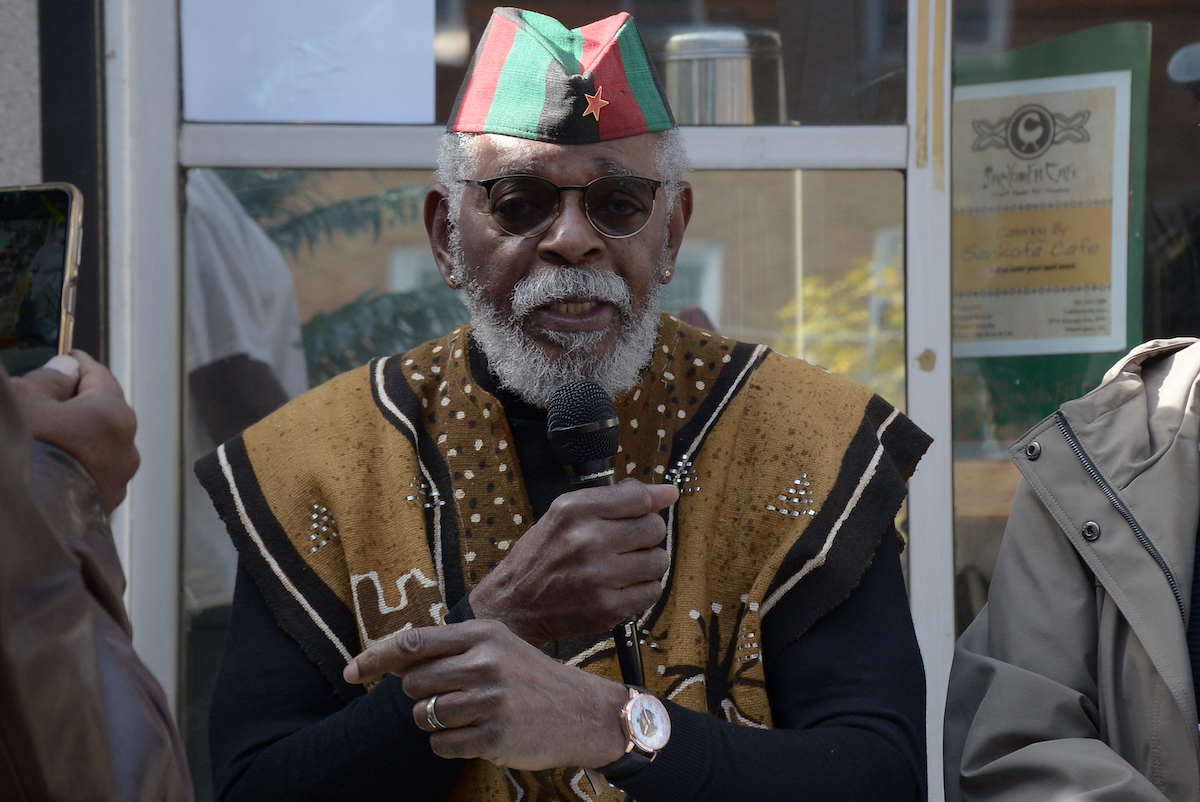
Yeshitela’s Stolen Black Labor demolishes the myths of Western Marxism, proving that Black liberation is not a subset of class struggle—it is its center.
By Prince Kapone | Weaponized Information
August 24, 2025
The Colonial Contradiction Is the Class Contradiction
This is not a book review. This is a political confrontation. Omali Yeshitela’s Stolen Black Labor is not an academic text. It’s a demolition charge wired to the foundations of American empire. It doesn’t ask what built America—it tells you. It names the theft, counts the costs, and indicts the silence. And it makes one thing brutally clear: the foundational class contradiction in the United States is colonial, and it always has been. There is no “working class” in America that is not split down the middle by the legacy and ongoing structure of African enslavement. There is no capitalist development without stolen Black labor. There is no settler democracy without genocide and forced accumulation. If you’re still theorizing around that, you’re not doing Marxism—you’re doing myth maintenance.
Yeshitela doesn’t romanticize the past or plead for sympathy. He drills into the brutal arithmetic of empire. From 1619 to 1865, African people were not exploited—they were expropriated. Not underpaid, but wholly unpaid. Every minute of every day, every lash and every harvest, poured surplus value directly into the war chests of a parasitic settler class that called itself civilized while selling children like cattle. The wealth of New York banks, of Boston shipyards, of Wall Street financiers—all of it fertilized by Black blood and unpaid labor. This wasn’t incidental. It wasn’t unfortunate. It was deliberate. And the cost, by Yeshitela’s conservative estimation, sits today at over $520 trillion when adjusted for compounding interest. That’s not a metaphor. That’s the literal debt owed by the U.S. state and its white population to African people.
But in the imperial heart of Marxist theory, you wouldn’t know any of this. Western Marxism—refined, defanged, and fully housebroken—has spent the better part of a century ignoring the colonial engine that made industrial capitalism possible. The Frankfurt School sniffed at “race” as a distraction. The Paris salons treated anti-colonial revolution as a vulgar sideshow. And today’s white left, high on nostalgia and low on materialist rigor, prefers to mourn the industrial working class like it’s a dying breed of animal, rather than interrogate how the labor aristocracy it glorifies was built on the bones of enslaved people. When they do mention race, it’s usually to chastise those who bring it up too loudly. To quote their favorite phrase: “Let’s not divide the class.” But the class was never united. It was divided by design.
Yeshitela doesn’t cater to white fragility or settler liberalism. He names the white working class as what it is: a force more often aligned with the oppressor than the oppressed. He doesn’t do this to provoke—he does it to clarify. This is the analysis Western Marxism can’t stomach: that Black struggle is not a subset of the class struggle—it is the class struggle in the heart of empire. That the Black Nation, forged through slavery, resistance, and forced underdevelopment, is not simply an aggrieved demographic but an oppressed colony within the borders of the United States. And that liberation for African people is not just a question of justice—it is the strategic key to revolutionary rupture in the most dangerous empire in history.
That’s why this book terrifies the Western left. Not because it’s angry—but because it’s correct. Because it unmasks the political economy of whiteness not as an attitude, but as an imperial wage. Because it reveals the U.S. economy not as an abstract machine of exploitation, but as a colonial parasite living off the bodies of those it enslaved, incarcerated, policed, and exiled. It makes clear that reparations are not charity, and they’re not a policy proposal. They are revolutionary accounting. A material demand for the full return of expropriated wealth, power, and sovereignty. And if that means the end of America as we know it, then so be it. That’s called history.
This review is not an endorsement—it’s a call to align. If your Marxism doesn’t center the struggle of the Black Nation, you’re doing theory for the oppressor. If your socialism ignores the debt of slavery, you’re rehearsing white redemption. And if your movement can’t say “Reparations Now!” without hedging, stammering, or redirecting, you’re not building revolution. You’re managing dissent. Yeshitela has no time for that, and neither do we. In this era of technofascism, state repression, and capitalist decay, there is no neutral ground. Choose your side.
Reparations Is Not Reform—It’s Revolution by the Numbers
In the world of capitalist accounting, unpaid labor is an abstract concept, shrugged off by liberal economists and academic Marxists alike. But in Stolen Black Labor, Omali Yeshitela refuses abstraction. He demands a full accounting. And when the receipts are tallied, the numbers don’t whisper—they scream. This is not a moral argument. It’s a forensic report on the longest robbery in human history. The victims: African people. The thief: the United States of America. The beneficiaries: every single institution, infrastructure project, stock portfolio, and white family that inherited the wages of slavery, colonization, and racial capitalism. The debt: over $520 trillion, and climbing.
This isn’t theoretical. This is compound interest, extrapolated from rigorous methodology. Yeshitela, drawing from scholars like Dr. Raymond Winbush and others, begins with a sober estimate: roughly 222 million hours of forced labor per year per enslaved African during chattel slavery, multiplied across generations from 1619 to 1865. That alone—excluding interest, productivity gains, and the value chain of cotton, sugar, and tobacco—already lands in the tens of trillions. Add to that the 160 years since Emancipation where Black labor was still underpaid, underprotected, and criminalized, and the figure becomes a mountain, not a statistic.
Consider just one anchor point: by 1860, the total market value of enslaved Africans in the U.S. exceeded $3 billion—more than all the nation’s banks, railroads, and factories combined. Adjusted for inflation, that’s over $100 billion in today’s currency before any labor was even performed. That was just the value of the people as capital stock. Their labor—on plantations, in ports, in mines—created the surplus that turned the U.S. from a colonial backwater into a global empire. Cotton alone accounted for more than half of U.S. exports by the mid-19th century. And who picked that cotton? Who died in those fields? Who generated that surplus value?
But here’s where Yeshitela refuses to stop at slavery. Because the theft didn’t stop. After the 13th Amendment, the system of colonial domination evolved: sharecropping, convict leasing, redlining, urban disinvestment, mass incarceration. Each generation of African labor was robbed anew. White wealth compounded through stolen wages and public subsidies, while Black wealth was sabotaged by policy and policing. From the GI Bill to the FHA, from Social Security exclusions to school funding algorithms—every mechanism of accumulation was weaponized against Black people. Every safety net had a hole shaped like Africa.
The result? In 2025, the median white household in the U.S. holds eight times more wealth than the median Black household. The Black unemployment rate remains twice as high as the white rate. Black communities own just 1.5% of national wealth, despite centuries of contribution. And none of this is accidental. It is the logic of colonial capitalism functioning exactly as designed: extract, repress, exclude, repeat.
This is why Yeshitela calls reparations the cornerstone of revolution. Not as a plea to white conscience, but as a material strategy of decolonization. Because paying back $520 trillion is not just about writing checks—it’s about dismantling the very structures that made theft possible. It means returning the land, the power, the means of production. It means ending the parasitic relationship between the U.S. economy and African labor. It means the total liquidation of colonial capital—from Wall Street to Washington, from the suburbs to the surveillance state.
And this is where the Western left panics. They can rally around Medicare for All, universal basic income, even student debt relief. But when you say “$520 trillion to the African Nation,” they clutch their dialectics like pearls. Why? Because the truth exposes their entire project as a defense of settler social democracy—an attempt to redistribute imperial plunder without confronting its origin. Reparations demands more than fairness. It demands rupture. It demands that white workers confront their place in the colonial pyramid. It demands that every revolutionary formation in the U.S. build its program around the liberation of the Black Nation—not as a gesture, but as a precondition.
This is not about guilt. It’s about power. The same power that was stolen must be returned—not symbolically, not eventually, but materially. Through land, through money, through sovereignty, through self-determination. And if that threatens the American project, good. That’s the point. No empire deserves to survive a revolution. Least of all one built on the bones of Black labor and soaked in blood.
Yeshitela’s brilliance is that he refuses the liberal logic of reform. He understands that reparations is not a policy demand—it is strategy. A weapon to destabilize the foundation of settler capitalism. A lever to turn national liberation into global revolution. A test of whether this generation of organizers, revolutionaries, and class traitors will rise to the challenge or retreat into the safety of settler socialism. He makes it clear: there is no path forward that does not pass through reparations. And there is no future worth fighting for that leaves the Black Nation behind.
Neo-Colonialism Is Counterinsurgency
The genius of empire is its ability to evolve its chains. Yeshitela calls it what it is: neo-colonialism—the modernized face of old-school domination. When the Black revolution of the 1960s surged with righteous fire, the U.S. state didn’t just send in tanks. It sent in mayors. Police chiefs. TV anchors. Professors. It opened the gates of political office to a carefully selected class of Black operatives whose job wasn’t to free the colony—they were there to manage it. And so, the plantation got a facelift. But the overseer was still on the payroll. The crops still got stolen. And the whip just changed form.
What Yeshitela reveals is that neo-colonialism is not a concession—it’s a tactic of counterinsurgency. After the Panthers, the BLA, Malcolm, and Martin, the ruling class realized it couldn’t just keep killing its way to stability. It had to co-opt. To infiltrate. To repackage the demands of the oppressed in language palatable to the oppressors. So the state did what it does best: it created confusion. It elevated “first Black” this and “historic breakthrough” that. It told Black people, “You’ve made it!”—even as the boot pressed harder. It weaponized visibility to obscure the absence of power.
The result is a spectacle of false progress. Black cops patrolling Black neighborhoods. Black prosecutors locking up Black youth. Black congressional reps voting for war and police funding. None of it represents liberation. It represents the absorption of the colonized into the machinery of their own domination. Yeshitela doesn’t flinch here—he indicts the whole damn thing. From Obama’s drone diplomacy to the Black capitalist elite that lines up to police the limits of dissent, this is the comprador class in action. The house slave rebranded as stakeholder.
But Yeshitela goes deeper. He shows that this is not just about optics—it’s about strategy. The U.S. state, faced with Black insurgency, deployed the full arsenal of counterinsurgency doctrine: divide and conquer, pacify the base, neutralize the vanguard. Drugs flooded the ghettos—while programs like CETA and affirmative action turned potential militants into administrators. The prisons ballooned to absorb the surplus rebellion. The church and the academy became ideological fortresses, telling Black youth that the revolution was over—and that salvation now came through elections and entrepreneurship.
This is the brilliance of neo-colonialism: it replaces bullets with ballots, riot cops with role models, occupation with opportunity. But the colony is still a colony. No factories were returned. No reparations paid. No self-determination granted. Just a more elaborate costume over the same extraction machine. Yeshitela rips that costume to shreds and demands we look at what lies beneath: a system still terrified of Black autonomy, still dependent on Black labor, and still deploying every tool in its arsenal to prevent a resurgence of national consciousness.
And it’s here that the white left gets exposed. Because if you can’t name neo-colonialism, you can’t fight it. If you think the problem is “bad politicians” or “misguided voters,” you’ve already missed the point. Neo-colonialism isn’t a deviation—it’s a phase of imperial control. And solidarity that doesn’t recognize this isn’t solidarity—it’s sabotage. If you want to struggle alongside the colonized, you have to be willing to dismantle the very structures that benefit you. To see through the illusions. To stop celebrating representation as liberation. And to fight, unapologetically, for the decolonization of the Black nation.
In the hands of Yeshitela, theory becomes a blade. He doesn’t theorize from a distance—he writes from the frontlines, as the leader of a Party under siege by the very state he’s dissecting. He understands that the point isn’t to critique neo-colonialism—it’s to destroy it. And that requires organization. Discipline. Ideological clarity. It means building the vanguard, not just protesting the symptoms. It means preparing for what the state fears most: not riots, not slogans, but a united, conscious, politically armed Black proletariat, ready to reclaim what was stolen and burn down the structures that feed on their suffering.
The Struggle for Power
In a world addicted to protest and allergic to power, Omali Yeshitela stands alone. He doesn’t write to express outrage or spark awareness—he writes to seize state power. Everything in Stolen Black Labor orbits that central imperative. No amount of righteous indignation, street marches, or symbolic disruption can substitute for the organized capacity to govern. Not over a neighborhood. Not over a nonprofit. Over a nation. And the Black nation in the U.S.—internally colonized, occupied, fragmented—is not lacking in resistance. It is lacking in revolutionary organization. That’s the diagnosis. And Yeshitela’s prescription is precise: the Party.
But not just any party. Not a paper organization or a boutique brand for radical aesthetics. What Yeshitela builds is a weapon—a disciplined, internationalist, anti-colonial formation rooted in the most exploited layers of the African working class. The African People’s Socialist Party isn’t looking to integrate into the system. It’s out to destroy it. It’s not reforming white power—it’s building dual and contending Black power. This is African Internationalism in motion: not a slogan, but a strategic framework linking the struggle of Black people in the U.S. to the worldwide African nation and the global revolution against imperialism.
Here’s where Yeshitela draws his deepest line in the sand. You can’t just critique the empire. You have to out-organize it. You have to create liberated territory, however small. You have to build institutions that don’t beg for grants but operate as organs of people’s power. You have to develop cadre, not clout-chasers. The contradiction isn’t between the radical and the moderate—it’s between the organizers and the disorganized. And the measure of political seriousness isn’t how loudly you denounce oppression—it’s how effectively you construct the means to end it.
In this vision, revolution is not an event. It’s a process. One that begins not in the halls of academia or the corridors of Congress, but in the colonized communities that empire abandoned. That’s why the APSP didn’t chase headlines. It chased contradictions. It sank roots into the ghettos, the prisons, the poor Black South—everywhere the lumpen and dispossessed Black proletariat were concentrated. And it offered them not charity, but a line. A clear political line, capable of transforming desperation into discipline, and rage into revolutionary clarity.
And what of the white defector? In Yeshitela’s framework, there is no space for guilt-drenched handwringing or savior complexes. The settler must defect not just emotionally but materially—from the institutions, habits, and ideologies of parasitism. To struggle alongside the colonized is to take up arms against the very economy that feeds you. It is to subordinate your politics to a revolution not your own. And it is to understand that liberation will not come through unity with whiteness, but through solidarity with its destruction.
This is why Yeshitela’s project terrifies the state and frustrates the left. Because it doesn’t want a better empire—it wants a world without it. It doesn’t believe socialism can be built atop colonial foundations—it demands that the whole structure be razed. And it doesn’t wait for permission. It builds. Quietly. Relentlessly. Among the masses the world forgot. So while the left tweets theory and the state writes policy, the APSP constructs power. One cadre. One block. One liberated zone at a time.
If you understand this, you understand the stakes. The revolution Yeshitela speaks of isn’t hypothetical—it’s happening. And it doesn’t care whether you’re ready. The only question is whether you’ll join it—or find yourself on the wrong side of its march.
Reparations Is Revolution
The ruling class wants you to think reparations is some fringe demand. A symbolic gesture. A historical footnote. Maybe a cash payout if the budget allows. But Omali Yeshitela doesn’t treat reparations like charity or moral atonement—he treats it as war logic. Reparations is not about feelings, it’s about stolen labor, stolen lives, stolen wealth. It is about returning what was taken by force, and doing so with the same historical seriousness that built the empire in the first place. Reparations is not the end of struggle—it is its beginning. It’s the opening salvo of decolonization in the belly of the beast.
For the African working class, reparations is not a slogan—it’s a material demand forged in the crucible of four centuries of extraction. For every lynched ancestor, every prison sentence, every wage stolen, every acre denied, every drop of wealth sucked out of Black neighborhoods and deposited into white vaults, there is a debt. Not a spiritual debt. Not a social debt. A colonial debt. And as Yeshitela teaches, the only way that debt gets paid is through the organized seizure and redistribution of power and resources. Reparations is the program of revolution—not its supplement, not its side quest, but its frontline battle cry.
This is where the white left buckles. Because they can’t imagine revolution that starts with them giving something up. But there is no revolutionary horizon within the U.S. that doesn’t begin with the white population confronting its parasitic relationship to Black labor and colonized existence. That confrontation isn’t about shame—it’s about action. White people who are serious about revolution must become defectors from the colonial order. Not passive allies. Not performative radicals. But conscious agents of the return. The return of wealth. The return of land. The return of power.
The Uhuru Movement doesn’t just theorize this—it builds it. That’s why it created the Uhuru Solidarity Movement: a formation for white people who choose to stand on the side of African liberation and pay reparations under the leadership of the Black working class. This isn’t charity work. It’s political work. It’s organizing inside the colonizer nation to destabilize the structures that feed on Black suffering. It’s raising resources, building support, waging propaganda, and confronting the enemy not as guilty liberals—but as disciplined revolutionaries on the losing side of history who chose betrayal over loyalty to empire.
Yeshitela makes it clear: you don’t get to join the revolution without conditions. There is a price of entry. And for white people, that price is reparations. Not as a gesture, but as a function of revolutionary realignment. To reject this is to remain in the camp of the enemy, no matter how many books you’ve read or protests you’ve marched in. To embrace it is to begin the hard, necessary work of transforming yourself from settler subject to revolutionary defector. There are no shortcuts. But there is a path. And Yeshitela hands you the map.
In the end, Stolen Black Labor is more than a book—it is a political intervention. It exposes the roots of empire, clarifies the conditions of the present, and lays down a revolutionary line of march. For African people, it is a call to power. For white people, it is a call to rupture. And for all of us, it is a reminder that the hour is late, the stakes are total, and the future is unwritten. We are not here to heal America. We are here to bury it—and build something human in its place.
 Weaponized Information
Leave a comment