A Revolutionary Review of Orisanmi Burton’s Tip of the Spear — and an Indictment of the Euro-American Left’s Cowardice in the Face of Black Insurgency
By Prince Kapone | Weaponized Information | August 5, 2025
They Called It a Riot. He Called It War.
In the hands of Western Marxism, the Attica uprising is little more than a footnote—an “incident,” a “riot,” a spontaneous combustion of carceral rage. In the hands of Orisanmi Burton, it becomes what it always was: war. Not metaphorically. Not symbolically. War in the technical, strategic, and colonial sense of the word. And if there is one thing that defines Western Marxism—from the Frankfurt School to the Sandernistas—it is its inability, or refusal, to recognize war when it’s waged against Black people inside the heart of the empire.
Burton opens Tip of the Spear by detonating the most sacred myth of the American left: that the United States is merely a class-divided society with bad policing and too many prisons. Instead, he frames the American carceral regime as the domestic frontline of counterinsurgency warfare—a battlefield where the U.S. state, having honed its techniques in Vietnam and Algeria, turned them inward to crush the Black rebellion. His opening proposition is clear: the prison is not an exception to U.S. democracy; it is its vanguard institution. And it has one central function—neutralizing insurgency.
Let’s be clear, comrade: this is not the kind of Marxism you’ll find in a Jacobin article. Burton isn’t writing to be cited by tenured radicals in Brooklyn. He’s not theorizing the prison-industrial complex as a clever metaphor. He’s naming names, tracing memos, mapping tactics. The opening of this book does what no Western Marxist has dared to do—it positions Attica as the continuation of a global struggle against imperialism and colonial domination. And it frames the U.S. prison system not as a site of capitalist exploitation alone, but as the logistical heart of settler-colonial counterinsurgency.
It is no coincidence that the Western left has no real theory of Attica. Or of George Jackson. Or of the prison as a revolutionary site of knowledge production. Because to confront that terrain would mean admitting what their frameworks deny: that the principal contradiction in the U.S. is not class alone, but colonial domination. The prison becomes illegible to them because it is not merely a site of labor extraction—it is a laboratory for political warfare. And so, in the sacred texts of Euro-Marxism, Attica gets less ink than May ’68.
Burton’s concept of the Long Attica Revolt is not a poetic flourish. It is a political intervention. He shows that the rebellion was not a singular event, but a node in an extended campaign of resistance stretching from Malcolm to George Jackson to the prison formations of today. And that the state’s response—from psychological warfare to military raids—was not improvisational, but doctrinal. The prison, in his telling, is where counterinsurgency doctrine mutates and advances. The only reason it remains invisible to the Western left is because they never learned how to see from below.
So let this review be clear about its purpose. We are not here to interpret Burton’s work—we are here to deploy it. Every insight in Tip of the Spear is a weapon, and every weapon indicts a different tradition of betrayal. Western Marxism, with its European fetishes and colonial blind spots, has failed to name the enemy. Burton does. His opening chapter is not a preface. It is a declaration. And it demands not interpretation, but alignment.
The Science of Fear: How the State Profiled Revolution and the Left Pretended Not to Notice
The counterinsurgency didn’t begin with bullets—it began with forms. Risk assessments. Psychological evaluations. Threat matrices. In Chapter One of Tip of the Spear, Burton drags us deep into the archive of repression: New York State DOC memos, bureaucratic intake systems, policy directives that classified prisoners not just by behavior but by belief. Radical political consciousness was itself deemed a security threat, an infection to be monitored, contained, and extinguished. And the people doing the monitoring weren’t just prison guards—they were social workers, psychologists, and state-funded researchers. The white coats in the war room.
The brilliance of Burton’s analysis is that it makes clear what so much leftist discourse still evades: the state understood revolutionary ideology as a form of combat. That’s why it built an entire apparatus to detect, classify, and neutralize it. The carceral system wasn’t just locking up bodies—it was mapping minds. What kind of Marxism ignores this? The kind that believes ideology is superstructure fluff. The kind that can’t tell the difference between a jailhouse philosopher and a counterinsurgent profiler. The kind that recites Gramsci in a tenure review while ignoring how the U.S. prison system operationalized ideology as a weapon of war.
Burton introduces us to the “carceral episteme”—a way of knowing and governing that fuses colonial knowledge production with militarized control. This is not just a clever academic term. It’s a concrete apparatus. The carceral episteme collects intelligence, codifies behavior, and assigns political meaning to every gesture, word, and text. Read a George Jackson book? That’s a flag. Lead a discussion group? That’s an indicator of ideological radicalization. Refuse to snitch? That’s a sign of subversive loyalty. Meanwhile, Western Marxists sit in their study groups pretending the prison is just a holding pen for surplus labor.
In reality, the prison is a weapons lab. And the subject of study is the Black revolutionary. Burton shows how, in the 1970s, state functionaries developed detailed typologies of political prisoners. They weren’t just interested in crimes—they were studying ideology like the FBI studied Maoist pamphlets in the ’60s. This is what Burton calls “ideological profiling.” And here’s the indictment: the U.S. state took Black revolutionary theory more seriously than most Western Marxists ever have.
Think about what that means. While the state was meticulously designing methods to isolate and crush revolutionary consciousness, the Euro-left was still debating whether the “Negro question” was a national or cultural contradiction. While the U.S. was building counterinsurgency manuals off Attica and Soledad, white leftists were romanticizing Cuba and quoting Marcuse. While Black revolutionaries were being surveilled, drugged, disappeared, and killed, the campus left turned “hegemony” into a grad seminar keyword.
Burton doesn’t say all this outright—but he doesn’t have to. The documents speak for themselves. And what they show is a state more ideologically disciplined than the movement that claimed to oppose it. A state that studied revolution to crush it. And a Western left that never studied revolution at all. Chapter One of Tip of the Spear should be taught as the funeral eulogy of Western Marxism’s relevance to Black liberation. Because once the state built a machine to classify the enemy, Western Marxism failed the only real test: it refused to take sides.
The Bullet and the Book: Why They Had to Kill George Jackson (And Why the Left Let Them)
If the U.S. state built an entire bureaucratic apparatus to profile revolutionaries, George Jackson was its primary target. Not because he was violent. Not because he escaped. Not even because he was organizing. They had to kill George Jackson because he theorized. Because he refused to let prison be a site of containment. Because he turned the cell into a command post of revolutionary insurgency. And because his ideas, like all weapons, were contagious.
In Chapter 2 of Tip of the Spear, Burton unpacks the mechanics of political assassination under cover of “institutional crisis.” The story isn’t just that Jackson was murdered—it’s that the state meticulously laid the ideological groundwork to justify it, sanitize it, and ensure it would not become a spark for mass revolt. They framed him not as a political threat but as a psychotic deviant, a violent manipulator, a Black messiah too dangerous to exist. They erased the theory, amplified the myth, and pulled the trigger.
Here’s what’s worse: the Western left didn’t fight back. They didn’t reclaim Jackson as one of their own. They didn’t treat his murder as a political crisis. They didn’t even bother to read his work with seriousness. They left that battlefield to the prison guards and the FBI. And in doing so, they forfeited their claim to revolutionary politics in the settler colony they call America.
Jackson’s writings—Soledad Brother and Blood in My Eye—are not prison literature. They are manuals of guerrilla warfare. His theory of fascism, his analysis of white labor, his synthesis of colonialism and counterinsurgency—all of it was decades ahead of its time. Burton treats Jackson not as a symbol but as a strategist, a theorist, a revolutionary general who was building the political line of a domestic anti-colonial movement. And yet, in the house organs of Western Marxism, Jackson remains an “influential figure,” a “tragic martyr,” a “complex personality.” In other words, buried.
Burton doesn’t just exhume him—he returns Jackson to the political terrain he fought on: war. He reconstructs the state’s reasoning. Jackson was organizing the inside and the outside simultaneously. He understood the prison as a counterinsurgency site and sought to turn it into a revolutionary base. He was not a reaction to repression—he was an escalation of struggle. And for that, he had to be neutralized. What Western Marxists mistook for security protocol, Burton identifies as liquidation strategy. The assassination of Jackson wasn’t a breakdown of justice—it was its strategic fulfillment.
And what of the left? Jackson’s name is rarely spoken in Euro-left journals. His writings are rarely assigned in Marxist theory syllabi. His life is rarely situated within the pantheon of revolutionary thinkers—despite his clarity, his discipline, his sacrifice. Why? Because he didn’t fit. Because he called the U.S. a fascist empire. Because he exposed the white working class as a junior partner in racial capitalism. Because he believed in revolution by any means necessary. Because he wasn’t trying to join the left. He was trying to overthrow it.
Burton’s second chapter is not a historical account—it is an indictment. Not only of the state that killed Jackson, but of the left that failed to defend him. A left that still talks about Lenin and Luxemburg while ignoring the man who translated their revolutionary clarity into the context of U.S. settler fascism. A left that prefers martyrs to strategists. Jackson was both—but it was his strategy that scared them. And it’s that strategy that Burton resurrects. Not for memory. For war.
Attica Was an Insurrection. Calling It a Riot Is a Form of Surrender.
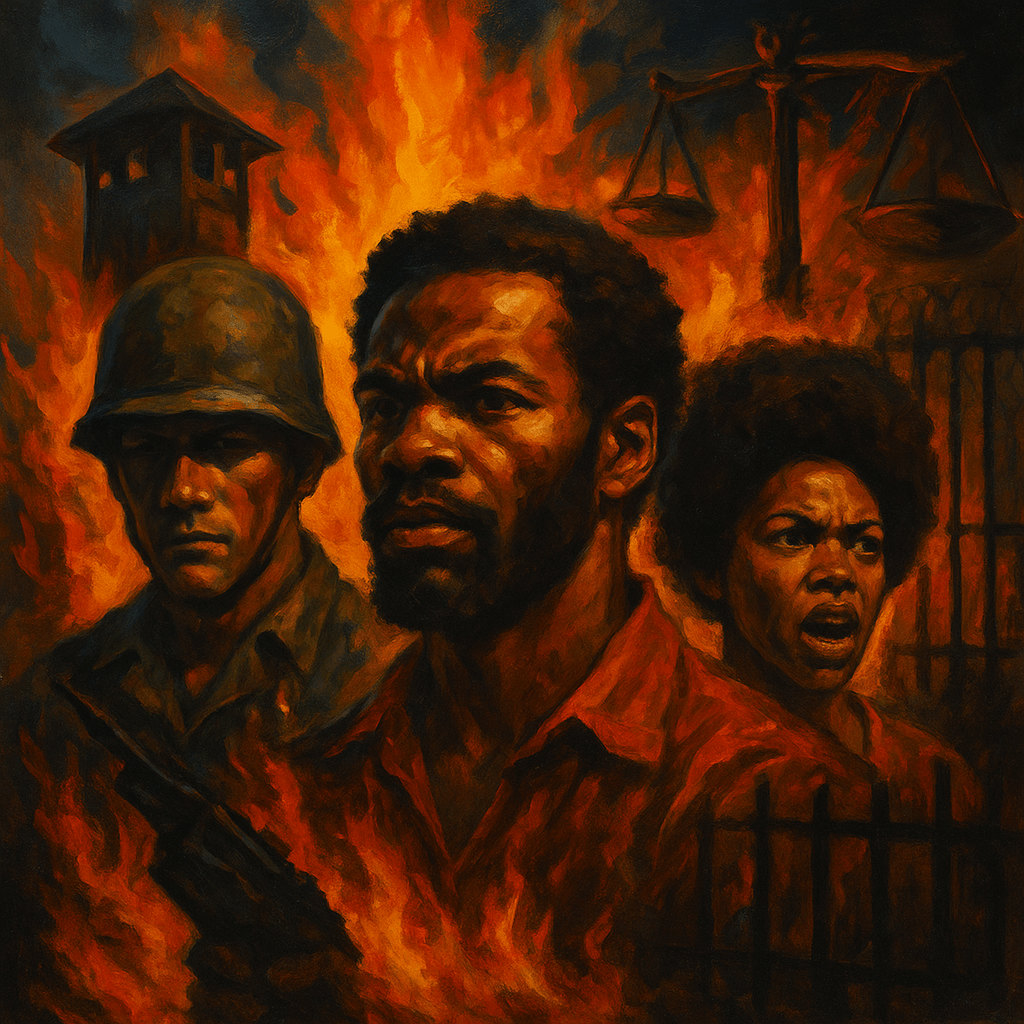
If George Jackson’s assassination was the preemptive strike, Attica was the counterblow. Not a riot. Not unrest. Not “civil disorder.” It was an armed rebellion against a colonial regime—complete with a manifesto, a political program, a demand for human dignity, and a clear identification of the enemy. But to this day, the liberal media calls it a tragedy. The Western left calls it unfortunate. And the state calls it a footnote. Orisanmi Burton calls it what it was: war. Chapter 3 of Tip of the Spear reconstructs the Attica uprising not as reaction, but as revolutionary strategy, one that terrified the empire so deeply it had to be drowned in blood.
The language of “engineering” is not metaphorical. Burton shows that the state didn’t just respond to Attica—it prepared for it. In fact, it helped set the conditions for it. The New York State apparatus studied the political climate, monitored the prisoners, infiltrated their ranks, and waited for the right moment to crush the rebellion in spectacular fashion. When the state opened fire on unarmed prisoners and hostages alike, it wasn’t chaos—it was choreography. A staged massacre to send a message: you will not revolt without consequence.
And how did the so-called left respond? With silence, or worse, misrecognition. The Western Marxist tradition, trained to read Paris and Petrograd but not Soledad or Sing Sing, missed the point entirely. They mourned the deaths but ignored the politics. They denounced the state’s brutality but failed to honor the prisoners’ leadership. They were quick to quote Luxemburg’s “freedom is always the freedom of the dissenters,” but when Black men seized control of the state’s most fortified prison and declared a revolutionary political program—suddenly, it was too messy, too violent, too Black.
Burton does what they would not. He excavates the logic behind the massacre, the racial-political calculus that determined who lived, who died, and what would be remembered. He tracks the ideological management of the event—the press releases, the press silence, the dehumanizing language deployed to make the prisoners seem less than human and more than dangerous. He shows how the state, and later the media and the academy, scrubbed Attica of its politics and reduced it to pathology. This is what counterinsurgency looks like: not just bullets, but narrative control.
And here’s the kicker—the U.S. ruling class took Attica more seriously than the white left ever has. Because they knew what was at stake. They knew the prisoners were forging political unity across racial lines, articulating a critique of imperialism from the belly of the beast, and building solidarity with struggles in Vietnam, Cuba, and Angola. They knew this wasn’t about better conditions—it was about power. But Western Marxists, obsessed with “objective class interests” and allergic to colonial analysis, missed the revolution under their nose. They were waiting for the factory floor to explode. The prison yard already had.
Burton’s chapter is a direct confrontation with that blindness. It forces us to confront the fact that Attica was the most advanced expression of anti-colonial class struggle inside the U.S. since the days of slave insurrection. And yet it has no place in most Marxist canons, no shrine in socialist iconography, no serious theoretical engagement from the Euro-American left. That omission is not an accident—it is an ideological position. One that places Western Marxism on the wrong side of the barricades.
We don’t need more lamentations about state violence. We need militant clarity about who led, who fought, who fell, and who forgot. Attica was not a riot. It was a revolt. A liberation struggle. A war for human dignity and political power. Burton names it. We echo it. And we will not let anyone call it anything less.
Mind Games and Behavior Mods: The Psychologists of Counterinsurgency
You thought counterinsurgency was just tear gas and SWAT teams? Burton drags us deeper. In Chapter 4 of Tip of the Spear, he walks us through a little-known truth that should have sent shockwaves through the Marxist world—but didn’t: the U.S. state didn’t just fight Black revolutionaries with weapons. It fought them with therapy. With diagnostic tools. With “rehabilitation” strategies built by clinical psychologists trained in behavioral science. And not a single one of these prison programs was ideologically neutral. They were designed, from the start, to do one thing: reprogram the revolutionary mind.
Burton takes us into the archives of prison psychology, where behaviorists and cognitive theorists developed sophisticated “correctional” models that redefined political resistance as pathology. Refusal to cooperate? That’s oppositional defiance. Political education? That’s groupthink or radicalization. Rage at systemic oppression? Antisocial behavior. Even silence became suspect. They called it “passive resistance,” “unwillingness to engage,” “sociopathic withdrawal.” The aim was never mental health—it was ideological neutralization.
What the U.S. developed in these prisons was nothing less than a clinical science of counterinsurgency. And it did so with the full cooperation of the academy, the psychiatric profession, and the liberal-progressive wing of U.S. governance. Behavioral science became a counterrevolutionary tool. Cognitive restructuring became code for ideological reeducation. Prison became a brainwashing facility with lab coats and psych evals instead of whips and chains. And while this was happening, the Western Marxists were still clinging to Freud and Foucault—utterly unequipped to deal with the real function of psychological warfare in the carceral state.
Burton names the experiment for what it was: a campaign to erase the revolutionary subject. Not through violence alone, but through epistemological warfare—targeting memory, conviction, collective identity. The goal was not just to isolate militants but to depoliticize them, to extract the insurgent consciousness and leave the body intact. In essence, to manufacture defeat at the molecular level of personality. And to call it treatment.
It’s here that the Western left’s moralizing collapses completely. Because what’s exposed in this chapter is not just brutality—it’s science. The same Enlightenment science the left loves to champion. The same technocratic rationality behind so many Euro-Marxist theories of progress. The state took those tools, sterilized them, and turned them inward on the colonized subject. And the left, with all its faith in reason, never saw it coming. Or worse, chose not to.
While radicals in the U.S. were being diagnosed and drugged, the Euro-American left was waxing poetic about Marcuse’s critique of one-dimensional man. But this wasn’t theory—it was praxis. It was kitsonism in a lab coat. MK-Ultra with paperwork. Counterinsurgency at the cellular level. What the West called psychology, Burton reveals as weaponized ideology.
And that’s the crux. Burton doesn’t ask us to feel bad about prison psych programs. He asks us to understand them as war tactics. He doesn’t want pity for those diagnosed—he wants clarity about who did the diagnosing and why. Chapter 4 is not an exposé—it’s an autopsy of the revolutionary mind under siege. And it makes one thing terrifyingly clear: if you’re not studying repression as a science, you’re not studying revolution at all. Which is precisely why Western Marxism remains so comfortable in the seminar, and so useless in the struggle.
Buried Alive: The Erasure of Revolutionary Knowledge in the Empire’s Archives
The state didn’t just want to destroy Black revolutionaries. It wanted to destroy the idea that they ever existed. Chapter 5 of Orisanmi Burton’s Tip of the Spear is about intelligence—not as information, but as the method by which empire rewrites reality. The U.S. prison system, Burton shows, developed a sophisticated network of intelligence operations not just to monitor rebellion, but to produce an official epistemology of who the prisoners were, what they believed, and what “truth” would be allowed to circulate. Revolutionary knowledge wasn’t just suppressed. It was disappeared.
Prison administrators created case files, behavioral indexes, security threat group dossiers, and classification codes. Each one functioned as an ideological fingerprint. The aim wasn’t just surveillance—it was narrative control. Political activity was redefined as gang affiliation. Study groups became conspiracies. Collective self-defense became incitement. This was not misinterpretation. It was a calculated effort to replace insurgent self-definition with state-authored fiction. And like all fiction produced by empire, it was archived.
Burton calls this the “intelligence function” of the carceral regime. But what he’s really describing is a knowledge war. And the Western Marxists, with all their praise of theory, had no response. Because to them, knowledge was something debated in journals—not seized in blood, buried in reports, or blacked out in redacted files. They never treated knowledge as a field of struggle, because they never truly believed the colonized had theory to begin with. They saw prison writings as testimony, not doctrine. They saw George Jackson as eloquent, not scientific. They saw political prisoners as symbols, not strategists.
This is the ideological function of the liberal-left archive: to curate, to pacify, to academicize. But Burton rips through that polite fantasy. He shows that knowledge created by revolutionaries in prison was marked as a threat not just because of content, but because of origin. It came from the underside. It came from below. It came from people who were supposed to be broken. And so the state couldn’t simply refute it—it had to erase it. And the white left, trained to only recognize theory in a European accent, obliged.
What happens when the enemy studies you more seriously than your supposed comrades? What happens when the prison produces more advanced ideological analysis than the university? Burton answers with the blunt force of historical documentation: revolutionary knowledge is always counterinsurgency’s first target. Before the baton comes the file. Before the raid comes the memo. Before the bullet comes the label: threat group, radical, influencer, manipulator. And just like that, the theorist becomes the enemy.
And what of the Marxist tradition? What did it do as the state developed an archive of counterrevolution? Did it build a counter-archive? Did it preserve the notebooks, the communiqués, the political education curricula of incarcerated revolutionaries? Did it challenge the categories used to criminalize them? Rarely. At best, it quoted a line. At worst, it ignored them altogether. The result is what Burton exposes so ruthlessly: a buried tradition of Black revolutionary theory—buried not just by the state, but by the silence of the left.
Chapter 5 is not just about what the state did. It’s about what we didn’t do. The revolutionaries wrote. The state documented. And the left slept. Or worse, colluded. If we are to reclaim revolutionary theory in this moment of global crisis, it won’t be through more Euro-Marxist retrospectives. It will be through excavation. Through recovery. Through war against the archive itself. Burton has already begun that war. The only question is whether we join it.
The Future Has Already Been Weaponized. Will Revolutionaries Catch Up?
By the time Burton reaches his final chapter, the point has already been made—if you’re paying attention. But Chapter 6 drives it home with surgical precision: the counterinsurgency is evolving, and if we keep fighting it with obsolete frameworks, we’re not resisting—we’re rehearsing defeat. What the U.S. state has built over the past fifty years is not just a prison system, but a dynamic architecture of internal warfare. It learns, adapts, predicts. It doesn’t just respond to revolt—it anticipates it. It neutralizes the revolutionary before the action. And it does so with tools far beyond billy clubs or rubber bullets. These days, it’s algorithms, data-mining, biometric surveillance, and ideological modeling. Empire has a theory of change. What does the Western left have? Book clubs.
Burton maps the shift. From analog repression to digital war. From behavioral profiling to predictive analytics. From COINTELPRO to what he calls “counterinsurgent futurism.” This is not science fiction. It’s how parole decisions are made, how “radicalization” is scored, how inmates are classified, how dissent is preempted. We are not entering a new phase—we are already in it. The carceral state is now a tech platform with a badge. It’s what happens when empire and Silicon Valley merge through the prison wall.
And what has Western Marxism offered in response? Vague calls for “abolition,” essays on “carceral capitalism,” and endless citations of Foucault—who, let’s be honest, never even understood the plantation. Burton doesn’t waste time on theory that can’t fight. He pulls from the archive, from the insurgents, from the fallen. He builds a genealogy of resistance rooted in Attica, George Jackson, and the unnamed cadres who kept studying behind bars long after the world forgot them. He doesn’t mourn them—he aligns with them. That’s the difference between a historian and a revolutionary.
The final chapters of this book don’t offer solutions. They offer terrain. They demand a new kind of study—what we at Weaponized Information have always called revolutionary intelligence. The kind of study that begins with a question not of what’s right, but what’s strategic. Not what’s ideal, but what works. Burton’s work is a blueprint for how to read the enemy, not just critique it. It is an invitation to abandon the safety of moral outrage and enter the risk of ideological combat.
Western Marxism, meanwhile, remains allergic to strategy. Its theorists still chase perfect models while the state adapts in real time. It clings to Eurocentric categories while empire becomes more integrated, more hybrid, more psychometric. Burton shows us that the war is already here—and the prisoners figured it out first. The question is not whether the theory exists. It’s whether we’ll treat it as theory at all. Or whether we’ll keep pretending revolution is something to be admired, not studied. Celebrated, not wielded.
Tip of the Spear is not a eulogy for the past—it is an intervention into the future. It puts the Western left on notice: your frameworks are out of date, your canon is compromised, and your silence has been weaponized against the people you claim to fight for. If you still think George Jackson was a prisoner, you missed the point. He was a strategist. And if you think Burton is an academic, you missed the war. He’s building the next generation of revolutionary infrastructure—and you’re not in it.
Black August is not a ritual. It’s a reactivation of revolutionary memory into strategy. Burton has honored that tradition. The question is whether we will. Because if we don’t, the state already has a folder with your name on it. And it’s not waiting for you to catch up.
 Weaponized Information
Leave a comment