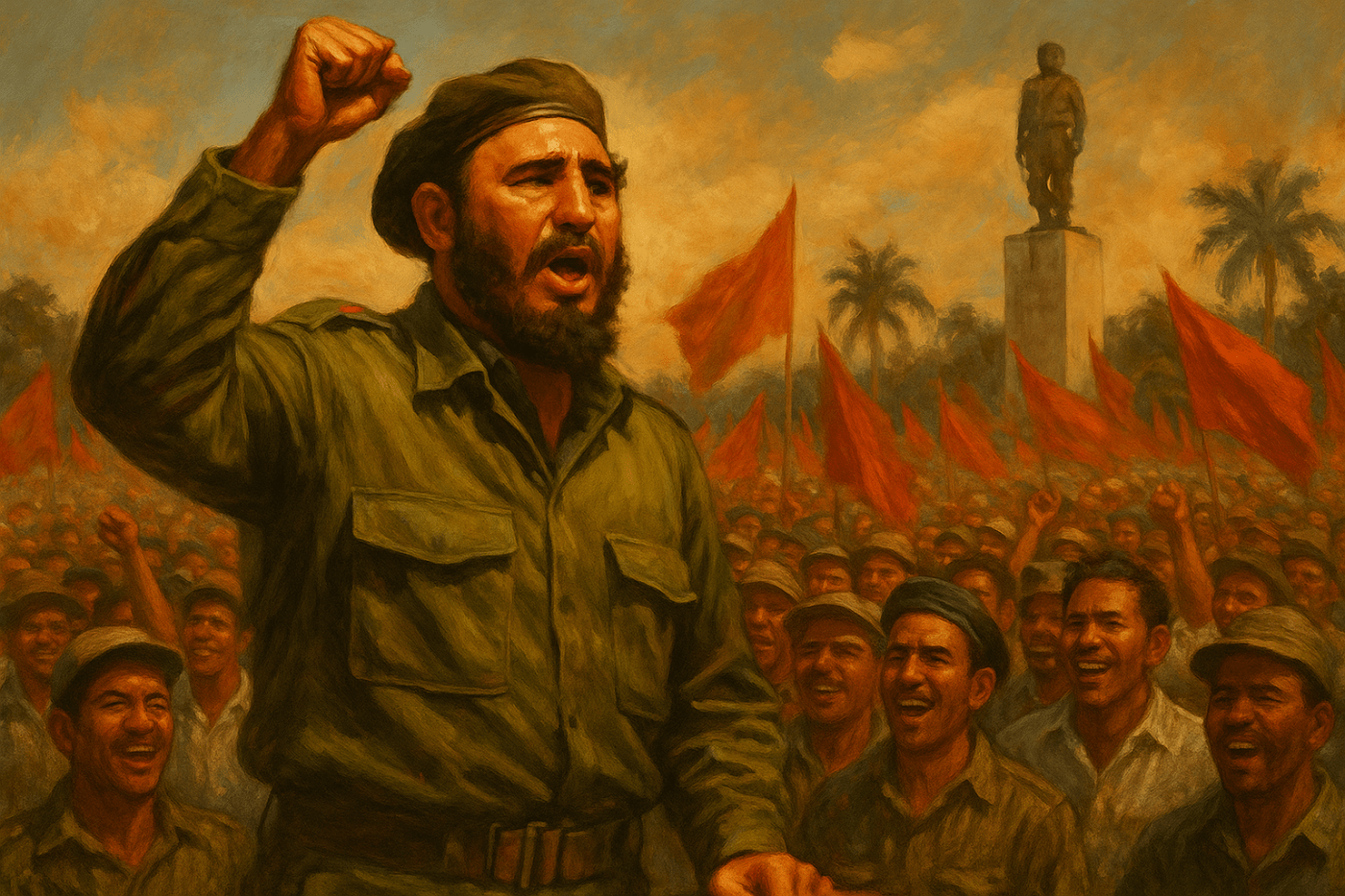
Weaponized Statecraft Series | In Commemoration of Fidel Castro’s Birthday
By Prince Kapone | Weaponized Information | August 13, 2025
Revolution is Not a Spectacle—It is a Verdict
“There is something that is not seen in cement or lumber or in stone, and that is what is built among the people, the education received by the people, the consciousness that a people acquire, the virtues developed by a people. These cannot be seen but they exist and they are invulnerable.”
On 26 July 1965, twelve years after the assault on the Moncada Barracks, Fidel Castro stood before the people of Santa Clara and delivered not a ceremony, but a sentence. He did not come to repeat the revolution’s mythology—he came to affirm its material force. The crowd was not an audience but a tribunal. “We do not gather to recall past history. We gather to write the new history.” This was not nostalgia. It was a renewal of revolutionary authority through living testimony—millions strong, armed with literacy, unity, and historical memory.
The contradictions at the heart of Castro’s address are as alive today as they were that day in 1965. Can a people crushed by centuries of slavery, illiteracy, and imperialism build a new society with their own hands? Can a revolution sustain itself without descending into bureaucracy, into vanity, into the deadening rituals of symbolic power? What kind of force can neutralize the machinery of Yankee imperialism—and how must it be organized, disciplined, and deployed? These are not rhetorical questions. They were posed by bombs dropped on Playa Girón, by counterrevolutionaries armed by Washington, by the blood of murdered teachers in the Escambray, and by the imperialist invasion of Santo Domingo in the very same year.
Castro did not flinch. His voice sharpened into strategy. “Guerrilla warfare is a formidable weapon when fighting against exploitation, against colonialism, against imperialism. But guerrilla warfare will never be an adequate or useful instrument for counterrevolution.” This was not just a tactical distinction. It was a political diagnosis. Class struggle is not a weapon you can hand to anyone—it is a blade forged in historical necessity. It cuts only in the hands of the exploited.
The speech unspools like a ledger of proletarian sacrifice. From the “thousands of lives” claimed in the clandestine struggle to the 295 revolutionaries killed in the anti-bandit campaigns, the revolution is portrayed not as an event, but as an accumulation. Blood in, power out. Memory in, discipline out. This is not Cuban exceptionalism. It is historical materialism sharpened by machete and mortar. “All material things can be destroyed… but the spirit of our people cannot be destroyed by anyone.”
The counterrevolutionaries are not debated—they are named and buried. “None of those doers of evil deeds who had killed brigade members, teachers, workers and peasants, managed to escape.” In the world of liberal politics, this would be called vengeance. In the world of revolutionary struggle, it is justice. The class war does not make room for innocence. It offers only one test: whose side are you on, and what are you prepared to defend?
If this speech were only a tally of victory, it would be unworthy of its speaker. But Fidel’s genius was not in boasting of triumphs—it was in converting them into discipline. “It is necessary to say that law and justice fell on the guilty ones,” he insists, not as a celebration but as a warning. This was not the end of vigilance. It was the beginning of organized permanence. Counterrevolution was not dead. It was mutating.
So the revolution, too, must mutate. “We keep our antibandit battalions organized,” Castro affirms. Not disbanded, not idle, but trained. The lesson is unmistakable: socialism is not built in peace—it is built in preparation. The struggle does not end with land reform or literacy campaigns. It ends with the liquidation of every last illusion that imperialism will allow you to breathe. And even then, it must be watched.
Fidel’s method is neither populism nor paranoia—it is the materialist synthesis of statecraft and mass confidence. “If what we have done once, we would be capable of doing again… and of doing it as many times as was necessary.” Here is a principle the left must re-learn: a revolutionary people must not only build. They must be prepared to rebuild. And to do that, they must internalize the conditions of their own destruction. That is the beginning of historical maturity.
Santa Clara was not just a commemoration. It was a calibration. A sharpening of the revolutionary blade against the whetstone of imperial reality. The speech does not speak from the past—it speaks into the future. It does not ask to be remembered. It demands to be repeated.
Bureaucracy is a Counterrevolution in Slow Motion
“There is always some excuse; sometimes an official’s status as a technician is taken as basis for giving him an important post in a province… We think, really, that men at the head of administrative bodies in the provinces should be revolutionaries, even if they are not technicians.”
With surgical precision, Fidel turned the blade inward. The enemy without had been defeated, disarmed, or buried. Now came the enemy within: bureaucratic inertia, petty-bourgeois individualism, and technocratic arrogance. These were not mere administrative flaws—they were ideological contaminants. They threatened to turn revolution into routine and governance into paralysis. Castro called it clearly: “This Moncada of the petty bourgeoisie must be destroyed.”
Here we find the speech’s most profound contradiction. Victory had created a new terrain of struggle: one where the revolution was no longer under siege, but under obligation. The war for liberation had transformed into the war for construction, and the frontlines now ran through ministries, provincial offices, public works projects, and the very minds of the revolution’s own cadre. “It seems on some labor fronts like a locomotive working at 25 percent of its full steam and capacity.”
This is where the speech becomes a textbook in revolutionary self-criticism. Castro did not scapegoat. He named the contradiction, admitted the failings, and laid down a line: the petty bourgeois spirit will be crushed not with rhetoric, but with rectification. The revolution would not fire people—it would retrain them. Unproductive office workers were not to be discarded but “set to studying.” Bureaucrats were not to be mocked—they were to be overthrown by the organized discipline of the masses.
And yet, Fidel refuses to moralize. He understands the roots of the problem. “Our revolution is seven years old. We have had to make many concessions to the petty bourgeois spirit in these seven years, because ignorance on the part of the revolutionaries, the lack of cadres…” The errors were real—but so were the reasons. This was not a purge. It was a correction.
What emerges from this passage is a revolutionary theory of administration. The central problem is not simply inefficiency, but the absence of revolutionary attitude. “It is not a matter of their being good. A decent man, no. Something more is needed than being good or decent. It is necessary to be competent and in addition have a revolutionary attitude toward problems.” This is Leninism stripped of jargon, spoken in the voice of a builder on a job site who has no time for philosophy but all the time in the world for results.
This also marks a rupture with liberal concepts of meritocracy and technocratic rule. A revolution led by engineers is still ruled by a class. If the engineer is not a revolutionary, then he is a liability. If the administrator cannot coordinate with the Party and the people, he is not neutral—he is sabotaging the mass line. This is a radical principle: revolutionary legitimacy is not derived from expertise—it is derived from class alignment and political commitment.
At the core of Castro’s critique is a Marxist understanding of alienation. Bureaucracy is not just inefficiency—it is the institutionalization of class detachment. It is the substitution of paperwork for power, the dead hand of the office over the living hands of the people. “Let us establish the fact that office work has enough personnel… and that the young must look to technological training.” Here again, the revolution does not condemn—it redirects.
This was no abstract polemic. It was embedded in the actual productive struggle of the people. He notes how Las Villas workers completed impossible projects in mere weeks, not because of central orders but because of cadre coordination, mass will, and revolutionary spirit. “Many argued as to whether this or that could be completed… But these things have been built.” Where bureaucracy saw obstacles, the people saw opportunity. Where the petty bourgeois spirit stalled, the revolutionary spirit accelerated.
And so, the call came down: Decentralize. Democratize. Organize. Control over barbershops, markets, roads, schools—these must belong not to Havana, but to the neighborhoods and municipalities that use them. This was not neoliberal devolution. It was socialist accountability. “The party will elect the chairman of the municipal administration… [and] give account to the workers of the locality every six months.” Here we glimpse a distinct vision of governance—not governance over the people, but governance by the organized masses, through their Party and their institutions, accountable at every turn.
Castro wasn’t just restructuring local administration. He was rearming the revolution from within. And he was doing so with full awareness of the danger: that the revolution, if left to drift, could be suffocated not by bombs but by bureaucracy. “We must work on various fronts… develop our people ideologically… increase the means of combat… and win the battle against the petty bourgeois spirit in public administration.”
This is not the language of utopia. It is the method of rectification. And it is the only path to revolutionary survival.
The Masses Are the Vanguard, Not the Spectators
“At times we ask ourselves on a day like today if it is we who are carrying a message to the people, who are telling the people something new, or is it the people who bring us a message? It is the people who come here to tell us something new.”
This is the heart of revolutionary leadership: to know when to speak—and when to listen. In Santa Clara, Fidel Castro stood not above the masses but within them. His speech was not the imposition of a line—it was a conversation with history, carried forward by the thunder of workers, peasants, teachers, and youth who had lived the revolution in their bones. The platform was his, but the power was theirs.
This is what bourgeois commentators never understood about Cuba, and what too many self-styled revolutionaries still forget. A revolution is not built on slogans or programs. It is not preserved in constitutions or anthems. A revolution lives or dies by its ability to renew the discipline, creativity, and consciousness of the exploited classes. “We gather to say that we are not a few… but that we are an entire nation on the move.”
And yet, Castro was not sentimental. He did not romanticize the people—he organized them. The lesson of the Escambray, of the literacy campaign, of the municipal administrations was clear: the revolution advances only when the masses are given real power and real responsibility. He demanded that the new cadre, the youth, the Party branches, the workplace leaders, take responsibility for the direction of the state. He offered no escape from labor. He extended no immunity from critique.
Nowhere is this clearer than in his challenge to revolutionary youth. “What we must proclaim here is that youth has a vast field in education, in furnishing various social services, and in production, and that no young person must set his eyes on office work.” The desk is not your destiny. The struggle is not a spreadsheet. The task is not to administer the revolution from a swivel chair but to build it with calloused hands and sharpened minds.
This wasn’t a moral lecture. It was a political orientation. The state, Castro insisted, must not reward upward mobility or bourgeois comfort. It must instead deploy its most promising minds to the frontlines of development: to the fields, the classrooms, the clinics, and the construction sites. That is how revolutionary consciousness is formed. Not in theory—but in struggle. Not in isolation—but through fusion with the people.
He makes the principle crystal clear: “What should we do with the young people? What we are doing… training teachers, training technicians, technicians for agriculture and industry.” No idle idealism here. This is Marxism with a machete. This is the labor theory of consciousness. The idea that revolutionary understanding comes not before experience but through it.
In doing so, Fidel turns even the problem of bureaucracy into a school for revolution. Those whose labor was “unproductive” were not to be discarded but redirected. “Train them, prepare them.” He insists the revolution does not throw people away—it redeploys them with purpose. Every error becomes a pedagogical site. Every contradiction becomes a classroom. This is the living dialectic of revolution.
And as always, the masses are not passive in this process. “Each person will be able to propose and suggest… to complain about the things he thinks are not functioning properly.” This is mass line as governance. Accountability is not an audit—it is a social relationship. And the Party, if it is to lead, must be accountable to the people not only in the streets, but in every factory, field, hospital, and schoolhouse.
This is why the Party must neither administer directly nor become detached. “We are not for having the party administer… the party’s functions are of directing on every front, providing impetus on every front, constant work with the masses.” Castro is articulating a political line few in the so-called Global North have ever grasped: the party is not a governing class—it is the disciplined instrument of the working masses.
This is not liberal democracy. This is not parliamentary performance. This is not technocratic reformism. This is revolutionary socialism in motion—messy, dynamic, dialectical, and accountable. It does not retreat from criticism. It thrives on it. It does not fear contradictions. It studies them. And it does not elevate leaders beyond reproach. It tasks them with constant rectification.
This is why Fidel could speak to the masses and say, with honesty and humility: “You are the ones who are here to give new impetus to the revolution, who bring new energies to our spirit.” No capitalist politician can say this without choking on their own lies. But a revolutionary who knows their place—within the people, not above them—can say it and mean it.
The Revolution That Builds Must Also Be Ready to Bleed
“What we have done once, we would be capable of doing again, and of doing it as many times as was necessary.”
These are not the words of a man resting on laurels. These are the words of a revolutionary hardened by betrayal, bombardment, and blockade—who understands that building socialism is not a one-time act but a recurring war of position, pace, and purpose. Fidel Castro did not promise peace. He promised preparation. And he made it clear that for a revolution to survive, it must be capable of rebirth—through ruin, through resistance, through revolutionary will.
He turned to Vietnam—not as a foreign affair, but as a mirror of Cuba’s own precarious position. “They fight and die not only for their own sake, but also for us.” In those lines, Castro articulated the internationalist soul of socialism: that every anti-imperialist struggle is a front in the same global war, and that Cuba’s survival depends not only on internal vigilance but on the advance of revolutions across the Global South. “Even though Cuba runs risks… we want the liberation of the peoples of Latin America.”
No defensive posture here. No selfish national sovereignty. This was the defiant solidarity of a small island willing to shoulder the consequences of standing with every colonized nation rising against the boot. He warned the imperialists with absolute clarity: “They would not have enough to crush the resistance of millions of Cubans.” And he assured the world that even if Cuba were to fall, the revolution would not: “The revolution in Latin America, as in Africa, Asia… is inevitable—with or without Cuba.”
Fidel’s refusal to hide behind “realism” or “national interest” is a lesson that still strikes like thunder. In an age of NGO socialism, of PR-optimized resistance, of sanitized slogans, he reminds us: revolution is not the avoidance of risk—it is its conscious embrace. “We accept the risks joyfully,” he said. Joyfully—not blindly. Because the price of retreat is higher than the cost of resistance.
His entire speech builds toward this crescendo of revolutionary responsibility. He diagnoses the imperialists’ desperation—not as strength, but as fear. “They intervene in Santo Domingo to scare the people… to intimidate the people.” But it is fear that makes them clumsy. Fear that makes them aggressive. And fear that will be their undoing. “How can they intervene in all the countries of Latin America?” he asks—then answers, like a prosecutor closing his case: “They will die in the mountains, in the jungles, rivers, and in the cities.”
What Castro modeled here is a form of leadership almost extinct in the West: not the manager of crises, not the negotiator of lesser evils, but the architect of a generational will to fight. His role was not to reassure the people—it was to steel them. Not to pacify—but to prepare. Because the contradictions were sharpening, and the imperial core was not going to let Cuba live in peace.
And yet—amidst all this—he still returns to the question of creation. Not just destruction. He sees no contradiction in saying: “We must develop the people ideologically. This too will make us stronger.” The gun and the book are not in opposition. The rifle and the plow are not at odds. The revolutionary who cannot fight is vulnerable. But the revolutionary who cannot build is doomed.
So he lays out a doctrine of dual preparation: build the future, defend the present, avenge the past. He calls for the drafting of Cuba’s socialist constitution—not to copy anyone else’s model, but to legalize their own lived revolutionary reality. “We shall eliminate the duality of government and party. When we say party we shall mean government, and when we say government we will mean party.” This is not autocracy. This is the material integration of revolutionary authority and political accountability. It is what Lenin meant when he called for the dictatorship of the proletariat—not a bureaucracy with red flags, but a party embedded in, accountable to, and disciplined by the organized working class.
In this section of the speech, Castro is doing what few revolutionary leaders have the courage to do: drawing the future map of struggle, while carrying the blood-soaked weight of the past. He refuses to let his comrades die in vain. He refuses to let the revolution stagnate in safety. And he refuses to let the next generation inherit illusions. What they will inherit is responsibility. “Let next year be greater than this one. Let our consciousness be even greater than this.”
There is no retreat in this vision. Only rectification. Only revolution. Only readiness.
 Weaponized Information
Leave a comment