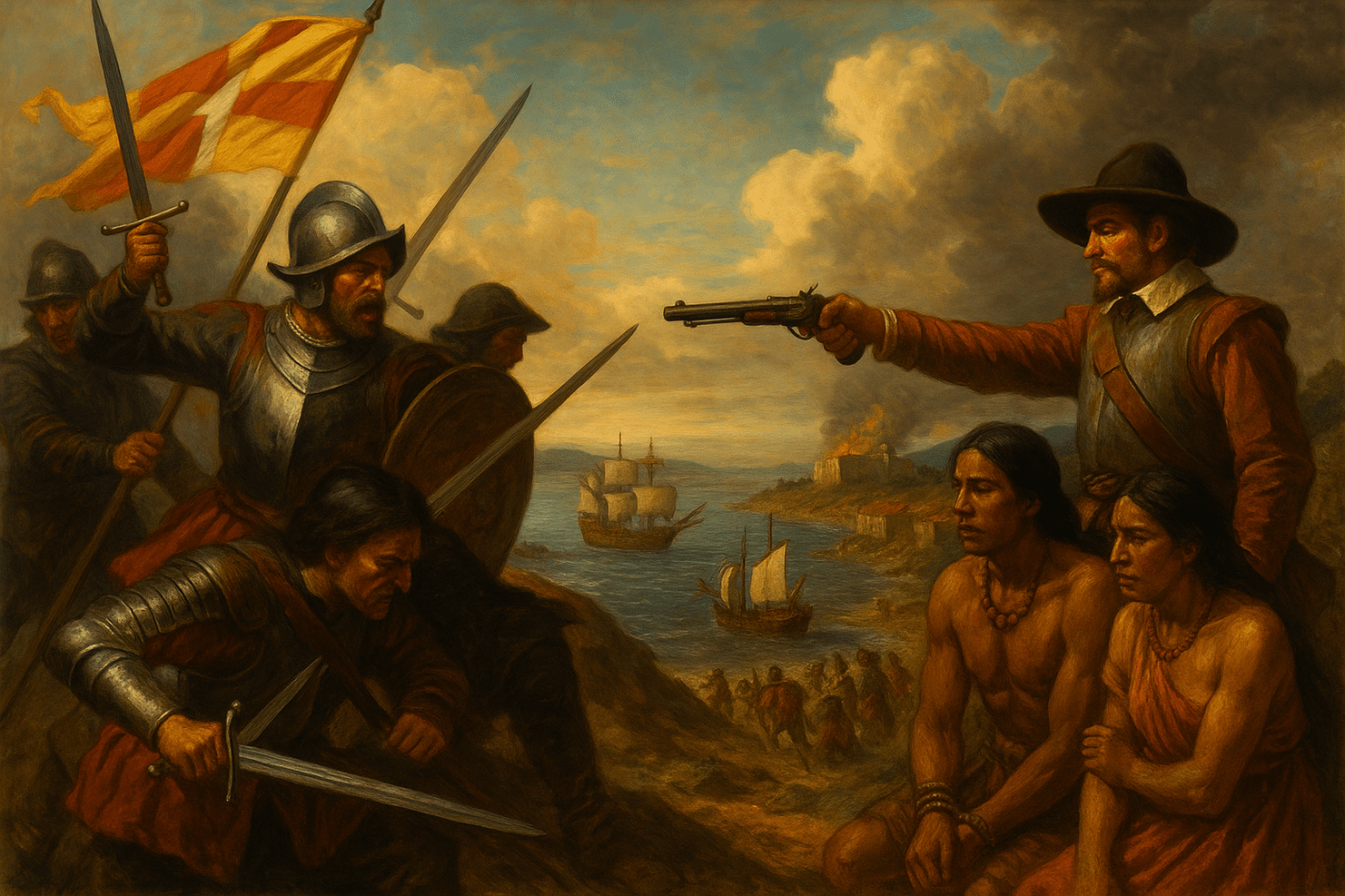
Revealing the 15th–18th century as the opening campaign in a continuous, centuries-long war to determine the destiny of the global majority — where Europe’s ruling class forged its power through colonial conquest, fratricidal rivalry, and uniting only to crush the resistance of the colonized.
By Prince Kapone and Pablo Katari | Weaponized Information | August 12, 2025
Part I – The Dialectic of Unity and Division
History’s official scribes would have us believe that Europe in the so-called “Age of Discovery” was a patchwork of squabbling kingdoms, each jealously guarding its flag, its creed, and its coin. They prefer to write the story as a drama of national rivalries and religious fervor, as if the cannons roared for theology and not for treasure. But peel back the banners and cassocks, and what emerges is a more obscene unity — a cartel of ruling classes, bound together by a shared appetite for conquest, their rivalries little more than disputes over the division of loot. That unity, however, was not given at the outset; it was produced over time by the very wars those kingdoms waged, a functional solidarity forged in the attempt of each to monopolize the colonial tap and, in doing so, to discipline the rest of Europe to its rule.
From the late 15th century to the 18th, the European elite waged what can only be called the First Capitalist World War. It was not declared in any single year, for it was less a formal campaign than a centuries-long hurricane of violence, a continuous process that dissolved the feudal order and rebuilt Europe’s internal coherence on a colonial foundation. Outwardly, this war appeared as a united European onslaught against Africa, the Americas, and Asia — the systematic reduction of vast societies to quarries of labor and reservoirs of gold, silver, and sugar. Inwardly, it manifested as a chain of what might be called “civil wars” within Christendom: dynastic feuds, mercantile competitions, and religious conflicts, each serving to determine the pecking order in a newly forming capitalist world system. The crucial point is dialectical: these fratricidal wars were the means by which a broader European unity against the colonized cohered.
The trick — and it was an old one — was to dress the seizure of land, the enslavement of peoples, and the pillaging of resources in the robes of moral purpose. Religion was the most convenient disguise. Catholic versus Protestant; Papist versus Reformer — the names changed with the treaties, but the economic engine beneath them remained constant. Protestant kings justified attacks on Iberian convoys as blows against the tyranny of Rome; Catholic monarchs blessed the plunder of “heretic” merchant ships as service to God. Even the celebrated reformers who protested the cruelty — think of the priests who denounced Indigenous enslavement — often proposed “humane” substitutions that preserved the colonial order by shifting the burden onto other peoples. All found divine sanction for the same act: the violent appropriation of the wealth of others.
Yet the colonized were never passive matter for European hands. Indigenous polities from the Caribbean to the Andes fought, negotiated, and revolted; African societies resisted capture, interdicted slave routes, and formed maroon communities that bled plantations and harbors; Asian states contested forts, embargoed trade, and toppled garrisons. These counter-movements did not merely “respond” to Europe — they shaped Europe’s internal conflicts, forcing shifts in strategy, finance, and alliance. The colonial front was not an afterthought to European struggles — it was their bloodstream. Silver from Potosí did not just mint coins; it paid armies that leveled German towns. Sugar from São Tomé and Hispaniola sweetened not only the tables of the rich, but also the arsenals of their navies. The plantation and the fortress were as much instruments of European state-building as the musket and the ballot — and the maroon settlement or port blockade could be as decisive as any continental campaign.
This is the dialectic at the heart of the First Capitalist World War: unity through conquest, division through the spoils. The bourgeoisie — that rising class of merchants, financiers, and state-chartered monopolists — learned early that their survival depended on closing ranks against the colonized while sharpening knives against one another at home. What they called competition was, in reality, the negotiation of a collective hegemony over the rest of the planet. Their monarchs were often cousins by blood and creditors by bond, their courts linked by marriage and usury no less than by cannon. The flags were many; the ledger book was one — and it was written, line by line, through wars that decided not whether to plunder, but who would lead the plunder.
Part II – Iberian Monopoly and the First Colonial-Capitalist Circuit
If the First Capitalist World War was a centuries-long campaign, then its opening barrage was fired from the prows of Portuguese caravels and Spanish galleons. In the mid-15th century, the Iberian ruling classes — still half-feudal, but already sniffing the winds of a new order — began to forge the first continuous circuit of colonial-capitalist accumulation. The Atlantic islands were their testing ground: Madeira, the Azores, the Canaries, and São Tomé became laboratories in which the architecture of modern plunder was assembled — plantation monocultures worked by enslaved Africans, fortified ports functioning as counting houses for merchant capital, and a logistical chain binding field, mill, and market. These experiments were not uncontested; enslaved Africans resisted on the plantations, Indigenous islanders fought displacement and enslavement, and maroon settlements formed in defiance of the emerging order.
The Portuguese at Elmina in 1482 built more than a fortress; they constructed the first stone monument to the marriage of merchant capital and military power. Behind its walls, gold dust from the Akan hinterlands was weighed, taxed, and dispatched to Lisbon, where it lubricated the gears of Europe’s emerging financial machinery. Elmina was also a slave depot, a choke-point where African captives were inventoried like livestock before being shipped to the sugar mills of São Tomé or, later, across the ocean to Brazil. Many captives fought capture or mutinied in transit, forcing the Portuguese to adapt their methods of transport and confinement. Here was the embryo of the triangular trade, already pulsing with profit and contested by the resistance of those it sought to commodify.
Spain’s thrust into the Americas after 1492 extended the circuit’s reach into the metallic heart of the New World. The silver mountains of Potosí and the mines of Zacatecas disgorged their wealth through a system that chained Andean and Mesoamerican labor to the monetary bloodstream of Europe and Asia. The Manila galleons ferried silver to China in exchange for silk and porcelain, proving that the Iberian monopoly was never a purely “European” affair; it was global from inception, knitting together continents in a single, unequal metabolism. Indigenous revolts, such as those in the Andes, and covert acts of sabotage within the mines disrupted extraction, often forcing new waves of violence and repression from the colonial authorities.
The Treaty of Tordesillas in 1494, that celebrated diplomatic triumph of cartography over reality, was less a demarcation of sovereignty than a shareholder agreement between two arms of the same plunder syndicate. Portugal and Spain, with the Pope as notary, divided the yet-to-be-conquered world into fiefdoms, as if oceans and peoples existed merely as lines on parchment. The fact that such a treaty was possible at all reflected a momentary Iberian consensus — but it also concealed underlying instability, for this monopoly was neither complete nor uncontested. In the cracks left by this division, Indigenous and African resistance continued to erode Iberian control, and the northern powers — England, France, and the Netherlands — bided their time, built their fleets, and honed their corsairs.
The Iberian Union of 1580–1640, when the crowns of Spain and Portugal rested on the same royal head, represented the high-water mark of this early capitalist unity. For six decades, the two great maritime predators coordinated their colonial slaughter, pooling the spoils of Africa, Asia, and the Americas. Yet this very concentration of wealth and power made them a prime target. England, France, and the Netherlands — each with its own merchant class swelling in strength — saw in the Iberian monopoly not the majesty of divine right, but the locked vault of a rival capitalist combine. The siege of that monopoly would be the next act in the world war, and it would be waged not only on the high seas and in the courts of Europe, but also in the forests, coasts, and mountains where Indigenous fighters, African maroons, and enslaved rebels struck blows that shaped the fortunes of empires.
Part III – The Reformation as Class Recomposition
The chroniclers of Europe would have us believe that the Reformation was a thunderclap of pure conscience — Luther’s hammer ringing against the corruption of Rome, Calvin’s austere sermons calling the faithful back to God. But beneath the hymns and polemics lurked the restless hand of capital, prying loose the jewels of the Church to finance the new order. The Papacy was not merely a spiritual authority; it was the continent’s largest landowner, a feudal rent-extractor whose wealth was sunk into monasteries, bishoprics, and the gilded lethargy of its own bureaucracy. For an emerging bourgeoisie and its allied petty nobility, the Reformation’s theology was less revelation than opportunity — a fiscal revolution dressed in piety.
In Protestant strongholds, indulgences were abolished, clerical taxes curtailed, and vast tracts of Church land seized and sold into private hands. This was primitive accumulation under a new banner: the liquefaction of feudal property into merchant capital. Princes and city councils, newly freed from Rome’s tithe, could now direct their revenues into shipyards, arsenals, and colonial ventures. The Reformation was the ideological solvent that broke the Catholic monopoly on legitimacy, allowing the state to sanctify its own authority and mobilize national-religious identity as a weapon of expansion.
This recomposition of class forces did more than shift the balance of power within Europe; it redrew the map of global plunder. Protestant powers, armed with both scripture and cannon, denounced the Iberian claim to exclusive dominion as a papist fraud. The Pope’s division of the world at Tordesillas was, to them, not holy decree but market restraint — and thus a contract to be broken. English and Dutch merchants sailed under the cross of St. George or the orange flag of the United Provinces with the moral certainty that “breaking the papist monopoly” was a godly act. In practice, it meant seizing African slave forts, raiding Caribbean sugar islands, and muscling into the spice trade of Asia.
Yet the colonized were neither mere spectators nor silent victims in this upheaval. African defenders at slave forts repelled assaults, Indigenous fighters in the Caribbean resisted Protestant raiders no less than Catholic ones, and Asian polities fought to keep Protestant merchants from fortifying their ports. These resistances forced tactical adaptations, shifting alliances, and escalations that shaped the course of the Reformation’s overseas theaters. Theological disputes that fractured Christendom also supplied the ideological arsenal for violating the old colonial division of labor — but the decisive actors on the ground were often those whom both sides sought to subjugate.
The new Protestant states did not reject the principle of conquest; they rejected the exclusivity of their Catholic rivals. And so, under banners proclaiming faith and liberty, they inaugurated a wider and bloodier phase of the First Capitalist World War, in which the Bible and the bond certificate became twin instruments of accumulation. If a priest like Bartolomé de las Casas could condemn Indigenous enslavement yet propose importing African captives as a “humane” alternative, it was because even the most celebrated moral critiques of the age could not escape the gravitational pull of the colonial mode of production. In this, the Reformation’s promise of liberation revealed its class content: a reordering of domination, not its abolition.
Part IV – The Dutch Revolt and the “Great Design”
If the Reformation cracked open the doors of Iberian monopoly, the Dutch Revolt blew them from their hinges. What began in 1568 as a provincial uprising against Spanish rule soon revealed itself as the blueprint for a new kind of war — one that fused the battlefields of Europe with the plunder circuits of Africa, Asia, and the Americas. The Eighty Years’ War was not simply a rebellion of Calvinist provinces against a Catholic king; it was the armed birth of a mercantile republic whose constitution was joint-stock capital itself.
The United Provinces understood, perhaps more clearly than any before them, that the key to independence was not merely defeating Spain in Flanders, but dismantling its colonial lifeline. This was the logic of the Groot Desseyn, the “Great Design” conceived by the Dutch West India Company: seize the sugar plantations of Brazil, capture the slave entrepôt of Luanda in Angola, and wrest from Iberia its choke points in the African and Asian trades. Each conquest was a cog in a single accumulation machine — slaves from Angola to cut Brazilian sugar, sugar profits funding fleets to dominate the spice islands, spices exchanged in Europe and Asia for bullion, and bullion recycled into new ventures.
The creation of the Dutch East India Company (VOC) in 1602 gave this vision a corporate form unprecedented in history. The VOC was not just a trading concern; it was a state apparatus in miniature, complete with its own army, navy, diplomatic corps, and the legal right to wage war. Its shareholders were not confined by nationality — capital from across Europe, including from supposed enemy states, found its way into VOC coffers through the clearing houses of Amsterdam. The Amsterdam stock exchange became the nerve center of this new order, where the fortunes of merchants, nobles, and financiers from Lisbon to London were bound together in the same ledgers.
Nor did the Dutch advance go unchallenged by those they sought to subjugate. African forces in Angola fought to defend Luanda, Indigenous Brazilians resisted the imposition of the plantation order, and Asian rulers in the spice islands contested VOC fortifications and monopolies. These struggles often disrupted Dutch timelines, drained resources, and forced military campaigns into prolonged stalemates, showing that colonial conquest was never a smooth extension of European designs.
Thus, the Dutch Revolt was never solely about sovereignty; it was about reengineering sovereignty to serve capital. The Republic’s independence was secured not by the purity of Calvinist doctrine, but by the integration of its military campaigns into a global strategy of primitive accumulation. And in this synthesis — of war, commerce, and colonial exploitation — the United Provinces announced to the world that the age of the merchant-state had arrived. From here forward, European conflicts would be fought as much in the sugar fields of Pernambuco and the harbors of Ceylon as on the muddy plains of the continent, each theater feeding the other in a single, voracious war economy.
Part V – Privateering, Piracy, and the State
The rise of the merchant-state brought with it a new species of soldier — the armed entrepreneur of the high seas. Privateers and buccaneers were not the lawless rogues of romantic fiction; they were the irregular troops of primitive accumulation, licensed by royal charters to seize ships, burn settlements, and redistribute the spoils upward to their investors. A letter of marque was no mere parchment; it was a legal title to plunder, stamped with the authority of the crown and underwritten by the merchant guilds and financiers who shared in the take.
These corsairs blurred the line between piracy and policy. Sir Francis Drake’s raids on Spanish treasure fleets were not crimes in the eyes of Elizabeth’s court — they were balance sheet operations, channeling Peruvian silver into English shipyards, foundries, and banking houses. The buccaneers of the Caribbean, often drawn from the refuse of European ports, formed multinational crews whose flags might change with the prevailing winds. Here was the embryo of a pan-European capitalist adventurism, where profit trumped patriotism and the enemy of yesterday became today’s trading partner.
But piracy was not a single, unified phenomenon. Alongside the crown-sanctioned plunderers were the autonomous or “free” pirates, operating beyond the direct control of any state or chartered company. These crews sometimes provided refuge to runaway slaves, Indigenous defectors, and other marginalized elements, creating shipboard societies that operated on a more communal basis, without rigid hierarchies and often with shared division of spoils. In such cases, piracy could function as an anti-capitalist and even anti-imperialist force — expropriating the expropriators — though this was not without contradiction, as some of these same pirates engaged in opportunistic slave trading or raiding of non-European communities when expedient.
The state’s role in fostering and shaping piracy’s more “official” forms was decisive. Without safe harbors to refit, markets to offload loot, and courts to adjudicate disputes among partners-in-crime, the commerce of plunder could not flourish. London, Amsterdam, and La Rochelle became not just ports but laundering stations for the world’s stolen wealth, where goods stripped from galleons were transformed into legitimate commodities. Insurance markets emerged to hedge the risks of these ventures, sometimes underwriting cargoes carried under enemy flags — a quiet reminder that capital’s appetite was never constrained by the banners of war.
In this way, privateering functioned as both a school and an extension of imperial strategy. It trained seamen in navigation, gunnery, and amphibious assault; it mapped coastlines and trade routes for future conquests; it accustomed the public to the idea that the wealth of distant peoples was the rightful prize of European arms. The profits did not vanish into the taverns — they sank roots into the industrial and financial infrastructure of the core, accelerating the transformation of merchant capital into the early capitalist state. The buccaneer’s cutlass, it turns out, was only the opening act for the accountant’s pen.
Part VI – England’s Apprenticeship in Plunder
The Anglo–Spanish War of 1585–1604 was England’s graduation from opportunistic raiding to organized imperial apprenticeship. Until then, the English merchant class had been a junior partner in the Atlantic system, dabbling in piracy, dabbling in trade, but lacking the colonial infrastructure of Iberia or the financial sophistication of the Dutch. The war with Spain — waged under the Protestant banner but driven by the hunger for bullion and markets — offered England its first sustained immersion in the logistics of global plunder.
Elizabeth’s court did not build its naval power from scratch; it built it on the decks of privateers. Figures like John Hawkins and Francis Drake were not merely naval heroes but early architects of the English slave trade. Hawkins’s voyages in the 1560s — kidnapping Africans on the West African coast and selling them in the Caribbean — were conducted with royal approval and partial crown investment. Many captives resisted capture, and some revolts at sea forced Hawkins to abandon cargoes, revealing that the slave trade’s profitability was inseparable from its constant vulnerability to the agency of the enslaved. The war years expanded these operations into a coordinated assault on Spain’s colonial arteries: treasure fleets from the Americas, sugar shipments from the Caribbean, and strategic ports along the Atlantic rim.
These ventures were not purely national efforts. English expeditions were often financed through Dutch credit and outfitted with supplies purchased from merchants who might, in the same season, underwrite a Spanish voyage. Capital cared little for the color of the flag so long as the return was secure. This transnational circulation of investment underscored the deeper unity of the European ruling class: enemies in the field, partners in the counting house.
The Virginia Company, chartered in 1606 but conceived in the closing years of the war, was the institutional child of this apprenticeship. Drawing lessons from Iberian and Dutch precedents, it fused royal authority with joint-stock investment, promising returns not only from gold and exotic commodities but from the cultivation of settler colonies. Here, England signaled its intent to shift from parasitic raiding to productive — that is, systematically exploitative — colonization. This shift met immediate resistance from Indigenous nations, who fought to defend their homelands and disrupt English settlement patterns, forcing the company to militarize its operations from the outset.
Thus, by the war’s end, England had acquired more than plunder: it had acquired the mercantile habits, maritime infrastructure, and transnational financial ties that would serve as the skeleton of its future empire. The lessons of its apprenticeship were clear — colonial wealth was not a windfall of chance encounters at sea, but the result of sustained integration between state power, merchant capital, and military force. And in this integration, England found its true vocation.
Part VII – The Thirty Years’ War: Civil War of Christendom
From 1618 to 1648, Europe convulsed in the Thirty Years’ War — a catastrophe remembered by polite historians as a “religious conflict,” as though sermons, not silver, fed the armies that burned half the continent. In reality, the war was the continental clearinghouse for a new capitalist order, a brutal rebalancing of power among Europe’s aspiring core states, financed in no small part by the blood and treasure wrung from the colonies.
The ostensible spark — a quarrel over Protestant and Catholic sovereignty within the Holy Roman Empire — was merely the kindling. The fire raged because Spain, France, the Habsburgs, Sweden, and a swelling England all saw in Germany not just a battlefield, but a pivot point in the control of trade routes, fiscal regimes, and the military alignments that would shape the division of global plunder. The war’s real stakes were geopolitical: who would hold the keys to Europe’s markets, and thus wield the power to project force into Africa, Asia, and the Americas.
Colonial wealth was the war’s hidden quartermaster. Spanish silver from Potosí and Zacatecas bankrolled the Habsburg cause, paying mercenaries who pillaged the Rhineland and Bohemia. French Caribbean sugar revenues, still modest but growing, underwrote Bourbon campaigns. Even the Dutch war chest — brimming with VOC profits from the spice trade and West India Company seizures in Brazil and Angola — fueled interventions in the Empire. In this sense, the war in Europe was only the inland theater of a much larger struggle: the global scramble for control of the colonial tap.
The colonized were not absent from this drama. In the Americas, Indigenous uprisings disrupted silver shipments; in Africa, local powers contested Dutch and Portuguese forts critical to financing the war; in Asia, rulers resisted the expansion of VOC and EIC trading monopolies. These acts of resistance directly affected European campaigns, delaying fleets, cutting revenues, and forcing powers to divert resources from European battlefields to defend colonial holdings.
The devastation of the German states was not collateral damage but a calculated clearing of the board. Entire regions were depopulated, not only by combat but by famine and disease deliberately stoked by scorched-earth tactics. This destruction served to break the back of the old feudal order in Central Europe, leaving space for capitalist forms of statecraft to take root in the ashes. The Treaty of Westphalia, that supposed monument to modern sovereignty, was in truth the first pan-European balance sheet of capitalist power, ratifying the gains of those who had successfully married military success at home with profitable aggression abroad.
Thus, the Thirty Years’ War stands as a textbook case of the First Capitalist World War’s dual character. While it appeared to be Europe’s supreme family quarrel — a “civil war” of Christendom — it was materially inseparable from the colonial war that raged across oceans. The same bullion that gilded chalices in Madrid bought gunpowder in Flanders; the same sugar that sweetened coffee in Paris financed cannon foundries along the Seine. Behind the smoke of piety and patriotism, the real issue was simple: who would dictate the terms of Europe’s unity in the conquest of the rest of the world.
Part VIII – The Dutch–Portuguese War: Capital’s Continental Siege
Between 1602 and 1661, Europe witnessed one of the clearest demonstrations of how colonial battlefields could determine the fate of the metropole: the Dutch–Portuguese War. On paper, it was a struggle between a newly independent merchant republic and an Iberian monarchy; in reality, it was a continental siege conducted by capital itself, waged not through the attrition of trench lines in Europe but through the seizure of strategic nodes in Africa, Asia, and the Americas.
For the Dutch, the campaign was a logical extension of the VOC’s founding charter: break the Iberian monopoly at its global hinges. The conquest of Ceylon in 1658 severed Portugal’s grip on the cinnamon trade; the capture of Malacca in 1641 pried open the gateway to the spice islands. In West Africa, the brief but decisive seizure of Luanda in 1641 interrupted the Atlantic slave pipeline, redirecting human cargo to Dutch-controlled Brazil. In Brazil itself, Indigenous and African resistance persisted throughout Dutch occupation, with uprisings and guerrilla actions that undermined plantation stability and forced heavy military expenditures.
These victories were not the product of national genius but of corporate strategy. The VOC and WIC were military-commercial hybrids whose investors hailed from across Europe, many of them nominal subjects of enemy states. In Amsterdam’s exchange, Portuguese “New Christian” merchants fleeing the Inquisition traded alongside Calvinist burghers, both profiting from the very wars that had driven them into exile. African rulers and maroon communities in Angola and Brazil played decisive roles — sometimes resisting Portuguese reconquest, sometimes exploiting Dutch–Portuguese rivalries to advance their own autonomy.
The siege of Portugal’s empire was thus a transnational venture: the flag over the fortress might be orange, but the dividends were paid into accounts from Genoa to Hamburg. The peace treaties that concluded the conflict, most notably the Treaty of The Hague in 1661, ratified this reality. Colonies, forts, and trading posts changed hands with more permanence than European borderlands. It mattered little that the Netherlands and Portugal might maintain diplomatic courtesies in Europe; what mattered was who held the sugar mills, the spice ports, and the slave depots that underpinned the whole system.
In this continental siege, the Dutch demonstrated the law of the First Capitalist World War: control the colonial arteries, and you can starve your rival’s heart without ever laying siege to their capital. It was a lesson every rising power would study — and one that would define the strategy of European warfare for the next two centuries.
Part IX – Franco–Spanish War: Catholic vs. Catholic
From 1635 to 1659, France and Spain waged yet another of Europe’s “great wars,” remembered in textbooks as a dynastic contest between Bourbon and Habsburg. Yet behind the polite fictions of court intrigue and religious rivalry lay a familiar engine: the contest for control over colonial wealth. That both crowns marched under the same Catholic banner only proves the point — unity in creed was no obstacle to disunity in the division of spoils. When profit beckoned, the Pope’s blessing could be safely ignored.
France, rising from decades of internal conflict, sought to carve its own path into the Atlantic system. Its strategy was not to assault Madrid directly, but to peel away the colonial sinews that fed Spanish power. In the Caribbean, French fleets targeted Spain’s sugar islands, seizing territories such as Guadeloupe and Martinique, planting the first large-scale French sugar plantations worked by enslaved Africans. These plantations became immediate sites of resistance: African captives engaged in sabotage, flight, and organized revolts, forcing the French to fortify their holdings and expand their reliance on violent discipline.
French ambitions extended to West Africa, where expeditions captured and fortified slave-trading posts in Senegal, thereby securing a direct line from the African coast to the French Caribbean. This was no sideshow. Control over slave embarkation points meant control over the labor supply without which sugar, indigo, and coffee plantations could not function. African coastal states and inland polities resisted these intrusions, at times playing French and Spanish traders against each other to preserve autonomy or extract concessions.
For Spain, the defense of these outposts was as critical as holding Flanders or Milan. Colonial silver and sugar revenues paid the tercios that fought in Catalonia and the Low Countries. Every island lost to France was not just a strategic setback but a fiscal amputation, reducing the flow of capital into the Habsburg war machine. The Franco–Spanish War was, in this sense, a colonial war with a European front, not the other way around. Resistance in the colonies was therefore doubly threatening: it endangered Spain’s imperial lifelines while offering opportunities for France to expand its reach.
The Treaty of the Pyrenees in 1659 shifted more than the Franco–Spanish border; it shifted the balance of power in the Atlantic. France emerged with a foothold in the Caribbean and Africa, while Spain’s once-dominant empire began its long decline. The lesson was plain: even among co-religionists, the real communion was not in the Mass but in the marketplace — and the marketplace had no sacrament holier than profit.
Part X – England’s Civil War and Cromwell’s “Western Design”
Between 1642 and 1651, England tore itself apart in a civil war that pitted royalist landed aristocracy against a rising bourgeois Parliament. While the pamphleteers argued about the divine right of kings and the liberties of freeborn Englishmen, the struggle’s real content was over the control of the state apparatus and the economic future it would serve. Would England remain a kingdom tethered to the feudal rentier class, or would it be retooled into a machine for the expansion of merchant capital?
The victory of Parliament’s New Model Army — disciplined, ideologically hardened, and backed by the commercial classes of London — resolved the question. The execution of Charles I in 1649 was not just the beheading of a monarch; it was the decapitation of a political form that had become an obstacle to the unification of state power and capitalist accumulation. Oliver Cromwell’s ascendance marked the integration of military force, fiscal innovation, and colonial ambition into a single program.
That program’s sharpest expression was the Navigation Acts of 1651, which declared the seas a closed preserve for English shipping and excluded foreign carriers from profiting in English trade. This was protectionism with a musket behind it — a legislative blueprint for economic war. But Cromwell’s most audacious move came in the form of the “Western Design” of 1655: a grand expedition to wrest Caribbean wealth from Spain. The assault on Hispaniola failed, but the seizure of Jamaica was a lasting prize. In that fertile island, the English state found the perfect laboratory for a plantation system driven by enslaved African labor, producing sugar for the European market and profits for the metropolitan elite.
Jamaica’s conquest was not without fierce opposition. Maroon communities of escaped slaves waged guerrilla war against English control, preserving zones of autonomy in the island’s interior and forcing the colonial authorities into decades of armed truces and punitive expeditions. These maroons represented a living negation of the plantation system, proving that colonial rule was never total and that enslaved Africans and their descendants were active agents in shaping imperial fortunes.
The conquest of Jamaica was no isolated venture. It signaled the Parliamentarian regime’s recognition that the key to securing England’s capitalist future lay not merely in domestic reform, but in commanding the flows of colonial wealth. The same navy that enforced the Navigation Acts patrolled the slave routes; the same financiers who underwrote the New Model Army invested in West Indian plantations. The civil war’s outcome was thus sealed as much in the cane fields of the Caribbean as on the battlefields of Naseby and Worcester.
By the time Cromwell died in 1658, England had completed its political apprenticeship. The monarchy would return, but the economic foundation it now sat upon was irrevocably altered. The fusion of state power, naval supremacy, and colonial exploitation — inaugurated in the fires of civil war and tested in the tropics — would become the permanent architecture of English imperial capitalism.
Part XI – Cross-National Capital and the Fiction of the Nation-State
By the mid-seventeenth century, the nationalist epics of Europe had already outlived their truth. Flags still flew, anthems still stirred the masses to kill and die for “their” king or republic, but in the counting houses of Amsterdam, Hamburg, and Geneva, capital had long since shed the skin of nationality. There, enemy and ally were distinctions for diplomats and pamphleteers; for merchants and investors, they were irrelevant costs of doing business. The bourgeoisie had discovered its true homeland — not in any patch of soil, but in the ledger.
Joint-stock companies became the most conspicuous instrument of this transnational unity. Shares in the Dutch East India Company (VOC), the English East India Company, or the French Compagnie des Indes could be purchased through intermediaries in neutral ports, even by subjects of enemy states. Portuguese “New Christian” merchants expelled by the Inquisition financed Dutch West India Company expeditions against Portugal’s own colonies. Hamburg brokers quietly arranged for English capital to underwrite French sugar ventures, while French bankers insured Dutch spice convoys bound for ports that, on paper, were at war with France.
This financial cosmopolitanism was not confined to polite boardrooms. In the colonies, it often played out in ways that exposed the farcical nature of national rivalry. Enslaved Africans and Indigenous allies, seizing opportunities in the cracks between competing powers, defected, traded information, or joined rival colonial forces if it meant survival or the chance to strike at a hated overlord. Such acts could tilt local balances of power, force new negotiations, and undermine the absolute control both crowns and companies sought to project.
Insurance markets perfected the hypocrisy. A London underwriter might insure a Spanish galleon’s cargo even as the English navy hunted that same ship on the high seas. The risk premium was simply another calculation; the destruction of the vessel was not a tragedy, but a payout opportunity. Neutral cities — Geneva, Amsterdam, Hamburg — became the great clearinghouses of this mercenary cosmopolitanism, sanctuaries where profit could be counted without embarrassment over the flag it had bled under.
The fiction of the nation-state was thus maintained as a mobilization device for the lower orders, who were called upon to fight and pay taxes in the name of a patriotic cause that did not exist in the dealings of their rulers. Nationalism was for the deckhand, the foot soldier, the peasant levied into service. For the capitalist, “nation” was merely the administrative shell through which to secure charters, monopolies, and naval protection for enterprises whose shareholders’ addresses were scattered across the map of Europe.
In this reality, the First Capitalist World War revealed its essential truth: Europe’s ruling class was already one, long before it proclaimed itself so. Its wars with itself were real enough, but there were quarrels over the division of a common plunder, not over its legitimacy. The nation-state was the drumbeat; the dance was always for capital.
Part XII – The Franco–English Hegemonic Struggle
From 1689 to 1763, Europe’s two most ambitious capitalist powers — Britain and France — fought a rolling series of conflicts that spanned continents. Known in the polite annals as the War of the League of Augsburg, the War of the Spanish Succession, and the Seven Years’ War, these campaigns were less discrete wars than successive rounds in a single contest: to decide which flag would fly over the global circuits of colonial accumulation. The struggle played out simultaneously in Europe’s fields, the sugar islands of the Caribbean, the slave forts of West Africa, the Mughal ports of India, and the forests of North America.
This was not simply imperial rivalry; it was the second phase of the First Capitalist World War, when the structure of Europe’s colonial unity was tested by its internal competition for primacy. Both Britain and France understood that the seat of supremacy lay in command over the colonial periphery — the plantations, mines, and trade monopolies that fed the treasuries of the core. Each war was thus fought in a double register: in the salons of Versailles and Westminster, and in the cane fields of Saint-Domingue, the rice paddies of Bengal, and the fur trading routes of the Ohio Valley.
The Seven Years’ War (1756–1763) brought this dynamic to its most naked expression. Britain’s victory — seizing Canada, dominating West African slave ports, and wresting strategic enclaves from France in India — was not just a triumph of arms but of logistics, finance, and maritime supremacy. It established Britain as the unrivaled broker of the Atlantic slave trade and the arbiter of global commerce, while France, though diminished, retained the richest colony on earth in Saint-Domingue. That colony, however, was a powder keg: enslaved Africans resisted through desertion, sabotage, and rebellion, forcing the French to devote massive resources to its security.
The contest did not end in annihilation because annihilation was never the goal; the mutual interest in suppressing colonial revolt and preserving the imperial system outweighed the temptation to destroy a rival entirely. Indeed, the Haitian Revolution of 1791–1804 would prove the deeper unity beneath the rivalry. When the enslaved of Saint-Domingue rose up, both Britain and France — sworn enemies in the decades prior — converged in their determination to crush the insurrection. British expeditions sought to seize the colony for themselves, only to be beaten back by the same Black revolutionary armies that routed France’s troops. The specter of a self-liberated Black republic threatened not only French profits but the entire architecture of European colonialism.
Here, the mask slipped completely: the competition for hegemony was suspended, and the old unity of the European bourgeoisie against the colonized reasserted itself without shame. Thus, the century-long Franco–English struggle was not the story of two separate destinies, but of a single capitalist class negotiating its own hierarchy. The wars settled the question of leadership within Europe’s imperial syndicate; they did not alter the fact that the syndicate itself was united in purpose against the rest of the world.
Part XIII – Colonial Unity in the Face of Revolt
If the internal rivalries of Europe were vicious, the response to colonial revolt revealed an even more ferocious unanimity. The Haitian Revolution of 1791–1804 was the decisive test. In the richest colony of the age — Saint-Domingue — enslaved Africans rose not merely to demand better conditions, but to abolish slavery and French rule entirely. For the ruling classes of Europe, this was not an isolated rebellion; it was the specter of universal contagion, the nightmare that the colonies might cease to be colonies.
France, torn between revolutionary slogans in Paris and plantation profits in the Caribbean, sent army after army to crush the uprising. Britain, which had been at war with France for most of the preceding decades, landed troops in Saint-Domingue to capture the colony for itself — only to be routed by the same Black armies. Even Spain, whose territories bordered the island, offered shifting alliances and arms when it suited their strategic interest, but never support for the idea of a free Black republic. All were united on the essential point: self-liberated Africans must not be allowed to stand as an example.
The unity was not confined to European states alone. Planter elites in the Americas, from the southern United States to Brazil, watched the Haitian Revolution with terror, tightening slave codes, expanding patrols, and crushing even the smallest hints of rebellion. The colonized, however, saw in Haiti’s victory a beacon: maroon communities, enslaved laborers, and Indigenous nations from the Caribbean to the mainland took inspiration, resisting and rebelling in ways that reverberated for decades.
This unity in repression was not an aberration of the late eighteenth century. A century later, the Boxer Rebellion in China (1899–1901) would replay the same script on a larger stage. Faced with an anti-imperialist uprising aimed at expelling foreign powers, the armies of eight nations — Britain, France, Germany, Russia, Japan, the United States, Austria-Hungary, and Italy — marched under a single banner of “civilization” to loot Beijing and impose new indemnities. These were nations that had fought bitter wars against one another; yet in the face of a colonial subject daring to defy their order, they moved as one organism.
The pattern was clear and had been forged during the era of the First Capitalist World War: Europe could quarrel internally over who would lead the imperial syndicate, but against the colonized it spoke with one voice, wielded one sword, and plundered with one hand. It was in these moments — when the oppressed seized their own destiny — that the true nature of the bourgeoisie’s “national” rivalries was exposed. Beneath the competing flags was a single imperative: preserve the system of global expropriation at all costs.
Thus, the Haitian Revolution and the Boxer Rebellion, though separated by a century and half a world, belong to the same historical logic. They reveal that the unity forged in conquest endures in defense of that conquest. For the capitalist class born in plunder, solidarity is not with the nations they rule, but with their fellow rulers in every other nation — so long as the enemy is the colonized.
Part XIV – Verdict of the First Capitalist World War
By the middle of the eighteenth century, the architecture of the capitalist world-system stood fully framed. At its core was not a single imperial center, but a polycentric cartel: Britain, France, the Netherlands, and the diminished yet still formidable Iberian powers, bound together by the shared logic of colonial expropriation. Around this core stretched the periphery — the plantations, mines, and trade enclaves of Africa, the Americas, and Asia — feeding raw materials, bullion, and enslaved labor into the furnaces of European accumulation.
This order was more than a balance of military power; it was an infrastructure of transnational capital. Amsterdam’s exchange, London’s insurance markets, Bordeaux’s merchant houses, and Hamburg’s banking syndicates formed the nervous system through which profits flowed, risk was shared, and investments crossed enemy lines with impunity. Joint-stock companies were the armed limbs of this system, projecting force as easily as they paid dividends, while neutral ports acted as safe harbors where the rivalries of the battlefield dissolved into the handshake of the deal.
The so-called First Capitalist World War had not produced a lasting peace in Europe — that was never its aim. It had, however, produced something far more durable: a permanent unity of purpose toward the rest of the world. The wars of religion, the dynastic feuds, the commercial blockades, and the pitched battles from the Elbe to the St. Lawrence were the quarrels of partners over the division of loot. The foundational consensus — that the wealth of Europe was to be built on the subjugation and plunder of the Global South — was never in question.
Nor was this unity born in peace or mutual trust. It was forged through ceaseless competition, brutal wars, and the relentless pursuit of monopoly over colonial wealth. Intra-European conflicts were as bloody and hostile as any fought with the colonized, but they were conditioned and shaped by the colonial contradiction: the shared dependence on a system of global expropriation. Dynastic intermarriages and elite kinship networks — sometimes literally incestuous — reinforced the social bonds of the ruling class, making realignments possible when colonial revolts threatened their collective interests.
Thus the European bourgeoisie was not born as a national class, but as an international syndicate of robbers, financiers, and chartered monopolists. Its members might squabble over precedence and profit shares, but they marched in lockstep when the colonized threatened to break the chains. The nation-state, in this context, was not the organic expression of a people’s will, but the armored storefront of a cartel — its banners tools of mass mobilization, its borders mere lines of administrative convenience.
In the smoke of cannon fire and the sugar dust of the plantations, the modern world was forged: a world where unity through conquest abroad coexisted with civil war within, and where both were essential to the birth of capitalism. That is the real verdict of this first, unacknowledged world war — the war that gave the bourgeoisie its first taste of planetary power and taught it the lesson it has never since forgotten: divided at home, united in plunder.
References
- Boxer, C. R. The Portuguese Seaborne Empire, 1415–1825. London: Hutchinson, 1969. — Provided detailed background on Portugal’s maritime expansion and its role in early capitalist accumulation (Elmina, São Tomé, Luanda, spice trade).
- Braudel, Fernand. Civilization and Capitalism, 15th–18th Century, Vol. III: The Perspective of the World. New York: Harper & Row, 1984. — Helped situate the global commercial networks and structures of early capitalism.
- Clarke, John Henrik. Christopher Columbus and the Afrikan Holocaust. Baltimore: Black Classic Press, 1993. — Informed the portrayal of Columbus’s voyages as genocidal and foundational to capitalist expansion.
- Diop, Cheikh Anta. Precolonial Black Africa: A Comparative Study of the Political and Social Systems of Europe and Black Africa. Brooklyn: Lawrence Hill Books, 1987. — Used to contrast African political-economic systems with the European colonial mode of production.
- Elliott, J. H. Empires of the Atlantic World: Britain and Spain in America, 1492–1830. New Haven: Yale University Press, 2006. — Provided comparative analysis for Iberian and British colonial governance in the Americas.
- French, Howard W. Born in Blackness: Africa, Africans, and the Making of the Modern World, 1471 to the Second World War. New York: Liveright, 2021. — Central to showing African centrality in shaping the early modern world economy.
- Games, Alison. The Web of Empire: English Cosmopolitans in an Age of Expansion, 1560–1660. Oxford: Oxford University Press, 2008. — Provided insight on England’s maritime expansion and cosmopolitan networks.
- Geggus, David. Haitian Revolutionary Studies. Bloomington: Indiana University Press, 2002. — Informed the section on the Haitian Revolution and its global repercussions.
- Horne, Gerald. The Apocalypse of Settler Colonialism: The Roots of Slavery, White Supremacy, and Capitalism in Seventeenth-Century North America and the Caribbean. New York: Monthly Review Press, 2018. — Used to link race, slavery, and capitalism in the 17th century colonial context.
- Horne, Gerald. The Counter-Revolution of 1776: Slave Resistance and the Origins of the United States of America. New York: New York University Press, 2014. — Provided perspective on colonial unity against slave resistance.
- Lenin, Vladimir I. Imperialism, the Highest Stage of Capitalism. Peking: Foreign Languages Press, 1970. — Framework for connecting monopoly capital to colonial expansion.
- Linebaugh, Peter, and Marcus Rediker. The Many-Headed Hydra: Sailors, Slaves, Commoners, and the Hidden History of the Revolutionary Atlantic. Boston: Beacon Press, 2000. — Informed analysis of multinational proletarian resistance (piracy, maritime labor).
- Marx, Karl. Capital: Volume I. Translated by Ben Fowkes. London: Penguin Classics, 1990. — The theoretical backbone for the accumulation and class struggle analysis.
- Northrup, David. Africa’s Discovery of Europe, 1450–1850. Oxford: Oxford University Press, 2002. — Informed sections on African agency and resistance in early encounters.
- Parry, J. H. The Spanish Seaborne Empire. London: Hutchinson, 1966. — Provided details on Spanish maritime and colonial logistics.
- Price, Richard. Maroon Societies: Rebel Slave Communities in the Americas. Baltimore: Johns Hopkins University Press, 1979. — Used in discussing maroon resistance to plantation economies.
- Rediker, Marcus. Between the Devil and the Deep Blue Sea: Merchant Seamen, Pirates, and the Anglo-American Maritime World, 1700–1750. Cambridge: Cambridge University Press, 1987. — Informed the treatment of piracy and maritime labor as capitalist instruments and resistances.
- Rodney, Walter. How Europe Underdeveloped Africa. London: Bogle-L’Ouverture Publications, 1972. — Core source for linking colonial extraction to underdevelopment in Africa.
- Wallerstein, Immanuel. The Modern World-System I: Capitalist Agriculture and the Origins of the European World-Economy in the Sixteenth Century. New York: Academic Press, 1974. — Provided the world-systems framework for situating the First Capitalist World War.
- Williams, Eric. Capitalism and Slavery. Chapel Hill: University of North Carolina Press, 1944. — Key text for explaining slavery as a driver of industrial capitalism.
- Wolf, Eric R. Europe and the People Without History. Berkeley: University of California Press, 1982. — Used to de-center Europe and highlight the agency of the colonized in shaping history.
 Weaponized Information
Leave a comment