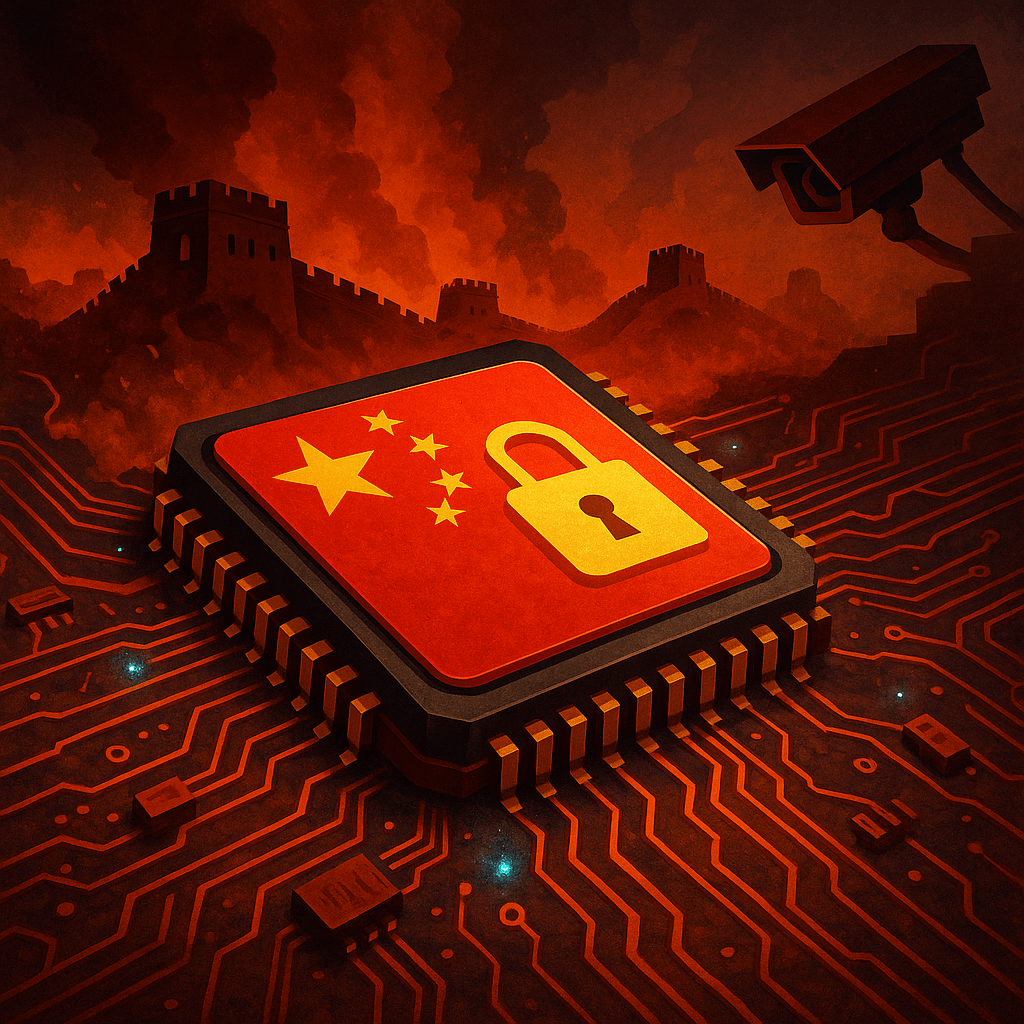
The AP frames sabotage-ready U.S. chips as neutral tech and paints China’s resistance as paranoia. We expose the buried facts: backdoor precedents, economic coercion, and digital siege strategy. The H20 chip is not a compromise—it’s a neocolonial device enforcing imperialist recalibration. Our task is to dismantle this architecture of control and build a sovereign digital resistance.
By Prince Kapone | Weaponized Information
August 1, 2025
Imperial Prose and the Chip Called Compliance
On July 31, 2025, the Associated Press published an article by Didi Tang titled “China summons Nvidia over ‘backdoor safety risks’ in H20 chips.” The story reports that China’s Cyberspace Administration summoned Nvidia to explain alleged “backdoors” in its H20 artificial intelligence chips—accusations that the chips may contain mechanisms enabling remote tracking or shutdown. Nvidia denies this. The article presents the episode as another brief disturbance in the great U.S.–China tech rivalry, noting that the H20 was recently re-approved for export after a Trump administration ban. U.S. lawmakers, including Rep. John Moolenaar and Sen. Chuck Schumer, are quoted expressing alarm over the chip’s potential utility to China. The AP frames the moment as one of geopolitical tension, commercial entanglement, and digital diplomacy—another ripple in a supposedly balanced tug-of-war.
But like all propaganda, the strength of this article lies not in what it says, but in what it compels the reader to accept without question. The Associated Press has perfected the art of ideological seduction: a performance of neutrality so smooth it numbs the senses. It doesn’t shriek like Fox or editorialize like The Atlantic—it simply folds its empire into the structure of the sentence. Every paragraph is clean, official, and deadly. This is not journalism. It’s anesthetic. And Didi Tang, who spent over a decade as the AP’s eyes and ears in Beijing before moving to Washington, plays her role as ideological ventriloquist with aplomb. Her writing flows seamlessly within the expectations of a media class trained not to investigate empire, but to narrate its routines as the weather of history. There’s no mention of state-corporate sabotage, no examination of digital militarism, no background on Nvidia’s deep ties to Pentagon contracts. Just balance, calm, and the steady insinuation that it is China, not the United States, whose actions are excessive.
The AP as an institution has long operated under the guise of nonprofit impartiality, but its function is neither neutral nor benign. It is the most efficient wire service of U.S. empire—an ideological logistics platform that feeds thousands of newsrooms across the globe with a homogenized account of world events, shaped and pre-approved by the sensibilities of the capitalist core. Its revenue streams—from corporate clients, government-linked subscriptions, and PR services—are quietly omitted from its branding. What remains is the illusion of global consensus. When the AP speaks, it is not merely describing the world—it is reproducing the worldview of the ruling class.
And that ruling class is not speaking alone. The article mobilizes its chorus: Nvidia’s CEO Jensen Huang serves as the responsible merchant explaining his wares. U.S. lawmakers Bill Huizenga and Bill Foster appear as dispassionate stewards of security, legislating surveillance with surgical precision. Sen. Schumer plays the voice of the concerned establishment, while Rep. Moolenaar dons the mask of Cold War vigilance. Together, they form a full spectrum of capitalist legitimacy—from private sector to legislature, from boardroom to press release. The reader is offered a curated ecosystem of concern. But what’s never questioned is the fundamental assumption that the United States—uniquely among nations—has the right to control, monitor, and disable technology anywhere in the world.
This ideological machinery is powered by techniques more subtle than brute force. The first is framing: the article casts China’s actions as diplomatic turbulence, while portraying U.S. chip surveillance laws as thoughtful, bipartisan safeguards. This normalizes the imposition of remote-control features on exported chips as a rational act of global stewardship. Second, there’s omission—not of facts alone, but of memory itself. Readers are not reminded of the NSA’s track record of embedding spy tools in commercial hardware, nor of the CIA’s capacity to infiltrate firmware, nor of the Snowden or Wikileaks disclosures. In this manufactured amnesia, U.S. surveillance becomes invisible, and Chinese scrutiny becomes hysteria.
Then comes emotional manipulation, dressed in the language of fatigue. Phrases like “another turbulence” train the reader to accept endless escalation as normal. Crisis becomes routine. A permanent state of siege is transformed into background noise. Meanwhile, the core function of Nvidia’s chips—their integration into U.S. military systems, drone targeting, and AI warfare—is cognitively bracketed out. The chip is treated as a neutral product, a kind of high-end smartphone part, rather than a weaponized instrument of computational dominance.
Perhaps the most pernicious sleight of hand is the false equivalence: China’s effort to ensure that imported chips do not contain kill-switches is subtly cast as a mirror image of American export restrictions. Both sides are shown to be managing technology for “security,” but only one side’s concerns are treated with suspicion. The United States is protecting the world from Chinese authoritarianism. China, it seems, is just being difficult.
And finally, lurking behind the tone of concern and policy is the old Orientalist trope: China as a shadowy techno-bureaucracy, paranoid and opaque. The article cites unnamed Chinese regulators, vague references to “safety concerns,” and shadowy expert opinion—just enough to stir doubt, but never enough to demand explanation. It is the literary style of Cold War liberalism, polished for a new age of silicon imperialism.
In the end, the AP’s performance is masterful. It does not lie. It arranges the truth so that the real story is unthinkable. It leads the reader through a world where empires do not sabotage rivals, where chips are just products, and where the free world merely seeks to protect itself from danger. But we know better. The article is not “biased reporting”—it is disciplined narrative warfare. And what it conceals is not just a set of facts, but a planetary project of control.
Facts Behind the Fog: Establishing the Material Terrain
The Associated Press article presents the Nvidia H20 episode as a fleeting disturbance in the ocean of U.S.–China relations, but behind the calm tone lies a tight constellation of facts that signal a much deeper struggle. China’s Cyberspace Administration summoned Nvidia to explain alleged security risks in its H20 chips—specifically, concerns that these chips may contain embedded “backdoors” allowing remote access, tracking, or shutdown. Nvidia publicly denied the existence of such vulnerabilities, asserting that its products contain no remote-control mechanisms. This confrontation came shortly after the Trump administration lifted an earlier ban on H20 chip exports, a decision that allowed Nvidia to resume shipments to China under the condition that the chips remained within the parameters of U.S. export compliance. CEO Jensen Huang announced the resumption during a high-profile trip to Beijing, signaling a return to what Nvidia hoped would be normal business. But the policy shift was met with backlash from key U.S. lawmakers, including Rep. John Moolenaar and Sen. Chuck Schumer, who warned that even these downgraded chips could enhance China’s artificial intelligence capabilities beyond what its domestic semiconductors can currently achieve.
Much of the article hinges on these surface events: a regulatory dispute, a contested technological capability, and a tug-of-war over export permissions. It notes that the H20 is a less powerful chip than Nvidia’s flagship H100 model, but still potent enough to accelerate machine learning applications and AI development in China. While the article touches on Washington’s strategic concerns, it omits the deeper infrastructure shaping those anxieties. Nowhere does it mention that in May 2025, U.S. representatives Bill Huizenga and Bill Foster introduced the Chip Security Act, a bill that would mandate export chips be embedded with “tracking and exploitation detection” mechanisms—precisely the kind of functionality Chinese regulators now suspect in the H20. The proposed legislation is not theoretical—it represents a formal attempt to normalize the export of surveillance-embedded hardware under the banner of national security.
What the AP does not include is even more revealing than what it reports. The article fails to reference Vault 7, the 2017 WikiLeaks dump that revealed the CIA’s capacity to compromise commercial electronics at the firmware level. Nor does it mention the NSA ANT Catalog, which detailed how U.S. intelligence agencies implanted spy tools directly into hardware products from companies like Cisco and Dell. These are not distant Cold War anecdotes—they are modern precedents for the precise type of sabotage China now fears. Technical literature in the field of machine learning has further confirmed that deep learning systems can be backdoored during either the training or deployment phase. None of this appears in the AP’s reporting, which instead relies on vague language—“safety concerns,” “unnamed regulators,” “claims of backdoors”—to paint the Chinese position as opaque and speculative.
Beyond the technical domain, the geopolitical conditions surrounding the H20’s reentry into China illuminate the larger stakes. The temporary export ban reversal was not a gesture of goodwill—it was a calibrated maneuver designed to recover market share in a context of growing Chinese semiconductor independence. China represents roughly 13–20 percent of Nvidia’s global AI chip revenue, giving Washington leverage over the company, which must balance commercial ambition with compliance to U.S. state directives. In turn, the U.S. government can selectively allow the sale of certain chips—crippled enough to hinder China’s autonomy, but functional enough to maintain strategic dependency. This is not de‑escalation. It is engineering a controlled imbalance.
This imbalance is now situated within a broader imperial architecture of digital containment. While Nvidia is permitted to sell H20 chips, the most advanced processors—like the H100 and A100—remain banned. The idea is not to block access entirely, but to manage the pace and direction of China’s AI development. Meanwhile, the reality on the ground is that Chinese firms continue to develop workarounds, optimizing older chips for machine learning purposes and closing the performance gap through software innovation. None of this is reflected in the AP narrative, which presents U.S. policy as steady-handed and effective.
These economic dynamics are inseparable from the military dimensions of chip warfare. The global artificial intelligence race is no longer framed in commercial terms—it is a battlefield in which computing power is equivalent to weapons development. China’s push toward domestic production—seen in initiatives by SMIC, Huawei, and Cambricon—is not simply a matter of industrial policy. It is a sovereign response to a global sanctions regime designed to stall, sabotage, and surveil. Every export license, every so-called “compromise chip,” every friendly CEO visit must be understood within this larger program of digital dominance.
Thus, what appears in the AP article as a bureaucratic friction or diplomatic misunderstanding is, in reality, a data point in a broader geopolitical offensive. The facts, once arranged, reveal not a rivalry, but a siege. Not a miscommunication, but a carefully architected system of managed dependency. The chips are the medium—but the target is control.
The Chip War Is Asymmetrical: From Silicon Compliance to Computational Siege
The Nvidia H20 chip is not just a product. It is a policy—etched in silicon, shipped with plausible deniability, and embedded with imperial prerogative. When China summoned Nvidia to explain suspected “backdoors,” it was not reacting to a single export. It was confronting the long arm of an empire that has spent the last decade perfecting the art of sabotage-by-design. The Associated Press may narrate the affair as a misunderstanding between trading partners, but the truth is sharper: this is not a rivalry—it is an invasion staged through semiconductors.
The mechanism at work here is what we must name with precision: Technofascism. The H20 chip, like its more advanced cousins the H100 and A100, is born of a system in which private capital—Nvidia, AMD, Intel—functions as an extension of the U.S. surveillance and weapons state. This is not metaphorical. Nvidia’s chips power Pentagon simulations, drone targeting systems, and battlefield AI models. When a U.S. firm designs a chip that can be remotely tracked or disabled, and the state mandates its inclusion in overseas exports, what emerges is a fusion of corporate product and state sabotage protocol. The chip becomes a programmable Trojan horse. Technofascism is not just about surveillance—it is about manufacturing the hardware that makes domination scalable. And it always wears the mask of innovation.
The H20’s approval for export was not an accident. It represents a deliberate exception within a wider regime of coercion. That regime is what we call the Sanctions Architecture: a globally enforced blockade system that weaponizes market access to discipline sovereign development. In this case, the United States did not simply block China from acquiring Nvidia’s best chips—it engineered a degraded version, permitted its sale, and then used that transaction as leverage. The H20 isn’t a gift. It’s a trap. It grants China partial functionality while embedding the risk of foreign control. The AP’s omission of Vault 7, the NSA’s ANT catalog, and the Chip Security Act is not an editorial choice—it is the ideological concealment of the very mechanism that makes the Sanctions Architecture viable: the ability to grant access on the condition of future sabotage.
This strategy of permitting limited, compromised access is part of a broader tactical shift we must understand as Imperialist Recalibration. The unipolar moment has ended, but empire is not retreating—it is adapting. The chip war shows how. The old model—total exclusion of China from U.S. tech—proved untenable. It pushed China faster toward indigenous semiconductor development. So the strategy shifted. Now, the goal is managed integration: let China access certain technologies, but ensure they arrive with remote control, dependency, and built-in obsolescence. This is not decoupling—it is entanglement with a knife at the throat. By allowing sales of chips like the H20 while denying the H100, Washington calibrates a leash: tight enough to restrict movement, loose enough to maintain extraction.
And if war were to break out—military or economic—the strategic function of this entanglement becomes clear. A chip with a kill switch is not a product—it is a weapon. This brings us to the final term: Digital Counterinsurgency. The embedded risk of remote deactivation is not a side effect; it is the plan. Just as COINTELPRO embedded informants in Black liberation movements, the U.S. now embeds exploit vectors in foreign infrastructure. These are not passive tools. They are pre-positioned acts of aggression. The moment China scales up its AI models using H20 chips, it risks building the future of its computing infrastructure on architecture designed to implode on command. That is digital counterinsurgency: suppressing sovereign development not by denying access, but by planting poison in the wiring.
This is the real face of the chip war. Not one of fair competition or miscommunication, but of imperial sabotage disguised as market logic. When China investigates the backdoors of a foreign-designed chip, it is not being paranoid—it is resisting occupation. The AP’s framing would have us believe this is overreactive, irrational, even authoritarian. But what state—faced with documented precedent of firmware exploitation, congressional legislation mandating surveillance, and corporate partnerships with military agencies—would not be alarmed? What would be truly irrational would be to allow that hardware to circulate without scrutiny.
From the standpoint of the global proletariat, this is not a battle between superpowers. It is the sharpening of empire’s digital sword, aimed at every nation that dares to build outside its control. The chip does not simply compute. It reports. It listens. It waits. The imperial center no longer needs boots on the ground—it just needs boots in the BIOS.
Sabotaging the Saboteurs: Building a Global Front for Technological Sovereignty
If the H20 chip is a weapon, then every refusal to install it is an act of disarmament. What the AP frames as “turbulence” is, in fact, a sovereign defense maneuver by China—a refusal to allow its infrastructure to be wired for remote occupation. But China is not alone in this confrontation. Across the Global South, states, engineers, workers, and researchers face the same choice: accept the poisoned chalice of “advanced” imperial tech, or struggle to develop alternatives under siege. This is not just China’s fight. It is ours.
We declare solidarity with Chinese engineers, chip designers, and cybersecurity researchers working to ensure technological independence in the face of escalating sabotage. Their refusal to accept compromised silicon underwrites a broader struggle for digital sovereignty across the multipolar world. Their work, often invisible beneath headlines about trade wars or export bans, is a frontline of defense against the invisible occupation encoded in Western tech.
This resistance is not hypothetical. In 2023, Chinese firms Huawei and SMIC successfully co-developed a 7nm processor using DUV lithography—a technique Washington assumed could not produce chips below 14nm. The success defied sanctions, accelerated domestic innovation, and demonstrated that technological sovereignty can be built even under embargo. This was not just a technical breakthrough—it was a geopolitical rupture.
In the imperial core, our task is not to spectate, but to intervene. First, we must launch targeted campaigns exposing Nvidia’s contracts with the Pentagon, DARPA, and intelligence-linked entities. These are not benign partnerships—they are the logistical arteries of imperial cyberwarfare. Universities, pension funds, and institutional investors must be pressured to divest from firms producing tools of global sabotage. Nvidia is not just a chipmaker—it is a mercenary of empire in microchip form.
Second, we must materially support independent Global South media platforms like Guancha.cn, Dongsheng News, and others that resist the monopolization of tech narratives by Western outlets. These platforms expose how “innovation” is weaponized and how “compliance” is enforced. Translation, amplification, and funding of these outlets is a strategic act of mutual aid—not charity, but communication warfare from below.
Third, we must establish open-source “Backdoor Resistance Labs” capable of auditing imported technologies for hidden sabotage. These spaces—housed in hacker collectives, university clubs, or independent cybersecurity networks—would analyze firmware, microcode, and communications protocols to uncover vulnerabilities by design. This is the digital equivalent of arms inspection, organized from the proletarian side of the screen.
Finally, political education is not a side task—it is core infrastructure. We must study, teach, and circulate materials on cyberimperialism, sanctions, chip warfare, and the role of firms like Nvidia in the architecture of Technofascism. Reading groups, teach-ins, podcasts, and short-form video breakdowns should integrate texts from Tricontinental Institute, Dongsheng, and Weaponized Information into curricula that explain how surveillance capitalism became the spearhead of imperial recalibration.
The chip is the new checkpoint. The motherboard is the new border wall. The BIOS is the new boot. If we do not build a counter-force to inspect, expose, and dismantle this architecture, then we will wake up one day to find that empire no longer knocks—it updates.
 Weaponized Information
Leave a comment