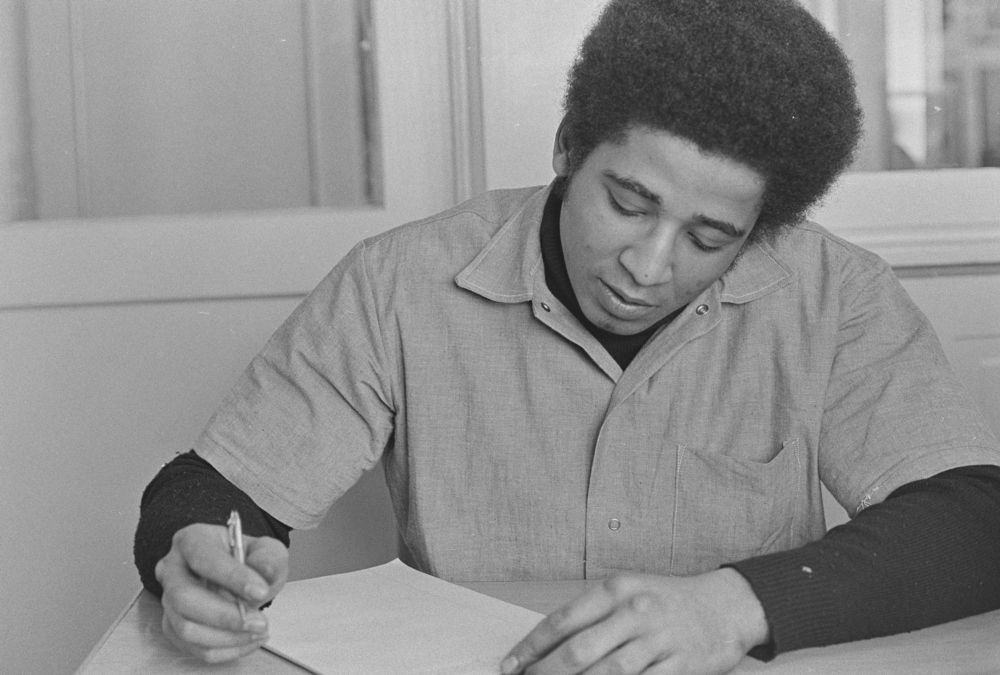
On the first day of Black August, we excavate George Jackson’s final manuscript—not to memorialize him, but to weaponize his theory of revolution behind bars, and his call for the liquidation of empire by its most discarded class.
By Prince Kapone | Weaponized Information | August 1, 2025
This System Has No Reformers—Only Gravediggers
George Jackson didn’t write Blood in My Eye to make the U.S. more just. He wrote it to bury it. From the isolation cell of San Quentin, surrounded by pigs in uniform and collaborators in blackface, Jackson produced what no liberal think tank, academic, or nonprofit can ever replicate: revolutionary clarity under conditions of total captivity. He didn’t appeal to the moral conscience of the state—he diagnosed the state as a parasitic weapon of war, and called for its destruction. Jackson wasn’t confused about democracy, about reform, about whether voting might one day break the chains. He saw through the entire settler apparatus: its constitutions, its courts, its prisons, its promises. All of it, he knew, was scaffolded on the bones of the African, the Indigenous, the colonized. There was no fixing this structure. There was only the fight to end it.
That fight, in Jackson’s view, was not on the horizon—it was already underway. Fascism wasn’t coming; it had already arrived, wearing the mask of democracy and the uniform of the corrections officer. Jackson understood fascism not as the exception, but as the form that imperialism takes when it loses its ability to coerce with illusions. When consent breaks down, bullets and bars fill the gap. The prison, in Jackson’s hands, becomes not a site of punishment but a laboratory of war. And unlike today’s abolitionist discourse—which too often leans on dreams of procedural fairness and decolonized sentencing—Jackson offered no fantasies of reformed cages. The prison was an extension of colonial counterinsurgency. And liberation, he made clear, would be illegal.
Jackson sharpened Marxism into a blade fit for the battlefield. He didn’t waste time debating policy adjustments or penning proposals to the overseers. He named the system—capitalist, settler-colonial, white supremacist—and he named its gravediggers: the colonized masses, led by the most dispossessed. In place of fantasy coalitions and anti-racist trainings, he called for strategy, cadre, discipline, and rupture. There is no third way in Jackson’s analysis. No reforms to soften the whip. Either the system falls, or the people do.
In that sense, Jackson’s work detonates liberal illusions like landmines under a parade float. His vision was not of an America redeemed, but of an America destroyed and replaced by a world free of its tyranny. His Marxism is unflinching, de-romanticized, and rooted in blood—Black blood, proletarian blood, spilled for the survival of empire. He doesn’t talk about fascism as a historical curiosity or as a potential threat. He names it as the condition of everyday life under late-stage imperialism. The fact that Jackson had to write this while shackled is not incidental—it is the proof of his thesis. The empire fears the revolutionary mind more than any weapon, because it knows the mind can produce weapons endlessly.
Blood in My Eye is not a book to be read for comfort. It’s a war manual, smuggled from behind enemy lines. And Jackson is not asking us to admire him—he’s demanding we join him. He’s telling us, without euphemism or escape hatch, that this system cannot be changed. It must be overthrown. And if you’re not on the side of the grave diggers, then you’re with the guards.
The Black Colony Within: Genocide Behind Bars
George Jackson didn’t need a passport to see colonialism. He was living inside it. For Jackson, the prison wasn’t just a place of confinement—it was the most perfected form of domestic colonial rule. He called it what it was: a zone of counterinsurgency. A war camp. A concentration cellblock for the surplus populations of the empire—the Black, the Brown, the poor, the rebel, the revolutionary. And in calling it that, Jackson tore off the liberal mask that tries to frame prison as justice or rehabilitation. He exposed the American carceral system for what it is: a genocidal mechanism for the management and destruction of an internal colony.
This is the core of Jackson’s method. The ghetto and the prison are not separate—they are two parts of the same colonial apparatus. One pacifies; the other disappears. The Black community is not a protected class under law—it is a targeted population under siege. And incarceration is the logic of conquest brought home. Jackson’s lens forces us to see mass incarceration not as “racial injustice” in the abstract but as a war strategy: one that evolved directly from slavery, from Jim Crow, from COINTELPRO, and from the empire’s broader playbook of extermination and extraction. The prison is not an anomaly—it’s the domestic battlefield of a settler state at war with its internal colonies.
Today’s reformers dress up these cages with language—“decarceration,” “restorative justice,” “racial equity”—but Jackson’s clarity cuts through all that. The state doesn’t put Black people in prison to fix them; it puts them there to destroy them, because their existence is a threat to the racial and economic order. His analysis predates, but predicts, the rise of the carceral technocracy: the data-driven policing, the AI-assisted surveillance, the biometric borders, and the militarized raids. What was once carried out with whips and nooses now comes with spreadsheets and ankle monitors—but the genocidal logic remains.
Jackson’s theory of internal colonialism situates the U.S. not as a “flawed democracy” but as a colonial regime built on extraction and extermination—internally as well as abroad. The same Pentagon that bombs Baghdad funds the police who gun down Black teenagers. The same banks that loot the Congo profit off prison labor in Louisiana. The geography is different, but the war is the same. And Jackson’s analysis doesn’t let us forget that. In fact, it demands that we center it: the prison is the front line of empire, and the Black prisoner is not a victim, but a soldier under siege.
To engage Jackson’s thought is to confront the brutal reality that the U.S. is not malfunctioning—it is functioning exactly as it was designed. Genocide is not an accident; it is a policy. The prison is not the failure of the state; it is its crowning achievement. Jackson’s gift to us is that he made this terror legible, unflinchingly. He made it impossible to unsee. And he did it not to elicit pity, but to fuel revolution. He wrote so that those trapped inside could become generals. So that those outside would stop asking for justice—and start organizing for power.
Lumpen as Vanguard: A Corrective to the Dogmatic Left
If Marxism is a science of revolution, George Jackson was one of its most radical field engineers. While the university Marxists clung to an industrial fantasy—of blue-collar white men leading history—Jackson looked around his cell block and saw the real vanguard: the lumpen. The outlaw. The unemployed. The hustler. The prisoner. Those whom the capitalist system had not simply exploited, but discarded. Not because they lacked value, but because their very existence threatened the value system itself. Jackson doesn’t romanticize them—but he does recognize their revolutionary potential. Because when the system no longer needs you to live, you no longer need the system to survive.
This is not some moral gesture. Jackson’s theory of the lumpen is strictly materialist. He’s not asking us to love the ghetto youth or the prison rebel because they suffer—he’s showing that the lumpen have fewer stakes in the system’s survival, and thus more capacity to destroy it. Unlike the stabilized worker, who is often seduced by wages, benefits, and dreams of upward mobility, the lumpen lives outside the formal circuits of value production. And that makes them dangerous. That makes them free. Not automatically—but potentially. Under political discipline, with revolutionary clarity, the lumpen becomes what Jackson calls the “rebel of the Third World in the First.” A soldier forged in captivity. A detonator waiting to be armed.
In this sense, Jackson’s line is a direct challenge to Western Marxism, which too often parades class reductionism as orthodoxy while dismissing the lumpen as criminal detritus. But what is that, really, except settler class chauvinism dressed up in socialist drag? Jackson calls it out. He names the betrayal. He exposes how white labor movements often aligned themselves with fascism, not against it—demanding jobs and privileges carved from Black suffering and Indigenous land. The so-called “proletariat” of the United States was a settler formation from the start. And Jackson’s politics begins with this betrayal—not to despair over it, but to break from it.
Jackson’s lumpen theory doesn’t negate class analysis—it deepens it. He doesn’t throw out the concept of exploitation; he repositions it within the colonial context. The lumpen is not “outside” class struggle, as many dogmatists claim. They are its bleeding edge—where imperialism sharpens its knives. Jackson locates revolutionary agency where Marx never had to look: in the slums, in the jails, in the broken bodies of the surplus population. And in doing so, he expands Marxism into a weapon for those who were never meant to live under capitalism, much less liberate themselves from it.
For us, reading this in the belly of the beast, the implications are clear: any revolutionary strategy that dismisses the lumpen is not just mistaken—it’s counterrevolutionary. To center the industrial worker in an age of mass incarceration and algorithmic unemployment is not fidelity to Marx—it’s nostalgia for a world that never existed. Jackson gives us no room for that delusion. He writes with the clarity of someone whose life depends on theory becoming praxis. And for millions of colonized people inside the empire’s borders, it still does.
Against the White Left: Betrayal, Liberalism, and Class Camouflage
George Jackson had no time for the white left’s self-congratulatory theater. He didn’t flatter their solidarity photos or chase their endorsements. He called them what they were—cowards in camouflage. Opportunists who used the rhetoric of revolution to mask their investment in the imperial spoils. And he wasn’t wrong. From SDS to the CPUSA, Jackson saw the same pattern: white radicals who talked a militant game until the rubber met the road—until the guns came out, the state cracked down, and whiteness could no longer be worn like a reversible jacket. At that moment, betrayal became default. “Revolution” reverted to reform. And the colonized were left bleeding, again.
Jackson’s critique cuts deeper than bad leadership or tactical disagreements. It’s about class position. About who benefits, even as they denounce benefit. Jackson saw that most white leftists—especially those in the U.S.—were not ready to defect. They wanted to “change” America, not end it. They wanted to rescue the republic from the fascists, not admit the republic is fascism institutionalized. Their socialism was always national, never anti-colonial. Their strategy: coalition with capital, not confrontation. Jackson offered no handshake to these forces. He offered a mirror, and a middle finger.
This is not bitterness—it’s strategy. Jackson knew that every failed movement of the 20th century bore the fingerprints of white sabotage, whether through ego, fear, or outright collaboration. He doesn’t generalize all white people; he indicts the systemic role that whiteness plays inside the empire: as buffer, as betrayer, as brake. And he dares white leftists to stop talking about “class unity” and start proving it—with material defection, not rhetorical performance. With stolen time, not borrowed slogans. With bodies on the line, not ballots in a box.
That challenge echoes louder today, in the age of technofascism. When surveillance is omnipresent, when the ruling class is arming itself with AI and algorithmic repression, the white left is still staging moral theater while Black and Brown revolutionaries face prison, drones, and death. Jackson demands more than allyship. He demands treason. He demands that white comrades burn their passports to empire, renounce the narcotic of innocence, and enter the war on the side of the colonized—not as leaders, not as equals, but as traitors to whiteness and soldiers for liberation.
From our position—as defectors attempting to dig out of settler identity—Jackson’s critique isn’t just accurate. It’s necessary. It’s a blade pressed against our throat, asking: are you still clinging to safety? Are you still negotiating with empire? Or have you, finally, chosen a side? Because neutrality, in Jackson’s world, is betrayal. And betrayal gets people killed. If we aren’t ready to match his discipline with action, his militancy with material rupture, then we should stop quoting him. We should shut the fuck up and get out the way. Because Jackson wasn’t recruiting fans. He was recruiting revolutionaries.
Armed Theory: Organization, Discipline, and Revolutionary Morality
For George Jackson, theory without a gun is just masturbation. Blood in My Eye is not a call to read more—it’s a call to organize for war. Jackson wrote with the urgency of a man who understood that the enemy doesn’t sleep, doesn’t negotiate, and doesn’t forgive. The settler state doesn’t fear ideas—it fears discipline. It fears organization. It fears cadres who not only study revolution but live it, train for it, and are prepared to die making it. Jackson’s work drips with the seriousness of someone who knows the cost of error. In a war, there are no second chances. And the colonial war waged by America is permanent.
This is why Jackson’s Leninism is not an academic posture—it’s a combat doctrine. He calls for clandestine structure, for cell-based formations, for militarized political education. Not because he fetishizes violence, but because he understands that the ruling class does. The empire already operates with counterinsurgency logic. The cops train like soldiers. The prisons function as war camps. The intelligence agencies have files on every organizer who speaks clearly. The state is not confused about the stakes. It is only the left that clings to dreams of peaceful transition, of “building power” without confrontation. Jackson scorches this fantasy. There is no way around the system. There is only through it, and over its corpse.
But Jackson doesn’t glorify spontaneity. He doesn’t call for rebellion without purpose. His insistence on political education is constant—cadres must be trained, not just radicalized. Morality is not a feeling but a discipline. It emerges from commitment, from action, from sacrifice. Jackson’s revolutionary ethics are forged in fire: betrayal is unforgivable, cowardice is contagious, and opportunism is fatal. These aren’t abstract principles. They are battlefield rules. Because in a war for survival, confusion kills. And clarity must be cultivated with the same rigor as any firearm.
In today’s landscape—of social media ego-tripping, horizontalist drift, and state-sponsored NGOs disguised as movements—Jackson’s clarity lands like a punch. Organization is not optional. Cadre is not elitism. Illegality is not immorality. Jackson reminds us that the most just movements have always been criminal in the eyes of empire. From Nat Turner to the Mau Mau, from the Algerian resistance to the Vietnamese liberation struggle—every genuine fight for freedom has been declared illegal. That’s how you know it’s real.
So Jackson’s legacy is not in slogans—it’s in infrastructure. In building the bones of a revolutionary force that can withstand repression, that can go underground, that can educate the masses while preparing for rupture. His lessons are not dated. They are unfinished. The task remains: to turn theory into fire, into structure, into power. And if we cannot do that, we should stop calling ourselves revolutionaries. Jackson didn’t write to be remembered. He wrote to be followed.
Scientific Socialism from a Cell: Method and Militancy
George Jackson didn’t theorize from a podium. He theorized from a cage. And still, his analysis slices through decades of leftist confusion like a prison shank through flesh. Blood in My Eye is a testament to the fact that Marxism doesn’t need a university—it needs commitment. From his cell, Jackson produced one of the most precise and militant applications of dialectical and historical materialism the U.S. has ever seen. Not in abstraction, but in war. He weaponized theory like a guerrilla sharpens steel. He didn’t quote Marx for clout—he wielded Marxism to decode imperialism, to expose the settler logic of the American state, and to forecast the next phase of global rebellion.
Jackson wasn’t stuck in 1848 or 1917. He took the science of revolution and updated it from the frontlines of U.S. fascism. He mapped the trajectory of empire—not just its past crimes but its future recalibrations. He saw how colonialism had gone technocratic, how liberalism masked genocide, how the Third World was rising. From inside a concrete box, Jackson could read Africa, Asia, and Latin America better than any Washington think tank. He recognized the anti-colonial tide that was sweeping the globe, and he demanded that the Black colony inside the U.S. see itself as part of that same insurgent current. Not as Americans, not as minorities, but as combatants in a planetary class war.
His method is forensic. He analyzes the political economy of imperialism not just to understand it, but to destroy it. He examines fascism as the logical evolution of capitalist decay, a last-ditch effort to preserve the empire by reorganizing repression with greater efficiency. He traces how liberal democracy serves as fascism’s ideological advance team—softening resistance, pacifying movements, neutralizing radicalism. Jackson’s genius lies in how he connects all this to the lived conditions of the colonized. This is not Marxism as formula—it is Marxism as militant clarity. Theory as insurgency.
In Jackson’s hands, dialectics are not an academic exercise—they are a combat technique. His analysis flows from contradiction: the contradiction between capital and labor, between settler and colonized, between the exploited and the surplus. He doesn’t reduce everything to one contradiction; he charts how they interlock, how they shift, how they sharpen. He teaches us to read the enemy—not just its language, but its logic. And more importantly, he shows us how to anticipate its moves. Jackson was forecasting a technocratic, militarized phase of imperialism long before today’s data-driven fascism took shape. He saw it coming. And he prepared.
That’s the real legacy of Jackson’s scientific socialism: it wasn’t frozen in doctrine, but alive in struggle. It evolved in direct confrontation with the most brutal face of empire. It made no room for compromise, no space for idealism unanchored from material analysis. And it demanded of its students the same thing it demanded of its author: courage, study, and readiness. Because theory is not complete until it becomes strategy. And strategy is not real until it meets the enemy in battle.
“To Die for the People”: Black August and the Legacy of Martyrdom
George Jackson was executed by the state on August 21, 1971—his body riddled with bullets inside San Quentin. They called it an escape attempt. We call it what it was: an assassination. A political execution carried out by the U.S. empire to silence one of its fiercest internal enemies. Jackson’s death was not the end of his struggle—it was its escalation. And Blood in My Eye, published posthumously, stands as the last communiqué of a soldier who refused to break, refused to kneel, and refused to believe that revolution was anything less than a sacred obligation.
Black August was born out of this blood. It is not a month of mourning—it is a month of war memory. A time to study our martyrs, sharpen our politics, and train for what comes next. Jackson joins a revolutionary lineage that stretches from Jonathan Jackson, his little brother gunned down in a courtroom raid at 17, to Bunchy Carter, to Fred Hampton, to Malcolm X, to Assata still hunted. Their names aren’t nostalgia—they are instruction. Every one of them fell because they refused compromise. Because they were building something the empire could not afford to let exist.
In this final section, we do not romanticize Jackson’s death. We situate it. He was killed because his ideas were dangerous. Because he was organizing prisoners into a political army. Because he was exposing the genocidal function of the U.S. state not as theory, but as lived reality. The state didn’t kill Jackson because he was violent. It killed him because he was effective. Because he was showing others how to fight and how to win.
Blood in My Eye is not a memoir. It is a manual. A call to arms. A declaration of war from inside the belly of the beast. And the best way to honor it is not by quoting it—but by building from it. Jackson’s politics were not soft. They were sharp and unforgiving because the system he faced was genocidal and relentless. And it still is. His clarity, his militancy, and his uncompromising discipline remain unmatched. But they are not unreachable. They are there to be studied. There to be inherited. There to be lived.
This is why we read him in Black August. Not to grieve, but to regroup. Not to perform, but to prepare. Jackson reminds us that revolutionaries don’t die—they are murdered. And when they are, it is our duty to pick up their weapons, their books, and their unfinished work. He left us no excuses, no way out. Only the road forward: toward freedom or death. Toward the fall of empire. Toward the liberation of the colonized. Toward the world he died trying to build. One where the people finally win.
 Weaponized Information
Leave a comment