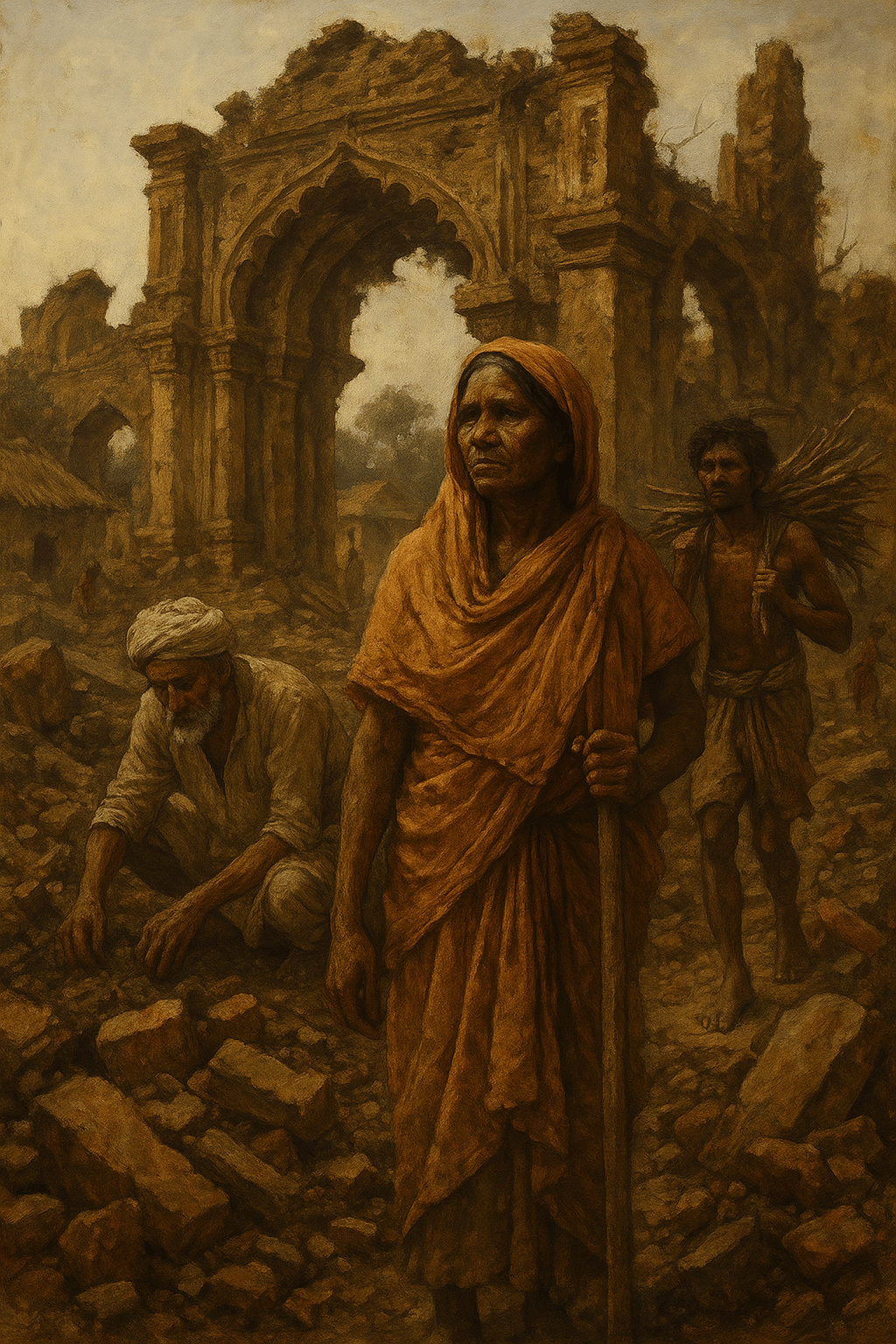
Not despotism but defiance—how India’s village communes preserved collective life beneath empire’s boot, and why their shattered forms remain the soil of future socialism
By Pablo Katari | Weaponized Information | July 25, 2025
Beyond Asiatic Despotism
Let us begin by tearing to shreds the musty European fairy tale that India is a land of timeless tyranny, a vast slumbering Orient where despots feast while the people grovel in mud and superstition. Such was the gospel preached in drawing rooms of the East India Company, echoed in the lecture halls of European universities, and printed in the imperialist gazettes with all the pomp of a religious truth. “The Indian village,” they declaimed, “is stagnant, unchanging, despotic—a fossil of history.” What they dare not say aloud is what they knew in private: it was not despotic at all, but communal; not backward, but incompatible with capital. And for this, it had to be broken.
For centuries before colonialism fastened its iron teeth into the subcontinent, the Indian village functioned as a self-reproducing organism. Not an atomized collection of private proprietors, but a commune of use—land was held in common, labor was shared, irrigation was cooperative, and production was bound to subsistence and ritual, not the anarchy of the market. These were not utopias free of contradiction—they bore the scars of caste, patriarchy, and hierarchy—but they contained within them a principle anathema to the capitalist order: social labor directed toward collective need.
The European bourgeoisie, encountering these formations, did what all ruling classes do when faced with something they cannot comprehend and cannot tolerate—they slandered it. They called it “Oriental despotism,” not because it was ruled by despots, but because it had not yet given birth to the despotism of the market. The bureaucratic expropriations of empires, the temple-tax apparatuses, the village headman’s levies—these were real enough. But the foundation remained: communal land tenure, regulated redistribution, labor obligation to the collective whole.
Indeed, the “despotism” lay not in the village, but in the colonial imagination. For what empire saw before it was not merely an agrarian lifeworld—it was a dangerous memory, an alternative social metabolism whose very existence mocked the sacred tenets of property, wage labor, and profit. Here were human beings tilling the soil without landlords; irrigating fields without capital investment; producing for use, not surplus. No wonder the British administrator recoiled in horror. The Indian village was not behind history—it was beside it, a parallel formation refusing to enter the slaughterhouse of capitalist time.
And so, under the guise of progress, the assault began. The village was pried open. Its communal property fragmented into surveyed plots; its customary rights shredded into legal abstractions; its shared obligations converted into debts. The colonial state did not merely govern—it restructured. And in this restructuring, it accomplished what centuries of conflict had failed to do: it severed the organic circuits of land, labor, and life that once defined the village commune.
Yet despite this onslaught, the form did not fully vanish. In the interstices of India’s vast agrarian terrain, one can still glimpse the stubborn persistence of communal logic—seasonal labor-sharing, caste-based grain redistribution, collective repair of irrigation tanks. These are not ghosts, nor romantic embellishments—they are residues of a different civilizational rhythm, one that colonialism could not fully erase. They are not primitive—they are prefigurative.
Thus, we begin not with elegy, but with confrontation. The Indian village was never the caricature of despotism painted by imperialist scribes. It was—and remains—an incomplete communism, artificially arrested by colonial violence. To study it today is not an act of nostalgia, but of insurgent memory. It is to dig beneath the rubble of conquest and excavate the foundations of another possible world.
Modes of Appropriation: Village Communities and Communal Property
Long before the British surveyor arrived with his compass and inkpot to dissect the village into taxable units, land in India was not owned but lived. It was not a commodity to be bought and sold, but a sacred inheritance to be used, stewarded, and shared. Every furrow in the field, every bund between plots, every irrigation canal carved by hand, testified to a different mode of appropriation: not capitalist possession, but collective usufruct. The land belonged to the community—not in the juridical sense, but in the practical, metabolic one. And this was precisely the problem for the imperialist and the financier.
What Marx termed the “Asiatic mode of production” was never a fixed schema but a materialist provocation—a challenge to linear theories of history. In India, Marx found a paradox: a village structure that was both stable and self-reproducing, yet subject to tribute by successive empires. The British, misunderstanding this duality, assumed the communal aspect was backward and the expropriatory apparatus was the real “state.” But in fact, the state siphoned without producing; the real engine was the village commune, which generated the material and social surplus that made any state—even the colonial one—possible.
The Ethnological Notebooks confirm Marx’s restless attempt to decipher these forms, especially his engagement with colonial texts like Phear’s “Aryan Village”. With caustic annotation, Marx noted the persistence of joint cultivation, rotational rights, and kinship-based allocation of plots. These were not the mere vestiges of a dying tradition—they were the living logic of a non-capitalist social formation. The communal village in India organized labor not through the wage, but through reciprocity and necessity; it redistributed harvests not by market price, but by social obligation; and it preserved land through custom, not enclosure.
To the European eye trained on capitalist forms, these relations appeared unintelligible. The village had no landlord, yet land was worked. There were no merchants, yet grain was distributed. There were no banks, yet irrigation systems spanning thousands of acres functioned for centuries. This, of course, was impossible according to the sacred catechism of political economy. And yet, there it stood—a material contradiction to the universalizing logic of capital.
But such a contradiction could not be tolerated for long. The Permanent Settlement of Bengal, the Ryotwari and Mahalwari systems—each was designed not to understand the village, but to obliterate it. Communal tenure was broken into alienable plots. Customary obligations were monetized into tax burdens. Debt relations proliferated where none had existed. In short, the British did not encounter a stagnant structure—they introduced stagnation by disembedding the village from its own historical logic and subordinating it to global capital.
And yet, like a stubborn root beneath the asphalt, the communal spirit endured. Even after legal fragmentation, families continued to cultivate collectively. Even when cash crops replaced food staples, water was still managed by village agreement. Even as capital tried to atomize the peasant into a “free” producer, the form resisted—not through nostalgia, but through necessity. For in India, the commune was not a dream of the past; it was the ground beneath every step.
Labor, Reciprocity, and Social Metabolism
If the British economist saw in the Indian village a lack of productivity, it is only because he could not hear the rhythm of a different drum. Where his world was organized around profit margins and price fluctuations, the village was organized around season, cycle, and subsistence. Labor here was not the dismembered individual selling hours on the auction block of time, but the collective act of maintaining life. A mother harvesting rice, a boy herding goats, a caste-bound artisan repairing the plow—these were not economic inputs but parts of a living system: an ecology of cooperation sustained not by competition, but by reciprocity.
This is what John Bellamy Foster would later call the “metabolic unity” of human society and nature. And here, in the Indian village, that unity was not yet broken. The peasant did not dominate nature—he rotated crops with it. He did not exhaust the soil—he returned to it through manure, compost, and fallow time. Communal irrigation systems, some older than Europe’s nation-states, flowed not from capital investment but from generational labor, governed by customary calendars and sacred oaths. The result was not surplus in the capitalist sense, but sufficiency in the ecological sense.
Labor in this mode was not alienated—it was socially embedded. The barber, the potter, the washer, the weaver: each received grain at harvest not as wage, but as customary share. The caste system, of course, deformed this reciprocity into hierarchy and exclusion. But the principle remained: labor was social, interdependent, and reproductive. One did not “work for a boss”; one worked as part of a metabolic circuit that reproduced both community and environment.
Contrast this with capitalist agriculture, where labor is ripped from its context and thrown into monocrop plantations and chemical dependency. Where soil is not replenished, but raped. Where water is not managed communally, but privatized and poisoned. Where every yield is measured in profit per hectare, even as groundwater disappears and pesticide cancers spike. Here, the metabolic rift is not a metaphor—it is the physical severing of the ecological umbilical cord that once tethered humanity to the earth.
The Indian village, by contrast, was not ecologically innocent—it was ecologically intelligent. Its limits were not technological, but ethical. Land could not be overused without shame. Forests could not be felled without ritual. Water could not be hoarded without consequence. These were not romantic notions—they were survival logics forged over millennia. And they reveal something capital can never reproduce: an economy rooted not in endless accumulation, but in cyclical renewal.
So when colonialism came with its rails and revenue men, it did not bring civilization—it brought rupture. It shattered the metabolic integrity of the village and replaced it with commodity production for foreign markets. Indigo instead of food. Opium instead of grain. Cotton for Manchester while famine stalked the countryside. The land was bled for export, the people were thrown into debt, and the very rivers were redirected to feed imperial circuits. In short: where once stood a communal metabolism, now stood an extraction apparatus.
Yet even today, in the cracks of modern India, the old rhythms persist. Communal wells are still dug by hand. Harvest festivals still honor the soil. Labor is still shared during peak seasons, not because it is efficient, but because it is human. These are not artifacts—they are blueprints. They whisper of a socialism that is not imported from the West, but grown from the earth itself.
Internal Contradictions and External Ruptures
Let us not fall into the trap of idyllic fantasy. The Indian village was not a classless paradise, nor a utopia of perfect equality. It bore its own contradictions, and at its core was the chasm of caste—a system of spiritualized stratification that naturalized servitude and ossified labor into hierarchy. The Brahmin monopolized knowledge, the Dalit was exiled from the commons, and the woman, in nearly every stratum, was expected to reproduce the community without ever commanding it. These were not incidental defects—they were structural. And yet, even here, the form of collective labor endured beneath the deformity of social rank.
It is precisely this contradictory character that made the village so explosive—so threatening to empire, and so promising to revolution. It was neither capitalist nor egalitarian; it was communal in substance but unequal in distribution. The laborers were not proletarians, but peasants bound to land and lineage. The land was held in common, but control was often exerted by dominant castes or kinship groups. In short, the Indian village was a social organism pregnant with contradiction, suspended between historical inertia and revolutionary potential.
It was into this delicate ecology that colonialism drove its plow—not to reform, but to annihilate. The British did not misunderstand the village—they understood it all too well. They saw in it a resilient form of reproduction outside the wage system, beyond the reach of the commodity, and inimical to the law of profit. And so they acted with the cold precision of class war. Communal property was legally fragmented through the Permanent Settlement of Bengal (1793), the Ryotwari system in Madras and Bombay, and the Mahalwari model in the North. All were variants of a single process: the juridical individualization of land to destroy collective use.
With private titles came private debts. The peasant, once embedded in a reciprocal village economy, was now isolated as a “freeholder,” liable for fixed revenue regardless of harvest. Enter the mahajan—the village moneylender, who rose from the margins to the center of rural life. In need of cash to pay taxes, peasants mortgaged land to the mahajan. When the monsoon failed or the market crashed, the land was lost—not to a distant corporation, but to a new indigenous petty bourgeoisie born of colonial restructuring.
Meanwhile, the construction of railways—hailed by liberal historians as infrastructure for “development”—functioned instead as arteries of expropriation. They did not bind village to village, but mine to port. The peasant’s labor was extracted in raw cotton and raw bone, funneled through rail to feed English mills and English markets. Colonial capital did not create a national economy—it carved the subcontinent into zones of export and zones of starvation.
And still, in the face of this devastation, communal lifeways persisted—not unchanged, but unextinguished. Resistance took many forms: the refusal to register titles, the evasion of taxes, the reassertion of customary claims, and, at times, open rebellion. These were not merely acts of desperation—they were peasant memory in motion, the stubborn refusal of a people to forget how to live without capital.
Thus the Indian village was torn from two sides: from within, by caste and patriarchal domination; and from without, by colonial rupture and capitalist encroachment. But it is precisely this double movement that makes it historically vital. For in its disintegration lies a record of how the world was forcibly turned upside down—and in its fragments lie the seeds of how it might be righted again.
Embryonic Communism and the Basis for Socialist Transition
In the dying embers of the Indian village, one can still detect the glow of something yet to come. Not in the form it once took—ritually sanctioned caste divisions, patriarchal inheritance, or divine-right production cycles—but in the logic that underpinned its survival: collective labor, shared reproduction, and social regulation of need. These were not backward customs awaiting capitalist liberation—they were forward-facing principles obstructed by imperial sabotage. And the task of revolution is not to bury these forms, but to transform them—to take what was latent and render it conscious, voluntary, and universal.
Recall the famous exchange between Marx and Vera Zasulich. When faced with the question of the Russian mir—a communal peasant structure with eerie similarities to the Indian village—Marx refused the dogma of capitalist inevitability. He insisted that if the mir could ally with the global proletariat, it might leap past the capitalist stage altogether. The same must be said of India. The village need not be seen as pre-modern residue but as artificially arrested communism—a mode of life that, if reanimated under proletarian leadership and stripped of caste and patriarchal distortions, could form the nucleus of a post-capitalist social order.
What would this require? Not technocratic planning imposed from above. Not statist collectivization with tractors and quotas enforced by distant bureaucrats. But the voluntary reorganization of rural life by the peasants themselves, drawing on the memory of communal labor but redirecting it toward emancipation. It would mean reclaiming the well, not just for water but for decision-making. It would mean re-seeding the land with cooperative principles, not commodity crops. And it would mean understanding the village not as an obstacle to socialism, but as one of its possible starting points.
The strength of the village has always been its embeddedness—its integration of labor, ecology, kinship, and knowledge into a single social body. The tragedy is that this body was never allowed to evolve on its own terms. Colonialism did not modernize the village; it froze, fractured, and plundered it. Thus, to speak of socialist transition in India is not to import blueprints from industrial Europe, but to excavate the real, historical capacities of India’s own people to reorganize their lives in common.
In this sense, the Indian village is less a thing of the past than a prefiguration of the future. Its failures—caste, patriarchy, hierarchy—must be abolished. But its core, its soul—the ethic of cooperation, the principle of shared subsistence, the habit of social regulation—must be redeemed and revolutionized. This is not a romantic appeal to return to the soil. It is a call to complete the interrupted trajectory of communal development—not by restoring what was, but by realizing what could have been, and must now become.
Socialism, then, must not descend like a foreign angel bearing five-year plans and imported tractors. It must rise, slowly and painfully, from the rubble of the communal forms capitalism tried—and failed—to erase. These forms, though battered, remain embedded in the consciousness of rural India. The task ahead is not to awaken them, for they are not asleep—but to arm them, link them, and elevate them to the level of revolutionary power.
Ecological Rationality and the Collective Commons
At the heart of the Indian village was not just a social structure, but an ecological reason—a rationality born not of spreadsheets and commodity forecasts, but of monsoon patterns, soil cycles, and the tacit knowledge of generations. Here, the land was not a lifeless asset but a living commons. Forests were not timber stockpiles, but regulated spaces of foraging and ritual. Rivers were not conduits for industrial discharge, but the arteries of a communal metabolism. What Western agronomy viewed as inefficiency was in fact a millennia-old science of survival, premised on the principle of interdependence, not extraction.
This is what Foster names the metabolic rift—the rupture between society and nature under capitalism. But in the Indian village, before colonialism accelerated that rupture, the rift had not yet been torn open. Labor returned nutrients to the soil through organic waste. Animal and human rhythms were synchronized with the seasons, not schedules. Grazing was rotational; irrigation was negotiated; trees were felled not by contract, but by consensus. These were not primitive customs—they were deliberate social technologies to maintain ecological balance.
Contrast this with the so-called “Green Revolution”—a Trojan horse of imperial science that promised abundance but delivered dependence, debt, and death. High-yield seeds demanded chemical fertilizers; fertilizers poisoned the water table; pesticides killed the pollinators. Yields rose briefly—then collapsed. Soil was leached, biodiversity was obliterated, and the village, once the steward of ecological knowledge, became a laboratory for agribusiness experiment and ruination.
Where the communal commons once rotated land use to preserve fertility, capitalist agriculture now imposes permanent production on exhausted fields. Where the village once managed water through tanks and collective desilting, privatized pumps now deplete aquifers at suicidal rates. Where commons grazing once sustained both cattle and community, now concrete colonizes pasture. In short, the logic of the commons—reproduction over profit, balance over growth, use over exchange—has been dismantled by the violent irrationality of the market.
Yet the memory persists. Across India today, movements of seed sovereignty, organic farming, forest defense, and water rights are not innovations—they are acts of re-membering, of reassembling the shattered fragments of ecological socialism long buried under asphalt and ideology. These are not “green” movements in the liberal sense. They are proletarian ecological insurgencies—led not by NGOs but by the landless, the marginal, and the caste-oppressed, who understand that the land will die if left to the logic of capital.
Thus, the ecological question in India cannot be separated from the communal one. To restore the metabolic balance between society and nature, we must restore the collective control over the conditions of reproduction. And this restoration cannot be nostalgic—it must be revolutionary: abolishing the class, caste, and gender hierarchies that once deformed the commons, while defending the communal principles that sustained them.
In this lies the paradox and the promise of the Indian village: it must be destroyed in its current form, and yet preserved in its deepest essence. The ecological rationality of the commons—its refusal to overuse, its rhythm of return, its embeddedness in community—is the very principle the world must now embrace, or perish. And the Indian village, despite all its wounds, still remembers how.
Conclusion: Towards a Conscient Communalism
What the British Raj called “stagnation,” what bourgeois historians called “primitivism,” what development economists still dismiss as “subsistence”—this, in truth, was the organized refusal to commodify life. The Indian village, scarred and stratified though it was, stood as an enduring form of collective reproduction outside capital’s command. And this is precisely why it was targeted—not for being obsolete, but for being dangerous. Dangerous because it posed a living alternative. Dangerous because it reminded the world that people can, in fact, live without landlords, without markets, without wage-slavery. That they had done so for centuries.
Let us have no illusions. The village in its old form cannot, and should not, return. Its caste exclusions, its patriarchal strictures, its rituals of domination—all must be cast into the dustbin of history. But neither can socialism be forged on scorched earth. To ignore the surviving logics of collective labor, social reciprocity, and ecological reason embedded in India’s rural lifeways is to amputate the very leg we must stand on. The revolutionary future must be built not by importing prefabricated blueprints, but by resurrecting and transforming the communal foundations that capitalism tried—and failed—to kill.
We do not need to restore the past. We must redeem its unrealized potential. To make conscience out of custom. To make planning out of memory. To move from the unspoken logic of reciprocity to the conscious discipline of socialist reproduction. What was once seasonal labor-sharing must become a worker-peasant alliance. What was once caste-based division of tasks must become class-based organization of labor. What was once organic ritual must be restructured as rational, ecological, communal governance.
And so we end not in mourning, but in militancy. The Indian village was not a relic—it was a rehearsal. A sketch. A broken but breathing outline of what it means to live beyond profit. It is time we draw from living roots, not imported grafts. Let the revolution be fertilized by the compost of communal memory. Let it be irrigated by the blood of those who resisted enclosure, eviction, and erasure. Let it sprout not in imitation of Western industrialism, but in conscious communion with the land, the people, and the rhythm of reproduction.
The road to artificially developed communism in India will not be paved by theory alone. It will be built—brick by brick, seed by seed—by those who remember how to live together. Those who refuse to forget. And those who, armed with memory and movement, will rise to ensure that the next village is not conquered—but consciously created.
References
- Marx, Karl. The Ethnological Notebooks. Edited by Lawrence Krader. Assen: Van Gorcum, 1972. A compilation of Marx’s ethnographic commentary on communal land and social formations in India and Russia.
- Marx, Karl. “The Future Results of British Rule in India.” New‑York Daily Tribune, written July 22 1853; published August 8 1853. Marx outlines Britain’s “double mission”: dismantling pre-capitalist social forms and laying foundations for modern society.
- Marx, Karl. “Letter to Vera Zasulich.” March 8 1881. Marx asserts that the Russian peasant commune could “leap past the capitalist stage altogether”—a basis for interpreting India’s village communes as latent socialist forms.
- Foster, John Bellamy; Clark, Brett; York, Richard. The Ecological Rift: Capitalism’s War on the Earth. New York: Monthly Review Press, 2010. Foundational ecosocialist analysis of the metabolic rift and collective ecological forms.
Publisher link - Mukherjee, Aditya. Imperialism, Nationalism and the Making of the Indian Capitalist Class, 1920–1947. New Delhi: SAGE, 2002. An economic‑historical analysis of how colonial policy reshaped agrarian life, village institutions, and created new rural bourgeois formations.
- Patnaik, Utsa. “The Agrarian Question and the Development of Capitalism in India.” Economic and Political Weekly, March 31 1990. Analysis of colonial agrarian transformations and emerging class hierarchies.
- Guha, Ranajit. Elementary Aspects of Peasant Insurgency in Colonial India. Duke University Press, 1999. Explores rural resistance grounded in communal memory and the destruction of village forms.
- Gadgil, Madhav; Guha, Ramachandra. This Fissured Land: An Ecological History of India. University of California Press, 1993. Investigates ecological governance and communal practices across India’s diverse regions.
- Dhanagare, D. N. Peasant Movements in India: 1920–1950. Oxford University Press, 1983. Traces continuities between colonial village communalism and organized agrarian struggle.
- Chatterjee, Partha. The Nation and Its Fragments: Colonial and Postcolonial Histories. Princeton University Press, 1993. Critically engages nationalist historiography that erases India’s communal social substrata.
 Weaponized Information
Leave a comment