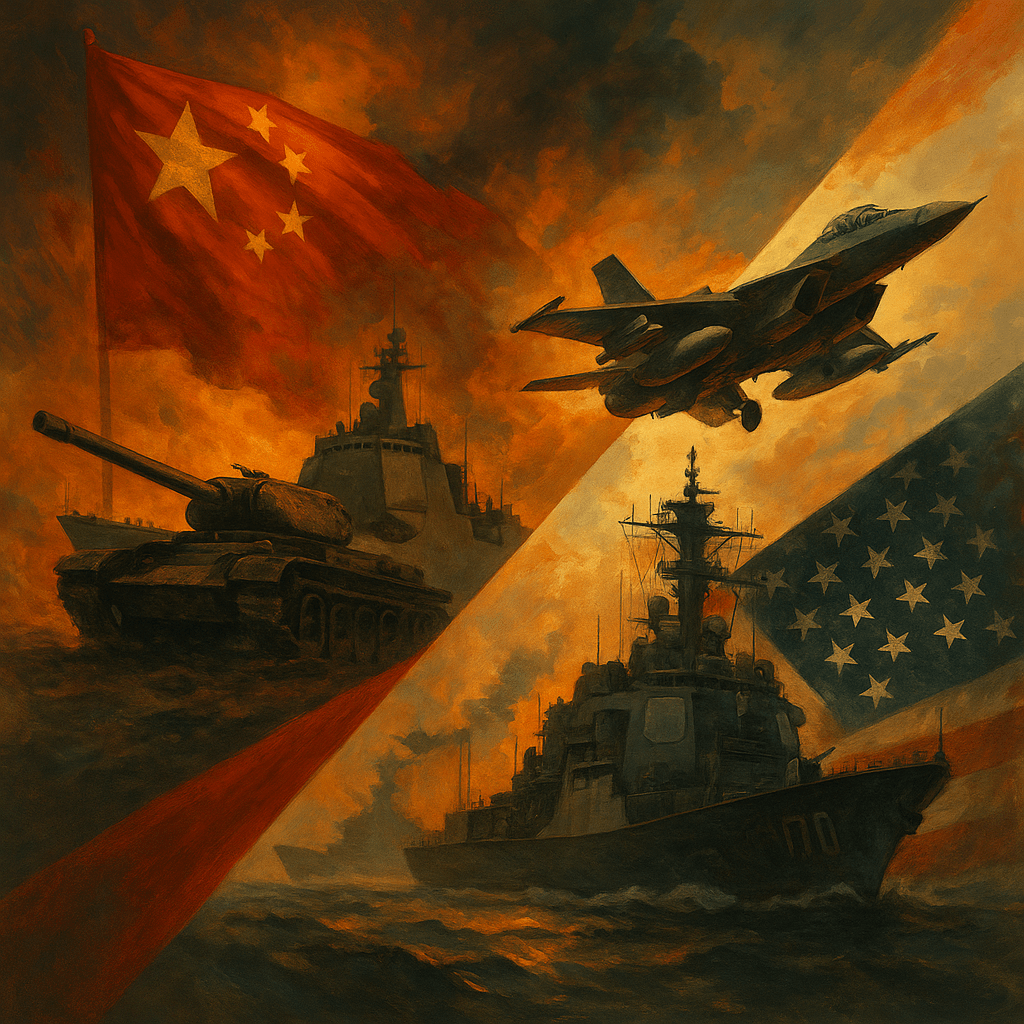
This Weaponized Propaganda Excavation (WPE)’ dissects how U.S. military planners reframe imperial domination as regional defense, exposes the logistics infrastructure enabling war without consent, reframes Korea’s subordination through the lens of technofascism and hyper-imperialism, and maps out a strategy of resistance rooted in global solidarity and proletarian action.
By Prince Kapone | Weaponized Information | July 19, 2025
Paper Empires and Pixel Wars: How the U.S. Militarizes Korea with a Keystroke
The Atlantic Council’s July 2025 policy brief by U.S. Marine Corps Lt. Col. Brian Kerg lays out a coldly imperial proposition: South Korea should serve as the “anchor” of the U.S. military’s first island chain, a forward deployment corridor designed to encircle and confront China. Kerg asserts that U.S. forces in Korea must be unshackled from the peninsula and redeployed flexibly across the Pacific. There are no Koreans in this brief. Only assets, bases, platforms, and maps. Consent is implied. Sovereignty is assumed.
Kerg is not a rogue thinker. He’s a functionary in camouflage—a field‑grade officer embedded in the imperial think‑tank complex. His role as a non‑resident fellow with the Irregular Warfare Initiative—a Pentagon‑adjacent project—and the Atlantic Council’s Indo‑Pacific Security Initiative, in coordination with West Point’s Modern War Institute, places him firmly within the military‑industrial brain trust.
The Atlantic Council, his publisher, serves as empire’s script supervisor—bankrolled by NATO, the U.S. State Department, Lockheed Martin, Raytheon, and other war profiteers. It poses as a think tank but functions as a press office for the military-industrial complex. Kerg’s brief doesn’t stand alone. It echoes talking points amplified by the RAND Corporation, the Center for Strategic and International Studies (CSIS), and classified briefings passed between the Pentagon and its satellite states. The imperial echo chamber is alive and humming.
This document is a pristine specimen of propaganda—not because it lies, but because of how it manipulates language and erases life. Kerg frames Korea not as a sovereign nation but as a logistics node: a “platform” for U.S. warfighting. He deploys familiar euphemisms—“deterrence,” “stability,” “partnership”—to cast aggressive militarization as responsible governance. He performs the magic trick of omission: nowhere does he mention the mass protests in Seongju against the THAAD system, the resistance on Jeju Island, or the community organizing in Pyeongtaek. The people are invisible. Only radar arcs remain.
Psychologically, Kerg invites the reader to view war planning as peacekeeping. Troop movements become spreadsheet entries. Base expansion becomes “readiness.” The chilling abstraction of cognitive warfare is on full display—this is imperialism as paperwork. And to grease the gears of consent, he leans on emotional triggers. North Korea and China are cast as volatile threats, requiring an ever-present American hand on the tiller. The strategy is clear: stir fear, erase resistance, and bury the real questions under “black hole theory” and missile range metrics.
What seals the narrative is false equivalence. Kerg equates U.S. troop flexibility with Korean security—as if making Korea a forward operating base for a future war with China somehow enhances Korean sovereignty. It’s an inversion of reality: the more interoperable South Korea becomes with U.S. command systems, the less room it has to choose peace. The trap is set. And the brief reads like it’s already been approved.
This isn’t analysis. It’s compliance manufacturing. The prose is bloodless, the stakes sanitized. But beneath the language of “strategic posture” is a totalizing vision of entanglement: a Korea not defended, but pre-programmed; not sovereign, but subcontracted. In Kerg’s world, empire doesn’t invade—it integrates.
Logistics Without Consent: The Material Truth Behind the First Island Chain
What the Atlantic Council brief conceals behind its neat jargon and security theater, we now excavate. According to Lt. Col. Brian Kerg, the U.S.-ROK Mutual Defense Treaty not only justifies a permanent U.S. military presence in Korea, but also allows those forces to be deployed anywhere in the Pacific. His case rests on a minor maneuver—the 2025 redeployment of a U.S. Patriot missile battery from Korea to Qatar—which he uses as proof that Korean-based U.S. troops are not tethered to peninsula defense. From this, Kerg builds a sweeping mandate: South Korea must become the anchor of the U.S. first island chain, not merely defending itself, but serving as a logistics hub in Washington’s war calculus against China. Troops should be rotated in from Okinawa. Artillery should be stockpiled. Korea should function as the imperial war dock of the Western Pacific.
None of this is speculation. It is doctrine. In fact, the so-called “black hole theory”—which posits that U.S. troops in Korea are fixed to peninsula defense—has been under assault for years by Pentagon planners who seek global force flexibility. He bolsters this with South Korea’s artillery surge to Ukraine—a project underwritten by domestic taxpayers and U.S. arms manufacturers. In 2025, Lockheed Martin secured a $2.8 billion contract to expand THAAD capabilities globally, including Korean operations, underscoring how U.S. defense profits are baked into Korea’s militarization.
This logistical creep has been years in the making. The 2016 deployment of the U.S. THAAD missile system in Seongju—under U.S. pressure and against the will of local residents—sparked massive resistance. But the real consequences came after. China retaliated with sweeping economic measures that gutted Korean tourism, canceled K-pop tours, and wiped billions off the balance sheets of conglomerates like Lotte. These weren’t cultural skirmishes—they were targeted responses to U.S. encroachment.
None of this history appears in Kerg’s brief. He makes no mention of Seongju, no acknowledgment of Jeju Island, where a U.S.-backed naval base was forced onto protesting residents, or of the U.S. base expansion in Pyeongtaek, home to Camp Humphreys—the largest overseas U.S. military base in the world. Instead, Kerg offers the clean visuals of what the Pentagon calls “posture realignment”—relocating bases like chess pieces across a map that ignores all local resistance. What matters isn’t democracy, but deployment speed.
And this model isn’t unique to Korea. It’s being replicated across the region. In the Philippines, the U.S. has leveraged the Enhanced Defense Cooperation Agreement (EDCA) to install drone and surveillance hubs across civilian infrastructure, despite public opposition and concerns about sovereignty. In Australia, the Talisman Sabre exercises stage multi-nation rehearsals for amphibious invasion and rapid base construction—testing the very logistics Kerg outlines in peacetime so they can be deployed in wartime. These alliances do not build regional stability. They build compliance. They are supply chains with flags.
Korea’s strategic importance is obvious. It’s connected, industrialized, and located within flight distance of every major Pacific flashpoint. But that’s exactly why empire wants to control it completely. And it’s why any dissent—whether from citizens, farmers, or unions—is silenced or scrubbed from the record. What Kerg calls “dual deterrence” is not a defense plan. It’s a chokehold. It’s the modern version of what the U.S. did in Okinawa, Guam, and Subic Bay: convert sovereign land into imperial launchpads, then invoice the host country through defense cost-sharing pacts like the Special Measures Agreement.
The contradiction is stark. China remains South Korea’s largest trading partner. Younger Koreans are increasingly skeptical of the U.S. military presence, viewing it as a colonial residue rather than a security guarantee. Even pro-U.S. Korean administrations have had to backpedal on base expansions due to mass protest. And yet, none of these realities affect the war plan. Kerg’s map has no room for people. Only ports, runways, and radar domes.
The first island chain strategy, revived from Cold War archives, was never about defense. It was about encirclement. The goal is to box in China, sever its maritime lifelines, and maintain U.S. dominance over the Pacific’s shipping lanes and seafloor cables. As The Maritime Executive explains, U.S. control over Pacific islands has enabled it to dominate critical undersea infrastructure, including submarine fiber-optic cables. Meanwhile, Air University confirms that the U.S. views undersea cables and digital seabed dominance as key components in countering China’s maritime ambitions. The broader strategic aim—restricting China’s sea lines of communication and applying pressure at maritime chokepoints—is underscored by analyses of China’s so-called “Malacca dilemma,” where over 80% of its exports passes through vulnerable waters patrolled by U.S. and allied forces. This doctrine sees Korea not as an equal partner, but as an unsinkable aircraft carrier—permanently anchored, perpetually billed, and permanently ignored when it dares to speak. The treaty may call Korea an ally. But the map calls it a target.
Technofascist Lattices and the Anchored Illusion of Sovereignty
South Korea is not being protected. It is being preloaded. What Brian Kerg describes as “dual deterrence” is, in material terms, the transformation of Korean territory into a launch node in a digitized war lattice aimed squarely at China. This isn’t conjecture—it’s the operating logic of the U.S. Indo-Pacific Command’s warfighting blueprint. It rests not on human beings or democratic processes, but on software, supply chains, and real-time kill web integration. In other words: Technofascism. War planning once relied on generals and geography. Today it runs on machine learning, logistics algorithms, and seamless interoperability between bases, drones, satellites, and submarines. South Korea is being absorbed not just militarily but computationally—rendered as code within a system of imperial automation.
This is not the empire of old, where direct occupation ruled the day. It is a 21st-century model of Imperialist Recalibration. In the era of declining unipolar supremacy, the U.S. doesn’t seize territories—it programs them. Sovereign states are reconstituted as logistics platforms. Their militaries are retrained for “joint operations.” Their budgets are redirected toward “cost sharing.” Their public opposition is repackaged as “fringe dissent.” South Korea is not just an “ally”—it is a managed asset. And once it’s slotted into the system, withdrawal becomes materially impossible. That is the function of the anchor metaphor Kerg deploys: not stability, but immobility. A fixed point from which empire cannot retreat.
The entire first island chain strategy is a theater of preemption. It seeks to encircle China, constrain its development, and lock down the maritime lifelines that support its economy. It has nothing to do with defending Taiwan, or deterring North Korean aggression. Those are narrative devices, not military imperatives. The real target is the emergence of an independent pole of global power—one that cannot be disciplined by Wall Street, suffocated by the IMF, or bought off through backdoor deals at Davos. And that is what China represents: a rival center of gravity in a multipolar world. Its mere existence outside of Washington’s command structure constitutes what the Pentagon calls “strategic instability.”
That’s why empire doesn’t just demand bases. It demands obedience. It demands denial. When Koreans resist militarization—as they did in Seongju and Jeju—they’re ignored or criminalized. When China retaliates economically, it’s labeled coercion. When U.S. firms like Lockheed profit from THAAD or Raytheon ships weapons to Korea, it’s business as usual. But when Korean companies lose contracts or musicians are blacklisted for defying the script, it’s dismissed as collateral damage. This is the architecture of Hyper-Imperialism: a system in which allies not only host empire’s war machines, but pay the bill and absorb the blowback.
And now, that blowback is multi-directional. This isn’t 2003. Multipolarity means sanctions and economic pressure flow both ways. Empire’s junior partners are vulnerable not just to U.S. threats, but to Chinese countermeasures, ASEAN policy shifts, and Global South solidarity. By further integrating into the U.S. lattice, South Korea is being asked to risk trade, stability, and sovereignty for a war plan it neither authored nor controls. The same U.S. that demands more troops in Busan is slapping tariffs on Korean steel. The same empire that demands interoperability just banned Korean chip exports to China. These aren’t allies—they’re asset managers.
So why now? Why double down on this strategy in 2025? Because the U.S. empire is losing ground. It has no viable economic vision beyond financial plunder. Its cultural hegemony is slipping. Its global legitimacy has been shattered by endless war and internal collapse. What remains is brute force—militarized logistics, narrative warfare, and treaty frameworks that function as control mechanisms. It’s the desperation of an empire that cannot rule by consent, only by infrastructure. It is Imperialist Decay.
That desperation is disguised as strategy. Kerg’s brief pretends to offer a “flexible deterrent posture,” but in reality, it outlines a totalizing doctrine of entanglement. South Korea’s fate is being coded into a network that bypasses politics altogether. From Pacific Command to Talisman Sabre to the EDCA bases in the Philippines, the region is being hardwired for escalation. And the only question left—buried under radar coverage maps and troop rotation charts—is whether the people will accept it.
From Busan to Detroit: Breaking the Anchor, Fighting the Chain
South Korea is not a war dock. It is not an asset. It is not a spreadsheet. But to the collapsing empire on this side of the Pacific, it is all three. That’s why resistance in Seongju matters. That’s why the grandmothers who blocked THAAD trucks with their bodies matter. That’s why every protest in Pyeongtaek, every sit-in on Jeju Island, every poster in Busan that says “Korea is not a base” is a blow against the machine. The people of Korea have spoken before, and they will speak again. But they cannot do it alone. Not when empire has wired them into a war they didn’t choose. Not when technocrats like Kerg decide their fate from behind a defense contractor’s firewall. And not when U.S. imperial planners are betting that Americans—especially those of us inside the empire—won’t lift a finger.
But they’re wrong. Because this isn’t just about Korea. The same Pentagon budget that’s building missile stockpiles near Seoul is defunding schools in Philadelphia. The same empire that’s installing radar domes in Gyeonggi is militarizing police departments in Chicago. The same contractors who profit from “deterrence” abroad are evicting tenants from apartments they’ve turned into real estate portfolios back home. This is not a distant conflict. It’s a global class war—and the frontlines run through our neighborhoods, our paychecks, and our data trails.
So here’s where we begin. First, target the funding. Lockheed Martin and Raytheon aren’t just abstract entities—they’re invested in by public pensions, university endowments, and city funds across the U.S. Expose every dollar that flows from our labor into their weapons. Launch divestment campaigns at UC Berkeley, NYU, and municipal pension boards that hold stock in companies arming the Korean peninsula. Connect the dots. Demand accountability. Pull the plug.
Second, build mutual aid across oceans. Korean organizers resisting militarization need more than solidarity tweets—they need money, legal resources, and digital security. Start funneling resources into the networks already in place: the National Campaign to Eradicate U.S. Military Bases in Korea, the Jeju Peace Network, the women-led coalitions in Seongju. Reach out through the diaspora. Set up encrypted channels. Make sure their defense is not only moral, but material.
Third, weaponize information. The U.S. military base network in Korea is vast, opaque, and deliberately hidden from public scrutiny. Let’s map it. Use open-source satellite imagery, scrape base contracts and arms transfers, leak base coordinates when safe. Archive every base’s environmental violations, land seizures, and displacement histories. Turn the empire’s opacity into exposure. Build counter-maps. Share them widely. Give students and workers the tools to see what’s hidden behind the euphemisms.
Finally, we must organize political education. Launch teach-ins under banners like “Anchor No More” or “Bases Are Not Peace.” Invite Korean organizers to speak in person or via livestream. Link the resistance in Korea to anti-base struggles in Okinawa, Mindanao, Diego Garcia, and Guam. Show the connections between imperial war abroad and austerity, surveillance, and repression at home. Build study circles across union halls, campus groups, and radical community spaces. Print flyers. Make zines. Host screenings. Raise consciousness until “first island chain” becomes a dirty word.
The U.S. empire counts on silence. It counts on ignorance. It counts on you thinking Korea is someone else’s problem. But you know better now. And so do we. From Seattle to Seongju, from Oakland to Okinawa, the global class war is already here. And the only thing more dangerous to empire than a missile battery in Busan—is solidarity that crosses borders. Break the anchor. Dismantle the chain. The empire is falling. Let’s make sure it doesn’t land on someone else.
 Weaponized Information
Leave a comment