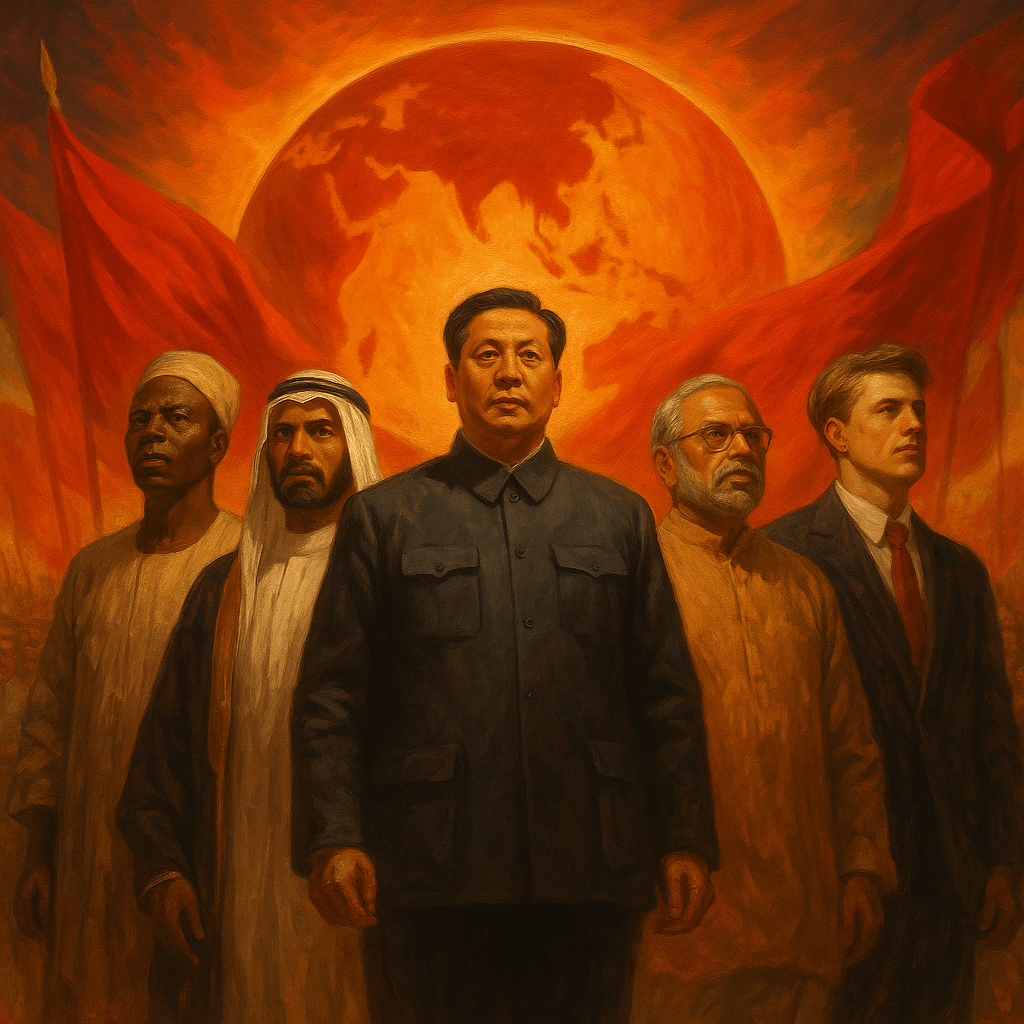
What the Global Civilizations Dialogue Reveals About the Moral Bankruptcy of the West
By Prince Kapone | Weaponized Information
July 17, 2025
When the Oppressed Speak, the Empire Scoffs
There is something deeply threatening, almost heretical, to the Western ruling class about the image of hundreds of delegates—African, Asian, Arab, Latin American, and even a handful of white Europeans—gathering in Beijing to talk peace. Not NATO’s kind of peace, the kind dropped from drones or negotiated at gunpoint. No. A peace built on mutual respect, cultural dignity, and multipolar solidarity. This week’s Global Civilizations Dialogue Ministerial Meeting did precisely that. While Washington continues to dress up permanent war in the language of “freedom,” China quietly assembled a roomful of nations to say: the world is bigger than the West, and the future will not be written in English alone.
You won’t find that in the New York Times. For them, a summit like this is a “soft power play.” When China builds bridges—literal and metaphorical—it’s seen as sinister. When the U.S. builds bases, it’s framed as “security cooperation.” Yet here we are: ministers, scholars, artists, and young people from 140 countries—Egyptians and Slovaks, Kenyans and Croatians—speaking across languages and civilizations, not in spite of their differences, but because of them. As Maged Refaat of Egypt said of his travels in China, “There is absolutely no barrier.” A single meal in a Chinese village became a moment of spontaneous internationalism, not orchestrated by a think tank or an NGO, but made possible by people’s curiosity, humility, and joy. That’s the kind of thing no State Department memo can predict—or replicate.
But it’s not just pleasantries and photo ops. Beneath the surface of dumplings and bullet trains lies a frontal assault on the West’s civilizational chauvinism. The very premise of the meeting—safeguarding diversity of human civilizations—is a political Molotov thrown at centuries of colonial ideology. The West insists on universalism: liberal democracy, individualism, free markets, as if every culture on Earth were a failed attempt to become Europe. But this summit says no. It says that China has its model, that Egypt has its needs, that Kenya has its dreams—and that none of them need to pass through Washington or Brussels to be valid. In a world where even a headscarf can be treated as a threat to Western order, asserting the legitimacy of civilizational plurality is revolutionary.
President Xi’s Global Civilization Initiative (GCI), first launched in 2023, has become a kind of narrative lodestar for the multipolar world. It doesn’t preach “democracy promotion” at the barrel of a gun. It doesn’t demand privatization, structural adjustment, or allegiance to the dollar. It advocates something far more dangerous to empire: mutual learning, sovereignty, and shared development without domination. That’s why it’s met with skepticism in the West. Not because it’s ineffective—but because it works. Because it dares to imagine a world where civilization isn’t defined by how many aircraft carriers you have.
This is what frightens the imperial core: not China’s GDP, but its capacity to convene. To create a space where a Slovak official can publicly rebuke Western media narratives, where a Kenyan railway engineer can credit the Belt and Road for giving him a future, and where an Olympic swimmer can turn sports rivalry into global inspiration. This is not “China rising” in the tired sense—it’s the oppressed of the world, from Shanghai to Qufu to Mombasa, finally getting to speak on their own terms. And when they speak, they don’t parrot liberal platitudes. They tell the truth.
What this summit made clear—intentionally or not—is that the real clash is not between civilizations, but between empire and the rest of humanity. The U.S. and its Atlantic satellites want you to believe that peace is dangerous, that dialogue is naïve, and that any attempt at civilizational cooperation outside their control is a prelude to tyranny. But the reality is this: the West needs conflict to survive. Its economy, its ideology, and its global influence are all built on division, destabilization, and dominance. Remove that—and suddenly the world starts to breathe differently.
That breath was felt this week in Beijing. And it wasn’t just symbolic—it was strategic. From agro-technology exchanges to cultural education, from spiritual heritage preservation to inter-civilizational sportsmanship, the Global Civilizations Dialogue wasn’t about “understanding China.” It was about understanding each other—with China as a convener, not a colonizer. That’s a role the West simply cannot play. Not anymore.
So don’t let the talking heads fool you. This wasn’t soft power. It was revolutionary hospitality. It was strategic internationalism. It was a glimpse of the world the oppressed have always deserved but never been allowed to build. And now, finally, they are building it—on their terms, in their languages, and with their people leading the way.
The Bridges of Multipolarity Are Built by the Colonized
You can tell a lot about a world order by who builds the bridges. In the decaying West, bridges are falling apart—from Baltimore to Birmingham—rotted out by austerity, privatization, and empire turned inward. But in the Global South, bridges are rising. Not just of steel and concrete, but of memory, labor, and solidarity. One of those bridges now stretches from Croatia to China. The Pelješac Bridge, built by the China Road and Bridge Corporation, stands not only as a marvel of engineering, but as a rebuke to those who still believe that Europe is the eternal civilizational center. Ranko Ostoji of Croatia called it “one of the most beautiful bridges in the country.” But his next words mattered more: “I believe this won’t be the last bridge between us.” There it is. Not a transaction. A transformation.
These bridges—literal and political—are not forged by elites in think tanks. They are being built by students like Jamlick Mwangi Kariuki, a Kenyan railway engineer trained under the Belt and Road Initiative, who now works on the Mombasa-Nairobi SGR line, a lifeline of mobility and modernity in East Africa. This is not foreign aid. This is reparative exchange, the beginning of a new kind of internationalism: grounded, cooperative, and unapologetically anti-colonial. Kariuki’s letter to Xi Jinping included a train ticket—proof that what’s being built is not just symbolic. It’s material. It moves people. It creates the very infrastructure that colonialism denied.
There is a vulgar arrogance in how the U.S. portrays these developments. When China trains African engineers, they call it “debt-trap diplomacy.” When Harvard trains African elites, it’s called “capacity-building.” The hypocrisy is structural. The West does not fear China because it dominates—it fears China because it doesn’t. Because it refuses to reproduce the racialized hierarchies that define Western liberalism. Because a bullet train in Kenya, a bridge in Croatia, or a cultural summit in Hangzhou exposes a different path—one where the oppressed are not clients or victims, but sovereign partners in shaping the future.
The Western reaction to this is telling. Panicked editorials. Smears about Confucian propaganda. Warnings about the loss of “universal values”—as if the world asked Europe to universalize anything but theft. But while empire panics, the world pivots. That pivot is civilizational. It is not about abandoning modernity, but reclaiming it—cleansed of white supremacy and capitalist absolutism. That’s what the Global Civilization Initiative represents: not a model to be imposed, but a stage to be shared. Where Black, Arab, Asian, and Indigenous voices speak—not to justify themselves, but to declare that they never needed Western permission to be modern.
At the sub-forums in Beijing, this wasn’t a theory—it was a practice. Swimmers from China and Romania spoke of mutual admiration, not market competition. Scholars debated cultural inheritance and innovation, not intellectual property theft. Even pop culture became terrain. When Liu Jianchao joked about not finding Labubu toys because they were sold out globally, it wasn’t just a light moment. It was a sign: Chinese stories, characters, and myths are speaking to the world—without Disney, without Silicon Valley, without colonial filters. And the world is listening.
This is why the bridges matter. Because every railway project, every scholarship program, every cultural exchange chips away at the foundation of imperial knowledge. It says: we don’t need your IMF. We don’t need your Harvard. We don’t need your fact-checkers. What we need is each other—and the means to meet, build, and grow on our own terms. And that’s precisely what’s happening. The West can’t stop it. It can only smear it. But even that is failing, because the proof is now global, mobile, and increasingly visible.
There is a reason why China can host a meeting with 600 participants from 140 countries without a single drone strike or sanctions threat. Because people remember. They remember who enslaved them, who bombed them, who extracted their minerals and erased their gods. And they see who’s offering trains, books, seeds, and science—with no strings attached. The bridges of multipolarity are not built by angels. They are built by formerly colonized peoples who are done begging, done waiting, and done apologizing. They are building because they must. Because the future depends on it.
The West Calls It Soft Power—But It’s Civilizational Rebirth
Let’s be clear: when the U.S. says “soft power,” it means manipulation without boots. When China speaks of civilization, it means something far more radical: a rebirth of global selfhood rooted in dignity, history, and shared becoming. To reduce the Global Civilizations Dialogue to a “soft power push” is like calling the Haitian Revolution a voter registration drive. It’s an intentional belittling—a tactic of imperial narration meant to flatten the aspirations of the Global South into strategy games intelligible to the Western mind. But what’s happening in Beijing is not a game. It is the quiet emergence of a new world story, spoken in many tongues but sharing one root: the rejection of colonial arrogance.
The West cannot understand this because it has never believed others had anything to teach. For five centuries, it has ruled with the assumption that Europe was the teacher of mankind—its enlightenment, its science, its art, its law. All other cultures were either waiting to catch up or fated to disappear. What the Global Civilization Initiative demolishes—deliberately and methodically—is that very presumption. It says no: Confucius does not bow to Kant. The Luo do not need Hobbes. The Persians do not need Plato. The Maya do not require Marx. These civilizations have their own logics, their own contradictions, their own revolutionary dialectics—none of which need the West to validate their existence.
This is what makes the initiative dangerous. Not because it threatens the West’s armies, but because it threatens the West’s mythology. The mythology that says development means Westernization. That power must follow whiteness. That modernity can only emerge from a European center. The GCI proposes a different trajectory: a world where traditions evolve, where cultures modernize without being mutilated, and where dialogue is not conversion, but communion. This is what frightens empire. Not China’s economy. Not Huawei. Not TikTok. But the possibility that the South may rise without shame.
And that shame is the ghost that haunts the West. After centuries of conquest, it cannot imagine global interaction that is not premised on superiority. So when a Kenyan engineer speaks fluent Mandarin, when a Slovak official denounces Euro-media bias, when an Egyptian diplomat marvels at Chinese agro-tech, Western analysts see infiltration. Because they can’t see mutuality. They can’t see a future not authored in English. So they cling to their own withering narratives—human rights theater, liberal democracy cosplay, the delusional export of values they no longer even uphold at home.
But the mask is slipping. The Global North is now a battleground of its own contradictions—racist implosions, austerity rebellions, crumbling infrastructure, technofascist surveillance regimes. And while it spirals inward, the rest of the world is talking—not about it, but around it. Talking about food sovereignty, cultural resilience, technological independence. Talking about Afro-Asian trade corridors, about multilingual film festivals, about bullet trains that respect elephants and economic zones that respect labor. The West hears all this and says: “That’s propaganda.” But that only proves how far it has fallen—unable to imagine a world where people choose peace over power.
What happened this week in Beijing wasn’t a media stunt. It was a declaration. A statement that the world no longer belongs to colonial curators. That civilization is not a museum, but a living, breathing, evolving process—and that the Global South is done being written out of its own story. When David Ferguson, a senior editor and long-time Western observer, said this summit signals a shift from conflict to dialogue, he wasn’t just speaking diplomatically. He was admitting that the tectonic plates of history are moving. That the unipolar fantasy is fading. That the colonized are no longer knocking at the door—they’re building their own house.
And when the West tries to frame all this as a threat, it only reveals its fragility. Because underneath all the think pieces and op-eds lies a simple truth: the world is tired of begging for understanding. It is now demanding respect. Not through war, but through vision. Through collaboration. Through civilization—not as a racial project, but as a shared inheritance of all humanity. This is not soft power. It’s sovereign rebirth. And it will not be stopped.
The Future Belongs to the Pluriversal
There was a time—not long ago—when the world was told there could only be one future. One system, one language of development, one roadmap to “modernity,” all paved by the bootprints of the West. That era is over. The Global Civilizations Dialogue didn’t just hint at it—it announced it. And what it revealed is not a “new Cold War,” nor a race to replace one empire with another. It revealed something far more dangerous to the global capitalist order: the emergence of the pluriverse—a world where many worlds coexist, not beneath or behind the West, but beside it, beyond it, and increasingly without it.
To be pluriversal is not to be relativist. It is not to say “everything is culture” or “truth is just a point of view.” No. It is to say that multiple truths, histories, and political trajectories can develop in solidarity, without being homogenized by imperial ideology. This is not postmodern drift—it is decolonial order. It is the recognition that the people of Iran and Bolivia, of Zimbabwe and Vietnam, of Palestine and Indonesia, all have the right to imagine their futures outside the shadow of the Pentagon, the IMF, and the Silicon Valley mind trap. And that right is not just abstract—it is being built now, in policy, in platforms, in trains, in treaties, and in the rising consciousness of the working and colonized classes.
This is what Western elites cannot abide. Because the pluriverse denies their centrality. In a unipolar world, the colonizer is the author. In a multipolar world, the colonizer is one voice among many. But in a pluriversal world? The colonizer must listen—or be left behind. This is the quiet terror behind every panicked headline about Chinese influence or BRICS expansion or Belt and Road. The fear that the oppressed are no longer asking permission. That they are coordinating, aligning, and moving—together. Not in uniformity, but in unity. Not under a new hegemon, but under a shared demand: dignity.
The plural civilizations represented in Beijing this week were not romantic abstractions. They were material realities: farmers using AI-guided irrigation, engineers preserving wildlife while building high-speed rail, students learning Swahili and Mandarin side by side. This is not utopia—it is the early structure of a world in delinking. A world no longer suspended in the false choice between McDonald’s and McKinsey, between Wall Street or warlords. It is a world choosing neither. A world making space for itself, in its own voice, with its own cadence.
For the U.S. and its allies, this pluriverse looks like chaos. But that’s only because their order depended on suppression. A single civilization claiming universality was always a lie. It took centuries of plunder, slavery, and genocide to make that lie look natural. Now the spell is breaking. The West shouts “rules-based order,” but nobody flinches anymore. Because the new rules are being written—not by think tanks, but by those who were once only footnotes. And what they’re writing is not a manifesto. It’s a world map. One with many centers. One with many names for freedom.
From the Sahel to the South China Sea, from the Andes to the Horn of Africa, the pluriversal is emerging as a revolutionary necessity. Not because it is more moral, but because it is more accurate. Because the world never was one thing. And now, finally, it won’t have to pretend. The Global Civilizations Dialogue showed us that the future will not be dictated. It will be negotiated, cultivated, and inherited—not from empires, but from each other.
So let the colonizers fear it. Let them slander it as “propaganda” or “authoritarian soft power.” Their cries are the echoes of a dying age. Because the pluriverse is not coming. It is here. In the hands of the builders, the thinkers, the farmers, the translators, the students, the revolutionaries. It is not waiting for the old world to fall. It is already building the next one.
Conclusion: Clarity, Not Comfort
The age of flattering the empire is over. The world no longer owes the West gratitude for its violence, nor reverence for its lies. What unfolded this week at the Global Civilizations Dialogue was not a plea for understanding—it was a pronouncement of autonomy. And for those of us in the belly of the beast, it should be heard as a call to rupture. The future is no longer something the empire gets to administer. It is something the oppressed are already producing—in steel and syllables, in seeds and software, in language and light. And it will not be asking for permission.
Let there be no confusion: this is not a geopolitical rebranding. This is not a softer empire in the East replacing a decaying one in the West. The revolutions unfolding across the Global South—whether diplomatic, developmental, or cultural—are not reducible to “China’s rise.” They are part of a broader and deeper recalibration of human history, long overdue, violently suppressed, and now irreversibly underway. And their logic is not imperialist—it is multipolar, decolonial, and proletarian in its orientation. This is the Other Side. The one we were never supposed to see, let alone join.
To the Western worker, colonized subject, and dissident intellectual: this moment demands sides. Not illusions. The imperial propaganda machine will tell you that every railway built outside Washington’s orbit is a trap. That every dialogue not hosted by NATO is theater. That every civilization not modeled after Europe is a threat. But here’s the truth: the real trap is staying loyal to a dying order that never had a future for you. The real danger is mistaking comfort for clarity, obedience for safety, and neutrality for peace.
Because clarity does not comfort—it confronts. It forces us to reckon with where we stand in the battle between those who build for life and those who bomb for profit. It forces us to name who profits from division and who bleeds from it. And it gives us the language to speak—not in defense of empire, but in alignment with revolution. The ministers, students, workers, and diplomats in Beijing this week didn’t just speak for themselves. They spoke for us. For all of us who believe another world is not only possible—it is already taking shape.
So let the world hear us now, in the voice of the Other Side: civilizations do not clash—empires do. And we, the many, are no longer interested in clashing. We are interested in living, in learning, in building what the old world tried to bury. We are no longer asking to be included. We are including ourselves—on our own terms. That is not soft power. That is power. And it’s ours now.
 Weaponized Information
Leave a comment