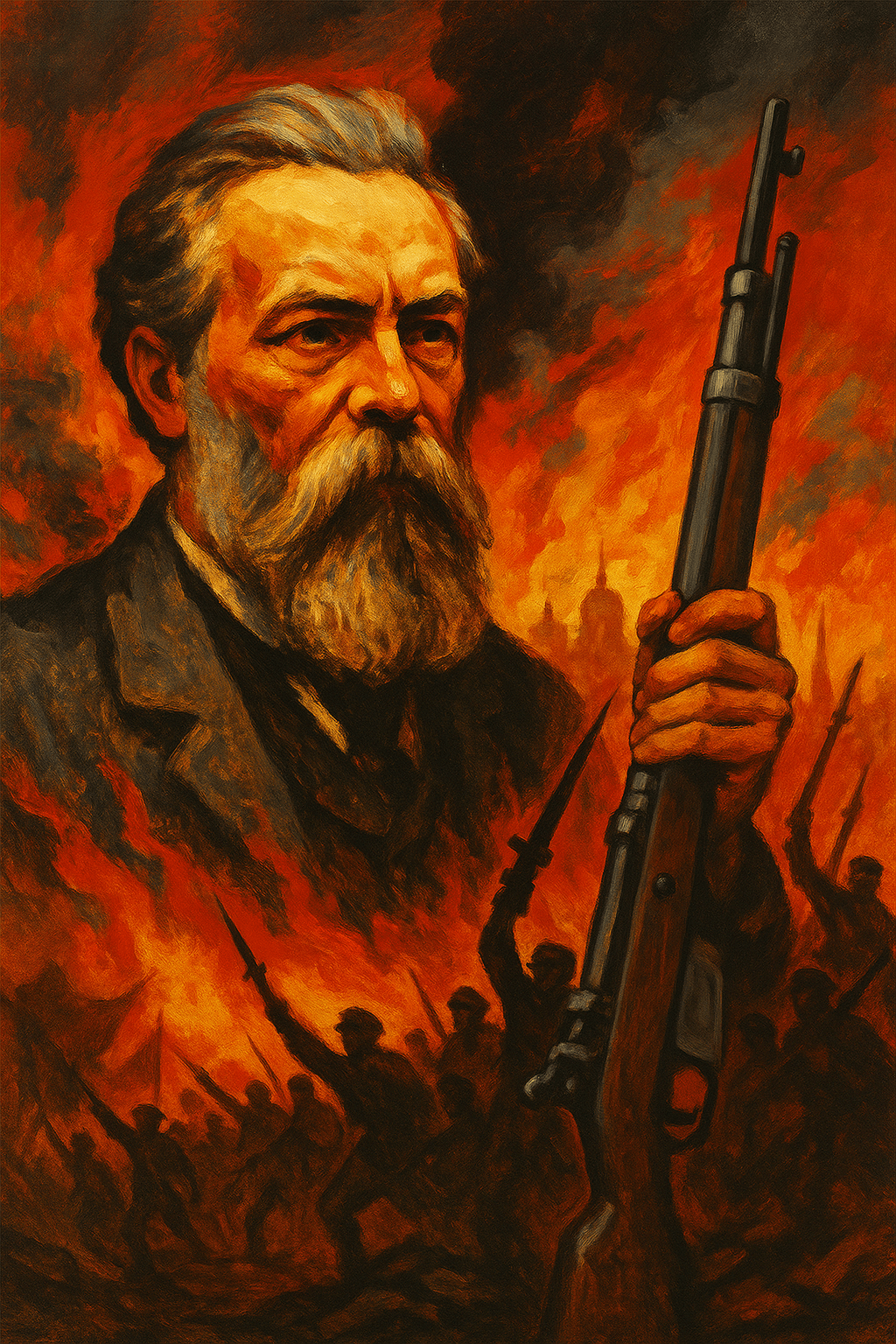
In his 1891 Introduction to The Civil War in France, Frederick Engels reloaded the most dangerous weapon the working class has ever forged: the truth that the state must be smashed, not reformed. Drawing on the blood-soaked memory of the Paris Commune, Engels warned that the dictatorship of the proletariat is not a slogan but a survival strategy. This article excavates the political sharpness of that intervention—against liberal pacification, academic distortion, and leftist retreat—and repositions it as a live weapon in the arsenal of today’s revolutionaries.
By Prince Kapone | Weaponized Information
July 17, 2025
🟥 Look at the Paris Commune: Dictatorship Without Illusions
“Do you want to know what this dictatorship looks like? Look at the Paris Commune. That was the Dictatorship of the Proletariat.” With this line, Engels did what few socialists dare: he called a thing by its name. Not with apology. Not with euphemism. But with revolutionary clarity sharpened by twenty years of blood, betrayal, and bourgeois slander. In his 1891 Introduction to The Civil War in France, Engels stood at the barricades of memory—not to mourn the fallen, but to arm the living.
He knew the danger wasn’t just forgetting the Commune—it was misremembering it. Sanitizing it. Turning it into a democratic costume party or some romantic Parisian riot. “The state is nothing but a machine for the oppression of one class by another,” he reminded us, and the working class can’t simply be invited into that machine to push different buttons. It must seize it, dismantle it, and build anew—not a replica, but a weapon of a different kind. That weapon, Engels insists, was glimpsed in the Commune.
It was not a utopia. It was a rupture. “The working class, once come to power, could not manage with the old state machine.” The real contribution of the Commune was not its failures, its naïveté, or even its heroism—but its demolition job. It broke the spine of the illusion that you can vote your way out of class rule. It revealed the state not as a neutral arena, but as a fortress. And fortresses aren’t reformed—they’re stormed.
What was at stake for Engels was not merely theoretical fidelity. It was the integrity of revolutionary memory. The same Social-Democrats who praised the Commune in public speeches were gutting its lessons in their party programs. The same parliamentary leftists who whispered about worker power in backrooms refused to say the words “dictatorship of the proletariat” aloud. Engels called it what it was: cowardice dressed in caution. “From the very outset the Commune had to recognize that the working class, once come to power, could not manage with the old state machine.” That lesson—etched in blood across the walls of Belleville—was being buried under speeches, statutes, and slogans. Engels dug it back up.
He wasn’t writing as a philosopher. He was speaking as a partisan. As someone who had seen the liberal bourgeoisie collaborate with monarchists to massacre workers. As someone who had witnessed revolutions betrayed by their own illusions. As someone determined to ensure that the name “Commune” would not be neutralized by nostalgia. When Engels said, “Look at the Paris Commune,” he wasn’t pointing to a museum. He was pointing to a mirror. And the question is: can we see ourselves in it?
🟥 Against Illusion: Reclaiming the Dictatorship of the Proletariat
Engels does not whisper. He interrupts the drift of reformism with a shout: “From the very outset the Commune had to recognize that the working class, once come to power, could not manage with the old state machine.” In one sentence, he strikes at the heart of every parliamentarian delusion, every socialist compromise with the ruling order. The contradiction Engels navigates is the same one that breaks movements to this day: whether revolution means taking power, or merely being allowed to perform opposition under the supervision of capital. For Engels, there is no middle path. Either you dismantle the bourgeois state or you are absorbed by it.
This is not theoretical posturing. It is the hard-earned clarity of a man who watched comrades murdered in cold blood, whose inbox was filled not with applause but with the sobbing aftermath of defeat. Engels wasn’t imagining what class dictatorship looked like—he had seen both kinds: the daily dictatorship of the bourgeoisie wrapped in laws, and the brief, blazing glimpse of proletarian dictatorship in the Commune. He judged them not by form but by content, by whose class interest each served. And in this, he declared the Commune a living rebuke to liberalism’s empty promises.
It’s here that Engels draws a sharp line between class collaboration and revolutionary rupture. He doesn’t engage in semantic gymnastics. He doesn’t wrap his politics in polite euphemism. When the German Social-Democrats stripped the phrase “dictatorship of the proletariat” from their program, Engels was livid—not because of doctrinal fidelity, but because it signaled ideological retreat. He wrote this preface to rearm them. “One thing especially was proved by the Commune,” he declared, “viz., that the working class cannot simply lay hold of the ready-made state machinery and wield it for its own purposes.” This is not a footnote—it is the cornerstone of revolutionary strategy.
Engels understood the battle was not just on the street, but in the narrative. The bourgeoisie had its own version of the Commune: chaotic, bloody, doomed. The reformists offered their version: noble but premature, a mistake not to be repeated. Engels carved a third path: the Commune as a dress rehearsal for the real thing. He insisted that its lessons be studied not to condemn it, nor to canonize it, but to correct course. The working class needed not a shrine to the Commune, but a strategy drawn from it.
So he struck back with militant clarity. He seized the language of dictatorship—so often used to smear proletarian power—and turned it into a badge of necessity. In doing so, Engels was not offering a model of tyranny, but exposing the dictatorship we already live under: the unspoken, unbroken rule of capital. The real scandal was never proletarian dictatorship. It was calling the dictatorship we already endure by its name.
🟥 The Commune as School of Leadership, and Warning
Frederick Engels was not writing to flatter the dead. He was training the living. “The Commune was formed of the municipal councilors, chosen by universal suffrage in the various wards of the town, responsible and revocable at short terms,” he wrote—not to admire the form, but to highlight the substance: accountability, revocability, responsibility to the masses. This wasn’t bourgeois democracy in red paint. It was revolutionary leadership in embryo. No inflated titles, no bureaucratic obscurity, no unchallengeable authority. The proletariat, for once, held the pen that wrote the laws. And yet, Engels did not romanticize it. He called it “a working body, executive and legislative at the same time.” He praised it not because it was perfect, but because it dared.
Engels was deeply aware that revolutionary leadership must be forged in contradiction. The Commune made mistakes—serious ones. It spared the Bank of France. It hesitated to march on Versailles. It underestimated the organized bloodlust of its class enemy. Engels does not conceal this. He puts it in front of us, as a kind of political mirror. Because to him, self-criticism is not a confession—it is a weapon. “Look here,” he seems to say, “this is where we failed last time. You will not be forgiven for failing in the same way again.”
This is why Engels refused to bury the Commune in sentimentalism. He treated it as a school. And not just for the French proletariat of 1871, but for the international working class. For our time. For our struggles. The principles of mass line, rectification, leadership accountable to the rank and file—these are not moral values for Engels. They are conditions of survival. The capitalist class has militaries, police, surveillance, media. The proletariat has only its consciousness, its organization, and its capacity for learning in real time. The Commune showed what is possible when the masses begin to rule. It also showed how quickly the ruling class will respond with genocide.
Engels admired the Commune, but more than that, he interrogated it. He offered it to us as both model and cautionary tale. And he reminded us that the discipline of leadership is not bureaucratic routine, but revolutionary vigilance. “The Commune had to recognize…”—had to. Not chose to. Not theorized abstractly. But was forced by the conditions of survival to break with the old order. That is the real pedagogy. The contradictions will not wait for us to be ready. They will impose decisions. The only question is whether we will be prepared to take them.
🟥 Pick Up the Rifle: The Lessons of 1871 Are Not Negotiable
Engels left us no soothing liberal message. No promise that voting would be enough. No illusion that the bourgeoisie would go quietly. Instead, he offered this: “Look at the Paris Commune. That was the Dictatorship of the Proletariat.” With that line, Engels made his final intervention. He refused to let the bourgeoisie define dictatorship as their enemy’s crime. He showed us what it really meant: workers breaking the spine of the state built to rule over them. Workers doing the unthinkable—governing themselves, even if only for 72 days.
The task Engels laid before us is not memorialization. It is continuation. In an age of drones, data-mining, and digital finance, the lesson of the Commune remains the same: the old state machine cannot be reprogrammed. It must be dismantled. Technofascism will not be voted out. The imperial military-industrial complex will not be “held accountable” by subcommittees. There is no progressive wing of empire. Only the reorganization of class power—by force, by clarity, by revolutionary discipline.
Engels warned us not to mistake legality for liberation. “The attempt to smash the state machine by legal means,” he implied, is an illusion bought at the price of blood. His voice cuts through 130 years of revisionist fog like a blade. And it lands squarely in our moment: a moment of social collapse dressed as stability, of rising fascism masked as bipartisan consensus. The lesson? If the proletariat does not seize power, the ruling class will make fascism its final offer.
We must not read Engels like a museum label. We must read him like a battle plan. The Commune did not fall because it dreamed too boldly. It fell because it hesitated when boldness was most needed. That is the real danger of reformism: not that it compromises, but that it pacifies. Engels’ Introduction is a call to end that pacification. To name the dictatorship of the bourgeoisie. To prepare for the dictatorship of the proletariat. Not in theory. Not someday. But as the only answer to the question empire keeps asking: Who will rule?
“Look at the Paris Commune,” Engels tells us. He means: study it. Learn from it. Grieve it. And then pick up the rifle it dropped when the last barricade fell.
 Weaponized Information
Leave a comment