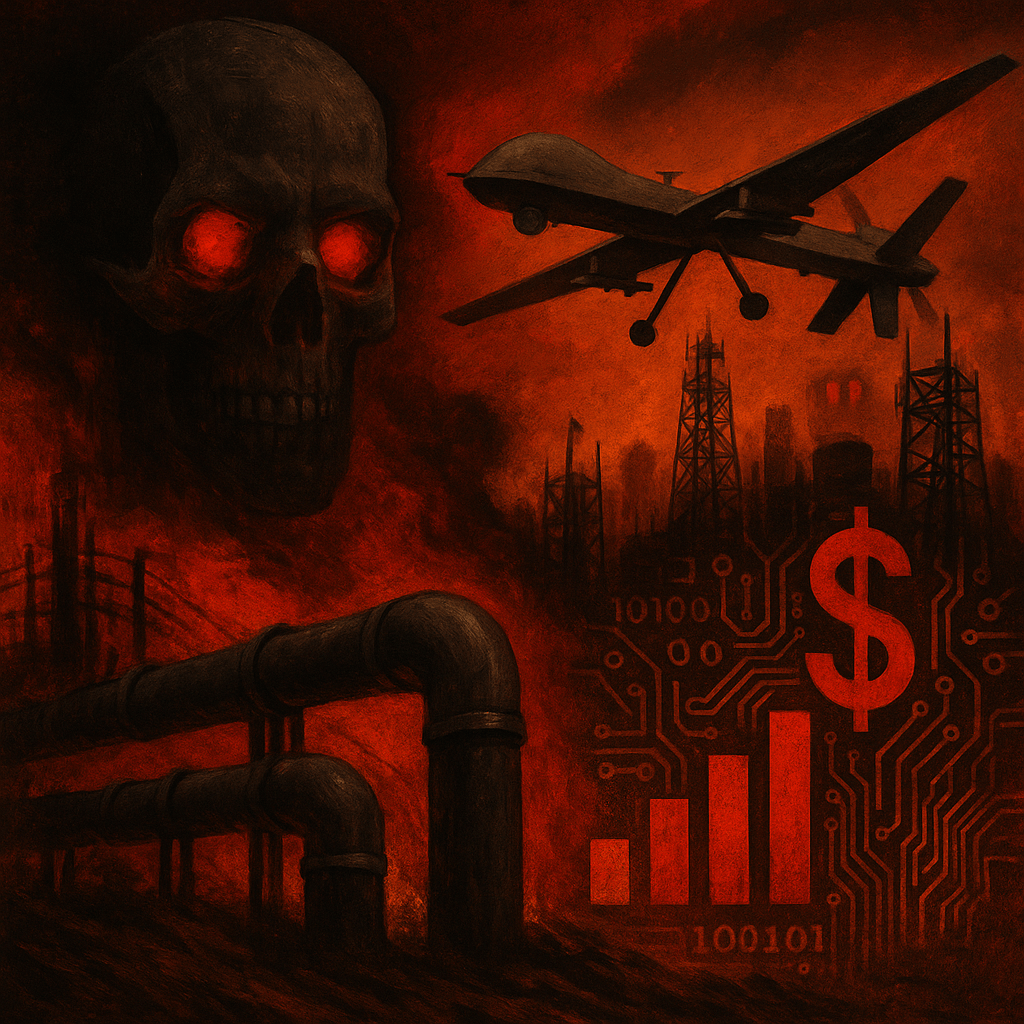
The U.S. empire no longer governs through rules or law—it governs through code, capital, and coercion. Trump 2.0 is not an anomaly, but the executive consolidation of a ruling-class bloc forged in counterinsurgency, asset management, and algorithmic repression.
By Prince Kapone | Weaponized Information | June 21, 2025
I. Introduction: Hyper-Imperialism and the Death of International Law
In the twilight of U.S. global dominance, the phrase “rules-based international order” has emerged not as a reaffirmation of global law, but as its final disfigurement. This nebulous term—invoked by G7 communiqués, NATO summits, and Atlantic Council think pieces—functions not as law but as cognitive warfare: a discursive shield for U.S. militarism, economic coercion, and regime-change operations masquerading as stability. It replaces legal norms with imperial discretion. But the age of even that pretense is ending.
Under the Trump 2.0 regime and its technofascist architects—Peter Thiel, Elon Musk, Erik Prince—the mask has been removed. This is not diplomacy, not legality, not leadership. It is the open consolidation of a global system of hyper-imperialism: a decaying empire’s desperate effort to maintain control through sanctions architecture, assassination networks, and algorithmic governance. The transition from international law to “rules-based order” is over. We now live under imperial gangsterism.
This essay traces that descent chronologically. From the post-WWII legal order forged at Nuremberg and codified in the UN Charter, through the Cold War’s selective enforcement, to the neoliberal recalibration of empire, and into the permanent state of exception unleashed by the War on Terror, U.S. imperialism has systematically eroded every legal barrier to domination. Today, that erosion has become policy. What remains is a scorched-earth doctrine of necropolitics: the use of mass death, surveillance, and economic siege as tools of global management.
To understand this moment, we must name its architecture. The Tricontinental Institute calls it hyper-imperialism: a stage of militarized-financial control that fuses Big Tech monopolies, war economies, and legal impunity into a single imperialist weapon. Within the borders of the U.S. and its allies, it manifests as technofascism—a political-economic formation where private algorithmic infrastructure governs both public repression and foreign intervention.
What were once legal norms have been reduced to chokepoints: SWIFT systems, undersea cables, satellite infrastructure. What were once war crimes are now policy tools. And what were once multilateral institutions are now armatures of coercion, deployed against the Global South to discipline, destabilize, or destroy.
The empire no longer governs by law. It governs by force, code, and capital. Our task is not to salvage the old order—but to bury it and forge a new one. One rooted in sovereignty, multipolar legality, and revolutionary rupture.
II. 1945–1979: Legal Order and the Seeds of Hyper-Imperialism
The myth of a law-abiding world order was born in the ashes of World War II. At Nuremberg, the victorious Allies—chief among them the United States—declared that aggressive war was the “supreme international crime.” The UN Charter codified a legal framework aimed at curbing militarism, affirming state sovereignty, and establishing the principles of collective security. But from the very beginning, this so-called international law bore the imprint of empire. It was not a universal standard; it was a political instrument designed and enforced by the same powers that ruled the colonial world.
This contradiction was evident in how international law was applied. The U.S. defined aggression as a crime—but only for others. The architects of Hiroshima, the enforcers of apartheid in South Africa, and the managers of Europe’s colonial holdings were never put on trial. Instead, the U.S. used the institutions of global governance—especially the UN Security Council—as imperial tools, shielding allies and punishing rivals. The legal structure of the postwar order was built not on justice, but on exceptionalism.
During the Cold War, this hypocrisy hardened into doctrine. The U.S. carried out coups in Iran (1953) and Chile (1973), backed fascist generals and death squads across Latin America, and waged counterrevolutionary warfare in Southeast Asia. These acts were not framed as violations of international law, but as righteous battles against communism—coded language for suppressing decolonization and defending U.S. capital.
In practice, this was lawfare before the term existed: the selective invocation of legal norms to criminalize resistance while legalizing imperial violence. The “international community” was invoked to sanction Cuba, Vietnam, and North Korea—but never the U.S. for napalming villages, carpet bombing cities, or sponsoring apartheid regimes. The Geneva Conventions applied to insurgents, not to the CIA.
The U.S. also shaped emerging legal and technological infrastructures to preserve extractive dominance. Early frameworks like the 1958 Law of the Sea excluded newly decolonizing nations and entrenched Euro-American control over global shipping lanes and strategic waters. What would later become chokepoints—Hormuz, Malacca, Suez—were being normalized as imperial arteries.
Meanwhile, the counterinsurgency wars in Korea, Vietnam, and the Philippines refined a distinctly settler-colonial mode of legal warfare: one that criminalized national liberation, collapsed civilians into combatants, and treated sovereignty as a privilege—not a right. Vietnam was not just a war—it was a laboratory of pacification, surveillance, and lawless extraction.
Beneath the liberal facade of the postwar legal order, the seeds of hyper-imperialism had already been sown. The law was never neutral. It was a weapon in the arsenal of empire.
III. 1980–2001: Neoliberalism and Imperialist Recalibration
The 1980s did not mark a retreat from empire—they marked a recalibration. With the crisis of U.S. manufacturing, the fall of Bretton Woods, and a wave of revolutionary movements sweeping the Global South, the ruling class restructured the machinery of domination. Under Reagan, imperialism shifted from direct warfare to networked counterinsurgency, embedding itself in markets, currencies, and proxy militias. The Cold War wasn’t ending—it was being automated, privatized, and financialized.
This recalibration took the form of both military doctrine and economic warfare. In Central America, the U.S. funded death squads in El Salvador, Guatemala, and the Contras in Nicaragua to crush socialist insurgencies. These forces were trained not just in combat but in psychological warfare, targeting teachers, unionists, and peasant leaders. This was lawfare by death squad: the criminalization of liberation movements through extralegal violence backed by U.S. law and covert funding.
At the same time, the rise of neoliberalism—spearheaded by Reagan and Thatcher—transformed the World Bank, IMF, and WTO into instruments of neocolonial extraction. Structural adjustment programs dismantled national sovereignty under the guise of development. Former colonies were forced to privatize resources, deregulate labor, and open markets to foreign capital—all enforced through debt. In this period, imperialism wore a suit and tie. But the goal remained unchanged: control, dispossession, and dependency.
The 1990s extended this logic through new ideological terrain: “human rights” and “humanitarian intervention.” Under Bill Clinton, the U.S. expanded its war apparatus under moral cover. The 1999 NATO bombing of Yugoslavia—carried out without UN Security Council approval—marked a watershed moment. For the first time, extra-legal military force was sold to the public as a benevolent act of civilization. The empire no longer needed law. It had weaponized morality.
Meanwhile, U.S.-enforced sanctions against Iraq—imposed under the banner of international law—resulted in the deaths of over 500,000 Iraqi children by 1999, according to UNICEF. This wasn’t a failure of policy. It was financial piracy by design: a siege tactic masquerading as diplomacy. Iraq’s infrastructure, currency, and population were methodically destroyed under the watch of the U.S.-dominated UN Security Council.
These developments formalized what we now recognize as the early mechanisms of hyper-imperialism:
- The use of sanctions architecture as a weapon of siege.
- The deployment of imperialist media apparatuses to frame war crimes as humanitarianism.
- The codification of market fundamentalism as global economic law, backed by military force.
By the end of the 20th century, the U.S. no longer needed to declare war to destroy a nation. It could collapse economies, demonize leaders, fund mercenaries, and bomb from the air—all while claiming to defend “human rights.” The shift was not from war to peace, but from war to automated imperial enforcement. This was the neoliberal empire: leaner, meaner, and dressed in the language of law it no longer respected.
IV. 2001–2016: War on Terror and Lawfare’s Ascendancy
The attacks of September 11, 2001, provided the U.S. ruling class with the perfect alibi to abolish the last remnants of international constraint. Under the banner of the “War on Terror,” the U.S. launched a planetary military campaign justified not by UN resolutions or legal mandates, but by the Authorization for Use of Military Force (AUMF)—a single paragraph passed by Congress that became the legal fig leaf for two decades of war, drone strikes, and extrajudicial killing. Lawfare now operated on a global scale, internalized within the very architecture of empire.
The Bush regime transformed international law into a tool of subversion:
- Extraordinary rendition moved prisoners across borders to avoid legal limits.
- Black sites institutionalized torture as state doctrine.
- Guantánamo Bay became a legal vacuum where neither domestic nor international law applied.
These were not exceptions—they were precedents. And they marked the birth of a new form of governance: one where algorithmic surveillance, biometric targeting, and legal impunity fused into the operating system of empire. This was the dawn of technofascism.
Domestically, the USA PATRIOT Act legalized mass surveillance, databasing, and indefinite detention—initiating a new chapter in algorithmic governance that would soon spread globally. Abroad, drone warfare became a normalized form of imperial policing. The U.S. no longer needed boots on the ground; it needed metadata, geolocation, and a kill list. Sovereignty was now something that could be overridden by software and vaporized from 30,000 feet.
The 2003 invasion of Iraq sealed the coffin of international law. It was launched without UN Security Council approval, based on knowingly false intelligence about weapons of mass destruction. The U.S. did not even attempt to conceal the fabrication. It simply manufactured legitimacy through its media apparatus: embedding journalists, staging briefings, and flooding networks with Pentagon psyops. This was preemptive war as spectacle, legalized through saturation propaganda.
The doctrine of “preemptive self-defense”—formally illegal under international law—was now claimed as a sovereign right. And the world watched, paralyzed, as a superpower destroyed a nation of 30 million people, occupied it for over a decade, and installed a puppet regime under the cover of democracy. The Geneva Conventions did not apply. The Nuremberg Principles were discarded. The “international community” meant Washington and whoever accepted the bribe.
Meanwhile, “coalitions of the willing” replaced formal alliances, and covert operations in Pakistan, Somalia, Yemen, Libya, Mali and beyond expanded the war zone to the entire Global South. The imperial kill network was now transnational:
- Facilitated by Palantir, NSA, and Five Eyes surveillance
- Backed by legal immunity for U.S. personnel and contractors
- Sanctioned by a media that normalized occupation and assassination
The liberal wing of the white ruling class, embodied by Barack Obama, rebranded these operations with elegance and legality—but did nothing to halt or reverse them. Obama expanded drone warfare, destroyed Libya, escalated Afghanistan, armed Saudi genocide in Yemen, and imposed economic warfare on Venezuela and Syria—all while invoking “responsibility to protect.” International law was not reformed. It was repackaged as narrative cover.
By 2016, the U.S. had built an imperial architecture of total impunity—legally unaccountable, algorithmically automated, and ideologically bulletproof. The “War on Terror” had become the global doctrine of empire: a universal license for violence, a blank check for sanctions, and the permanent suspension of legal norms.
In this stage, lawfare was no longer a tactic. It was the strategy. Empire governed not despite illegality, but through the selective, instrumental use of legality against its enemies—and the total disregard of it for itself.
V. 2017–2024: “Rules-Based Order” as Hyper-Imperialist Smokescreen
As the limits of U.S. hegemony became impossible to conceal—militarily in Syria and Afghanistan, economically in the rise of China, politically in the failure to dominate multilateral institutions—a new rhetorical weapon was deployed: the so-called “rules-based international order.” First invoked publicly by Samantha Power in 2017, and later adopted as a central slogan of the Biden administration and NATO, this phrase emerged as a strategic replacement for international law. But unlike the UN Charter or Geneva Conventions, these “rules” are neither codified nor universally agreed upon. They are proclaimed by the empire and enforced through violence.
The “rules-based order” functions as cognitive warfare: a semantic cloak that disguises unilateral coercion as collective stability. It paints China, Russia, Iran, and any Global South nation asserting sovereignty as “violators,” while excusing U.S. sanctions, drone strikes, and military occupations as necessary to uphold “the rules.” It is a textbook inversion: lawless powers branding themselves as defenders of law.
This narrative solidified during key geopolitical flashpoints:
- 2018 G7 Summit: Trump refused to endorse the joint statement invoking the “rules-based order,” fracturing elite consensus but exposing its growing ideological centrality.
- 2022 NATO Madrid Summit: Biden affirmed that the war in Ukraine could “mark the end of the rules-based international order,” positioning NATO expansion and proxy war as acts of global guardianship.
- 2023–2024: The term appeared in hundreds of State Department briefings, IMF releases, and op-eds defending sanctions on Venezuela, Afghanistan, and Ethiopia as “enforcement” of the rules.
Behind the phrase lies a strategic logic: hyper-imperialism without accountability. While international law requires multilateral approval, evidence, and due process, the “rules-based order” requires only imperial consensus. It gives the U.S. and its junior partners carte blanche to:
- Enforce economic sieges (sanctions on half the world’s population)
- Conduct hybrid warfare (media disinformation, proxy militias, cyberattacks)
- Control global infrastructure (chokepoints like SWIFT, DNS root servers, satellite networks)
These are not abstract instruments. They are weapons of global discipline. The exclusion of Iran, Venezuela, and Russia from SWIFT is not financial policy—it is war by other means. The labeling of China as a “strategic competitor” justifies U.S. militarization of the Pacific. “Rules” become code for chokeholds, blockades, and threats.
The liberal imperialists of the Biden era revived the language of order precisely because the order was collapsing. This was not a sign of strength, but of desperation. Unable to command loyalty through prosperity or legitimacy, the U.S. turned to narrative domination: the illusion of legal principle masking the reality of imperial panic.
What emerged was a new ideological formation: a world where legality is not defined by treaties or norms, but by power. “Order” means compliance. “Rules” mean U.S. interests. And “international” means NATO and its vassals.
In this stage, the empire no longer even pretends to uphold law—it defines it retroactively, through force. And when force fails, it rewrites the narrative to cast its collapse as righteous. This is not law. It is technofascist mythmaking.
VI. 2025–Present: Trump 2.0 and Necro-Imperial Nihilism
With the reinstallation of Donald Trump and the white ruling class now fully unified behind the technofascist program, the imperial mask has been completely discarded. The Trump 2.0 regime does not bother to invoke “rules,” “law,” or “democracy.” It openly rejects internationalism, tramples multilateralism, and treats sovereignty as a nuisance to be bypassed by coercion, drone, or algorithm. This is not a break from hyper-imperialism—it is its logical endpoint: the final phase of empire unrestrained by even the pretensions of liberal legality.
In this phase, U.S. foreign policy is dictated not by the State Department, but by the weapons contractors, tech oligarchs, and real estate fascists who make up the regime’s core bloc. Peter Thiel’s PalantirElon Musk’s Starlink, and Erik Prince’s mercenary networks form the new infrastructure of coercion. Technofascism is no longer a trend—it is now state policy.
The U.S. bombing of Iran in June 2025, carried out without Congressional approval or UN authorization, is emblematic of this necropolitical order. It was not framed as humanitarian, defensive, or rule-bound. It was framed as an act of “national interest”—that is, naked imperial prerogative. Iran was not attacked for violating any law. It was attacked for defying U.S. regional control, for threatening Israeli military supremacy, and for asserting sovereign autonomy.
This act of aggression, like the assassinations of Qassem Soleimani and Iranian scientists before it, reflects a doctrine of necro-extractivism: the use of military force to discipline resource flows, sabotage energy infrastructure, and inflict mass death as a mechanism of geopolitical control. The goal is not victory—it is destabilization. In this stage, empire does not extract wealth through conquest, but through strategic disintegration: turning entire regions into zones of perpetual crisis.
Technofascism operationalizes this violence algorithmically. Starlink-enabled battlefield networks, Palantir’s AI-driven kill chain, and biometric surveillance regimes now underpin U.S. warfare. Civilians are indexed by threat scores. “Combatants” are designated by metadata. Assassinations are pre-programmed. This is not war as diplomacy—it is war as logistics.
The domestic corollary is no less severe. The Trump regime has intensified repression against migrant communities, criminalized protest, and threatened military action against U.S. cities. Immigration raids are modeled on counterinsurgency doctrine. Dissidents are surveilled by AI. Media is reduced to algorithmically filtered propaganda. The imperial frontier has collapsed into the home front.
Meanwhile, international institutions are treated as enemies. The Trump 2.0 regime openly threatens to defund or withdraw from the United Nations, trashes World Court rulings, and scorns the ICJ’s genocide findings against Israel. There is no longer any need to manufacture consent. The regime functions on pure impunity: legal immunity for allies, terror for opponents.
The new imperial slogan is not “freedom” or “order”—it is “surrender or die.” And the tools are no longer diplomacy and trade—they are sanctions, assassinations, and satellite-enabled total war. This is not an aberration. It is hyper-imperialism laid bare: necropolitical, extractive, digital, and genocidal.
What remains is not an empire in command—but an empire in freefall, lashing out in every direction, unable to govern the world but determined to destroy any force that dares resist it.
VII. Multipolarity and Dual Power: Building Anti-Imperialist Sovereignty
While the U.S. escalates its descent into hyper-imperialism, the Global South is constructing a different path—one rooted in sovereignty, legality, and multipolar resistance. This emerging order is not born of treaties or declarations, but of material necessity. Faced with endless sanctions, drone warfare, economic blackmail, and algorithmic disinformation, sovereign states and popular movements are forging dual power formations to counter the chokehold of empire.
At the intergovernmental level, multipolar forces are building alternative architectures of global governance. The Group of Friends in Defense of the UN Charter unites more than 20 countries resisting imperialist lawfare, sanctions, and unilateralism—reaffirming sovereign equality as a principle of world order. Meanwhile, China’s Global Security Initiative (GSI) and Global Civilization Initiative (GCI) offer frameworks for peace, mutual respect, and cultural sovereignty—directly challenging the colonial arrogance of the U.S.-NATO world system. These are not rhetorical gestures—they are strategic alignments of the Global Majority against the empire’s ideological and military scaffolding.
Organizations like BRICS+, the Shanghai Cooperation Organization (SCO), and CELAC now function as multipolar blocs asserting collective autonomy from the dollarized war machine. These blocs are not perfect—but they represent an historic rupture: the shift from dependency to defiance. The creation of the BRICS New Development Bank, increasing de-dollarization trade agreements, and coordinated moves toward alternative payment systems like CIPS and the digital yuan international settlement hub signal the beginning of counter-chokepoint architecture.
Simultaneously, the use of legal institutions by Global South nations to challenge imperial power is increasing. South Africa’s ICJ case against Israel for genocide, Nicaragua’s complaint against Germany for enabling ethnic cleansing in Gaza, and the growing calls to investigate U.S. war crimes at the ICC mark a shift in legal consciousness. These are not appeals to liberalism—they are acts of guerrilla legal warfare: weaponizing the West’s own courts to expose its hypocrisies.
This legal resistance is matched by emerging movements in proletarian cyber-defense. Mesh networks, open-source encrypted platforms, and sovereign digital currencies are being developed to resist algorithmic governance and U.S. tech monopolies. Projects like Russia’s MIR system, China’s digital yuan, and Iran-Venezuela-Russia crypto exchanges represent steps toward building an autonomous digital infrastructure—one not tethered to Silicon Valley’s imperial pipelines.
Crucially, these formations are not only interstate. They are interclass. Popular forces—landless worker movements, Indigenous nations, Afro-descendant liberation fronts, and organized peasant unions—are asserting sovereignty from below. From Haiti to Mali to Bolivia, revolts against IMF austerity and U.S.-backed regimes are not sporadic—they are strategic. They signal the re-emergence of the colonized proletariat as the revolutionary subject of history.
The anti-imperialist legal order now under construction rests on three strategic pillars:
- Anti-Imperialist Sovereignty: the right of nations and peoples to exist without occupation, sanctions, or vassalage.
- Dismantling Chokepoints: replacing SWIFT, Visa/Mastercard, and undersea cable monopolies with sovereign and collective infrastructure.
- Proletarian Cyber Resistance: developing grassroots digital technologies to resist surveillance, misinformation, and financial warfare.
These are not abstract goals. They are strategic necessities. For any liberation movement to survive the technofascist counterinsurgency now unfolding, it must develop legal, digital, and economic defenses that cannot be disabled by a server switch in Virginia or a satellite dish in California.
Multipolarity is not a slogan. It is a global class front—an evolving coalition of states, movements, and technologies resisting the planetary tyranny of empire. And its success depends not only on institutional realignment, but on revolutionary rupture with the very systems—legal, financial, and digital—that uphold U.S. dominance.
VIII. Conclusion: Burying Hyper-Imperialism, Forging Liberation
The so-called “rules-based international order” was never about law—it was about control. First disguised as liberal leadership, then reframed as global security, it now stands fully exposed as a regime of hyper-imperial coercion backed by violence, sanctions, and digital domination. Its legal fictions have collapsed. Its institutions have rotted. And its contradictions—economic, ecological, racial, and geopolitical—can no longer be managed by narrative or firepower alone.
What we are witnessing under Trump 2.0 is not the resurgence of U.S. power—it is its death spiral. Empire is no longer managing the world; it’s torching it. A planetary arsonist, igniting crisis after crisis to postpone its own collapse.
This death spiral is not inevitable. It can be interrupted—if we confront it not with appeals to moral conscience or international “norms,” but with revolutionary rupture. The path forward lies not in reforming this decaying order, but in dismantling its chokeholds, neutralizing its propaganda, and building a new legal and political architecture grounded in anti-imperialist sovereignty.
That new architecture is already under construction. From the BRICS+ financial systems to ICJ lawsuits by the Global South, from proletarian digital resistance networks to grassroots liberation struggles in Africa, Asia, and Latin America—the counter-power to hyper-imperialism is taking shape. It is multipolar. It is class conscious. And it is building the legal, technical, and organizational tools to outmaneuver the empire’s sanctions, drones, and satellites.
But this confrontation cannot remain abstract. It must be anchored in strategic clarity: the U.S. empire will not relinquish control peacefully. It will respond to every act of sovereignty with violence. Every legal challenge with sabotage. Every independent technology with surveillance. That is the nature of hyper-imperialism. And that is why it must be not only resisted, but buried.
The task ahead is enormous. It requires new institutions, new alliances, and new revolutionary theories rooted in the concrete experiences of the colonized, the working class, and the digitally policed. But it also requires courage—the courage to say what must now be said:
The era of U.S. global leadership is over. The “rules-based order” is a lie. And the future of humanity depends on its defeat.
Let the grave of hyper-imperialism be marked not by lament, but by liberation. And let the struggle for a just world begin—not in the shadows of empire, but in the embers of its collapse.
 Weaponized Information
Leave a comment