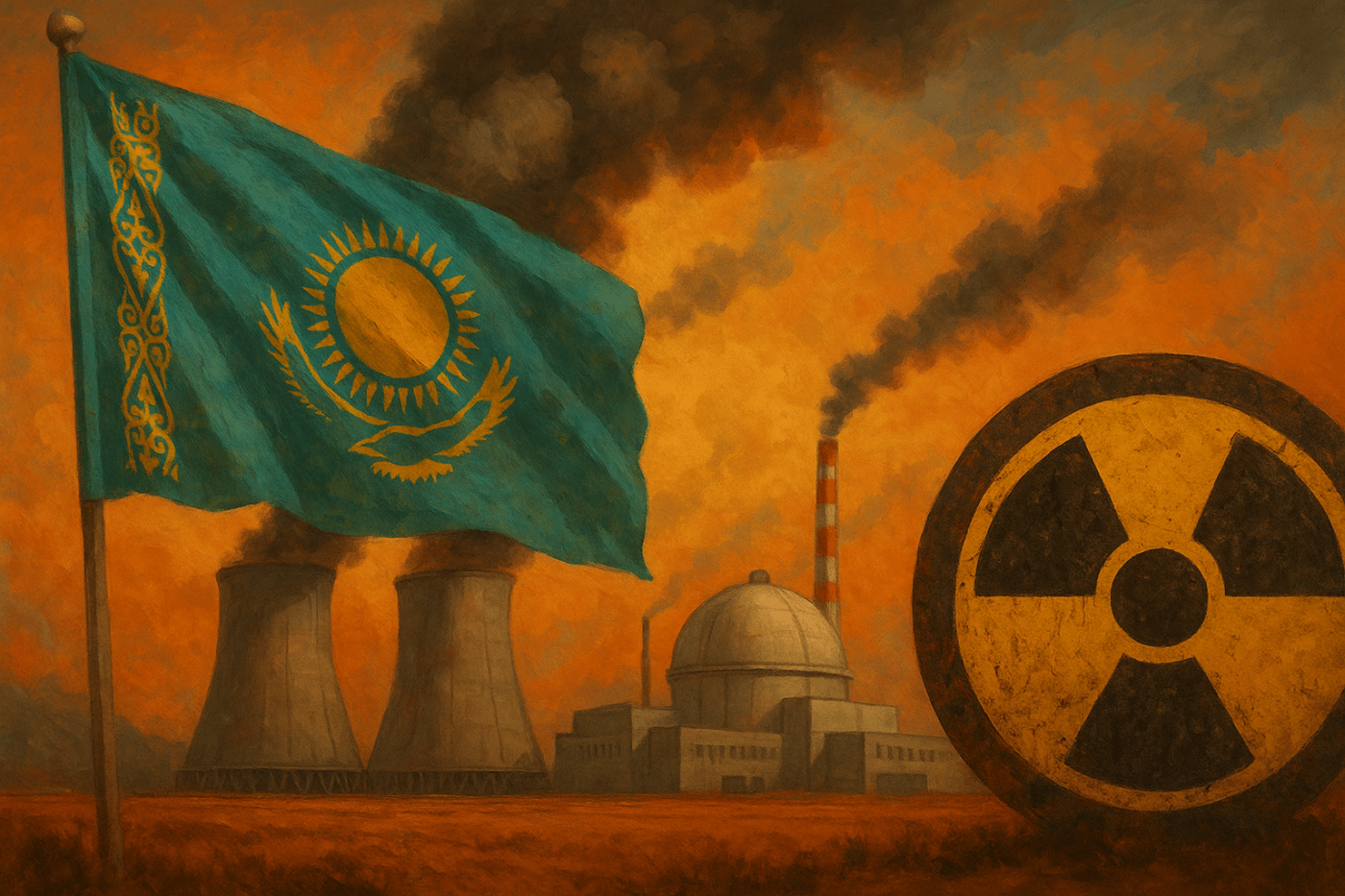
How Rosatom, CNNC, and a radioactive legacy became the battleground for multipolar recalibration and anti-imperialist resistance
By Prince Kapone | Weaponized Information | June 21, 2025
Ink, Isotopes, and Imperial Optics: Fraternal Media and the Manufacturing of Multipolar Confusion
It was a Saturday announcement—always the imperial elite’s favorite graveyard for inconvenient truths. On June 14, the government of Kazakhstan declared that Russia’s Rosatom would construct the nation’s first nuclear power plant, a two-reactor complex slated for completion by 2035 in the town of Ulken. Hours later, Almasadam Satkaliyev, head of the nation’s nuclear energy agency, dropped another shock: Kazakhstan would build a second plant, this time likely with China’s state-owned China National Nuclear Corporation. What should have triggered a global reckoning—a former Soviet republic strategically hedging the imperial chokehold of Western finance by contracting two sanctioned multipolar powers—was instead buried beneath a haze of narrative sedatives by Eurasianet and its echo chamber.
Eurasianet—a media outlet funded by the National Endowment for Democracy and operated out of elite academic networks in New York and Prague—functions as a textbook node in the Imperialist Media Apparatus. Its editorial team includes graduates from Georgetown, Columbia, and the London School of Economics, all institutions ideologically aligned with neoliberal orthodoxy and technocratic energy governance. Its regional coverage, under the guise of independence, launders IMF talking points and World Bank “best practices” into native-language content for Eurasian consumption. The outlet’s role is not to inform, but to perform—to script Global South autonomy as geopolitical instability and to cast South-South cooperation as diplomatic acrobatics gone awry.
In this instance, their coverage of Kazakhstan’s twin-reactor strategy cast the move as a “balancing act” between two rival authoritarians—Russia and China—implying Astana was navigating a minefield of dependency rather than asserting leverage against Western energy colonialism. This is not analysis. It is Cognitive Warfare: the deliberate manipulation of narrative to erode ideological sovereignty and blunt mass perception of liberation in motion. It’s the same logic that portrayed the Non-Aligned Movement as a chaotic bloc of fence-sitters, or BRICS+ as a tea club for tinpot populists. As always, the imperial center cannot comprehend a world where the Global South acts with intention rather than obedience.
Eurasianet’s authors—careerist transplants who shuttle between Soros-funded research fellowships, EU development programs, and NGO journalism grants—represent the antithesis of the Guerrilla Intellectual. They speak not to the working class but over it, translating imperial anxiety into digestible middle-class moralism. The nuclear question, for them, is not whether Kazakh energy sovereignty can be reclaimed by the people—but whether the right balance of foreign inputs can stabilize the regime without threatening foreign investors.
What goes completely unexamined is the structural trauma that undergirds this moment: the irradiated memory of Semipalatinsk, where 456 Soviet nuclear tests turned entire villages into fallout corridors. This wasn’t a “strategic oversight”—it was organized abandonment, necropolitics by neutron wave. The current pivot toward nuclear development—while painted by Eurasianet as a shiny technocratic solution to energy shortfalls—carries that same structural logic forward, now under the banners of decarbonization and energy security. Glossy PowerPoint decks tout “clean baseload,” but no survivor of Semey would mistake fallout for freedom.
What the article also suppresses is the unprecedented form of strategic coordination Kazakhstan is undertaking. It isn’t flailing between “two authoritarian patrons.” It is engaging in multipolar recalibration. The decision to move forward with both Rosatom and CNNC is not hedging—it is counter-hegemonic calibration. It is the praxis of a state under siege maneuvering within a global system of asymmetry to widen the cracks in empire.
Eurasianet, of course, has no interest in these contradictions. Its task is simpler: frame any deviation from Western dependency as chaos, any alignment with the East as capitulation, and any move toward sovereignty as a mistake. What it cannot see—what it is ideologically forbidden from seeing—is that Kazakhstan, for all its contradictions, is not merely reacting to crisis. It is probing the very limits of imperial control. And that frightens them more than uranium ever could.
Uranium Without Power: Extractive Contradictions and the Terms of Multipolar Survival
The official numbers are hard to argue with. In October 2024, over 71 % of Kazakh voters approved the construction of a domestic nuclear plant. The state’s justification was equally clear: a looming energy deficit of up to 7 GW during peak winter hours. With uranium under its feet but no sovereign energy sovereignty to show for it, Kazakhstan moved to reverse decades of underdevelopment with two deals: one with Rosatom, and another with CNNC.
But facts do not equal power. Kazakhstan may produce more than 43 % of the world’s uranium, but it doesn’t control the means of enrichment, energy generation, or the global pricing regimes set in London and New York. This is the uranium trap: a peripheral nation forced to export raw materials and import value-added energy at markup. As WI’s analysis of BRICS and imperial contradictions makes clear, the Global South remains locked in a global division of labor where energy sovereignty is not a given—but a battlefield.
Astana’s reactor tandem intensifies its multipolar recalibration. Both Rosatom and CNNC offer not just hardware, but shelter from the imperial chokepoints that punish disobedient nations. CNNC’s involvement links the project to China’s Digital Silk Road, as detailed in WI’s investigation of Sino‑Kazakh infrastructure integration. Rosatom, meanwhile, has become a diplomatic weapon of the Russian state—a sanctioned but still-operational export mechanism designed to bypass fossil-fuel bottlenecks and secure soft power through nuclear infrastructure. Together, they form a geopolitical circuit breaker: a way to cut out Washington’s energy leash and short-circuit Europe’s carbon colonialism.
While the $15 billion price tag is steep, it does not follow the familiar script of imperial debt traps. Rosatom is not a vulture fund—it is a state instrument operating outside Western capital flows. The risks here are real, but they stem from internal class contradictions, not foreign looting. What’s at stake is how Kazakhstan negotiates, repays, and governs—not whether Rosatom will recolonize it. As seen in Turkey’s Akkuyu reactor—also built by Rosatom—the danger lies in the terms of implementation, not the presence of multipolar partners. If left unchallenged by the working class, even counter-hegemonic infrastructure can be captured by local elites.
This pivot reactivates the necro-extractivist logic of Semipalatinsk—where Soviet tests sacrificed 1.5 million lives for atomic supremacy. The consequences—birth defects, cancer clusters, generational trauma—were rendered invisible by Moscow’s strategic calculus. Today, that legacy is rebranded as opportunity, with nuclear energy cast as “clean” and “forward-looking.” But for survivors like Gulnara Imanova, who told the 2024 Nuclear Survivors Forum, “They turned our wombs into sacrifice zones—now they want our light bills,” the contradiction couldn’t be clearer. This is not clean energy. It is necro-extractivism with a green badge.
Even the infrastructure narrative is a mirage. Kazakhstan’s railways are already stitched into China’s Eurasian logistics lattice, bypassing U.S.-controlled maritime chokeholds. As detailed in WI’s report on multipolar chokepoints, these corridors are more than trade routes—they are sovereignty corridors. By anchoring nuclear development into these logistical veins, Kazakhstan inserts itself into a BRICS+ circuit where SWIFT blacklists and EU climate tariffs carry less sting. That is the material definition of Anti-Imperialist Sovereignty: not rhetorical independence, but infrastructural disobedience.
Still, these gains are partial. Until the Kazakh working class claims direct control over energy production, financing, and environmental governance, the state will remain an intermediary—bargaining for better terms in a rigged casino, but not breaking the table. As WI’s Silk Road analysis reminds us, only an organized, proletarian force—rooted in unions, survivor councils, rural cooperatives, and student cells—can transform that opening into a rupture.
Reactors Without Revolution: Sovereignty as Struggle, Not Slogan
If we follow Eurasianet’s framing, Kazakhstan’s nuclear pivot is a diplomatic tightrope act—wobbling between “authoritarian patrons,” nervously appeasing Moscow and Beijing. But that’s not what’s happening on the ground. Kazakhstan is not a passive state swaying in geopolitical winds. It is a peripheral power staging a deliberate multipolar recalibration. To the Western imperial bloc, this appears as recklessness. But to the workers, miners, survivors, and farmers beneath that system, it is a chance to seize something long denied: sovereignty not on paper, but in practice.
This is the logic of anti-imperialist sovereignty—the sovereign right of oppressed nations to pursue development, industrialization, and infrastructural independence on their own terms. Not through USAID grants or IMF austerity packages, but through South-South partnerships, state-led planning, and strategic contradiction. In this context, Kazakhstan’s Rosatom–CNNC tandem is not a contradiction—it is a tactic. One reactor supplies credit and reactor technology from Russia, a state forced into strategic realignment by the West’s bid to destroy it. The other opens a circuit to China’s socialist industrial model, one capable of delivering reactors, logistics, and digital sovereignty at scale. Together, they form a wedge—not just against U.S. dominance, but against the entire sanctions architecture that underpins it.
Yet the narrative must be tempered: reactors alone do not emancipate. Kazakhstan’s nuclear program—if left solely to state planners and technocrats—risks entrenching a new elite. But that danger lies not in the Russian or Chinese partnerships themselves—it lies in how Kazakhstan’s own institutions distribute power, cost, and control. The real struggle is not with foreign allies—it is between the class that builds the plant and the class that commands the switchboard.
Here, resistance is not theoretical. In Karaganda, miners’ syndicates are circulating internal Rosatom-CNNC bidding documents—unofficially leaked via Telegram—from comrades in Vietnam’s energy sector, as detailed in WI’s Silk Road report. These workers are not merely bargaining for wages. They’re building a platform for oversight: workplace committees to monitor environmental compliance, push for tariff protections, and demand profit-sharing mechanisms rooted in energy redistribution. In Almaty, engineering students have launched a radiation-tracking open-source portal using data from the former Semipalatinsk testing zone—linking the memory of necro-extractivism to real-time surveillance of today’s reactors. This is Proletarian Cyber Resistance in embryonic form.
Meanwhile, survivors of Semipalatinsk are demanding reparations and co-governance. It is not a question of reactors or no reactors. It is a question of who owns the grid, who writes the contracts, who controls the fuse box—and whether that infrastructure serves the people, or disciplines them.
The West calls this “playing with fire.” We call it Dual and Contending Power. The state may own the land and license the projects. But power is not ownership—it is control. And in Kazakhstan, control is slipping from the hands of bureaucrats and consultants and pooling in the calloused hands of those who still remember the burn. That is not a public-private partnership. That is class war in wattage.
Sabotage the Saboteurs: Revolutionary Tasks in the Imperial Core
Let’s be clear: the nuclear double-deal in Kazakhstan is not a local matter. It’s a seismic tremor in the global architecture of energy power—and it shakes hardest at the empire’s foundations. If Astana is reaching for multipolar sovereignty through energy infrastructure, then Washington, Brussels, and Wall Street are already drawing up plans to sink it. That’s not speculation—it’s doctrine. Sanctions, sabotage, lawfare, and narrative warfare are the default weapons of a panicked hegemony. So the question is not whether the empire will strike. It’s what the revolutionary movement inside the belly of the beast will do to strike first.
For anti-imperialists and multipolar allies in the Global North, this is your front line. The task isn’t to cheer from afar while Kazakhstan builds dual reactors. The task is to expose the levers of imperial interference—the banks that back regime change, the think tanks that script the disinformation, the utilities that inflate electricity bills to punish energy independence.
Start with sanctions intelligence: build a public repository of U.S. and EU sanctions targeting state-owned energy companies, financial institutions, and tech infrastructure in Kazakhstan, Uzbekistan, Iran, and Vietnam. Connect the dots between executive orders, World Bank loans, and the Pentagon’s energy chokepoint maps. WI’s “Steel Tracks & Sovereignty” outlines how the Belt and Road is framed as a threat—not because of debt, but because it bypasses empire.
Then trace the propaganda pipeline: document how Eurasianet, the Atlantic Council, the German Marshall Fund, and Bloomberg recycle the same talking points—”energy dependence,” “nuclear debt trap,” “Chinese overreach.” These aren’t reports; they’re war memos dressed in liberal language. Leak them, track them, name the donors. Use WI’s Glossary #12: Imperialist Media Apparatus to train new researchers in decoding this narrative supply chain.
Coordinate with energy justice movements across the imperial core. Build cross-border technical brigades of software engineers, grid workers, and climate activists to provide direct assistance to Global South infrastructure projects—open-source tools for tariff audits, radiation mapping, and secure intergovernmental energy data sharing. This is not charity. This is counter-colonial logistics.
Most of all: agitate within the settler-colonial machine. If you’re in the U.S., expose how U.S. uranium contracts with Kazakhstan are structured to enforce dependency. If you’re in the UK, sabotage parliamentary narratives against “nuclear authoritarianism.” If you’re in Canada, block exports of GE-Hitachi reactor tech to undercut multipolar development. Your governments are the empire’s energy enforcers. That makes you responsible for breaking their grip.
This is a moment of clarity. Multipolarity won’t be built by states alone—it will be defended and deepened by a revolutionary class force that can see the system from both sides. If Kazakhstan is staking its future on nuclear sovereignty, then the anti-imperialist movement must stake its future on defending it—materially, ideologically, internationally. That means organizing from New York to Almaty, from Berlin to Balkhash, not just against imperial war, but against the pipelines of power that sustain it.
The time is now. Expose the pirates. Sabotage the saboteurs. Electrify the resistance.
 Weaponized Information
Leave a comment