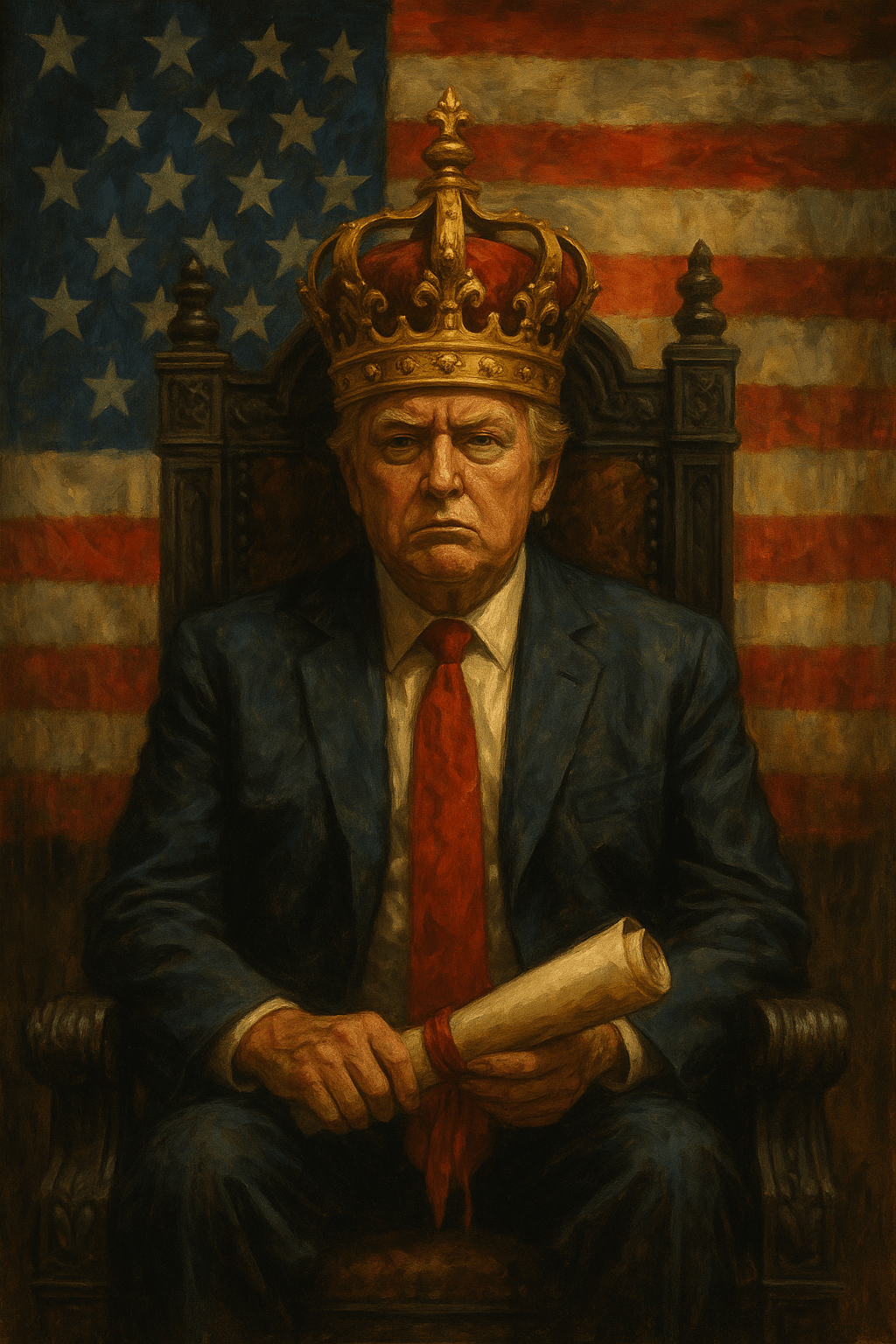
The “No Kings” protests rage against the symptom—but not the system. While Trump governs like a monarch, it’s the bipartisan ruling class—and the liberal base that backed them—that built the imperial presidency brick by brick. This isn’t about who wears the crown. It’s about the empire that needs one.
By Prince Kapone | Weaponized Information
June 15, 2025
Part I – The Throne They Built Together
It’s always the same script. When the presidency is in the hands of a Republican demagogue, the liberal intelligentsia rediscovers its spine and screams, “No kings!” Protesters flood the streets, nonprofits light up social media, and everyone from MSNBC pundits to Instagram socialists starts quoting Hannah Arendt. But what no one wants to admit—especially not the blue-tie faithful—is that the so-called “imperial presidency” they now oppose was forged with their full support.
This didn’t happen overnight. It wasn’t the product of a single man or even a single party. The concentration of power in the executive branch has been a long bipartisan project—meticulously constructed by both Republicans and Democrats, and cheered on by liberals, progressives, and even some “socialists” who convinced themselves that the only way to defend democracy was to bypass it.
The presidency in the United States was never neutral. From the start, it served as the control center of a settler-colonial empire—built to protect property, suppress insurrection, and discipline the poor. What’s changed over the last century is not its purpose, but its power. And that power has grown steadily with each crisis: war, recession, riot, pandemic. Each one used as a pretext to expand executive authority—always in the name of stability, security, or reform.
Liberals cheered when Roosevelt invoked emergency powers to rescue capitalism from collapse. They nodded along when Truman gave us the CIA and the National Security Council. They celebrated when Kennedy and Johnson used the White House to manage imperial war abroad and counterinsurgency at home. Clinton governed like a CEO—gutting welfare, militarizing the police, and passing NAFTA—all while expanding the federal state’s reach through executive action. And Obama, the liberal darling, took Bush’s war powers and turned them into standard operating procedure. Drone strikes, mass surveillance, secret kill lists—all made palatable because they came with punctuation and polish.
None of this was done in secret. It was done with votes, budgets, and signatures. With the consent—often enthusiastic—of the very same liberal and progressive forces now calling foul. Their mistake wasn’t that they were tricked. It’s that they believed the presidency could be a force for justice as long as the right person held the reins. They confused personality with power, style with substance, and in doing so, helped create a political system where elections change the face, not the function, of executive rule.
So now the chants return: “No kings!” But what is a king if not a ruler with unilateral power to declare war, execute without trial, spy without warrant, and silence opposition? Isn’t that the very definition of the modern presidency—constructed not by coup, but by Congress, courts, and compliant voters? This is not a monarchy imposed from above. It’s a dictatorship built from bipartisan consensus.
Part II – Executive Power Isn’t the Problem. It’s the Plan.
The people who spent the last two decades pulling levers for Democrats are now outraged that the executive office holds too much power. But where were they when that power was being built? Where was all this constitutional outrage when “their” administrations used executive authority to deport millions, bomb sovereign nations, and prosecute whistleblowers? Where was all this concern for democracy when liberal presidents bypassed the public and ruled by executive memo, drone strike, and surveillance court?
It’s not just hypocrisy. It’s historical amnesia—and it’s dangerous. Because executive power in this country didn’t metastasize by accident. It grew by design. And every so-called “emergency”—from 9/11 to COVID to inflation—has been used to justify further consolidation. Under Bush, the liberal class surrendered civil liberties for security. Under Obama, they surrendered transparency for “competence.” Under Biden, they surrendered principle for pragmatism. The result? A presidency with near-absolute authority over life, death, borders, budgets, and war.
This is what we mean by the mass surveillance, police-military state—a domestic architecture of repression designed to secure capital and contain dissent. It includes the FBI, ICE, the NSA, the Joint Terrorism Task Forces, and a web of data-sharing agreements with tech corporations that monitor, map, and manipulate public behavior. It’s not some rogue state—it’s the modern state. And it was built piece by piece through bipartisan legislation, liberal silence, and progressive compromise.
The irony is sharp: the very people who championed this machinery when it was aimed at Native Americans, Blacks, immigrants, Muslims, and radicals now panic because it might be used on them. But this is how empire works. It rehearses its violence on the colonized, the racialized, the poor—and when it’s done practicing, it brings it home. That’s not overreach. That’s the script.
So no, the danger isn’t that the wrong man holds power. The danger is that this system concentrates power in the first place—and does so with the blessing of those who claim to oppose it. The danger is that technocratic liberalism, when faced with capitalist crisis, always chooses order over freedom, stability over justice, and executive fiat over collective action.
This isn’t about Trump. It’s about the presidency itself—about the structure that allows one man, backed by capital and cloaked in legality, to rule like a monarch. And it’s about the liberal political imagination that cannot envision liberation without a manager at the top. Until that illusion is shattered, we will keep trading kings, and mistaking the ballot box for a revolution.
Part III – From Crisis Management to Technofascism
Let’s stop pretending. The modern presidency is not just bloated. It’s weaponized. It doesn’t merely command a country—it orchestrates a globe-spanning system of war, finance, and surveillance. And in the 21st century, that system has a name: technofascism—a political form where executive rule fuses with digital surveillance, permanent war, and financial discipline to preserve the rule of capital in crisis.
This is not some future dystopia. It’s the political reality of U.S. empire today. And it wasn’t built by fascists alone. It was assembled in pieces by liberals, conservatives, and technocrats who all agreed on one thing: democracy is a threat when the people want more than capitalism can give. The modern presidency has become the software hub of that repression. One man sits at the top, but the real program is running underneath—powered by banks, algorithms, police, and drones.
Here’s how it works: the economy crumbles under its own contradictions—wages stagnate, the planet burns, debt explodes. The state can’t fix it, because the state works for capital. So instead of solving the crisis, the ruling class manages it. With data. With war. With executive orders. With riot cops and predictive policing. With social media censorship and high-frequency propaganda. And the presidency becomes the key node in this network—a position that disciplines the domestic population while keeping the imperial periphery in check.
This is not a return to fascism. It’s fascism adapted to the needs of digital capital. Not brownshirts but biometric scanners. Not bonfires of books but algorithmic suppression. Not state-run industry but tech monopolies aligned with the state. And the liberal class has been complicit every step of the way. While they were busy celebrating the “efficiency” of Amazon logistics and the “ethics” of Silicon Valley innovation, the military-industrial-surveillance complex was quietly rebranding itself as a convenience.
Under Obama, we got the perfect merger: drones in the sky, data in the cloud, and a soft-spoken constitutional lawyer explaining it all in complete sentences. Under Biden, it matured into policy—public-private counterterrorism initiatives, disinformation task forces, biometric border tech, all justified in the name of defending “our democracy.” But whose democracy? When billionaires and generals co-govern, when protests are treated as insurgencies, and when elections are treated as risk assessments, what exactly are we defending?
Technofascism is not a glitch. It is capitalism’s answer to its own breakdown. It arises when the ruling class can no longer rule through consent alone—when economic promises collapse and repression becomes the only viable strategy. And the presidency—fat with power, unaccountable by design—is the perfect vessel for that transition. It doesn’t need ideology. It doesn’t need mass support. It just needs crisis. And in a system built on endless war, endless debt, and endless inequality, crisis is the only thing that’s guaranteed.
The real betrayal isn’t just that liberals failed to stop this. It’s that they helped normalize it. They convinced people that this system could be reformed, managed, tweaked. They told us the problem was the wrong man in office—not the office itself. Not the surveillance laws, the war budgets, the tech monopolies, the colonial police. They told us to vote harder while the ground beneath us turned to digital concrete.
So let’s name it clearly: what we’re facing now is not just executive overreach. It is the consolidation of a technofascist regime—one born of bipartisan complicity, corporate coordination, and liberal cowardice. And unless we confront it as a system—not a scandal, not a policy disagreement, but a full-blown mode of rule—we will remain spectators to our own dispossession.
Part IV – The Soft Police: How the Left Became Managers of the Crisis
Every empire needs its enforcers—but not all of them wear uniforms. Some wear tote bags and Zoom filters. Some write grant proposals and policy memos. In the age of technofascism, repression doesn’t only come with a badge. It also comes with a nonprofit logo, a carefully worded press release, and a Get Out the Vote campaign. And it’s time we said it plainly: much of the so-called progressive movement in the U.S.—from liberal NGOs to self-described “democratic socialists”—has become the soft police of empire.
They don’t smash skulls. They manage dissent. They redirect anger. They translate systemic exploitation into personal trauma, police brutality into “bad apples,” and settler-colonial capitalism into a “broken system.” They hold up procedural reform as revolution, tweet through genocide, and write open letters about “civility” while the ruling class drains the life out of the planet. In every crisis, they show up—not to disrupt the system, but to help it adapt.
This is not accidental. It’s structural. As the contradictions of U.S. capitalism sharpen, the state needs more than just force. It needs ideology. It needs mediation. It needs a class of political actors who can talk to the discontented without letting them organize dangerously. That’s where the left-liberal ecosystem steps in: organizing voter drives while ICE builds new detention centers, writing policy white papers while Palestine bleeds, marching against fascism while propping up the very parties that authorize fascist tools.
Even the democratic socialist wing, which should know better, too often functions as a pressure valve. They speak the language of class struggle while reinforcing the institutions that suppress it. They talk about socialism, but treat the Democratic Party like an awkward uncle instead of the imperial party of war and finance it has always been. They win city council seats and celebrate “representation” while eviction courts and Amazon warehouses churn untouched. They have mistaken access for power—and history will not forgive them for it.
Meanwhile, the NGOs—the “civil society” professionals—offer soft cover for the hard state. They get grants to document the crisis, conferences to discuss the crisis, and media airtime to lament the crisis. But what they can’t do—won’t do—is fight it at its root. Because the root pays their salary. The function of the NGO class is not to end injustice. It is to regulate it, audit it, and reproduce it—on more diverse terms.
So when people cry out against kings, when they march against tyranny, when they wake up to the horror of concentrated power—they will be offered a softer tyrant, a rainbow coalition of managers, and a return to “normalcy.” And unless we break from that managed opposition—unless we expose its role in sustaining empire—we will remain trapped in a hall of mirrors, arguing over costumes while the system reloads.
Part V – Break the Throne: Real Power Lies Below
This system is not reformable. You cannot regulate empire into justice. You cannot diversity-train your way out of mass surveillance. And you sure as hell can’t vote technofascism out of existence. The U.S. presidency—whoever occupies it—is not malfunctioning. It is functioning perfectly as a dictatorship of capital. The only way out is through rupture.
The force that can break this is not in Congress or on a podcast. It’s not on a ballot line or inside a 501(c)(3). It lives in the warehouses and the fields, in the prisons and the borderlands, in the strike lines and the breadlines. It is the global working class—the colonized poor, the precarious migrants, the hyper-exploited laborers who keep this empire running while getting nothing but war, debt, and prison in return. They are the ones with nothing to lose and everything to gain. And they are already rising.
From the Sahel to Chiapas, from Amazon warehouses in Alabama to fishing communities in Gaza, the global proletariat is not waiting for permission. They are resisting in the rubble, organizing under curfew, holding the line in refugee camps and under martial law. They are not writing think pieces. They are building dual power. They are not asking for kings to be nicer. They are refusing the throne entirely.
In the heart of empire, our task is clear: break with the ruling class, expose the system, and build power from below. That means no more illusions about good presidents, competent managers, or “lesser evils.” That means no more looking up for salvation. That means organizing our people—across race, class, and border—into a force capable of shattering the whole damn machine.
The throne must fall. Not be remodeled. Not be reupholstered. Destroyed. Because no one gets to rule justly over the many. And if there’s any hope in this moment—any flicker of possibility—it lies in our willingness to stop begging for justice and start building the power to take it.
 Weaponized Information
Leave a comment