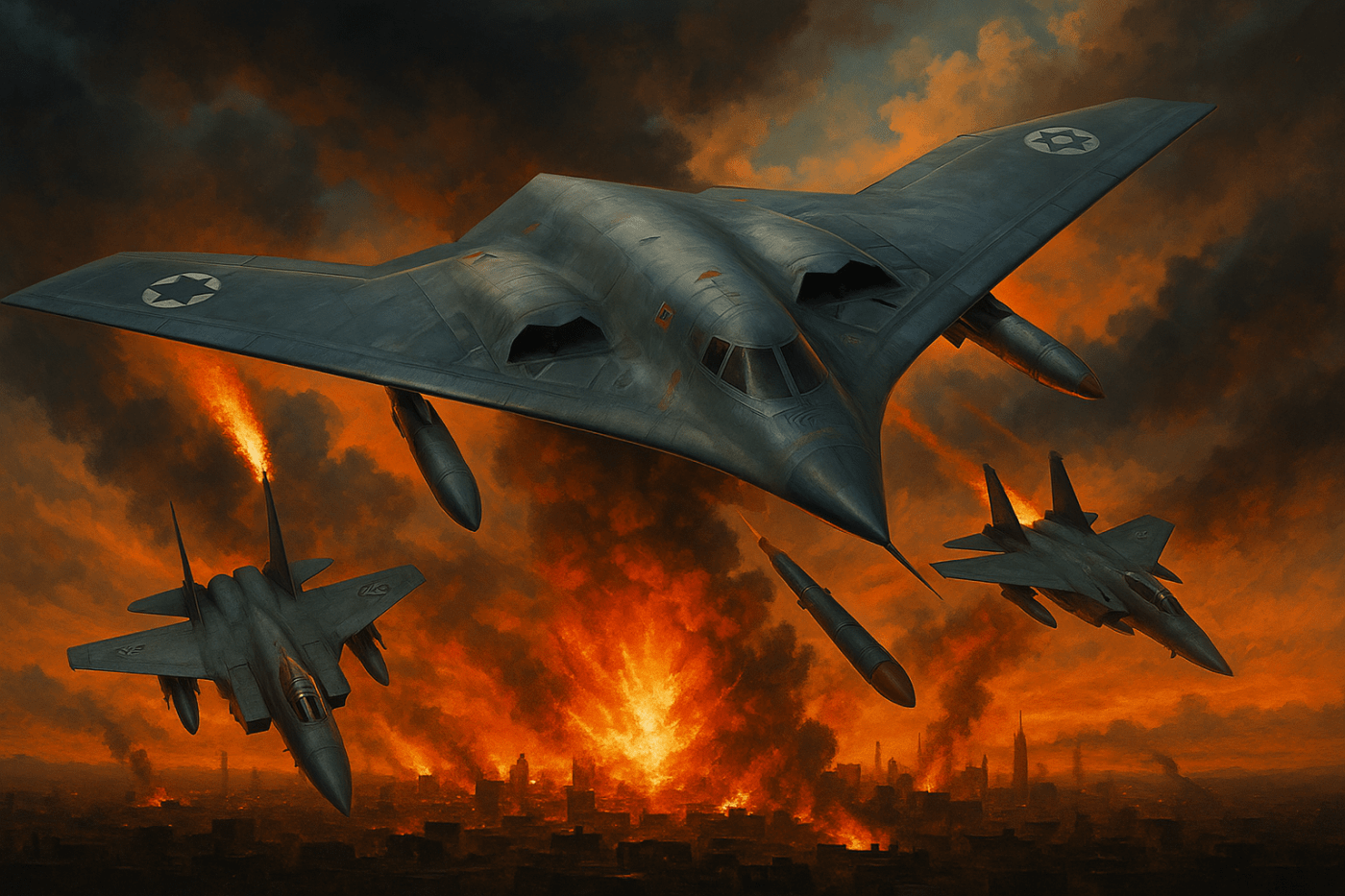
It wasn’t miscommunication. It was choreography. From evacuation optics to narrative delay, Trump’s so-called diplomacy gave cover to an imperial assault. The bombs were coordinated. The story was scripted. The target was sovereignty.
By Prince Kapone | Weaponized Information | June 13, 2025
Smoke and Mirrors at 30,000 Feet
On 13 June The Guardian ran a straight-faced news hit about Donald Trump “walking a tightrope” after Israel’s latest bombing run over Iran. Strip away the cool prose and you find a fog machine: liberal doubt swirling thick enough to hide a joint U.S.–Israeli blitz behind a curtain of journalistic respectability.
The Messenger and His Masthead
Andrew Roth wears the title “global affairs correspondent,” but his real craft is laundering State-Department talking points for the respectable classes. From Moscow scare-pieces to Beltway puffery, Roth’s byline is a revolving door between press room and power. It fits the house style. The Guardian—bankrolled by the Scott Trust’s finance grandees and sweetened by Silicon-philanthro dollars—sells humanitarian war with a latte foam of independence.
Sharing the stage are Donald Trump, Benjamin Netanyahu, Marco Rubio, the Pentagon’s PR brigade, and the usual weapons peddlers—each slotting neatly into the imperial supply chain, each reciting lines that keep the war drums beating.
How to Cook a Narrative: Six Quick Tricks
- Good Cop, Bad Cop. First the story shows Trump pleading for calm; next it quotes him bragging he “knew what’s going on.” The flip-flop offers plausible deniability while keeping his fingerprints on the trigger.
- Levelling the Battlefield. Iran’s right to defend its skies is equated with Israel’s right to invade them—colonizer and colonized flattened into “strategic choices.”
- Humanitarian Airbrushing. The rushed evacuation of U.S. staff becomes a tale of bureaucratic care, not battlefield choreography.
- Orientalist Panic Button. Tehran is cast as volcanic and irrational; Tel Aviv as cool and “calculated,” forced to act by uncivilized others.
- Entrapment Alibi. Maybe, the paper muses, Israel “tricked” Washington. A handy storyline that paints the empire as gullible, never complicit.
- The Vault of Silence. Nowhere do we hear about the decades-old pipeline of U.S. arms, the bomber fleets parked nearby, or the sanctions that softened Iran up for the hit. History is squeezed into a 24-hour sound bite.
Blend these moves and you get an optical illusion: a rogue Israel, a reluctant Trump, and a crisis that just happened. What evaporates is the scaffolding of hyper-imperialism—the machinery that turns bomb runs into business as usual. Our job is to smash the illusion, not polish it.
Behind the Curtain: What the Guardian Hides in Plain Sight
Strip away the spin, and what remains in the Guardian’s report is a skeleton of facts—some spoken, many silent. What’s clear is this: the Israeli military executed a large-scale air assault on Iran, targeting over 100 sites with more than 200 warplanes. The U.S. had advance knowledge of the strike. Trump first performed disapproval from the East Room, then told the Wall Street Journal he was not caught off guard. “We know what’s going on,” he said. In fact, Israeli state media admitted the strike was coordinated with Washington, despite media hedging that Trump may have been “entrapped.”
The U.S. didn’t just know—it prepared. According to Reuters, the U.S. deployed both B‑2 stealth bombers and B‑52s to Diego Garcia weeks before the strike—aircraft capable of long-range strategic bombing, including against hardened targets like Iran’s Fordow nuclear facility. Simultaneously, the U.S. resupplied Israel’s Iron Dome missile defense systems “in recent weeks.” These were not defensive moves. They were preparations for a region-wide escalation.
Meanwhile, the U.S. State Department began evacuating non-essential personnel from Israel and nearby outposts only 24 hours before the operation—a move that Rosemary Kelanic, Middle East Director for Defense Priorities, said was “not enough time to get people out of harm’s way.” Translation: the evacuation was symbolic cover, not genuine protection. By then, the war plans were already in motion.
And yet, for all its reporting, the Guardian carefully avoids connecting the dots. It never names the war for what it is: a joint U.S.–Israeli attack on Iran, timed and staged to appear spontaneous. It fails to note that this operation follows a year of increasing U.S. sanctions pressure on Tehran, the expansion of CENTCOM forward operations, and the joint military exercises conducted with Israel and regional proxies. This is not an isolated event. It is a deliberate phase of what we call hyper-imperialism: spasmodic militarism deployed to reassert domination after the failure of economic and diplomatic pressure.
What the Guardian calls a “tense moment” is in fact a chapter in a much larger strategy—a strategy rooted in settler-colonial counterinsurgency. Israel’s bombardment of Iran was never just about “deterrence.” It was about reaffirming U.S. dominance over West Asia’s political geography, punishing a Global South nation that refuses to fold to empire, and signaling to every anti-imperialist force from Beirut to Sanaa to Caracas: this is what happens when you resist.
And like all imperial wars, this one moves through a choreography: soft power sets the stage, hard power delivers the blow, and the press rewrites the script. The Guardian plays its part with discipline—casting bombs as “geopolitical signals,” warplanes as “deterrence tools,” and imperial aggression as a “tightrope walk.” But the facts—when extracted, contextualized, and held to the fire—tell a different story: this wasn’t a breakdown of diplomacy. It was diplomacy as deception.
This Was Never About Nukes—It’s About Sovereignty
Let’s stop pretending. The strike on Iran wasn’t about “deterrence,” or nuclear fears, or some last-ditch bid to avoid regional chaos. It was a coordinated imperial assault—waged by a settler colony and its patron empire—to discipline a defiant Global South state that refuses to bow to the U.S.-led world order. The warplanes took off from Israel, but the green light came from Washington. And the target wasn’t a weapons site—it was Iran’s right to exist outside the reach of empire.
For over a decade, the U.S. and its junior partners have been laying the groundwork for this moment. As early as 2018, Weaponized Information warned that the U.S. withdrawal from the JCPOA was not an accident—it was a strategic move to sabotage diplomacy, isolate Iran, and justify future military strikes. The goal was never to stop a bomb. It was to prevent a sovereign Iran from building regional alliances, trading outside the dollar system, and asserting control over its development path. In short, the goal was to block Iran from stepping fully into a multipolar world.
That world is already being born. Iran has deepened ties with China through its 25-year strategic partnership, strengthened its relationship with Russia, and participated in BRICS summits that envision a future beyond U.S. hegemony. In April, Weaponized Information laid bare how this multipolar realignment threatens the fragile core of Western financial power. Iran’s inclusion in these efforts—especially its push for non-dollar trade and cooperation in energy, tech, and regional security—is exactly why it must be demonized. Empire can live with nuclear weapons in Israel. It cannot live with independence in Iran.
This is why Western media tirelessly fabricates the “nuclear threat” narrative. In May, WI exposed how Reuters and the IAEA jointly weaponized incomplete inspections and false timelines to portray Iran as irrational, secretive, and dangerous. Meanwhile, the same states who hand-wave Israel’s undeclared nuclear arsenal accuse Iran of “escalation” for refusing to disarm itself into colonized obedience. This is not just hypocrisy—it’s strategy. The imperial machine cannot afford to let Iran control its own resources, much less act as a regional node in the breakdown of U.S. unipolarity.
This war, then, isn’t just about Iran. It’s about every state and people that dares to live beyond the leash. Venezuela, Cuba, Yemen, Syria, Mali, Burkina Faso—each has faced the same pattern: delegitimize, isolate, destabilize, strike. If that fails, criminalize and blockade. If resistance survives, lie louder. In Iran’s case, Trump’s supposed “diplomacy” was not a break from war but a narrative delay tactic. He bought time. He evacuated just enough bodies. Then the bombs fell—coordinated, precise, deniable.
But the myth of imperial omnipotence is cracking. The deeper contradiction isn’t between Iran and Israel. It’s between a dying empire and the future of global sovereignty. What we are witnessing is the violence of imperialist decay: the U.S. can no longer impose its will through soft power, so it returns to spasmodic militarism—bombs where dollars used to work. This is textbook hyper-imperialism: sanctions, lawfare, psy-ops, and airstrikes rolled into one last desperate grasp to hold onto a world that’s slipping away.
And Iran, for all its contradictions, has stood firm. It has resisted war, survived sanctions, and deepened ties with the Global South. That defiance makes it a symbol—not of Islamic nationalism alone, but of sovereign resistance. It stands not as an isolated rogue state, but as part of a growing international front that rejects domination by one empire, one currency, and one set of rules rigged for capital.
To stand with Iran today is not to endorse every policy of its state, but to defend the principle of anti-imperialist sovereignty: the right of nations to chart their own course without being threatened, bombed, or starved into submission. The U.S.–Israeli strike was not a surgical response. It was an imperial punishment for refusing to kneel.
And every revolution, every resistance, every decolonial struggle now faces the same question: when the empire comes knocking with bombs and headlines, will we hide behind neutrality—or will we stand with those who dare to disobey?
Solidarity in Action: Resistance Beyond Words
Today the weapons drop. But tomorrow we organize. If this war on Iran is the empire’s punishment for stepping off the dollar leash, then our answer must be more than outrage—it must be action, grounded in class solidarity and anti-imperialist strategy.
Standing With Defiance
Iran’s working people—students, nurses, truck drivers, bakers—are already in motion. Even before the bombs, the nationwide strikes earlier this spring showed a popular determination to resist both economic strangulation and political repression. Our solidarity must meet that same energy.
- Workers’ Shutdowns: Dockworkers in San Francisco refused to load Israeli weapons in 2024—our class knows how to disrupt the supply chains of war.
- Solidarity Protests: From Boston to London and Los Angeles to Washington, thousands gathered to demand “Hands Off Iran.” These were acts of international solidarity and refusal. 2
- Stock Market Edge: Even investors are nervous—S&P 500 futures flickered on news of U.S.–Israeli aggression, revealing how finance is intertwined with war.
Declare Revolutionary Unity
We stand with the class-struggles of Iran, Venezuela, Cuba, Palestine—every people under fire from empire. The resistance was never national alone—it is global. We call on revolutionaries everywhere to recognize that Iran’s defiance today is our defiance tomorrow. There is no neutrality under bombs.
Build the Counter-Power
Our tactics must be strategic, material, and militant:
- Mutual Aid Networks: Build solidarity funds for Iranian families impacted by war and sanctions. Distribute solidarity kits at protests.
- Worker-People Coordination: Campaign inside unions like ILWU and Teamsters to stop any flow of weapons to Israel.
- Propaganda Distribution: Guerrilla pamphlets, stickers, social-media zines exposing this attack as imperial punishment—not a “tightrope moment.”
- Direct Actions: Occupy weapons producers like Boeing, Raytheon, Lockheed—disrupt their operations and expose war profiteering.
- Political Education: Host teach-ins and classes linking Iran’s struggle to broader contestations over hyper-imperialism, anti-colonial sovereignty, and multipolar futures.
- Digital Resistance: Fan informational flame-walls against state media frames, cutting through mainstream disinformation with anti-imperialist clarity.
Prefigure Dual Power
Empire wants obedience. We build institutions of self‑determination. Create local councils, solidarity cooperatives, food distribution hubs, multilingual leafleting teams. These are seeds of Dual and Contending Power. In our communities, we can show a world where solidarity, not bombs, shapes our future.
Join the Movement – What You Can Do Now
- Attend or organize protests in your city this weekend—link local events into a global solidarity chain. Look for “Hands Off Iran” rallies.
- Reach out to immigrant and diaspora networks—especially Iranian communities—and co-create co-led mutual aid and public education actions.
- Launch workplace petitions and union motions to halt shipments of defense exports to Israel.
- Support independent media, particularly Weaponized Information’s anti-war dispatches—they turn facts into strategy.
- Donate to solidarity funds for Iranian workers and dissidents, ensuring your resources reach the ground.
History doesn’t wait for permission. When empire struck Tehran, it didn’t just target rockets—it targeted the dignity of resistance. Now it’s our turn to answer with solidarity rooted not just in rhetoric, but in revolution. Build the tools. Fight the power. March with the people. When we say “no more imperial bombs,” we mean it in action, not just in words.
 Weaponized Information
Leave a comment