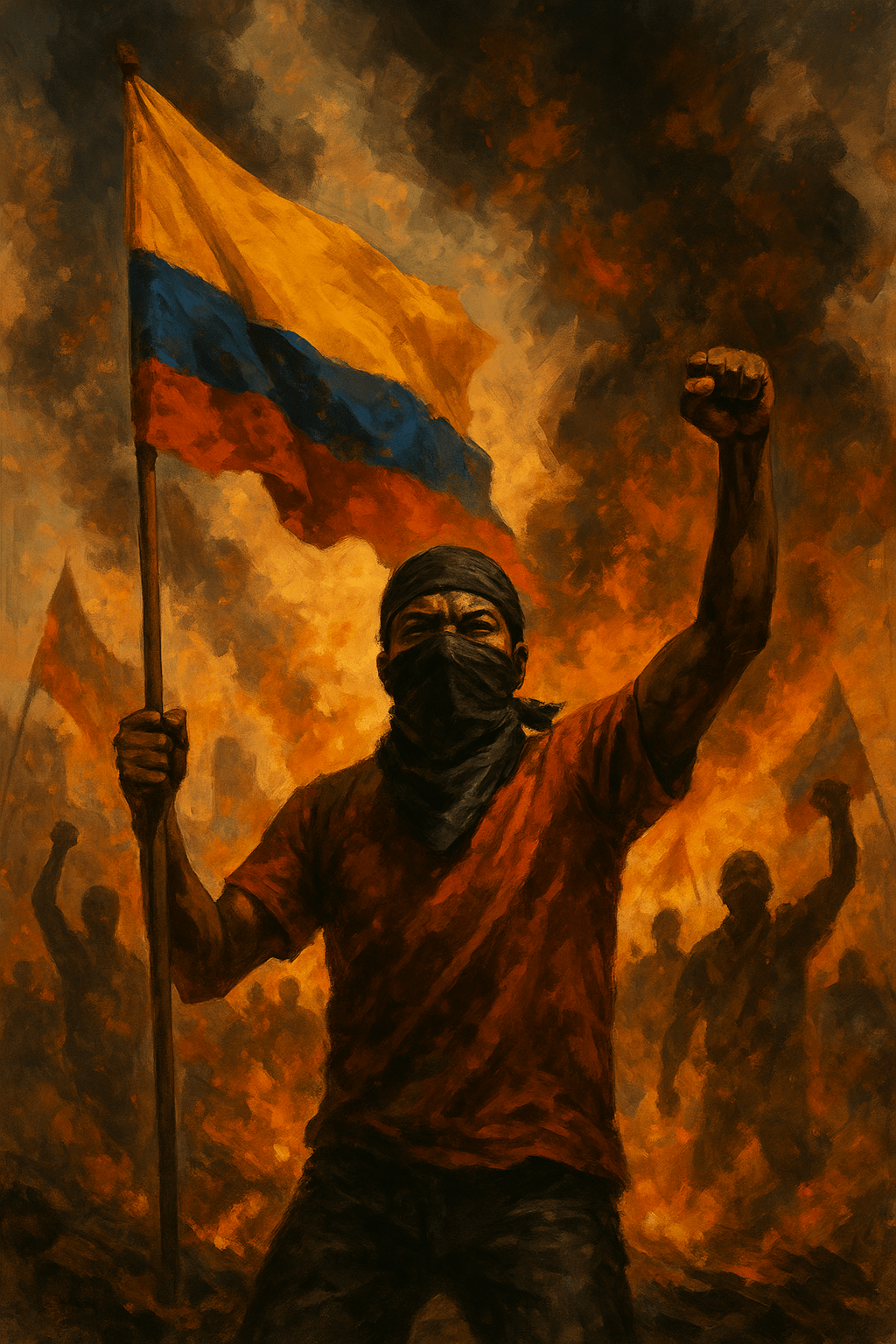
The Washington Post spins an assassination attempt on Miguel Uribe Turbay into a tale of elite victimhood—erasing decades of U.S.-backed terror, paramilitary violence, and repression. We expose the propaganda, reframe the struggle, defend the Petro rupture, and call for internationalist solidarity to stop the imperial rollback.
By Prince Kapone |Weaponized Information | June 8, 2025
On June 7, The Washington Post published a report by Samantha Schmidt covering the attempted assassination of Colombian senator and presidential hopeful Miguel Uribe Turbay. According to the article, a gunman opened fire during a campaign event in Bogotá. The shot didn’t kill him, but the narrative sure tried to. Within a few lines, Uribe is cast as a symbol of Colombian “democracy,” his near-death experience likened to the country’s blood-soaked history of political violence, and his attackers implied to be stirred up by the “leftist rhetoric” of President Gustavo Petro. It’s a familiar tune: imperial propaganda set to a liberal melody, playing softly over the screams of the dispossessed.
Schmidt writes from Bogotá, but her compass points north. Her work isn’t intended for the barrio or the campo—it’s crafted for the editorial boardrooms of Washington and the intelligence briefings of Langley. She knows the imperial grammar well: violence from below is criminal, but violence from above is “stability.” Her writing is polished, but never neutral. It’s a velvet glove over an iron fist. She doesn’t investigate empire—she markets it.
The Washington Post itself is no impartial observer. It’s the house organ of U.S. liberal imperialism, owned by Jeff Bezos, the world’s richest delivery boy and a Pentagon contractor. The Post consistently runs interference for empire, laundering coups as constitutional crises, austerity as responsible governance, and narco-states like Colombia as democracies under siege. Behind every moral headline is a budget line for bullets and boots.
The article wastes no time invoking imperial favorites. Marco Rubio, now U.S. Secretary of State, uses the moment to lash out at “leftist rhetoric”—as if words, not decades of militarized state repression, are what destabilize Colombia. Bogotá’s mayor, Carlos Fernando Galán, offers up a teary plea for unity, invoking the memory of his assassinated father to demand silence in the face of elite violence. Meanwhile, Defense Minister Pedro Arnulfo Sánchez promises swift action to “secure the nation”—which is code for more troops, more prisons, more repression.
And then there’s Miguel Uribe Turbay himself. Son of a journalist killed during a military raid. Grandson of a president who introduced Colombia’s infamous “Security Statute,” which gave legal cover for torture and mass arrests during the 1970s. None of this history is mentioned. Instead, Uribe is painted as a reformer, a moderate, a casualty of chaos. The Post mourns him like he’s Colombia’s last chance at democracy—while ignoring the thousands of murdered trade unionists, social leaders, and ex-combatants whose blood has soaked the soil.
You wouldn’t know from this article that Colombia has long been a war zone—for the poor. No mention of the decades long civil war. No mention of the long history of political assassinations in the country. Not a peep about the death squads backed by the oligarchs and the US governmnt. No talk about the lawfare and destabilization campaigns by the opposition aimed at paralyzing Petro’s government. In this story, history is a liability, and structural violence is just background noise.
Instead, the article leans hard on familiar tricks: moral equivalence (“both sides”), historical amnesia (no mention of U.S.-backed death squads), and elite empathy (the oligarch’s pain is personal, the peasant’s death is statistical). Schmidt deploys the soft language of reconciliation to obscure the hard reality of class war. Her prose doesn’t reveal—it disarms. That’s not journalism. That’s counterinsurgency with a byline.
So let’s call this what it is. This isn’t just coverage of a shooting. It’s an imperial eulogy for a system in crisis. The Washington Post isn’t mourning a senator—it’s mourning the slow unraveling of U.S. hegemony over a country that’s beginning to speak the language of multipolarity, land recovery, and popular sovereignty.
They say Uribe was nearly killed by violence. Maybe. But if you read closely, you’ll see something more insidious: a ruling class trying to resurrect itself through narrative—hoping we forget who actually pulls the trigger in Colombia, and who has been bleeding for decades without a single headline.
Beneath the Bullet: Empire, Paramilitaries, and the Machinery of Silence
The Washington Post gives us the smoke, but never the fire. It tells us about a bullet in Bogotá, but not the barrel it came from. In its telling, Colombia is a fragile democracy under siege. But in truth, Colombia is a laboratory of empire—a narco-terrorist state molded by oligarchy, maintained by death squads, and backed by billions in U.S. military aid. That violence didn’t start with the shooter on June 7. It started with Plan Colombia, with CIA-backed paramilitaries, with the fusion of counterinsurgency doctrine and capitalist expansion. And it continues to this day.
But we must make a critical distinction. While the Colombian state remains structurally captured by narco-paramilitary and comprador forces, the current administration under President Gustavo Petro represents a rupture—albeit a limited and reformist one. Petro was swept into power by popular mobilizations demanding peace, land reform, and sovereignty. His government does not control the full apparatus of the state; it governs within it, against it, and despite it. Much of Colombia’s military, police, judiciary, and regional bureaucracy remain loyal to the oligarchy—and hostile to Petro’s program. This contradiction is essential to understanding both the limits of reform and the intensifying backlash from empire and its local clients.
Let’s extract what the Post tells us and what it conveniently leaves out.
It reports that Senator Miguel Uribe Turbay was nearly assassinated in Bogotá, that he is a center-right figure, and that he hails from a “prominent Colombian family.” But it says nothing about what that family represents. Julio César Turbay—Uribe’s grandfather—was president from 1978 to 1982 and implemented the infamous Security Statute, which authorized mass arrests, torture, and repression against unionists, students, and suspected leftists. His administration laid the foundation for Colombia’s modern counterinsurgency state. His grandson inherits not just a name, but a class position forged in blood.
The article mentions President Petro’s call for unity, but it subtly places him in the crosshairs of responsibility, quoting U.S. Secretary of State Marco Rubio who blames the attack on “leftist rhetoric.” This is a propaganda sleight-of-hand—one that shifts blame from the armed agents of repression to the political figures who threaten their power. It implies that Petro’s words, not the entrenched interests of paramilitary capital, are what destabilize the nation. But what destabilizes Colombia is not a speech—it’s a state built to serve empire.
Since the signing of the 2016 peace accords with the FARC, over 1,400 social leaders—including unionists, Indigenous leaders, and land defenders—have been assassinated. According to data from Indepaz and the UN, these killings are rarely prosecuted and often carried out by paramilitary groups like the AGC (Clan del Golfo), which operate with the tacit consent of state actors. Entire communities are being displaced to make way for extractive projects. This isn’t collateral damage—it’s policy by other means.
The Post doesn’t mention that Colombia receives more U.S. military aid than any country in the hemisphere. Between 2000 and 2023, that aid has totaled over $13 billion. This money didn’t go to schools or clinics—it went to Black Hawk helicopters, assault rifles, intelligence systems, and military bases. According to Oliver Villar and Drew Cottle in their groundbreaking work, Cocaine, Death Squads, and the War on Terror, this militarization under the guise of drug interdiction has actually expanded the narcotics economy. The paramilitaries that traffic cocaine are the same forces used to crush peasant organizing.
The Post also ignores the deep political connections between paramilitary structures and elite governance. Villar and Cottle detail how Colombian paramilitarism functions as an arm of both capital accumulation and political enforcement. It is not rogue—it is systemic. And while Petro has taken steps to curb this apparatus, he governs under siege. Many of the judges, officers, and officials tasked with enforcing his reforms were trained under—and remain loyal to—the old regime.
The framing of the assassination attempt as an attack on “democracy” is especially galling when viewed in this context. Colombia’s so-called democracy has long been a facade—where elections are held under the shadow of the gun, and popular mandates are buried in mass graves. The real democratic threat isn’t violence—it’s the poor organizing for land, dignity, and autonomy.
What the article also leaves out is Colombia’s geopolitical realignment. Petro has openly challenged U.S. drug policy, supported regional integration with Venezuela, and raised the question of U.S. military bases on Colombian soil. These are red lines for Washington. As the empire recalibrates in the face of multipolar resistance, it seeks to discipline even mildly defiant regimes through economic pressure, diplomatic isolation, and media warfare. This assassination attempt—and the narrative built around it—must be understood within this larger strategy of imperial containment.
In short, the facts extracted from the article are selectively chosen to preserve the legitimacy of U.S. policy and its Colombian proxies. They tell us Uribe was nearly killed—but not who benefits from framing him as a martyr. They tell us Petro must “unite the country”—but not who’s dividing it. They tell us violence stalks Colombian democracy—but not that Colombian democracy was founded on the repression of the colonized and the working poor.
This is not journalism. It’s imperial narrative management. And it must be confronted with the full force of historical and material truth.
What They Call Democracy, We Call Counterinsurgency
Let’s be clear about what’s really under attack in Colombia. It isn’t just a senator who dodged a bullet—it’s a rupture, however partial and contested, in the long arc of U.S.-backed oligarchic domination. Miguel Uribe Turbay didn’t just represent a political opponent of President Gustavo Petro; he is a scion of the very apparatus Petro’s presidency challenges: the narco-financed, death squad–defended elite that has ruled Colombia for generations. And the media’s mourning of Uribe is not about his ideas or his policies. It’s about protecting the class he comes from—the class that owns the banks, commands the generals, and writes the laws to legalize their crimes.
The Washington Post would have us believe that Colombia is a healthy liberal democracy threatened by extremists on the left. But Colombia is not—and has never been—a democracy for the working class, the campesinos, the Afro-Colombians, the Indigenous nations, or the urban poor. What they call democracy is a counterinsurgency state designed to discipline the masses and defend property. A narco-paramilitary system fortified by decades of U.S. military aid, Plan Colombia, and CIA coordination with death squads that target teachers, trade unionists, and peasant leaders with surgical efficiency.
Into this system walked Gustavo Petro—a former guerrilla, elected not because the system embraced him, but because the people forced open the gates. His election was a rupture in the continuum of technofascist rule, not a revolution, but a radical break nonetheless. Petro didn’t seize power; he was swept in on a tidal wave of rebellion from below: the 2021 National Strike, the massive uprisings in Cali, the landless movement in Cauca, the feminist and Indigenous mobilizations across the country. His presidency represents the hopes of a people long exiled from political power.
And what has he tried to do with that mandate? Petro has advanced a land reform plan to return dispossessed territory to campesino families and Indigenous communities. He has called for public ownership of energy resources, a transition away from fossil fuel dependency, and an end to extractive violence in the Amazon. He’s proposed the demilitarization of the police and the dismantling of ESMAD—the riot force that maimed and murdered young protesters during the National Strike. He has opened peace negotiations with guerrilla groups and even attempted to reintegrate sectors of the paramilitary armed forces. He has demanded justice for the murdered, truth for the disappeared, and dignity for those pushed off the map.
In a normal country, these would be seen as common sense reforms. In Colombia, they’re treated as revolutionary threats. Because in Colombia, reform is revolution when the state is built on mass graves, cocaine profits, and foreign occupation. Petro governs a state he does not control—a state loyal to Washington, to capital, and to the blood-soaked traditions of uribismo. His proposals are blocked in Congress. His ministers are sabotaged. His name is smeared across the corporate press. The very structures he seeks to reform have declared war on him—and by extension, on the people who dared to vote for something different.
So what is the role of propaganda here? It is to reverse the rupture. The assassination attempt on Uribe is being used as a narrative weapon: to reframe Petro’s reformist project as extremist, to legitimize increased militarization, and to prepare public opinion—both in Colombia and abroad—for the eventual removal of this government by legal coup, economic sabotage, or bullet. This is how empire works today. It doesn’t always need tanks when it has headlines.
The Washington Post article serves this function perfectly. It mourns an oligarch while ignoring the masses. It cries for one man while erasing 1,400 assassinated social leaders. It pretends the violence started yesterday and refuses to name the architects of mass death. It builds a false equivalence between the violence of the oppressed and the organized brutality of the state. And in doing so, it manufactures consent for the counterinsurgency to come.
But we remember. We remember the dirty war, the helicopters, the fumigations. We remember the 2008 false positives scandal, where poor boys were dressed up as guerrillas and executed for cash rewards. We remember the stolen lands, the disappeared, the mothers still searching for their children’s bones. We remember, because our memory is a weapon.
And we say this clearly: defending Petro’s government is not about worshipping a politician. It’s about defending a rupture that the people made. A door was opened. What we do now—whether we defend that space, deepen it, and protect it from reaction—will determine whether Colombia remains a graveyard for the poor or becomes a battleground for the future.
Defend the Rupture, Deepen the Struggle
The assassination attempt on Miguel Uribe Turbay is not just a single event—it is a signal. A narrative is being crafted. A counterrevolution is being prepared. And if we remain passive, the rupture represented by Gustavo Petro’s government may soon be closed with bullet casings, U.S. dollars, and imperial doctrine.
This is a moment that demands clarity, not neutrality. Petro is not a socialist revolutionary. But his election was made possible by revolutionary struggle. His modest reforms—on land, peace, and energy—have touched the exposed nerves of the narco-oligarchy and the imperial power structure that backs it. The Colombian state remains occupied by entrenched interests hostile to any attempt at redistribution or sovereignty. And that’s exactly why this rupture must be defended. Not out of faith in one man, but out of commitment to the people who cracked the wall open.
From the palenques of Afro-Colombian resistance to the Indigenous Minga to the rebellious youth of Cali and Bogotá, the Colombian people have paid in blood for the right to speak, to vote, to live. And the empire has never accepted that. Whether by coup, assassination, or manufactured consent, the U.S. empire always tries to restore the pre-rupture order. It did so in Haiti. In Bolivia. In Venezuela. And now it eyes Colombia.
We say: not this time.
To the international left, anti-imperialists, and revolutionaries:
- Expose the narrative war. Push back against the headlines that frame Petro as a threat to “stability.” Name the oligarchs and generals behind the campaign to undermine him.
- Stand with Colombian movements. From the Coordinador Nacional Agrario (CNA) to the Organización Nacional Indígena de Colombia (ONIC) and regional student and labor blocs—amplify their voices, not Washington’s mouthpieces.
- Disrupt U.S. complicity. Demand the cancellation of U.S. military aid to Colombia. Expose Plan Colombia as a blueprint for counterinsurgency, not peace. Target the arms companies and surveillance firms arming the repressive apparatus.
- Defend Petro critically. Support his government where it advances reforms for peace, land, and dignity. Criticize it when it wavers. But never let empire define him, isolate him, or eliminate the space he opened.
- Build militant solidarity. Organize forums, publish denunciations, pressure embassies, protest military contractors—make clear that empire cannot act in the shadows.
The attempted assassination of Miguel Uribe Turbay is already being used to escalate the psychological and political war against Petro’s administration. This is how soft coups begin—with media mourning, elite speeches, and a public prepped to accept the rollback of reform as “security.”
But we have seen this play before. And this time, we fight back.
Defend the rupture. Defend the people’s mandate. Deepen the struggle. No return to death squad democracy. All power to the Colombian working class and oppressed. Hands off Petro. Long live the Colombian people’s resistance.
🔗 More from Weaponized Information on Colombia and the Battle for Sovereignty
- Cash, Coca, and Counterinsurgency: Colombia’s Substitution Scheme is a Smokescreen
- The Oligarchy Votes No, The Masses Say Go: Colombia’s Labor Revolt
- The Horizontal Horizon: Petro, Civilizational Solidarity, and the Imperialist Fear of Dialogue
- Colombia Breaks the Script: From U.S. Satellite to Belt and Road
- The Vampires Have Names: IMF Blackmail, Bloomberg Propaganda, and Colombia’s Struggle for Sovereignty
- CELAC at the Crossroads: Integration, Sovereignty, and the Battle for a Post-Imperial Future
- Gustavo Petro Speech at IX CELAC Summit
 Weaponized Information
Leave a comment