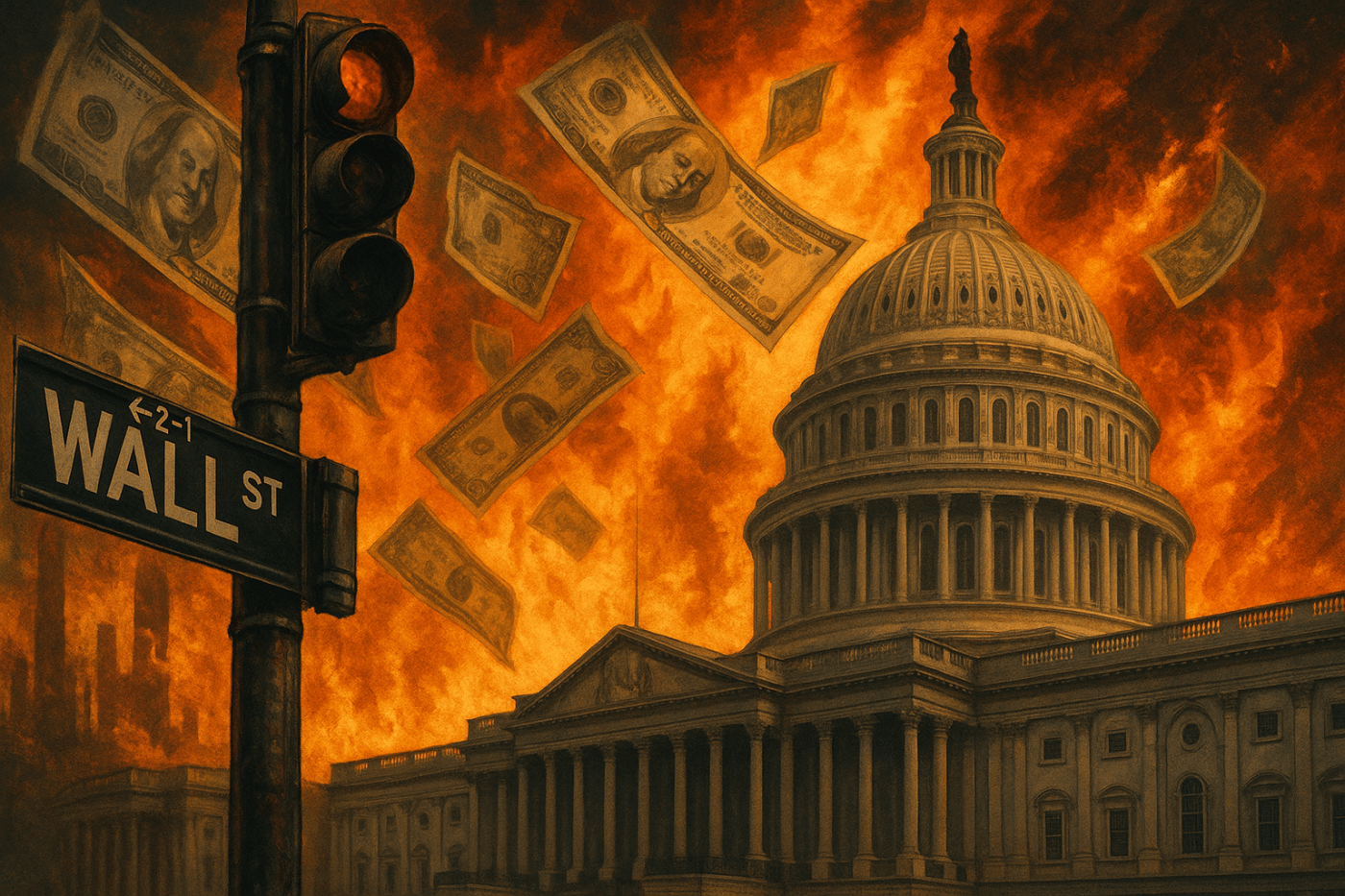
North America isn’t “stable”—it’s a bunker for capital in a collapsing world. Behind the propaganda of investor confidence lies the truth of hyper-imperialist cannibalism.
By Prince Kapone | Weaponized Information | June 6, 2025
I. “Confidence” by Coercion: Dissecting the Propaganda of Capital Flows
The article in question comes from YourMoney.com, one of those finance-advice websites that looks like it’s there to help the average investor, but actually just sings lullabies to the managers of empire. It reports that investors—especially from the UK—are pouring money into North American equities and money market funds. On the surface, this is being sold as a sign of “confidence.” Apparently, even in the face of inflation, tariffs, and economic unrest, smart money still trusts the U.S. and Canada. Meanwhile, capital is fleeing Asia, especially China, supposedly because of Trump’s new round of tariff threats. The message? Don’t worry—the empire’s still got it under control.
The article’s author, Rosie Murray-West, is a familiar face in British financial media. Her job isn’t to challenge capital—it’s to interpret its spasms and sell them as strategy. She’s written for The Telegraph, The Times, and now shuffles through the corridors of AE3 Media, which runs YourMoney.com. These aren’t independent outlets—they’re info-extensions of the City of London, designed to keep the retail investor in line with the imperial herd. She’s not a journalist. She’s a translator for a dying empire, whispering sweet nothings into the ears of pension fund managers and middle-class dreamers still chasing a piece of the vanishing pie.
And the experts she leans on—Miranda Seath of the Investment Association and Victoria Hasler from Hargreaves Lansdown—aren’t really giving analysis. They’re managing moods. Seath works in industry PR, and Hasler is a spokesperson for a major investment platform. They don’t study markets to uncover truth. They study sentiment, so they can keep small investors buying into a system rigged to serve monopoly-finance capital.
Here’s what the article doesn’t say out loud: this isn’t confidence—it’s desperation dressed up in a suit. Capital is moving into North America not because the fundamentals are strong, but because that’s where the enforcement tools are sharpest. The dollar is still king. Wall Street still calls the shots. And the U.S. state still knows how to discipline the world—through tariffs, sanctions, surveillance, and militarized finance. This is capital running for cover in the one place it knows the state will crack skulls before letting stock prices fall.
The propaganda tricks are textbook. The piece paints investors as either daring cowboys “buying the dip” or cautious savers tucking their money into low-risk funds. But what it refuses to admit is that both strategies are symptoms of fear. The global economy is falling apart—wages are down, climate disasters are up, inflation is eating the poor alive—and investors are parking money where they believe the empire can still guarantee returns. That isn’t bravery. It’s bunker behavior. And that bunker is built on imperial violence.
China, as usual, is framed as the danger. The article blames “market jitters” on Trump’s tariffs and the unpredictability of Asia. But the real instability isn’t coming from Beijing—it’s coming from Washington. Trump’s tariff war isn’t a bug in the system—it’s a feature of hyper-imperialism. It’s an attempt to throttle China’s rise and force capital back into the Western fold. What we’re seeing here is narrative warfare—a psychological operation to make empire look like order and multipolarity look like chaos.
This article is a perfect case study in how monopoly-finance capital uses media to legitimize its survival strategy. When things fall apart in the periphery, capital doesn’t panic. It consolidates. It moves into markets where the state is most willing to repress dissent, privatize everything, and enforce order with algorithms and debt. That’s not a healthy economy—that’s technofascist stabilization. Investors aren’t flocking to the U.S. and Canada because they expect growth—they’re betting on repression. They’re banking on the fact that when collapse hits, these states will protect capital at all costs, even if it means turning the working class into cannon fodder and the planet into a charred ruin.
So don’t fall for the fairy tale of “confidence.” What we’re witnessing isn’t a market adjusting to risk. It’s a system cannibalizing the periphery to prolong its own decay. It’s monopoly-finance capital regrouping under the shelter of U.S. empire, hiding behind the dollar while the rest of the world burns. This isn’t the free market. It’s the funeral march of a system that can no longer rule by consent—and must now rule by coercion.
II. The Flows of Fear and Force: Extracting the Real Story Behind the Numbers
Let’s take a scalpel to the numbers. According to the article, UK investors dumped record amounts into North American markets this April: £1.1 billion into money market funds, while “risk-on” speculators poured capital into U.S. and Canadian equities. At the same time, £121 million was yanked out of China-focused investments. The article tries to dress this up as seasonal optimism and “buying the dip,” but what we’re really seeing is flight capital—a strategic retreat of global finance back to the heart of empire, under conditions of worldwide instability it helped orchestrate.
This is not a random shuffle of portfolios. This is the latest maneuver in a broader pattern of imperial recalibration—what Foster and Magdoff long ago identified as the logic of monopoly-finance capital: an unproductive financial system so bloated with overaccumulated capital that it has no use for investment in real production. Instead, it gorges itself on speculation, debt, and state-backed guarantees. That’s why Wall Street looks attractive right now—not because it’s creating value, but because it’s built like a casino where the house never loses, and the U.S. state is the pit boss. As we’ve previously argued, this is the spectacle of market fascism—where investor “confidence” is manufactured through coercion, spectacle, and state intervention.
There is no mystery here. Capital is moving into North America because that’s where technofascist stabilization has already been locked in. As outlined in our critique of Foster’s analysis of MAGA, the U.S. state is no longer simply neoliberal—it is technofascist: an unholy fusion of Big Finance, Big Tech, and the imperial state. Capital doesn’t need democracy—it needs data surveillance, algorithmic labor discipline, and militarized police to protect assets in a decaying world. That is what North America now guarantees.
What the article calls “safety” is actually the U.S. empire’s ability to discipline global capital flows. Investors are not “parking cash”—they are waiting for the next asset seizure, the next round of IMF-imposed austerity, the next artificial crisis to justify privatization. This is the business model of empire. As we explored in our breakdown of Gulf capital realignment, sovereign wealth funds from junior client states like the UAE and Saudi Arabia are also pouring into U.S. assets. This isn’t because America is the future—it’s because it’s the core node of an imperial financial architecture that is collapsing everywhere else.
That collapse is accelerating. Japan’s bond markets are melting down, Europe is stagnating, and China is being choked by sanctions and propaganda. As we exposed in “Default of the West”, these capital flows are not signs of Western recovery—they’re signals of contraction. The empire of debt is shrinking. Capital has fewer safe harbors. And so it consolidates where the strongest repressive capacities remain—in the U.S., where the dollar is still king, and Wall Street is still armed to the teeth.
This is not “free market behavior.” This is hyper-imperialist liquidity management. A world where crisis is manufactured, managed, and then monetized. A world where the financial system no longer floats on trust in production, but on the violent enforcement of dollar supremacy. That’s why money flees to the U.S. Not because it’s safe—but because it’s organized to profit from collapse.
Investors aren’t irrational. They’re strategic parasites. They understand, as clearly as we do, that when the world burns, Washington will make sure the fire spreads everywhere except their balance sheets. That’s why capital flows where the empire is strongest—not in spirit or democracy, but in financial tyranny. Not in production, but in control. And that, comrades, is what they mean by “confidence.”
III. Crisis Is the Currency of Empire: Reframing Capital Flows as Technofascist Liquidity Discipline
What we’re witnessing is not a temporary shift in investor sentiment—it’s the strategic choreography of a dying system. Capital is not flowing to North America because it sees opportunity. It is flowing there because empire, in its current form, has weaponized collapse. This is the political economy of technofascism: the fusion of monopoly-finance capital, Big Tech surveillance regimes, and a militarized state apparatus whose job is no longer to manage growth, but to discipline entropy. Crisis isn’t the enemy—it’s the model. Instability across the Global South, market panic in Asia, and deindustrialization across the European periphery are not “externalities.” They’re prerequisites for hyper-profitable flows into the imperial core.
This is why North America appears “safe.” Not because it’s productive, but because it’s protected—by dollar dominance, algorithmic governance, coercive trade policy, and the institutional violence of central banks. As our earlier analysis of the Fed under Trump laid bare, monetary policy is no longer a tool for managing the economy—it’s a weapon for enforcing class hierarchy and imperial extraction. The central bank doesn’t just set interest rates; it choreographs liquidity flows like a general in wartime. And Wall Street is the battlefield headquarters.
What the article calls “investor confidence” is better understood as capital’s faith in repression. Investors trust that the U.S. state will use tariffs, sanctions, surveillance networks, legal instruments, and military pressure to protect asset values. As explained in Monthly Review’s study of surveillance capitalism, data monopolies like Google, BlackRock’s AI-driven risk models, and algorithmic central bank strategies have converged into a totalizing infrastructure of predictive control. The U.S. doesn’t need to manufacture consent—it just needs to manage behavior. It doesn’t need growth—it needs obedience. And that is what these capital flows are rewarding.
There’s a reason why money market funds, not factories, are the big winners here. Capital isn’t investing in the future—it’s squatting on the ruins. This is the liquidity version of the casino model: the Fed prints the chips, empire sets the odds, and private capital pockets the winnings. Investors “buying the dip” aren’t betting on recovery—they’re betting on hyper-imperial discipline to produce another round of privatizations, another currency crash in the periphery, another round of asset seizures. The dip is profitable when the pain is planned.
And let’s be clear: this isn’t just about the U.S. It’s about the continuity of a Western-dominated financial architecture with its twin command centers: Wall Street and the City of London. These are not markets—they are military installations in the war for global liquidity. As we argued in “Slick Sheikhs”, even the Gulf’s sovereign wealth realignment shows that junior nodes of empire are consolidating around Western institutions—not because of innovation, but because of institutional power. Capital obeys strength, not reason. And today, strength means digital surveillance, militarized credit systems, and the ability to crush revolt wherever it appears.
So when we say that crisis is the currency of empire, we’re not being metaphorical. The global financial system now treats collapse as collateral. Every food riot in Africa, every debt default in Latin America, every sanctions-induced breakdown in Eurasia—all of it pushes capital toward the imperial core. Capital flows are not accidental—they are engineered. What looks like market preference is really monetary counterinsurgency. Investors are not just following the money—they are following the boot that guarantees it.
This is what hyper-imperialism looks like at the level of flows: the orchestration of chaos abroad to ensure financial concentration at home. It is not merely about defending dollar hegemony—it is about reproducing the global hierarchy of wealth and power by punishing every attempt at sovereignty. This is why de-dollarization terrifies them. This is why China must be painted as “risky.” This is why money doesn’t trickle—it evacuates.
We are living through the final consolidation of a dying regime. And these capital flows aren’t the signs of its strength—they are the last spasms of a system that can only live by choking the rest of the world. The empire is not stable—it is fortified. And every pound, dollar, or euro that flows into its markets is a vote of confidence in its willingness to rule by force.
IV. Against Capital’s Fortress: Mobilizing for Anti-Imperialist Financial Sovereignty
We are not neutral observers to this process—we are living through it. We are its victims, its analysts, and its antagonists. As monopoly-finance capital retreats into the armored compounds of Wall Street and the City of London, dragging behind it the wealth extracted from the collapsing periphery, we must understand: these flows are not abstract. They’re made possible by hunger in Zambia, austerity in Argentina, sanctions in Venezuela, and debt slavery from Ghana to Pakistan. Every “safe” dollar in the U.S. money market is soaked in the instability imposed elsewhere. This is not a technical issue—it is class war on a planetary scale.
That’s why we align—politically, ideologically, and materially—with all those forces fighting to break this imperial financial order. We stand with the BRICS+ bloc not because it offers utopia, but because it is a battlefield where multipolarity is being forged in struggle against U.S. dollar hegemony. We stand with states experimenting with de-dollarization, public banking, and sovereign monetary policy—from Nicaragua to Iran. And we stand with the movements pushing from below: the peasant and labor uprisings resisting IMF austerity in Kenya, the Black-led land reclamation projects in the U.S., and the grassroots campaigns to build dual and contending power over local finance, land, and resource flows.
Resistance isn’t just about calling out the flows. It’s about rerouting them. It’s about disrupting the mechanisms that make capital “safe” in the first place. That means fighting for:
- Capital controls in the Global South—blocking speculative outflows and repatriating stolen wealth.
- Public and sovereign banking institutions to reinvest in collective needs, not imperial profitability.
- Debt refusal and default coalitions that treat Western credit ratings like the colonial weapons they are.
- Popular education campaigns to unmask the ideological façade of “investment” and train mass cadres in revolutionary political economy.
- Cyber-resistance to imperial financial networks—from exposing the algorithms of surveillance to sabotaging the flows of parasitic capital.
We don’t romanticize multipolarity—we organize within it. We don’t beg empire to regulate itself—we build power to abolish it. The flows of capital are not laws of nature. They are enforced realities, backed by guns, spreadsheets, algorithms, and treaties. But they can be disrupted. They can be blocked. They can be reversed. That work is already happening—in villages, in currency experiments, in legal insurgencies, in hacked financial databases, and in debt refusal campaigns.
Our role as revolutionary media is not just to interpret the world, but to help arm those fighting to change it. That means naming the class forces behind the flows. That means refusing liberal fantasies of “reform.” That means standing with the global majority who do not experience capital as opportunity, but as occupation.
The empire’s safe zones are built on planetary instability. So let us become the instability they fear. Let us become the storm that reroutes the flows. Let us build not just analysis, but resistance. Not just knowledge, but power. And let us always remember: what flows can be stopped—and reversed.
 Weaponized Information
Leave a comment