By Prince Kapone, Weaponized Information
The Revolutionary Subject from the Soil
Western Marxism long wrote off the peasantry as pre-political, reactionary, or at best transitional. But history—especially in the colonial and semi-colonial world—has exposed that lie with blood and fire. The most successful revolutions of the 20th century—China, Vietnam, Cuba, Mozambique, Angola, Guinea-Bissau—were peasant-based, anti-colonial, and socialist.
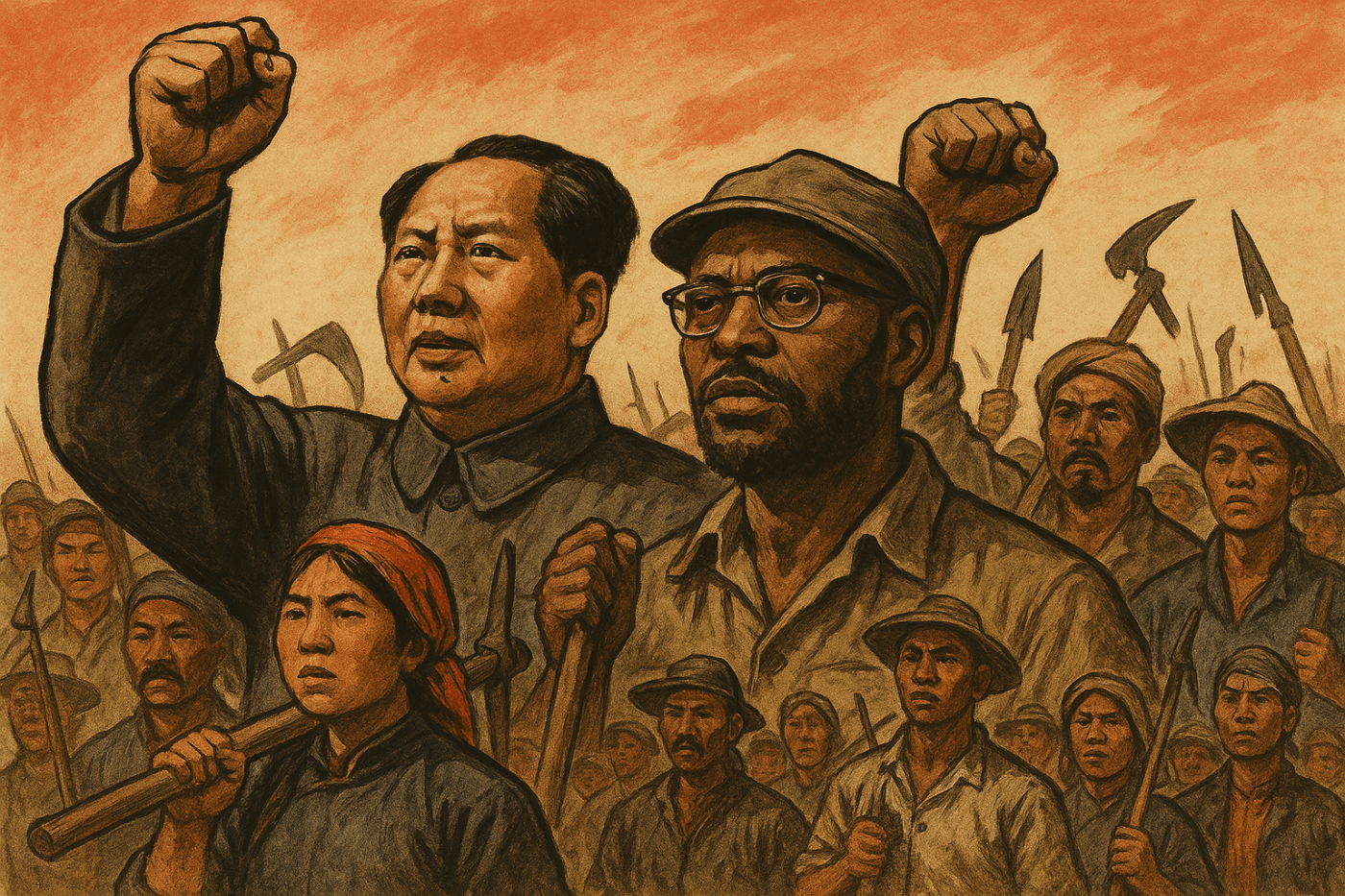
From Mao Zedong in the mountains of Yan’an to Amílcar Cabral in the fields of Bafatá, revolutionaries built mass movements from the countryside—not despite its contradictions, but by organizing through them. In today’s world, where technofascism and imperial collapse are displacing billions, their lessons are more urgent than ever.
Mao Zedong: The Poor Peasant as Vanguard
Mao broke with the mechanical Marxists of his time by insisting that the peasantry, not just the urban proletariat, could be a revolutionary class. In semi-feudal, semi-colonial China, the peasant bore the double burden of imperialist exploitation and landlord domination. Through mass line, land reform, and People’s War, Mao transformed the countryside into a revolutionary base area.
“No investigation, no right to speak,” Mao insisted. The Chinese revolution was not imported from the West; it was forged in the experience of rural oppression and resistance. He showed that revolutionary consciousness can be developed through struggle, not assumed by textbook formulas.
Amílcar Cabral: Class Suicide and the Weapon of Culture
In Guinea-Bissau and Cape Verde, Cabral led one of the most advanced rural liberation movements in history. With no standing army and a largely peasant population, Cabral built dual power from the ground up—establishing liberated zones, collective agriculture, schools, and clinics under colonial siege.
Cabral was clear: revolution required the leadership to commit “class suicide”—abandoning petty-bourgeois privileges to serve the working masses. He saw culture not as a museum piece but as a weapon of resistance, rooted in the daily life of the people. His revolution was not a military insurrection alone; it was an ideological and agrarian transformation.
What They Understood: Land as Life, the Peasantry as Force
Mao and Cabral, like the Vietnamese and Cuban revolutionaries, understood what the imperial core still denies:
- That land is not a commodity, but the basis of life;
- That the peasantry is not pre-revolutionary, but the most exploited and strategically crucial class in the Global South;
- That without addressing the agrarian contradiction, no true socialism is possible.
Their revolutions were not perfect. But they proved this: the rural poor, when organized, can destroy empires.
Lessons for the Present: Rural Revolution in the Age of Technofascism
Today’s conditions are different—but the contradictions remain. Digital capitalism has created new enclosures, and climate collapse has turned agriculture into a battleground. Yet around the world, new revolutionary rural movements are emerging:
- La Vía Campesina fights for food sovereignty and agroecology against imperialist agribusiness;
- India’s farmer uprisings united millions against neoliberal farm laws in one of the largest strikes in history;
- Landless movements in Brazil, South Africa, and the Philippines continue direct action for redistribution and survival;
- Revolutionary Farmer and Indigenous movements are integrating ecology, autonomy, and land defense into their struggles.
All of these echo Cabral and Mao—not in form, but in essence. They are movements of the people, from the soil, against the machine.
The Future is Rural—and Revolutionary
As capitalism dies, it tries to drag the planet with it. Its final fantasy is to escape Earth itself—terraforming Mars, digitizing agriculture, uploading humanity into corporate-controlled clouds. But revolution does not launch from Silicon Valley. It rises from the land.
We must once again take seriously the revolutionary potential of the peasantry—not as a romantic ideal, but as a strategic necessity. The struggle for land, food, and autonomy is not secondary—it is the front line of the global class war.
Let the memory of Mao and Cabral not be museumized but mobilized. The next revolution will be planted, not coded. And it will grow from below.
Part IV Coming Soon: “Digital Enclosures and the Global Land Grab”
 Weaponized Information
Leave a comment