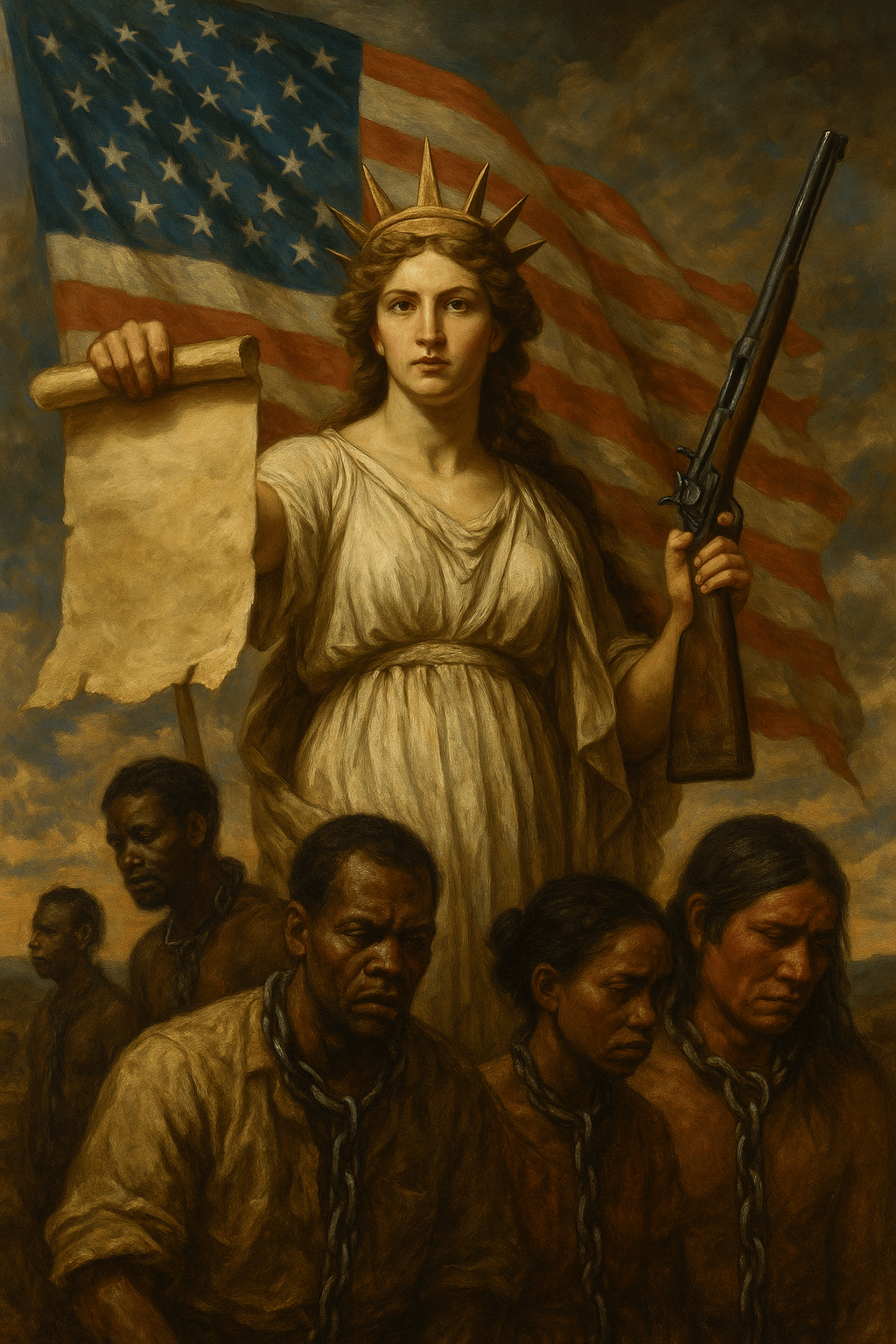
Settler Panic, Colonial Amnesia
By Prince Kapone | Weaponized Information | June 1, 2025
Why the Collapse of Empire Feels Like Oppression to Those Who Lived Off It
“We’re losing our country.” “Our rights are under attack.” “Democracy is in danger.” These are the cries echoing across settler America like the last wails of a dying god. From white liberals clinging to the Constitution like a holy scroll, to reactionaries mistaking their fading privileges for persecution, the refrain is the same: something sacred is being taken from us. But what exactly are we losing?
Let’s be honest. What we’re experiencing isn’t some sudden authoritarian nightmare. It’s not the rise of tyranny from thin air. It’s the slow decay of a settler empire that was never built on freedom to begin with. The so-called “rights” we now mourn were never universal—they were settler rights. White rights. The spoils of conquest. And now that the ruling class is beginning to discard even us, many of us are finally recognizing the nature of the beast we once helped feed.
What some of us are now calling “fascism” is what colonized peoples—Indigenous nations, African communities, and Chicano/Mexicano workers—have lived under since the first day of this so-called republic. Surveillance, dispossession, police terror, labor exploitation, cultural erasure, reservation and ghetto confinement—this has always been the American way. The U.S. was never a democracy for them. There were no golden eras. No constitutional sanctuaries. Just chains to be broken and a colonial regime to resist.
But now, as the empire contracts and the facade of inclusion peels away, many settlers—including some of us—are stunned. We’re told our freedoms are vanishing, that “our” democracy is being stolen. And in our panic, we’re urged to unite—to rally even the colonized to “save the republic.” As if Black and Indigenous people, long brutalized by this government, should now defend its institutions. As if we’re all suddenly on the same sinking ship. As if those who never had rights should now fight to protect ours.
The truth is bitter: the Bill of Rights protected slavers, not the enslaved. The Constitution erased Indigenous sovereignty, it didn’t recognize it. Settler freedom was subsidized by stolen land, stolen labor, and stolen life. The government we now accuse of “turning on us” never served the people—it served empire. And we were its beneficiaries.
This article is not about nostalgia. It’s not a call to defend settler democracy. It’s an indictment of it. We will trace the U.S. Constitution back to its roots in genocide and slavery. We will expose the legal architecture of white power—slave codes, Indian Removal, Black Codes, Jim Crow, mass incarceration—as tools of colonial war. And we will challenge our fellow settlers to stop pretending this system was ever just, and start building real solidarity with the colonized. Not to restore the republic—but to end the empire.
This isn’t about mourning democracy. It’s about organizing for decolonization. We’re not losing our country. We’re losing our place at the top of a genocidal pyramid. And that’s not a tragedy—it’s an opportunity to fight for something real.
The Constitution: A Colonial Blueprint, Not a Democratic Charter
The U.S. Constitution is treated like sacred scripture in this country—an untouchable text said to enshrine liberty, protect the people, and limit tyranny. But if we read it not as theology, but as history, the story it tells is clear. It is not a charter of freedom. It is a blueprint for settler colonial domination.
From its inception, the Constitution was not written for “the people”—it was written for a specific class of people: property-owning white settler men. As John Jay, the first Chief Justice of the Supreme Court, openly declared, “Those who own the country ought to govern it.” And that’s exactly what the Constitution was built to ensure. It wasn’t a break from monarchy—it was a transfer of power from British elites to settler elites, under the illusion of popular sovereignty. The king was dead; long live the landlords.
The so-called “Founding Fathers” didn’t stumble into hypocrisy. They were wealthy planters, merchants, and enslavers who designed a legal system to secure their material interests. As historian Charles Beard rigorously documented in his Economic Interpretation of the Constitution, a majority of the framers held substantial personal investments in government securities, commercial enterprises, Western lands, and enslaved labor. The Constitutional Convention, far from being a meeting of philosophical minds, was a gathering of economic stakeholders engineering a legal order to protect their assets and suppress popular demands.
Beard’s analysis confirms what the material record already makes plain: the Constitution was not the product of some abstract quest for justice. It was a counter-revolution—a reaction by elite settlers against the more democratic, populist uprisings of indebted farmers, smallholders, and veterans of the Revolution. It was designed to check the power of the many and consolidate power in the hands of the few. And within that few, the colonized—Indigenous, Black, and Brown—were never even considered human participants.
Gerald Horne, in his groundbreaking work The Counter-Revolution of 1776, goes even further—arguing that the American Revolution itself was launched to defend slavery. As Britain began to show signs of wavering on the expansion of the slave trade and as enslaved Africans increasingly rebelled and fled toward British lines, colonial elites saw the writing on the wall. Independence was not a move toward freedom, but a desperate maneuver to preserve racial slavery, westward expansion, and settler supremacy. The U.S. Constitution was the legal consolidation of this reactionary project.
The Constitution enshrined slavery through the 3/5 Clause, the Fugitive Slave Clause, and the delayed ban on the slave trade. It empowered the federal government to manage commerce with “Indian tribes”—a polite euphemism for legitimizing land theft and treaty violation. And it structured the republic to protect property first and foremost—because property in this system always meant land, capital, and bodies.
What we call the Bill of Rights was not some moral breakthrough. It was a political concession to appease anti-Federalist factions who feared too strong a central government—not a declaration of universal dignity. The “rights” it guaranteed—freedom of speech, the press, religion, assembly, and arms—were constructed within a colonial frame. They applied to settlers, not the colonized. They defended the speech of slavers, the press of land speculators, the religion of missionaries, the assembly of militias, and the right to bear arms in the conquest of Indigenous nations.
For Indigenous people and enslaved Africans, none of this legal architecture offered protection. The same Constitution that protected a settler’s right to a jury trial sanctioned the auction block and the forced march. The same document that barred “cruel and unusual punishment” turned a blind eye to torture, rape, and execution for those outside the circle of whiteness and property.
We have to stop pretending the Constitution was flawed in application but noble in intent. It was not a neutral contract corrupted by later injustices. It was a class document, a settler document, a colonial contract. And its rights—our rights—have always rested on the structural exclusion and violent subjugation of others.
So when we invoke the Constitution today to defend ourselves from tyranny, we must ask: who are we quoting? What system are we defending? And at whose expense were those “rights” ever made possible? If we want freedom, we’ll have to look beyond parchment. Because real liberation was never written into the laws of empire—it has always come from the struggle to overturn them.
Indigenous Nations: Sovereignty Crushed by Settler Law
Before the United States existed, there were hundreds of Indigenous nations across the continent with their own political systems, legal traditions, and territorial sovereignty. These nations were not “nomadic tribes” or “wards of the state”—they were governments, communities, and civilizations. Early treaties between the U.S. and Native nations even acknowledged this fact, recognizing them as sovereign political entities. But as settler interests expanded westward, that recognition was swiftly and violently revoked.
The U.S. Constitution granted Congress the power to regulate commerce with “the Indian tribes,” establishing a legal foundation not for mutual respect, but for unilateral domination. Under this clause, Indigenous nations were reduced to obstacles to expansion—barriers to be managed, displaced, or eliminated. The so-called “rule of law” functioned as the rule of theft.
What followed was a rolling legal and military offensive against Indigenous sovereignty. The Indian Removal Act of 1830 authorized the mass expulsion of Native peoples from their ancestral lands under the banner of “civilization” and “progress.” The Dawes Act of 1887 atomized collective land ownership through forced allotment, breaking up tribal land bases and transferring millions of acres to white settlers. Indigenous children were stolen from their families and forced into boarding schools designed to “kill the Indian and save the man.” The Termination Era of the 1950s sought to dissolve entire Native nations and strip them of federal recognition.
Legal scholar and activist Ward Churchill, in his searing work Perversions of Justice, meticulously documents how U.S. law functioned as a weapon of colonization. Far from being a neutral arbiter, the courts routinely fabricated doctrines—like the “Doctrine of Discovery” and the “Plenary Power Doctrine”—to justify the dispossession of Native lands and the denial of Indigenous rights. The Supreme Court’s landmark decisions in Johnson v. M’Intosh (1823), Cherokee Nation v. Georgia (1831), and Lone Wolf v. Hitchcock (1903) all affirmed one thing: that Indigenous people have no legal standing against the settler state that seeks to erase them.
Churchill exposes how these decisions were not legal missteps, but carefully constructed tools of conquest. The U.S. legal system created a legal “fiction” in which Indigenous nations were simultaneously treated as sovereign for the purpose of treaty-making and non-sovereign for the purpose of treaty-breaking. It was a rigged game—one in which the rules were written by the colonizer, enforced by the courts, and backed by the army.
To this day, the United States remains in violation of hundreds of legally binding treaties with Indigenous nations—treaties that carry the full force of international law, but are ignored with impunity. The result is a condition of permanent occupation: Indigenous nations live under settler domination, their land bases fractured, their resources plundered, their laws subordinated to federal authority.
Settler “rights” have always depended on the erasure of Indigenous rights. The right to own property, to move freely, to bear arms, to expand—all were exercised through the violent suppression of Native sovereignty. There is no settler democracy without Indigenous dispossession. There is no Bill of Rights without the breaking of treaties. The very existence of the United States is a standing violation of Native law, life, and land.
So when we hear settlers lament that “our rights are under attack,” we must ask: whose rights were ever protected? Whose laws were ever upheld? For Indigenous peoples, the Constitution did not mark the beginning of liberty—it marked the institutionalization of legal warfare. And until that regime is dismantled, there can be no justice on this land.
Enslaved Africans: Human Property Under Constitutional Law
When the U.S. Constitution was drafted in 1787, it didn’t just fail to abolish slavery—it protected and fortified it. It didn’t overlook the enslaved—it defined them as property. The document enshrined chattel slavery into the very foundation of the American republic, transforming human beings into commodities under the law. And in doing so, it helped build the capitalist economy of the United States on a foundation of blood.
Slavery wasn’t a regional exception or moral contradiction—it was the engine of U.S. economic development. The wealth of Northern merchants, Southern planters, Wall Street banks, and Ivy League institutions was soaked in the labor and suffering of African people held in bondage. And this arrangement was guaranteed by the Constitution. The infamous 3/5 Compromise counted enslaved people as partial persons for the purpose of white political power—giving Southern slavers inflated representation in Congress while denying the enslaved any voice at all. The Fugitive Slave Clause mandated that no freedom could be found even across state lines. The delayed ban on the international slave trade ensured the flow of African labor would not be disrupted too soon.
These were not oversights. They were calculated clauses. The Constitution was a contract between capitalists and slavers, written to harmonize their shared interests in property, profit, and power. And in America, property always meant people. Black people.
Even the so-called “rights” enumerated in the Bill of Rights were not designed to protect the enslaved—but their enslavers. The First Amendment guaranteed the speech of preachers who defended bondage, the press of plantation newspapers, the religious institutions that baptized slavery as divine will. The Second Amendment was written, in part, to preserve the right of slave states to maintain armed militias to crush slave revolts. The Fourth and Fifth Amendments never applied to the slave cabin. There was no protection against unreasonable search, no due process for the whip.
After the Civil War, the 13th Amendment supposedly ended slavery. But it did so with a deadly loophole: “except as punishment for crime.” This clause became the legal basis for a new regime of racialized captivity—one that persists to this day. In the decades that followed, we saw:
- Convict leasing: where newly freed Black men were arrested en masse and forced back into labor on plantations and in mines.
- Black Codes and vagrancy laws: designed to criminalize Black life and re-establish racial domination through the courts.
- Jim Crow apartheid: a racial legal order that maintained white supremacy under the guise of “separate but equal.”
- Mass incarceration: a modern plantation system that cages millions, disproportionately Black and Brown, and forces them into prison labor.
The legal status of Black people in this country has never been grounded in protection—it has always been structured around control. From slave codes to stop-and-frisk, the law has served not as a shield but as a whip. And the Constitution was the master’s rulebook.
So when we hear settlers today invoke “our rights,” we must ask: whose rights are they really talking about? The right to own? To command? To dominate? Because for African people brought here in chains—and for their descendants—the U.S. legal system has never been a vehicle of justice. It has been the engine of captivity.
To honor the truth, we must stop romanticizing the Constitution as a flawed but noble document. It was not flawed. It did what it was designed to do: protect the wealth and power of the ruling class by legalizing the dehumanization of the colonized. And until we confront that reality, we will never be free.
The Rights of the Settler Are Built on Colonial Subjugation
It’s a hard truth to swallow, but one we have to face head-on: the so-called rights that settlers have long cherished—speech, press, guns, property, movement, and political representation—have never been universal. They were not forged in some shining moment of democratic enlightenment. They were constructed atop a system of colonial domination. They were made possible, materially and legally, through the violent exclusion, exploitation, and dehumanization of Indigenous, African, and colonized peoples.
The settler right to property meant the theft of Indigenous land. The settler right to bear arms meant arming white militias to put down slave revolts and wage war against Native nations. The settler right to vote meant political power for white men who owned land and bodies. The settler right to free speech never protected Black radicals or Indigenous resistance—it protected slavers, land thieves, and the institutions that served them. In other words, settler rights were rights of domination, not liberation.
And these rights did not gradually become universal through benevolent reform. They were dragged, kicking and screaming, into broader application only under massive pressure—from rebellion, uprising, legal confrontation, and international condemnation. Every inch of “expansion” was conditioned by the logic of colonial preservation. Every so-called victory for inclusion was co-opted, reinterpreted, and constrained by the needs of empire.
Even when rights were formally extended to the colonized, they were delivered with conditions, exceptions, and state violence. The right to vote for Black people came with literacy tests, poll taxes, lynchings, and redistricting. The right to protest came with surveillance, infiltration, and COINTELPRO. The right to due process came with racist judges, biased juries, and over-policing. These weren’t distortions of the system—they were expressions of it.
The Constitution doesn’t stand outside this history—it is the scaffolding of it. It gave legal form to a settler capitalist order built on slavery, genocide, and dispossession. As Charles Beard showed, it was written by men of wealth to protect wealth. As Gerald Horne revealed, it was part of a counterrevolution to preserve slavery and white supremacy. As Ward Churchill exposed, it weaponized law against Native nations. And every so-called right enshrined in its parchment was calibrated to defend those systems—not dismantle them.
The idea that rights exist in a vacuum—that they are timeless, apolitical, and equally accessible—is a myth. Rights are not floating abstractions. They are rooted in material relations. And in this country, those relations were colonial from the start. The expansion of white settler rights always moved in lockstep with the expansion of empire.
So when settlers today cry out that their rights are being eroded, it’s worth asking: what were those rights based on in the first place? And who paid the cost for us to have them? Because if our freedoms came through the unfreedom of others, then they were never just. They were never equal. They were never truly ours to begin with.
The call now must not be to restore those rights, but to reckon with their origins—and to build a new concept of freedom that does not depend on anyone else’s oppression.
Democracy from Below: Revolutionary Traditions of the Colonized
If democracy means the power of the people, then the U.S. Constitution has never embodied it. What the colonized have built in defiance of this settler regime—not what was written by its slave-owning architects—is where the true struggle for democracy lives. For Indigenous peoples, Africans enslaved and brutalized on stolen soil, and Chicano/Mexicano communities colonized by force, democracy has never come from above. It has always been forged from below—through resistance, rebellion, and revolutionary self-organization.
The first true democracies on this land were not constitutional republics but maroon communities of self-emancipated Africans who escaped the plantations and formed autonomous zones of freedom—many of which allied with Indigenous nations. These were democratic in the most radical sense: collective, horizontal, and rooted in survival and mutual aid. They were criminalized, hunted, and destroyed by the settler state precisely because they represented an alternative to the colonial order.
The same can be said of Indigenous confederacies like the Haudenosaunee (Iroquois) Confederacy, which maintained complex systems of governance based on consensus, council, and accountability. Their political traditions predated the U.S. by centuries and directly contradicted the logic of private property, patriarchy, and conquest enshrined in the Constitution. Instead of being acknowledged as democratic foundations, these systems were erased or appropriated—while their practitioners were subjected to extermination and displacement.
Every generation of the colonized has continued this legacy of democracy from below. Enslaved Africans led hundreds of rebellions against impossible odds. During Reconstruction, Black communities organized schools, mutual aid societies, militias, and political institutions—only to have them crushed by white terror and federal betrayal. In the 20th century, radical formations emerged that embodied people’s power: the Black Panther Party’s survival programs, the American Indian Movement’s autonomous zones, the Brown Berets’ community clinics, and the Young Lords’ occupation of hospitals and schools. These were not cries to be included in settler democracy. They were blueprints for its replacement.
What united these movements was their clarity: the state could not be reformed to serve the colonized. It had to be confronted, dismantled, and replaced with new institutions rooted in collective power, not elite control. Their methods—people’s assemblies, revolutionary councils, mutual aid, armed self-defense—were not just tactics. They were expressions of a different kind of political logic. One that centers liberation instead of law. One that builds solidarity instead of hierarchy. One that doesn’t depend on the permission of empire to function.
These traditions are not relics of the past. They are blueprints for the future. As the empire decays and the settler project shows its true face, we cannot look to its documents, its courts, or its politicians for salvation. We must look to those who fought it from the bottom up. Those who knew that democracy does not come in the form of rights granted by rulers, but through struggle, organization, and the reclaiming of life itself.
If we are serious about freedom, then we must learn from those who refused to beg for it. We must study the revolts, rebuild the networks, reawaken the memory. Because the only democracy worth defending is the one we build together—against the settler state, not within it.
We’re Not Losing “Our” Country—We’re Losing Their Empire
“We’re losing our country.” It’s the battle cry echoing through school board meetings, militia gatherings, and liberal op-eds alike. But let’s tell the truth: we’re not losing a country—we’re watching the empire that built it unravel. The panic isn’t about losing democracy. It’s about losing dominance. The Constitution was never ours. The republic was never built for the people. And the rights we’ve been taught to cherish? They were handed to us on the backs of the colonized—and now, as the system begins to eat its own, some of us are just starting to feel the heat that others have endured for centuries.
For Indigenous peoples, the U.S. government has always been an occupying force. For Black people, it’s always been a carceral regime. For Chicano and Mexicano communities, it’s always been an annexing power. The brutal truth is that the settler project was never democratic—it was parasitic. And now that the parasite is cannibalizing its own hosts, those of us raised in its shadow are being asked to defend it. To rally. To “save the republic.” To preserve the Constitution. To defeat fascism by protecting the very institutions that enforced it on others.
This is where we must be clear. *Weaponized Information* does not mock the fear of fascism—we name it more precisely. What we are witnessing is not an aberration, but an evolution: technofascism. It is the logical consolidation of a crisis-ridden empire. It is the merger of state power, corporate surveillance, military force, and digital control mechanisms into a new form of total domination. But technofascism did not fall from the sky. It is the high-tech refinement of the same colonial violence that built this country in the first place. The difference now is that the boot is widening its stomp—reaching into sectors of the settler population who once thought they were immune.
Fascism is not new. It did not begin with Trump, or Biden, or Reagan. It began with Columbus. With the Virginia colony. With the chains on the slave ship and the rifle aimed at the buffalo. The mass surveillance, the paramilitary police, the corporate state—these are not departures from American democracy. They are its logical conclusion.
The danger now is not that settlers are waking up too late—it’s that many are waking up and still looking in the wrong direction. Still clinging to the parchment instead of breaking the chains. Still asking how to restore the republic instead of asking who it was ever built for in the first place.
We must make a clean break. Not with principles of justice, or of freedom, or of collective life—but with the colonial project that has perverted those very words. The republic is not ours to save. The Constitution is not sacred. The country we were raised to pledge allegiance to is a settler empire, and its unraveling is not our loss—it is our opening.
Our task is not restoration. It is revolution. To stand in solidarity with the colonized. To build new structures of power rooted in land, labor, and liberation. To bury the Constitution—not because we hate democracy, but because we know that what was called democracy in this country was never meant for most of us.
Let the empire fall. Let the parchment burn. And in its ashes, let something new take root—something worthy of the name freedom.
 Weaponized Information
Leave a comment