By Prince Kapone | Weaponized Information | May 27, 2025
Drought, Debt, and Dispossession
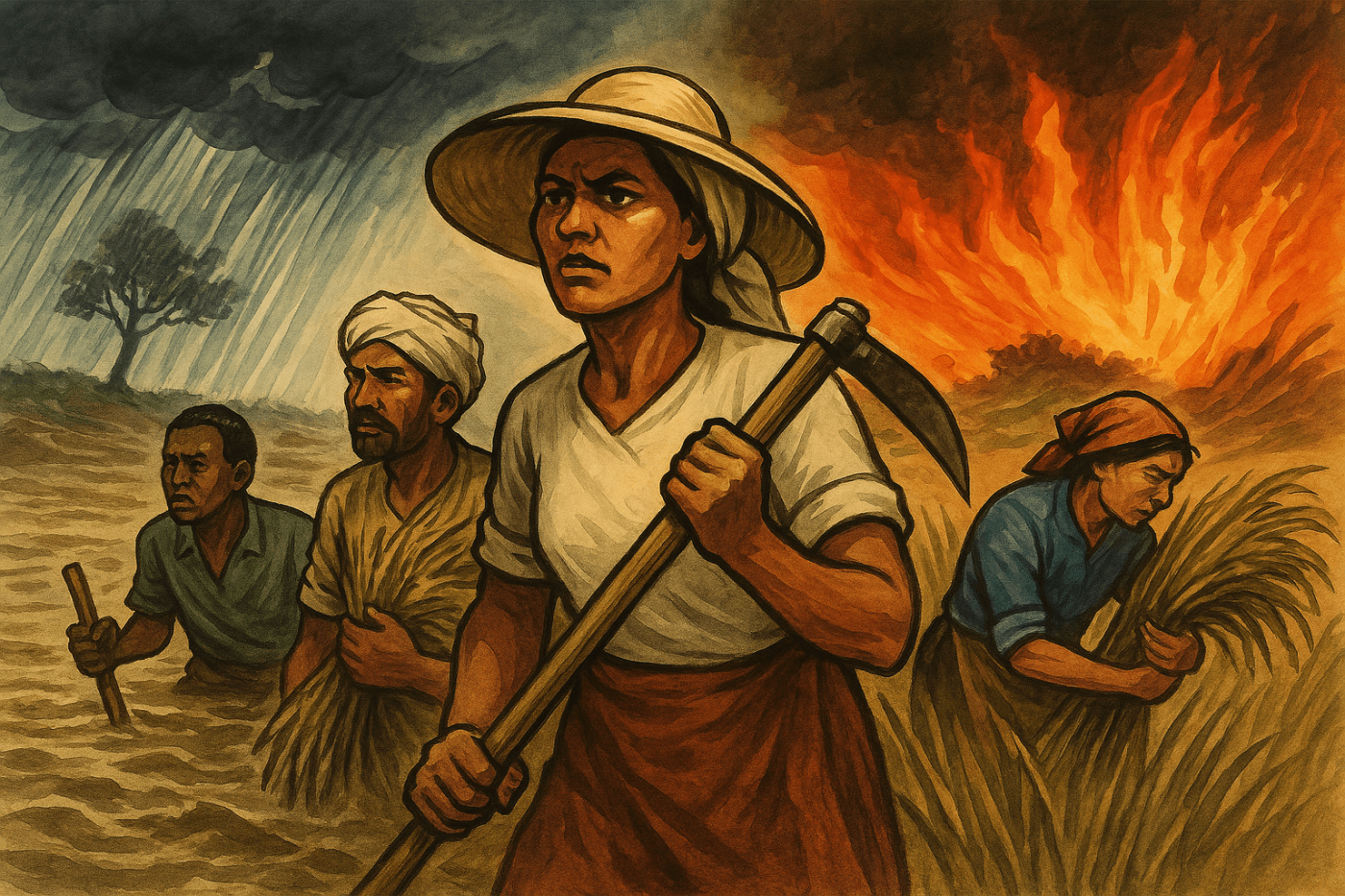
The rural question is no longer confined to the peasantry’s relation to land and production. It is now entangled in the most urgent crisis facing humanity: the death spiral of planetary life under capitalism. From scorched fields in Somalia to submerged farms in Sri Lanka, the peasantry of the Global South is being annihilated—not by “natural disasters,” but by the anthropogenic ecocide of imperial capital.
This installment analyzes how the climate crisis is an imperial crisis. It reveals how technofascism—rooted in monopoly finance capital, state violence, and digital domination—uses planetary collapse as an opportunity to consolidate control over land, labor, and food systems. Against this, we raise the banner of ecosocialism rooted in revolutionary peasant struggle.
Section I: The Global South is Burning (and Drowning)
In Somalia, five consecutive failed rainy seasons from 2020–2023 triggered famine for over 6 million people. In Pakistan, floods displaced over 30 million in 2022. In Central America, the “dry corridor” has become a death trap for small farmers. Meanwhile, Sri Lanka’s collapse following fertilizer bans and debt crises shows how ecological stress is used to force neoliberal restructuring.
These crises are not isolated. They are a combined result of:
- Global warming driven by fossil capital;
- Monoculture agriculture and land-use changes imposed by IMF and World Bank programs;
- Debt-dependence and market integration that strip nations of food sovereignty;
- Militarized borders and surveillance regimes that criminalize climate migration.
These conditions are engineered. And they are enforced by empire—not by drought or flood alone, but by the policies that manufacture vulnerability.
Section II: Technofascism and Climate Capitalism
Climate catastrophe has become the preferred terrain for technofascist accumulation. Here’s how:
- Big Tech deploys satellite surveillance and climate data platforms to map “underutilized” land—code for new territory to enclose and control;
- Finance capital (BlackRock, JPMorgan, Vanguard) now trades carbon futures and invests in “green” megaprojects that dispossess Indigenous and peasant communities;
- Agri-tech giants promote drought-resistant GMOs and “climate smart” agriculture—solutions that increase dependency on proprietary seeds, digital farming platforms, and debt;
- The state militarizes rural zones under the banner of “environmental protection,” pushing small farmers into refugee camps while granting concessions to mining, tourism, or biofuel projects.
This is climate capitalism under monopoly rule. It is not a response to climate collapse. It is the monetization of collapse.
Section III: Revolutionary Ecosocialism or Barbarism
We must be clear: no just transition is possible without addressing the rural question. That means dismantling the structures that destroy land-based life:
- End imperialist control over food systems and agriculture;
- Return land to those who work it—peasants, Indigenous nations, rural collectives;
- Abolish climate debt and false “green” financialization mechanisms like carbon markets;
- Build agroecological systems based on communal control, biodiversity, and degrowth from the bottom up;
- Unify the struggles of the rural and urban poor, recognizing that they are produced by the same planetary system of capitalist enclosure.
As John Bellamy Foster and Samir Amin both argued, only an ecosocialist transformation—rooted in the liberation of both land and labor—can resolve the dual contradiction of ecocide and exploitation.
Planetary Survival is a Peasant Question
The Western technocratic fantasy of climate salvation—from Elon Musk’s Mars colonies to Davos “Green Capitalism”—is a genocidal lie. The real path forward runs through the rice fields of Bangladesh, the coffee farms of Colombia, the drylands of the Sahel, and the flooded deltas of Southeast Asia. There, amid crisis, new systems are emerging—not of capitalist resilience, but of collective survival and resistance.
The rural proletariat is not dead. It is rising. And it holds the keys not only to a new world, but to saving this one.
Part III Coming Soon: “Peasants and Revolution: From Mao to Cabral”
 Weaponized Information
Leave a comment