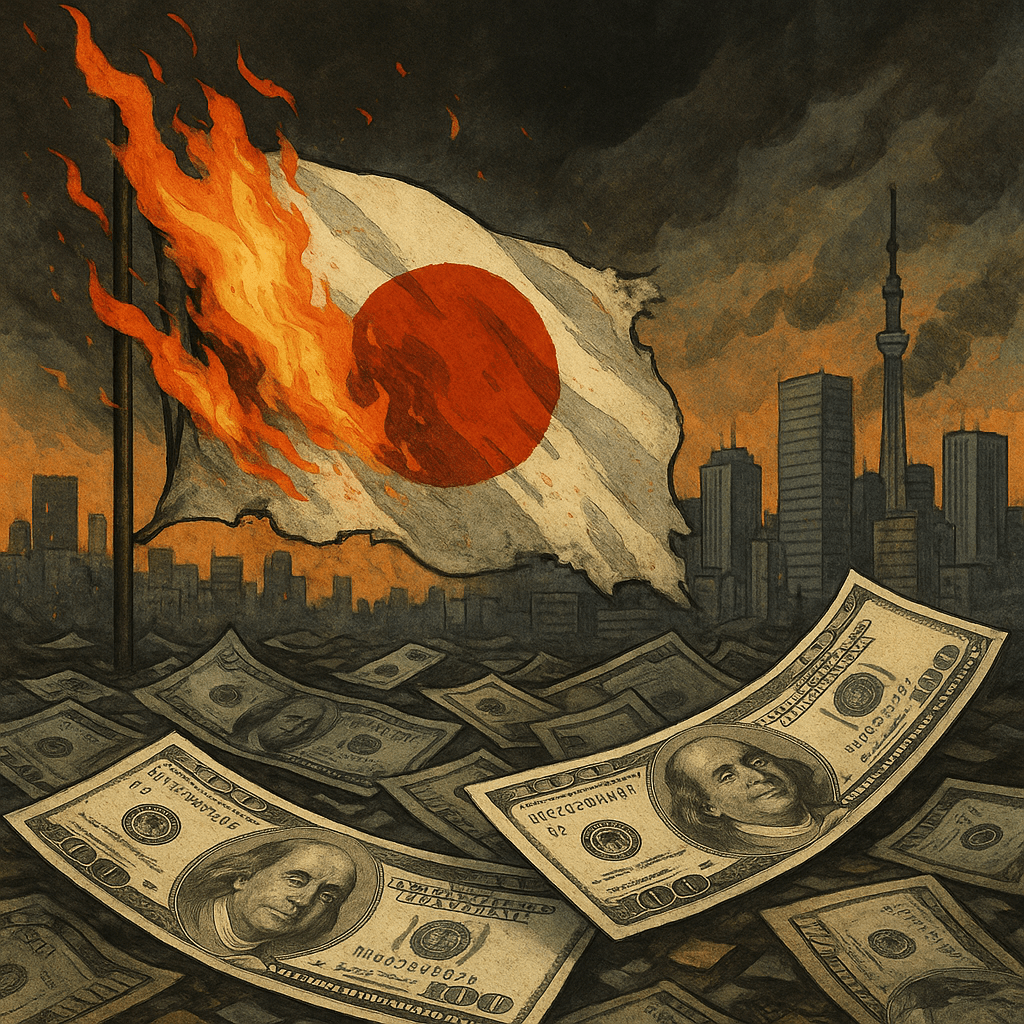
From Tokyo to Washington, the crisis of monopoly finance capital reveals a collapsing imperial order. Austerity is not the cure—it’s the cover story.
By Prince Kapone | Weaponized Information
May 22, 2025
Part I – The House Is on Fire, But They’re Selling Sprinklers: How the Financial Media Manages Imperial Decline
The article in question, “‘Worse than Greece’: The debt crisis threatening to blow up the global economy”, is written by Hans van Leeuwen and published through The Telegraph, syndicated on Yahoo Finance. These are not neutral institutions. They are platforms of imperial finance—ideological clearinghouses for the ruling class’s anxieties, stitched into the algorithmic veins of monopoly capital’s news feed. Their job is not to analyze capitalism’s crises, but to mediate them—to narrate collapse in a way that protects the system and criminalizes resistance.
Van Leeuwen is no outsider to empire. His beat is structured around parliamentary whispers, central bank rituals, and capital market volatility. He writes not for the working class, but for the investor class—the ones who hold the bonds, skim the yields, and call austerity “prudence.” His prose reflects this: filled with technical buzzwords (“bid-to-cover ratios,” “tail spreads,” “fiscal consolidation”), it obscures material pain behind euphemisms of risk. There is no mention of class, empire, or capitalism—only “volatility,” “uncertainty,” and “investor sentiment.” The prose is sterile because its function is to sanitize panic.
Behind the article’s performative concern lies a warning: the imperial core’s house of cards—anchored by U.S., British, and Japanese debt—is beginning to sway. But van Leeuwen will not say this directly. Instead, Japan is framed as the “canary in the coal mine.” Greece is evoked like a ghost. Trump is cited as a source of “volatility.” Nowhere is there an attempt to explain why these crises are happening in unison—because to do so would mean indicting the entire system.
Let’s be clear: this is not journalism. It is financial counterinsurgency. It is ideological prep-work for the next round of technofascist stabilization: higher interest rates, austerity budgets, asset seizures, public sector cuts. The media’s task is to preempt rebellion by presenting collapse as natural, inevitable, and technical—not political. The debt crisis is described like a weather event, when in truth it is the accumulated wreckage of imperial overreach, neoliberal plunder, and collapsing legitimacy.
And who benefits from this framing? The usual suspects: the IMF, BlackRock, Vanguard, the World Bank, and the central banking cartel of the Imperialist Triad. Bond traders are positioned as rational referees of fiscal discipline, while the populations of Japan, the U.S., the U.K.—and soon the Global South—are prepped for another wave of sacrifice. The message is clear: the bond market must be appeased. The people must pay.
This is the ideological function of finance journalism in the era of hyper-imperialism. It is not here to explain the crisis—it is here to manage the narrative, discipline the imagination, and soften the ground for what’s coming. And what’s coming is not stability. It’s seizure. Expropriation. Austerity by spreadsheet, enforced by drones, and narrated by Yahoo Finance.
Part II – When the Bond Market Trembles, Empire Bleeds: Situating Japan’s Crisis Within Imperialist Collapse
Strip away the technocratic fog, and the article lays out a simple truth: Japan’s bond market is imploding. A failed auction of 20-year government bonds sparked a spike in long-term yields, raising alarm across the imperial core. The government’s debt-to-GDP ratio stands at an astonishing 235%—surpassing even Greece’s during its Eurozone crisis. Prime Minister Ishiba calls the situation “worse than Greece.” Finance Minister Kato warns of “excessive inflation” and “loss of trust.” This is not metaphor. It is the early tremor of a structural convulsion.
But what the article leaves unsaid is more important than what it reports. It presents Japan’s fiscal spiral as an isolated case—as if the world’s third-largest economy just wandered off a cliff. In reality, Japan is only the first domino. The U.S. sits at 123% debt-to-GDP and just suffered another credit downgrade. The U.K. and EU are seeing bond yields spike in tandem. And the same imperialist bloc that once used cheap debt to pacify domestic populations and loot the Global South is now running out of rope. This isn’t just about borrowing. It’s about the expiration of empire’s post-2008 financial lifeline.
Since the last financial crisis, Western governments printed trillions through quantitative easing, inflating asset bubbles while gutting real wages. They kept interest rates near zero to make the system appear stable. But once inflation surged in the post-pandemic period, central banks were forced to hike rates. Now, the cost of servicing all that debt is skyrocketing—and the welfare state is the first casualty.
Japan’s dilemma is the canary in a collapsing coal mine. The Bank of Japan is trying to taper its bond purchases after decades of buying up state debt. But no one wants the bonds. Why? Because capital sees the writing on the wall: the fiscal model of the imperial core is no longer sustainable. Japan, like the U.S., is running trillion-dollar deficits while its population shrinks and its economy stagnates. This is not “bad management.” It is the culmination of the internal contradictions of monopoly-finance capital.
And why is this happening now? Because the empire is losing its external lifeline. The Global South is increasingly delinking from the Western-led system. BRICS+ expands. Trade is shifting to yuan, rubles, and rupees. Nations once looted for grain, lithium, cobalt, and oil are asserting sovereignty and cutting out the dollar. As this happens, the imperialist triad’s access to cheap energy, food, labor, and minerals is drying up. The shelves in the metropole are thinning because the colonies are rebelling.
The crisis of imperialism is feeding into the crisis of finance. Japan’s inflation, its bond collapse, its deficit spiral—these are the symptoms. The disease is that the empire is running out of bodies to exploit and land to drain. The former colonies are no longer subsidizing First World stability. So now, the only way to sustain capital’s rule is through austerity, technocratic repression, and mass pacification.
This is the bigger picture the article hides: Japan is not an anomaly. It is a test case. The empire is cannibalizing its own core. And the only way forward, for those in power, is through what we call technofascist stabilization: slashing pensions, privatizing services, militarizing infrastructure, and using digital finance and surveillance to enforce obedience as the system crumbles.
Part III – Capital Has No Country: Japan’s Meltdown and the Shrinking Geometry of Empire
Let’s stop calling this a “debt crisis.” It’s a system failure. And it’s not just Japan. The entire imperialist world economy—anchored by the U.S., EU, and Japan—is eating itself alive. What mainstream finance calls a “loss of investor confidence” is really a collapse in the credibility of empire’s economic script. After decades of looting the Global South, the imperial core is now devouring its own citizens to stay afloat.
Japan’s fiscal implosion is the natural result of a system that relied on infinite credit, zero interest, and colonial resource theft to buy social peace at home. But the colonies are leaving the plantation. BRICS+ expands. The Belt and Road reshapes trade. Nations from the Sahel to the Andes are asserting sovereignty. That means the supply lines are closing, the imperial surplus is shrinking, and the cost of empire is being dumped onto the backs of domestic workers. The real headline isn’t “Japan is broke.” The real headline is: there’s nothing left to steal.
This is the crisis of monopoly-finance capital in real time. Japan, like its counterparts in London and Washington, is no longer able to sustain the illusion of growth. Its central bank owns more than half of its national debt. Its demographics are collapsing. Its economy is stagnant. Its bond yields are surging. Its government is trying to exit decades of “cheap money” without triggering a total collapse. Spoiler: they can’t.
The system they built was never designed to serve the people. It was designed to serve rentier elites—bondholders, hedge funds, currency speculators, the lords of finance who produce nothing and control everything. Now those same elites are panicking. Not because they fear instability, but because the states they once controlled can no longer guarantee their returns. That’s what a “fiscal crisis” really means. It means the empire is no longer creditworthy—morally, politically, or financially.
And how will they respond? With austerity. With digital rationing. With technocratic dictatorship. With privatized “solutions” that extract the last drops of value from public services before selling them for parts. This is what we call technofascist stabilization: a recalibration of capitalist rule where consent is replaced by control, and the market is upheld by algorithm, not ideology.
Make no mistake: this is not a Greek tragedy, it’s a global forecast. Japan’s collapse is a case study in how imperial finance handles terminal decline. They won’t fix it. They’ll monetize it. They’ll squeeze the elderly, evict the poor, militarize the cities, and call it “fiscal responsibility.” Meanwhile, media outlets like Yahoo Finance will narrate the bloodbath with spreadsheets.
We say: don’t believe the metrics. Read the contradictions. This isn’t about yields. It’s about sovereignty. It’s about who pays when the system cracks—who gets bailouts and who gets buried. The crisis in Japan is not the end of capitalism. But it is a fracture in the logic of empire. And every fracture is an opening.
Part IV – Fight the Default, Not the Debt: Building a Revolutionary Front Against Fiscal Dictatorship
The bond markets are not neutral. They are battlegrounds. And every uptick in yields is a declaration of war against workers, pensioners, migrants, and the poor. Japan’s looming collapse is not a local crisis—it is a dress rehearsal for the austerity wave the imperialist core is preparing to unleash on its own populations. And if we don’t organize now, the coming fiscal storm will bury us all beneath spreadsheets and riot cops.
The ruling class is already moving. Central banks are locking in higher interest rates. Parliaments are proposing pension cuts and service rollbacks. The language of “debt sustainability” is being weaponized to prepare the public for mass privatizations, regressive taxation, and brutal labor discipline. This is technofascist stabilization: the fusion of fiscal policy and state repression under digital command.
Our task is clear: we must transform debt panic into class war from below. The state is not “broke.” It is busy transferring trillions from public hands to private vaults—using crisis as cover. Every dollar in interest paid to bondholders is stolen from hospitals, housing, food, and wages. Every austerity measure is a choice, not a necessity.
We must build the organizational infrastructure to resist and rupture. That means:
- Debt refusal and mass education: Popularize political education campaigns that demystify sovereign debt and expose bond markets as tools of capitalist control. Develop frameworks for debt audits, repudiation, and reparative redistribution.
- Disrupt imperial finance circuits: Target central banks, rating agencies, and finance ministries with coordinated actions. Expose the banks and corporations profiting from austerity in Japan, the U.S., and beyond.
- Forge internationalist alliances: Link up with movements resisting IMF austerity in the Global South—Argentina, Tunisia, Ghana, Lebanon. The same vampire feeds on us all.
- Defend public services and strike preemptively: Organize worker blocs to resist budget cuts before they are implemented. Launch coordinated strikes in transit, education, healthcare, and utilities sectors—the pillars empire seeks to liquidate.
- Build dual power in the ruins: Where the state retreats, we must advance. Mutual aid networks, revolutionary cooperatives, people’s assemblies—these are not charity. They are counter-infrastructure for survival and power.
And we must never forget the deeper connection: the fiscal crisis in Japan, the U.S., and Europe is being driven by imperial decay. The Global South is breaking the chain. The empire’s logistics are cracking. Dollar hegemony is being contested. The colonial surplus that kept food on our shelves and capital in our pensions is evaporating. And without it, the ruling class has only one option: make the working class pay for the collapse.
We say: no more. No more bailouts for banks while schools crumble. No more “fiscal responsibility” that means freezing wages and gutting healthcare. No more technocrats in suits deciding who starves while the bond market robs the future.
Japan is not an anomaly—it is a mirror. And if we do not confront this system now, we will soon be staring at our own reflection in the ruins.
Let us raise the banner of revolutionary anti-austerity internationalism. Let us strike against debt. Let us organize from the rubble. And let us break this global bond market prison before it swallows the world.
 Weaponized Information
Leave a comment