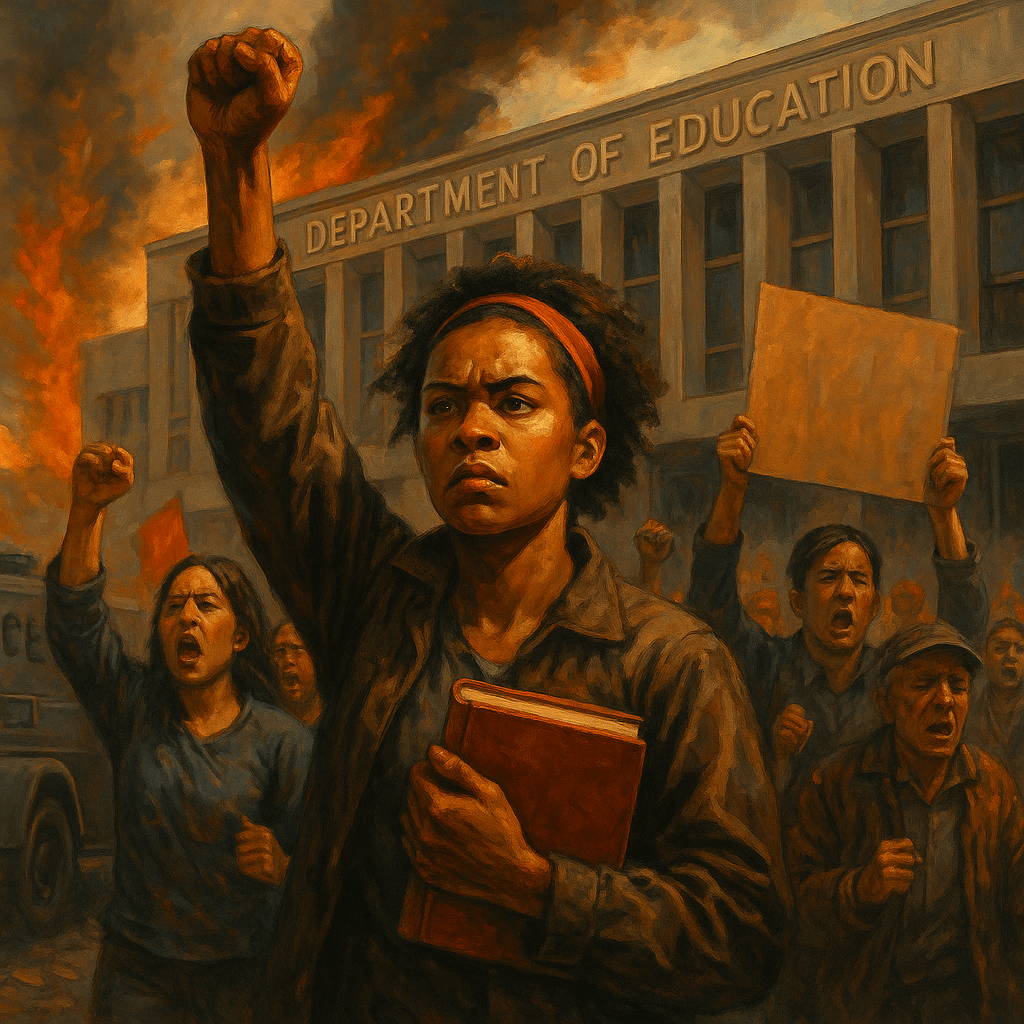
They’re not just cutting jobs. They’re closing the door on critical thought. This is counterinsurgency against the classroom—and it’s being dressed up as reform.
By Prince Kapone | Weaponized Information
May 22, 2025
Part I – Shutting Down the Mind: Inside the Media Mask of a Counterinsurgency Operation
The article under review comes from NPR, co-authored by Cory Turner and Nicole Cohen, two long-serving functionaries in the liberal wing of U.S. corporate journalism. Both are career professionals who’ve spent over a decade reporting from inside the state-sanctioned safe zone of Beltway education discourse. Cohen, with her degrees from Michigan and Northwestern, and Turner, who cut his teeth at USC and rose through the editorial ranks of “All Things Considered,” are not rogue propagandists—but reliable stewards of institutional legitimacy. Their career portfolios focus on bureaucratic reform, technocratic fixes, and carefully managed coverage of policy “failures”—but never the system itself. In short, they are the perfect scribes for a collapsing empire’s softer cultural front.
They publish under the banner of NPR, a public-private chimera bankrolled by government grants, elite philanthropic capital, and underwriting from corporate sponsors like Bank of America and Amazon. NPR poses as “neutral,” but its true role is cultural pacification. It trains its upper-middle-class audience to see systemic violence as procedural mismanagement, and resistance as incivility. Its editorial line defends the state—not through crude jingoism, but through soft language, historical amnesia, and selective outrage.
The article is amplified across platforms by White House spokespeople like Jacob Daniels, education bureaucrats such as Linda McMahon, and centrist validators like Ezra Klein. These figures shape the permissible boundaries of discourse and operate as cultural enforcers of the technofascist consensus.
What the article does, in essence, is take a direct assault on public education and repackage it as a legal squabble between co-equal branches of government. Trump’s executive order to dismantle the Department of Education is not framed as the technofascist blitzkrieg it is, but as an overreach—excessive, perhaps poorly timed, but fundamentally within the realm of political normalcy. There’s no mention of McMahon’s role in the America First Policy Institute, no interrogation of the decades-long billionaire-funded campaign to eliminate public education altogether. Instead, we’re fed a steady stream of euphemisms: “efficiency,” “reorganization,” “streamlining,” “reduction-in-force.” The authors deliberately avoid the language of power and class. They present the story as institutional malfunction, not the ideological warfare it truly is.
The most glaring omission is the political economy of the assault itself. The article does not ask who benefits. It does not connect the dismantling of the DOE to charter school profiteers, ed-tech surveillance firms, or far-right ideological networks. There’s no historical context, no class analysis, no structural critique. Just polite nods to administrative chaos and legal uncertainty. In doing so, the piece performs its true function: not to inform the public, but to tranquilize it.
Part II – Facts on the Ground: Layoffs, Liquidation, and the Logic of Empire
Here’s what we know. Back in March, Trump’s Education Department—led by WWE executive turned technofascist hatchetwoman Linda McMahon—announced plans to lay off more than 1,300 workers. Another 600 quit or took early retirement. That’s over 45% of the agency gone overnight. The stated reason? “Efficiency.” The real reason? They want the Department of Education to die, but quietly—under the radar, wrapped in paperwork, and dressed up like reform.
Then in May, a federal judge stepped in and told them to stop. The ruling was blunt: you can’t just fire your way out of a legal mandate. The department still has laws to enforce, programs to manage, and over 40 million student loan borrowers to serve. But by that point, the damage was done. Whole sections of the agency were gutted, federal responsibilities were already being shifted to other arms of the state, and the press had already moved on. That’s how dismantling works in a dying empire—bit by bit, until the building’s still standing but the lights are off and no one’s home.
This isn’t about saving money. It’s not about bureaucratic bloat. This is the endgame of a decades-long war on public education. First they called for “school choice,” then they defunded schools, then they said public education was failing—and now they’re swinging the axe. Trump didn’t invent this plan. Reagan flirted with it. DeVos laid the groundwork. The America First Policy Institute drew up the blueprints. Trump 2.0 just has the crisis, the courts, and the chaos to finish the job.
Let’s be real. What they’re doing is not “streamlining government”—they’re stripping the copper from the walls before the building burns. The student loan system? That’s a trillion-dollar asset they’re moving over to the SBA, a crony-ridden agency tailor-made for profit extraction. Special education programs? Up for grabs. The working class gets debt, digital tracking, and maybe a Zoom link. The capital class gets contracts, back doors, and data flows.
And NPR? They don’t touch any of that. Not a word about how this attack fits into a broader system of **technofascist stabilization**—a regime that doesn’t need functioning public schools because it’s got surveillance tech, faith-based charters, and an algorithm to teach your kid what to think. The story ignores how the dismantling of the DOE fits into a long arc of de-skilling, dehumanizing, and depoliticizing the next generation of labor. No mention of how this impacts Black and Indigenous communities who already live on the frontlines of school disinvestment. No analysis of who profits. Just more talk about legality, logistics, and whether or not the layoffs were “efficient.”
But this isn’t about efficiency. It’s about erasure. This is **counterinsurgency** at the level of the classroom. Not just shutting down schools—but shutting down thought itself. You don’t need riot cops to crush a generation if you can feed them broken laptops, Christian nationalism, and a state that doesn’t even pretend to care. What we’re watching isn’t policy—it’s the spiritual assassination of public education.
Part III – Reframing the Story: From Shutdown to Struggle
Let’s call this what it is: a war on thought, dressed up as cost-cutting. The move to dismantle the Department of Education isn’t some policy dispute or budgetary debate—it’s part of a larger counterinsurgency campaign to erase the very idea that the working class has a right to learn, to question, or to understand the world beyond the lies of the ruling class. What NPR frames as an administrative overreach is in fact a calculated step in the long, grinding project of technofascist stabilization: restructure society from the top down so that knowledge, like everything else, is hoarded by the elite and sold back to us in pieces we can’t afford. This is one prong in a larger offensive: Trump’s regime isn’t just dismantling education—it’s preparing the ground for a domestically restructured labor force. A labor force that’s been stripped of rights, denied political consciousness, and trained to accept Third World conditions at home. This isn’t collateral damage—it’s policy.
What replaces public education is part of a larger vision: gut the social state, crush labor, militarize the poor, and reindustrialize America on the backs of a newly desperate workforce. Trump’s reshoring fantasy isn’t about good union jobs—it’s about creating sweatshop zones within the U.S. borderlands, where wages are low, dissent is criminalized, and schools exist to funnel students into algorithmic obedience and gig-work peonage. That’s technofascist labor recalibration—rebuilding the American economy by tearing down the people who built it. Meanwhile, abroad, this same regime is tightening its grip on the global periphery, launching tariff wars, sanction regimes, and economic blockades in a desperate bid to slow down the rise of multipolarity. At home and abroad, it’s the same program: discipline labor, destroy alternatives, and reassert U.S. dominance through brute economic force.
The goal here isn’t to improve learning. The goal is to produce a depoliticized, fractured labor force that knows how to clock in, shut up, and blame itself when things fall apart. They want workers who can follow protocol, not question it. They want students who can read spreadsheets, not history. They want a future where kids learn more from YouTube ads than they do from teachers—because teachers are too expensive, too radical, and too human.
And what do they fear most? Not lawsuits. Not strikes. Not polls. They fear the classroom that teaches struggle. The school that links history to resistance. The student who reads Rodney, not Ayn Rand. Because when education becomes a space where the oppressed understand why they’re oppressed—when the poor start connecting the dots from slavery to segregation to student debt—that’s when empire starts to shake.
So we must reframe the story. This isn’t about saving a federal agency. This is about defending a frontline in the class war. It’s about protecting one of the last public institutions where revolutionary ideas can be seeded, cultivated, and weaponized. The Department of Education isn’t the prize—it’s the terrain. What we do with it determines whether future generations inherit indoctrination or liberation.
Part IV – Mobilization: We Defend the Right to Learn Because We Intend to Win
The attempted demolition of the Department of Education isn’t just an isolated policy strike—it’s one front in a coordinated war. Trump’s regime is rolling out a blueprint to gut the social state, privatize public life, and turn schools, hospitals, and housing into profit centers for the ruling class. His vision for America is simple: create an internal colony of cheap, disciplined labor under constant surveillance, while waging economic war abroad to suppress rising centers of anti-imperialist power. At home, it’s layoffs and learning pods. Abroad, it’s tariffs, sanctions, and gunboats. This is technofascism at full throttle.
We stand in firm ideological unity with every teacher, student, parent, worker, and rebel who refuses to let the empire extinguish the flame of human thought. They aren’t just shutting down a federal department—they’re trying to make it illegal to think. They want to train the next generation for obedience, not liberation. That means our task is clear: we must turn every classroom, every campus, every community space into a node of resistance.
Across the country, that resistance is already alive. Teachers’ unions are fighting back. Black and Indigenous-led freedom schools are organizing outside state control. Students are walking out. Families are rediscovering that education doesn’t begin or end with the state—it begins with people, with struggle, with memory and purpose. This is dual and contending power—the construction of new institutions from within the decay of the old.
We call on comrades to:
- Organize mass teach-ins to expose the dismantling of education as a strategic element of technofascist stabilization.
- Develop and circulate revolutionary curriculum rooted in anti-imperialist sovereignty, class struggle, and the history of resistance—across borders, generations, and sectors.
- Target charter school firms, ed-tech contractors, and policy shops profiting from the destruction of public education. Expose them, blockade them, shut them down.
- Forge solidarity with movements fighting the broader war on the poor: housing coalitions, transit unions, disability justice organizers, student debt abolitionists, and anti-surveillance activists.
- Build international alliances with educators resisting austerity in the Global South. Public education is under attack from Johannesburg to Jackson—our resistance must be global, too.
Education is not a luxury. It is not a product. It is a battlefield. And in this moment, it must become a weapon of liberation. What they fear most is not the bureaucracy of the Department—it’s the revolutionary potential of the people who still believe learning should serve humanity, not capital.
As Walter Rodney reminded us, “The idea of education as something which makes one aware of the world and its contradictions, and helps one to change it, is what the ruling class cannot abide.” So let’s give them something they can’t abide. And let’s make sure the next generation never forgets who tried to silence them—or who stood up and said: not this time.
 Weaponized Information
Leave a comment