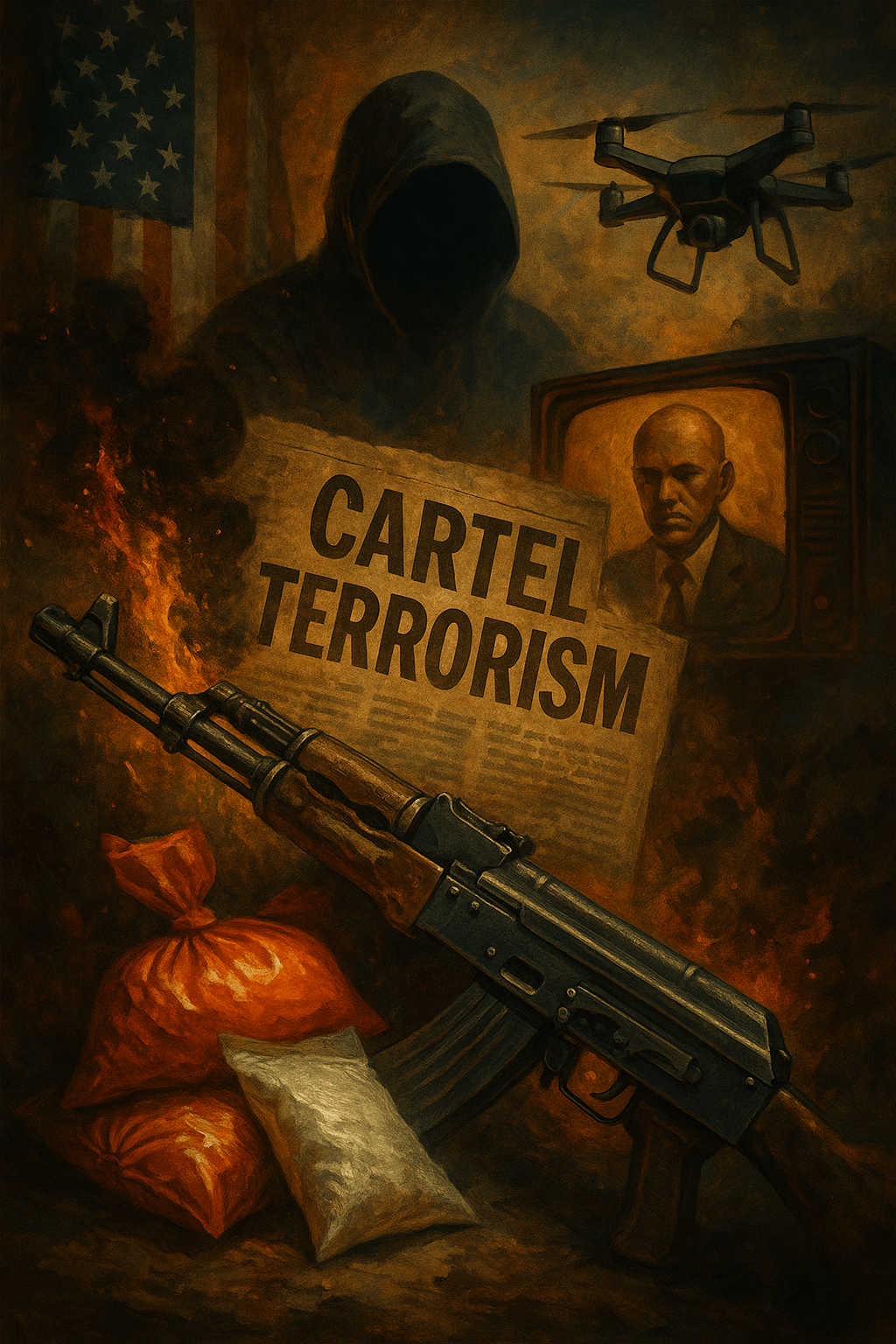
Labeling Mexican Cartels “Terrorists” Is Not About Justice—It’s About Jurisdiction
By Prince Kapone | Weaponized Information
May 16, 2025
I. Excavating the Imperial Script: Who Writes and Who Benefits?
Salvador Rivera, author of the original Border Report piece, has spent decades reporting from the US-Mexico border, winning accolades from the likes of Edward R. Murrow Awards and regional Emmys—prestigious honors bestowed by the institutional gatekeepers of American journalism. Rivera’s career, built firmly within mainstream media, positions him not as a dissident voice but rather as a trusted conduit for empire’s narrative: reporting border violence with meticulous detail, yet never daring to expose the structural logic of imperialism behind it. Border Report itself is owned by Nexstar Media, a corporate conglomerate deeply embedded in the fabric of American capitalist media, which profits directly from sensationalized border violence narratives, reinforcing the militarization and securitization regime at the southern border.
Behind the scenes, figures like U.S. Attorney General Pamela Bondi and Southern California’s U.S. Attorney Adam Gordon act as amplifiers of empire’s new war narrative. Bondi frames the cartel indictment as a novel legal crusade against “terrorists,” while Gordon declares a mission to “Take Back America.” Neither addresses the empire’s own historic and ongoing complicity in creating and managing the narcotics economy, nor do they acknowledge the systematic violence of US-imposed neoliberalism that drives cartel proliferation. Their roles are clear: legitimizing a legal pretext for expanding military and covert intervention south of the border, a tried-and-tested tactic of hyper-imperialist lawfare.
The narrative crafted in Rivera’s reporting meticulously obscures more than it reveals. By designating the Sinaloa cartel and specifically the Beltran Leyva Organization as “terrorist groups,” the Trump administration is not interested in ending the narcotics trade—it is recalibrating imperial control. The invocation of terrorism, a term strategically weaponized post-9/11, is intended to justify cross-border drone strikes, military incursions, and black operations. Just as the “War on Terror” in Afghanistan was never about democracy or peace, this labeling is a prelude to imperialist recalibration: violent jurisdictional expansion, reshaping Mexico into a laboratory for technofascist governance.
This is how empire operates—labeling cartels terrorists isn’t a legal technicality; it’s the imperialist media apparatus scripting the next act of militarized imperialism, obscured behind the façade of criminal justice. To understand the stakes, we must first tear down these narratives and expose their hidden intentions.
II. Extraction and Contextualization: Imperialism’s Hidden Hand Behind the Cartel Crisis
The indictment unveiled by the Southern District of California charges Pedro Inzunza Noriega and his son Pedro Inzunza Coronel, alongside other Beltran Leyva Organization leaders, with narco-terrorism and material support for terrorism, explicitly tying their fentanyl operations to national security. Yet beneath this carefully curated imperial script lie glaring omissions. The objective facts Rivera dutifully records—massive fentanyl production, trafficking, violence—are not fabrications. But these facts, severed from historical context, obscure the deeper, structural origins of Mexico’s drug economy: decades of U.S.-enforced neoliberal policy, the violent dismantling of rural economies under NAFTA, and Washington’s documented covert alliances with select cartel factions like Sinaloa itself.
Rivera’s report, carefully constructed by the imperialist media apparatus, mentions none of these historical truths. Nowhere is it noted how the U.S., through policies and proxies, cultivated the narco-economy it now criminalizes selectively. Nor does Rivera explore the strategic timing of this designation—why now, amid growing Mexican ties to multipolar blocs like BRICS+ and renewed assertions of anti-imperialist sovereignty under administrations like López Obrador and Claudia Sheinbaum? The cartel indictment and “terrorist” designation serve precisely the imperialist recalibration of U.S. hegemony—enforcing jurisdictional control, military intervention rights, and increased surveillance across strategic logistics corridors.
To truly comprehend the cartel crisis, we must restore the omitted historical narrative. The CIA’s documented complicity with narco-traffickers in Nicaragua and Afghanistan, the DEA’s negotiated toleration of Sinaloa cocaine shipments, and the Bush-Obama era’s militarization of Mexico under Plan Mérida—all critical historical facts Rivera leaves buried—demonstrate clearly that the U.S. empire doesn’t seek to eradicate cartels. Rather, it manages them as assets of geopolitical control. Labeling cartels as terrorists is thus not a rupture from past policies but their logical, technofascist continuation.
III. Reframing: Narco-Terrorism as Imperialist Recalibration and Technofascist Jurisdiction
The indictment of Mexican cartel leaders as “terrorists” isn’t about public safety or ending drug trafficking—it’s about imperialist recalibration. Washington is deploying a familiar playbook: criminalize and militarize the very crises it engineered through decades of neoliberal pillaging and clandestine partnerships. By weaponizing lawfare and expanding legal jurisdiction, the Trump regime is setting the stage for direct military interventions, drone warfare, and intensified surveillance along strategic corridors from Tijuana to Tamaulipas. Narco-terrorism is merely the latest camouflage for a hyper-imperialist agenda that sees Mexico as a laboratory for technofascist stabilization—a territory to be disciplined, surveilled, and militarily managed under the guise of “national security.”
While the U.S. media amplifies cartel violence to justify this expansion, revolutionary clarity demands exposing the underlying logic: the Mexican narco-economy isn’t a foreign threat, but a deliberate outcome of U.S. policies—NAFTA’s destruction of rural livelihoods, CIA-DEA complicity with favored cartels, and decades-long militarized imperialism disguised as a “war on drugs.” The Beltran Leyva indictment serves not to dismantle cartels, but to reposition them as subcontractors in empire’s counterinsurgency strategy—terrorizing working-class barrios, indigenous land defenders, and popular movements demanding anti-imperialist sovereignty.
To truly end narco-violence, Mexico needs liberation from imperialist strangleholds, not deeper subordination to U.S. drone strikes and Pentagon logistics. Our revolutionary perspective insists that genuine security emerges from land reform, economic sovereignty, and dismantling the U.S.-crafted narco-paramilitary nexus—not from Trump’s technofascist “terror” designations or border militarization. The cartel indictment is empire’s narrative; our task is to tear it apart, exposing its fraudulent foundations and reaffirming the people’s struggle for liberation from imperialism’s grip.
IV. Mobilization: From Border Spectacle to Revolutionary Solidarity
The empire’s latest maneuver—branding Mexican cartels as terrorists—demands more from revolutionaries than passive critique. We see clearly the game being played: the “War on Drugs” as imperialist recalibration, as technofascist consolidation, and as militarized imperialism waged under the familiar disguise of law and order. Our response cannot merely expose this violence; we must actively dismantle it.
Material solidarity with the Mexican people resisting both cartel terror and imperial intervention begins here, within the belly of the beast. We must amplify and materially support grassroots formations in Mexico—Indigenous self-defense groups in Michoacán and Guerrero, peasant unions resisting neocolonial extraction, and radical community networks holding the line against cartel violence and state complicity. Their fight is our fight, shared against the same enemy: imperialism, its narco-subcontractors, and the corporate vultures circling overhead.
Concrete solidarity actions must target not just rhetorical, but economic and logistical nodes of empire. Campaigns must expose and disrupt corporations profiting from border militarization and surveillance—companies like Palantir, Northrop Grumman, Raytheon, and Lockheed Martin. Every dollar denied to these agents of technofascist stabilization is a victory for internationalist resistance.
Revolutionary media also has a critical role: exposing the imperialist media apparatus that legitimizes state violence, countering cognitive warfare through relentless ideological clarity, and popularizing revolutionary analyses through weaponized propaganda excavation (WPE). We must ensure that the empire’s narratives crumble under our ideological assault, leaving them no quarter.
We stand unwaveringly with the migrants, workers, and Indigenous nations resisting settler-colonial pacification along both sides of the border. Our struggle is not confined by imperial boundaries—it defies them, shatters them, and reorganizes our forces for revolutionary rupture. From community defense patrols to radical mutual aid networks, from digital counter-surveillance to international proletarian cyber resistance, our tactics must be as adaptive and relentless as the empire we confront.
This moment calls for collective action rooted in revolutionary discipline. Let us march, organize, educate, and agitate relentlessly, never losing sight of our enemy’s maneuvers. Solidarity is our weapon, clarity our shield, and internationalist struggle our unbreakable bond. Forward, together, until imperialism’s border regime is reduced to rubble beneath the feet of united peoples fighting for liberation.
 Weaponized Information
Leave a comment